AnimaliaNot EvaluatedacceptedspeciesAccepted
Hemisus guineensis

Hemisus guineensis

Cope, 1865

GBIF:231569739

0year

ABOUT

Descriptions(1)

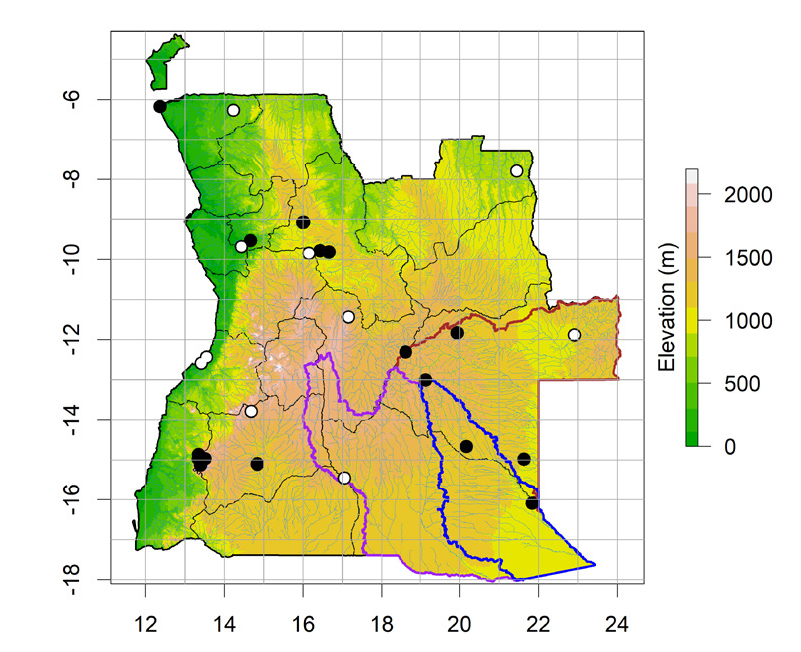
Guinea Shovel-snouted Frog (Fig. 11; Map 10) Material (6 specimens): PEM A 14955, Cuando River, CUD 2018 AC Camp 27, - 16.09006 ° 21.83947 °, 1,038 m asl; PEM A 14832 – 3, INBAC: WC- 6948, Lake Hundo, - 14.97431 ° 21.62966 °, 1,100 m asl; PEM A 13831, Cuando River, camp 18, - 14.66105 ° 20.16858 °, 1,124 m asl; PEM A 12771, Cuando River Source, trap 3, - 13.00334 ° 19.13564 °, 1,360 m asl. Additional material (1 tadpole lot): SAIAB 209095 (7 tadpoles), small wooden bridge across wetland on road between Cuanavale River source camp and Munhango, - 12.30714 ° 18.62333 °, 1,397 m asl. Description: Small to medium sized frog; hardened pointed snout; small eyes; tympanum hidden; smooth dorsum (except PEM A 12771, in which the yellow spots are slightly elevated); transverse skin ridge between posterior corners of eye, extending behind eye to above the arm; reduced webbing; large inner metatarsal and outer metacarpal tubercles. Grey dorsum with yellow mottling or spots; yellow vertebral stripe present; ventrum granular, with small irregular spots. Males with dark throats. Adult females (n = 3) varied from 40.5 – 49.2 (43.4) mm (largest female: PEM A 12771); adult males (n = 3) varied from 26.7 – 31.6 (29.8) mm (largest male: PEM A 14955). Habitat and natural history notes: No calls were heard. Specimens were either caught in traps or by hand while they were active at night after heavy rains in November, near open grassland and pans. One female (PEM A 13831) collected in November was gravid. Comments: Laurent (1972) assigned all Angolan material he examined to the subspecies H. guineensis microps, and this was followed by Ruas (1996). However, Channing (2001) and Marques et al. (2018) documented two species of Hemisus occuring in Angola, Hemisus guineensis in the north and H. marmoratus in the south-central region. We follow Laurent (1972) and assign all Angolan material to Hemisus guineensis until an in-depth phylogenetic work is conducted to assess the taxonomic status of the available material.
Conradie, Werner, Keates, Chad, Verburgt, Luke, Baptista, Ninda L., Harvey, James (2023): Contributions to the herpetofauna of the Angolan Okavango- Cuando-Zambezi river drainages. Part 3: Amphibians. Amphibian & Reptile Conservation (e 325) 17 (1): 19-56, DOI: 10.5281/zenodo.12761936

Export occurrence data

Darwin Core Archive (ZIP)

CLASSIFICATION

Taxonomic Classification Tree

MULTIMEDIA

Media Files(2)

Fig. 11. Adult female Hemisus guineensis from Cuando River source. Photo by Werner Conradie.

Imageimage/png© Conradie, Werner;Keates, Chad;Verburgt, Luke;Baptista, Ninda L.;Harvey, JamesConradie, Werner;Keates, Chad;Verburgt, Luke;Baptista, Ninda L.;Harvey, James

Map 10. Distribution of Hemisus guineensis in Angola.

Imageimage/png© Conradie, Werner;Keates, Chad;Verburgt, Luke;Baptista, Ninda L.;Harvey, JamesConradie, Werner;Keates, Chad;Verburgt, Luke;Baptista, Ninda L.;Harvey, James

IMAGES

Gallery(2)

See Gallery

Occurrences with images

Source Information

Contributions to the herpetofauna of the Angolan Okavango- Cuando-Zambezi river drainages. Part 3: Amphibians

checklist

This dataset contains the digitized treatments in Plazi based on the original journal article Conradie, Werner, Keates, Chad, Verburgt, Luke, Baptista, Ninda L., Harvey, James (2023): Contributions to the herpetofauna of the Angolan Okavango- Cuando-Zambezi river drainages. Part 3: Amphibians. Amphibian & Reptile Conservation (e 325) 17 (1): 19-56, DOI: 10.5281/zenodo.12761936

Abstract. —This article is the third and final installment of the herpetofaunal results obtained from a series of rapid biodiversity surveys of the upper Cuito, Cubango, Cuando, Zambezi, and Kwanza River basins in Angola. The amphibian survey results are presented along with an updated checklist of the historical and current records of amphibians from the southeastern region of Angola. A total of 1,114 new amphibian records were documented, comprising 37 species, bringing the total number of recognized amphibian species in this region to 49. These surveys documented two new country records (Hyperolius cf. inyangae and Kassinula wittei) and at least two candidate new species, and elevated Amnirana adiscifera stat. nov. (which now encompasses the western green form formerly regarded as A. darlingi). Finally, updated distribution maps for all of Angola are provided for all the species encountered within the study region.

Conradie W, Keates C, Verburgt L, Baptista N L, Harvey J, felipe (2023). Contributions to the herpetofauna of the Angolan Okavango- Cuando-Zambezi river drainages. Part 3: Amphibians. Plazi.org taxonomic treatments database. Checklist dataset https://doi.org/10.15468/xqyzdr accessed via GBIF.org on 2026-06-16.

CC0Published 8/4/2023View dataset
GBIF Usage Key
231569739
Dataset Key
5e6c8fd8-74a8-4de2-8687-29b4ea71fac1
Origin
source
Backbone Key
2423957
Taxon ID
4357878800363F5E88A1604BFE9B054A.taxon
Last Crawled
6/9/2026
Last Interpreted
6/9/2026