
AnimaliaNot EvaluatedacceptedspeciesAccepted
Arthroleptis stenodactylus
Pfeffer, 1893
GBIF:231569745
0year
ABOUT
Descriptions(1)
Material (43 specimens): PEM A 12495, 4 km upstream from Cuanavale River source lake, - 13.05084 ° 18.89726 °, 1,395 m asl; PEM A 12501 – 4, river crossing before Samboano village, - 12.30700 ° 18.62350 °, 1,397 m asl; PEM A 12526, Munhango village, - 12.16310 ° 18.55430 °, 1,421 m asl; PEM A 12527, Protea stop en route to Cuito River source, - 12.30040 ° 18.62070 °, 1,429 m asl; PEM A 12528 – 36, INBAC: (no number x 4), Cuito River source lake, - 12.68935 ° 18.36012 °, 1,431 m asl; PEM A 12585, 10 km north of Cuemba village, - 12.03481 ° 18.04869 °, 1,372 m asl; PEM A 13815, en route to Lungwebungu River, - 12.25034 ° 18.63742 °, 1,506 m asl; PEM A 12616 – 7, en route road to Cuito River source, - 12.55152 ° 18.41434 °, 1,507 m asl; PEM A 12618, en route road to Cuito River source, - 12.25050 ° 18.63730 °, 1,519 m asl; PEM A 12620, drive to Cuanavale River camp from Samanunga village, - 13.03803 ° 18.82977 °, 1,623 m asl; PEM A 12644, Cuanavale River source lake, - 13.18067 ° 18.92172 °, 1,340 m asl; PEM A 12647, stop on road to Cuito River source, - 12.50584 ° 18.41382 °, 1,556 m asl; PEM A 12648 – 9, camp 1 en route to Cuito River source, - 12.35920 ° 18.56280 °, 1,510 m asl; PEM A 12729, Cuando River source, - 13.00346 ° 19.12751 °, 1,346 m asl; PEM A 12803 – 4, Lake Tchanssengwe, - 12.41402 ° 18.64418 °, 1,415 m asl; PEM A 12843 – 50, INBAC: (no number x 2), Quembo River source lake, - 13.13624 ° 19.04591 °, 1,411 m asl. Additional records: P 2 - 276 (photograph and tissue sample), wetland near old quarry east of Quemba, - 12.16960 ° 18.22965 °, 1,353 m asl. Description: Medium sized Arthroleptis; stocky build; rounded snout; tympanum clearly visible; well-developed inner metatarsal tubercle; no webbing; toe tips not dilated. Dorsum uniformly beige to pink, with scattered white speckles; no darker hourglass pattern observed on dorsum; yellow vertebral stripe either absent (n = 23) or present (n = 12); faint dark facial mask from tip of snout to the eye, continuous to the arm; ventrum immaculate. Breeding males with dark throats; minute spines on lower back; elongated 3 rd finger, with spines on the inner side and to the tip. Adult females (n = 11) varied from 32.6 – 37.7 (34.6 average) mm SUL (largest female: PEM A 12846); adult males (n = 4) varied from 19.5 – 23.6 (21.5) mm (largest male: PEM A 12804). Habitat and natural history notes: All specimens were collected in miombo woodland. Gravid females were collected in October / November. Males were heard calling on overcast days and evenings after rain. In February / March, juveniles and subadults were abundant, but no adults were collected or heard calling. Comments: Historically, this species was only known from three records from eastern Angola (Marques et al. 2018). Our new material shows that this species is more common in eastern Angola than previously recognized. This was expected as it is widespread to the east of the Zambian border (Poynton and Broadley 1985 a, 1991; Channing 2001). Additionally, these are the first confirmed records from the Okavango River basin. Studies have shown that A. stenodactylus comprises two distinct ecomorphs that occur in different habitats. One form, to which our material belongs, prefers drier savanna, while the other form is known from montane forests (Loveridge 1953; Pickersgill 2007; Bittencourt-Silva et al. 2020).
Conradie, Werner, Keates, Chad, Verburgt, Luke, Baptista, Ninda L., Harvey, James (2023): Contributions to the herpetofauna of the Angolan Okavango- Cuando-Zambezi river drainages. Part 3: Amphibians. Amphibian & Reptile Conservation (e 325) 17 (1): 19-56, DOI: 10.5281/zenodo.12761936
Export occurrence data
Darwin Core Archive (ZIP)
CLASSIFICATION
Taxonomic Classification Tree

MULTIMEDIA
Media Files(2)
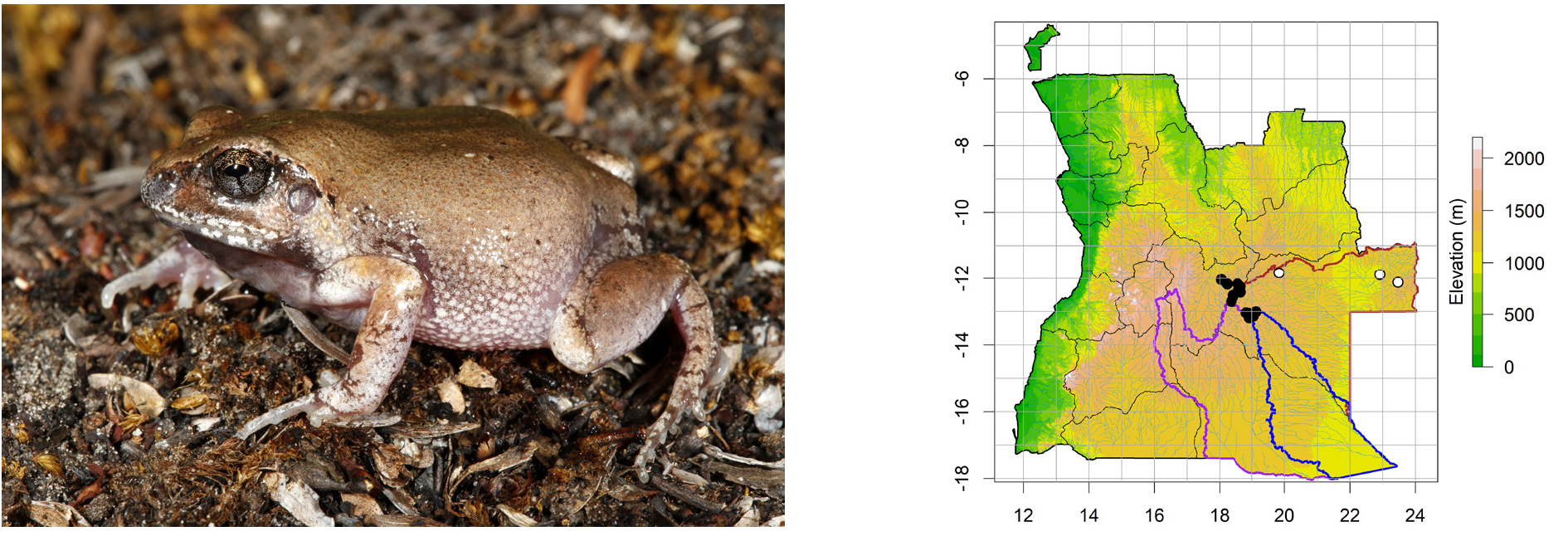
Fig. 1. Adult male Arthroleptis stenodactylus from Lungwebungu River. Photo by Werner Conradie.
Imageimage/png© Conradie, Werner;Keates, Chad;Verburgt, Luke;Baptista, Ninda L.;Harvey, JamesConradie, Werner;Keates, Chad;Verburgt, Luke;Baptista, Ninda L.;Harvey, James

Map 1. Distribution of Arthroleptis stenodactylus in Angola. Historical records (Marques et al. 2018) are indicated by white dots, while new records are indicated by black dots. Axis values are in degrees (°). Purple polygon – Okavango River basin, Blue polygon – Cuando River basin, Brown polygon – Zambezi River basin.
Imageimage/png© Conradie, Werner;Keates, Chad;Verburgt, Luke;Baptista, Ninda L.;Harvey, JamesConradie, Werner;Keates, Chad;Verburgt, Luke;Baptista, Ninda L.;Harvey, James
IMAGES