
AnimaliaNot EvaluatedacceptedspeciesAccepted
Hyperolius benguellensis
(Bocage, 1893)
GBIF:231569754
0year
ABOUT
Descriptions(1)
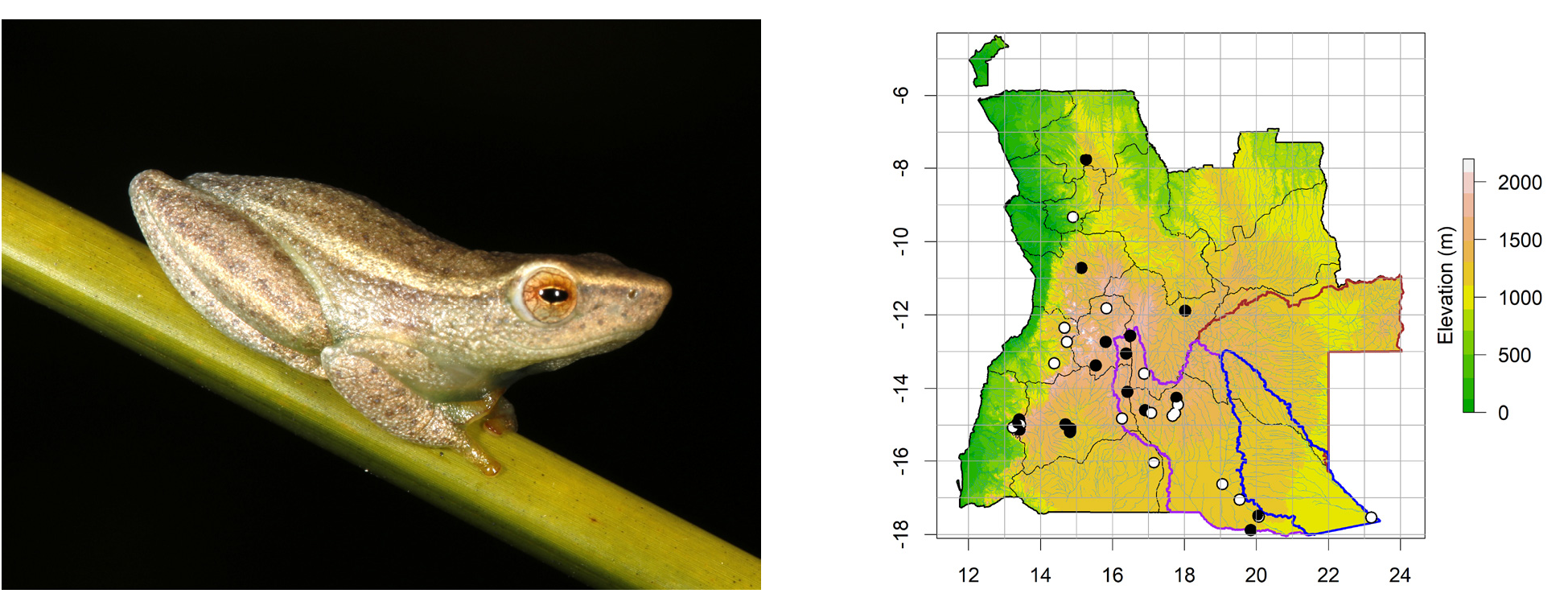
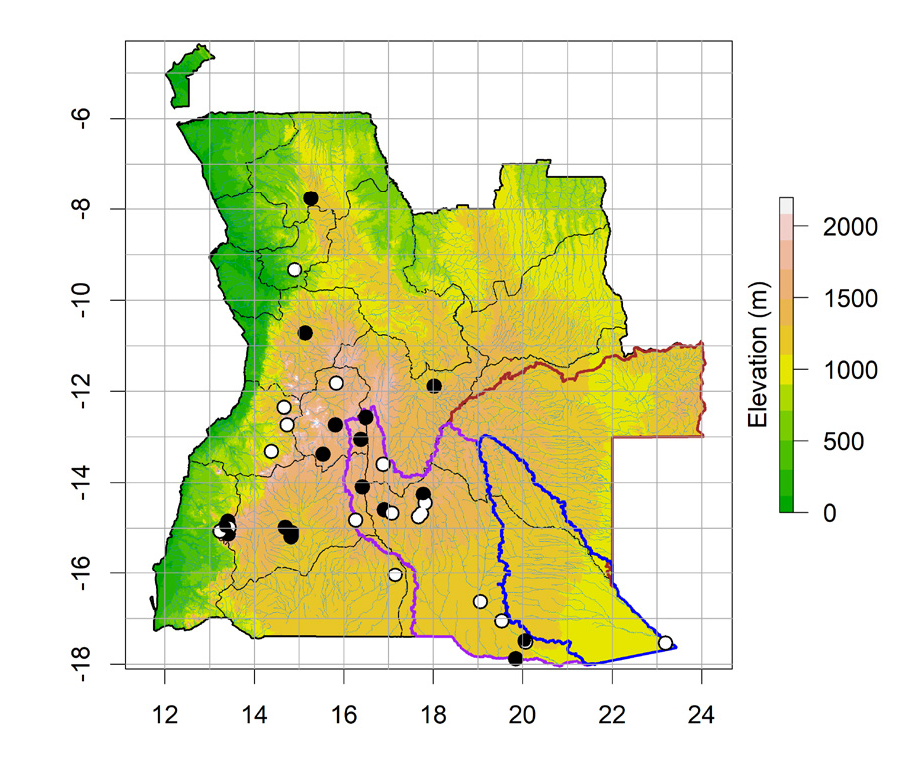
Material (8 specimens, 1 tadpole lot): PEM A 12438 – 41, INBAC (no number x 2), Cuchi River gorge, - 14.59000 ° 16.90758 °, 1,365 m asl; PEM A 12661, PEM A 14172, Campsite 2 near old Cuvango Mission, - 13.33451 ° 16.41280 °, 1,356 m asl; PEM A 12675 – 6, Camp 3, Malova Village, Mipanha River, - 14.09140 ° 16.41476 °, 1,553 m asl; PEM A 12666, Cubango River campsite 1 below rapids, west of Fundo village, - 13.04790 ° 16.37896 °, 1,568 m asl. Additional specimens (1 tadpole lot): SAIAB 209058 (18 tadpoles), Cuvango power station, entrance to canal, - 14.38650 ° 16.28767 °, 1,457 m asl. Description: Small reed frog; sharp but truncated snout, with small to no anterior protrusion; pedal webbing formula: I (1), II i / e (1 – 0.5), III (1 – 0.5), IV (1 – 1), V (0.75). Dorsum green with white dorso-lateral stripes (mostly males) or uniformly green with scattered brown spots (mostly females); ventrum transparent. Males with yellow gular disc. Single adult female measured 24.7 mm (PEM A 12438); adult males (n = 7) varied from 16.2 – 22.8 (19.7) mm (largest male: PEM A 12440). Habitat and natural history notes: Found on margins of rivers and in wetlands. Restricted to the western side of the study area, associated with the Cubango River system. Comments: In the most recent revision of the Hyperolius nasutus - complex, 16 species have been recognized (Channing et al. 2013). At least four species are expected to occur in Angola (Channing et al. 2013; Marques et al. 2018; Baptista et al. 2019), namely H. benguellensis, H. nasutus, H. adspersus, and H. dartevellei. Two clear morphotypes exist based on the general snout shape: sharp (benguellensis group) and rounded (nasutus group). Of the sharp snouted form, we distinguished between two morphotypes in southeastern Angola: the ‘ shark’ - like profile (H. benguellensis, this species account) and the acutely pointed snout, with a distinct protruding tip (H. cf. inyangae, see species account below). These identifications were confirmed by comparing 16 S rRNA barcodes (W. Conradie, unpub. data) to published sequences (Channing et al. 2012). The remaining material is assigned to the nasutus group (see species account below). However, it must be noted that these little green frogs have been the subject of rigorous taxonomic debate over the years due to their cryptic nature, molecular and morphological similarity, and substantial geographic overlaps (see Channing et al. 2012 for overview). The taxonomic status of Angolan species belonging to these groups needs to be assessed in a broad-scale phylogenetic study.
Conradie, Werner, Keates, Chad, Verburgt, Luke, Baptista, Ninda L., Harvey, James (2023): Contributions to the herpetofauna of the Angolan Okavango- Cuando-Zambezi river drainages. Part 3: Amphibians. Amphibian & Reptile Conservation (e 325) 17 (1): 19-56, DOI: 10.5281/zenodo.12761936
Export occurrence data
Darwin Core Archive (ZIP)
CLASSIFICATION
Taxonomic Classification Tree

MULTIMEDIA
Media Files(2)
IMAGES