
AnimaliaNot EvaluatedacceptedspeciesAccepted
Henneguya calcarifer

Henneguya calcarifer

Borkhanuddin, Cech, Molnár & Shaharom-Harrison, 2020

GBIF:233768090

0year

ABOUT

Descriptions(1)

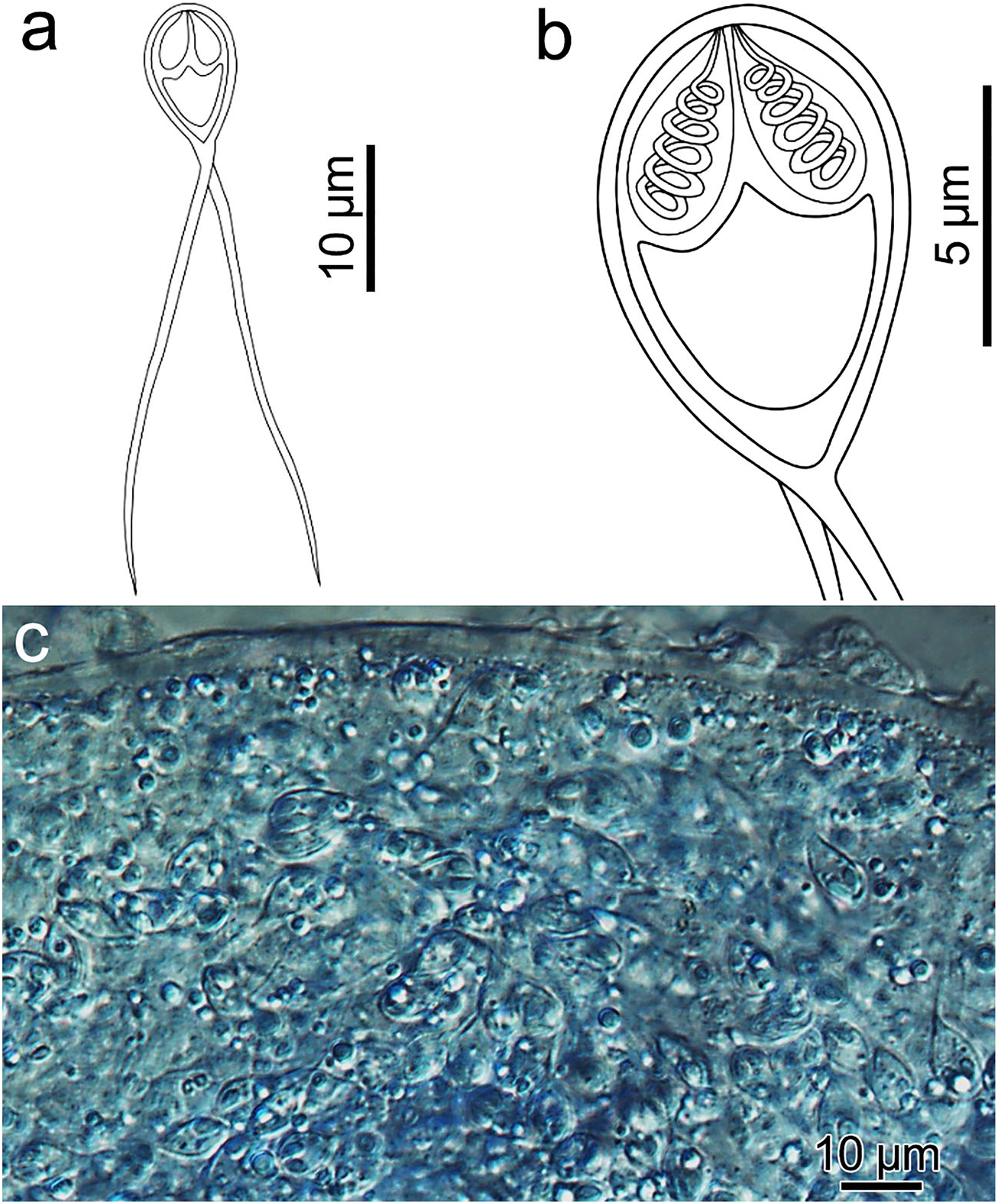
Type host: barramundi, Lates calcarifer (Bloch 1790). Site of infection: Skeletal muscle. Type locality: Setiu Wetlands, Terengganu, Malaysia. Prevalence of infection: 2.8 % (1 / 35). Type material: Digital images of syntype spores were deposited in the parasitological collection of the Zoological Department, Hungarian Natural History Museum, Budapest, collection no. HNHM- 71894. The 18 S rDNA sequence was deposited in GenBank under accession number MH 743109 Etymology: The species is named after the host. Description of spores: Fig. 3. Myxospores symmetric, with two equal caudal appendages, and equal-sized polar capsules. Spore wall 0.3 – 0.4 μm, smooth and composed of two equal valves. Apical end of spore body blunt, the caudal end tapers and extends into the caudal appendages, total length 34 – 45 μm. Spore length 9.4 ± 0.6 (8.3 – 10.0) μm, width 5.2 ± 0.3 (4.8 – 5.5) μm and thickness 3.8 ± 0.1 (3.7 – 4.0) μm. Two polar capsules pear shaped, blunt at the posterior end and taper anteriorly, length 3.4 ± 0.2 (3.1 – 3.7) μm and width 1.4 ± 0.2 (1.1 – 1.7) μm. Polar tubules coiled in 6 turns perpendicular to the long axis of the capsule. Sporoplasm binucleate with a small iodinophilous vacuole. Caudal appendages straight, tapering, length 30.9 ± 3.0 (28.0 – 35.0) μm, ~ 4 times longer than the spore body. Plasmodia spherical 300 × 400 μm. Remarks: H. calcarifer n. sp. resembles morphologically and morphometrically both H. setiuensis n. sp. and H. voronini n. sp. (Table 2) but has different tissue site of development (muscles not gill). This is the first muscle-infecting Henneguya described from Lates calcarifer and is relatively distinct from the only other species from a Lates congener: H. ghaffari from muscle and gills of L. niloticus in Egypt (Table 2). Molecular analysis: 1696 bp 18 S rDNA were sequenced. A BLAST search indicated that the most similar species were other Henneguya species, but all <89 %. Pairwise analysis showed H. calcarifer n. sp. was molecularly very similar (97.7 % over 1696 bp) with H. voronini n. sp., described from the same fish (above). Histology: Low intensity of parasite plasmodia in the host skeletal muscle meant no plasmodia were visible in histological sections.
Borkhanuddin, Muhammad Hafiz, Cech, Gábor, Molnár, Kálmán, Shaharom-Harrison, Faizah (2020): Henneguya (Cnidaria: Myxosporea: Myxobolidae) infections of cultured barramundi, Lates calcarifer (Perciformes: Latidae) in an estuarine wetlands system of Malaysia: description of Henneguya setiuensis n. sp., Henneguya voronini n. sp. and Henneguya calcarifer n. sp. Parasitology Research (85) 119 (1): 85-96, DOI: 10.1007/s00436-019-06541-1, URL: http://dx.doi.org/10.1007/s00436-019-06541-1

Export occurrence data

Darwin Core Archive (ZIP)

CLASSIFICATION

Taxonomic Classification Tree

MULTIMEDIA

Media Files(1)

Fig. 3 Henneguya calcarifer n. sp. (a–b) Line drawings of mature myxospores in frontal view showing polar capsules with coiled polar tubules. (c) Unstained, compressed plasmodium, densely packed with mature myxospores

Imageimage/png© Borkhanuddin, Muhammad Hafiz;Cech, Gábor;Molnár, Kálmán;Shaharom-Harrison, FaizahBorkhanuddin, Muhammad Hafiz;Cech, Gábor;Molnár, Kálmán;Shaharom-Harrison, Faizah

IMAGES

Gallery(1)

See Gallery

Occurrences with images

Source Information

Henneguya (Cnidaria: Myxosporea: Myxobolidae) infections of cultured barramundi, Lates calcarifer (Perciformes: Latidae) in an estuarine wetlands system of Malaysia: description of Henneguya setiuensis n. sp., Henneguya voronini n. sp. and Henneguya calcarifer n. sp.

checklist

This dataset contains the digitized treatments in Plazi based on the original journal article Borkhanuddin, Muhammad Hafiz, Cech, Gábor, Molnár, Kálmán, Shaharom-Harrison, Faizah (2020): Henneguya (Cnidaria: Myxosporea: Myxobolidae) infections of cultured barramundi, Lates calcarifer (Perciformes: Latidae) in an estuarine wetlands system of Malaysia: description of Henneguya setiuensis n. sp., Henneguya voronini n. sp. and Henneguya calcarifer n. sp. Parasitology Research (85) 119 (1): 85-96, DOI: 10.1007/s00436-019-06541-1, URL: http://dx.doi.org/10.1007/s00436-019-06541-1

Abstract

Examination of 35 barramundi (Lates calcarifer) from aquaculture cages in Setiu Wetland, Malaysia, revealed a single fish infected with three Henneguya spp. (Cnidaria: Myxosporea). Characterization of the infections using tissue tropism, myxospore morphology and morphometry and 18S rDNA sequencing supported description of three new species: Henneguya setiuensis n. sp., Henneguya voronini n. sp. and H. calcarifer n. sp. Myxospores of all three species had typical Henneguya morphology, with two polar capsules in the plane of the suture, an oval spore body, smooth valve cell surfaces, and two caudal appendages. Spores were morphometrically similar, and many dimensions overlapped, but H. voronini n. sp. had shorter caudal appendages compared with H. calcarifer n. sp. and H. setiuensis n. sp. Gross tissue tropism distinguished the muscle parasite H. calcarifer n. sp. from gill parasites H. setiuensis n. sp. and H. voronini n. sp.; and these latter two species were further separable by fine-scale location of developing plasmodia, which were intra-lamellar for H. setiuensis n. sp. and basal to the filaments for H. voronini n. sp. small subunit ribosomal DNA sequences distinguished all three species: the two gill species H. setiuensis n. sp. and H voronini n. sp. were only 88% similar (over 1708 bp), whereas the muscle species H. calcarifer n. sp. was most similar to H. voronini n. sp. (98% over 1696 bp). None of the three novel species was more than 90% similar to any known myxosporean sequence in GenBank. Low infection prevalence of these myxosporeans and lack of obvious tissue pathology from developing plasmodia suggested none of these parasites are currently a problem for barramundi culture in Setiu Wetland; however additional surveys of fish, particularly at different times of the year, would be informative for better risk assessment.

Borkhanuddin M H, Cech G, Molnár K, Shaharom-Harrison F, felipe (2019). Henneguya (Cnidaria: Myxosporea: Myxobolidae) infections of cultured barramundi, Lates calcarifer (Perciformes: Latidae) in an estuarine wetlands system of Malaysia: description of Henneguya setiuensis n. sp., Henneguya voronini n. sp. and Henneguya calcarifer n. sp.. Plazi.org taxonomic treatments database. Checklist dataset https://doi.org/10.15468/j469zn accessed via GBIF.org on 2026-06-17.

CC0Published 11/25/2019View dataset
GBIF Usage Key
233768090
Dataset Key
0a7f870a-286b-46e9-8019-591781f9e2cd
Origin
source
Taxon ID
03881A177748E76D2FB4FA6F84A855CD.taxon
Last Crawled
6/9/2026
Last Interpreted
6/9/2026