
AnimaliaNot EvaluatedacceptedspeciesAccepted
Libys callolepis

Libys callolepis

Ferrante, Menkveld-Gfeller & Cavin, 2022

GBIF:236724362

0year

ABOUT

Descriptions(5)

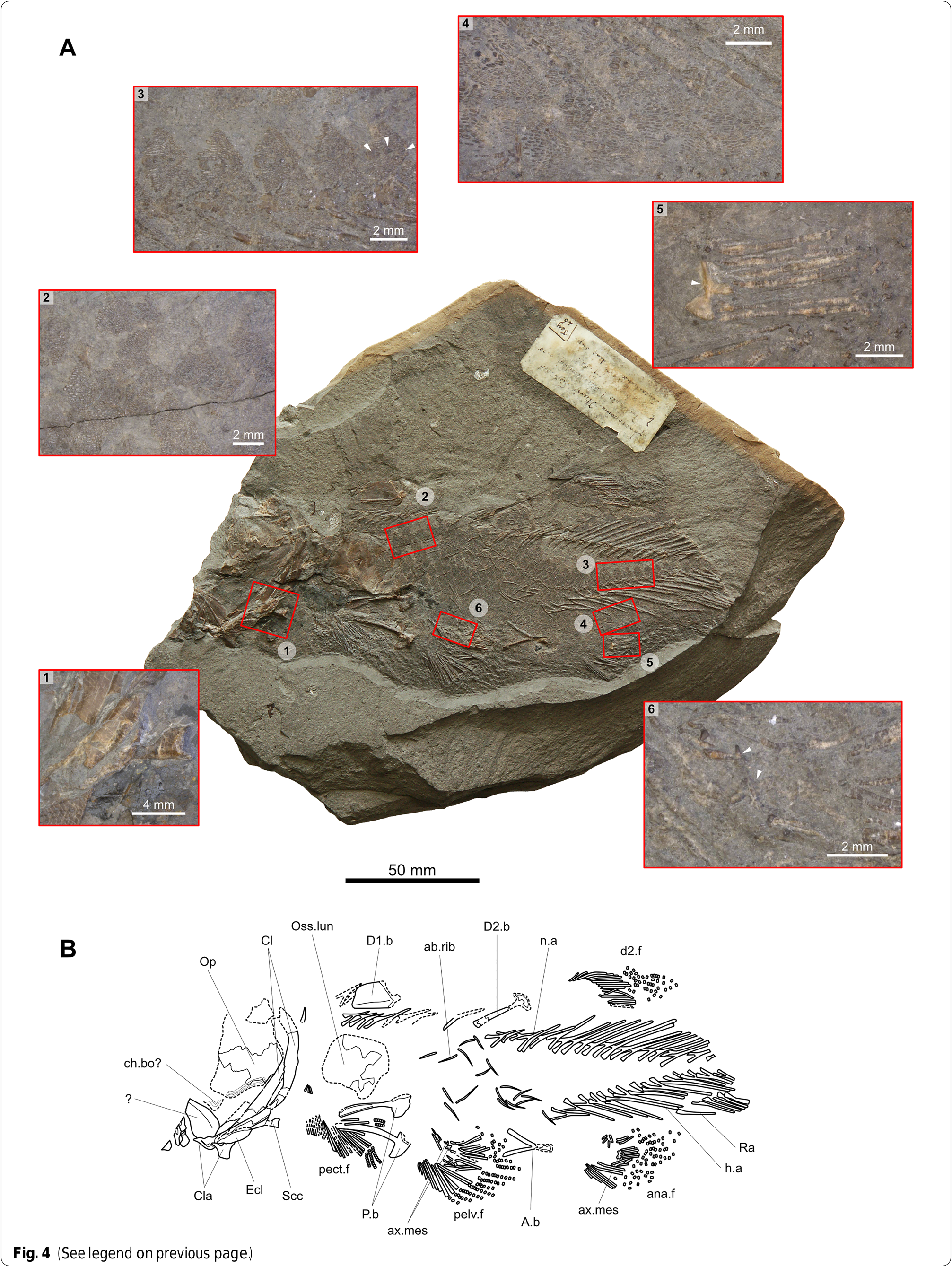
Description Generalities Most of the bones of the specimen are preserved on the part (NMBE 5034073) (Fig. 3). From the head, most of the dermal bones of the skull roof are preserved. Te bones of the cheek and the lower jaw are missing, revealing then the bones of the palatoquadrate and of the branchial apparatus. Te axial skeleton, the girdles and the fins are almost entirely preserved, except the posterior tip of the supplementary caudal fin lobe. Te scales are well preserved on the entire body in natural position, especially on the counterpart (NMBE 5034072) (Fig. 4). Te specimen may represent an adult individual as all the basal plates are fully ossified, which is a feature observed in adult coelacanths (e. g., Schultze, 1980; Witzmann et al., 2010). Tis view is reinforced because the specimen shows some well ossified axial mesomere and the scapulocoracoid (Fig. 4 A 1, A 5, A 6, B). Although a long supplementary lobe of the caudal fin is considered as a juvenile character (e. g., Forey, 1981; Schultze, 1972), the prominent supplementary lobe of the caudal fin (Fig. 3) observed in the specimen of Teysachaux represents rather a generic character of the specimen. Dermal bones of the skull roof Te bones of the skull are only preserved on the part (Figs. 3 and 5). Te skull roof is divided into a parietonasal and postparietal shields, free from one to the other and separated by the intracranial joint, which appears to be straight. Te postparietal shield appears to be smaller than the parietonasal shield, this last being about 1.45 longer. Although slightly lower, this ratio is however close to the ratios of Jurassic and Cretaceous coelacanths that have typically a parietonasal shield circa 1.5 to 2 times longer than the postparietal shield (e. g., Libys polypterus has a ratio of about 1.7). On the Teysachaux specimen, the dermal bones of the skull appear to be smooth and unornamented.
Ferrante, Christophe, Menkveld-Gfeller, Ursula, Cavin, Lionel (2022): The first Jurassic coelacanth from Switzerland. Swiss Journal of Palaeontology (15) 141 (1): 1-20, DOI: 10.1186/s13358-022-00257-z, URL: http://dx.doi.org/10.1186/s13358-022-00257-z
Measurements and meristic (TB) Total body length 290 mm (estimation); (SL) standard length 255 mm. d 1. f = 10; d 2. f = 16; pect. f = 18 – 22; pelv. f ≥ 17; ana. f = 20 – 23; cau. f = 15 / 14 – 16; n. a = 44 – 47; h. a = 18 – 20.
Ferrante, Christophe, Menkveld-Gfeller, Ursula, Cavin, Lionel (2022): The first Jurassic coelacanth from Switzerland. Swiss Journal of Palaeontology (15) 141 (1): 1-20, DOI: 10.1186/s13358-022-00257-z, URL: http://dx.doi.org/10.1186/s13358-022-00257-z
Diagnosis Libys species with the postparietal shield about half the length of the parietonasal shield (the parietonasal is then proportionally shorter than in the type species). Te teeth covering the prearticular are very small, and rounded and smooth. Between 41 – 47 neural arches. Fin rays are slender than in the type species and then not expanded. Te scales are strongly ornamented with irregularly sized and elongated round-to-ovoid ridges disposed along a longitudinal axis.
Ferrante, Christophe, Menkveld-Gfeller, Ursula, Cavin, Lionel (2022): The first Jurassic coelacanth from Switzerland. Swiss Journal of Palaeontology (15) 141 (1): 1-20, DOI: 10.1186/s13358-022-00257-z, URL: http://dx.doi.org/10.1186/s13358-022-00257-z
Etymology From the ancient Greek ΚΑλός, kalós, (‘ beautiful’, ‘ nice’) and λεπίς, lepís, (‘ scale’) in reference to the nicely ornamented scales of the species, which differentiates it from the type species.
Ferrante, Christophe, Menkveld-Gfeller, Ursula, Cavin, Lionel (2022): The first Jurassic coelacanth from Switzerland. Swiss Journal of Palaeontology (15) 141 (1): 1-20, DOI: 10.1186/s13358-022-00257-z, URL: http://dx.doi.org/10.1186/s13358-022-00257-z
Holotype and only known specimen NMBE 5034072 and 5034073, a sub-complete specimen preserved in right lateral view as part and counterpart. Most of the bones, including the scales on the body, are preserved in anatomical position and only the bones of the cheek and the jaw are missing. Te specimen is kept in the collections of the Natural History Museum Bern (Canton of Bern, Switzerland). Horizon and type locality Toarcian (Lower Jurassic), Creux de l’Ours section, locality of Les Pueys near the Teysachaux summit (Canton of Fribourg, Switzerland). Nomenclatural act Te present work and its nomenclatural act are registered in ZooBank, the online registration system for the International Commission on Zoological Nomenclature. Te Life Science Identifiers for this publication is “ urn: lsid: zoobank. org: pub: D 03 A 2 AC 9 - 51 F 9 - 45 E 6 - 8 CAC-F 06 A 1526 AF 2 C ” and can be resolved appending the prefix “ http: // zoobank. org / ” in any standard web browser.
Ferrante, Christophe, Menkveld-Gfeller, Ursula, Cavin, Lionel (2022): The first Jurassic coelacanth from Switzerland. Swiss Journal of Palaeontology (15) 141 (1): 1-20, DOI: 10.1186/s13358-022-00257-z, URL: http://dx.doi.org/10.1186/s13358-022-00257-z

Export occurrence data

Darwin Core Archive (ZIP)

CLASSIFICATION

Taxonomic Classification Tree

MULTIMEDIA

Media Files(5)

Fig. 1 Maps showing the localization of the fossiliferous outcrops. A Paleogeographical map showing the continent configuration during the Toarcian (modified from Scotese,2014, Map 39) with the distribution of (1) Diplurus longicaudatus, (2) Holophagus gulo, (3) Trachymetopon, (4) Undina (?) barroviensis, (5) Libys callolepis sp. nov. (6) Atacamaia solitaria and (7) Indocoelacanthus robustus. B Paleogeographic map of the NW Tethys Ocean (modified from Fantasia et al., 2019), enlargement of B (red square). C Map of Switzerland with the locality of Les Pueys near the Teysachaux summit (Canton of Fribourg, Switzerland)

Imageimage/png© Ferrante, Christophe;Menkveld-Gfeller, Ursula;Cavin, LionelFerrante, Christophe;Menkveld-Gfeller, Ursula;Cavin, Lionel

Fig. 5 Skull of Libys callolepis sp. nov. on the part (holotype, NMBE 5034073). A Photos and B outline of the skull

Imageimage/png© Ferrante, Christophe;Menkveld-Gfeller, Ursula;Cavin, LionelFerrante, Christophe;Menkveld-Gfeller, Ursula;Cavin, Lionel

Fig. 6 Comparison of scales between Libys callolepis sp. nov. and some other Latimeriidae. A Libys callolepis sp. nov. (holotype, NMBE 5034072). Scales of the flank below the neural arches between the basal plates of the anterior and posterior dorsal fin. B Libys polypterus (‘L. superbus’) (BSM AS I 801a). Scales of the flank located between the neural arches and the basal plate of the second dorsal fin. C Undina penicillata (BSM 1870 XIV 22). Scales of the middle flank located on the neural arches below the basal plate of the second dorsal fin. D Trachymetopon (‘Macropoma’) substriolatum (holotype, SMC J27415) from the Kimmeridgian of Cottenham, Cambridgeshire. Scales of the middle flank. It is worth noting that this species was first attributed by Huxley (1866) to the genus Macropoma and latter to Coccoderma by Reis (1888). Forey (1998) kept this species within Coccoderma, but remarked that it shows affinities with Holophagus. Recently,Cavin et al. (2021a) attributed this specimen to the genus of Trachymetopon regarding, among other characteristics, the coarse ornamentation on the dermal bones

Imageimage/png© Ferrante, Christophe;Menkveld-Gfeller, Ursula;Cavin, LionelFerrante, Christophe;Menkveld-Gfeller, Ursula;Cavin, Lionel

Fig. 3 Skeleton of Libys callolepis sp. nov. on the part (holotype, NMBE 5034073).A Photos with osteological details: 1, denticles on the proximal fin rays of the caudal fin. 2, Postparietal shield with the otic sensory canal opening as a deep groove crossed by pillars (white arrowhead). 3, Posterior parietal and the supraorbitals with their pillars (white arrowhead). 4, Consolidated snout with the anterior opening for the rostral organ (white arrowhead). 5,Teeth on the prearticular. B Semi-interpretative line drawing of the specimen
Imageimage/png© Ferrante, Christophe;Menkveld-Gfeller, Ursula;Cavin, LionelFerrante, Christophe;Menkveld-Gfeller, Ursula;Cavin, Lionel

Fig. 4 Skeleton of Libys callolepis sp. nov. on the counterpart (holotype, NMBE 5034072).A Photos with osteological details: 1, articular head of the scapulocoracoid. 2, Scales on the flank immediately beneath the first anterior dorsal fin. 3, Scales of the lateral line showing the ornamental pattern with the larger central tubercles (white arrowheads point, showed only on one scale).4, Scales on the ventral flank from the pelvic to the anal fin. 5, Axial mesomere (white arrowhead) surrounded by some fin rays of the anal fin. 6, Axial mesomeres (white arrowhead) partially covered by sediment in the pelvic fin. B Semi-interpretative line drawing of the specimen

Imageimage/png© Ferrante, Christophe;Menkveld-Gfeller, Ursula;Cavin, LionelFerrante, Christophe;Menkveld-Gfeller, Ursula;Cavin, Lionel

IMAGES

Gallery(5)

See Gallery

Occurrences with images

Source Information

The first Jurassic coelacanth from Switzerland

checklist

This dataset contains the digitized treatments in Plazi based on the original journal article Ferrante, Christophe, Menkveld-Gfeller, Ursula, Cavin, Lionel (2022): The first Jurassic coelacanth from Switzerland. Swiss Journal of Palaeontology (15) 141 (1): 1-20, DOI: 10.1186/s13358-022-00257-z, URL: http://dx.doi.org/10.1186/s13358-022-00257-z

Ferrante C, Menkveld-Gfeller U, Cavin L, felipe (2022). The first Jurassic coelacanth from Switzerland. Plazi.org taxonomic treatments database. Checklist dataset https://doi.org/10.15468/7qea5r accessed via GBIF.org on 2026-06-15.

CC0Published 9/22/2022View dataset
GBIF Usage Key
236724362
Dataset Key
21b570bc-eafa-4448-b23b-61a89ddddd63
Origin
source
Taxon ID
03E487A4F34BFF86139F8B66BDCDFBFD.taxon
Last Crawled
6/9/2026
Last Interpreted
6/9/2026