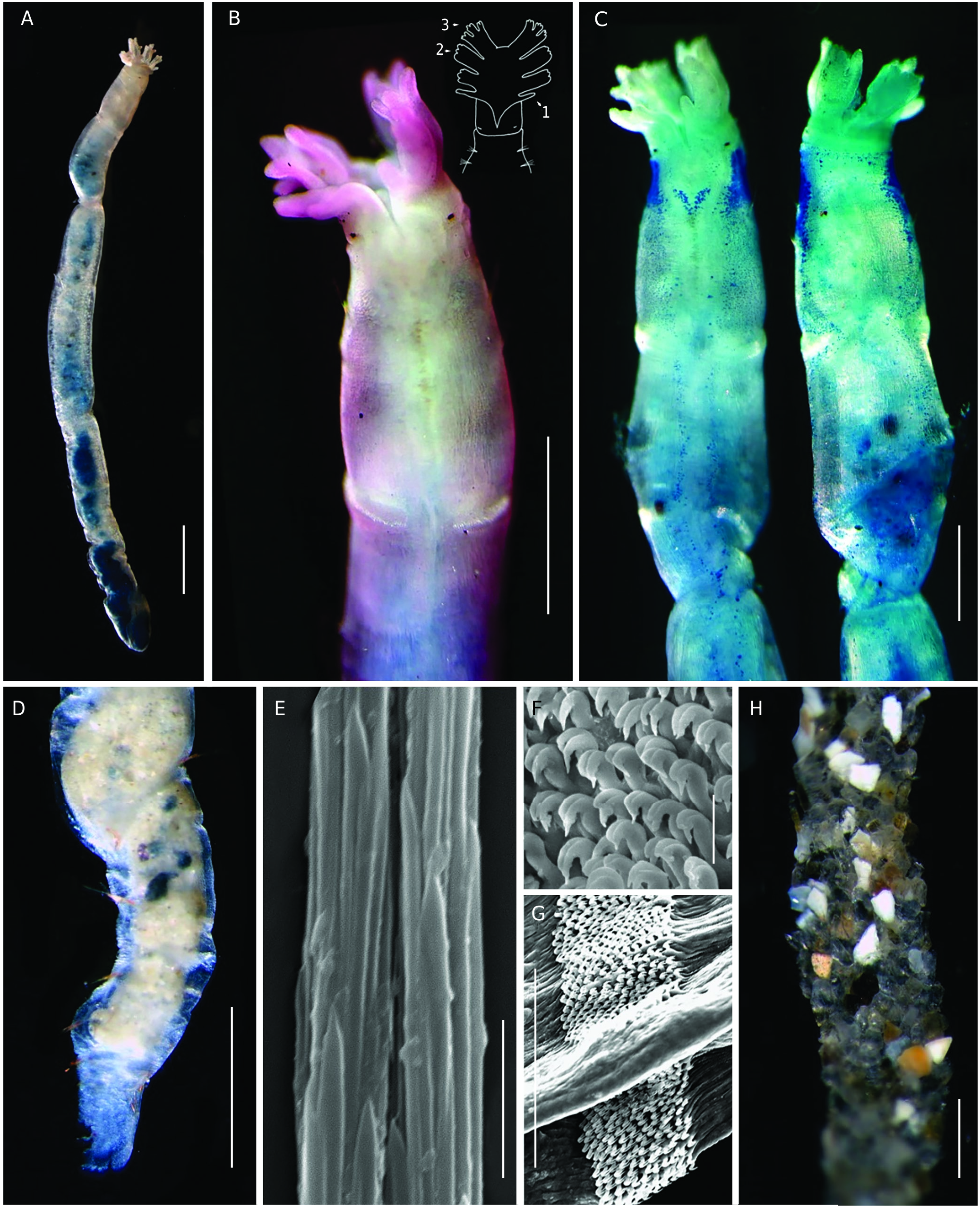
DESCRIPTION (BASED ON HOLOTYPE) Complete specimen, elongated body, cylindrical in cross-section, BL: 10 mm long, BW: 0.065 mm, 15 segments. Creamy-white colour in alcohol, with no pigmentation. Body divided into three sections: tentacular crown, thorax and abdomen. Short, anteriorly cylindrical, posteriorly tapering and dorsoventrally flattened with two lobes (Fig. 3 A, D). Fragile mid and posterior body, tightly attached to tube by hooks. Short tentacular crown (C / UL ratio c. 0.5), narrow (C / UW ratio c. 0.75), with three pairs of tentacles, slightly longer dorsal-most pair; each tentacle with short, subdistal ramification that slightly lengthens toward dorsal tentacles (Fig. 3 B, C), except mid-ventral paired tentacle proximally with isolated and digitiform ramification (Fig. 3 B); second dichotomy located very close to distal end, with two or three smooth lobe-like tips, with oral grooves present at the third pair of tentacles (dorsal side). Dorsally and ventrally split tentacular crown. Distinct separation between left and right paired tentacles, marked V-shaped slit at mid-ventral side (Fig. 3 B, C). Two brown long elliptical eyespots present lateroventrally at base of crown (Fig. 3 B, C). Junction between thorax and tentacle crown marked by short, barely membranous, straight collar, closely aligned with body wall, without covering eyespots. First and third segments half as long as third segment (RLUS): 1 - 2 - 1. Uniramous segments with three pairs of poorly developed notopodia with capillary chaetae. First and second segments present in a larger number of chaetae and shorter, at ventrolateral position; third and subsequent segments with fewer and longer chaetae located at dorsolateral side, closer to the first biramous notopodia (tori and capillary chaeta). Notochaetae with shafts composed of densely packed scales (Fig. 3 E). Uniramous neuropodia absent. Presence of constriction on 5 th segment. Width of biramous segment decreasing posteriorly, posterior segments short, compact, flattened and tapering off. Poorly developed notopodia in biramous parapodia with capillary chaeta similar to uniramous notochaetae, displaced more dorsally. Gold-coloured notochaetae bundle present from 8 th segment toward posterior end (Fig. 3 D). Neuropodial tori from the 4 th segment, continue toward posterior end; tori wide, with several rows of neurochaetal hooks. Long, narrow and nearly rectangular tori, almost encircling the body, separated only by the notochaetal bundles on dorsal surface (Fig. 3 G). First two biramous segments longer than total uniramous segment length. Longest segment 6 th. Similar neurochaetal uncini throughout, consisting of hooks with shaft ending in two teeth, with left teeth bending toward the right teeth, concave side of teeth bearing approximately 45 ° angles with three bends per tip (Fig. 3 F). Longitudinal lines present at mid ventral (two lines) position, from uniramous region to posterior part. Pygidium flattened with two lobes. Methylene blue stain concentrated at lateral side of collar and less concentrated at lateral side of uniramous region and longitudinal line (Fig. 3 C). Absence of staining at mid-dorsal and ventral collar and thorax (Fig. 3 C). Tube short, and tapered posteriorly; made of overlapping exogenous materials of quartz grains and shell fragments (outer layer), cemented together and arranged like roof tiles (Fig. 3 H). Inner sheath consisting of a translucent successive layers, attached tightly to the neurochaetal hooks. VARIATION Number of total segments: 5 - 13. Total body length: 3 - 10 mm. Maximum body width: 0.03 - 0.065 mm. Some paratypes without simple solitary ramification at mid-ventral paired tentacles. Tips of tentacles completed with two to three small, smooth lobes. Some paratypes with three simple ramifications at the most dorsal paired tentacles. Crown length to thorax ratio either 0.3 or 0.5. Most paratypes without pigments. One of them with less concentrated brown pigmentation at tentacles (with the exception of the base and tip of the crown) and collar (just a band around the dorsal collar). One paratype heavily pigmented at the base of tentacles (with the exception of the tips of the crown), less concentrated at the collar and half-uniramous region. Varying relative length of uniramous segment (RLUS), mostly 1 - 2 - 1. Longest segment either 5 th or 6 th. Posterior segments of a few complete paratypes simply rounded and slightly pointed.
Ibrahim, Nur Fazne, Villalobos-Guerrero, Tulio F., Idris, Izwandy (2024): Review of Oweniidae Rioja, 1917 (Annelida, Palaeoannelida) from Malaysia, with a description of two new species and a key to South China Sea species. Zoosystema 46 (20): 513-542, DOI: 10.5252/zoosystema2024v46a20, URL: https://sciencepress.mnhn.fr/sites/default/files/articles/pdf/zoosystema2024v46a20.pdf