
AnimaliaNot EvaluatedacceptedspeciesAccepted
Siphonorhis daiquiri
Olson, 1985
GBIF:241079690
0year
0
Synonyms
ABOUT
Descriptions(4)
Cuban Pauraque (Torico Cubano)
Suárez, William (2022): Catalogue of Cuban fossil and subfossil birds. Bulletin of the British Ornithologists’ Club 142 (1): 10-74, DOI: 10.25226/bboc.v142i1.2022.a3
Siphonornis daiquiri: Z elenkov & González 2020: 416 (lapsus calami). History. — February 1917: Harold E. Anthony collects first material at type locality (see Anthony 1917, 1919). October 1980: field work by S. L. Olson et al. provides the holotype and some paratypes (Olson 1985: 528 – 530). 1982: two additional specimens identified (April) by Olson, previously collected by E. N. Kurochkin in Camagüey province (Olson 1985: 529, see Olson & Kurochkin 1987: 354). First mentioned as ‘ Siphonorhis sp. ’ by Acevedo-González & Arredondo (1982: table 1). 16 May 1985: original description of S. daiquiri published (Olson 1985). Autumn 2000: first record from western Cuba, in El Sumidero, Cueva de Sandoval, Artemisa (formerly La Habana) province, an apparently older deposit than the type locality (Suárez 2000 b: 67). April 2004: reported from Cueva El Abrón, its westernmost known fossil locality (Suárez 2004 b: 156), in the mountains of Pinar del Río province (see Suárez & Díaz-Franco 2003).
Suárez, William (2022): Catalogue of Cuban fossil and subfossil birds. Bulletin of the British Ornithologists’ Club 142 (1): 10-74, DOI: 10.25226/bboc.v142i1.2022.a3
Distribution. — Cave deposits across the main island of Cuba (see Appendix). Pinar del Río. Los Palacios: PEA (Suárez 2004 b: 156). Artemisa. Caimito: ASA (Suárez 2000 b: 66, fig. 3 = tarsometatarsus: A [anterior], B [posterior], fig. 4 = idem: A [anterior]). Mayabeque. Quivicán: YBL (Jiménez Vázquez et al. 2005: 97 – 98). Camagüey. Sierra de Cubitas: CFO (Olson 1985: 529). Santiago de Cuba. Santiago de Cuba: SCI = type locality (Olson 1985: 528 – 529 [‘ Siphonorhis daiquiri, new species’], Arredondo 1996: 1). Direct 14 C dating. — None. For dating of associated fauna from PEA (17,406 ± 161 14 C yr BP) and YBL (7,864 ± 96 14 C yr BP), see Suárez & Díaz-Franco (2003: 373) and Jiménez Vázquez et al. (2005: 90), respectively. Notes. — Not rare in cave deposits containing relatively ancient barn owl pellets (cf. Tyto furcata and T. noeli). Genus Siphonorhis is endemic to the Greater Antilles and a primitive caprimulgid stock, being one of the most ancient members of the West Indies avifauna (Olson 1978, 1985). The extinct (but see Olson 1985: 531, Suárez 2000 b: 68) Cuban Pauraque was first mentioned by Acevedo-González & Arredondo (1982: table 1) as ‘ Siphonorhis sp. ’, without reference to specimens or locality, based on information supplied by S. L. Olson (O. Arredondo pers. comm.). Subsequently, it was deleted without comment in Arredondo (1984: 30). Three species are known in Siphonorhis (not ‘ S. noctitherus † in Puerto Rico’ as appears in Kirkconnell et al. 2020: 65), distributed on Hispaniola including Gonâve Island (Least Pauraque S. brewsteri [Chapman, 1917]; see Garrido 2003, Keith et al. 2003, Latta et al. 2006), Jamaica (Jamaican Pauraque † S. americana [Linnaeus, 1758], see Olson & Steadman 1977, Downer & Sutton 1990, AOU 1998) and Cuba (Cuban Pauraque † S. daiquiri). The latter is intermediate in size compared to the two other species (Olson 1985: 530, see Olson & Steadman 1977: 456).
Suárez, William (2022): Catalogue of Cuban fossil and subfossil birds. Bulletin of the British Ornithologists’ Club 142 (1): 10-74, DOI: 10.25226/bboc.v142i1.2022.a3
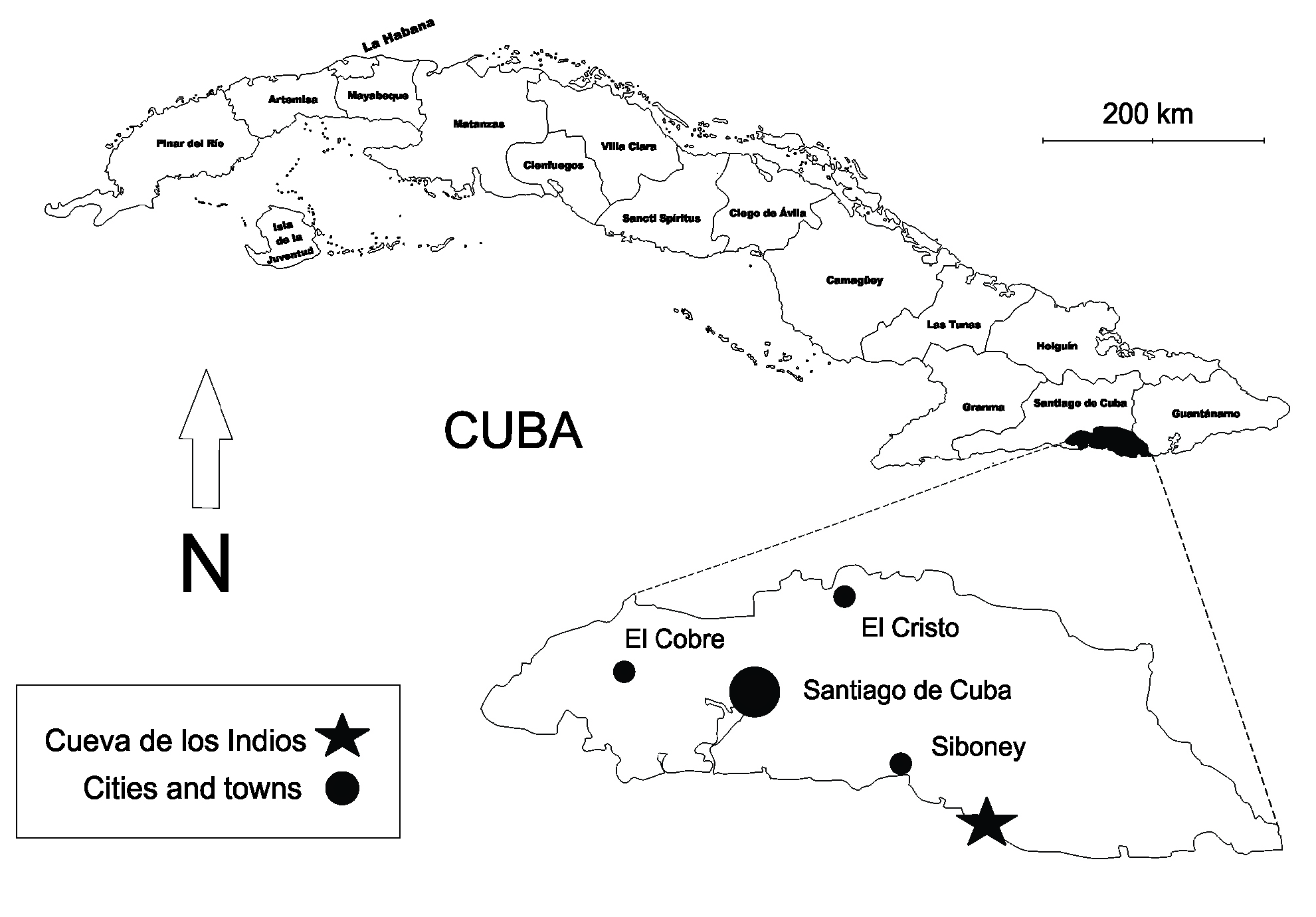
Holotype. — Distal half of right tarsometatarsus, USNM 336506 — not ‘ Right proximal humerus (USNM 336506) ’ as stated by Orihuela (2019: 64) — (Olson 1985: 528, fig. 1: A [anterior], B [posterior], fig. 2: B [posterior]). Collected 31 October 1980 by S. L. Olson et al. [= Jim Lynch, Nicasio Viña and Fernando González (S. L. Olson in litt. 2015)] (Olson 1985: 528). Other material. — Coracoid: left, USNM 336507. Humerus: right, AMNH 21905 (Olson 1985: 529, fig. 3: B [anconal]), AMNH 21906; right lacking distal end, AMNH 21907; proximal ends of right, AMNH 21908, USNM 336508; proximal end of left, USNM 336509; left lacking proximal end, AMNH 21909. Carpometacarpus: right lacking minor metacarpal, AMNH 21904; proximal end of left, USNM 336510. AMNH material collected by H. E. Anthony in 1917 (Olson 1985: 529, see ‘ History’). Type locality. — Cueva de los Indios (SCI), near Daiquirí, c. 22 km east-southeast of Santiago de Cuba, Santiago de Cuba province, Cuba (Olson 1985: 528; see Anthony 1917, 1919). Fig. 2.
Suárez, William (2022): Catalogue of Cuban fossil and subfossil birds. Bulletin of the British Ornithologists’ Club 142 (1): 10-74, DOI: 10.25226/bboc.v142i1.2022.a3
Export occurrence data
Darwin Core Archive (ZIP)
CLASSIFICATION
Taxonomic Classification Tree

NOMENCLATURE
Synonyms(1)
IMAGES