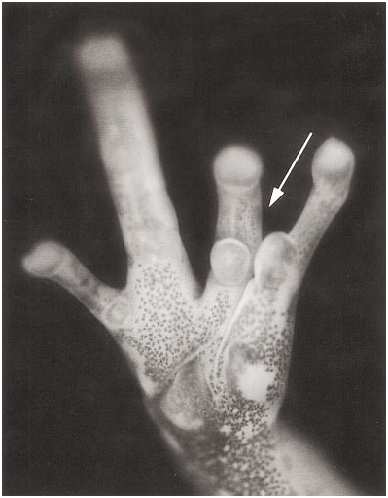
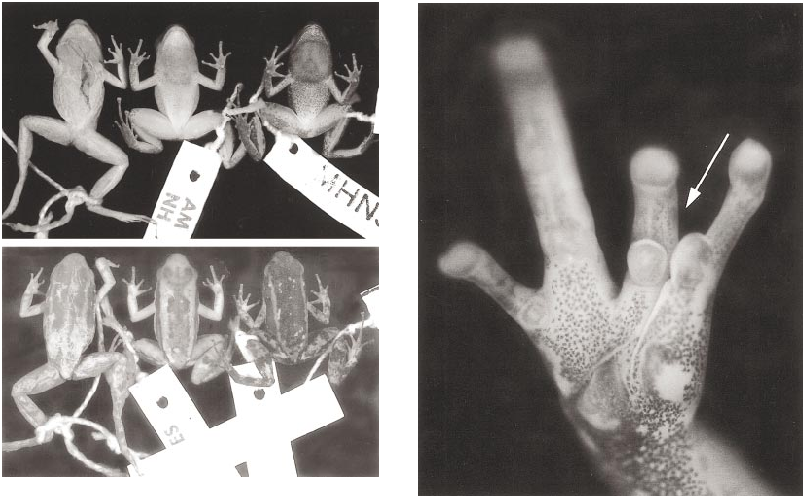
MEASUREMENTS OF HOLOTYPE (in mm): BMNH. 1947.2.14.20 is an adult male with vocal slits and large, unpigmented (white) testes. SVL, 17.2; forearm length from proximal edge of palmar tubercle to outer edge of flexed elbow, 4.0; hand length from proximal edge of palmar tubercle to tip of Finger III, 3.8; shank length from outer edge of flexed knee to heel, 8.0; foot length from proximal edge of outer metatarsal tubercle to tip of Toe IV, 7.2; head width between angle of jaws, 6.0; head length diagonally from corner of mouth to tip of snout, 5.3; eye length from posterior to anterior corner, 2.5; eye to naris distance from anterior corner of eye to center of naris, 1.5; distance between centers of nares, 2.5; snout length from anterior corner of eye to tip of snout, 2.8; interorbital distance, 1.9; diameter of tympanum immeasurable (due to preservational artifact). REDESCRIPTION A composite redescription is provided based on 123 specimens from one Ecuadorian and 13 Peruvian localities. Many of these localities and / or their anuran assemblages have been described in detail (Toft and Duellman, 1979; Aichinger, 1987; Duellman and Koechlin, 1991; Rodríguez, 1992; Duellman and Mendelson, 1995; Duellman and Thomas, 1996; Wild, 1996; Parmelee, 1999). All localities are below 900 m. Given that several of the most crucial diagnostic characters are restricted to adult males, the four localities for which adult males were not available are marked with an asterisk and are only tentatively referred to Colostethus trilineatus (number of specimens examined in parentheses; see fig. 1 and appendix): Aguas Negras * (5); Río Alto Purús (1); Candamo * (2); Cocha Cashu (26); Río Curanja (4); Cuzco Amazónico (16); Explornapo * (1); Genaro Herrera (4); Limoncocha, Ecuador (3); Panguana (50); Río Santiago (1); Tambopata (2); Teniente López * (3); Yurimaguas (5). Colostethus trilineatus also has been reported from Bolivia (Morales, 1994; De la Riva et al., 1996; Köhler and Lötters, 1999; Gonzalez et al., 1999), but Bolivian material was not examined in this study. MORPHOLOGY: Adult males 15.0 – 17.7 mm SVL (n = 48, x = 16.45 ± 0.09 mm), adult females 15.2 – 19.3 mm SVL (n = 57, x = 17.09 ± 0.12 mm). The holotype is larger than the other two males from Yurimaguas (MUSM 15611 = 16.1 mm SVL; AMNH FS 8689 = 16.0; see fig. 3), but the difference in SVL is less than that observed within some other populations (e. g., Panguana). Testes unpigmented (white) in all males. Mature ova pigmented black or brown. Most of dorsal and ventral surfaces smooth, except variably expressed tubercles scattered over posterior part of body and dorsal surfaces of legs and a weak, low tubercle on each eyelid in well preserved specimens. A weak to strong postrictal bulge present, reminiscent of postrictal spicules or tubercles found in many Colostethus. Head width between angle of jaws 31 – 36 % of SVL, 1.02 – 1.25 times head length in males and 0.95 – 1.14 in females. Interorbital distance 27 – 38 % of head width. Snout sloped, rounded in dorsal aspect, sharply rounded in profile, protruding beyond jaws. Loreal region flat or weakly concave, not sloping outward to lip. Canthus rostralis sharply rounded and well defined. Eye length 39 – 53 % of head length. Eyenaris distance 50 – 64 % of snout length and 54 – 80 % of eye length. Nares directed posteriorly in profile, protuberant in dorsal aspect. Tympanum small; greatest diameter 33 – 48 % of eye length. Teeth on maxillary arch straight, moderate in length, not curved and fanglike. Hand length (fig. 4) 20 – 26 % of SVL, 0.89 – 1.15 times forearm length. Finger I> Finger II when appressed. Relative lengths of appressed fingers III> I> II> IV. Fingers weakly keeled distally. Metacarpal fold absent. A single, protuberant subarticular tubercle on each of Fingers I and II, two on Finger III, and one or two on Finger IV. Palmar tubercle well defined, elliptical or subtriangular. Thenar tubercle weak, elliptical. Digital discs weakly expanded. A pair of strong dorsal scutes on each disc. Finger III swollen in all adult males (contra Duellman and Mendelson, 1995: 338), not distally exaggerated. Degree of swelling somewhat variable, but strong and conspicuous along entire length of preaxial side of digit in all but a few adult males. Finger II also swollen along preaxial side between level of subarticular tubercle and finger disc (fig. 4) in five (of 11) adult males from Cocha Cashu, two (of six) from Cuzco Amazónico, and 12 (of 20) from Panguana (Finger II of several other specimens from these and other localities could not be unequivocally coded as swollen or not). Not all males from a locality had Finger II swollen, and no specimen had Finger II swollen and Finger III not swollen. Shank length and foot length 41 – 49 and 37 – 47 % of SVL, respectively. Relative lengths of appressed toes IV> III> V> II> I. Basal webbing between Toes II – IV (webbing formula II 1 ½ – 3 ½ III 2 ½ – 4 IV, following Myers and Duellman, 1982). Weak keels or fringes present on both edges of all toes. Outer metatarsal fold 3 present, often forming small tubercle. Tarsal keel on distal third of tarsus well defined, tuberclelike, arising roughly onethird to onefourth tarsus length from the distal end of the tarsus, not extended distad to reach outer edge of inner metatarsal tubercle. Toe discs weakly expanded; each with pair of welldefined scutes on dorsal surface. One subarticular tubercle on Toes I and II, two on III and V, and three on IV. Outer metatarsal tubercle round; inner metatarsal tubercle elliptical; both tubercles welldefined and protuberant. COLOR IN PRESERVATIVE: The dorsal coloration (figs. 2, 3, 5) is tan to dark brown, either uniform or with small, dark spots scattered over the dorsum. Withinpopulation variation in the expression of a narrow, pale vertebral stripe is as follows (present: absent): Aguas Negras (0: 5); Río Alto Purús (0: 1); Candamo (0: 2); Cocha Cashu (19: 7); Río Curanja (1: 3); Cuzco Amazónico (8: 8); Explornapo (0: 1); Genaro Herrera (0: 4); Limoncocha (0: 3); Panguana (0: 50); Río Santiago (0: 1); Tambopata (1: 1); Teniente López (0: 3); Yurimaguas (1: 4); total for all localities (30: 93). All specimens have a pale dorsolateral stripe from the posterior corner of the eyelid to almost the end of the urostyle, although it is inconspicuous in specimens that are dorsally very light (e. g., MUSM 9186 and 9195, both from Cocha Cashu). In one specimen (AMNH FS 8689 from the type locality; see fig. 3) the pale dorsolateral stripes broaden medially just behind the eyelids to form the outline of an hourglass pattern. The eyelid is blackish brown in all specimens. Ventral coloration among adult males is somewhat variable (figs. 3, 5). In most specimens, the throat and chest are stippled gray, but in some (e. g., MUSM 9196 and 15611) the stippling is much heavier, making the throat and chest dark gray or brown (but never solid black). In females, the throat, chest, and medial belly are immaculate or nearly so (very weak stippling often occurs on the chin). In all specimens examined, the belly is more strongly pigmented laterally than medially. In some specimens (e. g., MUSM 9184) the lateral belly ventral (medial) to the ventrolateral stripe is dark brown with whitish spots, whereas in others (e. g., KU 194916) it is stippled brown or gray with a variable number of elongate brown spots. Thigh coloration is highly variable (figs. 3, 5). Dorsally, thighs are tan or light brown, free of dark markings (e. g., AMNH FS 8689, fig. 3) or with numerous, irregular, small spots or blotches, one or more welldefined blotches, or one welldefined transverse band of variable width. In most specimens, the anterior surface of the thigh exhibits a diffuse pale brown, brown, or black (in dark specimens, e. g., MUSM 15611) stripe from the knee through the groin and continuous with the dark coloration of the flank. A few specimens (e. g., KU 194916) lack a dark anterior thigh stripe; in these, the anterior surface is the same color as the dorsal surface. A flash mark is absent from the groin. The posterior surface of the thigh is gray, pale brown, brown, or dark brown and invariably with minute, diffuse, whitish dots. The white spot on either side of the cloaca that Boulenger (1883) described is present in all wellpreserved specimens, although it varies from a prominent, welldefined spot (e. g., AMNH FS 8689) to an inconspicuous narrow line (e. g., MUSM 9184; much of the variation in this character is shown in fig. 5). Thighs are usually ventrally immaculate, although they occasionally have a few diffuse gray or brown specks of pigment. The dorsal surface of the shank has one poorly to welldefined transverse band in most specimens, although in some (e. g., MUSM 9183) the shank is covered in irregular, dark brown blotches that fail to define a transverse band. Concealed surfaces of the shank are invariably pigmented pale brown or gray (i. e., flash marks absent). The inner surface of the foot is immaculate creamy white, free of melanophores. The plantar surface is brown or gray with creamy white blotches and spots; contact surfaces of tubercles are dark gray. Webbing between Toes III – IV is creamy white or brown. The arm is dorsally gray or tan with variably expressed darker brown blotches that extend from the anterior and posterior surfaces. The anterior and posterior surfaces of the upper arm have welldefined, dark brown, longitudinal stripes. The anterior stripe extends from near the base of the arm almost to the elbow; the posterior stripe extends from the axilla around the elbow, where it meets the dark brown mottling on creamy white ground of the outer and ventral sides of the forearm. Palmar surfaces are brown. The flank is dark brown or blackish brown with or without pale flecks and spots (fig. 6). The dark coloration of the flank is delimited ventrally by a moderately to welldefined ventrolateral stripe passing just dorsal to the arm, present in all specimens. Most specimens in all populations have a diffuse pale area anterior to the groin that extends anterodorsad to a point no further than half the distance to the arms (figs. 2 and 6). In some (e. g., MUSM 9201), this pale area includes several diffuse, whitish spots. In a few specimens (e. g., KU 194916), the area anterior to the groin is not obviously lighter than the rest of the flank, but this is probably a preservational artifact, as all wellpreserved and living frogs have this pale region (e. g., fig. 2). The dark coloration of the flanks continues anteriad from the eye, through the loreal region, and around the snout (encompassing nares) to form a face mask. Below this, the face is creamy white with gray stippling or a blackish brown stripe along the upper lip (e. g., MUSM 15611). Dark lower lip line absent. COLOR IN LIFE: Color in life was described for specimens from Teniente López (Duellman and Mendelson, 1995) and Río Curanja (Duellman and Thomas, 1996), and color photographs of Bolivian specimens were published in Gonzalez et al. (1999). Photographs taken by LOR of material from Cocha Cashu (e. g., fig. 2) and Genaro Herrera agree with the published accounts except that the spots on either side of the cloaca and the vertebral stripe are yellowish bronze and the vertebral stripe is bordered by black.
GRANT, TARAN, RODRÍGUEZ, LILY O. (2001): Two New Species of Frogs of the Genus Colostethus (Dendrobatidae) from Peru and a Redescription of C. trilineatus (Boulenger, 1883). American Museum Novitates 3355: 1-24, DOI: 10.1206/0003-0082(2001)355<0001:TNSOFO>2.0.CO;2, URL: http://www.bioone.org/doi/abs/10.1206/0003-0082%282001%29355%3C0001%3ATNSOFO%3E2.0.CO%3B2