AnimaliaNot EvaluatedacceptedspeciesAccepted
Colostethus alessandroi

Colostethus alessandroi

Grant & Rodríguez, 2001

GBIF:245321493

0year

ABOUT

Descriptions(7)

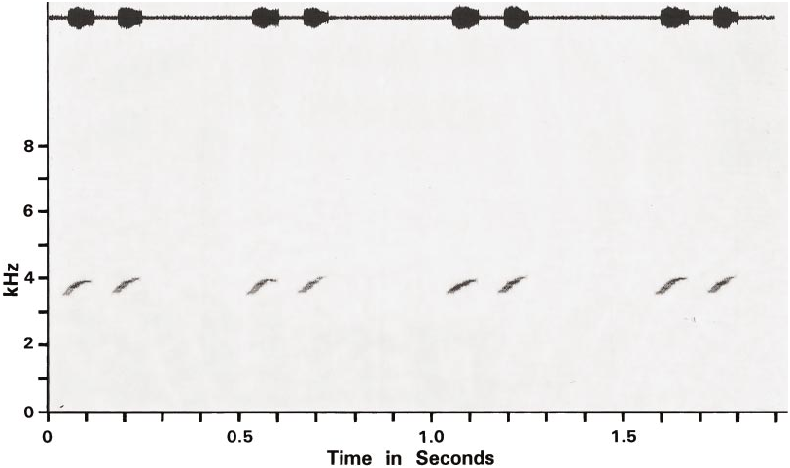
NATURAL HISTORY: Colostethus alessandroi is riparian. All the specimens collected to date were taken from habitats in early stages of succession. Males were observed calling beside streams, perched on moss­covered rocks or fallen vegetation, or hidden among rocks and vegetation. Calling activity was greatest in early morning and tapered off by midday, although it also was observed to continue into the afternoon, especially during the rainy season. VOCALIZATIONS An uncollected individual was recorded by Alessandro Catenazzi at a creek at the type locality at 10: 00 h on 21 February 1999, 17.4 ° C (AMNH herpetology reel 289). Although the specimen evaded capture, it was clearly observed calling from a moss­covered rock overhung by tree roots; many other specimens were also observed calling, and all emitted the same vocalization. Data were taken from a continuous train of 321 couplets and two single notes in 1.40 min of continuous tape. Couplets are produced rhythmically at an average rate of 1.58 couplets per sec. Detailed data were taken from the first 35 vocalizations of this series; the two single notes were pooled with the first notes of couplets. The duration of the first note of each couplet is significantly longer than the second note (P = 0.0001); the first note ranges from 84.4 – 103.1 msec (n = 35, x = 91.96 ± 0.62 msec), whereas the second note is 75.0 – 87.5 msec (n = 33, x = 81.06 ± 0.64 msec). Internote duration is 34.4 – 53.1 msec (n = 33, x = 46.69 ± 0.65 msec). Time between couplets is 212.5 – 596.9 msec (n = 33, x = 365.4 ± 19.6 msec). Notes are weakly or nonpulsatile. Spectral energy is concentrated between 3400 – 4320 Hz with the greatest energy peak at 3720 – 4160 Hz (n = 68, x = 3881 ± 10 Hz); all but four of the 35 calls exhibit greatest energy peaks below 4.0 kHz. Each note is strongly frequency modulated from lower to higher (fig. 18). The two notes of each couplet overlap almost completely in all spectral parameters and are only statistically distinguishable in that the minimum frequency of the first note is slightly higher than the second note (first note: n = 35, x = 3512 ± 9 Hz; second note: n = 33, x = 3484 ± 9 Hz; P = 0.0351).
GRANT, TARAN, RODRÍGUEZ, LILY O. (2001): Two New Species of Frogs of the Genus Colostethus (Dendrobatidae) from Peru and a Redescription of C. trilineatus (Boulenger, 1883). American Museum Novitates 3355: 1-24, DOI: 10.1206/0003-0082(2001)355<0001:TNSOFO>2.0.CO;2, URL: http://www.bioone.org/doi/abs/10.1206/0003-0082%282001%29355%3C0001%3ATNSOFO%3E2.0.CO%3B2
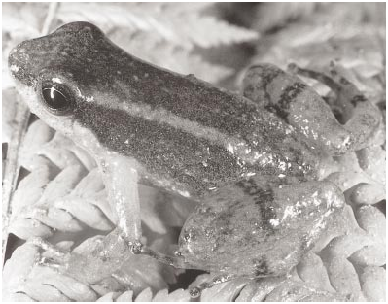
Colostethus kingsburyi, from northern Peru and Ecuador, is most easily distinguished from C. alessandroi by lacking webbing and having a conspicuous, incomplete oblique lateral stripe (see photo in Coloma, 1995: plate 1 C) and a black venter with pale reticulations or irregular spots in adult males. MEASUREMENTS OF HOLOTYPE (in mm): The holotype MUSM 15609 is an adult male with vocal slits and enlarged, white (unpigmented) testes. SVL 22.0; forearm length from proximal edge of palmar tubercle to outer edge of flexed elbow, 4.7; hand length from proximal edge of palmar tubercle to tip of Finger III, 5.8; shank length from outer edge of flexed knee to heel, 10.2; foot length from proximal edge of outer metatarsal tubercle to tip of Toe IV, 9.6; head width between angle of jaws, 7.6; head length diagonally from corner of mouth to tip of snout, 7.0; eye length from posterior to anterior corner, 3.0; eye to naris distance from anterior corner of eye to center of naris, 2.0; distance between centers of nares, 3.0; snout length from anterior corner of eye to tip of snout, 3.9; interorbital distance, 2.3; greatest diameter of tympanum, 1.1. DESCRIPTION OF TYPE SERIES The type series consists of five specimens, four adult males with enlarged, granular, white (unpigmented) testes, and one subadult female. MORPHOLOGY: Males 21.3 – 22.1 mm SVL (n = 4, x = 21.90 ± 0.20 mm). Adult females unknown (subadult female MUSM 17737 is 23.4 mm SVL). A few small, low, weak tubercles scattered over eyelids, lower back, and upper surfaces of legs. A pair of elongate preaxilar tubercles extended toward ventral edge of tympanum. Cloacal tubercles absent. Ventral surfaces smooth. Head width between angle of jaws 34 – 35 % of SVL and 1.05 – 1.09 times head length. Interorbital distance 30 – 35 % of head width. In profile, snout gently rounded above and bluntly pointed, protruding beyond jaws. In dorsal aspect, snout bluntly pointed. Loreal region flat and weakly sloping outward to lip. Canthus rostralis sharply rounded and well defined. Eye length 43 – 48 % of head length. Eye­naris distance 51 – 57 % of snout length and 63 – 67 % of eye length. Nares directed posteriorly in profile; protuberant in dorsal aspect. Tympanum small, its greatest diameter 37 – 41 % of the eye length. Teeth on maxillary arch straight, moderate in length, not curved and fanglike. Hand length (fig. 17) 26 – 28 % of SVL, 1.11 – 1.23 times forearm length. Relative lengths of appressed fingers III> IV> I> II. All fingers with well­defined keellike lateral fringes, most prominent distally. Metacarpal fold short. A single subarticular tubercle on Fingers I and II, two on Fingers III and IV; distal tubercle of Finger IV diffuse, all others well defined and protuberant. Palmar tubercle subtriangular and well defined. Thenar tubercle elongate, small, poorly defined. Digital discs weakly expanded. Paired scutes on dorsal surface of each disc prominent. Preaxial side of Finger III swollen along entire length in adult males. Shank length 46 – 50 % of SVL. Foot length 42 – 47 % of SVL. Relative lengths of appressed toes IV> III> V> II> I. Welldeveloped webbing between all toes except Toes IV – V (webbing formula I 1 ½ – 2 II 1 ½ – 3 III 2 ½ – 3 ½ IV; fig. 14). Well­developed fringes on both edges of all toes. Weak outer metatarsal fringe present, as is curved tarsal keel. Toe discs weakly expanded with welldefined scutes on dorsal surface of each. One subarticular tubercle on Toes I and II, two on III and V, and three on IV; proximal tubercle on Toe III smaller than others and offset from midline. Inner metatarsal tubercle round, outer metatarsal tubercle elliptical, both well developed. COLOR IN PRESERVATIVE: Dorsal coloration (figs. 13, 16) is dark gray to black, with minute pale spots scattered over the dorsum. The snout is somewhat paler than the surrounding area. A diffuse, gray dorsolateral stripe extends from the posterior corner of the eyelid to the pelvic region (broken and inconspicuous posterior to the level of the arms in MUSM 15609). Ventral coloration is somewhat variable. In all, the throat, chest, and belly have gray stippling (fig. 15). In MUSM 15608 the stippling on the belly is limited to a few fairly discrete spots, but the venter is still darker than in C. mcdiarmidi. In AMNH 159110 the venter is much more sparsely pigmented than in other specimens, similar to C. mcdiarmidi. The subadult female also has extensive ventral stippling. Thigh coloration is variable. Dorsally, the thigh is gray with one diffuse dark gray or blackish transverse band of variable width and numerous poorly defined dark gray and black blotches and spots (fig. 16). The anterior surface of the thigh has a diffuse dark gray or black stripe from the knee to the groin. The groin appears to be free of flash marks. The posterior surface of the thigh is gray and black with minute, diffuse whitish spots and flecks. A conspicuous white spot is present on each side of the cloaca. The thigh is ventrally immaculate. The dorsal surface of the shank has one or two blackish transverse bands and numerous diffuse dark blotches and spots. The concealed surface of the shank is pale, free of melanophores. The inner surface of the foot is immaculate creamy white or faintly stippled pale gray; the plantar surface is gray with creamy white blotches and spots. Toe webbing is immaculate or stippled gray. The dorsal surface of the arm is gray with variably expressed darker blotches. The anterior surface of the arm is also gray in AMNH 157004 and MUSM 15608, but the holotype (MUSM 15609) has a black spot at the base of each arm and a very weak, darker gray longitudinal stripe. The posterior surface of the arm is uniform gray, fading proximally. The arm is ventrally immaculate. The palmar surface is gray. The flank is black with an inconspicuous paler area or one or more elongate spots near the groin. The dark coloration of the flank is delimited ventrally by a poorly defined, pale ventrolateral stripe consisting of a wavy stripe or series of elongate spots. In ventral view, the lateral portions of the belly (i. e., medial and / or ventral to the ventrolateral stripe) are stippled gray. The black coloration of the flanks continues anteriad through the loreal region and around the snout (encompassing the nares). Below this the face is stippled gray. COLORATION IN LIFE: AMNH 157004 (fig. 13) was greenish brown on the dorsum and flanks. The arms and legs had a yellowish tinge, especially the posteroproximal surface of the upper arm. The dorsolateral stripe was pale brown with a bronze tinge anteriorly. The iris was black with golden flecks with a conspicuous golden ring around the pupil.
GRANT, TARAN, RODRÍGUEZ, LILY O. (2001): Two New Species of Frogs of the Genus Colostethus (Dendrobatidae) from Peru and a Redescription of C. trilineatus (Boulenger, 1883). American Museum Novitates 3355: 1-24, DOI: 10.1206/0003-0082(2001)355<0001:TNSOFO>2.0.CO;2, URL: http://www.bioone.org/doi/abs/10.1206/0003-0082%282001%29355%3C0001%3ATNSOFO%3E2.0.CO%3B2
Figures 13 – 18
GRANT, TARAN, RODRÍGUEZ, LILY O. (2001): Two New Species of Frogs of the Genus Colostethus (Dendrobatidae) from Peru and a Redescription of C. trilineatus (Boulenger, 1883). American Museum Novitates 3355: 1-24, DOI: 10.1206/0003-0082(2001)355<0001:TNSOFO>2.0.CO;2, URL: http://www.bioone.org/doi/abs/10.1206/0003-0082%282001%29355%3C0001%3ATNSOFO%3E2.0.CO%3B2
DIAGNOSIS: A small species (adult males to roughly 22 mm SVL, adult females unknown); Finger III swollen in adult males; venter stippled pale gray; testes white (unpigmented) in adult males; toes moderately webbed; dorsolateral stripe present; oblique lateral stripe present as a pale region or group of one or more elongate spots near the groin; ventrolateral stripe present; median lingual process absent; cloacal tubercles absent; anal sheath absent; black armband absent. Colostethus alessandroi is most similar to C. mcdiarmidi Reynolds and Foster, 1992, but differs in having (1) more extensive toe webbing (fig. 14); (2) a darker venter (usually; fig. 15); (3) slightly smaller adult male SVL (C. alessandroi = 21.3 – 22.1 mm; C. mcdiarmidi = 22.5 – 24.3 mm); (4) different dorsal coloration (C. alessandroi lacks discrete light spots on the posterior dorsum and has darker, more diffuse dorsolateral stripes and darker thigh coloration; fig. 16); (5) proportionately longer shanks (shank length / SVL = 0.46 – 0.50 in C. alessandroi, 0.43 – 0.46 in C. mcdiarmidi); and (6) slightly smaller tympana, both absolutely (1.1 – 1.3 mm in C. alessandroi, 1.5 – 1.8 mm in C. mcdiarmidi) and proportionately (e. g., tympanum / eye = 0.37 – 0.41 in C. alessandroi, 0.45 – 0.56 in C. mcdiarmidi). Finger III is swollen in adult males of both species (contra Reynolds and Foster, 1992; fig. 17).
GRANT, TARAN, RODRÍGUEZ, LILY O. (2001): Two New Species of Frogs of the Genus Colostethus (Dendrobatidae) from Peru and a Redescription of C. trilineatus (Boulenger, 1883). American Museum Novitates 3355: 1-24, DOI: 10.1206/0003-0082(2001)355<0001:TNSOFO>2.0.CO;2, URL: http://www.bioone.org/doi/abs/10.1206/0003-0082%282001%29355%3C0001%3ATNSOFO%3E2.0.CO%3B2
REMARKS Given the overall morphological similarity and geographic distributions of Colostethus alessandroi and C. mcdiarmidi, it is likely that they are closely related. Indeed, the possibility exists that they are geographic variants of a single species, such as extremes in a cline. However, although few specimens are presently available, we compared directly equivalent semaphoronts (adult males) from several localities and found no evidence of clinal variation along either a latitudinal or altitudinal gradient, 7 and a number of characters distinguish the two groups. Additional specimens, especially from intermediate localities, are required to further assess intraspecific variation and test our hypothesis. Similarly, the inclusion of additional lines of evidence (e. g., vocalizations, osteology, DNA sequence data) could further elucidate this problem, although failure to discover differences in them would not necessarily prove these populations to be conspecific.
GRANT, TARAN, RODRÍGUEZ, LILY O. (2001): Two New Species of Frogs of the Genus Colostethus (Dendrobatidae) from Peru and a Redescription of C. trilineatus (Boulenger, 1883). American Museum Novitates 3355: 1-24, DOI: 10.1206/0003-0082(2001)355<0001:TNSOFO>2.0.CO;2, URL: http://www.bioone.org/doi/abs/10.1206/0003-0082%282001%29355%3C0001%3ATNSOFO%3E2.0.CO%3B2
ETYMOLOGY: The specific epithet is a patronym for Alessandro Catenazzi in recognition of his field studies of the Peruvian herpetofauna.
GRANT, TARAN, RODRÍGUEZ, LILY O. (2001): Two New Species of Frogs of the Genus Colostethus (Dendrobatidae) from Peru and a Redescription of C. trilineatus (Boulenger, 1883). American Museum Novitates 3355: 1-24, DOI: 10.1206/0003-0082(2001)355<0001:TNSOFO>2.0.CO;2, URL: http://www.bioone.org/doi/abs/10.1206/0003-0082%282001%29355%3C0001%3ATNSOFO%3E2.0.CO%3B2
HOLOTYPE: MUSM 15609 (field number AMNH FS 11862), an adult male collected 17 January 1998 by Lily O. Rodríguez, Alessandro Catenazzi, and Fredy Qertehuari at San Pedro, Cosñipata, Paucartambo, Departamento de Cuzco, Peru, GPS coordinates 13 ° 03 ' S, 71 ° 32 ' W, 1480 m. The specimen was taken from atop a rock beside a stream. PARATYPES: AMNH 157004, collected with the holotype. AMNH 159110, MUSM 17737, collected 21 – 22 February 1999 by Alessandro Catenazzi at the type locality. MUSM 15608, collected 23 June 1994 by Fonchii Chang 3 km from Pueblo San Gabán, Departamento de Puno, Peru, 13 ° 27 ' S, 70 ° 27 ' W, ca. 820 m.
GRANT, TARAN, RODRÍGUEZ, LILY O. (2001): Two New Species of Frogs of the Genus Colostethus (Dendrobatidae) from Peru and a Redescription of C. trilineatus (Boulenger, 1883). American Museum Novitates 3355: 1-24, DOI: 10.1206/0003-0082(2001)355<0001:TNSOFO>2.0.CO;2, URL: http://www.bioone.org/doi/abs/10.1206/0003-0082%282001%29355%3C0001%3ATNSOFO%3E2.0.CO%3B2

Export occurrence data

Darwin Core Archive (ZIP)

CLASSIFICATION

Taxonomic Classification Tree

MULTIMEDIA

Media Files(6)

Fig. 14. Plantar view of feet with toes splayed. Left: C. mcdiarmidi (holotype USNM 257805). Right: C. alessandroi (AMNH 157004). Scale bar = 2 mm.

Imageimage/png© GRANT, TARAN;RODRÍGUEZ, LILY O.GRANT, TARAN;RODRÍGUEZ, LILY O.

Fig. 13. Colostethus alessandroi AMNH 157004 (SVL = 21.3 mm). (From color transparency by Alessandro Catenazzi.)

Imageimage/png© GRANT, TARAN;RODRÍGUEZ, LILY O.GRANT, TARAN;RODRÍGUEZ, LILY O.

Fig. 15. Ventral view of adult males of Colostethus mcdiarmidi holotype USNM 257805 (left) and C. alessandroi AMNH 157004 (right). Scale bar = 5 mm.

Imageimage/png© GRANT, TARAN;RODRÍGUEZ, LILY O.GRANT, TARAN;RODRÍGUEZ, LILY O.

Fig. 16. Dorsal view of similar species of Colostethus. From left to right, top row: C. alessandroi MUSM 15609 (Ƌ), MUSM 15608 (Ƌ), AMNH 157004 (Ƌ); bottom row: C. mcdiarmidi USNM 257805 (Ƌ), USNM 257806 (♀), NKA 3712 (♀), NKA 3708 (Ƌ). ×1.3.

Imageimage/png© GRANT, TARAN;RODRÍGUEZ, LILY O.GRANT, TARAN;RODRÍGUEZ, LILY O.

Fig. 17. Palmar view of right hand of Colostethus alessandroi (AMNH 157004). Scale bar = 2 mm.

Imageimage/png© GRANT, TARAN;RODRÍGUEZ, LILY O.GRANT, TARAN;RODRÍGUEZ, LILY O.

Fig. 18. Narrow­band (59 Hz) spectrogram and waveform of advertisement call of Colostethus alessandroi from the type locality.

Imageimage/png© GRANT, TARAN;RODRÍGUEZ, LILY O.GRANT, TARAN;RODRÍGUEZ, LILY O.

IMAGES

Gallery(6)

See Gallery

Occurrences with images

Source Information

Two New Species of Frogs of the Genus Colostethus (Dendrobatidae) from Peru and a Redescription of C. trilineatus (Boulenger, 1883)

checklist

This dataset contains the digitized treatments in Plazi based on the original journal article GRANT, TARAN, RODRÍGUEZ, LILY O. (2001): Two New Species of Frogs of the Genus Colostethus (Dendrobatidae) from Peru and a Redescription of C. trilineatus (Boulenger, 1883). American Museum Novitates 3355: 1-24, DOI: 10.1206/0003-0082(2001)355<0001:TNSOFO>2.0.CO;2, URL: http://www.bioone.org/doi/abs/10.1206/0003-0082%282001%29355%3C0001%3ATNSOFO%3E2.0.CO%3B2

ABSTRACT

Colostethus trilineatus (Boulenger, 1883) is widespread in the lowlands of Amazonian Peru and Ecuador. It is characterized, in part, by small size, gray throat and Finger III strongly swollen in adult males, and an advertisement call of 10 notes with emphasized frequencies at 4920–6040 Hz. Material examined revealed extensive variation in dorsal, ventral, and thigh coloration. In numerous adult males from several localities Finger II is also swollen. The swelling of Finger II varies intraspecifically, possibly as a function of male reproductive activity.

Vocalizations of Colostethus trilineatus recorded at the type locality are temporally distinct from those reported from other localities. At the type locality, advertisement calls are composed of single notes (i.e., not couplets) of (usually)> 40 msec duration and <90 msec between notes, whereas other calls consist of notes of <30 msec duration produced as couplets repeated at roughly 200 msec intervals. Although these differences in amplitude modulation could indicate the existence of two species, the calls at the three localities are spectrally identical (all have emphasized frequencies primarily between 5 and 6 kHz) and the specimens examined from these localities are morphologically indistinguishable. For the time being, we interpret the differences in temporal patterning as intraspecific variation.

Colostethus melanolaemus is a new species known from the type locality near the mouth of the Napo River and the upper Ampiyacu River. Colostethus melanolaemus most closely resembles C. trilineatus and C. juanii Morales, 1994, but it differs from them in male throat color, swelling of Finger III, snout­vent length, and advertisement call. Although this species reaches a snout­vent length of nearly 24 mm, Finger IV is shorter than or equal to Finger II, and the distal subarticular tubercle is absent. The advertisement call of C. melanolaemus usually consists of four notes with emphasized frequencies of 3840–4560 Hz. For comparative purposes, the advertisement call of C. juanii is also described.

1 Division of Vertebrate Zoology (Herpetology), American Museum of Natural History; Center for Environmental Research and Conservation/Faculty Fellow, Columbia University MC5557, 1200 Amsterdam Ave., New York, NY 10027, USA.

2 Division of Vertebrate Zoology (Herpetology), American Museum of Natural History; Investigadora Asociada: Asociación Peruana para la Conservación de la Naturaleza (APECO), Parque José de Acosta 187, Lima 17, Peru´; and Museo de Historia Natural de la Universidad Mayor de San Marcos, Apartado 140434, Lima 17, Peru´.

The oblique lateral stripe, found in many dendrobatids, occurs as a diffuse, inconspicuous, pale region or group of small spots that extends from the groin to midway along the flank in Colostethus brunneus (Cope, 1887), C. juanii, C. melanolaemus, C. trilineatus, and several other similar species of Colostethus. This pattern differs from the states found in most species of Colostethus.

Colostethus alessandroi is a new species found between about 800–1500 m on the eastern slopes of the Andes of southern Peru. This species is most similar to C. mcdiarmidi Reynolds and Foster, 1992, but differs in amount of toe webbing, ventral coloration, snout­vent length, dorsal coloration, shank length, and tympanum diameter. Both C. alessandroi and C. mcdiarmidi have swollen third fingers in adult males. The call of C. alessandroi is composed of couplets repeated rhythmically in series of over 300 calls. Spectral energy is concentrated between 3400 and 4320 Hz, with the greatest energy peaks usually below 4.0 kHz. The first note of each couplet is longer than the second.

GRANT T, RODRÍGUEZ L O, carolina (2001). Two New Species of Frogs of the Genus Colostethus (Dendrobatidae) from Peru and a Redescription of C. trilineatus (Boulenger, 1883). Plazi.org taxonomic treatments database. Checklist dataset https://doi.org/10.15468/8q3g5k accessed via GBIF.org on 2026-06-14.

CC0Published 12/31/2001View dataset
GBIF Usage Key
245321493
Dataset Key
5862be48-59a5-4c51-8ac7-e608e91897c8
Origin
source
Backbone Key
2426305
Taxon ID
C35F879EFF92FFC4FD7B77E6FDA82A1B.taxon
Last Crawled
6/9/2026
Last Interpreted
6/9/2026