
AnimaliaNot EvaluatedacceptedspeciesAccepted
Alluroides lauzannei
Ljungstrom, 1971
GBIF:245596641
0year
0
Synonyms
ABOUT
Descriptions(2)
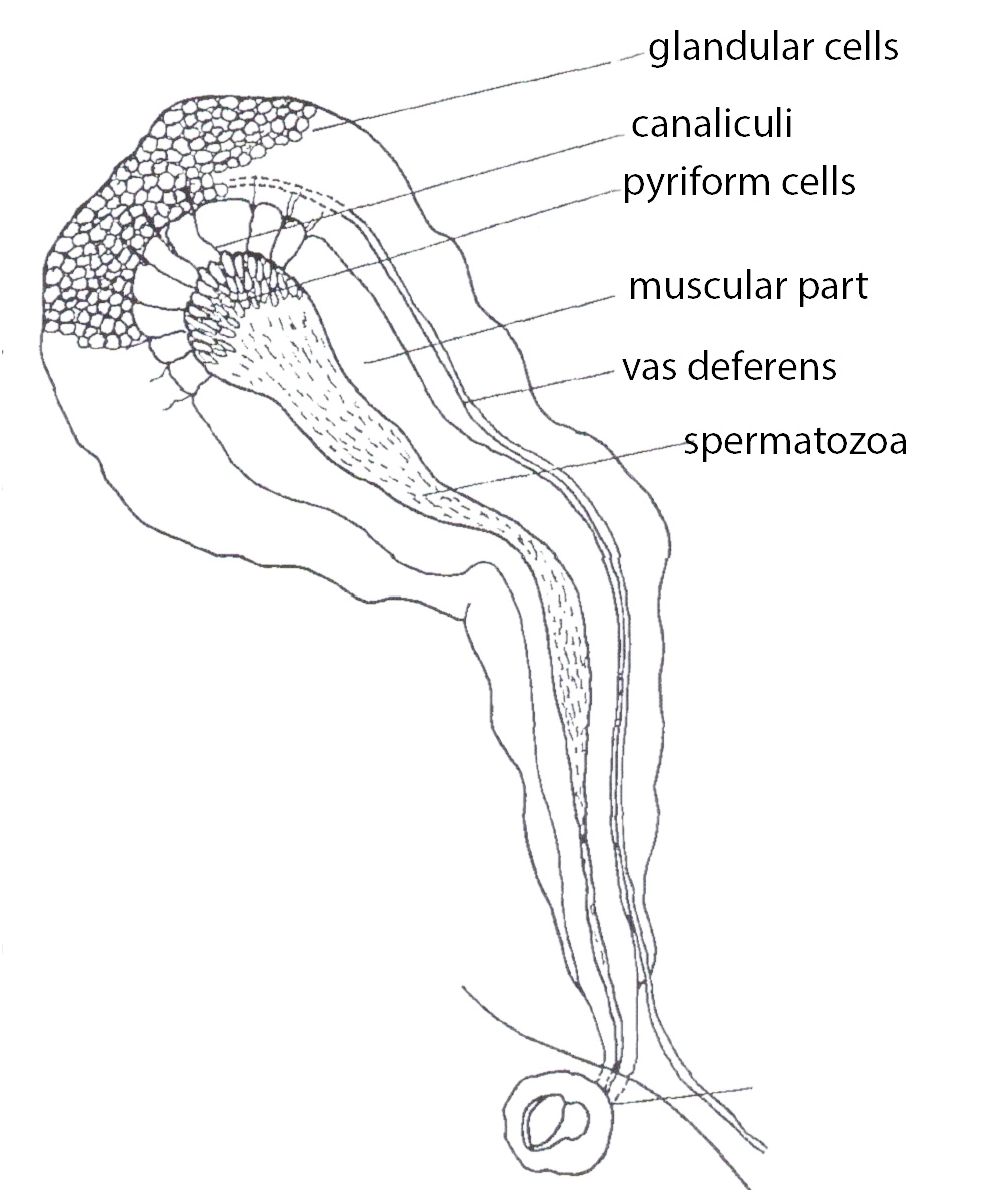
Length 20 – 60 mm. width 1.2 – 1.5 mm, segments 110 – 150. Colour rose to red. Prostomium conical and ciliated, divided into two parts. Setae 2 per bundle; simple – pointed and 150 – 170 um long; well demarcated and very thick in the anterior region; ventral setae absent in the region of the male pores. Clitellum poorly developed, in IX to XIII. Spermatheca single, with dorsomedial pore anterior in VIII forming a pad clearly visible on the body wall. Septa strongly developed in the anterior region as far as XII. Mouth followed by a well-developed pharynx. Oesophagus extending to XII – XIII where it is followed by a straight intestine with strongly marked constrictions. Gizzard absent. Circulatory system consisting of a large contractile dorsal vessel and a smaller ventral vessel. In the midregion the commissures short and not ramifying and attached to the intestine. In the anterior region (II – XII) the commissures long, powerful, contractile, and coiled. The posterior region richly vascularized; the commissures ramify into numerous vessels; this region possibly functioning as gills. Nephridia two per segment; absent from the anterior region, commencing in VIII; in VIII very near to intersegment 7 / 8; constituted by a thin – walled ovoid pouch and a strongly muscular duct. Segments X and XI occupied by a conspicuous mass, constituting, very likely, the testes, in X, and a sperm sac. Segment XII occupied by a yellowish mass constituted by the ovaries and sexual products. At maturity the eggs occupying the posterior of segments XIII and XIV; voluminous and rich in yolk These products apparently included in an ovisac issuing from septum 12 / 13. Female ducts not observed. Male genital tract represented in XIII by two voluminous, pyriform, and very elongate atria each with a thick muscular part. For most of its length but particularly in the swollen region each covered on the largest part of its length by a glandular mass, very likely functioning as a prostate; this formation richly vascularised. A series of fine canaliculi traverses the muscular mass in the swollen region. In the swollen part of the atrium there are pyriform cells orientated longitudinally. Atrium opening ventrolaterally via a short pseudo – penis, in the form of a corolla which becomes a truncated cone on fixation. Male funnel issuing from septum 10 / 11 closely associated with the sperm mass. The narrow sperm duct is elusive and better seen in the living animal. It follows the length of the ventral body wall and reaches segment XIII in the region of the pseudo – penis. It remounts the atrium at the interior of the glandular bed where its course is lost, it has not been possible to detect its opening into the atrium and it is presumed that the sperm enter the atrium through the canaliculi already referred to. The single, voluminous spermatheca, projecting into IX; consisting of an ovoid pouch with thin walls and a well – developed muscular duct.
Jamieson, Barrie G. M., Fragoso, Carlos (2024): A monograph of the Oligochaete family Alluroididae. Zootaxa 5529 (3): 401-435, DOI: 10.11646/zootaxa.5529.3.1, URL: http://dx.doi.org/10.11646/zootaxa.5529.3.1
Distribution. This worm forms the major part of the biomass of benthic oligochaetes in Lake Chad. It prefers sandy bottoms where currents give good oxygenation but is never found where vegetable debris predominates. The reproductive period is November to February. It is equally collected in Lakes Léré and Fianga (Mayo Kebi Region).
Jamieson, Barrie G. M., Fragoso, Carlos (2024): A monograph of the Oligochaete family Alluroididae. Zootaxa 5529 (3): 401-435, DOI: 10.11646/zootaxa.5529.3.1, URL: http://dx.doi.org/10.11646/zootaxa.5529.3.1
Export occurrence data
Darwin Core Archive (ZIP)
CLASSIFICATION
Taxonomic Classification Tree

NOMENCLATURE
Synonyms(1)
IMAGES