
AnimaliaNot EvaluatedacceptedspeciesAccepted
Amphiuma means

Amphiuma means

Garden

GBIF:249834906

ABOUT

Descriptions(1)

Amphiuma means Garden in Smith, 1821

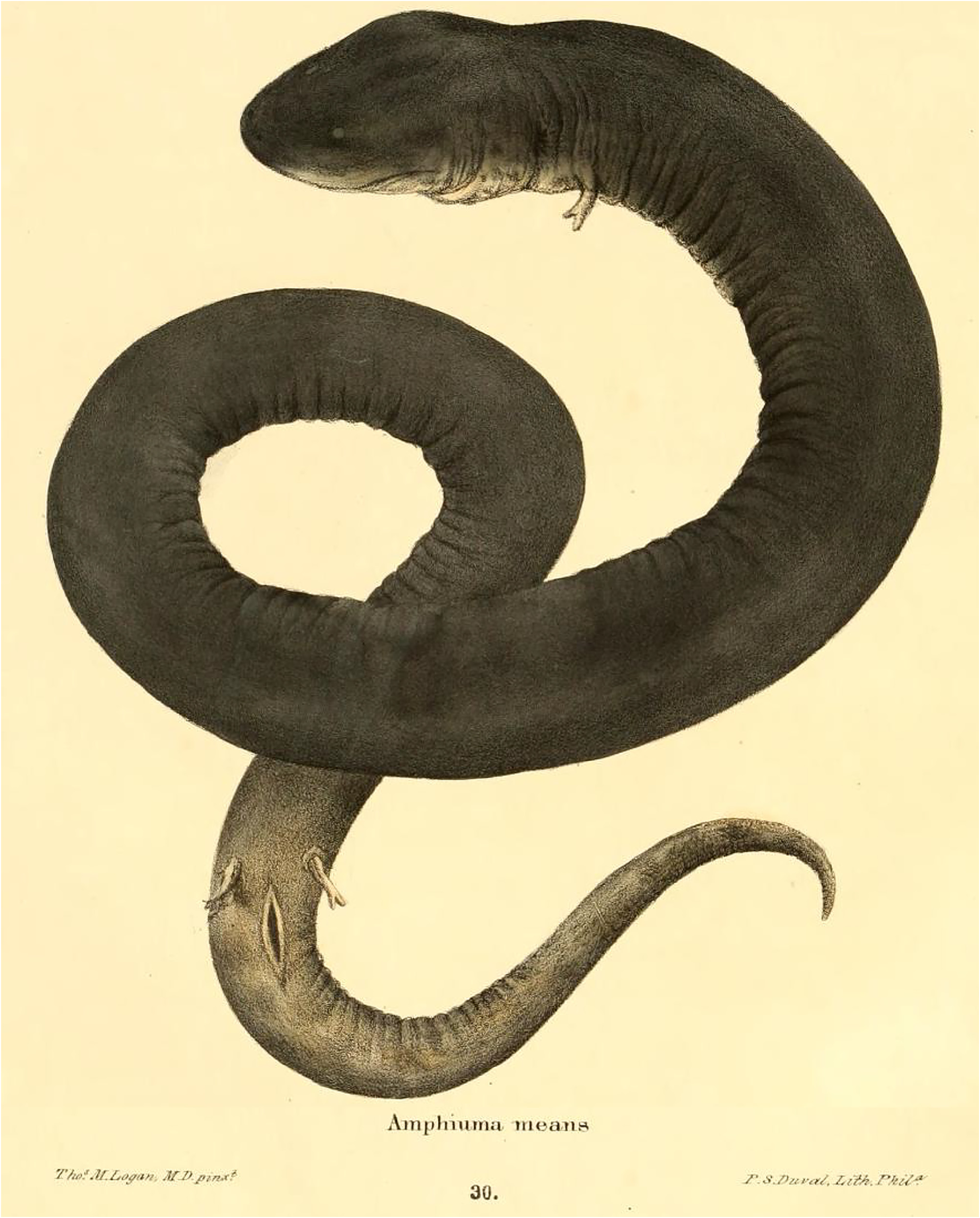
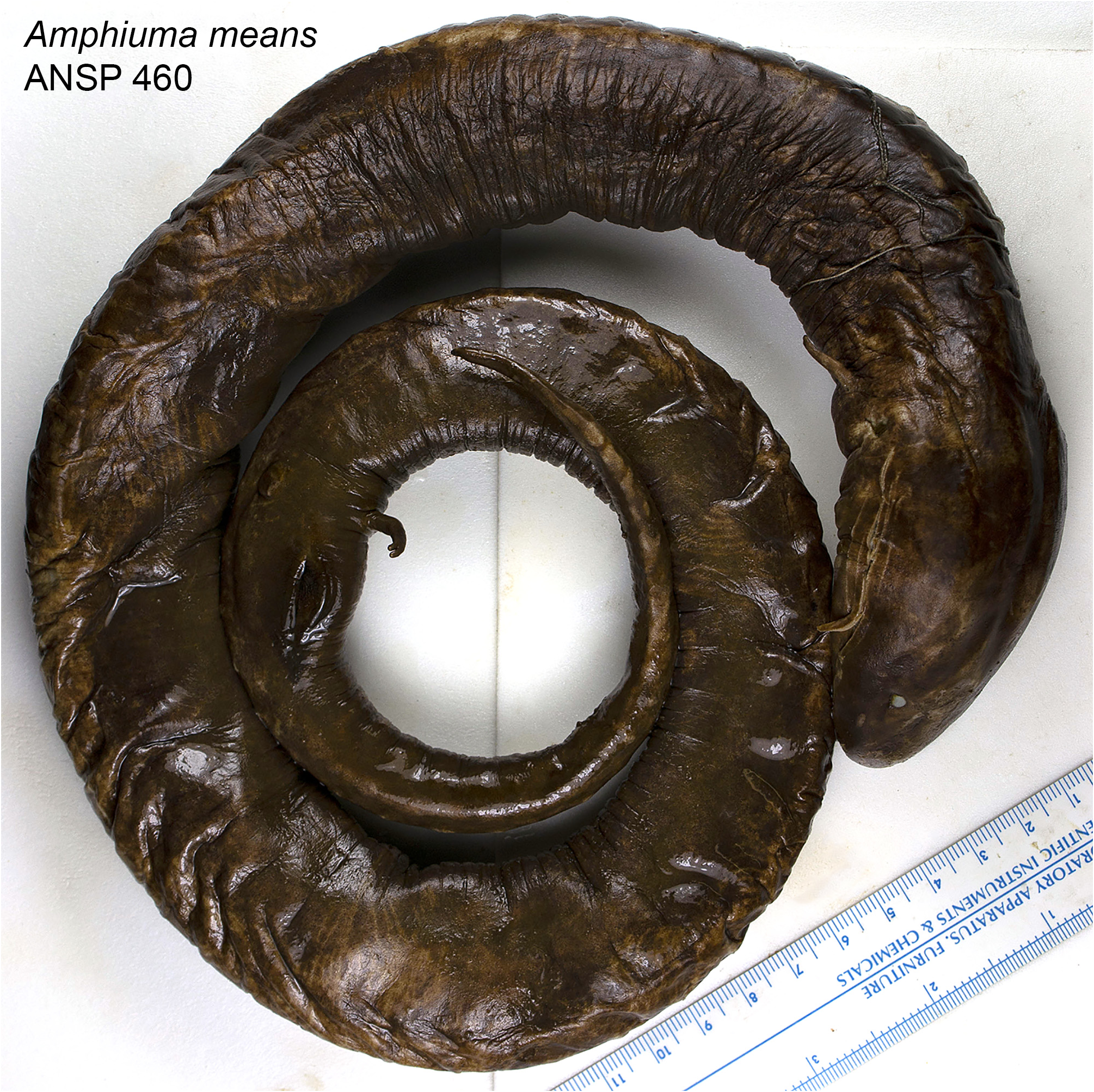
Holbrook (1842e:89, pl. 30) provided an in-depth account of the Two-toed Amphiuma, along with a life-like illustration by Thomas M. Logan, M.D. (Fig. 11). Holbrook presented a detailed account of its anatomy, as well as citing numerous other observations and descriptions of its habits from other authors. The MCZ catalog records three specimens collected by Holbrook in South Carolina, donated by Agassiz on 19 October 1862 (Table 1). These were not present in the collection during our visit, and their location and disposition is unknown. Two Holbrook specimens (ANSP 460–461) are extant in Philadelphia, which appear to be the specimens on which his account is based. One (ANSP 461) is completely dissected abdominally, though he did not report on his own observations of internal anatomy. The other (ANSP 460) has a dissection of the lower jaw, facilitating his description of oral morphology. This specimen roughly matches the measurements given in the account, as well as the proportions and orientation of Logan’s drawing. We suggest that ANSP 460 is the specimen illustrated in pl. 30 (Fig. 12), which the ANSP catalog records from “ South Carolina .”

Pyron, R. Alexander, Beamer, David A. (2022): A nomenclatural and taxonomic review of the salamanders (Urodela) from Holbrook’s North American Herpetology. Zootaxa 5134 (2): 151-196, DOI: 10.11646/zootaxa.5134.2.1MagnoliaPress via PlaziNo known copyright restrictions apply. See Agosti, D., Egloff, W., 2009. Taxonomic information exchange and copyright: the Plazi approach. BMC Research Notes 2009, 2:53 for further explanation.

Export occurrence data

Darwin Core Archive (ZIP)

CLASSIFICATION

Taxonomic Classification Tree

MULTIMEDIA

Media Files(2)

FIGURE 11. Holbrook (1842e)’s illustration by Thomas M. Logan M.D. of Amphiuma means.
Imageimage/png© Pyron, R. Alexander;Beamer, David A.Pyron, R. Alexander;Beamer, David A.

FIGURE 12. A Holbrook specimen (ANSP 460) of Amphiuma means from “South Carolina” that matches the measurements, proportions, and approximate orientation of Holbrook (1842e)’s illustration by Thomas M. Logan M.D. (Fig. 11). Note the dissection of the lower jaw facilitating Holbrook’s description of oral morphology. Ruler closest to specimen is marked in cm.

Imageimage/png© Pyron, R. Alexander;Beamer, David A.Pyron, R. Alexander;Beamer, David A.

IMAGES

Gallery(2)

See Gallery

Occurrences with images

Source Information

A nomenclatural and taxonomic review of the salamanders (Urodela) from Holbrook’s North American Herpetology

checklist

This dataset contains the digitized treatments in Plazi based on the original journal article Pyron, R. Alexander, Beamer, David A. (2022): A nomenclatural and taxonomic review of the salamanders (Urodela) from Holbrook’s North American Herpetology. Zootaxa 5134 (2): 151-196, DOI: 10.11646/zootaxa.5134.2.1

A nomenclatural and taxonomic review of the salamanders (Urodela) from Holbrook’s North American Herpetology

R. ALEXANDER PYRON 1,2 & DAVID A. BEAMER 3

1 Department of Biological Sciences, The George Washington University, 2023 G St. NW, Washington, DC 20052 � rpyron@colubroid.org; https://orcid.org/ 0000 -0003-2524-1794

2 Division of Amphibians and Reptiles, Department of Vertebrate Zoology, National Museum of Natural History, Smithsonian Institution, Washington, DC 20560

3 Department of Natural Sciences, Nash Community College, Rocky Mount, NC 27804

� dabeamer973@nashcc.edu; https://orcid.org/0000-0003-0796-274X

Abstract

John Edwards Holbrook published North American Herpetology in 11 volumes from 1836–1842, authoring the first accounts of numerous amphibians and reptiles from the eastern and central United States, including 32 salamanders (Urodela). We reviewed these and located 51 extant salamander specimens from Holbrook in the Academy of Natural Sciences (Philadelphia), Museum of Comparative Zoology (Cambridge), and Muséum national d’Histoire naturelle (Paris), six of which are types. We identified four other specimens figured by Holbrook in the MNHN and National Museum of Natural History (Washington), all of which are types from descriptions by other authors. We designate lectotypes for S. porpyhritica Green, 1827 (USNM 3840; reversing neotype MCZ A-35778), Salamandra gutto-lineata Holbrook, 1838a (ANSP 716), S. auriculata Holbrook, 1838b (MNHN-RA 0.4675), S. maculo-quadrata Holbrook, 1840 (ANSP 821), S. granulata De Kay in Holbrook, 1842e (USNM 3981), S. quadridigitata Holbrook, 1842e (ANSP 490; reversing neotype UF 178833), and Plethodon variolosum Duméril, Bibron, and Duméril, 1854 (MNHN-RA 0.4666). Allocation of S. auriculata Holbrook, 1838b, S. “Haldemani” Holbrook, 1840, and P. variolosum Duméril, Bibron, and Duméril, 1854 is still ambiguous. We consider S. maculo-quadrata Holbrook, 1840 to be a junior subjective synonym of S. fusca Green, 1818; no valid name has ever been applied to Black-bellied Salamanders (Desmognathus sp. “ quadramaculatus ”) at the species level, and up to five candidate species require new names. Additional discoveries of data and specimens pertaining to Holbrook’s names may remain to be made among his surviving papers and collections.

Pyron R A, Beamer D A, plazi (2022). A nomenclatural and taxonomic review of the salamanders (Urodela) from Holbrook’s North American Herpetology. Plazi.org taxonomic treatments database. Checklist dataset https://doi.org/10.15468/4s67xm accessed via GBIF.org on 2026-06-15.

CC0Published 5/10/2022View dataset
GBIF Usage Key
249834906
Dataset Key
a2181b64-0776-4864-8fa3-e230a7bb15c6
Origin
source
Backbone Key
2432084
Taxon ID
DF5187BB5336FFEBFF588DFAFD35D142.taxon
Last Crawled
6/9/2026
Last Interpreted
6/9/2026