
AnimaliaNot EvaluatedacceptedspeciesAccepted
Triton niger

Triton niger

(Green, 1818)

GBIF:249834946

0year

0

Synonyms

ABOUT

Descriptions(1)

Triton niger (Green, 1818)

[= S. fusca Green, 1818]

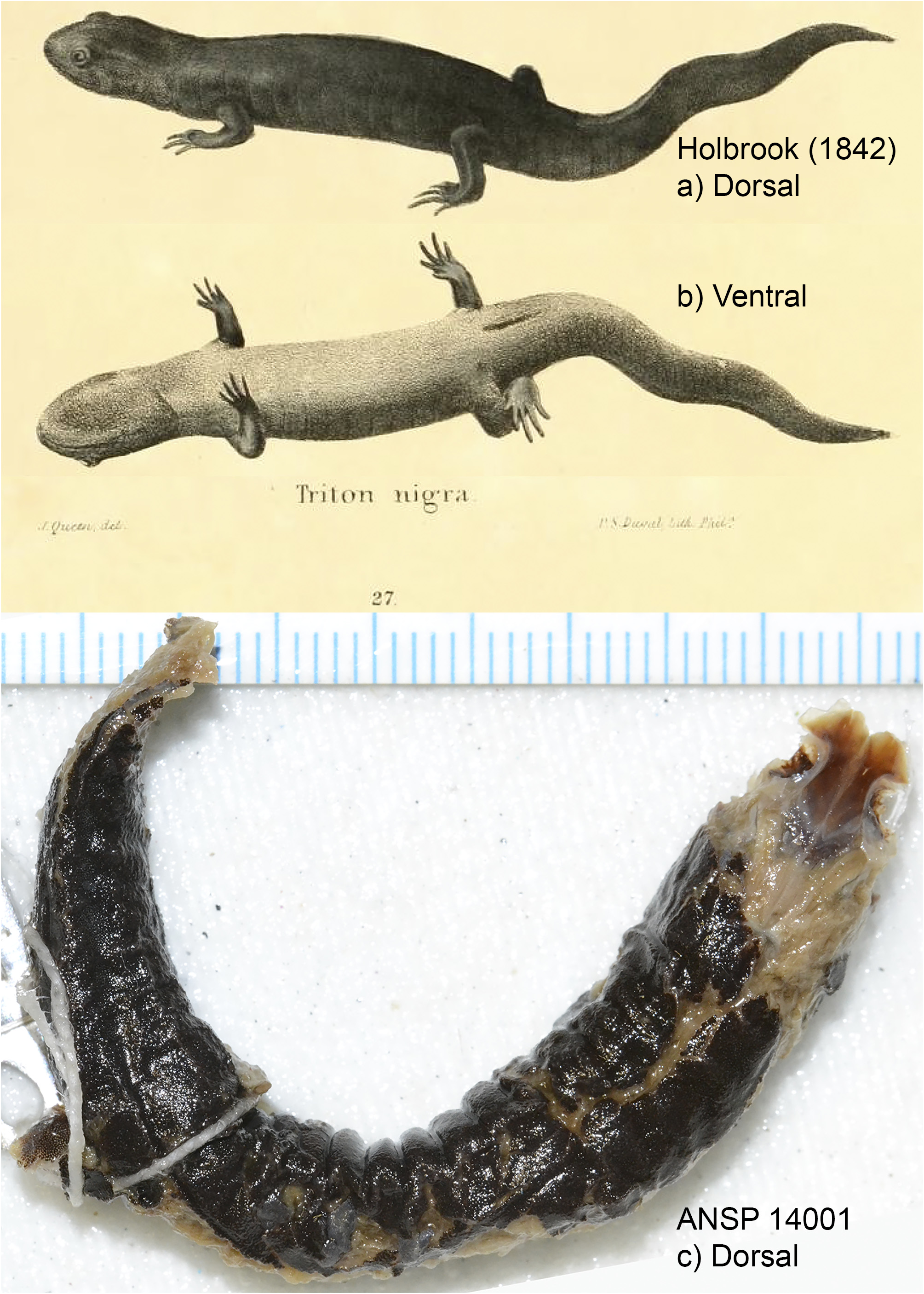
Holbrook (1842e:81, pl. 27) gave a brief account of Green’s species with an illustration by J. Queen, precipitating an excruciatingly complicated series of events that have already been detailed here (see account for Salamandra maculo-quadrata) and elsewhere (Pyron and Beamer 2020). In brief, Holbrook collected specimens of Black-bellied Salamander ( Desmognathus sp. “ quadramaculatus ”) in Georgia and Carolina and was sent specimens of D. conanti or D. valentinei from Louisiana. Based on these, he expanded the definition of Green’s name to include populations of multiple species ranging from Massachusetts to Louisiana: “This animal inhabits the Atlantic states from lat. 43° to the Gulf of Mexico.” He also included S. intermixta Green, 1825b and S. picta Harlan, 1825d in synonymy, both of which are junior subjective synonyms of S. fusca Green, 1818 . Two of Holbrook’s specimens in Paris (MHNH-RA 0.4677 & 2012.464) may have originally been allocated to this taxon, but likely post-date publication of North American Herpetology. Upon examining one of Holbrook’s specimens (ANSP 14001), Baird (1850) informally restricted this name to Black-bellied Salamanders, a precedent that was followed by most authors. Subsequently and with little stated justification, Stejneger (1903) instead resurrected D. quadrimaculatus for these populations. Curiously, Stejneger continued to recognize D. niger, but did not elaborate on his concept of that taxon.

Both Salamandra nigra Green, 1818 and S. maculo-quadrata Holbrook, 1840 are also junior subjective synonyms of S. fusca Green, 1818, and no valid name has ever been applied to Black-bellied Salamanders (themselves a polyphyletic cryptic species complex) at the species level. Regardless, Holbrook deserves credit for first collecting and describing this group, and two of his specimens (ANSP 14001 and MCZ A-183) are known to be extant in collections. One of these (likely ANSP 14001) is probably the specimen illustrated in pl. 27 (Fig. 10). In contrast, MCZ A-183 was donated to MCZ by Agassiz in 1854. A handwritten note from Barbour in the bottle notes that it was probably given to Agassiz by Holbrook. This must have occurred after the publication of North American Herpetology during the former’s visits to the latter in Charleston, which started in 1847 after Agassiz’s arrival in the US (Anderson 2014). Neither specimen is in good condition, although ANSP 14001 is severely degraded and was reported lost at one point (E. V. Malnate pers. comm. to Adler 1976). Regardless, both are confidently referred to Black-bellied Salamanders, though their actual collection data are unknown, and both bear erroneous localities: ANSP 14001 “Penns.” and MCZ A-183 “Charleston, S.C.” Consequently, it is unclear to which of the numerous candidate species either specimen belongs. This ambiguity has fortunately little nomenclatural relevance given our actions regarding the nomenclature of S. nigra and S. maculo-quadrata (see above).

Pyron, R. Alexander, Beamer, David A. (2022): A nomenclatural and taxonomic review of the salamanders (Urodela) from Holbrook’s North American Herpetology. Zootaxa 5134 (2): 151-196, DOI: 10.11646/zootaxa.5134.2.1MagnoliaPress via PlaziNo known copyright restrictions apply. See Agosti, D., Egloff, W., 2009. Taxonomic information exchange and copyright: the Plazi approach. BMC Research Notes 2009, 2:53 for further explanation.

Export occurrence data

Darwin Core Archive (ZIP)

CLASSIFICATION

Taxonomic Classification Tree

NOMENCLATURE

Synonyms(1)

MULTIMEDIA

Media Files(1)

FIGURE 10. Holbrook (1842e)’s illustration by J. Queen in (a) dorsal and (b) ventral views, and specimen ANSP 14001 (c; dorsal view) of Triton niger (Green, 1818). This specimen bears an erroneous locality of “Penns.” in the ANSP catalog but is likely from the series that Holbrook notes he has collected in Georgia and “Carolina.” Ruler is in mm.

Imageimage/png© Pyron, R. Alexander;Beamer, David A.Pyron, R. Alexander;Beamer, David A.

IMAGES

Gallery(1)

See Gallery

Occurrences with images

Source Information

A nomenclatural and taxonomic review of the salamanders (Urodela) from Holbrook’s North American Herpetology

checklist

This dataset contains the digitized treatments in Plazi based on the original journal article Pyron, R. Alexander, Beamer, David A. (2022): A nomenclatural and taxonomic review of the salamanders (Urodela) from Holbrook’s North American Herpetology. Zootaxa 5134 (2): 151-196, DOI: 10.11646/zootaxa.5134.2.1

A nomenclatural and taxonomic review of the salamanders (Urodela) from Holbrook’s North American Herpetology

R. ALEXANDER PYRON 1,2 & DAVID A. BEAMER 3

1 Department of Biological Sciences, The George Washington University, 2023 G St. NW, Washington, DC 20052 � rpyron@colubroid.org; https://orcid.org/ 0000 -0003-2524-1794

2 Division of Amphibians and Reptiles, Department of Vertebrate Zoology, National Museum of Natural History, Smithsonian Institution, Washington, DC 20560

3 Department of Natural Sciences, Nash Community College, Rocky Mount, NC 27804

� dabeamer973@nashcc.edu; https://orcid.org/0000-0003-0796-274X

Abstract

John Edwards Holbrook published North American Herpetology in 11 volumes from 1836–1842, authoring the first accounts of numerous amphibians and reptiles from the eastern and central United States, including 32 salamanders (Urodela). We reviewed these and located 51 extant salamander specimens from Holbrook in the Academy of Natural Sciences (Philadelphia), Museum of Comparative Zoology (Cambridge), and Muséum national d’Histoire naturelle (Paris), six of which are types. We identified four other specimens figured by Holbrook in the MNHN and National Museum of Natural History (Washington), all of which are types from descriptions by other authors. We designate lectotypes for S. porpyhritica Green, 1827 (USNM 3840; reversing neotype MCZ A-35778), Salamandra gutto-lineata Holbrook, 1838a (ANSP 716), S. auriculata Holbrook, 1838b (MNHN-RA 0.4675), S. maculo-quadrata Holbrook, 1840 (ANSP 821), S. granulata De Kay in Holbrook, 1842e (USNM 3981), S. quadridigitata Holbrook, 1842e (ANSP 490; reversing neotype UF 178833), and Plethodon variolosum Duméril, Bibron, and Duméril, 1854 (MNHN-RA 0.4666). Allocation of S. auriculata Holbrook, 1838b, S. “Haldemani” Holbrook, 1840, and P. variolosum Duméril, Bibron, and Duméril, 1854 is still ambiguous. We consider S. maculo-quadrata Holbrook, 1840 to be a junior subjective synonym of S. fusca Green, 1818; no valid name has ever been applied to Black-bellied Salamanders (Desmognathus sp. “ quadramaculatus ”) at the species level, and up to five candidate species require new names. Additional discoveries of data and specimens pertaining to Holbrook’s names may remain to be made among his surviving papers and collections.

Pyron R A, Beamer D A, plazi (2022). A nomenclatural and taxonomic review of the salamanders (Urodela) from Holbrook’s North American Herpetology. Plazi.org taxonomic treatments database. Checklist dataset https://doi.org/10.15468/4s67xm accessed via GBIF.org on 2026-06-14.

CC0Published 5/10/2022View dataset
GBIF Usage Key
249834946
Dataset Key
a2181b64-0776-4864-8fa3-e230a7bb15c6
Origin
source
Taxon ID
DF5187BB5335FFE9FF588A5EFBEAD0B5.taxon
Last Crawled
6/9/2026
Last Interpreted
6/9/2026