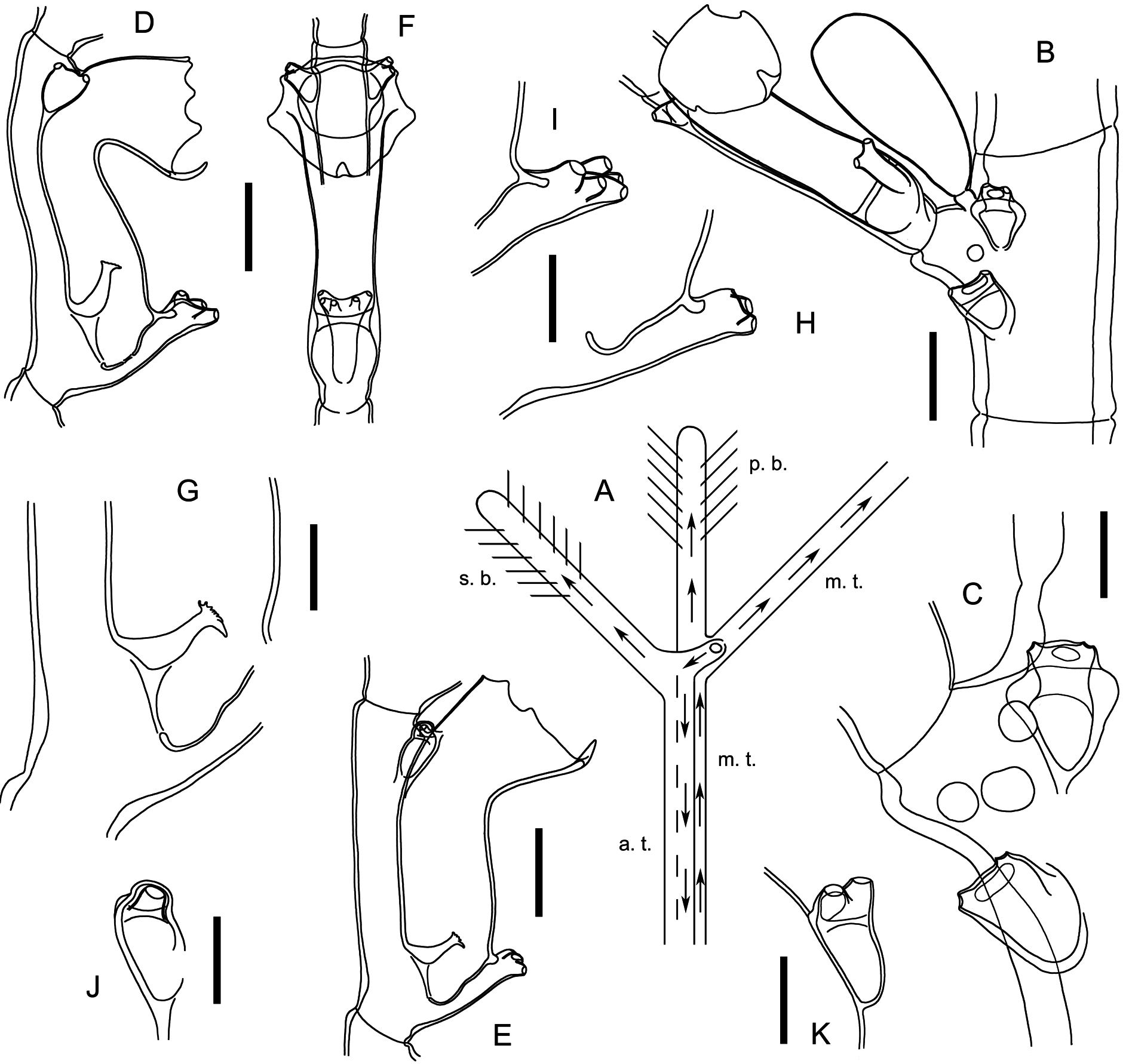
Remarks For a description of this species, refer to Vervoort (1966) and Rees & Vervoort (1987); a quite recent synonymy is given in Vervoort & Watson (2003). In these accounts, only slightly bent hydrothecae, whose nematothecae have single apical apertures, were documented, not reaching the extreme degree of curvature (aperture parallel to long axis of the internode) met with in material MNHN-IK- 2015 - 516, in which, additionally, the mesial nematothecae display 4 – 6 frontal apertures, while the pairs of laterals have bifid apertures. In contrast, the material MNHN-IK- 2015 - 515 has less curved hydrothecae (their apertures form an angle of 45 ° with the long axis of the internode), but their mesial nematothecae still display 2 – 3 frontal apertures, while the laterals possess only one. An intermediate situation is met with in sample MNHN-IK- 2015 - 518, in which the hydrothecal apertures form an angle of ca 70 ° with the internode and the mesial nematothecae possess 1 – 2 frontal apertures, while the laterals have only one. Bifid mesial nematothecae were observed so far in specimens from Japan studied by Schuchert (2015). In all samples examined the branching pattern is ‘ trifid’, with either mono- (the 16 cm-high colony from sample MNHN-IK- 2015 - 517) or lightly polysiphonic (all remaining material) stems; in addition, their hydrothecae are free from their corresponding internodes for ca ⅓ of their adaxial length, fitting the original account by Jäderholm (1903). There is no thorough description available of the mode of branching in this species, especially at microscopic level. The original account is quite evasive (“ Die Verästelung ist sehr regelmässig und characteristisch. Die nach allen Seiten gerichteten Äste sitzen fast immer zu zweien zusammen, sind sehr deutlich spiralförmig angeordnet und nach aussen gebogen ” [The branching is very regular and characteristic. The branches are directed to all sides, almost always they are given off in pairs, are arranged in an obvious spiral, and are bent outwards]). However, Jäderholm (1903: pl. 14 fig. 5) provides a comprehensive illustration of the macroscopic appearance of a typical colony. According to his figure, a pair of plumes is given off at each geniculation of the stem, the successive pairs facing outwards with respect to the spiral built up by the stem. Subsequent accounts seem to provide rather divergent data. Indeed, the material studied by Stechow (1909: 103, fig. 8) was devoid of the characteristic spiral growth pattern, the main stem giving rise, here and there, to secondary branches that further divide trichotomously. The colony studied by Billard (1918: 25, as Halicornaria sibogae) formed a helicoid sympodium (“ Colonie […] ramifiée en sympode hélicoïde ”), thus partly agreeing with the type, although nothing is said about its branching pattern. The account given by Vervoort (1966: 165) (“ The structure of the colony is sympodially [sic]: the main axis is formed by the basal parts of successive plumes, arranged in spiral fashion, each succeeding plume rising about 8 mm from the base of the preceding plume ”) does not conform with the structure of the type either since, at each geniculation, only one plume, instead of two, is given off. Rees & Vervoort (1987) observed a “ Sympodially built stem with helically arranged, unbranched plumes … ” in their material, resembling those examined earlier by Vervoort (1966). On the other hand, the colony illustrated by Rho & Park (1980: pl. 9 fig. 1) is undoubtedly similar to that of the type, despite their description (Rho & Park 1980: 27) providing only limited details: “ Colonies large, not fascicled, spirally branched. The hydrocaulus [is] divided into regular internodes, zigzagshaped ”. Finally, Vervoort & Watson (2003: 289) claim that they “ have little to add to the descriptions of this characteristic species given by previous authors ”. As noted above, the branching pattern met with in the present material from New Caledonia is superficially trifid, as follows: the stem is geniculate and describes a spiral; at more or less regular intervals, the main tube bifurcates at each geniculation: in the exact continuation of the long axis of the original portion before the geniculation, it is prolonged as a plume (bearing hydrocladia), while the divergent part continues, slightly inclined (with respect to the preceding longitudinal axis), as the main stem proper; from the base of the divergent portion of the stem, two (originally twin) tubes are given off: one runs downwards along the preceding portion of the stem below the geniculation (bringing polysiphony to the colony), while the other is given away upwards, forming a second plume (bearing hydrocladia) (Fig. 10 A). In this context, the specific separation between G. expansum and its closest congener, Gymnangium tubulifer (Bale, 1914), seems to rely exclusively on the appearance of the colonies resulting from their mode of branching. When describing his species, Bale (1914) referred to the structure of the colony of G. vegae (Jäderholm, 1903), as did Vervoort & Watson (2003), who stated that the stem of G. tubulifer “ … is geniculate and more or less spiral, composed of the proximal parts of stem elements that at each geniculation turn aside to form a branch. At the same place the proximal element splits off to form 3 ramifications of which [one] continues as the “ stem ”, [one] as a branch pointing away from the original element, and [one] as a downwardly directed tube, covering the more proximal parts of the “ stem ””. This results in a colony whose distinctive appearance is depicted by Jäderholm (1903: pl. 15 fig. 1). In a molecular study by Ronowicz et al. (2017), G. expansum is shown to cluster with members of the genus Gymnangium Hincks, 1874 instead of with Taxella Allman, 1874, in spite of the colony structure showing obvious affinities with the latter. As noted by these authors, Stechow (1921) proposed a new genus, Halicetta, to accommodate G. expansum, with the following diagnosis: “ hydrothecae elongated, curved but not bent, with no abaxial septum ”. This, however, does not differ much from characters of Taxella, even though emphasis was placed on characters of the gonosome in particular. A more comprehensive analysis is necessary to elucidate the generic affinities of Jäderholm’s (1903) hydroid.
Galea, Horia R. (2020): Aglaopheniid hydroids (Cnidaria: Hydrozoa: Aglaopheniidae) from off New Caledonia collected during KANACONO and KANADEEP expeditions of the French Tropical Deep-Sea Benthos Program. European Journal of Taxonomy 615: 1-47, DOI: 10.5852/ejt.2020.615