AnimaliaacceptedgenusAccepted
Blastopathes

Blastopathes

Horowitz, 2020,2020

GBIF:10685151

0datasets
0year

0

Descendants

0

Children

0

Species

PROFILE

Species Profile

Habitat

Marine

Characteristics

Extant

ABOUT

Descriptions(6)

(Figures 2 – 8; Tables 1 – 2)
Morphological and molecular description of a new genus and species of black coral (Cnidaria: Anthozoa: Hexacorallia: Antipatharia: Antipathidae: Blastopathes) from Papua New Guinea
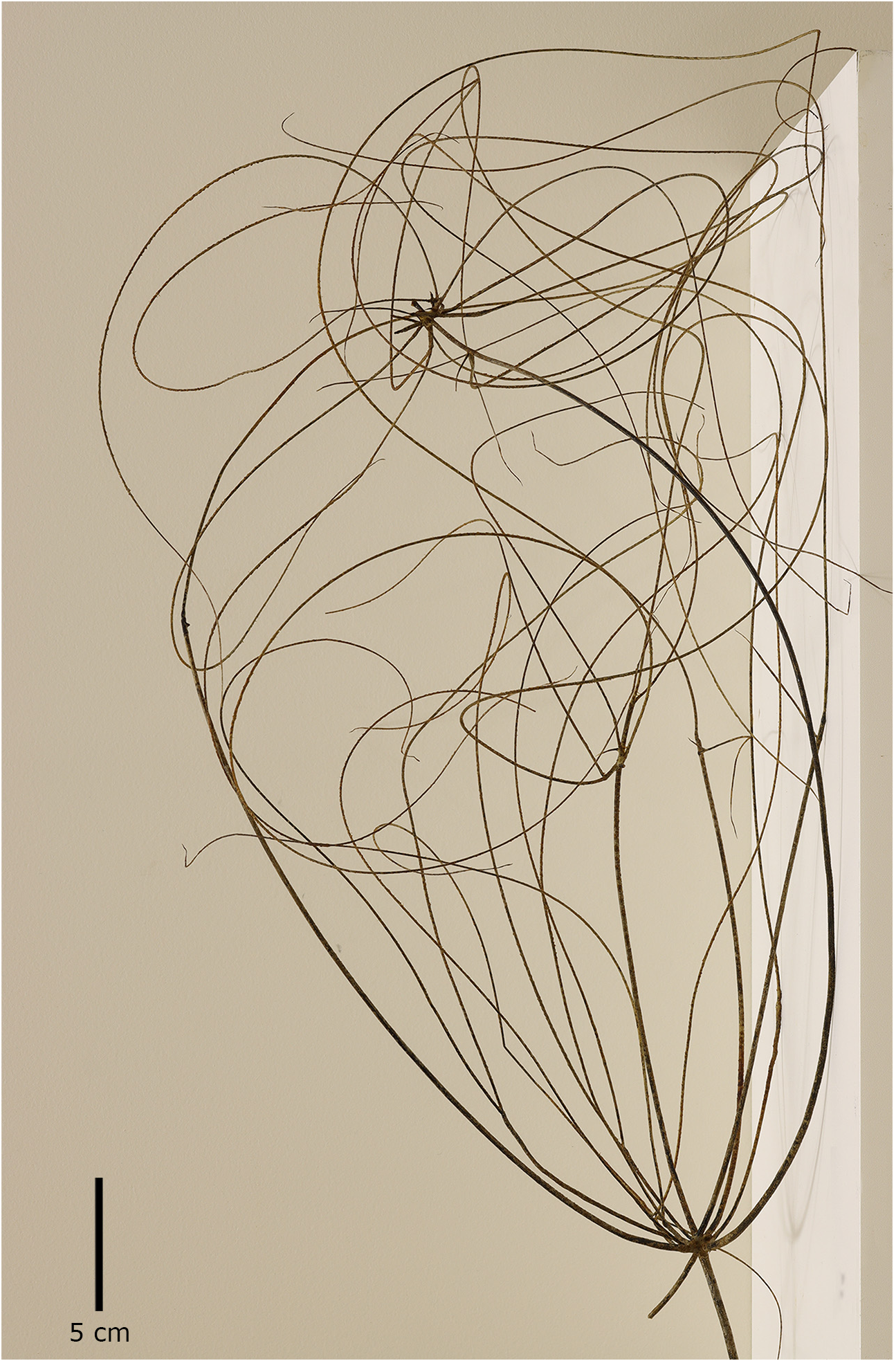
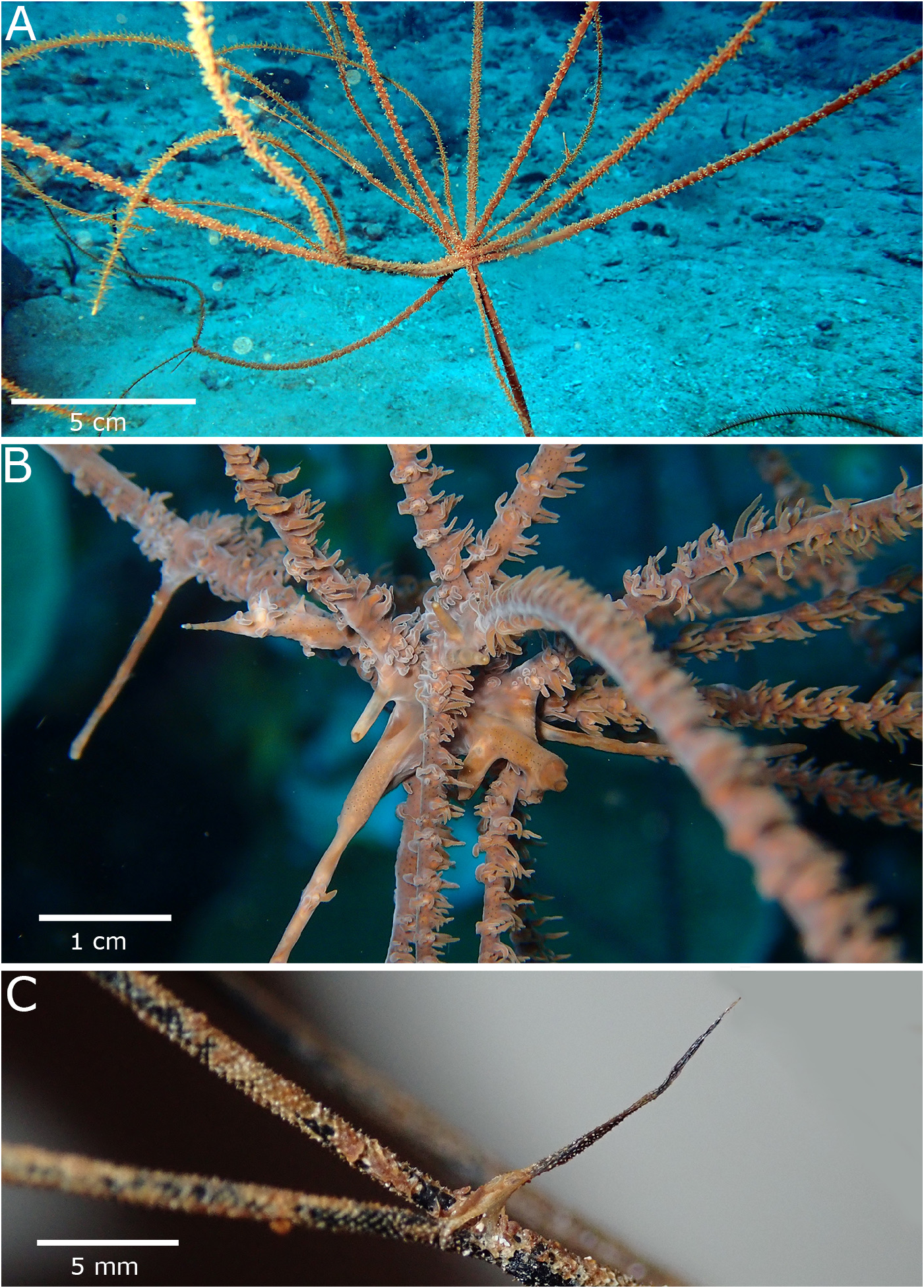
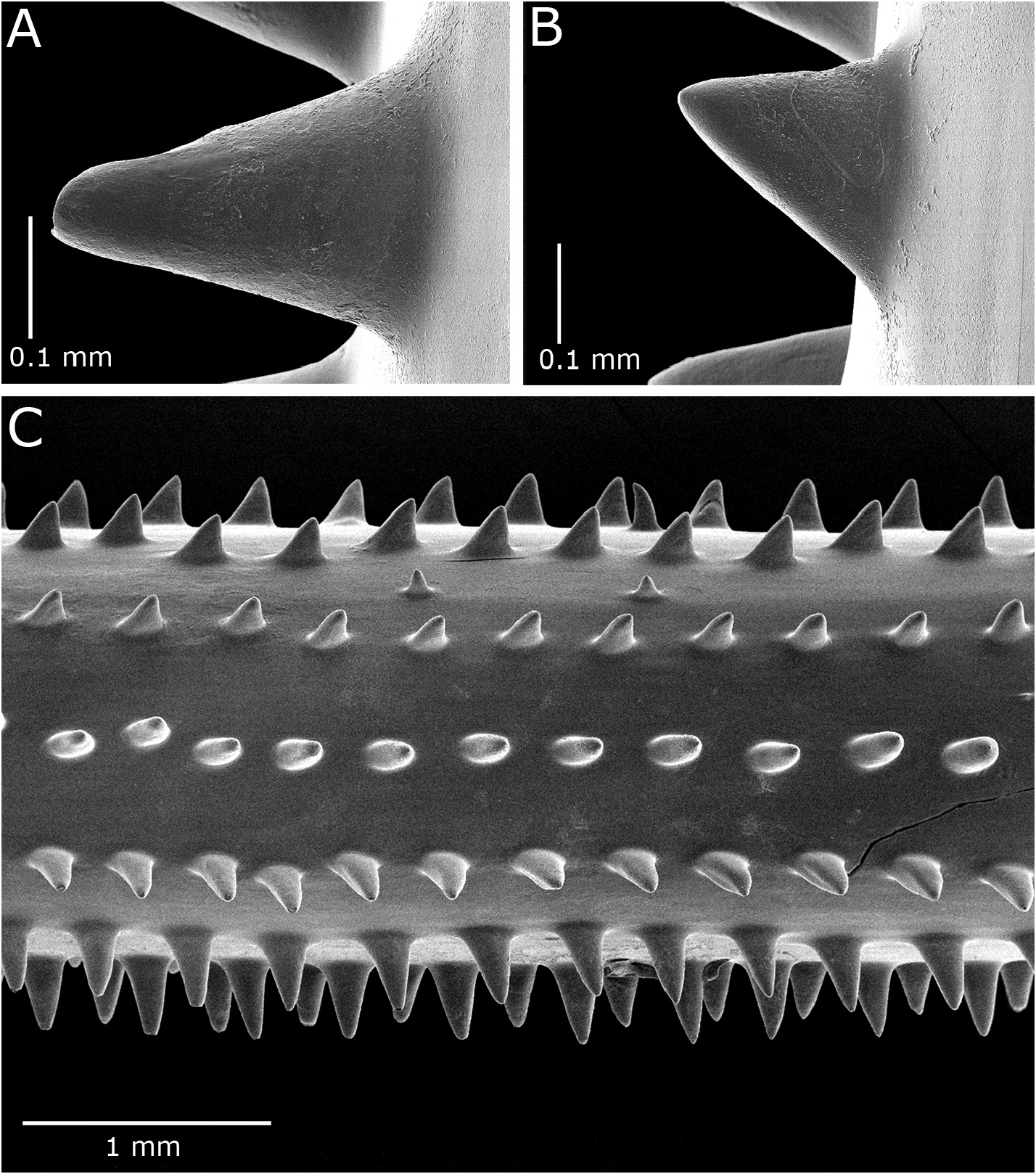
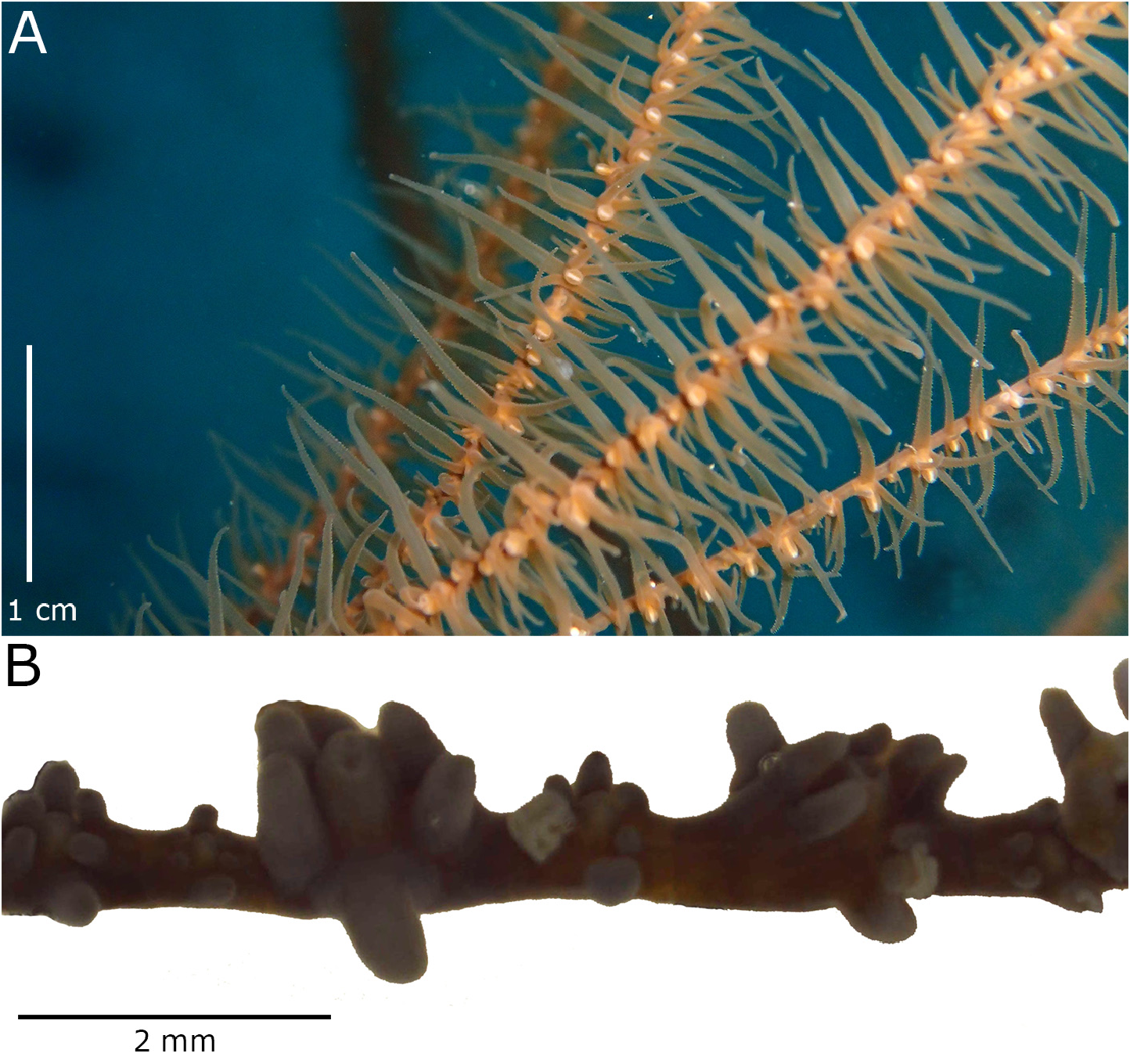
Description. The holotype is a 1.2 m tall specimen that branches to the third order (Figure 4). The stem is 0.6 m in length, 6.3 mm in diameter near the base, and 4 mm in diameter just below the first branch cluster. First branch cluster occurs at the apex of the stem and consists of 10 elongate branches extending in different directions (Figure 5 A) of varying lengths (maximum length 1.3 m) and diameters (none thicker than the stem). One first order branch is 0.6 m in length, 4 mm in diameter near the base, and 2 mm in diameter just below a second order branch cluster consisting of ~ 10 branches (Figure 5 B), with a maximum branch length of 50 cm. Another first order branch is 1.3 m in length, 3 mm in diameter near the base, and 0.5 mm at the branch tip and does not produce a branch cluster. Another first order branch extends from the center of the branch cluster and extends 0.9 m directly upwards with a branch thickness of 4 mm near the base and 2 mm just below a second order branch cluster consisting of four branches with a maximum branch length of 65 cm. Another first order branch extends 5 cm, is 2 mm in diameter near the base and increases to 2.5 mm just below what resembles a new branch cluster consisting of three branches of different lengths and thicknesses. The longest of the three branches coming from the 5 cm branch is 0.6 m in length, 1.5 mm in diameter near the base, and 0.5 mm diameter near the tip. The second longest branch is 0.42 m in length, 0.2 mm in diameter near the base, and 0.1 mm near the tip. The shortest of the three branches is 5 cm in length, 0.8 mm in diameter near the base, and <0.1 mm near the tip. Branchlets are found on all branch clusters (Figure 5 B) and locations on branches that seem to be newly forming branch clusters (Figure 5 C) ranging from 1 cm to 8 cm in length, with ~ 0.5 mm diameters at their bases and <0.5 mm diameters at branch tips. The spines (Figures 6 A – 6 C) on the branches and stem are smooth and laterally compressed. Polypar spines are 0.2 mm – 0.34 mm tall, are conical at right angles to branch axes with rounded apexes, and spines are spaced ~ 0.45 mm in one row (Figure 6 A). Abpolypar spines are 0.12 mm – 0.24 mm tall and are triangular with distally slanted proximal edges and perpendicular or proximally slanted distal edges, and spines are spaced ~ 0.38 mm in one row (Figure 6 B). Seven to eight, sometimes offset rows of spines can be counted in one view of a branch and stem, and approximately three spines can be counted in 1 mm of a spine row on a branch (Figure 6 C) and stem. The polyps (Figures 7 A – 7 B), olive in color when alive, are arranged in a single row on thin branches (Figure 7 A), and in multiple rows on the stem and thick branches (Figure 5 A). In-situ measurements reveal that lateral tentacles (~ 3 mm in length, extended) are less than half the length of sagittal tentacles (~ 8 mm in length, extended) (Figure 7 A). Polyps range 0.5 mm – 1.38 mm in transverse diameter and are spaced ~ 1 mm apart, resulting in approximately five polyps per 1 cm in one row (Figure 7 B). The sizes of contracted and extended polyps are quite variable. The paratypes (Figures 8 A – 8 E) range from 0.4 m to 0.5 m in height. The stem lengths range from 3 to 10 cm in length from basal plate to the first branch cluster. All paratypes have branch clusters (Figures 8 A – 8 C), 7 to 8 rows of compressed spines, tall and conical polypar spines, and triangular distally slanted abpolypar spines (Figure 8 D), with polypar spine heights ranging from 0.14 mm to 0.3 mm and abpolypar spines ranging from 0.1 mm to 0.2 mm. About five polyps per 1 cm with lateral tentacles less than half the length of sagittal tentacles, with varying polyp sizes like the holotype (Figure 8 E).
Morphological and molecular description of a new genus and species of black coral (Cnidaria: Anthozoa: Hexacorallia: Antipatharia: Antipathidae: Blastopathes) from Papua New Guinea
Diagnosis. Corallum sparsely branched to the third and sometimes fourth order, not pinnulate. Branches long (up to 1.3 m) and spaced far apart (distances between first order branches and second order branches range from 210 cm to 560 cm) and occurring singly or in verticil-like clusters of varying numbers (as many as 10). Stem and branches thick (up to 6 mm diameter) and rigid. Each branch extending out at their base perpendicular to the stem and lower order branches from which they arise, and then curving upward with distal ends being straight or curved. One branch can extend directly upwards from the center of the cluster. Spines triangular or conical, laterally compressed, smooth, up to 0.34 mm tall. Polyps, ~ 1.25 mm in transverse diameter, ~ 6 polyps per cm in one row. Sagittal tentacles (~ 8 mm in length, extended) are more than twice the length of lateral tentacles (~ 3 mm in length, extended).
Morphological and molecular description of a new genus and species of black coral (Cnidaria: Anthozoa: Hexacorallia: Antipatharia: Antipathidae: Blastopathes) from Papua New Guinea
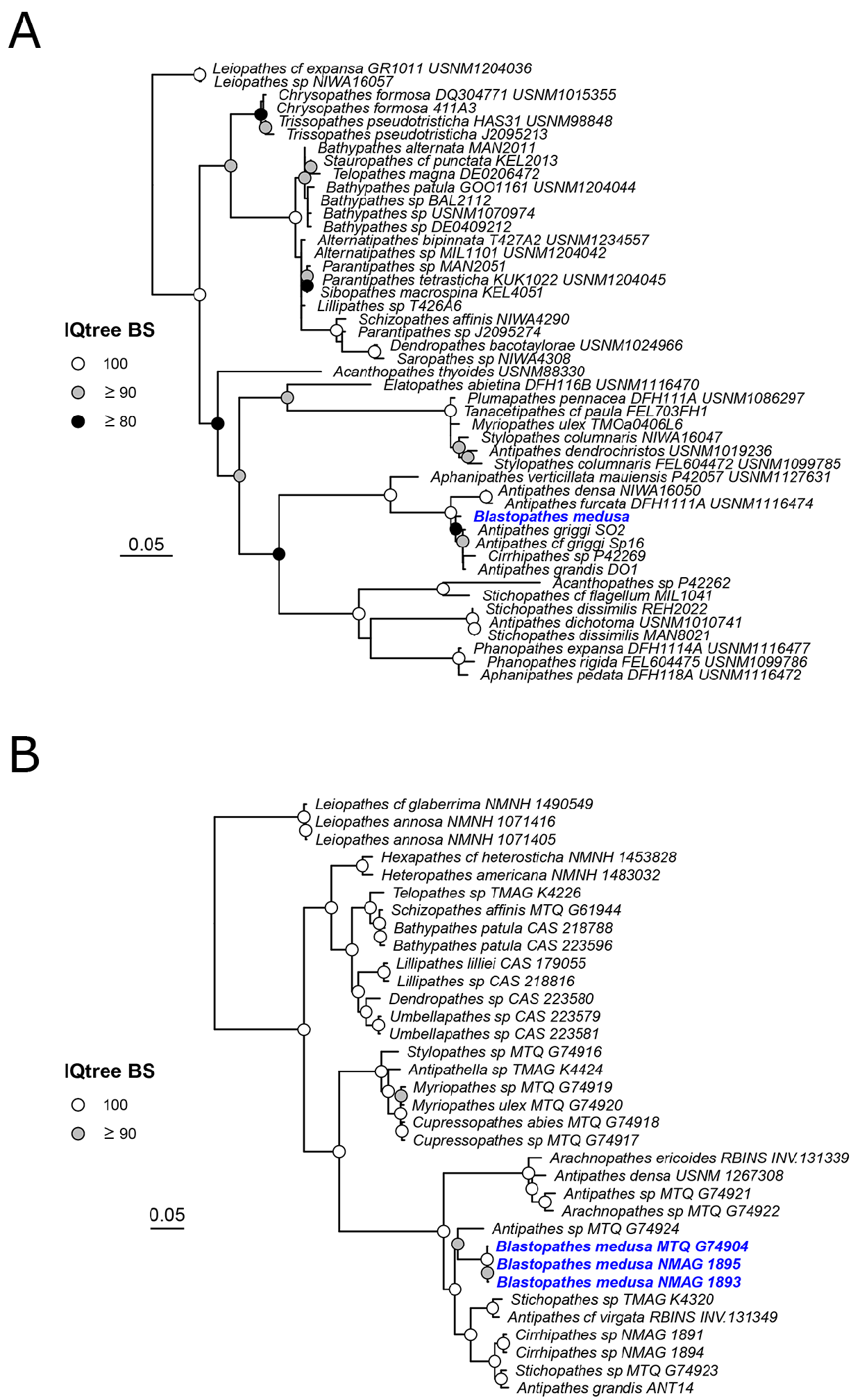
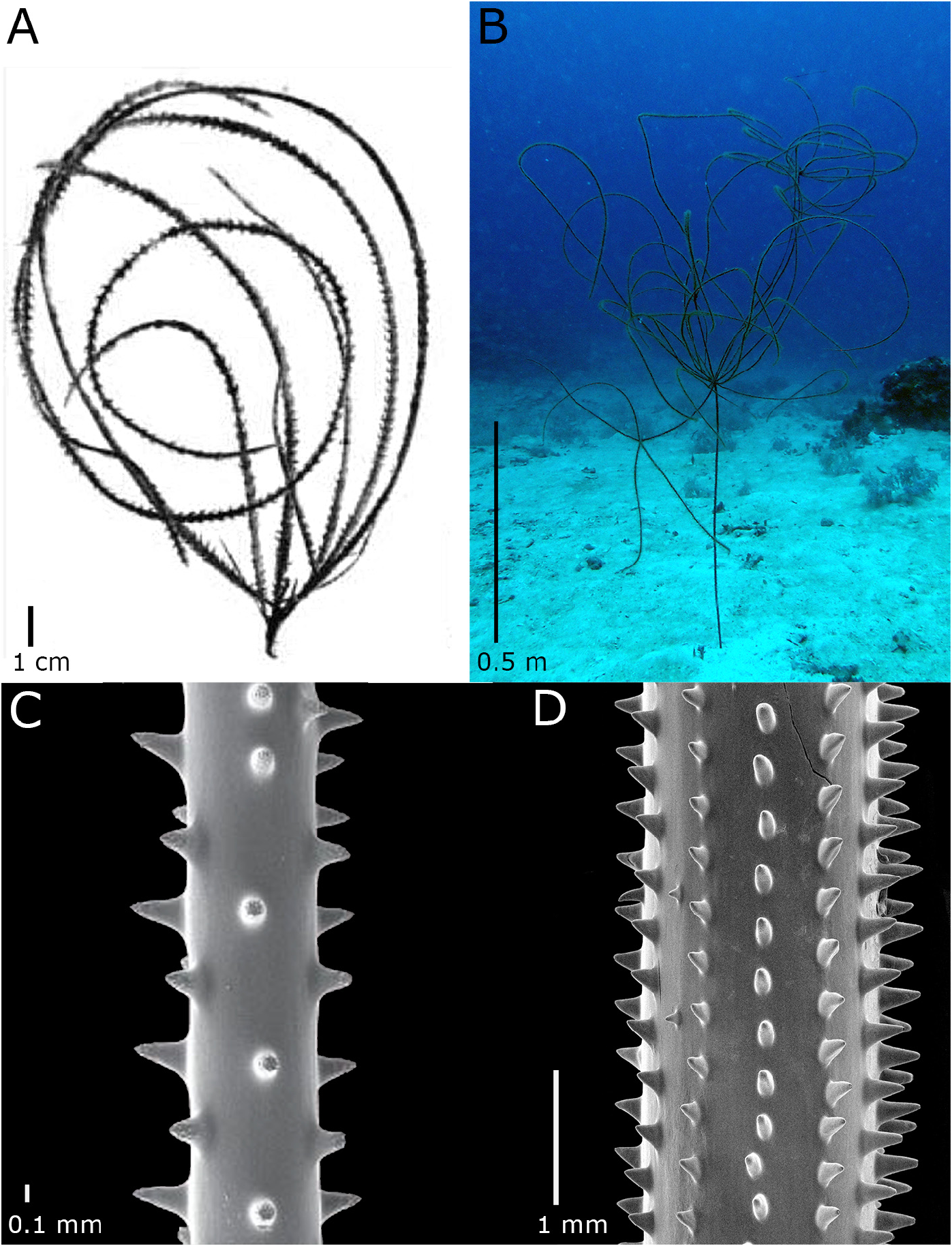
Remarks. Blastopathes morphologically resembles Allopathes Opresko & Cairns, 1994, which also has stemlike branches coming from a singular location on the corallum (Opresko & Cairns 1994). However; Blastopathes differs from Allopathes by having branch clusters that do not necessarily occur near the base of the stem and in having more than one branch cluster (Figures 2 A – 2 B). Additionally, the abpolypar spines of Blastopathes are triangular, smooth, and distally slanted while all spines of Allopathes are conical with conical tubercles near the apex (Figures 2 C – 2 D). Other genera that contain sparse and elongate branches are Pteropathes Brook, 1889, Hillopathes van Pesch, 1910, and in the genus Antipathes, Antipathes dichotoma Palla, 1766; however, none contain branch clusters. Lastly, Blastopathes contains a stiff and non-pinnulate stem and branches that resemble unbranched genera Pseudocirrhipathes Bo et al., 2009, Cirrhipathes de Blainville, 1830, and Stichopathes Brook, 1889, all of which differ from Blastopathes by lacking branches. Molecular results. The mitochondrial igrN sequences for specimens NMAG 1893 and NMAG 1895 consisted of 482 base pairs. The two specimens shared identical sequences across 465 comparable bases. The complete igrN alignment consisted of 47 sequences, 682 bp, and included species from all seven black coral families. In the 682 bp alignment there were 274 parismony informative site (40 %). Targeted capture data for 33 specimens that spanned six of the seven families in the Antipatharia, resulted in a total number of raw reads ranging from 44,898 to 3,603,888. One sample (10 raw reads, C 705) was removed due to sequencing failure. Quality control and adapter trimming resulting in a mean of 1,606,997 ± 1,640,018 SD trimmed reads per sample. Trimmed reads were assembled into a mean of 927 ± 154 SD contigs per sample. The total number of matched UCE / exon loci was 2,309 with an average base pair length of 752 (ranging from 83 to 18,423 base pairs). The 75 % taxon occupancy matrix included 286 loci that were concatenated into an alignment with a total length of 111,929 base pairs. A total of 36,052 parismony informative (PI) sites were identified (32 % of total sites), with an average of 126.06 PI sites per locus. Alignment were also constructed for the for the holotype specimen (MTQ G 74904) and the two paratype specimens (NMAG 1893 and NMAG 1895). The total number of matched loci across the three samples was 1,290 with an average base pair length of 623 (ranging from 189 to 4,068 bp). A complete (all three samples present in each loci) concatenated matrix included 792 loci, with a total alignment length of 499,264 base pairs. There were 3,855 variable sites (~ 0.7 % of total sites) among the three samples. Despite the difference in species-level sampling, the maximum likelihood phylogenies displayed similar topologies for both alignment types (igrN, UCE / exon). In both cases, the new genus formed a distinct clade within the family Antipathidae and members of the genera Cirrhipathes and Antipathes formed separate monophyletic groups (Figures 3 A – 3 B). Differences between the two trees include the UCE / exon tree suggesting that Arachnopathes Milne Edwards H., 1857, and Stichopathes also share a common ancestor with Blastopathes, while in the igrN tree Stichopathes is more closely related to another lineage containing members of the Aphanipathidae Opresko, 2004, than to Blastopathes.
Morphological and molecular description of a new genus and species of black coral (Cnidaria: Anthozoa: Hexacorallia: Antipatharia: Antipathidae: Blastopathes) from Papua New Guinea
Etymology. From the Greek “ blastos ”, germ, sprout, or shoot, in reference to the branch cluster features, and the commonly used suffix “ pathes ”. From the Latin “ Medusa ” in reference to thick and upward curving branches, like the snakes on the mythical gorgon’s head.
Morphological and molecular description of a new genus and species of black coral (Cnidaria: Anthozoa: Hexacorallia: Antipatharia: Antipathidae: Blastopathes) from Papua New Guinea
Type material. Holotype, MTQ G 74904, Papua New Guinea, Bismarck Sea, West New Britain Province, Kimbe Bay, Vanessa’s Reef, 35 m depth, 13 March 2019 (SEM stubs MTQ G 74906 to MTQ G 74910, schizo- holotype NMAG 1892). Paratypes, NMAG 1893, Papua New Guinea, Bismarck Sea, West New Britain Province, Kimbe Bay, Christine’s Reef, 30 m depth, 13 March 2019; MTQ G 74911, Papua New Guinea, N Bismarck Sea, West New Britain Province, Kimbe Bay, Lady Di, 37 m depth, 15 March 2019 (SEM stub MTQ G 74912); MTQ G 74913, Papua New Guinea, Bismarck Sea, West New Britain Province, Kimbe Bay Restrf Island, 30 m depth, 16 March 2019 (SEM stub MTQ G 74915); NMAG 1895, Papua New Guinea, Bismarck Sea, West New Britain Province, Kimbe Bay, Christine Reef, 30 m depth, 16 March 2019. Type locality. Kimbe Bay, Papua New Guinea. Latitude: - 5.305; Longitude: 150.124
Morphological and molecular description of a new genus and species of black coral (Cnidaria: Anthozoa: Hexacorallia: Antipatharia: Antipathidae: Blastopathes) from Papua New Guinea

Export occurrence data

Darwin Core Archive (ZIP)

CLASSIFICATION

Taxonomic Classification Tree

MULTIMEDIA

Media Files(7)

FIGURE 2. Comparison A–B, branching characteristics of Allopathes denhartogi and Blastopathes medusa (A from A. denhartogi holotype RMNH Coel. 31293, B from B. medusa holotype MTQ G74904); comparison C–D, spine characteristics of A. denhartogi and A. medusa (C from A. denhartogi schizoholotype USNM 1014577, D from B. medusa holotype MTQ G74904)

Imageimage/png© Horowitz, Jeremy;Brugler, Mercer R.;Bridge, Tom C. L.;Cowman, Peter F.Morphological and molecular description of a new genus and species of black coral (Cnidaria: Anthozoa: Hexacorallia: Antipatharia: Antipathidae: Blastopathes) from Papua New Guinea

FIGURE 3. Maximum likelihood-based phylogenetic reconstructions: A, using igrN sequence data; B, using UCE and exonic sequence data.

Imageimage/png© Horowitz, Jeremy;Brugler, Mercer R.;Bridge, Tom C. L.;Cowman, Peter F.Morphological and molecular description of a new genus and species of black coral (Cnidaria: Anthozoa: Hexacorallia: Antipatharia: Antipathidae: Blastopathes) from Papua New Guinea

FIGURE 4. Blastopathes medusa holotype (MTQ G74904): Lateral view of corallum.

Imageimage/png© Horowitz, Jeremy;Brugler, Mercer R.;Bridge, Tom C. L.;Cowman, Peter F.Morphological and molecular description of a new genus and species of black coral (Cnidaria: Anthozoa: Hexacorallia: Antipatharia: Antipathidae: Blastopathes) from Papua New Guinea

FIGURE 5. Blastopathes medusa holotype (MTQ G74904): A, branch cluster on stem; B, branch cluster on branch; C, branchlet on branch.

Imageimage/png© Horowitz, Jeremy;Brugler, Mercer R.;Bridge, Tom C. L.;Cowman, Peter F.Morphological and molecular description of a new genus and species of black coral (Cnidaria: Anthozoa: Hexacorallia: Antipatharia: Antipathidae: Blastopathes) from Papua New Guinea

FIGURE 6. Blastopathes medusa holotype (MTQ G74906): A, polypar spines on terminal branch; B, abpolypar spines on terminal branch; C, section of terminal branch.

Imageimage/png© Horowitz, Jeremy;Brugler, Mercer R.;Bridge, Tom C. L.;Cowman, Peter F.Morphological and molecular description of a new genus and species of black coral (Cnidaria: Anthozoa: Hexacorallia: Antipatharia: Antipathidae: Blastopathes) from Papua New Guinea

FIGURE 7. Blastopathes medusa holotype (MTQ G74904): A, single row of polyps on multiple terminal branches; B, interpolypar space on terminal branch.

Imageimage/png© Horowitz, Jeremy;Brugler, Mercer R.;Bridge, Tom C. L.;Cowman, Peter F.Morphological and molecular description of a new genus and species of black coral (Cnidaria: Anthozoa: Hexacorallia: Antipatharia: Antipathidae: Blastopathes) from Papua New Guinea

IMAGES

Gallery(7)

See Gallery

Occurrences with images

CITATIONS

References(2)

  • 1

    Horowitz, J.; Brugler, M. R.; Bridge, T. C.; Cowman, P. F. (2020). Morphological and molecular description of a new genus and species of black coral (Cnidaria: Anthozoa: Hexacorallia: Antipatharia: Antipathidae: <em>Blastopathes</em>) from Papua New Guinea. <em>Zootaxa.</em> 4821(3): 553-569.

    original descriptionThe Interim Register of Marine and Nonmarine Genera
  • 2

    Horowitz, J.; Brugler, M. R.; Bridge, T. C.; Cowman, P. F. (2020). Morphological and molecular description of a new genus and species of black coral (Cnidaria: Anthozoa: Hexacorallia: Antipatharia: Antipathidae: <em>Blastopathes</em>) from Papua New Guinea. <em>Zootaxa.</em> 4821(3): 553-569.

    original descriptionWorld Register of Marine Species
  • Source Information

    GBIF Backbone Taxonomy

    GBIF Backbone Taxonomy

    checklist

    The GBIF Backbone Taxonomy is a single, synthetic management classification with the goal of covering all names GBIF is dealing with. It's the taxonomic backbone that allows GBIF to integrate name based information from different resources, no matter if these are occurrence datasets, species pages, names from nomenclators or external sources like EOL, Genbank or IUCN. This backbone allows taxonomic search, browse and reporting operations across all those resources in a consistent way and to provide means to crosswalk names from one source to another.

    It is updated regulary through an automated process in which the Catalogue of Life acts as a starting point also providing the complete higher classification above families. Additional scientific names only found in other authoritative nomenclatural and taxonomic datasets are then merged into the tree, thus extending the original catalogue and broadening the backbones name coverage. The GBIF Backbone taxonomy also includes identifiers for Operational Taxonomic Units (OTUs) drawn from the barcoding resources iBOL and UNITE.

    International Barcode of Life project (iBOL), Barcode Index Numbers (BINs). BINs are connected to a taxon name and its classification by taking into account all names applied to the BIN and picking names with at least 80% consensus. If there is no consensus of name at the species level, the selection process is repeated moving up the major Linnaean ranks until consensus is achieved.

    UNITE - Unified system for the DNA based fungal species, Species Hypotheses (SHs). SHs are connected to a taxon name and its classification based on the determination of the RefS (reference sequence) if present or the RepS (representative sequence). In the latter case, if there is no match in the UNITE taxonomy, the lowest rank with 100% consensus within the SH will be used.

    The GBIF Backbone Taxonomy is available for download at https://hosted-datasets.gbif.org/datasets/backbone/ in different formats together with an archive of all previous versions.

    The following 105 sources have been used to assemble the GBIF backbone with number of names given in brackets:

    • Catalogue of Life Checklist - 4766428 names
    • International Barcode of Life project (iBOL) Barcode Index Numbers (BINs) - 635951 names
    • UNITE - Unified system for the DNA based fungal species linked to the classification - 611208 names
    • The Paleobiology Database - 212054 names
    • World Register of Marine Species - 188857 names
    • The Interim Register of Marine and Nonmarine Genera - 183894 names
    • The World Checklist of Vascular Plants (WCVP) - 131891 names
    • GBIF Backbone Taxonomy - 114350 names
    • TAXREF - 109374 names
    • The Leipzig catalogue of vascular plants - 75380 names
    • ZooBank - 73549 names
    • Integrated Taxonomic Information System (ITIS) - 68377 names
    • Plazi.org taxonomic treatments database - 61346 names
    • Genome Taxonomy Database r207 - 60545 names
    • International Plant Names Index - 52329 names
    • Fauna Europaea - 45077 names
    • The National Checklist of Taiwan (Catalogue of Life in Taiwan, TaiCoL) - 36193 names
    • Dyntaxa. Svensk taxonomisk databas - 35892 names
    • The Plant List with literature - 32692 names
    • United Kingdom Species Inventory (UKSI) - 29643 names
    • Artsnavnebasen - 29208 names
    • The IUCN Red List of Threatened Species - 21221 names
    • Afromoths, online database of Afrotropical moth species (Lepidoptera) - 13961 names
    • Brazilian Flora 2020 project - Projeto Flora do Brasil 2020 - 13829 names
    • Prokaryotic Nomenclature Up-to-Date (PNU) - 10079 names
    • Checklist Dutch Species Register - Nederlands Soortenregister - 8814 names
    • ICTV Master Species List (MSL) - 7852 names
    • Cockroach Species File - 6020 names
    • GRIN Taxonomy - 5882 names
    • Taxon list of fungi and fungal-like organisms from Germany compiled by the DGfM - 4570 names
    • Catalogue of Afrotropical Bees - 3623 names
    • Catalogue of Tenebrionidae (Coleoptera) of North America - 3327 names
    • Checklist of Beetles (Coleoptera) of Canada and Alaska. Second Edition. - 3312 names
    • Systema Dipterorum - 2850 names
    • Catalogue of the Pterophoroidea of the World - 2807 names
    • The Clements Checklist - 2675 names
    • Taxon list of Hymenoptera from Germany compiled in the context of the GBOL project - 2496 names
    • IOC World Bird List, v13.2 - 2366 names
    • Official Lists and Indexes of Names in Zoology - 2310 names
    • National checklist of all species occurring in Denmark - 1922 names
    • Myriatrix - 1876 names
    • Database of Vascular Plants of Canada (VASCAN) - 1822 names
    • Taxon list of vascular plants from Bavaria, Germany compiled in the context of the BFL project - 1771 names
    • Orthoptera Species File - 1742 names
    • A list of the terrestrial fungi, flora and fauna of Madeira and Selvagens archipelagos - 1602 names
    • Aphid Species File - 1565 names
    • World Spider Catalog - 1561 names
    • Taxon list of Jurassic Pisces of the Tethys Palaeo-Environment compiled at the SNSB-JME - 1270 names
    • Backbone Family Classification Patch - 1143 names
    • GBIF Algae Classification - 1100 names
    • International Cichorieae Network (ICN): Cichorieae Portal - 975 names
    • Psocodea Species File - 803 names
    • New Zealand Marine Macroalgae Species Checklist - 787 names
    • Annotated checklist of endemic species from the Western Balkans - 754 names
    • Taxon list of animals with German names (worldwide) compiled at the SMNS - 503 names
    • Catalogue of the Alucitoidea of the World - 472 names
    • Lygaeoidea Species File - 462 names
    • Catálogo de Plantas y Líquenes de Colombia - 422 names
    • GBIF Backbone Patch - 317 names
    • Phasmida Species File - 259 names
    • Cortinariaceae fetched from the Index Fungorum API - 234 names
    • Coreoidea Species File - 233 names
    • GTDB supplement - 139 names
    • Mantodea Species File - 119 names
    • Endemic species in Taiwan - 93 names
    • Taxon list of Araneae from Germany compiled in the context of the GBOL project - 88 names
    • Species of Hominidae - 78 names
    • Taxon list of Sternorrhyncha from Germany compiled in the context of the GBOL project - 77 names
    • Taxon list of mosses from Germany compiled in the context of the GBOL project - 75 names
    • Mammal Species of the World - 73 names
    • Plecoptera Species File - 71 names
    • Species Fungorum Plus - 64 names
    • Catalogue of the type specimens of Cosmopterigidae (Lepidoptera: Gelechioidea) from research collections of the Zoological Institute, Russian Academy of Sciences - 47 names
    • Species named after famous people - 41 names
    • Dermaptera Species File - 36 names
    • Taxon list of Trichoptera from Germany compiled in the context of the GBOL project - 34 names
    • True Fruit Flies (Diptera, Tephritidae) of the Afrotropical Region - 33 names
    • Range and Regularities in the Distribution of Earthworms of the Earthworms of the USSR Fauna. Perel, 1979 - 32 names
    • Taxon list of Diplura from Germany compiled in the context of the GBOL project - 30 names
    • Lista de referencia de especies de aves de Colombia - 2022 - 24 names
    • Taxon list of Auchenorrhyncha from Germany compiled in the context of the GBOL project - 20 names
    • Catalogue of the type specimens of Polycestinae (Coleoptera: Buprestidae) from research collections of the Zoological Institute, Russian Academy of Sciences - 19 names
    • Taxon list of Thysanoptera from Germany compiled in the context of the GBOL project - 19 names
    • Lista de especies de vertebrados registrados en jurisdicción del Departamento del Huila - 18 names
    • Taxon list of Microcoryphia (Archaeognatha) from Germany compiled in the context of the GBOL project - 15 names
    • Catalogue of the type specimens of Bufonidae and Megophryidae (Amphibia: Anura) from research collections of the Zoological Institute, Russian Academy of Sciences - 12 names
    • Grylloblattodea Species File - 11 names
    • Coleorrhyncha Species File - 9 names
    • Taxon list of liverworts from Germany compiled in the context of the GBOL project - 9 names
    • Embioptera Species File - 7 names
    • Taxon list of Pisces and Cyclostoma from Germany compiled in the context of the GBOL project - 6 names
    • Taxon list of Pteridophyta from Germany compiled in the context of the GBOL project - 6 names
    • Taxon list of Siphonaptera from Germany compiled in the context of the GBOL project - 5 names
    • The Earthworms of the Fauna of Russia. Perel, 1997 - 5 names
    • Taxon list of Zygentoma from Germany compiled in the context of the GBOL project - 4 names
    • Asiloid Flies: new taxa of Diptera: Apioceridae, Asilidae, and Mydidae - 3 names
    • Taxon list of Protura from Germany compiled in the context of the GBOL project - 3 names
    • Taxon list of hornworts from Germany compiled in the context of the GBOL project - 2 names
    • Chrysididae Species File - 1 names
    • Taxon list of Dermaptera from Germany compiled in the context of the GBOL project - 1 names
    • Taxon list of Diplopoda from Germany in the context of the GBOL project - 1 names
    • Taxon list of Orthoptera (Grashoppers) from Germany compiled at the SNSB - 1 names
    • Taxon list of Pscoptera from Germany compiled in the context of the GBOL project - 1 names
    • Taxon list of Pseudoscorpiones from Germany compiled in the context of the GBOL project - 1 names
    • Taxon list of Raphidioptera from Germany compiled in the context of the GBOL project - 1 names

    GBIF Secretariat (2023). GBIF Backbone Taxonomy. Checklist dataset https://doi.org/10.15468/39omei accessed via GBIF.org on 2026-06-16.

    CC BYPublished 8/28/2023View dataset
    GBIF Usage Key
    10685151
    Dataset Key
    d7dddbf4-2cf0-4f39-9b2a-bb099caae36c
    Origin
    source
    Backbone Key
    10685151
    Taxon ID
    gbif:10685151
    Last Crawled
    8/22/2023
    Last Interpreted
    8/22/2023