AnimaliaNot EvaluatedacceptedspeciesAcceptedRestricted
Archaebranchinecta aimara

Archaebranchinecta aimara

Cohen, Marinone & Adamowicz, 2019

GBIF:10754564

0countries
0year

PROFILE

Species Profile

Habitat

Freshwater

ABOUT

Descriptions(6)

(Figs. 2, 5, 6, 7, 8, 9, 10, 11)
A new species of Archaebranchinecta (Anostraca: Branchinectidae) from the South American Altiplano

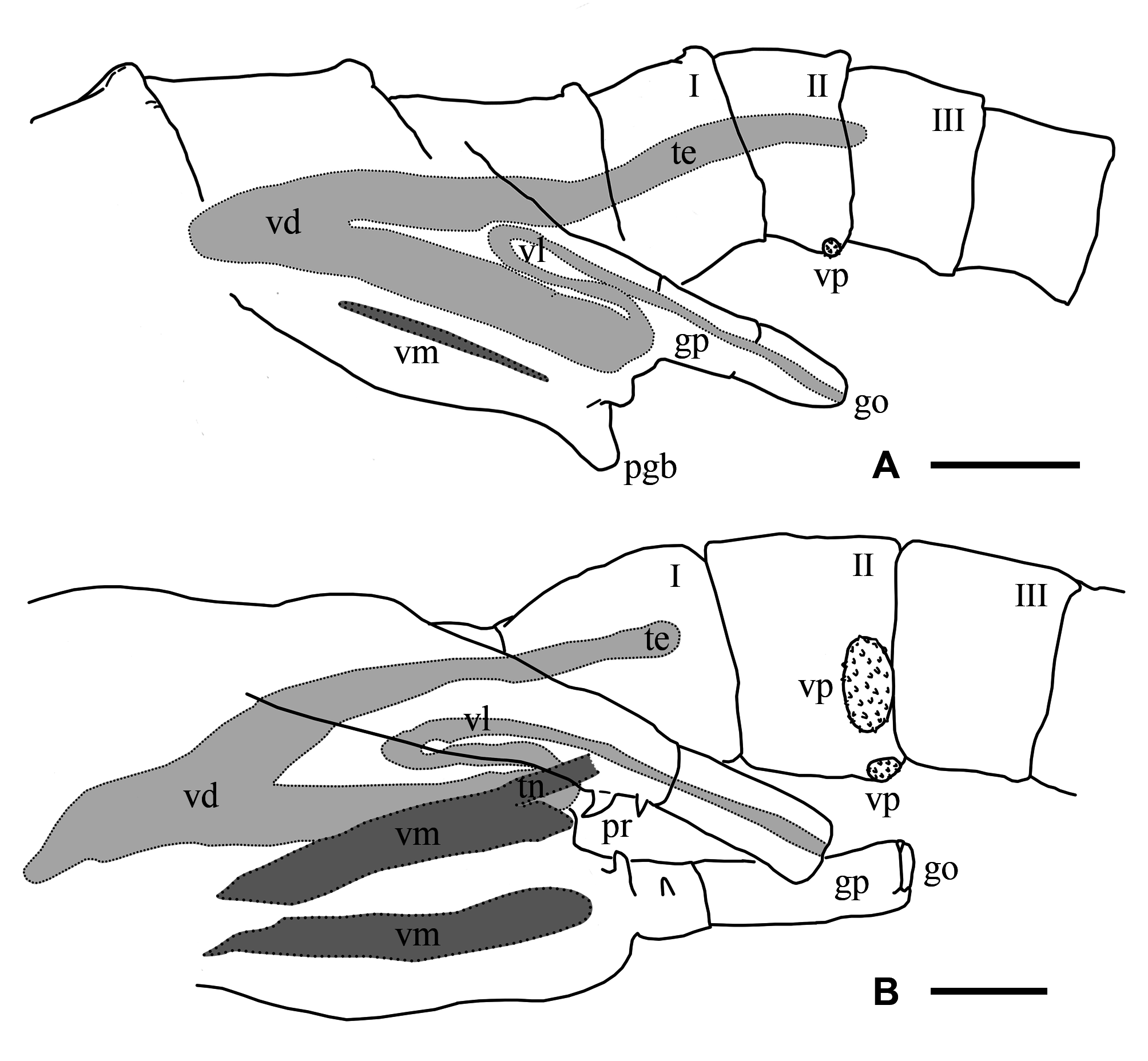
Description. Male. Cuticle ornamented with granulations throughout the whole body, mainly evident in the head, genital and abdominal segments, and gonopods. Compound eyes mean diameter: 0.6 mm (0.4 – 0.8 mm; n = 26), on average 1.5 times larger (1.4 – 2.0; n = 56) than in females (Tables 3, 4). First antennae partially multi-articulated, with incomplete rings (Fig. 2 C). Second antennae basal antennomere, with a basal swollen bulge (bb), on its anterior surface, near the medial edge (Figs. 2 C). Under SEM magnification, the bulge looks paved by small slightly convex cuticular plates, some of which rise and point anteromedially, forming triangular denticles arranged in circular groups encircling a central hyaline sensory seta. The basal antennomere bears on its anterior surface a more distal swollen bulge (db), similarly paved with convex small plates which do not rise as denticles, and scattered warty sensory areas surrounding a hyaline seta (Fig. 2 C); posteromedially at the same level, a spherical knob hangs from a peduncle as a slender pedunculate process (pp) distally dilated (Figs. 2 C; 5 A, D); the peduncle has a granulous cuticle, whereas the tip of the process is ornated with mesetiform elements tightly arranged, and interspersed setae (Fig. 5 A, D, E); more distally in the basal antennomere, and also protruding from its posteromedial surface, there is a digitiform process (dp) that may not be visible in anterior view of the head, remaining hidden behind the posterior face of the basal antennomere (Figs. 5 A, C, D), or its tip barely appears medially (Fig. 2 C); in any case, the digitiform process of each antenna does not reach the small process of its own side, nor projects medially until coming into contact with the digitiform process of the other second antenna. The digitiform process is ornamented with sharp denticles that are more developed on the surface facing the ornate tip of the pedunculate process; from this surface to both sides, denticles gradually flatten until disappearing, so that the cuticle appears almost smooth (Fig. 5 B). At the level of the origin of the digitiform process but in the medial surface of the antennomere there is a transverse oblique crest or medial crest (mc), ending posteromedially into a small process (sp) represented by a low mound (Fig. 5 A, C, D); the small process is ornamented with columnar grooved spines distally divided into several irregular points, scattered simple smooth spines and interspersed hyaline setae (Fig. 5 F). The distal antennomere bends from its anterior surface in posteromedial direction, narrowing distally as it curves, and culminating in a rounded spatulate tip (Fig. 2 C). A little beyond its proximal articulation, the anterolateral surface of the antennomere protrudes like a vertical globose triangular ledge (ld) with proximal base (Fig. 2 C), which narrows in distal direction and ends up at the distal third of the lateral edge of the antennomere. A wide rasp-like area covered with conspicuous mesetiform ornamentations, like those present in several Branchinecta species, is observed from the tip of the appendage, advancing on the posterior and medial surfaces of the distal antennomere. Mandibles asymmetric, showing no sexual dimorphism. In the left mandible (Fig. 6 C, D), starting at the posterior pole, a deepened posterodorsal region along the dorsal margin bears a row of teeth decreasing in size in anterior direction; the region extends up approximately to 3 / 4 of the margin, so that the teeth do not reach the anterior round- ed mandibular pole, and are gradually replaced by spiniform setae. The right mandible shows a similarly deepened posterodorsal region starting at the posterior pole but lacking teeth; instead, parallel rows of multibranched projections transversal to the major mandible axis, gradually develop; these rows progressively reach the level of the main masticatory surface, approximately at 1 / 4 of the dorsal margin. Both mandibles show at the posterior pole a tooth slightly stronger than those at dorsal margin of left mandible, associated with one long and thick seta (rarely two), curved inwards (Fig. 6 C, D). A reduced mandibular palp protrudes from a polygonal area in the convex side of the mandibular surface (Cohen 1991). Maxilla 1 with a strong ventral spine and 20 long setae; the spine is 1.5 – 2 times the width at the basal portion of the long setae, and barely surpasses in length this basal portion. Maxilla 2 with 8 – 10 plumose distal setae plus 2 – 3 anteriorly directed densely plumose setae, with setules all around. Thoracopods show no sexual dimorphism. Endopodite of thoracopods 1 to 2 – 3, transversely subrectangular with triangular apex; from thoracopod 3 or 4 to 7 the endopodite is triangular; in thoracopods 8 and 9 it is triangularoval; in thoracopods 10 and 11 it is oval. Lower edge: throughout the thoracopods 1 to 8, the 80 % of the lower edge of endopodite shows plumose setae; in distal direction the setae become long, slender, curved and pectinate, elongating to the apex of the lobe; in endopodites 9 and 10, these later setae become shorter and weaker; in endopodite 11 the plumose setae are followed in the distal direction by pectinate or bipectinate straight setae shortening to the apex. Medial edge: from the apex, the setae gradually decrease in length all along the medial edge of the endopodite. Here, the setae bordering the endopodite 1 are bipectinate and straight; those in endopodites 2 – 8 are pectinate and curved, though the most proximal ones are short and straight; in endopodite 9 and 10, the setae are pectinate but weaker, shorter and curved or straight; in endopodite 11 the setae are pectinate or bipectinate, short and straight; the proximal half of the medial edge is devoid of setae. Endites 1 and 2 throughout all the thoracopods showed the typical number and arrangement of anterior and posterior setae proposed by Linder (1941) for anostracans. In the 1 st pair of thoracopods the number of setae on the remaining endites was, in endite 3: 8 anterior setae plus a long spine and 3 posterior plumose setae; in endite 4: 7 – 8 anterior setae plus a long spine and 2 posterior plumose setae; in endite 5: 8 – 9 anterior setae and 2 posterior plumose setae. In pairs 2 to 11 the number of setae in the endite 3 was: 1 – 2 anterior seta plus a long spine and 3 posterior plumose setae (2 posterior setae, in pair 11); in the endite 4: 1 – 2 anterior seta plus a long spine and 2 posterior plumose setae; in the endite 5: 2 – 4 anterior setae and 2 – 3 posterior plumose setae. In addition, the thoracopods 1 – 10 show an oval epipodite with smooth margin, and a unique preepipodite with serrated margin, with or without a small marginal notch. In the pair 11, the epipodite is big, oval and margined with around 6 – 11 plumose setae, and the preepipodite is a triangular much-reduced lobe, with smooth margin and apex rounded. Genital and abdominal segments. Abdominal segment II (second postgenital segment) bearing, close to its posterior articulation, a pair of ovoid ventrolateral denticulate protuberances (vp), showing diverse degrees of separation from each other in different specimens (Fig. 7 F, H, I); these protuberances densely covered by denticles surrounding a seta (Fig. 7 C) seem to correspond to a hypertrophied pair of segmentary sensory areas. Similarly ornate but less prominent areas were observed in equal positions, near the posterior articulation of abdominal segments IV and VI. Besides, both genital segments present a conspicuous pair of dorsal warty sensory areas, also observed in several abdominal segments. Gonopods (gp) widely separated, extending ventrolaterally, with non-eversible portions partially visible in dorsal view; very long when completely everted, extending up to the abdominal segments III or the beginning of IV (Fig. 7 D, H, I). The rigid basal portion of gonopods bears a medial sclerotized projection (pr) with two processes (Fig. 7 I) as characteristic in the genus; in addition, more laterally in the basal portion there is a ventral pair of low granulous mounds (gm) (Fig. 7 I). In ventral view, near the distal edge of the second genital segment and between the rigid basal portions of both gonopods, there is a pair of low genital bulges (lgb), next to each other at the midline and distally rounded (Figs. 7 F, G); in lateral view they barely protrude or are almost indistinguishable (Fig. 7 H, I). Eversible portion of the gonopod very long, reaching the abdominal segment III or the beginning of IV (Fig. 7 H). Anterior or lateral longitudinal rows of denticles were not observed on this portion of the gonopod. Like in the other Branchinectidae, each eversible portion of the gonopods shows two dentate warts (dw) in its distal part (Fig. 7 D, E). Both warts are forwardly and obliquely directed, and bear 6 to 8 short marginal spines; one of the warts is medial and close to the tip of the gonopod and the other is dorsal and located at ¾ of the length of the everted portion of the gonopod (Fig. 7 D, H). The internal structure of the male genital segments in lateral or ventral view (Fig. 8 B), shows that each testis (te) is connected with the dorsal branch of a wide V-shaped portion of the vas deferens (vd) extending forwardly along both genital segments and turning to continue into a ventral branch that extends posteriorly throughout the genital region; each ventral branch narrows abruptly to become the thin loop portion of the vas deferens (vl) that enters in the partially everted or non-everted gonopod (gp), and then stretches when the penis is wholly everted. In ventral view, both branches of the vas deferens look superimposed, though they are hidden under a ventral muscle (vm) along the genital region, which is connected by means of a tendon (tn) with the non eversible portion of the gonopods. Testes reach abdominal segments I to III (Fig. 8 B). Uropods (or cercopods) length: 1.6 mm (1.1 – 2.6 mm; n = 26), longer than in females (male uropod / female uropod: 1.3 (0.9 – 1.5); n = 56), on average 3.2 times as long as the anal segment (or telson) (2.5 – 3.9; n = 26) (Table 3), divergent, uniformly provided with marginal plumose setae. Female. Cuticle ornamented with granulations, mainly evident in the head, genital and abdominal segments, and brood pouch. Compound eyes smaller than in male, mean diameter: 0.4 mm (0.3 – 0.5 mm, n = 30) (Table 3). First antennae as in male (Fig. 9 A). Second antennae presenting a strong conical medial projection (mp), in the inner surface, medially directed, giving the appendage a cheliform aspect (Fig. 9 C, E). The anterior surface of the antenna as well as the medial projection, including its tip, present warty sensory areas (sa) associated with a central seta (Fig. 9 E). Instead, the apical projection (ap) of the appendage lacks sensory areas (Fig. 9 E). Just proximal to the medial projection there is a medial bulge (mb) (Fig. 9 C, D), slightly rough, provided with hyaline setae, either like low (Bo- 35) or prominent (Bo- 18) warty areas. Mandibles as in male; no differences between sexes in the molar ornamentation are apparent. Maxilla 1, with a strong ventral spine and 24 – 25 long setae; the spine is almost four times the width of the basal portion of long setae, and barely surpasses in length that basal portion. Maxilla 2, with 4 – 5 plumose distal setae plus 2 anteriorly directed densely plumose setae, with setulae all around. Thoracopods showing the same morphology of lobes as in male. Particularly, the shape of endopodites is similar throughout the series, changing from subrectangular to triangular to oval (in pairs 10 and 11), and also both sexes agree in their setose armature bordering lower and medial edges. The number of anterior and posterior setae of endites 1 to 5 in thoracopods 1 – 11 is like in the male, differing in ± 2 setae. In thoracopods 1 – 10, the preepipodites present a serrated margin without a defined marginal notch; in pair 11, the preepipodite is a triangular lobe not as reduced as in the male, and the epipodite is big, oval and margined with around 9 – 10 plumose setae. Thoracic ornamentation. Dorsally poorly developed (Fig. 10 F, H), though it may vary even within the same sample (Fig. 10 G). Up to two pairs of evaginations, one dorsal and one dorsolateral, can be observed in each thoracomer 9 or 10 to 11. When the evaginations are present in segment 9, they are low, rounded, and one of the pairs may be missing; in segments 10 and 11 the dorsal ornamentations are rounded to conical, confluent in the midline, and the dorsolateral ones are usually low, globose or conical or may be missing. Thoracomer 12 (first genital segment) with a conspicuous strong lateral spine (sg 1) on each side; dorsally, the segment presents a pair of rounded evaginations, more or less prominent, confluent at the midline, which are associated with dorsal warty sensory areas; sometimes an additional pair of conical dorsolateral evaginations is found. Thoracomer 13 (second genital segment) with a strong ventrolateral spine (sg 2) on each side, just above the brood pouch (Figs. 10 F, G, H); dorsally, this segment presents a pair of usually prominent sensory areas. Abdominal segment II bearing a pair of ovoid ventrolateral denticulate protuberances (vp) (Fig. 10 E) as in male, showing diverse degrees of separation from each other in different specimens (Fig. 7 G, H). These protuberances may be hidden by the brood pouch (Fig. 10 F). Similar but smaller structures were also observed in abdominal segments IV and VI. Ovaries T-shaped, extending up to abdominal segments I – IV, or more rarely V. Brood pouch subcylindrical and rounded at the tip, without ventrolateral outgrowths, extending to abdominal segments IV – V (Fig. 10 G, H); however, in Bo- 18 it is particularly longer, reaching abdominal segment VI or even slightly surpassing the abdomen length (Fig. 10 F). Uropods (or cercopods) length: 1.2 mm (0.8 – 2.2; n = 30), markedly shorter than in male (Tables 3, 4); on average 2.4 times as long as the anal segment (or telson) (1.9 – 3.4; n = 30) (Table 4), divergent, uniformly provided with plumose marginal setae all over. Cysts (resistant eggs). Only type I cysts were found in the brood pouches of the new species. Cysts spherical (Fig. 11 A), mean diameter: 223 µm (187 – 242 μm; n = 7). Surface sculptured with ridges defining numerous cells (9 to 11) across the egg diameter, irregularly sized, subcircular or oval; mean dimensions: 28 – 35 µm (20 – 44 to 33 – 45 µm; n = 22), cells either isolated or coalescent (more frequently in pairs up to 5 cells that are delimited by narrower and lower ridges), cell groups either lined up or forming diverse arrays; each cell forms a shallow depression with grained bottom (Fig. 11 C); ridges are steep-sided and narrow except at intersections. Internal alveolar layer made of thin trabeculae (0.8 – 1.0 μm) separating polygonal or spherical vesicles that gradually decrease in size from the cortical (0.5 – 0.6 μm) to the basal zone (0.3 – 0.4 μm), where they are densely packed (Fig. 1 1 E). Size. Male total length from the front to the tip of uropods (or cercopods) excluding setae: 14 mm (10 – 22 mm; n = 26); measurements of other characters in Table 3. Female total length from the front to the tip of uropods (or cercopods) excluding setae: 14 mm (11 – 22 mm; n = 30); measurements of other characters in Table 4. Differential diagnosis. The morphological diagnostic characters of the two species of the genus Archaebranchinecta from the South American Altiplano are summarized in Table 5.
A new species of Archaebranchinecta (Anostraca: Branchinectidae) from the South American Altiplano
Diagnosis. Male. Pedunculate process of the second antenna basal antennomere slender, distally dilated; digitiform process of the male second antennae basal antennomere short, usually hidden behind the posterior face of the basal antennomere (even not visible in anterior view), or just its tip barely appearing medially, not reaching the small process of its own side, nor in contact with the digitiform process of the opposite side; small process barely rising from the transversal medial crest, ending in a single rounded mound. Pedunculate process length / digitiform process length: 1.7 (0.9 – 3.6; n = 25). Genital region, showing a pair of ventral low rounded bulges, close to each other at the midline; and slightly protruding or sometimes inconspicuous in lateral view. Female. Thoracic ornamentation often poorly developed; thoracomer 12 (first genital segment) with a strong lateral spine; thoracomer 13 (second genital segment) with a strong ventrolateral spine just above the brood pouch and a dorsal pair of usually prominent sensory areas. Brood pouch subcylindrical, without ventrolateral outgrowths at its distal third.
A new species of Archaebranchinecta (Anostraca: Branchinectidae) from the South American Altiplano
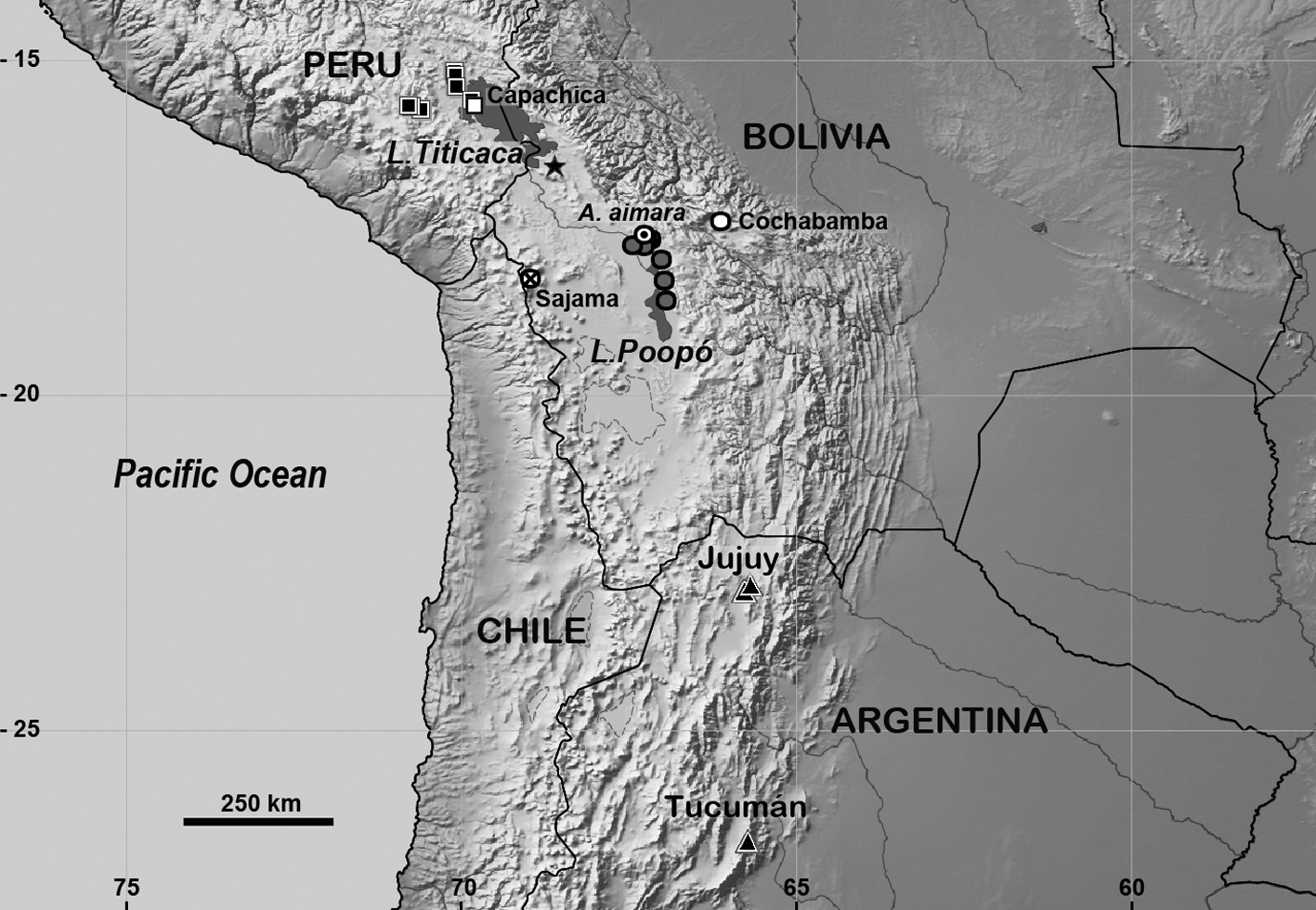
Distribution and ecology. A. aimara sp. nov. was found in high elevation (3,721 – 3,861 m a. s. l.) freshwater temporary habitats, such as ponds, pools, and roadside ditches in the arid part of the central Bolivian Altiplano (Table 1, Fig. 1). All of these water bodies were small to medium-sized, shallow (30 - 50 cm deep), mostly turbid and argillaceous, with sandy substrate, waters of low conductivity (no salt precipitation was observed), and mostly filled by rainfalls during the rainy season (December-March).
A new species of Archaebranchinecta (Anostraca: Branchinectidae) from the South American Altiplano
Etymology: The species-group name “ aimara ” is a noun in apposition that refers to the indigenous culture (also called “ aymara ”) that flourished during pre-Columbian times, and still prevails around the Lakes Titicaca and Poopó and the River Desaguadero, in the Andean high plain of South America, where the new species is distributed.
A new species of Archaebranchinecta (Anostraca: Branchinectidae) from the South American Altiplano
Type locality. Turbid pool Bo- 44, near dirt road between Caracollo and Soledad, 2.2 km SW from Route 1 Caracollo-Oruro, Oruro Department, Bolivia (17 ° 39 ’ 47.40 ” S; 67 ° 13 ’ 57.48 ” W), 3,776 m a. s. l. (Table 1, Fig. 1). Type material. Holotype. Undissected mature male preserved in 96 % ethanol. Vial (MACN-In 42300), colls. S. J. Adamowicz, M. C. Marinone and S. A. Menu Marque, January 2008. Size: total length from the front to the tip of uropods (or cercopods) excluding setae, 12.9 mm. Allotype. Undissected mature female preserved in 96 % ethanol. Vial (MACN-In 42301), colls. S. J. Adamowicz, M. C. Marinone and S. A. Menu Marque, January 2008. Size: total length from the front to the tip of uropods (or cercopods) excluding setae, 13 mm. Paratypes. 5 males and 4 females preserved in 96 % ethanol. Vial (MACN-In 42302), colls. S. J. Adamowicz, M. C. Marinone and S. A. Menu Marque, January 2008. Size: males total length from the front to the tip of uropods (or cercopods) excluding setae, 13 mm (12 – 14 mm); females total length from the front to the tip of uropods (or cercopods) excluding setae, 13 mm (11 – 15 mm). Type and paratype material was deposited in the National Collection of Invertebrates of the Museo Argentino de Ciencias Naturales Bernardino Rivadavia (MACN-In), Buenos Aires City, Argentina. Material examined. Samples from 8 temporary freshwater habitats (Table 1, Fig. 1), near the southern shore of Lake Titicaca, and around the eastern shores of the River Desaguadero and the Lake Poopó, Bolivia, colls. S. J. Adamowicz, M. C. Marinone and S. A. Menu Marque, January 17 to 28, 2008.
A new species of Archaebranchinecta (Anostraca: Branchinectidae) from the South American Altiplano

Export occurrence data

Darwin Core Archive (ZIP)

GEOGRAPHY

Distribution Map

Occurrence Map

Loading map…

Tiles © GBIF Maps API | Map powered by MapLibre GL

REGIONS

Geographic Distribution(3)

South America
South America
South America

DATA

Occurrence Datasets

Loading datasets…

CLASSIFICATION

Taxonomic Classification Tree

MULTIMEDIA

Media Files(9)

FIGURE 1. Distribution of Archaebranchinecta in the South American Altiplano. Grey circles: new sites for A. aimara sp. nov.; white circle with a black dot: type locality for A. aimara sp. nov.(Bo-44); black star: new site near Tiwanaku for A. aimara sp. nov. (Bo-18); black squares: new sites for A. pollicifera. Published localities: white square: type locality for A. pollicifera in Capachica Peninsula; white circle: paratype locality for A. pollicifera in Cochabamba by Harding (1940), which most probably belongs to A. aimara sp. nov.; crossed white circle: redescription site for A. pollicifera in Sajama National Park by Rogers & Coronel (2011), herein assigned to A. aimara sp. nov.; and black triangles: first report sites for Archaebranchinecta in northern Argentina.

Imageimage/png© Cohen, Rosa Graciela;Marinone, María Cristina;Adamowicz, Sarah J.A new species of Archaebranchinecta (Anostraca: Branchinectidae) from the South American Altiplano

FIGURE 2. Male head in Archaebranchinecta. A, A. pollicifera Pe-30, anterior view. B, A. pollicifera Pe-30, detail of basal and distal swollen bulges in basal antennomere of second antenna, anterior view. C, A. aimara sp. nov. Bo-52, anterior view. D, A. pollicifera Pe-22, detail of basal bulge in basal antennomere of second antenna, anterior view. Scale bars: A and C: 500 µm; B: 250 µm; D: 50 µm.

Imageimage/png© Cohen, Rosa Graciela;Marinone, María Cristina;Adamowicz, Sarah J.A new species of Archaebranchinecta (Anostraca: Branchinectidae) from the South American Altiplano
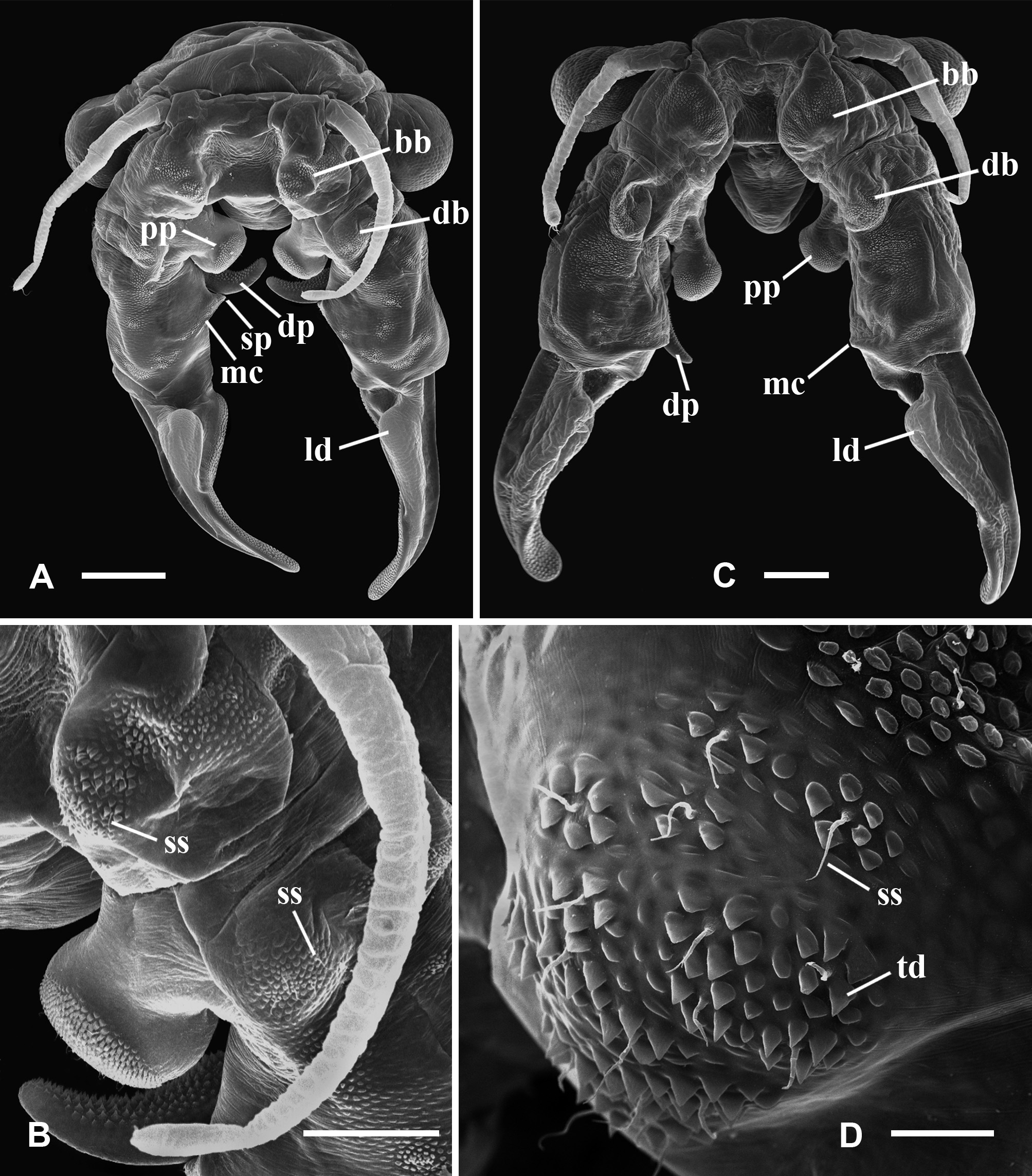
FIGURE 5. Archaebranchinecta aimara sp. nov. male, processes of basal antennomere of second antenna. A, Bo-52, posterior view. B, Bo-52, detail of digitiform process showing smooth surface opposite to denticulate side. C, Bo-45, detail of small process and digitiform process, posterior view. D, Bo-52, posteromedial view. E, Bo-52, detail of the tip of pedunculate process. F, Bo-51, detail of medial crest ornamentation. Scale bars: A, C and D: 250 µm; B: 50 µm; E and F: 20 µm.

Imageimage/png© Cohen, Rosa Graciela;Marinone, María Cristina;Adamowicz, Sarah J.A new species of Archaebranchinecta (Anostraca: Branchinectidae) from the South American Altiplano

FIGURE 6. Mandibles in Archaebranchinecta. A, A. pollicifera Pe-30 female, left mandible with supernumerary tooth. B, A. pollicifera Pe-29 male, right mandible. C, A. aimara sp. nov. Bo-45 male, left mandible. D, A. aimara sp. nov. Bo-52 male, left mandible. Scale bars: A, B, C, and D: 50 µm.

Imageimage/png© Cohen, Rosa Graciela;Marinone, María Cristina;Adamowicz, Sarah J.A new species of Archaebranchinecta (Anostraca: Branchinectidae) from the South American Altiplano
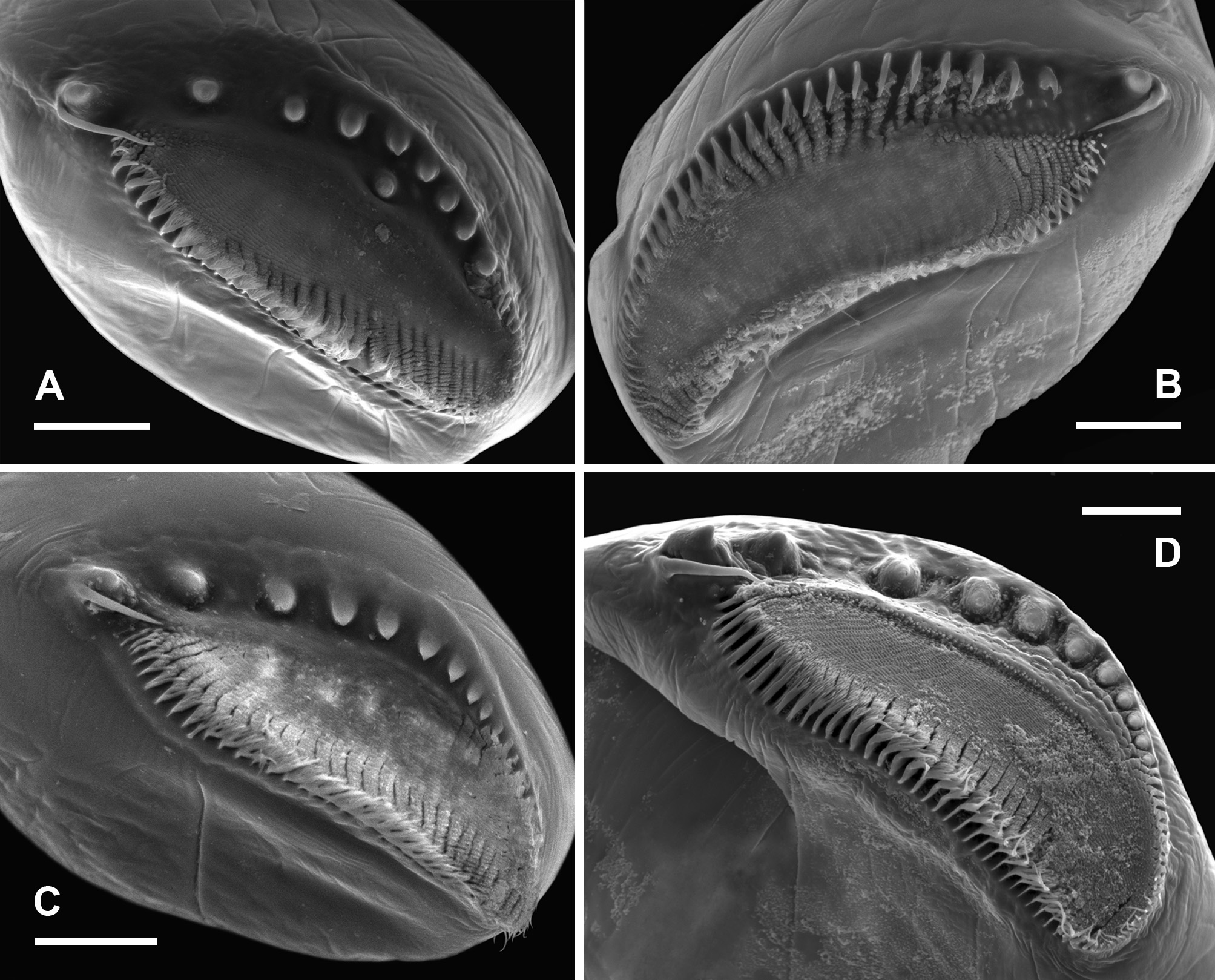
FIGURE 7. Male genital segments in Archaebranchinecta. A, A. pollicifera Pe-22, ventral view. B, A. pollicifera Pe-22, lateral view. C, A. aimara sp. nov. Bo-18, detail of ventrolateral denticulate protuberance in abdominal segment II. D, A. aimara sp. nov. Bo-18, everted gonopod. E, A. aimara sp. nov. Bo-52, detail of gonopod dentate wart. F, A. aimara sp. nov. Bo-35, lateral view. G, A. aimara sp. nov. Bo-35, detail of low genital bulges, ventral view. H, A. aimara sp. nov. Bo-18, lateral view. I, A. aimara sp. nov. Bo-18, ventral view. Scale bars: A, B, F, G, H, and I: 500 µm; C: 50 µm; D and E: 100 µm.

Imageimage/png© Cohen, Rosa Graciela;Marinone, María Cristina;Adamowicz, Sarah J.A new species of Archaebranchinecta (Anostraca: Branchinectidae) from the South American Altiplano
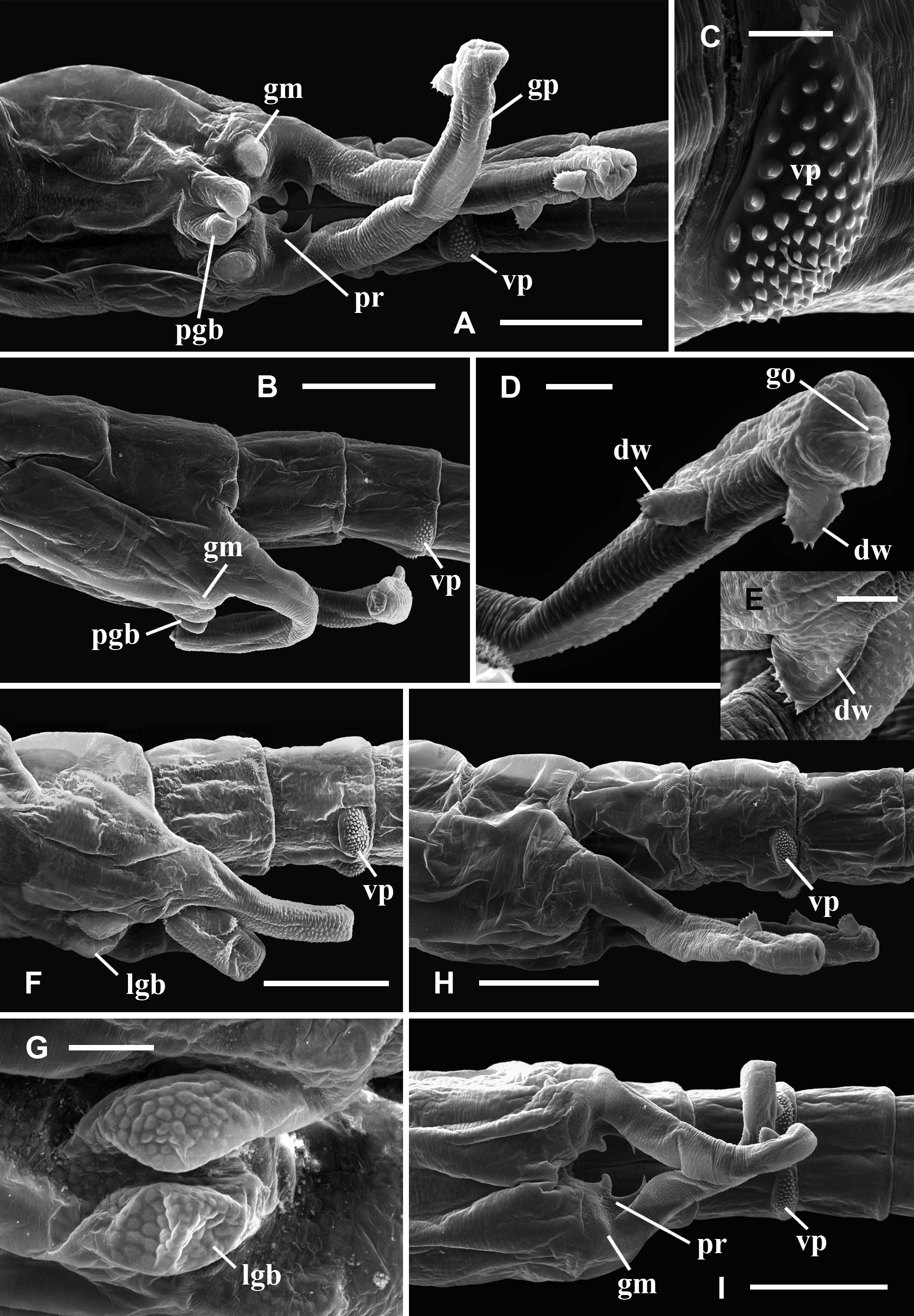
FIGURE 8. Male genitalia internal structure in Archaebranchinecta. A, A. pollicifera Pe-30, lateral view. B, A. aimara sp. nov. Bo-52, ventrolateral view. Scale bars: A and B: 500 µm.

Imageimage/png© Cohen, Rosa Graciela;Marinone, María Cristina;Adamowicz, Sarah J.A new species of Archaebranchinecta (Anostraca: Branchinectidae) from the South American Altiplano
IMAGES

Gallery(9)

See Gallery

Occurrences with images

CITATIONS

References(2)

  • 1

    Cohen, R. G.; Marinone, M. C.; Adamowicz, S. J. (2019). A new species of Archaebranchinecta (Anostraca: Branchinectidae) from the South American Altiplano. <em>Zootaxa.</em> 4683(1): 55-83.

    original descriptionWorld Register of Marine Species
  • 2

    Cohen, Rosa Graciela, María Cristina Marinone, and Sarah J. Adamowicz, 2019: A new species of Archaebranchinecta (Anostraca: Branchinectidae) from the South American Altiplano. Zootaxa, vol. 4683, no. 1. 55-83.

    Integrated Taxonomic Information System (ITIS)
  • Source Information

    GBIF Backbone Taxonomy

    GBIF Backbone Taxonomy

    checklist

    The GBIF Backbone Taxonomy is a single, synthetic management classification with the goal of covering all names GBIF is dealing with. It's the taxonomic backbone that allows GBIF to integrate name based information from different resources, no matter if these are occurrence datasets, species pages, names from nomenclators or external sources like EOL, Genbank or IUCN. This backbone allows taxonomic search, browse and reporting operations across all those resources in a consistent way and to provide means to crosswalk names from one source to another.

    It is updated regulary through an automated process in which the Catalogue of Life acts as a starting point also providing the complete higher classification above families. Additional scientific names only found in other authoritative nomenclatural and taxonomic datasets are then merged into the tree, thus extending the original catalogue and broadening the backbones name coverage. The GBIF Backbone taxonomy also includes identifiers for Operational Taxonomic Units (OTUs) drawn from the barcoding resources iBOL and UNITE.

    International Barcode of Life project (iBOL), Barcode Index Numbers (BINs). BINs are connected to a taxon name and its classification by taking into account all names applied to the BIN and picking names with at least 80% consensus. If there is no consensus of name at the species level, the selection process is repeated moving up the major Linnaean ranks until consensus is achieved.

    UNITE - Unified system for the DNA based fungal species, Species Hypotheses (SHs). SHs are connected to a taxon name and its classification based on the determination of the RefS (reference sequence) if present or the RepS (representative sequence). In the latter case, if there is no match in the UNITE taxonomy, the lowest rank with 100% consensus within the SH will be used.

    The GBIF Backbone Taxonomy is available for download at https://hosted-datasets.gbif.org/datasets/backbone/ in different formats together with an archive of all previous versions.

    The following 105 sources have been used to assemble the GBIF backbone with number of names given in brackets:

    • Catalogue of Life Checklist - 4766428 names
    • International Barcode of Life project (iBOL) Barcode Index Numbers (BINs) - 635951 names
    • UNITE - Unified system for the DNA based fungal species linked to the classification - 611208 names
    • The Paleobiology Database - 212054 names
    • World Register of Marine Species - 188857 names
    • The Interim Register of Marine and Nonmarine Genera - 183894 names
    • The World Checklist of Vascular Plants (WCVP) - 131891 names
    • GBIF Backbone Taxonomy - 114350 names
    • TAXREF - 109374 names
    • The Leipzig catalogue of vascular plants - 75380 names
    • ZooBank - 73549 names
    • Integrated Taxonomic Information System (ITIS) - 68377 names
    • Plazi.org taxonomic treatments database - 61346 names
    • Genome Taxonomy Database r207 - 60545 names
    • International Plant Names Index - 52329 names
    • Fauna Europaea - 45077 names
    • The National Checklist of Taiwan (Catalogue of Life in Taiwan, TaiCoL) - 36193 names
    • Dyntaxa. Svensk taxonomisk databas - 35892 names
    • The Plant List with literature - 32692 names
    • United Kingdom Species Inventory (UKSI) - 29643 names
    • Artsnavnebasen - 29208 names
    • The IUCN Red List of Threatened Species - 21221 names
    • Afromoths, online database of Afrotropical moth species (Lepidoptera) - 13961 names
    • Brazilian Flora 2020 project - Projeto Flora do Brasil 2020 - 13829 names
    • Prokaryotic Nomenclature Up-to-Date (PNU) - 10079 names
    • Checklist Dutch Species Register - Nederlands Soortenregister - 8814 names
    • ICTV Master Species List (MSL) - 7852 names
    • Cockroach Species File - 6020 names
    • GRIN Taxonomy - 5882 names
    • Taxon list of fungi and fungal-like organisms from Germany compiled by the DGfM - 4570 names
    • Catalogue of Afrotropical Bees - 3623 names
    • Catalogue of Tenebrionidae (Coleoptera) of North America - 3327 names
    • Checklist of Beetles (Coleoptera) of Canada and Alaska. Second Edition. - 3312 names
    • Systema Dipterorum - 2850 names
    • Catalogue of the Pterophoroidea of the World - 2807 names
    • The Clements Checklist - 2675 names
    • Taxon list of Hymenoptera from Germany compiled in the context of the GBOL project - 2496 names
    • IOC World Bird List, v13.2 - 2366 names
    • Official Lists and Indexes of Names in Zoology - 2310 names
    • National checklist of all species occurring in Denmark - 1922 names
    • Myriatrix - 1876 names
    • Database of Vascular Plants of Canada (VASCAN) - 1822 names
    • Taxon list of vascular plants from Bavaria, Germany compiled in the context of the BFL project - 1771 names
    • Orthoptera Species File - 1742 names
    • A list of the terrestrial fungi, flora and fauna of Madeira and Selvagens archipelagos - 1602 names
    • Aphid Species File - 1565 names
    • World Spider Catalog - 1561 names
    • Taxon list of Jurassic Pisces of the Tethys Palaeo-Environment compiled at the SNSB-JME - 1270 names
    • Backbone Family Classification Patch - 1143 names
    • GBIF Algae Classification - 1100 names
    • International Cichorieae Network (ICN): Cichorieae Portal - 975 names
    • Psocodea Species File - 803 names
    • New Zealand Marine Macroalgae Species Checklist - 787 names
    • Annotated checklist of endemic species from the Western Balkans - 754 names
    • Taxon list of animals with German names (worldwide) compiled at the SMNS - 503 names
    • Catalogue of the Alucitoidea of the World - 472 names
    • Lygaeoidea Species File - 462 names
    • Catálogo de Plantas y Líquenes de Colombia - 422 names
    • GBIF Backbone Patch - 317 names
    • Phasmida Species File - 259 names
    • Cortinariaceae fetched from the Index Fungorum API - 234 names
    • Coreoidea Species File - 233 names
    • GTDB supplement - 139 names
    • Mantodea Species File - 119 names
    • Endemic species in Taiwan - 93 names
    • Taxon list of Araneae from Germany compiled in the context of the GBOL project - 88 names
    • Species of Hominidae - 78 names
    • Taxon list of Sternorrhyncha from Germany compiled in the context of the GBOL project - 77 names
    • Taxon list of mosses from Germany compiled in the context of the GBOL project - 75 names
    • Mammal Species of the World - 73 names
    • Plecoptera Species File - 71 names
    • Species Fungorum Plus - 64 names
    • Catalogue of the type specimens of Cosmopterigidae (Lepidoptera: Gelechioidea) from research collections of the Zoological Institute, Russian Academy of Sciences - 47 names
    • Species named after famous people - 41 names
    • Dermaptera Species File - 36 names
    • Taxon list of Trichoptera from Germany compiled in the context of the GBOL project - 34 names
    • True Fruit Flies (Diptera, Tephritidae) of the Afrotropical Region - 33 names
    • Range and Regularities in the Distribution of Earthworms of the Earthworms of the USSR Fauna. Perel, 1979 - 32 names
    • Taxon list of Diplura from Germany compiled in the context of the GBOL project - 30 names
    • Lista de referencia de especies de aves de Colombia - 2022 - 24 names
    • Taxon list of Auchenorrhyncha from Germany compiled in the context of the GBOL project - 20 names
    • Catalogue of the type specimens of Polycestinae (Coleoptera: Buprestidae) from research collections of the Zoological Institute, Russian Academy of Sciences - 19 names
    • Taxon list of Thysanoptera from Germany compiled in the context of the GBOL project - 19 names
    • Lista de especies de vertebrados registrados en jurisdicción del Departamento del Huila - 18 names
    • Taxon list of Microcoryphia (Archaeognatha) from Germany compiled in the context of the GBOL project - 15 names
    • Catalogue of the type specimens of Bufonidae and Megophryidae (Amphibia: Anura) from research collections of the Zoological Institute, Russian Academy of Sciences - 12 names
    • Grylloblattodea Species File - 11 names
    • Coleorrhyncha Species File - 9 names
    • Taxon list of liverworts from Germany compiled in the context of the GBOL project - 9 names
    • Embioptera Species File - 7 names
    • Taxon list of Pisces and Cyclostoma from Germany compiled in the context of the GBOL project - 6 names
    • Taxon list of Pteridophyta from Germany compiled in the context of the GBOL project - 6 names
    • Taxon list of Siphonaptera from Germany compiled in the context of the GBOL project - 5 names
    • The Earthworms of the Fauna of Russia. Perel, 1997 - 5 names
    • Taxon list of Zygentoma from Germany compiled in the context of the GBOL project - 4 names
    • Asiloid Flies: new taxa of Diptera: Apioceridae, Asilidae, and Mydidae - 3 names
    • Taxon list of Protura from Germany compiled in the context of the GBOL project - 3 names
    • Taxon list of hornworts from Germany compiled in the context of the GBOL project - 2 names
    • Chrysididae Species File - 1 names
    • Taxon list of Dermaptera from Germany compiled in the context of the GBOL project - 1 names
    • Taxon list of Diplopoda from Germany in the context of the GBOL project - 1 names
    • Taxon list of Orthoptera (Grashoppers) from Germany compiled at the SNSB - 1 names
    • Taxon list of Pscoptera from Germany compiled in the context of the GBOL project - 1 names
    • Taxon list of Pseudoscorpiones from Germany compiled in the context of the GBOL project - 1 names
    • Taxon list of Raphidioptera from Germany compiled in the context of the GBOL project - 1 names

    GBIF Secretariat (2023). GBIF Backbone Taxonomy. Checklist dataset https://doi.org/10.15468/39omei accessed via GBIF.org on 2026-06-14.

    CC BYPublished 8/28/2023View dataset
    GBIF Usage Key
    10754564
    Dataset Key
    d7dddbf4-2cf0-4f39-9b2a-bb099caae36c
    Origin
    source
    Backbone Key
    10754564
    Taxon ID
    gbif:10754564
    Last Crawled
    8/22/2023
    Last Interpreted
    8/22/2023