
AnimaliaacceptedgenusAccepted
Anopsobius
Silvestri, 1899
GBIF:119331591
0datasets
0year
0
Descendants
0
Children
0
Species
ABOUT
Descriptions(3)
Diagnosis: Anopsobiinae with spiracles on segments 3, 5, 8, 10, 12 and 14; most specimens of all species with 15 antennal articles; distal spinose projection on tibia of legs 1 12; posteroventral spine on pretarsus short, with a smaller accessory spine.
Edgecombe, Gregory D. (2003): A new species of the Gondwanan centipede Anopsobius (Chilopoda: Lithobiomorpha) from New South Wales, Australia. Zootaxa 204: 1-15, DOI: 10.5281/zenodo.156359
Discussion: The high spiracle count that traditionally defines Anopsobius is a plesiomorphic character relative to that of other Gondwanan anopsobiine genera (Dichelobius Attems, 1911, and its possible junior synonym Tasmanobius Chamberlin, 1920; Catanopsobius Silvestri, 1909 b), being shared with Henicopinae and Lithobiidae as well as nonlithobiomorph outgroups. This character thus does not provide positive evidence for the monophyly of Anopsobius as conventionally understood (e. g., Attems 1928; Chamberlin 1962). Particularly doubtful as members of a clade based on the type species, A. productus, are the Chilean species A. actius Chamberlin, 1962, and A. diversus Chamberlin, 1962, both of which lack a ventrodistal spur on the prefemur of legs 14 and 15. These spurs are shared by Anopsobius s. s. and Dichelobius, and seem to provide a compelling synapomorphy. If so, a primitive absence of the spurs in A. actius and A. diversus would exclude them from a monophyletic Anopsobius. segments and gonopods, scale 100 µm. New to the diagnosis is a diminutive posteroventral spine on the pretarsus. The short spine and smaller accessory spine in Anopsobius wrighti (Figs. 30, 31) are shared with A. neozelanicus. In contrast, the type species of Dichelobius, D. flavens Attems, 1911, and D. bicuspis Ribaut, 1923, have an elongate posteroventral spine, nearly as long as the main pretarsal claw. A monotypic subgenus Promethon Chamberlin, 1962, was based on an “ unusual form of the prosternum ” in A. diversus Chamberlin, 1962. This distinction seemingly involves the projection of the dental margin, a narrow and deep median notch, and the positioning of the porodont between the two most lateral teeth on the maxillipede coxosternite. The taxonomic significance of the porodont position is called into question by variation in Anopsobius neozelanicus, in which the porodont ranges from the outer edge of the outer tooth, in front of the outer tooth, or between the two outer teeth (the “ Promethon ” state). Likewise, the dental margin is scarcely more projected in A. diversus (Chamberlin 1962, fig. 40) than in some specimens of A. neozelanicus (Archey 1917, fig. 41), nor is the median notch deeper or narrower. A subgenus Promethon has little merit.
Edgecombe, Gregory D. (2003): A new species of the Gondwanan centipede Anopsobius (Chilopoda: Lithobiomorpha) from New South Wales, Australia. Zootaxa 204: 1-15, DOI: 10.5281/zenodo.156359
Type species: Anopsobius productus Silvestri, 1899. Assigned species: See key below.
Edgecombe, Gregory D. (2003): A new species of the Gondwanan centipede Anopsobius (Chilopoda: Lithobiomorpha) from New South Wales, Australia. Zootaxa 204: 1-15, DOI: 10.5281/zenodo.156359
Export occurrence data
Darwin Core Archive (ZIP)
CLASSIFICATION
Taxonomic Classification Tree

HIERARCHY
Child Taxa(1)
MULTIMEDIA
Media Files(1)
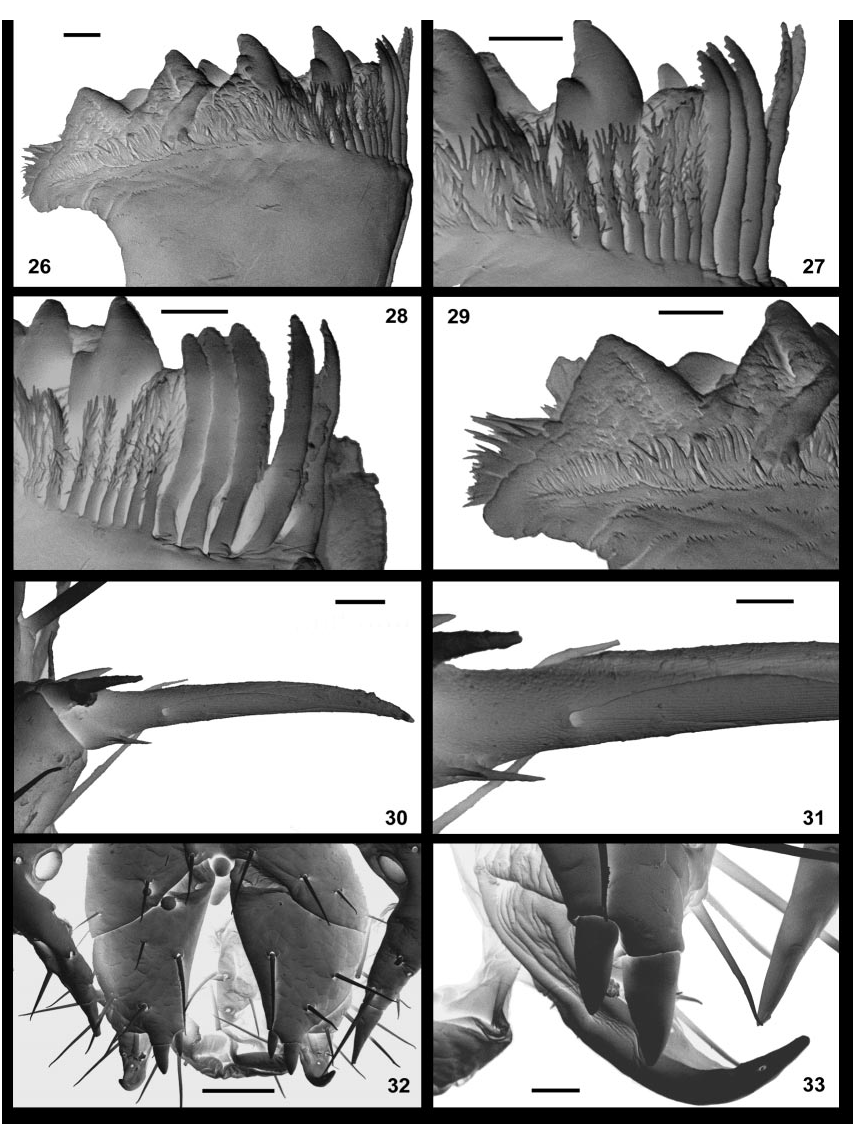
FIGURES 26 33. Anopsobius wrighti n. sp. 26 31, AM KS 57959, male, all 10 µm except 31, 5 µm. 26, gnathal edge of mandible; 27, 28, ventral part of mandibular gnathal edge; 29, dorsal mandibular teeth and furry pad; 30, 31, pretarsus of leg 13, posterior view and detail showing pore on main claw. 32, 33, AM KS 84039, female, gonopods and detail of spurs and claw, scales 50 µm, 10 µm.
Imageimage/png© Edgecombe, Gregory D.Edgecombe, Gregory D.
IMAGES