
AnimaliaNot EvaluatedacceptedspeciesAccepted
Netrostoma nuda
GBIF:119361819
0
Synonyms
ABOUT
Descriptions(5)
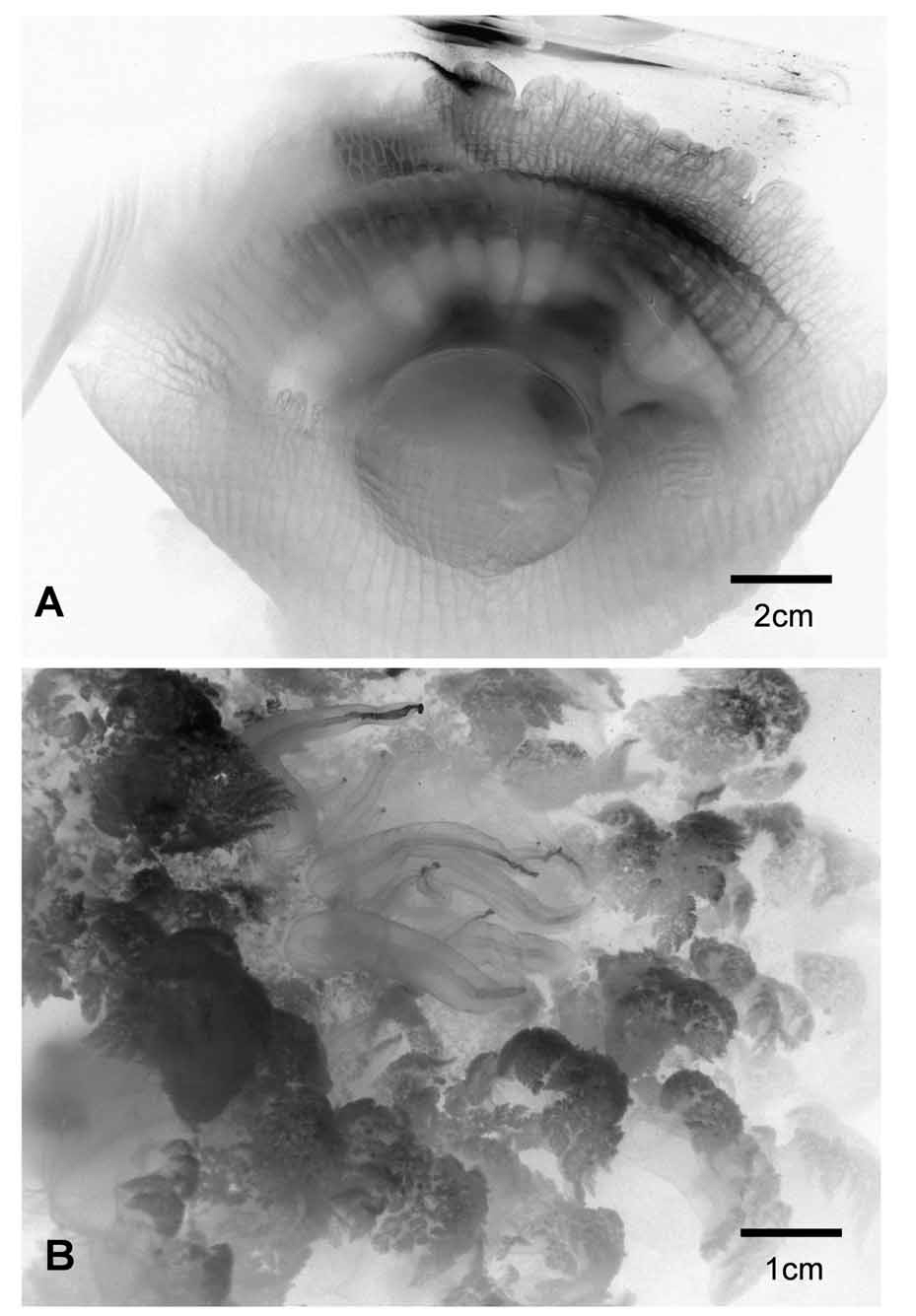
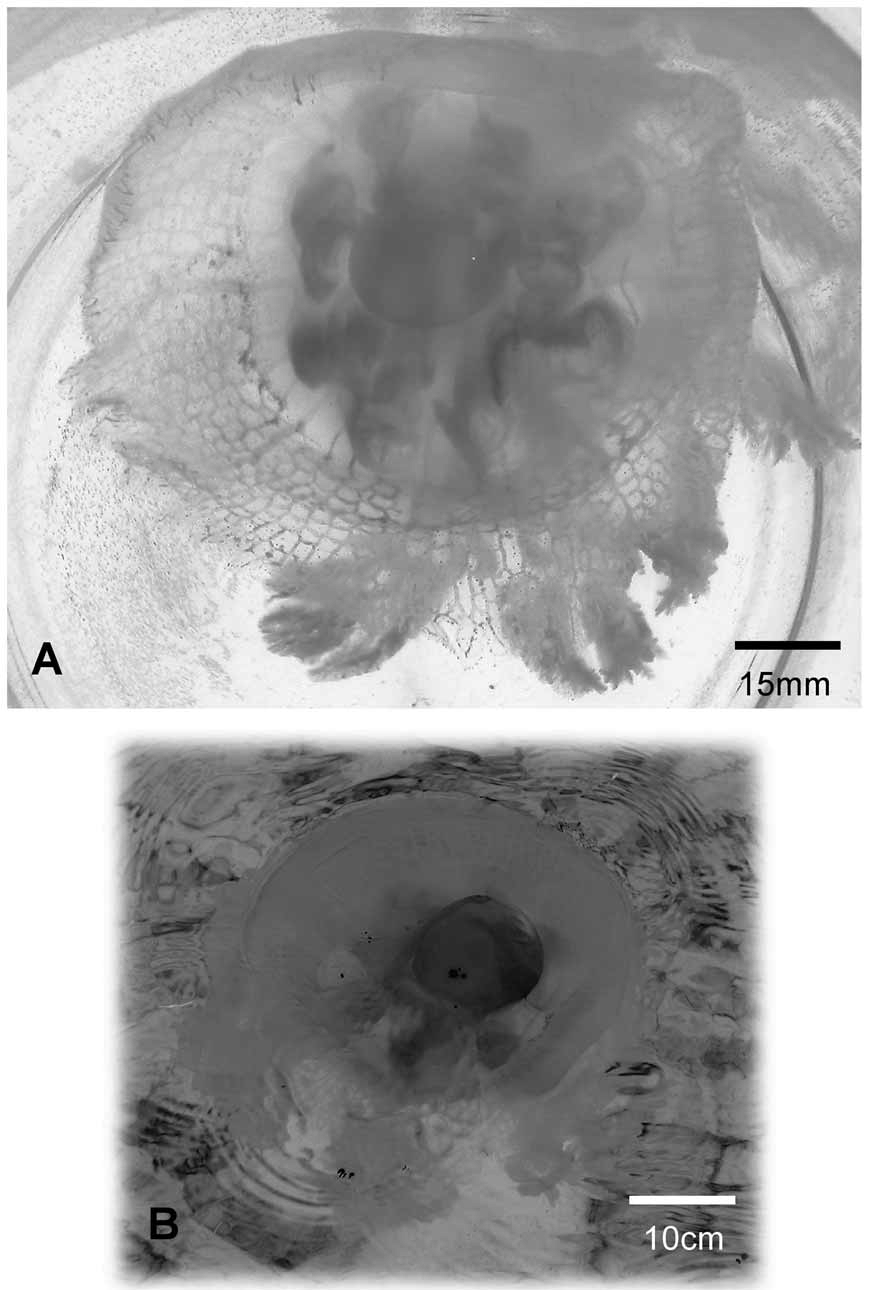
Description of holotype. Exumbrella smooth, lacking papillae or warts; ornamented only with a single, large, round apical knob (Figures 2 A, 3 A & B); subumbrella with approximately 10 gelatinous radial ridges per octant, extending from peripheral edge of gastro-gonadal region approximately halfway to margin. Peripheral region of bell inverted. Lappets 9 per octant, of two types: rhopalial lappets small, pointed, with simple blind projection of radial canal network; remaining 7 (velar) lappets rounded, large, each with one or more short blind spikes projecting distally from top of radial canal loop. Oral arms 8, about as long as bell radius; bi-forked, with numerous progressively shorter branches along adaxial side of arm; branches further branched, dendritic, with feather-like mouths; lacking appendages between mouths (Figure 2 B). Radial canals: Rhopaliar canals 8, of even thickness; inter-rhopaliar canals 3 per octant (total of 32 canals projecting from gastro-gondal region); completely anastomosed in outer 1 / 3 of bell, with “ squares ” proximally, becoming “ rectangles ” peripherally; with many blind diverticula, especially in proximal region where main canals have not yet anastomosed, with diverticula from network pointing laterally toward main canals. Rhopalia 8, 4 perradial and 4 interradial, within heart-shaped niches, “ pointed ” end of heart being the opening between adjacent lappets, with “ bilobed ” end enveloping a short radial canal projection; niches closed entirely on exumbrellar side, with short subumbrellar protective membrane, such that rhopalium directly exposed to water flow on subumbrellar side. Oral plate with numerous long, stiff, hollow, cylindrical, gelatinous appendages (Figure 2 B) arising at branch-points of oral canal network. Body open to outside only at 4 small interradial funnels; gastric and genital systems continuous. Gonads 4, interradial, U-shaped to amorphous, entirely enclosed. Color in life translucent hazy bluish-white throughout, lacking spots, streaks, or other pigment (Figure 3 B); preserved mostly transparent with translucent canals and oral arms, gonads yellowish. Variation. Paratype MTQ G 55273, presumably a sub-adult based on size, with only 5 – 6 velar lappets per octant, which are fused; it also has only 2 – 3 radial canals per octant between main canals, and gonads appear mature, but we can only identify three with confidence. The remaining paratypes all have a damaged apical knob; despite this fact, there can be no mistake that it is without papillae. One possible explanation for the damage may be found in the collection label with specimen MTQ G 55272, which noted “ part showing above water while swimming. ” As mesoglea dries quickly when exposed to air, perhaps this, or compaction during preservation, attributed to the damage. Observations on live animals. Netrostoma nuda drifts along near the surface, with the knob bobbing above or just below the surface of the water; in some specimens the knob is damaged, possibly as a result of desiccation from being held above the water too long. Occasionally the species comes inshore in large numbers, giving a mild but annoying sting to swimmers. The largest medusa we have observed was well over 30 cm bell diameter; the knob is conspicuous at all sizes (range 10 – 30 + cm).
Gershwin, Lisa-Ann, Zeidler, Wolfgang (2008): Two new jellyfishes (Cnidaria: Scyphozoa) from tropical Australian waters. Zootaxa 1764: 41-52, DOI: 10.5281/zenodo.181987
Diagnosis. Netrostoma with a single large, round protruding knob at apex of umbrella; with 7 rounded velar lappets, 2 pointed smaller rhopaliar lappets per octant; lacking exumbrellar papillae and appendages between the mouths.
Gershwin, Lisa-Ann, Zeidler, Wolfgang (2008): Two new jellyfishes (Cnidaria: Scyphozoa) from tropical Australian waters. Zootaxa 1764: 41-52, DOI: 10.5281/zenodo.181987
Remarks. Stiasny (1921) and Kramp (1961) both separated the genera of Cepheidae based on the number of radial canals per octant, with Netrostoma having three, Cephea having more than three. Unlike the four other species of Netrostoma, N. nuda does not have warts or papillae on the exumbrella. Rather, it has only a single large central knob, much like the knob on the lid of a saucepan. Although Kramp (1961) defined the genus Netrostoma as having large warts on the central dome, N. nuda clearly must be assigned to this genus based on its radial canal arrangement, namely three per octant between main canals. It seems most sensible to broaden the genus Netrostoma to include taxa lacking exumbrellar warts or papillae, rather than to propose a new genus for this taxon.
Gershwin, Lisa-Ann, Zeidler, Wolfgang (2008): Two new jellyfishes (Cnidaria: Scyphozoa) from tropical Australian waters. Zootaxa 1764: 41-52, DOI: 10.5281/zenodo.181987
Distribution. Previous records of Netrostoma spp. in Australian waters deserve some comment. The first was by Stiasny (1926), as N. coerulescens, from Funafuti Island north of Australia. However, this may have actually been N. nuda, since it lacked oral-arm appendages, but no mention was made of the apical structure. Stiasny (1931) later recorded the same species from Wilson Islet, Capricorn Group, QLD, though it is unclear what species he actually had. He commented that the oral appendages were only small, indicating that they did occur on the oral arms as well as the oral disk, but made no comment as to the exumbrellar ornamentation. He further commented that the species was rare in Australia. Subsequently, Kramp (1965) reported N. coerulescens from Tongue Reef, QLD. However, we have examined Kramp’s specimen (SAM H 958 = RVS A 516) and it is clearly N. nuda, lacking any form of oral arm appendages between the mouths, having seven velar lappets per octant, and a squashed but papilla-free apical knob. Curiously, N. nuda is quite common in North Queensland waters, being well represented in Australian collections. We have yet to see Australian specimens that correspond to the description of any other species of Netrostoma. The only other reference that we are aware of, which appears to be for this species, is in a field guide for New Caledonia (Laboute & Magnier 1979); thus extending the range of N. nuda.
Gershwin, Lisa-Ann, Zeidler, Wolfgang (2008): Two new jellyfishes (Cnidaria: Scyphozoa) from tropical Australian waters. Zootaxa 1764: 41-52, DOI: 10.5281/zenodo.181987
Holotype: QM G 325000, Palm Cove, Cairns, QLD, coll. L. Gershwin, 1 February 2005; ca. 15 cm absolute BD, female. Paratypes: MTQ G 55271, no data, from James Cook University Teaching Collection; ca. 118 mm BD. MTQ G 55272 (JHB J 916), Bathurst Head, Princess Charlotte Bay, York Peninsula, QLD, coll. H. W. Cummings, 22 December 1961; ca. 132 mm BD, with 2 small associated fish. MTQ G 55273 (JHB J 924), Palm Beach, Cairns, QLD, 10 January 1962; ca. 74 mm BD. SAM H 958 (RVS A 516), north side of Tongue Reef, Cairns, QLD, at surface, coll. T. Purcell, 30 January 1960; ca. 115 mm BD, previously identified by P. Kramp as N. coerulescens. AM G 16003, Palm Cove, Cairns, QLD, south side of stinger net, coll. J. Seymour, 18 January 1999; ca. 93 mm BD. QM G 317065, Coral Sea, E. of MacGillivray Reef, 1 – 2 m below surface, coll. Lyle Vail, 13 February 2000; ca. 120 mm BD. QM G 317066, same data as QM G 317065; 1 specimen ca. 100 mm BD, plus fragments from 2 others. QM G 306742, Casuarina Beach, W. side of Lizard Island, GBR, QLD, 14.40.8 ’ S, 145.26.6 E, coll. JNA Hooper & PA Tomkins, 7 March 1996, over soft coral beds, sand base; 2 specimens, ca. 15 cm BD. QM G 324996 – G 324999, same collection data as holotype; ca. 10 – 12 cm absolute BD. SAM H 1584, same collection data as holotype; 9 specimens in 6 jars, ca. 10 – 15 cm absolute BD. Type locality: Palm Cove, Cairns district, North Queensland.
Gershwin, Lisa-Ann, Zeidler, Wolfgang (2008): Two new jellyfishes (Cnidaria: Scyphozoa) from tropical Australian waters. Zootaxa 1764: 41-52, DOI: 10.5281/zenodo.181987
Export occurrence data
Darwin Core Archive (ZIP)
CLASSIFICATION
Taxonomic Classification Tree

NOMENCLATURE
Synonyms(1)
MULTIMEDIA
Media Files(2)
FIGURE 2. Netrostoma nuda, sp. nov., holotype. A, Exumbrellar view; note large central knob and lack of papillae. B, Subumbrellar view; note presence of thick appendages on oral plate, but lack of appendages between the mouths.
Imageimage/png© Gershwin, Lisa-Ann;Zeidler, WolfgangGershwin, Lisa-Ann;Zeidler, Wolfgang
IMAGES