
AnimaliaNot EvaluatedacceptedspeciesAccepted
Plumatella javanica
Kraepelin, 1906
GBIF:119384684
0year
0
Synonyms
ABOUT
Descriptions(4)
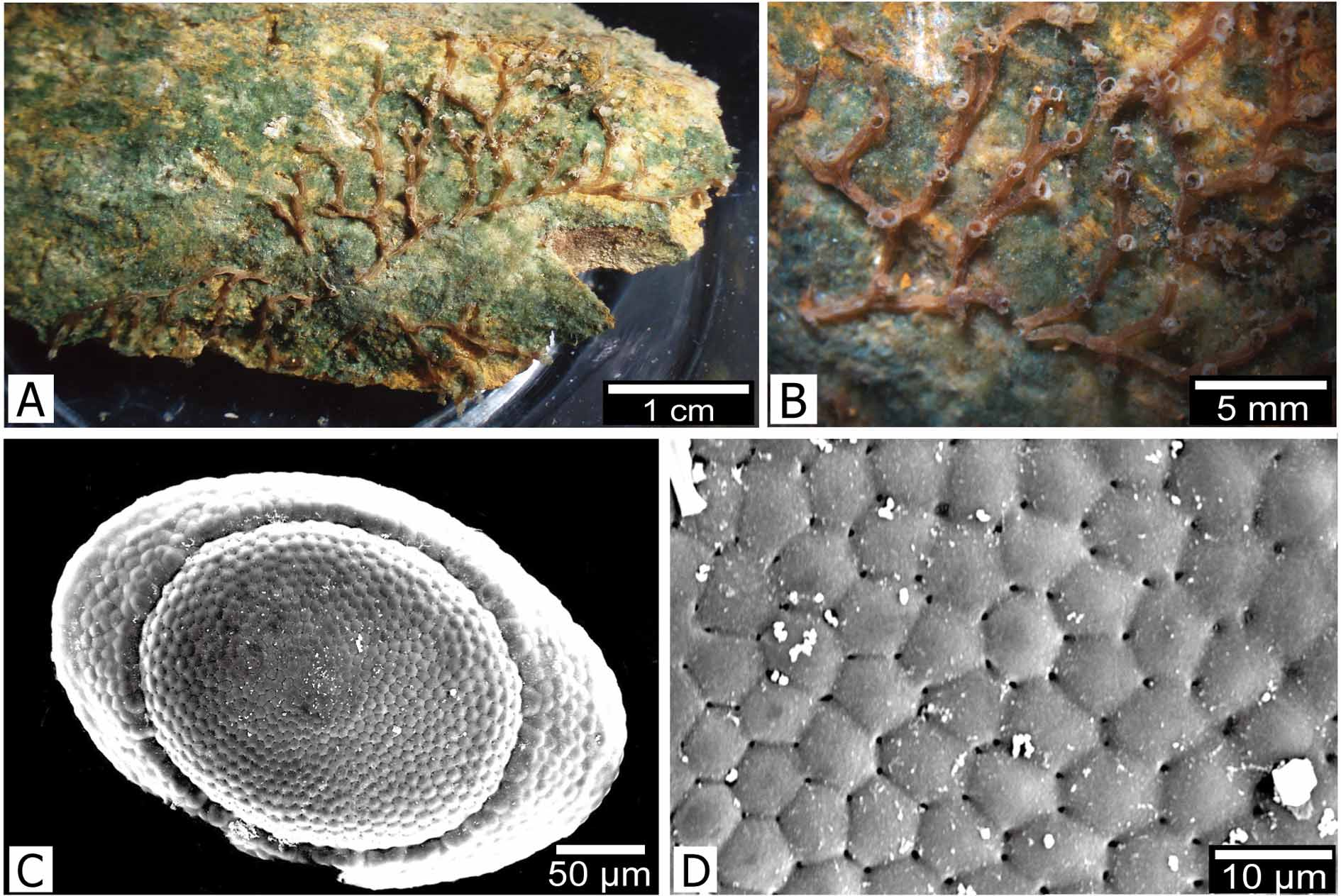
Description. Observed colony light brown or reddish brown, its surface encrusted (Fig. 3 A); almost entirely recumbent, with pronounced keel, ends of branches often rising from substratum (Fig. 3 B). Tentacle number about 45. Floatoblast elliptical in our specimen, large, about 340 – 410 (366 ± 38) μm long by 180 – 236 (215 ± 31) μm wide (n = 3) (Fig. 3 C); length / width ratio about 1.8. Fenestrae of floatoblast large; in SEM view, surface entirely covered with minute, rounded tubercles that are rounded-hexagonal in outline, with 5 – 8 (average 6) small, irregular pores in the angles (Fig. 3 D). Ventral fenestra 200 – 246 (225 ± 23) μm long by 182 – 211 (194 ± 15) μm wide; dorsal fenestra about 150 – 180 (174 ± 10) μm long by 130 – 160 (139 ± 16) μm wide (n = 3). Floatoblast valves asymmetrical in lateral and transverse views, the ventral valve strongly convex and dorsal valve almost flat. Suture line of both valves with a simple ridge. Sessoblast also with tuberculate surface (Wood et al. 2006).
Hirose, Masato, Mawatari, Shunsuke F. (2011): Freshwater Bryozoa of Okinawa, Japan, with descriptions of Rumarcanella gen. nov. (Phylactolaemata: Plumatellidae) and two new species. Zootaxa 2732: 1-19, DOI: 10.5281/zenodo.276554
Remarks. Kraepelin (1906) originally described P. javanica from Indonesia. Previous authors have considered statoblast morphology, colony color and colony form as important diagnostic characters of this species. Annandale (1911) reported a transparent, glassy ectocyst and a strong raphe, and Smith & Wood (1995) also indicated these characters. However, as with other plumatellid species, these characters vary ecophenotypically; for example, Annandale (1911) specifically mentioned variation in the form of colonies attached to dead wood. Like P. javanica, P. vorstmani (see below) also has a transparent ectocyst, but the tentacle number in P. j a v a n i c a is almost twice that in P. vorstmani, and statoblast size and morphology are different.
Hirose, Masato, Mawatari, Shunsuke F. (2011): Freshwater Bryozoa of Okinawa, Japan, with descriptions of Rumarcanella gen. nov. (Phylactolaemata: Plumatellidae) and two new species. Zootaxa 2732: 1-19, DOI: 10.5281/zenodo.276554
Distribution. Distributed mainly in tropical regions (Bushnell 1973), including Southeast Asia (Lacourt 1968; Wood et al. 2006), central Africa (Wiebach 1964), and the Amazon River in South America (Wiebach 1967, 1970). This is the first record of P. javanica from Japan, where it occurs on Okinawa and the Pacific side of southern Honshu (Ibaraki, Tokyo, and Kochi Prefectures).
Hirose, Masato, Mawatari, Shunsuke F. (2011): Freshwater Bryozoa of Okinawa, Japan, with descriptions of Rumarcanella gen. nov. (Phylactolaemata: Plumatellidae) and two new species. Zootaxa 2732: 1-19, DOI: 10.5281/zenodo.276554
Material examined. Mature colony with floatoblasts from Fukuji Dam, village of Higashi.
Hirose, Masato, Mawatari, Shunsuke F. (2011): Freshwater Bryozoa of Okinawa, Japan, with descriptions of Rumarcanella gen. nov. (Phylactolaemata: Plumatellidae) and two new species. Zootaxa 2732: 1-19, DOI: 10.5281/zenodo.276554
Export occurrence data
Darwin Core Archive (ZIP)
CLASSIFICATION
Taxonomic Classification Tree

NOMENCLATURE
Synonyms(1)
MULTIMEDIA
Media Files(1)
FIGURE 3. Plumatella javanica Kraepelin, 1906. A, B, colony on a stone at two magnifications. C, SEM micrograph of floatoblast, ventral view. D, enlarged view of the fenestra surface in C, showing the small, irregular pores.
Imageimage/png© Hirose, Masato;Mawatari, Shunsuke F.Hirose, Masato;Mawatari, Shunsuke F.
IMAGES