
AnimaliaacceptedgenusAccepted
Plumatella
Lamarck, 1816
GBIF:119384682
0datasets
0year
0
Descendants
0
Children
0
Species
ABOUT
Descriptions(6)
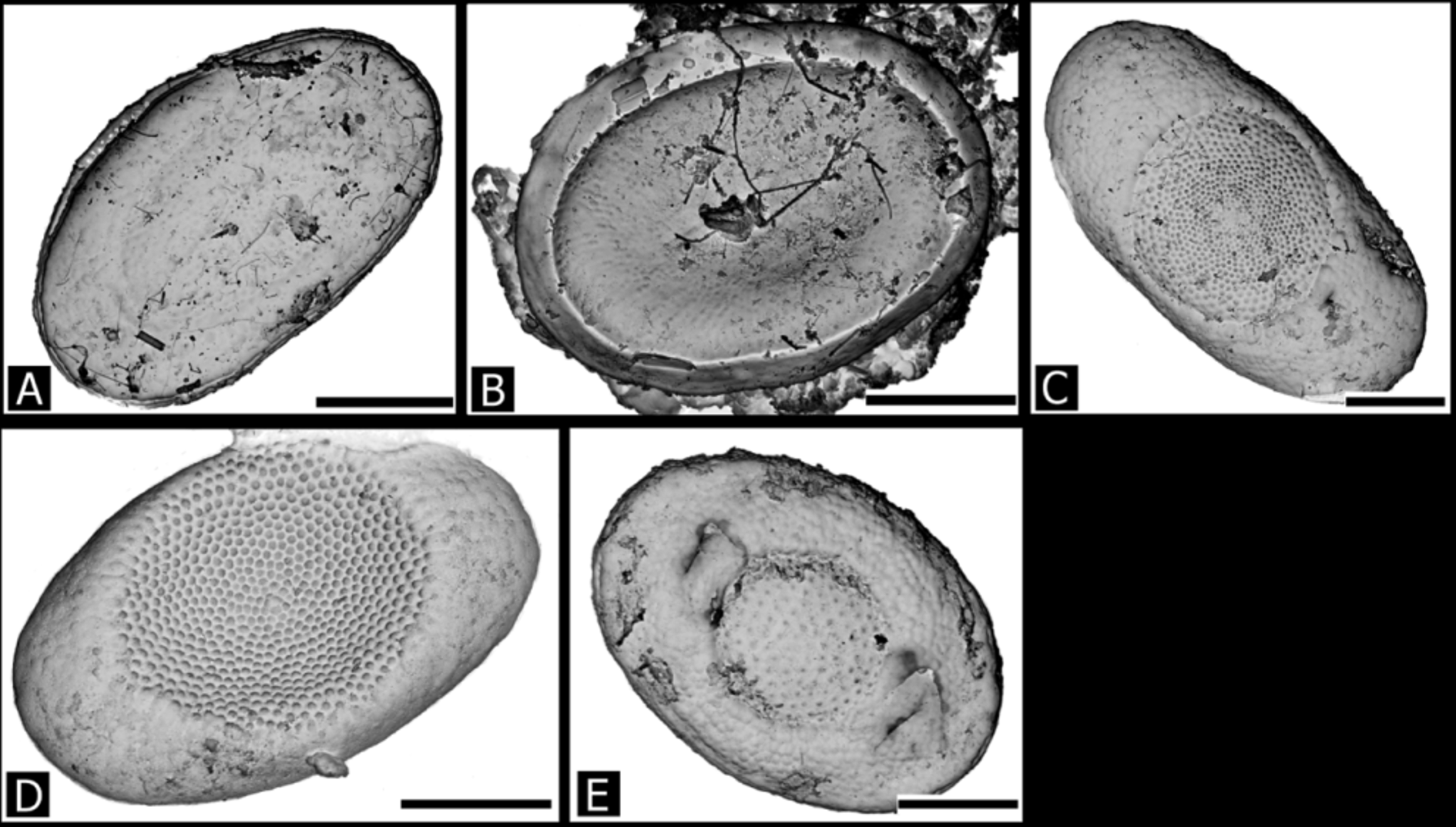
Description. Colony variable; tubular, light brown, almost entirely attached to substratum; compact colonies sometimes assuming a honeycomb-like shape; tentacle number about 21 – 25 (Hozawa & Toriumi 1940; Bushnell & Wood 1971). Two types of free floatoblasts, the normal plumatellid floatoblast (capsuled floatoblast) and another lacking the internal capsule (leptoblast). In sampled Okinawan population, the capsuled floatoblast is oval, 334 – 369 (348 ± 11) μm long by 192 – 212 (203 ± 7) μm wide (n = 10), with length / width ratio of about 1.7, symmetrical in lateral view; surface of fenestra with weak tubercles or sometimes almost smooth (Fig. 2 A). Leptoblast elliptical, longer than capsuled floatoblast, 369 – 390 (378 ± 11) μm long by 164 – 197 (179 ± 17) μm wide (n = 3), with length / width ratio of about 2.1. Sessoblast 285 – 312 (296 ± 11) μm long by 206 – 232 (224 ± 12) μm wide (n = 4), with length / width ratio of about 1.3; annulus wide and smooth, the surface of the capsule smooth (Fig. 2 B).
Hirose, Masato, Mawatari, Shunsuke F. (2011): Freshwater Bryozoa of Okinawa, Japan, with descriptions of Rumarcanella gen. nov. (Phylactolaemata: Plumatellidae) and two new species. Zootaxa 2732: 1-19, DOI: 10.5281/zenodo.276554
Diagnosis. Colony composed of branching tubules, well chitinized; ectocyst varies in thickness and form depending on the species, the age of the colony and the environment. Colonies produce both floatoblasts and sessoblasts; a type of floatoblast called a leptoblast that lacks the internal capsule has been reported only from Plumatella casmiana.
Hirose, Masato, Mawatari, Shunsuke F. (2011): Freshwater Bryozoa of Okinawa, Japan, with descriptions of Rumarcanella gen. nov. (Phylactolaemata: Plumatellidae) and two new species. Zootaxa 2732: 1-19, DOI: 10.5281/zenodo.276554
Remarks. Rogick (1941, 1943) showed detailed drawings of the colony and statoblasts of P. c a s m i a n a from North America.
Hirose, Masato, Mawatari, Shunsuke F. (2011): Freshwater Bryozoa of Okinawa, Japan, with descriptions of Rumarcanella gen. nov. (Phylactolaemata: Plumatellidae) and two new species. Zootaxa 2732: 1-19, DOI: 10.5281/zenodo.276554
Distribution. Distributed worldwide (Bushnell 1973; Wood et al. 2006); recently reported from Thailand (Wood et al. 2006); widely distributed in Japan, from Okinawa to northern Hokkaido.
Hirose, Masato, Mawatari, Shunsuke F. (2011): Freshwater Bryozoa of Okinawa, Japan, with descriptions of Rumarcanella gen. nov. (Phylactolaemata: Plumatellidae) and two new species. Zootaxa 2732: 1-19, DOI: 10.5281/zenodo.276554
Material examined. Several floatoblasts and leptoblasts from a pond in the city of Okinawa; small colonies with sessoblasts from Kanna Dam, village of Ginoza.
Hirose, Masato, Mawatari, Shunsuke F. (2011): Freshwater Bryozoa of Okinawa, Japan, with descriptions of Rumarcanella gen. nov. (Phylactolaemata: Plumatellidae) and two new species. Zootaxa 2732: 1-19, DOI: 10.5281/zenodo.276554
Type species. Tubipora repens Linnaeus, 1758.
Hirose, Masato, Mawatari, Shunsuke F. (2011): Freshwater Bryozoa of Okinawa, Japan, with descriptions of Rumarcanella gen. nov. (Phylactolaemata: Plumatellidae) and two new species. Zootaxa 2732: 1-19, DOI: 10.5281/zenodo.276554
Export occurrence data
Darwin Core Archive (ZIP)
CLASSIFICATION
Taxonomic Classification Tree

MULTIMEDIA
Media Files(1)
FIGURE 2. SEM micrographs of statoblasts from three phylactolaemate species from Okinawa. A, Plumatella casmiana Oka, 1907, floatoblast, dorsal view. B, Plumatella casmiana, sessoblast. C, Plumatella emarginata Allman, 1844, floatoblast, ventral view. D, Plumatella mukaii Wood, 2001, floatoblast, ventral view. E, Plumatella repens (Linnaeus, 1758), floatoblast, dorsal view. Scale bars: 100 μm.
Imageimage/png© Hirose, Masato;Mawatari, Shunsuke F.Hirose, Masato;Mawatari, Shunsuke F.
IMAGES