AnimaliaNot EvaluatedacceptedspeciesAccepted
Chikila fulleri

Chikila fulleri

(Alcock, 1904) Alcock, 1904

GBIF:119569667

0year

ABOUT

Descriptions(7)

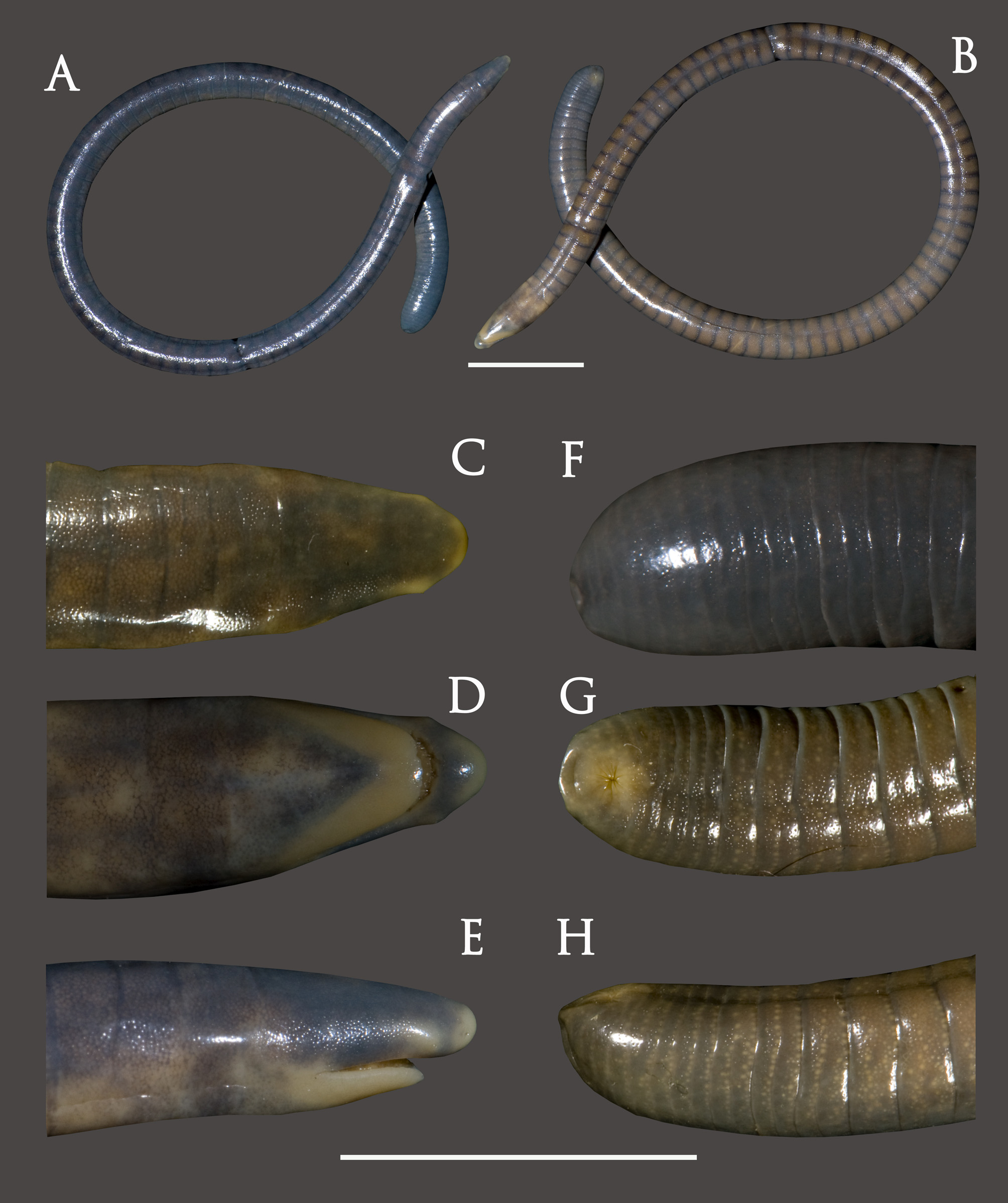
Description of the species Chikila fulleri (Figure 9 A, 10 and 11). Some morphometric and meristic data are given in Tables 3 C and 4. Body slightly tapering on anterior half; dorsoventrally flattened; L / W = 28 – 37.9. Head shape variable, mostly moderately pointed. In lateral view, top of head straight or marginally convex; upper lip concave (barely in BNHS 5510) with apex generally closer to TA than to eye; lower jaw height from just over a half to just under one times the height of upper jaw at CM. In ventral view, lower jaw and AM more blunt anteriorly than ST, but variably so. Eyes visible (e. g., in BNHS 5510, BNHS 5513, BNHS 5516) as dark very diffuse spot (larger than TAs) on one or both sides or not. TAs generally elevated (to varying extent), visible ventrally (not dorsally), on or just below imaginary line from naris to CM, about same size or slightly smaller than nares, quite variable from narrow to subcircular, generally with long axis pointing down and backwards. Nares not clearly visible in dorsal or ventral view. Teeth of inner series smaller; VP series angulate anteriorly; snout projects beyond anterior of mouth ca. 1.5 to a little more than twice distance between PM and VP series anteriorly. Choanae ovate, the smallest distance between them 1.5 to 2 times width of each at that point. Tongue pointed, mostly pale and unpigmented, with paired paramedian grooves posteriorly and sometimes also a single paramedian and / or lateral grooves. Darker narial plugs not projecting beyond anterior margin of tongue, partially surrounded by grooves that are incomplete either posteriorly (e. g., BNHS 5514, ZSI A 11535, SDB. DU 1308) or anteriorly (e. g., BNHS 5515). Nuchal region marginally more massive than back of head and body. NG 1 and NG 2 mostly complete and generally strongly marked, faint and incomplete in BNHS 5515; NG 1 complete but NG 2 incomplete ventrally in BNHS 5510 and BNHS 5511. Longitudinal midline crease between mandibles extending slightly onto C 1 in BNHS 5509, BNHS 5513, BNHS 5516 and SDB. DU 2009.533, and to back of C 1 in ZSI A 11535. AGs dorsally mostly incomplete except on anterior and posterior sixths of the body (except BNHS 5513, BNHS 5516, SDB. DU 2009.533) mostly narrowly incomplete ventrally except in last fifth of body (except BNHS 5513, BNHS 5516, SDB. DU 2009.533), patches more substantially incomplete at midbody in some (e. g., BNHS 5509, BNHS 5515). Posterior edges of PAs generally slightly raised posteriorly. Vent mostly slightly wider than long (e. g., BNHS 5510) or more circular (e. g., BNHS 5509) with little difference in lengths of anterior and posterior denticulations; vent region interrupts last two to five AGs, mostly three. Vent in circular, fairly discreet disc with 10 – 12 denticulations. Two rows of strongly overlapping, squarish (0.6 x 0.5 mm) scales, and possibly a third row of supernumerary scales, present dorsally in posterior (85 th PA) of body in pocket approximately half-length of PA in BNHS 5509. One scale row and no supernumerary scales in BNHS 5511 and, two rows and no supernumeraries in SDB. DU 1304 and BNHS 5516. Bicoloured, dorsally grey to more brownish grey anteriorly, notably darker posteriorly; ventrally variable tan. Dorsal grey stops fairly abruptly just above midway down flank on anterior half, while further posteriorly it extends further ventrally. A thin, faint and sometimes patchy (e. g., BNHS 5510) dark line below the transition from dorsal to ventral colour, less clear more posteriorly. Head may or may not be more grey on dorsum than body, but all specimens have some paler marking, often posterior to the expected position of the mesethmoid and the mm. depressor mandibulares. ST with pale spot extending back to converge with faintly indicated large, pale spots encompassing nares. TAs in whitish spot with narrower stripe extending back, sometimes reaching, rarely extending beyond expected position of eye. Colour on ventral surface of head and collars variable and irregular. Entire ventral surface of head to level of CMs unpigmented in BNHS 5515, with pigmentless area extending up sides of C 1 and a little less up sides of C 2, fading out on third PA. SDB. DU 1308 has thick white lines along edges of lower jaw, separated medially by a grey triangle with barely a hint of ventral midline colour invading the triangle and a large white spot ventrally on C 2. In SDB. DU 1304 there are whitish mandibular lines, thick on the left and thin on the right, barely continuous anteriorly, separated by a grey triangle with patchy brownish ventral colour medially. Macroscopically, AGs appear darker than adjacent skin except posteriorly where they may appear a little paler. Microscopically, AGs usually have a poorly marked whitish edge and the posterior end of each annulus has a narrow darker area, at least ventrally and dorsolaterally, that tends to expand but becomes more diffuse as it crosses the midline ventrally, even where AGs are incomplete. Some posteriormost annuli on dorsum have a substantial somewhat darker aglandular area on posterior margins. Disc generally pigmented but variably so. Entire disc pigmented in some (e. g., BNHS 5509, BNHS 5516, SDB. DU 1304). Pigment on at least the base of some denticles (i. e. proximal to the vent) except perhaps for BNHS 5515. No unpigmented area just anterior to disc though the area all around the disc can be substantially paler than adjacent areas. In life (SDB. DU 1304, Figure 9 A) dorsally shiny dark lilac, laterally and ventrally paler lilac with a strong pinkish tinge; head paler than body; lower jaw in ventral view bears a thick cream V parallel to and reaching lower lip, bordering a dark lilac triangular patch centrally; chin, throat and anteriormost PAs with substantial pale blotches; snout tip, “ eye ” – tentacle stripe, areas around nares and CMs pale grey. In preservation (BNHS 5509, Figure 11) colour similar except lilac colours more grey dorsally and grey-brown ventrally and paler areas (e. g around nares and CMs) more whitish. Chikila alcocki Chikila darlong Female (n = 8) Male (n = 7) Female (n = 8) Male (n = 8) Range Mean SD Range Mean SD Range Mean SD Range Mean SD Length 216 – 271 243.3 20.6 204 – 255 233.1 19.0 131 – 164 145.5 12.0 144 – 198 162.6 16.9 PAs 87 – 92 90.0 1.6 89 – 94 91.9 1.7 87 – 91 89.1 1.2 86 – 92 89.6 1.8 First PA with SAG 71 – 84 75.5 4.0 67 – 87 77.1 8.0 73 – 80 76.8 2.0 73 – 79 75.6 2.1 SAGs 9 – 20 15.5 3.3 8 – 22 15.3 6.2 11 – 18 13.4 2.3 12 – 17 15 2 First PA with dorsally complete SAG 74 - 89 79.1 5.7 78 – 88 83.4 4.2 76 – 83 78.3 2.3 75 – 80 76.9 1.7 First PA with ventrally complete SAGs 81 – 89 85.1 2.2 89 – 90 89.5 0.6 81 – 87 85.0 2.2 85 – 89 86.6 1.5 TGs on C 1 0 – 1 0.9 0.4 1 – 2 1.1 0.4 1 1.0 0.0 1 1.0 0.0 TGs on C 2 1 – 2 1.1 0.4 1 – 2 1.3 0.5 1 1.0 0.0 1 – 2 1.1 0.4 LH 6.3 – 9.2 8.2 0.9 7.6 – 9.3 8.6 0.7 5.3 – 6.3 5.8 0.3 5.9 – 7.3 6.4 0.4 ST – CM 5.6 – 7.1 6.2 0.5 5.3 – 6.9 6.3 0.6 3.9 – 4.4 4.1 0.2 4.3 – 5.2 4.7 0.3 Width at CMs 4.2 – 5,6 4.9 0.5 4.3 – 5.3 4.8 0.4 2.6 – 3.4 3.0 0.3 3.0 – 4.1 3.4 0.3 WH 5.3 – 7.0 5.8 0.6 5.1 – 6.3 5.8 0.5 3.0 – 4.1 3.5 0.3 3.7 – 4.7 4.0 0.3 Denticles around vent 10 – 12 10.6 0.8 10 – 11 10.7 0.6 9 – 11 9.7 0.8 9 – 10 9.7 0.6 / W 25.1 – 34.8 30.1 3.3 26.8 – 38.9 29.7 4.3 26.1 – 38.1 31.5 3.9 29.6 – 35.8 32.3 2.1 / H 26.5 – 38.4 29.9 3.7 25.5 – 28.3 27.1 0.9 23.4 – 26.5 25.3 1.1 23.2 – 27.1 25.2 1.2 Chikila fulleri Chikila gaiduwani Female (n = 9) Male (n = 4) Female (n = 9) Male (n = 11) Range Mean SD Range Mean SD Range Mean SD Range Mean SD Length 173 – 230 196.8 21.4 160 – 190 177.8 12.8 164 – 253 219.3 30.0 202 – 272 236.2 21.7 PAs 89 – 92 91.0 1.4 89 – 92 90.5 1.3 90 – 97 93.2 2.3 89 – 97 93.6 2.4 First PA with SAG 75 – 81 78.4 2.1 71 – 79 76.0 3.5 79 – 88 83.4 2.8 76 – 90 83.0 3.8 SAGs 9 – 16 13.1 2.1 12 – 22 15.3 4.7 8 – 15 10.6 2.6 7 – 14 10.7 2.1 First PA with dorsally complete SAG 77 – 83 81.1 1.7 79 – 84 81.3 2.2 79 – 90 85.4 3.4 82 – 90 86.3 2.7 First PA with ventrally complete SAGs 85 – 90 1.2 0.8 84 – 89 86.7 2.5 84 – 92 89 3.6 86 – 95 91.3 2.9 TGs on C 1 1 1.0 0.0 0 – 1 0.8 0.5 1 1.0 0.0 1 – 2 1.2 0.4 TGs on C 2 1 – 3 1.7 0.7 1 – 2 1.8 0.5 1 – 2 1.1 0.3 1 – 3 1.5 0.7 LH 6.6 – 7.8 7.1 0.4 6.8 – 8.8 7.6 0.9 6.5 – 8.5 7.5 0.6 7.2 – 9.5 8.5 0.7 ST – CM 4.9 – 5.5 5.2 0.2 5.3 – 5.9 5.7 0.3 4.3 – 6.1 5.5 0.6 5.8 – 7.1 6.5 0.4 Width at CMs 3.6 – 4.3 4.0 0.2 3.6 – 4.1 3.8 0.2 3.3 – 4.7 4.1 0.5 4.2 – 5.5 4.9 0.4 WH 4.2 – 4.9 4.5 0.2 4.3 – 4.7 4.4 0.2 3.9 – 5.9 5.0 0.7 4.8 – 6.9 5.7 0.6 Denticles around vent 11 – 12 11.3 0.7 11 11.0 0.0 10 – 14 12.0 1.4 10 – 12 11.0 1.0 / W 28 – 37.3 33.4 3.7 29 – 36.5 32.3 3.1 28.2 – 39 34.1 4.0 30.4 – 38 33.0 2.4 / H 24.7 – 33.8 27.6 3.1 20.8 – 26.2 23.6 2.3 21.9 – 32.4 29.0 2.9 24.9 – 27.8 27.8 1.7 Character C. alcocki sp. nov. C. darlong sp. nov. C. fulleri C. gaiduwani sp. nov. (n = 15; 8 females, 7 males) (n = 16; 8 females, 8 males) (n = 13; 9 females, 4 males) (n = 20; 9 females, 11 males) English common name. The earliest suggested English common name for Chikila fulleri that we are aware of is ‘ Kuttal caecilian’ (Frank & Ramus 1995). We suggest the common name as Fuller’s chikila.
Kamei, Rachunliu G., Gower, David J., Wilkinson, Mark, Biju, S. D. (2013): Systematics of the caecilian family Chikilidae (Amphibia: Gymnophiona) with the description of three new species of Chikila from northeast India. Zootaxa 3666 (4): 401-435, DOI: 10.11646/zootaxa.3666.4.1

Gegeneophis fulleri (Alcock, 1904): Taylor (1968)
Kamei, Rachunliu G., Gower, David J., Wilkinson, Mark, Biju, S. D. (2013): Systematics of the caecilian family Chikilidae (Amphibia: Gymnophiona) with the description of three new species of Chikila from northeast India. Zootaxa 3666 (4): 401-435, DOI: 10.11646/zootaxa.3666.4.1
Diagnosis. A Chikila that differs from all congeners in having the chin, throat and underside of the anteriormost 1 st – 3 rd PA generally with substantial pale patches (vs. absent), the bases of the denticulations surrounding the vent pigmented and lacking an unpigmented patch immediately anterior to the disc that surrounds the vent (vs. disc and a patch immediately anterior to it unpigmented), very strongly pigmented AGs (very faintly marked AGs in C. alcocki, moderately pigmented AGs in C. darlong, C. gaiduwani), a generally shorter and less distinct pale eye-TA patch, normally not reaching where eye is expected to lie (vs. more extensive in length and breadth, generally encircling and extending beyond the eye). Chikila alcocki Chikila darlong Chikila fulleri Chikila gaiduwani Museum ZSIC BNHS ZSI BNHS BNHS BNHS no. 14759 1304 1306 5515 A 11543 5495 1560 1535 5502 5507 RS Status H H P RS RS P 30 PM ca. 22 27 – 28 26 25 30 28 26 27 26 33 VP – 26 – 27 25 29 – – 24 – 24 24 OM – c. 20 21 21 22 21 20 24 18 4 IM – 5 – 7 6 6 4 – 5 3 4 3 6
Kamei, Rachunliu G., Gower, David J., Wilkinson, Mark, Biju, S. D. (2013): Systematics of the caecilian family Chikilidae (Amphibia: Gymnophiona) with the description of three new species of Chikila from northeast India. Zootaxa 3666 (4): 401-435, DOI: 10.11646/zootaxa.3666.4.1
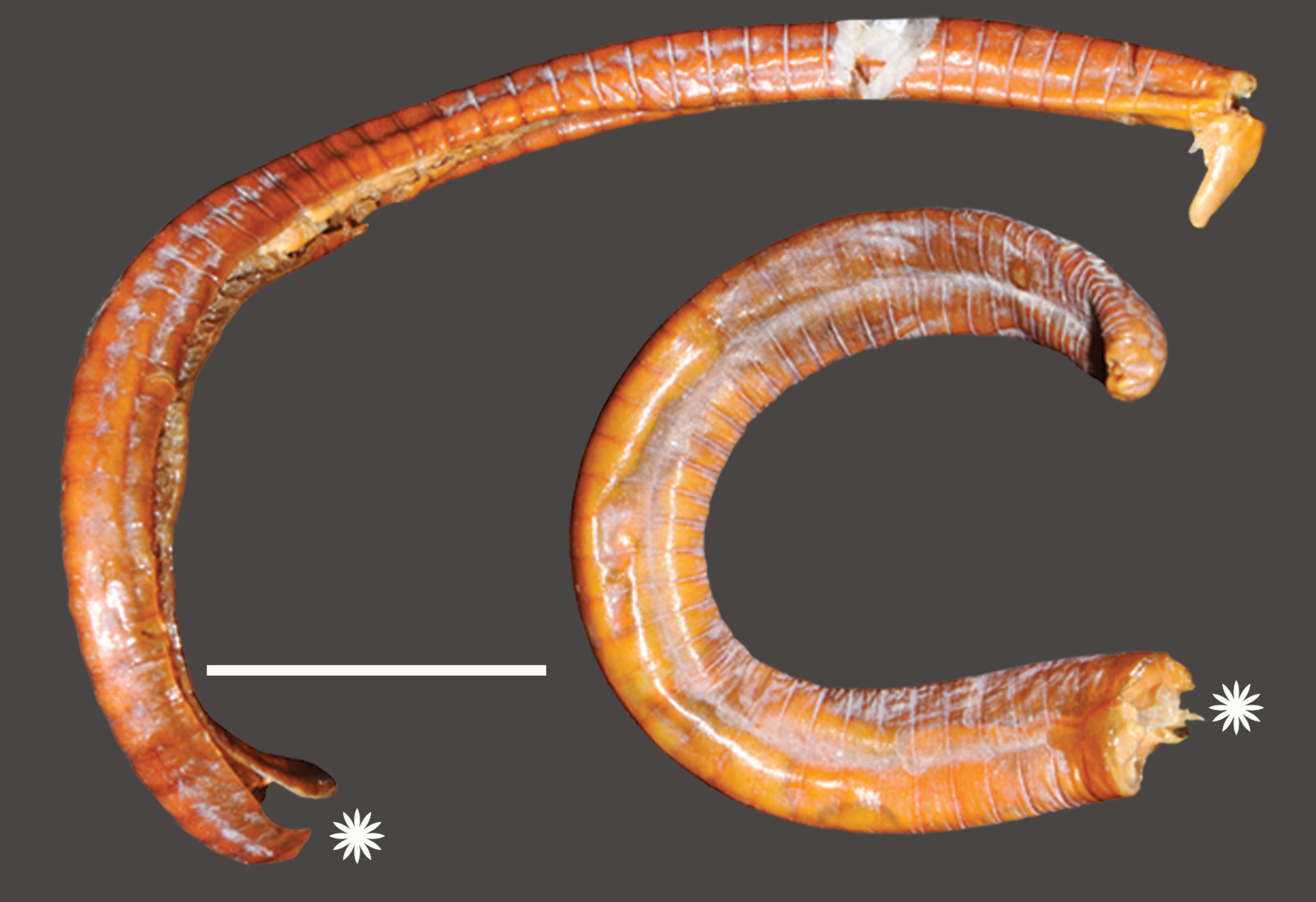
Comments. Chikila fulleri was described originally as a species of Herpele Peters, 1879. Taylor (1968) transferred the species to Gegeneophis Peters, 1879. The species was described on the basis of a single specimen that was discovered in a collection of snakes from Kuttal (Assam) that Alcock purchased from Mr C. B. Antram. Collection date as far as we know is not recorded. Until Kamei et al. ' s (2012) report no further specimens of C. fulleri had been documented and the species was thought to probably be extinct at the type locality (Ahmad 2001). The holotype (ZSIC 14579) is severely dried and broken, with part of the head missing (Figure 10) such that redescription is not particularly helpful. We provide instead a detailed description of C. fulleri based on new material, and present comparative morphometric and meristic data for a total of 13 specimens. All except four specimens in this study were collected from the type locality and there is nothing in the comparison of meristics with the holotype (Table 3 C) that causes us to think that the holotype and referred specimens are not conspecific. Live specimens from Buchangphai and Lunglei in Mizoram were examined for external morphological characters (total length, annular counts, colour) in the field but were not collected because of refusal of a permit from the state’s Forest Department. Based on external morphology and proximity of these two localities in Mizoram to the type locality (ca. 100 km), the Mizoram populations are considered most likely to belong to C. fulleri.
Kamei, Rachunliu G., Gower, David J., Wilkinson, Mark, Biju, S. D. (2013): Systematics of the caecilian family Chikilidae (Amphibia: Gymnophiona) with the description of three new species of Chikila from northeast India. Zootaxa 3666 (4): 401-435, DOI: 10.11646/zootaxa.3666.4.1
Remarks. Summary comparisons are provided in Tables 5 and 6. Beyond the differences given in the diagnosis, the examined material of Chikila fulleri differs from C. alcocki in: being more bicoloured; having a more pointed head in dorsal view; having a relatively longer, narrower head; in its relatively high TA, imaginary naris-TA line crosses upper lip much closer to CM than AM (one quarter of the distance vs. halfway). Chikila fulleri differs from C. darlong in: having an anteriorly angulate (vs. gently curved) VP series; eyes that are externally in- (or only faintly) visible; subequal VPs and PMs (vs. fewer VPs than PMs); less pointed head in dorsal view. Chikila fulleri differs from C. gaiduwani in: being less bicoloured; having an anteriorly angulate (vs. gently curved) VP series; having relatively smaller choanae. The uncorrected mean divergences (16 S and cox 1 genes) between Chikila fulleri and C. alcocki, C. darlong and C. gaiduwani are 9.5 %, 9.0 % and 8.6 %, respectively (Table 2). The data suggest also that C. fulleri might differ from C. alcocki in being more attenuate; from C. darlong in attaining a greater maximum length; and from C. gaiduwani in relatively fewer SAGs and in attaining a smaller maximum length.
Kamei, Rachunliu G., Gower, David J., Wilkinson, Mark, Biju, S. D. (2013): Systematics of the caecilian family Chikilidae (Amphibia: Gymnophiona) with the description of three new species of Chikila from northeast India. Zootaxa 3666 (4): 401-435, DOI: 10.11646/zootaxa.3666.4.1
Distribution and natural history. The type locality of Chikila fulleri as recorded in the original description is ‘ Kuttal, six miles southwest of Silchar in Cachar’ (Alcock 1904). A label in the holotype bottle reads ‘ Kuttal (Rampur Tea Garden) '. The newly collected specimens reported here are from the Prakashpur Division of Kathal Tea Estate, Silchar, Cachar District, Assam. The type locality as recorded in the original description (Alcock 1904) refers to the present Kathal Tea Estate located southwest of Silchar, Cachar district of Assam. Kathal Tea Estate was established in approximately 1860 and was the first tea garden established in Cachar district (G S Sodhi, General Manger, Kathal Tea Estate, personal communication, 2007). The new specimens were collected from inside the tea garden by digging in moist, sandy soils that supported sparse grass, shrubs and climbers. An additional specimen (BNHS 5511) was collected from approximately 30 km southeast of the type locality, in Chinglaeu, Bhubon Hills, Silchar, Assam by digging in loamy soils moistened by a seepage. The northern Tripura specimens were collected from a marshy area near a pond around human habitation. The southern Tripura specimens were collected in marshy areas alongside permanent streams within Trishna Wildlife Sanctuary. Though previously known only from the holotype from Assam, C. fulleri is now known to be relatively widely distributed, extending to at least one (Tripura) and probably a second (Mizoram) additional northeast Indian state (Figure 1; Table 1). The species is currently known to occur at elevations ranging from 10 – 602 meters asl and was common at a couple of localities.
Kamei, Rachunliu G., Gower, David J., Wilkinson, Mark, Biju, S. D. (2013): Systematics of the caecilian family Chikilidae (Amphibia: Gymnophiona) with the description of three new species of Chikila from northeast India. Zootaxa 3666 (4): 401-435, DOI: 10.11646/zootaxa.3666.4.1
Holotype. ZSIC 14759, female (large oval yolky eggs) from “ Kuttal, 6 miles south-west of Silchar in Cachar " (Alcock 1904), Assam, India. Referred material. BNHS 5509, SDB. DU 1308, collected 0 2 May 2008 from Prakashpur; BNHS 5510, BNHS 5514, ZSI A 11535, SDB. DU 1304, collected 0 2 May 2008 from Prakashpur 1; BNHS 5515, SDB. DU 1306, collected 0 3 May 2008 from Prakashpur 2; BNHS 5511, collected 0 4 May 2008 from Chinglaeu, Bhubon Hills; SDB. DU 2009.533, collected 0 4 July 2009 from Joychandpur tower; BNHS 5516, collected 0 7 July 2009 from Rambhadra; BNHS 5513, collected 10 July 2009 from below Eden Tourist Lodge 1. All referred specimens collected by RGK & SDB.
Kamei, Rachunliu G., Gower, David J., Wilkinson, Mark, Biju, S. D. (2013): Systematics of the caecilian family Chikilidae (Amphibia: Gymnophiona) with the description of three new species of Chikila from northeast India. Zootaxa 3666 (4): 401-435, DOI: 10.11646/zootaxa.3666.4.1

Export occurrence data

Darwin Core Archive (ZIP)

CLASSIFICATION

Taxonomic Classification Tree

MULTIMEDIA

Media Files(6)

FIGURE 1. Northeast India showing the distribution of the genus Chikila. Positioning of locality dots is approximate; for exact coordinates, see Table 1.

Imageimage/png© Kamei, Rachunliu G.;Gower, David J.;Wilkinson, Mark;Biju, S. D.Kamei, Rachunliu G.;Gower, David J.;Wilkinson, Mark;Biju, S. D.

FIGURE 2. DNA phylogeny of Chikila based on the analysis of 1,982 base pairs (bp) of mitochondrial (mt) sequence data comprising a 696 bp long fragment of mt cytochrome oxidase 1 (cox 1), and two (non-overlapping) fragments of mt small subunit ribosomal DNA (16 S) of 463 and 823 bp. Numbers at nodes are support values for Maximum Likelihood (ML) and Bayesian inference (BI) analyses (see Kamei et al. 2012 for details).

Imageimage/png© Kamei, Rachunliu G.;Gower, David J.;Wilkinson, Mark;Biju, S. D.Kamei, Rachunliu G.;Gower, David J.;Wilkinson, Mark;Biju, S. D.

FIGURE 3. Midbody (lateral view) of Chikila species skinned and unskinned to show the pigmentation of the annular grooves and of septa in the underlying musculature. A. Chikila alcocki sp. nov. (SDB. DU 1662), B. Chikila darlong sp. nov. (SDB. DU 1695), C. Chikila fulleri (SDB. DU 1304), D. Chikila gaiduwani sp. nov. (SDB. DU 1560). Scale bar: 10 mm.

Imageimage/png© Kamei, Rachunliu G.;Gower, David J.;Wilkinson, Mark;Biju, S. D.Kamei, Rachunliu G.;Gower, David J.;Wilkinson, Mark;Biju, S. D.

FIGURE 9. Photographs of profile in life. A. Topotype of Chikila fulleri (SDB. DU 1304), B. Holotype of Chikila gaiduwani sp. nov. with eggs (ZSI A 11543).

Imageimage/png© Kamei, Rachunliu G.;Gower, David J.;Wilkinson, Mark;Biju, S. D.Kamei, Rachunliu G.;Gower, David J.;Wilkinson, Mark;Biju, S. D.

FIGURE 10. Preserved holotype of Chikila fulleri (ZSIC 14759). Scale bar: 20 mm.

Imageimage/png© Kamei, Rachunliu G.;Gower, David J.;Wilkinson, Mark;Biju, S. D.Kamei, Rachunliu G.;Gower, David J.;Wilkinson, Mark;Biju, S. D.

FIGURE 11. A preserved topotype of Chikila fulleri (BNHS 5509). A. Dorsal, B. Ve nt ra l, C. Dorsal view of head, D. Ven t ral view of head, E. Lateral view of head, F. Dorsal view of body terminus, G. Ventral view of body terminus, H. Lateral view of body terminus. Scale bars: A – B, 20 mm; C – H, 10 mm.

Imageimage/png© Kamei, Rachunliu G.;Gower, David J.;Wilkinson, Mark;Biju, S. D.Kamei, Rachunliu G.;Gower, David J.;Wilkinson, Mark;Biju, S. D.

IMAGES

Gallery(6)

See Gallery

Occurrences with images

Source Information

Systematics of the caecilian family Chikilidae (Amphibia: Gymnophiona) with the description of three new species of Chikila from northeast India

checklist

This dataset contains the digitized treatments in Plazi based on the original journal article Kamei, Rachunliu G., Gower, David J., Wilkinson, Mark, Biju, S. D. (2013): Systematics of the caecilian family Chikilidae (Amphibia: Gymnophiona) with the description of three new species of Chikila from northeast India. Zootaxa 3666 (4): 401-435, DOI: 10.11646/zootaxa.3666.4.1

Abstract

A taxonomic review of the monogeneric northeast Indian caecilian family Chikilidae is presented based on 64 specimens. Chikila fulleri (Alcock, 1904), known previously only from a single specimen collected more than 100 years ago, is rediagnosed and characterised based on recent collections. We describe three additional species new to science, Chikila alcocki sp. nov., Chikila darlong sp. nov., and Chikila gaiduwani sp. nov. This species-level taxonomy is consistent with mitochondrial DNA sequence data. A key to the species of Chikila is presented.

Key words: DNA, herpetology, identification key, morphology, taxonomy

Kamei R G, Gower D J, Wilkinson M, Biju S D, plazi (2013). Systematics of the caecilian family Chikilidae (Amphibia: Gymnophiona) with the description of three new species of Chikila from northeast India. Plazi.org taxonomic treatments database. Checklist dataset https://doi.org/10.11646/zootaxa.3666.4.1 accessed via GBIF.org on 2026-06-18.

CC0Published 12/31/2013View dataset
GBIF Usage Key
119569667
Dataset Key
ae8b490a-b325-4d9f-90ed-ba0721b3bf5b
Origin
source
Backbone Key
8670052
Taxon ID
FD2D8785FFD2802BFF7DFD29FEB0FB1C.taxon
Last Crawled
6/11/2026
Last Interpreted
6/11/2026