AnimaliaNot EvaluatedacceptedspeciesAccepted
Chikila darlong

Chikila darlong

GBIF:119569669

ABOUT

Descriptions(7)

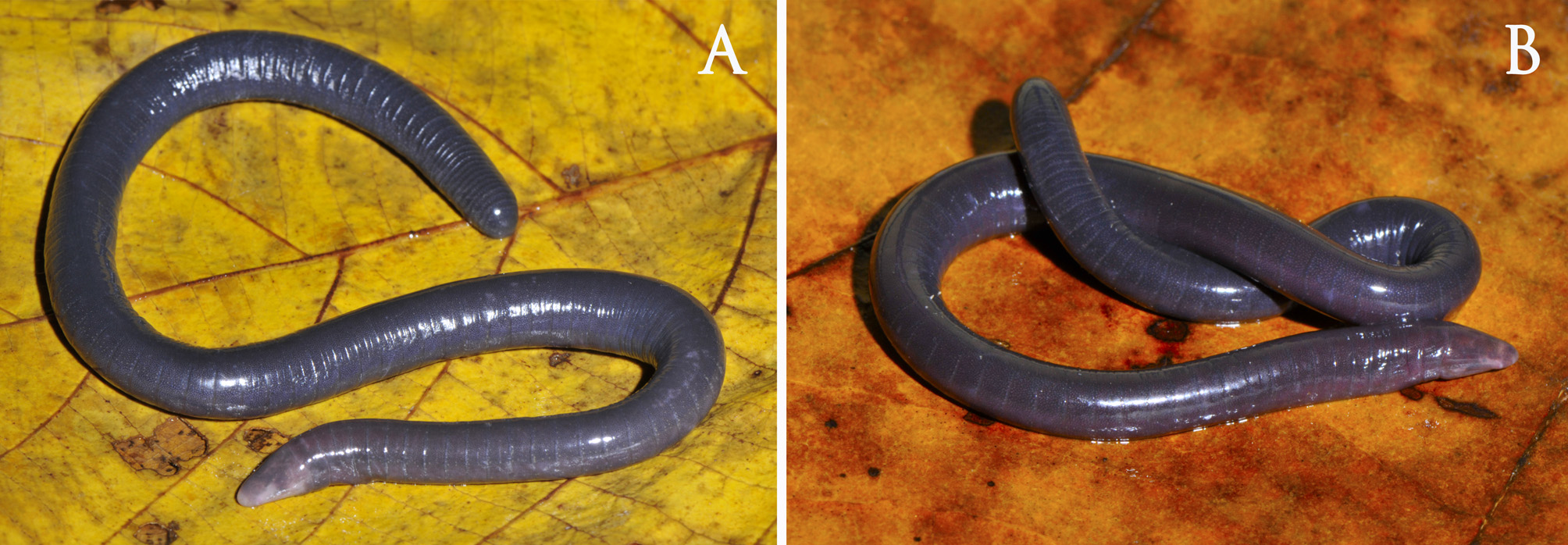
Description of the holotype (Figures 4 B and 8). Some morphometric and meristic data are given in Tables 3 B and 4. In good condition; a midventral incision extending for ca. 15 mm from ca. 30 mm anterior to vent; one posterior scale pocket open dorsally; artefactual longitudinal ridges laterally on all but posteriormost ca. 35 mm of body; small piece of stratum corneum missing from above and behind right naris and smaller patch around left naris; terminal cap with two dents. Female with yolky ova, largest 3.6 x 1.8 mm. Body distinctly tapering on anterior half; L / W = ca. 32. In dorsal view, sides of head straight, converging strongly to level of TAs, gradually between TAs and snout tip. In lateral view, top of head weakly convex; upper lip concave with apex slightly closer to level of eye than TA; lower jaw approximately same height as upper jaw at CM. In ventral view, lips slightly more blunt anteriorly than ST. Eyes visible as dark spots, larger than TAs and nares, approximately halfway between lip and top of head in lateral view, barely inset from sides of head in dorsal view, lenses not discernable. TAs distinctly closer to imaginary lines between nares and eyes than to lip, slightly elevated, visible ventrally (not dorsally), lying on imaginary lines between nares and CMs. Nares barely visible ventrally, not dorsally. Teeth of inner series approximately half as small as those of outer series; VP series forming gently curved (not angulate) arc anteromedially; projection of snout approximately twice the distance between VP and PM series anteriorly. Choanae ovate, the smallest distance between them approximately twice the width of each at that point; valves visible. No gap between anterior tip of tongue and IMs, or between lateral margins of tongue and OMs. Narial plugs flap-like, not extending beyond tongue margin, separated from body of tongue by deep grooves, except posteriorly. Tongue with deep median furrow and a clear lateral groove on each side. Nuchal region slightly more massive than adjacent body and back of head. NG 1 and NG 2 completely encircling body, NG 2 particularly strongly and NG 1 more weakly marked ventrally, NG 2 curving slightly anteromedially on dorsum; one long TG on C 2, one shorter TG on C 1 barely visible in lateral view. AGs mostly narrowly incomplete middorsally except for approximately anterior sixth and posterior eighth of body where complete; ventrally AGs mostly incomplete along midline (more narrowly so anteriorly than at midbody), complete on posterior sixth of body. Posterior edges of most PAs flat, slightly raised posteriorly. Anteriormost SAG right lateral and dorsolateral on 77 th PA; SAGs middorsally complete from 80 th PA, ventrally complete on 83 rd, 85 th and 86 th PAs. Vent region interrupts last five AGs. Vent distinctly closer to front than back of ovate (wider than long), fairly discrete disc with 10 vent denticulations. One main row of substantially overlapping scales present dorsally in posterior (84 th PA) of body in pocket approximately half-length of PA. Scales here squarish (0.6 mm). Bicoloured, dorsally grey, ventrally brown with weak, darker midventral line; darker on last tenth of body. Dorsal grey stops abruptly (less so posteriorly) just above halfway down flank; ventral brown not notably paler ventrally. Top of head with some central patches paler than body. Midline of lower jaw anteriorly with projection of same brown as body; lateral to this a grey V, a thick whitish V, and then very thin pale grey (patchy anteriorly) bordered by thicker whitish edge to lower lip. TAs and eyes in whitish spots connected by narrower whitish stripe. Nares in broad whitish blotches that meet anteriorly at pale snout tip. To unaided eye, AGs distinct, dark except immediately anterior to vent where whitish. Microscopically, AGs laterally with whitish edge, giving way to darker very narrow glandular posterior margins of annuli; ventrally, a thicker dark band (microscopically with line of scattered pale enlarged glands) just behind anterior edge of annuli extending across midline even where AGs incomplete. Disc surrounding vent unpigmented; unpigmented area extends in front of disc for approximately half length of disc. Tongue unpigmented. In life (Figure 4 B), dorsally lavender brown, darker towards posterior one-tenth of body, darker dorsum colour stops more or less abruptly approximately halfway down the flank and merges with paler ventral colour. Head paler than rest of body and with some white patches; eyes and TAs in flesh-pink spots connected by narrower stripe; nares, lips, areas around CMs and snout tip whitish; lower jaw bears a thick whitish V separated from the whitish margins of lips.
Kamei, Rachunliu G., Gower, David J., Wilkinson, Mark, Biju, S. D. (2013): Systematics of the caecilian family Chikilidae (Amphibia: Gymnophiona) with the description of three new species of Chikila from northeast India. Zootaxa 3666 (4): 401-435, DOI: 10.11646/zootaxa.3666.4.1

Diagnosis. A Chikila that differs from all congeners in its more pointed head shape in dorsal view (vs. moderately broad in C. alcocki, moderately pointed in C. fulleri, broad in C. gaiduwani), fewer VPs than PMs (vs. generally more VPs than PMs), and eyes generally distinct as black spots in life and preservation (vs. not visible).
Kamei, Rachunliu G., Gower, David J., Wilkinson, Mark, Biju, S. D. (2013): Systematics of the caecilian family Chikilidae (Amphibia: Gymnophiona) with the description of three new species of Chikila from northeast India. Zootaxa 3666 (4): 401-435, DOI: 10.11646/zootaxa.3666.4.1
Distribution and natural history. Chikila darlong is known from the type locality in Darlong and from Pakke Tiger Reserve (approximately 3 – 5 km from the type locality) (Figure 1; Table 1). The type series and one referred specimen (SDB. DU 1738) were collected by digging in slushy mud next to perennial streams bordering paddy fields; soil was clay loam. The referred specimens BNHS 5486, ZSI A 11548, SDB. DU 1694, SDB. DU 1695 were collected from secondary forest in Pakke Tiger Reserve in slushy areas about one metre away from small, perennial streams. The species is known from altitudes of 120 – 350 m asl and was common (not difficult to find) at the type locality. Chikila darlong is the first, and only caecilian species endemic to Arunachal Pradesh.
Kamei, Rachunliu G., Gower, David J., Wilkinson, Mark, Biju, S. D. (2013): Systematics of the caecilian family Chikilidae (Amphibia: Gymnophiona) with the description of three new species of Chikila from northeast India. Zootaxa 3666 (4): 401-435, DOI: 10.11646/zootaxa.3666.4.1
Etymology. The species is named after Darlong where the type series was collected. Darlong is treated as an invariable noun in apposition to the generic name. Suggested English common name. Darlong chikila.
Kamei, Rachunliu G., Gower, David J., Wilkinson, Mark, Biju, S. D. (2013): Systematics of the caecilian family Chikilidae (Amphibia: Gymnophiona) with the description of three new species of Chikila from northeast India. Zootaxa 3666 (4): 401-435, DOI: 10.11646/zootaxa.3666.4.1
Holotype. ZSI A 11546, female, collected 0 7 July 2008 by RGK & SDB from Darlong (26.93722 N, 92.99611 E; 121 m asl), Seijosa, East Kameng district, Arunachal Pradesh, India. Paratypes. BNHS 5482 – 5484, BNHS 5488 – 5489, ZSI A 11545, collected with the holotype; ZSI A 11547, BNHS 5490 – 5492, collected 0 8 July 2008 from Darlong 1 (ca. one km from the holotype locality). All specimens collected by RGK & SDB. Referred specimens. SDB. DU 1694, collected 0 6 July 2008 from Pakke Tiger Reserve (PTR); BNHS 5486, collected 0 9 July 2008 from PTR 2 (Jaali nullah 2); ZSI A 11548 collected 0 6 July 2008 from PTR 3 (Jaali nullah 3); SDB. DU 1695 collected 0 6 July 2008 from PTR; SDB. DU 1738, collected 0 9 July 2008 from Darlong 1. All specimens collected by RGK & SDB.
Kamei, Rachunliu G., Gower, David J., Wilkinson, Mark, Biju, S. D. (2013): Systematics of the caecilian family Chikilidae (Amphibia: Gymnophiona) with the description of three new species of Chikila from northeast India. Zootaxa 3666 (4): 401-435, DOI: 10.11646/zootaxa.3666.4.1
Variation and additional information from the paratypes and referred specimens. Some morphometric and meristic data are given in Tables 3 B and 4. Noteworthy differences from the type include the following. Any anterior tapering of the body is weak. Convergence of sides of head in dorsal view is stronger in ZSI A 11545 and BNHS 5488. In lateral view, top of head straight in some specimens (e. g., BNHS 5492), position of apex of mouth curvature variable, lower jaw height distinctly less than upper at CM. Eye faintly visible on either or both sides (BNHS 5492, SDB. DU 1695), not visible in ZSI A 11548, mostly more strongly inset (by up to one eye width) from the sides in dorsal view. TAs sometimes slightly below imaginary lines between nares and CMs (e. g., ZSI A 11545) and either sometimes barely visible or not dorsally and ventrally. VP series maybe either more or less angulate anteriorly. Snout projects beyond mouth about 1.25 to 2 times the distance between VP and PM series anteriorly. Narial plugs are not flap-like and do not project beyond the margin of the tongue in most specimens. Tongue pigmented or not, most have some pigment; tongue grooves present or not. Choanae sometimes only gently ovate or subcircular. NG 1 not particularly weakly indicated ventrally in some. AGs mostly smooth, never more than slightly raised. In BNHS 5482, AGs 8 – 24 are distinctly offset dorsally. Unpigmented area in front of disc not less than half length of disc, in some more than in type but less than the length of the disc. Almost entire top of head pale in BNHS 5483, and same colour as body in BNHS 5482. Median throat line usually a pale groove, generally onto back of C 1, but barely onto C 1 in BNHS 5484, BNHS 5488 and BNHS 5492. In BNHS 5482 and BNHS 5492 the white patch on throat narrower and not complete anteriorly and in some (e. g., BNHS 5491, ZSI A 11545) the associated thin grey area is particularly weak. Pale spot around eye not expanded in some (e. g., BNHS 5482, BNHS 5492). When extensive, pale areas on lower jaw often continuous with pale spots at CMs.
Kamei, Rachunliu G., Gower, David J., Wilkinson, Mark, Biju, S. D. (2013): Systematics of the caecilian family Chikilidae (Amphibia: Gymnophiona) with the description of three new species of Chikila from northeast India. Zootaxa 3666 (4): 401-435, DOI: 10.11646/zootaxa.3666.4.1
…… continued on the next page TABLE 3 D. (Continued) Remarks. Summary comparisons are provided in Tables 5 and 6. Beyond the differences given in the diagnosis, the examined material of C. darlong differs from all other species in its smaller maximum size (no specimens longer than 200 mm in length vs. largest specimens more than 225 mm). Chikila darlong differs from C. alcocki in: having moderately bicoloured adult colour pattern with a fairly gradual transition from darker dorsum to paler venter (vs. largely unicoloured); having relatively larger choanae. Chikila darlong differs from C. fulleri in: having moderately (vs. very strongly) pigmented AGs; lacking pale blotches on the chin, throat and underside of anteriormost PAs; having a more extensive (length and breadth) pale eye-TA patch generally encircling and extending beyond the eye; having an unpigmented disc around the vent and a pale patch anterior to disc; having a VP series forming a gentle arc anteriorly (vs. angulate). Chikila darlong differs from C. gaiduwani in: being moderately bicoloured with a fairly gradual transition from darker dorsum to paler venter (vs. distinctively bicoloured); having relatively smaller choanae. The uncorrected mean divergences (16 S and cox 1 genes) between Chikila darlong and C. alcocki, C fulleri and C. gaiduwani are 10.2 %, 9.0 % and 6.7 %, respectively (Table 2). The data suggest also that C. darlong might differ from C. alcocki in having relatively more SAGs and a proportionately shorter head; from C. gaiduwani in having relatively fewer SAGs.
Kamei, Rachunliu G., Gower, David J., Wilkinson, Mark, Biju, S. D. (2013): Systematics of the caecilian family Chikilidae (Amphibia: Gymnophiona) with the description of three new species of Chikila from northeast India. Zootaxa 3666 (4): 401-435, DOI: 10.11646/zootaxa.3666.4.1

Export occurrence data

Darwin Core Archive (ZIP)

CLASSIFICATION

Taxonomic Classification Tree

MULTIMEDIA

Media Files(4)

FIGURE 1. Northeast India showing the distribution of the genus Chikila. Positioning of locality dots is approximate; for exact coordinates, see Table 1.

Imageimage/png© Kamei, Rachunliu G.;Gower, David J.;Wilkinson, Mark;Biju, S. D.Kamei, Rachunliu G.;Gower, David J.;Wilkinson, Mark;Biju, S. D.

FIGURE 2. DNA phylogeny of Chikila based on the analysis of 1,982 base pairs (bp) of mitochondrial (mt) sequence data comprising a 696 bp long fragment of mt cytochrome oxidase 1 (cox 1), and two (non-overlapping) fragments of mt small subunit ribosomal DNA (16 S) of 463 and 823 bp. Numbers at nodes are support values for Maximum Likelihood (ML) and Bayesian inference (BI) analyses (see Kamei et al. 2012 for details).

Imageimage/png© Kamei, Rachunliu G.;Gower, David J.;Wilkinson, Mark;Biju, S. D.Kamei, Rachunliu G.;Gower, David J.;Wilkinson, Mark;Biju, S. D.

FIGURE 3. Midbody (lateral view) of Chikila species skinned and unskinned to show the pigmentation of the annular grooves and of septa in the underlying musculature. A. Chikila alcocki sp. nov. (SDB. DU 1662), B. Chikila darlong sp. nov. (SDB. DU 1695), C. Chikila fulleri (SDB. DU 1304), D. Chikila gaiduwani sp. nov. (SDB. DU 1560). Scale bar: 10 mm.

Imageimage/png© Kamei, Rachunliu G.;Gower, David J.;Wilkinson, Mark;Biju, S. D.Kamei, Rachunliu G.;Gower, David J.;Wilkinson, Mark;Biju, S. D.

FIGURE 4. Holotypes in life. A. Chikila alcocki sp. nov. (ZSI A 11539), B. Chikila darlong sp. nov. (ZSI A 11546).

Imageimage/png© Kamei, Rachunliu G.;Gower, David J.;Wilkinson, Mark;Biju, S. D.Kamei, Rachunliu G.;Gower, David J.;Wilkinson, Mark;Biju, S. D.

IMAGES

Gallery(4)

See Gallery

Occurrences with images

Source Information

Systematics of the caecilian family Chikilidae (Amphibia: Gymnophiona) with the description of three new species of Chikila from northeast India

checklist

This dataset contains the digitized treatments in Plazi based on the original journal article Kamei, Rachunliu G., Gower, David J., Wilkinson, Mark, Biju, S. D. (2013): Systematics of the caecilian family Chikilidae (Amphibia: Gymnophiona) with the description of three new species of Chikila from northeast India. Zootaxa 3666 (4): 401-435, DOI: 10.11646/zootaxa.3666.4.1

Abstract

A taxonomic review of the monogeneric northeast Indian caecilian family Chikilidae is presented based on 64 specimens. Chikila fulleri (Alcock, 1904), known previously only from a single specimen collected more than 100 years ago, is rediagnosed and characterised based on recent collections. We describe three additional species new to science, Chikila alcocki sp. nov., Chikila darlong sp. nov., and Chikila gaiduwani sp. nov. This species-level taxonomy is consistent with mitochondrial DNA sequence data. A key to the species of Chikila is presented.

Key words: DNA, herpetology, identification key, morphology, taxonomy

Kamei R G, Gower D J, Wilkinson M, Biju S D, plazi (2013). Systematics of the caecilian family Chikilidae (Amphibia: Gymnophiona) with the description of three new species of Chikila from northeast India. Plazi.org taxonomic treatments database. Checklist dataset https://doi.org/10.11646/zootaxa.3666.4.1 accessed via GBIF.org on 2026-06-18.

CC0Published 12/31/2013View dataset
GBIF Usage Key
119569669
Dataset Key
ae8b490a-b325-4d9f-90ed-ba0721b3bf5b
Origin
source
Backbone Key
8463428
Taxon ID
FD2D8785FFCA8023FF7DFE4BFE74FD5C.taxon
Last Crawled
6/11/2026
Last Interpreted
6/11/2026