
AnimaliaNot EvaluatedacceptedspeciesAccepted
Pseudopotamilla aspersa

Pseudopotamilla aspersa

(Krøyer, 1856) Kroyer, 1856

GBIF:128527388

0year

0

Synonyms

ABOUT

Descriptions(5)

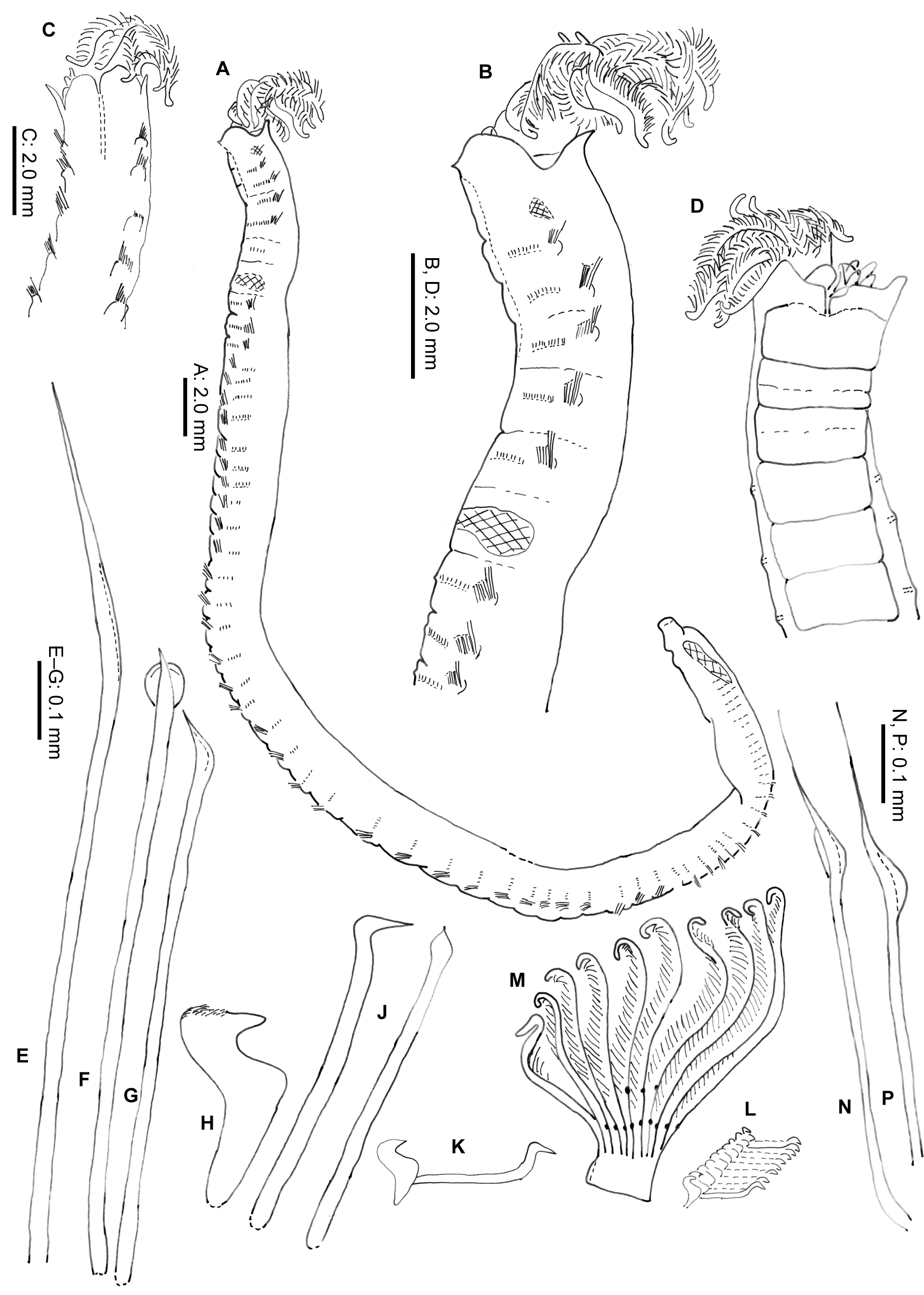
Description. Body length (without radiolar crown) about 31 (48) mm and 2 mm wide (Fig. 4 A). Crown damaged, but Krøyer’s unpublished figures of a lost syntype shows crown length equal to length of 8 thoracic segments and Fig. 4 M (copy of Krøyer’s figure) shows a detached crown with one or two single compound eyes per radiole, except dorsal-most. Dorsal lip with bifid appearance, but difficult to see (Figs 4 B – D). Body (damaged posteriorly) with about 60 (90) abdominal segments and 10 thoracic ones. First thoracic segment about twice length of following ones (Fig. 4 B). Dorsal collar margins convex with rounded, low lappets extending above junction of crown and thorax. Oblique lateral collar margins sloping posteriorly, forming each side a wide V – shaped notch showing peristomium (Fig. 4 B). Highest ventral collar margin distant from midline incision in front of small ventral sacs (Fig. 4 B – D). Anterior margin of first ventral shield indented medially, following thoracic shields rectangular, some with indistinct transverse grooves (Fig. 4 D). Thoracic tori with gap between ventral ends and lateral margins of shields (Fig. 4 B). Thoracic tori with about nine avicular uncini each with numerous teeth on crest covering third of main fang, and handle not much longer than length from breast to crest, but adjacent companion chaetae with handle at least twice as long (Figs 4 J – L). First thoracic fascicle with two rows of broadly hooded chaetae, hood a little wider than handle. Superior notochaetae of other thoracic fascicles narrowly hooded (about 5), most longer than inferior ones that are paleate (about 17) with a distal mucro (Fig. 4 F – G). All abdominal chaetae elongate broadly hooded, each with hood twice width of handle (Fig. 4 N, P). Abdominal uncini smaller than those of thorax (shorter handles, Figs 4 K – L). Pygidium bilobed. Tube “ leathery, tenacious, rather pale or yellowish, covered with sand or bare ” (Krøyer 1856). Colour. “ Yellow or orange with the lateral margins of the first four to ten segments purple ” “ purple spots on paler radioles (with a single eyespot or two.) ” (Krøyer, 1856). Preserved type pale.
Knight-Jones, Phyllis, Darbyshire, Teresa, Petersen, Mary E., Tovar-Hernández, María Ana (2017): What is Pseudopotamilla reniformis (Sabellidae)? Comparisons of populations from Britain, Iceland and Canada with comments on Eudistylia and Schizobranchia. Zootaxa 4254 (2): 201-220, DOI: 10.11646/zootaxa.4254.2.3
Diagnosis. Collar with low, rounded lappets dorsally; dorsal collar margin convex; peristomium slightly exposed laterally; lateral margins of collar V-shaped; handles of companion chaetae twice length of handles of adjacent uncini.
Knight-Jones, Phyllis, Darbyshire, Teresa, Petersen, Mary E., Tovar-Hernández, María Ana (2017): What is Pseudopotamilla reniformis (Sabellidae)? Comparisons of populations from Britain, Iceland and Canada with comments on Eudistylia and Schizobranchia. Zootaxa 4254 (2): 201-220, DOI: 10.11646/zootaxa.4254.2.3
Remarks. The type is one of three specimens of Sabella aspersa listed in Krøyer’s catalogue of sabellids (RLC). Some of his material was passed on to the Zoological Museum of the University of Copenhagen. Only one specimen remains in the ZMUC collection, which can be regarded as type. Excellent drawings exist (RLC) of a lost syntype and Krøyer shows the unusually long handles of the companion chaetae compared with those of the adjacent uncini (Fig. 4 K – L), the main diagnostic character of the species. Krøyer mysteriously mentioned “ Buccal cirri very minute almost rudimentary, but more numerous than usual (5 – 6 each side) ”. There should be only four, if one counts the enlarged pinnule attached to each dorsal lip (e. g. Fig. 1 F). The other ‘ cirri’ may have been digitiform regeneration of radioles after damage similar to the protuberances in Fig. 4 D, where the left side of the crown has been shed. Krøyer also noted that the faecal groove continues longitudinally across the thoracic ventral shields of one of his specimens. This is not uncommon, and represents a thorax once regenerated from abdominal segments after predation (or scissiparity). He notes that the species is rare so probably not found together in a clump, often an indication of scissiparity. Malmgren (1867 as Potamilla) and McIntosh (1923 as Potamilla) wrongly synonymised P. aspersa with P. reniformis, but they probably did not see Krøyer’s material and unpublished drawings. The collar of P. aspersa differs from P. reniformis in being low ventrally; in having low, rounded dorsal lappets slightly exposing the peristomium; and dorso-lateral margins with deeper notches. The most consistent difference between P. reniformis and P. aspersa is that the latter differs in having each companion chaeta with a handle about twice as long as that of its adjacent uncinus (measured from the breast). Habitat. Krøyer does not note the habitat of Pseudopotamilla aspersa. Pseudopotamilla reniformis, commonly found on the shore, is also found in Greenland, so niche separation may indicate that P. aspersa is found in deeper water.
Knight-Jones, Phyllis, Darbyshire, Teresa, Petersen, Mary E., Tovar-Hernández, María Ana (2017): What is Pseudopotamilla reniformis (Sabellidae)? Comparisons of populations from Britain, Iceland and Canada with comments on Eudistylia and Schizobranchia. Zootaxa 4254 (2): 201-220, DOI: 10.11646/zootaxa.4254.2.3
Distribution. Greenland.
Knight-Jones, Phyllis, Darbyshire, Teresa, Petersen, Mary E., Tovar-Hernández, María Ana (2017): What is Pseudopotamilla reniformis (Sabellidae)? Comparisons of populations from Britain, Iceland and Canada with comments on Eudistylia and Schizobranchia. Zootaxa 4254 (2): 201-220, DOI: 10.11646/zootaxa.4254.2.3
Material examined. Type material: Type (ZMUC – POL 00423), Greenland, by default as two other syntypes are missing. In the description, other data in brackets comes from unpublished drawings and notes of one of Krøyer’s missing syntypes (RLC, New Royal collection, 322).
Knight-Jones, Phyllis, Darbyshire, Teresa, Petersen, Mary E., Tovar-Hernández, María Ana (2017): What is Pseudopotamilla reniformis (Sabellidae)? Comparisons of populations from Britain, Iceland and Canada with comments on Eudistylia and Schizobranchia. Zootaxa 4254 (2): 201-220, DOI: 10.11646/zootaxa.4254.2.3

Export occurrence data

Darwin Core Archive (ZIP)

CLASSIFICATION

Taxonomic Classification Tree

NOMENCLATURE

Synonyms(1)

MULTIMEDIA

Media Files(2)

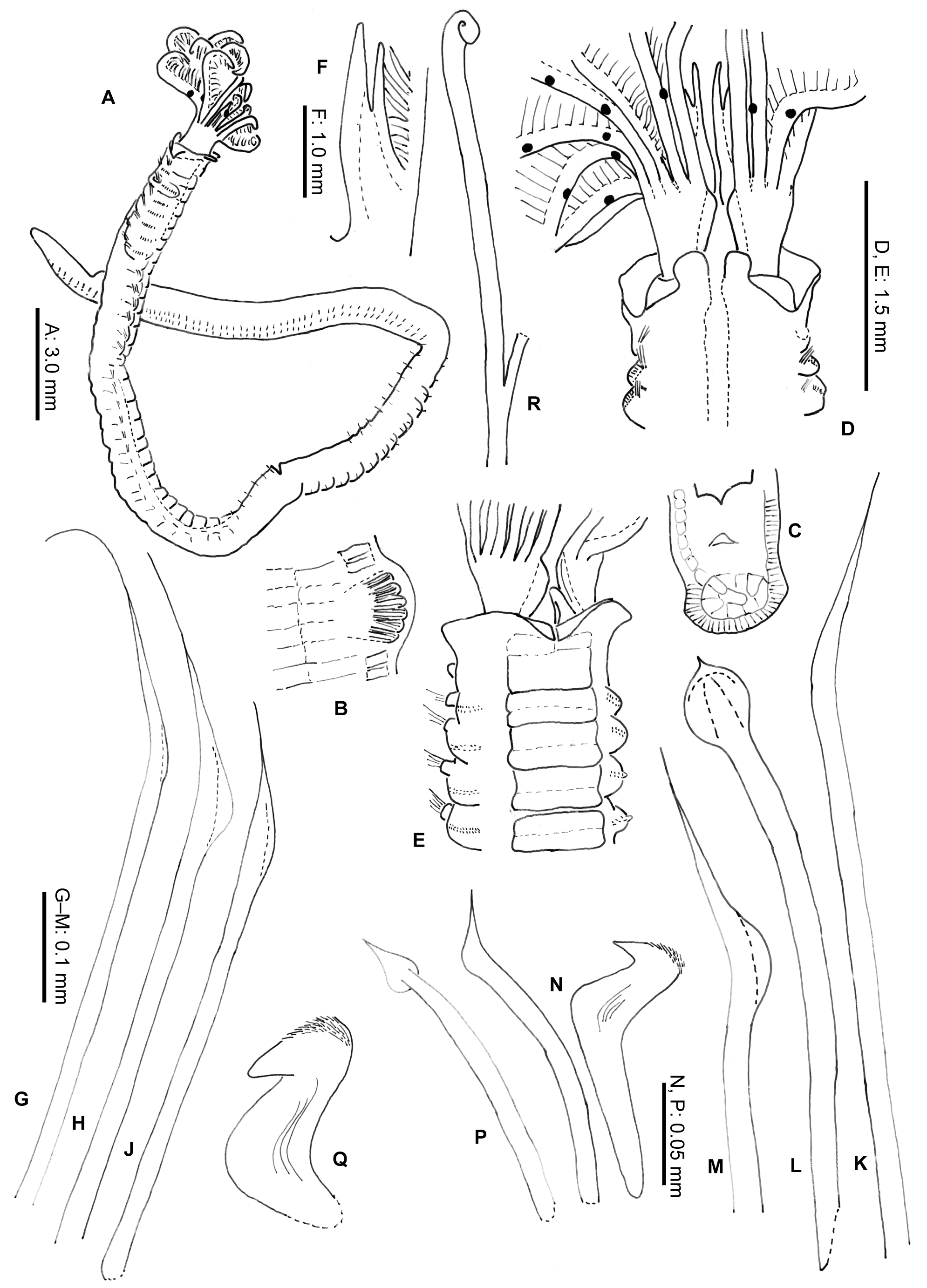
FIGURE 1. Pseudopotamilla reniformis (Bruguiére, 1789), Neotype (NMW. Z. 2001.042.0001). A) Whole worm; B) radiolar compound eye; C) cross section of radiole; D) dorsal view of anterior thorax and crown base; E) same, ventral view; F) dorsal lip and dorsal radiolar appendage; G – H, J) collar chaetae; K) superior thoracic chaeta; L) inferior thoracic chaeta; M) abdominal chaeta; N) thoracic uncinus (right) and companion chaeta (left); P) different view of companion chaeta; Q) abdominal uncinus; R) tube showing distal enrolling and the branch of an offspring. Not scaled: B – C, Q & R.
Imageimage/png© Knight-Jones, Phyllis;Darbyshire, Teresa;Petersen, Mary E.;Tovar-Hernández, María AnaKnight-Jones, Phyllis;Darbyshire, Teresa;Petersen, Mary E.;Tovar-Hernández, María Ana

FIGURE 4. Pseudopotamilla aspersa (Krøyer, 1856). A – J & P, N: Type ZMUC POL- 00523; K, L, M: lost Syntype, after Krøyer: A) ‘ whole’ worm, left crown missing, posterior damaged; B) antero-lateral detail of A; C) anterior thorax, dorsal view; D) same, ventral view; E) superior thoracic chaeta; F) inferior thoracic chaeta, front view; G) same, side view; H) side views of thoracic uncinus (left) and companion chaeta (right); J) view of companion chaeta showing teardrop-shaped ‘ blade’; K) uncinus and companion chaeta (after Krøyer); L) same, but part of torus; M) left side of crown; N) and P) two views of abdominal chaetae. Not scaled: H, J. Krøyer gave no scales for K – M.

Imageimage/png© Knight-Jones, Phyllis;Darbyshire, Teresa;Petersen, Mary E.;Tovar-Hernández, María AnaKnight-Jones, Phyllis;Darbyshire, Teresa;Petersen, Mary E.;Tovar-Hernández, María Ana

IMAGES

Gallery(2)

See Gallery

Occurrences with images

Source Information

What is Pseudopotamilla reniformis (Sabellidae)? Comparisons of populations from Britain, Iceland and Canada with comments on Eudistylia and Schizobranchia

checklist

This dataset contains the digitized treatments in Plazi based on the original journal article Knight-Jones, Phyllis, Darbyshire, Teresa, Petersen, Mary E., Tovar-Hernández, María Ana (2017): What is Pseudopotamilla reniformis (Sabellidae)? Comparisons of populations from Britain, Iceland and Canada with comments on Eudistylia and Schizobranchia. Zootaxa 4254 (2): 201-220, DOI: 10.11646/zootaxa.4254.2.3

Abstract

A neotype of Amphitrite Müller (1771) is established and re-described, using material collected in 2001 from near the type locality on the southwest coast of Iceland. We examined material from Iceland, Nova Scotia and Newfoundland, identified as Pseudopotamilla reniformis, showing scissiparity and commonly found in aggregations within kelp holdfasts or amongst encrusting fauna. By contrast, scissiparity has not been seen in a population recorded as P. reniformis from Wales (broadcast spawning is presumed, Chughtai & Knight-Jones 1988), which bores into limestone and that the present analysis shows to belong to a different species from P. reniformis. Sabella oculata Krøyer (1856, Norway) is a junior synonym of P. reniformis. Sabella aspersa Krøyer (1856, Greenland) and Sabella saxicava (Quatrefages, 1866, France) are re-instated and re-described in Pseudopotamilla. Pseudopotamilla saxicava (= Potamilla ehlersi Gravier, 1906) has a widespread distribution from Britain to the Arabian Gulf, Pseudopotamilla aspersa is found in Greenland and the distribution of P. reniformis is reduced to Iceland, northern Norway, Nova Scotia and Newfoundland. The genera Eudistylia Bush and Schizobranchia Bush are discussed in relation to Pseudopotamilla.

Key words: Fan worms, Sabella aspersa, Sabella saxicava, scissiparity, neotype, rock borings

Knight-Jones P, Darbyshire T, Petersen M E, Tovar-Hernández M A, plazi (2017). What is Pseudopotamilla reniformis (Sabellidae)? Comparisons of populations from Britain, Iceland and Canada with comments on Eudistylia and Schizobranchia. Plazi.org taxonomic treatments database. Checklist dataset https://doi.org/10.11646/zootaxa.4254.2.3 accessed via GBIF.org on 2026-06-14.

CC0Published 12/31/2017View dataset
GBIF Usage Key
128527388
Dataset Key
07060c15-139e-413a-8b41-e123e4232696
Origin
source
Backbone Key
9599988
Taxon ID
747D7A68FFD9061AFF41F903FE29F791.taxon
Last Crawled
6/11/2026
Last Interpreted
6/11/2026