
AnimaliaacceptedgenusAccepted
Pseudopotamilla

Pseudopotamilla

GBIF:128527386

0datasets

0

Descendants

0

Children

0

Species

ABOUT

Descriptions(1)

Key to Pseudopotamilla species described here

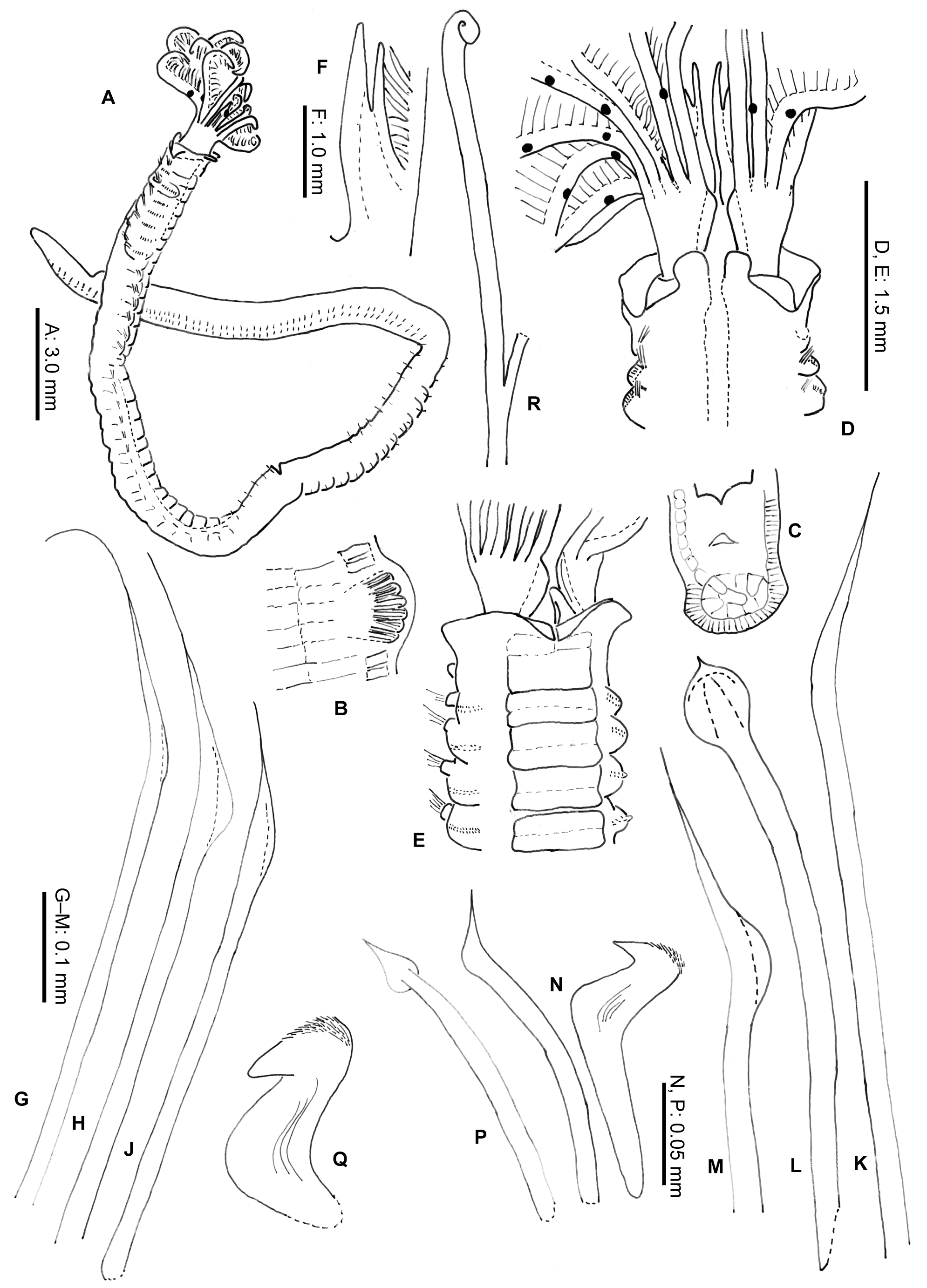
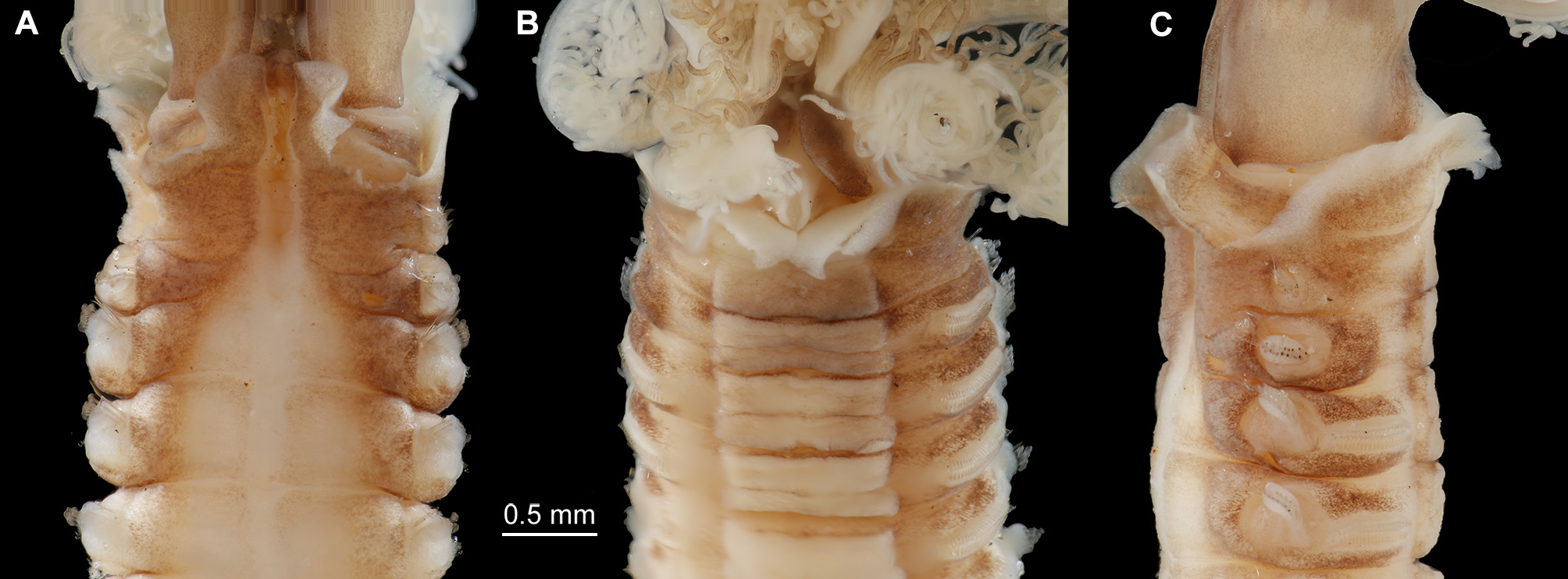
1. Collar with high, well-developed, rounded lappets dorsally (Fig. 1 D); dorsal margins V-shaped (Figs 1 D, 2A); and peristomium well exposed dorsally (Fig. 1 D, 1A) and laterally above collar margins (Fig. 2 C)...... P. reniformis (Bruguiére, 1789)

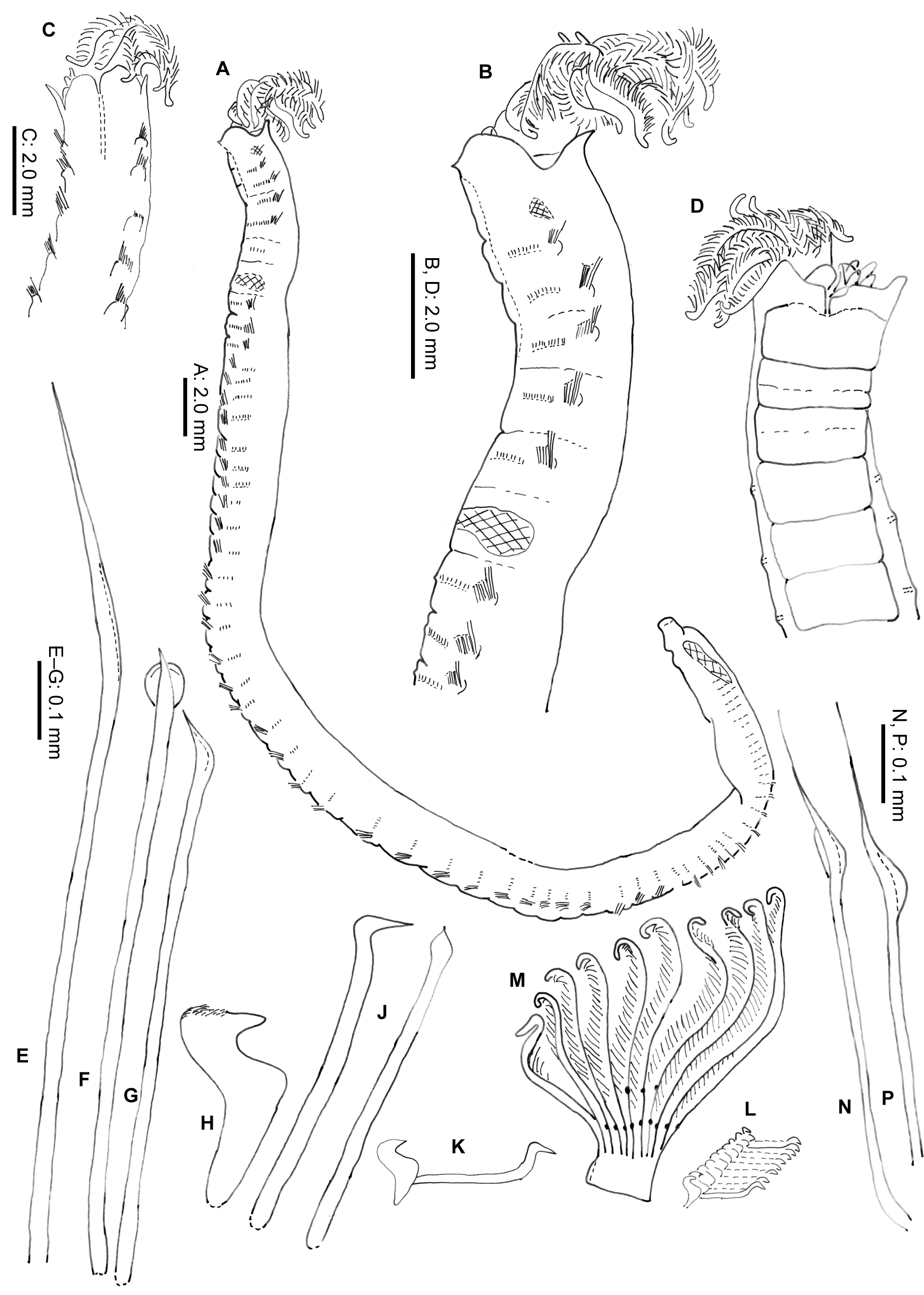
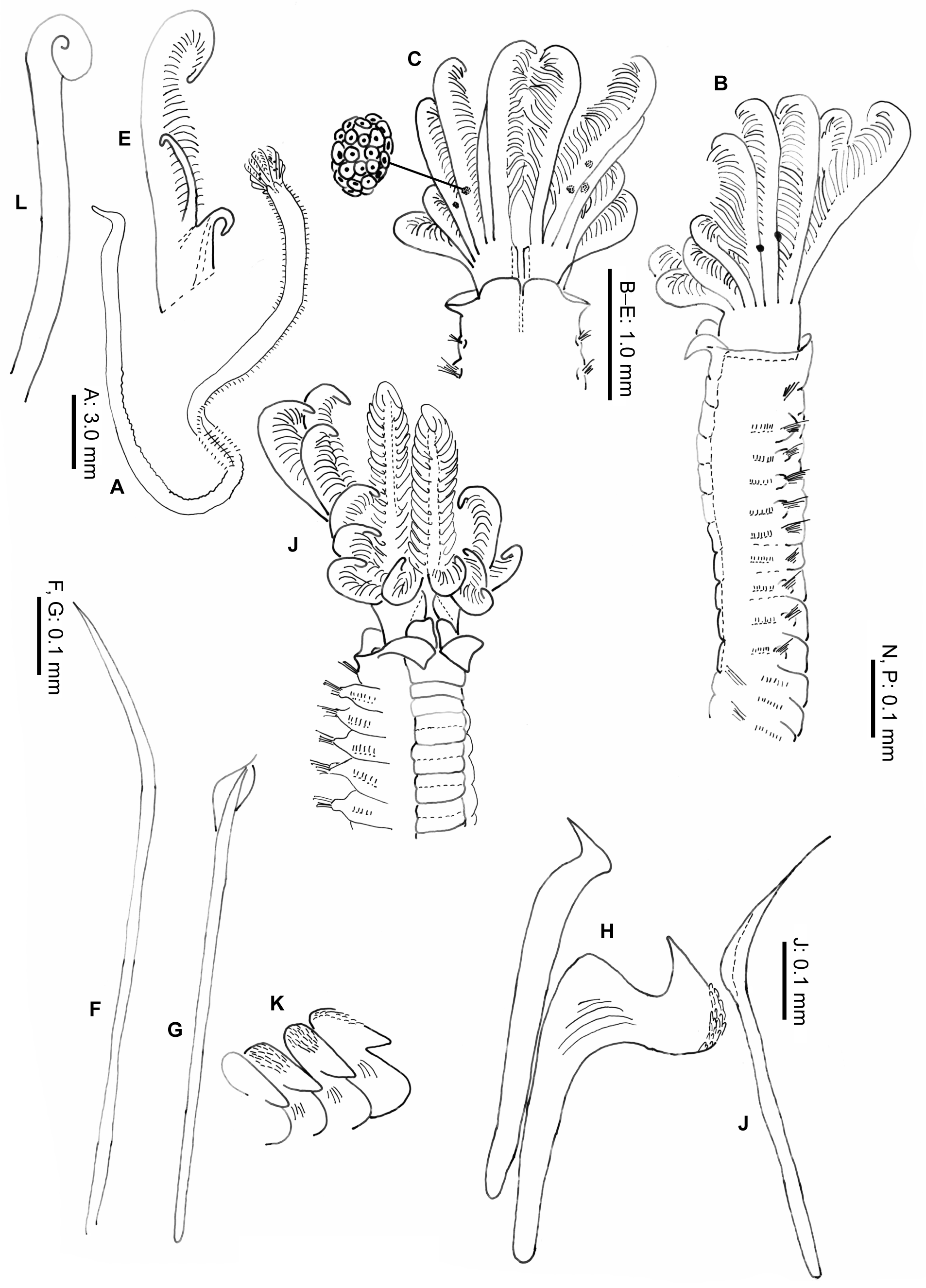
- Collar with low, rounded lappets dorsally (Figs 4 C, 5C); dorsal collar margin convex (Figs 4 C, 5C); and peristomium slightly exposed laterally (Fig. 4 B) or not exposed above collar margins (Fig. 5 B–C)..................................... 2

2. Lateral margins of collar V-shaped (Fig. 4 B); handle of each companion chaeta twice length of handle of adjacent uncinus (Fig. 4 K)........................................................................ P. aspersa (Krøyer, 1856)

- Lateral margins of collar even (in line with the horizontal body axis) (Fig. 5 B); handle of companion chaeta slightly longer than handle of adjacent uncinus (Fig. 5 H)......................................... P. saxicava (Quatrefages, 1866) .

Knight-Jones, Phyllis, Darbyshire, Teresa, Petersen, Mary E., Tovar-Hernández, María Ana (2017): What is Pseudopotamilla reniformis (Sabellidae)? Comparisons of populations from Britain, Iceland and Canada with comments on Eudistylia and Schizobranchia. Zootaxa 4254 (2): 201-220, DOI: 10.11646/zootaxa.4254.2.3MagnoliaPress via PlaziNo known copyright restrictions apply. See Agosti, D., Egloff, W., 2009. Taxonomic information exchange and copyright: the Plazi approach. BMC Research Notes 2009, 2:53 for further explanation.

Export occurrence data

Darwin Core Archive (ZIP)

CLASSIFICATION

Taxonomic Classification Tree

MULTIMEDIA

Media Files(4)

FIGURE 1. Pseudopotamilla reniformis (Bruguiére, 1789), Neotype (NMW. Z. 2001.042.0001). A) Whole worm; B) radiolar compound eye; C) cross section of radiole; D) dorsal view of anterior thorax and crown base; E) same, ventral view; F) dorsal lip and dorsal radiolar appendage; G – H, J) collar chaetae; K) superior thoracic chaeta; L) inferior thoracic chaeta; M) abdominal chaeta; N) thoracic uncinus (right) and companion chaeta (left); P) different view of companion chaeta; Q) abdominal uncinus; R) tube showing distal enrolling and the branch of an offspring. Not scaled: B – C, Q & R.
Imageimage/png© Knight-Jones, Phyllis;Darbyshire, Teresa;Petersen, Mary E.;Tovar-Hernández, María AnaKnight-Jones, Phyllis;Darbyshire, Teresa;Petersen, Mary E.;Tovar-Hernández, María Ana

FIGURE 2. Pseudopotamilla reniformis (Bruguiére, 1789), Neotype (NMW. Z. 2001.042.0001). Anterior of neotype in A) dorsal view; B) ventral view; C) lateral view.
Imageimage/png© Knight-Jones, Phyllis;Darbyshire, Teresa;Petersen, Mary E.;Tovar-Hernández, María AnaKnight-Jones, Phyllis;Darbyshire, Teresa;Petersen, Mary E.;Tovar-Hernández, María Ana

FIGURE 4. Pseudopotamilla aspersa (Krøyer, 1856). A – J & P, N: Type ZMUC POL- 00523; K, L, M: lost Syntype, after Krøyer: A) ‘ whole’ worm, left crown missing, posterior damaged; B) antero-lateral detail of A; C) anterior thorax, dorsal view; D) same, ventral view; E) superior thoracic chaeta; F) inferior thoracic chaeta, front view; G) same, side view; H) side views of thoracic uncinus (left) and companion chaeta (right); J) view of companion chaeta showing teardrop-shaped ‘ blade’; K) uncinus and companion chaeta (after Krøyer); L) same, but part of torus; M) left side of crown; N) and P) two views of abdominal chaetae. Not scaled: H, J. Krøyer gave no scales for K – M.
Imageimage/png© Knight-Jones, Phyllis;Darbyshire, Teresa;Petersen, Mary E.;Tovar-Hernández, María AnaKnight-Jones, Phyllis;Darbyshire, Teresa;Petersen, Mary E.;Tovar-Hernández, María Ana

FIGURE 5. Pseudopotamilla saxicava (Quatrefages, 1866) (NMW. Z. 2009.038.0903). A) Whole worm; B) thorax and crown, lateral view; C) same, dorsal view; D) same, ventral view; E) dorsal lip; F) superior thoracic chaeta; G) inferior thoracic chaeta; H) thoracic uncinus (right) and companion chaeta (left); J) abdominal uncini, three-quarter view. Not scaled: H, K.

Imageimage/png© Knight-Jones, Phyllis;Darbyshire, Teresa;Petersen, Mary E.;Tovar-Hernández, María AnaKnight-Jones, Phyllis;Darbyshire, Teresa;Petersen, Mary E.;Tovar-Hernández, María Ana

IMAGES

Gallery(4)

See Gallery

Occurrences with images

Source Information

What is Pseudopotamilla reniformis (Sabellidae)? Comparisons of populations from Britain, Iceland and Canada with comments on Eudistylia and Schizobranchia

checklist

This dataset contains the digitized treatments in Plazi based on the original journal article Knight-Jones, Phyllis, Darbyshire, Teresa, Petersen, Mary E., Tovar-Hernández, María Ana (2017): What is Pseudopotamilla reniformis (Sabellidae)? Comparisons of populations from Britain, Iceland and Canada with comments on Eudistylia and Schizobranchia. Zootaxa 4254 (2): 201-220, DOI: 10.11646/zootaxa.4254.2.3

Abstract

A neotype of Amphitrite Müller (1771) is established and re-described, using material collected in 2001 from near the type locality on the southwest coast of Iceland. We examined material from Iceland, Nova Scotia and Newfoundland, identified as Pseudopotamilla reniformis, showing scissiparity and commonly found in aggregations within kelp holdfasts or amongst encrusting fauna. By contrast, scissiparity has not been seen in a population recorded as P. reniformis from Wales (broadcast spawning is presumed, Chughtai & Knight-Jones 1988), which bores into limestone and that the present analysis shows to belong to a different species from P. reniformis. Sabella oculata Krøyer (1856, Norway) is a junior synonym of P. reniformis. Sabella aspersa Krøyer (1856, Greenland) and Sabella saxicava (Quatrefages, 1866, France) are re-instated and re-described in Pseudopotamilla. Pseudopotamilla saxicava (= Potamilla ehlersi Gravier, 1906) has a widespread distribution from Britain to the Arabian Gulf, Pseudopotamilla aspersa is found in Greenland and the distribution of P. reniformis is reduced to Iceland, northern Norway, Nova Scotia and Newfoundland. The genera Eudistylia Bush and Schizobranchia Bush are discussed in relation to Pseudopotamilla.

Key words: Fan worms, Sabella aspersa, Sabella saxicava, scissiparity, neotype, rock borings

Knight-Jones P, Darbyshire T, Petersen M E, Tovar-Hernández M A, plazi (2017). What is Pseudopotamilla reniformis (Sabellidae)? Comparisons of populations from Britain, Iceland and Canada with comments on Eudistylia and Schizobranchia. Plazi.org taxonomic treatments database. Checklist dataset https://doi.org/10.11646/zootaxa.4254.2.3 accessed via GBIF.org on 2026-06-14.

CC0Published 12/31/2017View dataset
GBIF Usage Key
128527386
Dataset Key
07060c15-139e-413a-8b41-e123e4232696
Origin
source
Backbone Key
2329243
Taxon ID
747D7A68FFD3061EFF41FD2CFA56F2DA.taxon
Last Crawled
6/11/2026
Last Interpreted
6/11/2026