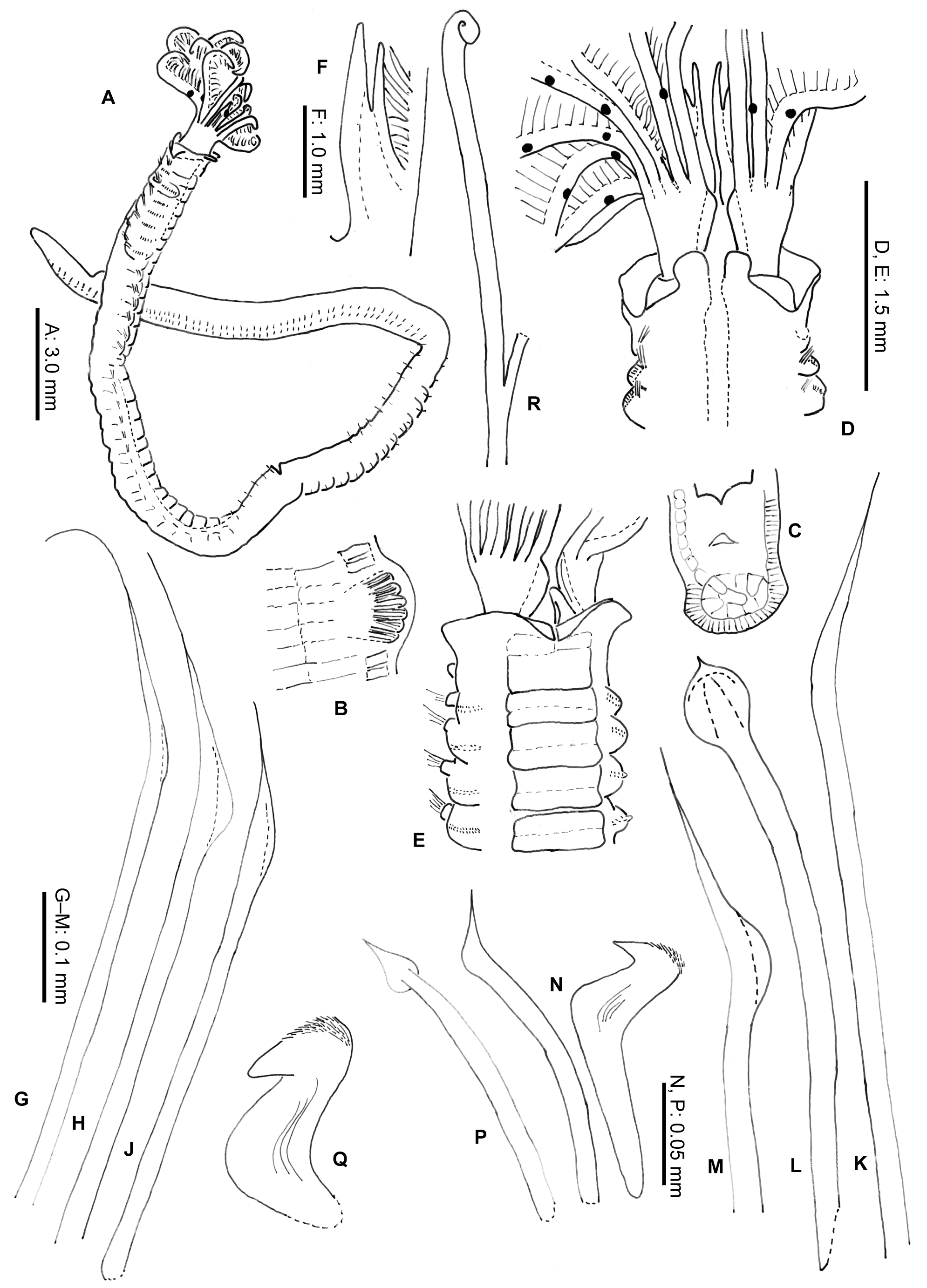
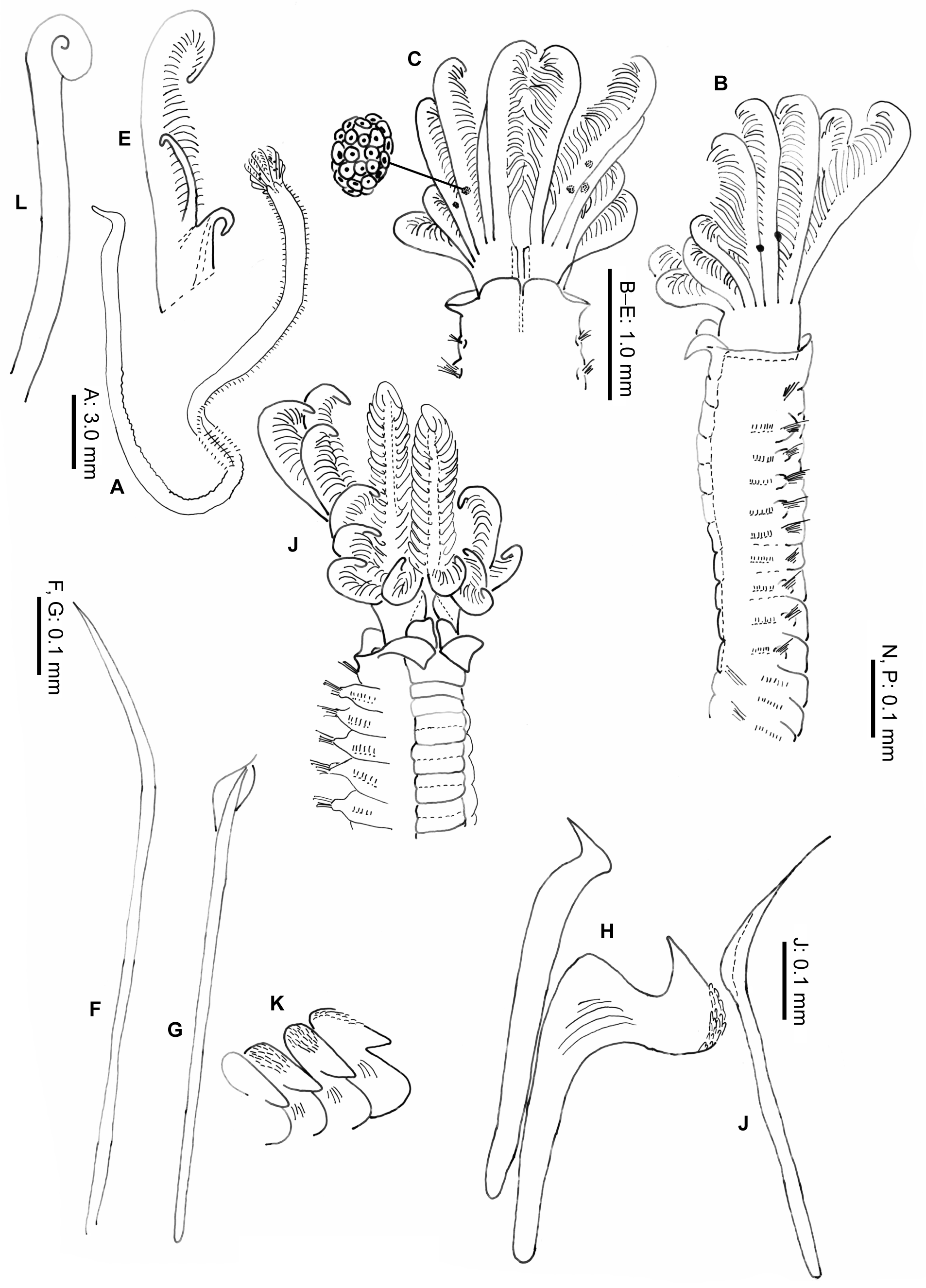
Habitat. Pseudopotamilla saxicava is reported to be a boring species. At Bracelet Bay, Swansea the emergent parts of the muco-silt tubes, with enrolled distal aperture like that of Pseudopotamilla reniformis (Fig. 1 R), indicated the presence of Pseudopotamilla in unusually hard limestone. Such pieces of rock, removed with a hammer and chisel, showed galleries with some containing P. saxicava (Chughtai 1984 as P. reniformis). The species seemed to have taken advantage of the shelter of cavities at the bases of old Hiatella (piddock) excavations, where the distal parts had been eroded by sea abrasion. The sabellid bores into the hard limestone by chemical means (Chughtai & Knight-Jones 1988, Fig. 1). To record oocyte size, collections were made every month except March (Chughtai 1984, table II, as P. reniformis) and no asexual reproduction was observed. Broadcast spawning was, therefore, assumed (Chughtai 1986). The absence of boring sabellids at the same site in 2003 was curious as other fauna was much the same. The only observable difference was that Hiatella borings into the limestone were much more numerous, leaving little room for sabellid borers. At West Angle, where the rock seems to be less hard, the population of P. saxicava was as abundant as it was in the 1980 ’ s. At Hannafore, West Looe (Cornwall), specimens of P. saxicava were harder to find in 2003 than in the 1980 ’ s, but they were numerous in a small area on one low-water reef. The rock here has very fine laminations, so P. saxicava has less boring to do and the specimens were much easier to remove after chiselling with the grain. McIntosh, 1868 (as Sabella) refers to a record from Plymouth in which P. saxicava (as Sabella) was found in limestone. He had also frequently found the species boring into oyster, Pecten, Anomia, and other dead and living shells dredged off the Channel Islands. In the Gouliot caves on the island of Sark (Channel Islands), he found the species amongst barnacles encrusting the cave walls with their tubes standing proud, having pierced the barnacle shells and coiled themselves in grooves (presumably of their own making) between the barnacle and rock. Pseudopotamilla saxicava can also be found emerging from encrusting bryozoans, sponges and ascidians. Gravier (1908, as Potamilla ehlersi) found it within the calcareous structures of Porites, Fauvel (1927 as P. reniformis) within old shells and Ben-Eliahu (1975, as Pseudopotamilla ehlersi) within Dendropoma. Other material, which seems to be P. saxicava, has been found in galleries in crud (‘ Lithothamnium ’ and shell) in the Bay of Islands, New Zealand, boring through old oyster shells on a rope at the University of Hawaii Marine Station on Coconut Island, off Oahu, and in dead coral at the mouth of Pearl Harbour, Hawaii (KJC). These all have the typical collar and the enrolling of the tube mouth of P. saxicava, but more ventro-lateral radioles also bear compound eyes, except for material from Pearl Harbour. Material identified as P. reniformis, (MEP, ZMUC POL 849) from holding tanks at the Marine Fisheries laboratory, Milford, Connecticut (originally from a Long Island oyster farm) were found boring in oyster shells. The collar is like that of P. saxicava, but their tubes do not enrol distally, so the ventro-lateral radioles are not truncated and more ventral radioles bear eyes; radioles can bear up to six eyes, but one to three is more common. Thus one should consider Pseudopotamilla oculifera (Leidy, 1855, as Sabella) from Rhode Island, but that form enrols its distal tube, to judge from Leidy’s figure 55 where the radioles are differentially truncated on one (always the ventral) side. This and its habitat indicates that Leidy’s species is P. reniformis (see above) and the habitat of the Long Island material would suggest P. saxicava, except that the distal tube does not enrol distally. More detailed studies of habitat, and the shape of the thoracic collar may be necessary to confirm that the Long Island material is really P. reniformis and the Rhode Island specimens are P. saxicava.
Knight-Jones, Phyllis, Darbyshire, Teresa, Petersen, Mary E., Tovar-Hernández, María Ana (2017): What is Pseudopotamilla reniformis (Sabellidae)? Comparisons of populations from Britain, Iceland and Canada with comments on Eudistylia and Schizobranchia. Zootaxa 4254 (2): 201-220, DOI: 10.11646/zootaxa.4254.2.3