
Seira
GBIF:148692410
0
Descendants
0
Children
0
Species
ABOUT
Descriptions(1)
Key to Seira species with known dorsal chaetotaxy from the Western Palearctic region*
1 Abd II with 3 central mac (Fig. 11D)...................................................................... 2
- Abd II with 4 or 5 central mac (Figs 6D, 15D)............................................................... 4
2 Head mac Ps2 present (Fig. 10E); Th III with 11–14 central mac (Fig. 11B); Abd I with 5 central mac (Fig. 11C).......... 3
- Head mac Ps2 absent; Th III with 8 central mac; Abd I with 4 central mac..................................................................................... S. taeniata (Handschin, 1925) in Handschin, 1925a sensu Yoshii, 1990
3 Body all bluish (Fig. 2B); Th II with 5–3(rarely) mac in PmC group (Fig. 11 A); unguiculus with outer lamella serrated (Fig. 8F).................................................................... S. dinizi Gama, 1988 in Gama, 1988a
- Body with one transverse strip of dark blue on Abd III; Th II with 6 mac in PmC group; unguiculus with outer lamella smooth (Fig. 21F).............................................................. S. dori Gruia, Poliakov & BroZa, 2000
4 Abd II with 4 central mac, mac a3 absent (Fig. 15D).......................................................... 5
- Abd II with 5 central mac, mac a3 present (Fig. 6D)......................................................... 18
5 Abd I with 5 or less central mac (Fig. 11C)................................................................. 6
- Abd I with 6 central mac (Fig. 6C)........................................................................ 7
6 Head mac Ps2 absent; Th II with 3 medio-central mac; Abd I with 2 central mac.............. S. algira Jacquemart, 1974
- Head mac Ps2 present (Fig. 5F); Th II with 4 medio-central (m1– 1i, m2– 2i) mac (Fig. 11 A); Abd I with 5 central mac (Fig. 11C)...................................................................... S. elisae Gers & Deharveng, 1985
7 Head mac Pp5 absent.................................................................................. 8
- Head mac Pp5 present (Fig. 5F)......................................................................... 10
8 Head with 7 mac in sutural series, S 6i mac present (Fig. 5 A); Th II with 7 antero-lateral mac (Fig. 6 A).................. 9
- Head with 6 mac in sutural series, S 6i mac absent; Th II with 8 antero-lateral mac........... S. debruyni Jacquemart, 1974
9 Head with interocellar mac and Pa5 mac present; Th II with 6 mac in PmA group (Fig. 19 A)... S. agadesi Jacquemart, 1974
- Head lacking interocellar and Pa5 mac absent; Th II with 8 mac in PmA group............... S. punica Jacquemart, 1974
10 Th III with 14 central mac (Fig. 11B)..................................................................... 11
- Th III with 16 central mac...................................................... S. tongiorgii Tosi & Parisi, 1990
11 Body depigmented or with a different colour pattern; unguis apical tooth present (Fig. 21F)......................... 12
- Body black with legs yellowish (Fig. 3C); unguis apical tooth absent (Fig. 29E)........ S. barrai sp. nov. Cipola & Baquero
12 Abd IV with 4–5 antero-central and 3 postero-central mac (Fig. 20 A)........................................... 13
- Abd IV with 6 antero-central and 4 postero-central mac.................................... S. tigridica Rusek, 1981
13 Abd IV with 4 antero-central mac (Fig. 12 A)............................................................... 14
- Abd IV with 5 antero-central mac (Fig. 16 A)............................................................... 15
14 Body colour with distinct pattern, one transverse strip on Abd I–II, and anterior and posterior Abd IV................................................................................ S. maroccana Negri, Pellecchia & Fanciulli, 2005
- Body depigmented......................................................... S. vanderheydeni Jacquemart, 1974
15 Males with femur and tibiotarsi of leg I with spine-like chaetae (Fig. 21E)........................................ 16
- Males without modified chaetae in legs................................................................... 17
16 Ant IV annulated; unguis with median tooth larger than basal and apical (Fig. 21F); manubrium ventrally with 18 apical chaetae (Fig. 21G)............................................................ S. mantis Zeppelini & Bellini, 2006
- Ant IV normal; unguis with basal and median tooth subequal, both larger than apical; manubrium ventrally with 16 apical chaetae............................................................................... S. uwei Barra, 2010
17(15) Body with blue pigment on anterior and posterior margins of Th II to Abd III, all Abd IV and appendages (Fig. 2C–D);....................................................................................... S. ferrarii Parona, 1888
- Body depigmented................................................................ S. nigeri Jacquemart, 1974
18 Head mac M 4i and Pa 4 present (Fig. 22D); Th II with 7 or more medio-central (m1–2 complex) mac (Fig. 37 A); Abd I with 8–10 central mac (Fig. 37C)............................................................................ 19
- Head mac M 4i and Pa 4 absent (Fig. 31E); Th II with 6 or less medio-central (m1–2 complex) mac (Fig. 32 A); Abd I with 6 or less central mac (Fig. 32C)............................................................................. 25
19 Ant I–II normal, without modifications................................................................... 20
- Ant I –II enlarged and with scales elongated in spiral-shaped (Figs 35 A –D)............ S. burgersi sp. nov. Cipola & Arbea
20 Th III with 18 or less central mac (Fig. 23B)............................................................... 21
- Th III with 24 central mac............................................................ S. lusitanica Gama, 1964
21 Th III with 15 central mac.............................................................................. 22
- Th III with 16 or more central mac (Fig. 23B).............................................................. 24
22 Th II with 8–9 mac in PmC group....................................................................... 23
- Th II with 10 mac in PmC group................................................ S. saxatilis Gisin & Gama, 1962
23 Body color with distinct pattern, general with longitudinal strip on Th II to Abd I and transverse strips on Abd III–IV; Abd IV with 7 antero-central mac............................................................... S. dollfusi Carl, 1899
- Body dark blue, appendages yellowish; Abd IV with 7–9 antero-central mac................... S. pallidipes Reuter, 1895
24(21) Head mac Pp6 present (Fig. 22D); Th II with 11–13 mac in PmC group (Fig. 23 A).......... S. pini Jordana & Arbea, 1989
- Head mac Pp6 absent; Th II with 9 mac in PmC group........................... S. squamoornata (Scherbakov, 1898)
25 Th II with 5 or less medio-central (m1–2 complex) mac (Figs 27 A, 32 A); Abd I with 6 central mac (Fig. 27C).......... 26
- Th II with 6 medio-central (m1–2 complex) mac; Abd I with 5 central mac (Fig. 11C)......... S. insalahi Jacquemart, 1974
26 Th II with 4 medio-central mac (Fig. 6 A); Abd IV with 12 central mac (B1–2 absent) (Fig. 7 A)....................... 27
- Th II with 5 medio-central mac (Fig. 32 A); Abd IV with 14 central mac (B1–2 present) (Fig. 33 A)................................................................................................ S. betica sp. nov. Cipola & Arbea
27 Th II with 5 mac in PmC group (Fig. 19A)................................................................ 28
- Th II with 8–10 mac in PmC group, generally 9 (Fig. 6 A)............................... S. domestica (Nicolet, 1842)
28 Ant IV annulated; trochanteral organ with 20 or less spine-like chaetae; unguiculus with outer lamella serrated (Fig. 8F)... 29
- Ant IV normal; trochanteral organ with more than 30 spine-like chaetae; unguiculus with outer lamella smooth (Fig. 21F). 30
29 Body color pale, without distinct pattern, pigments restrict to Ant I–IV, part of head and legs (except tibiotarsi); Th III with 15 central mac, p1ip present......................................... S. atlantica Negri, Pellecchia & Fanciulli, 2005
- Body with two longitudinal strips on Th II to Abd I and other transversal strip on Abd III; Th III with 14 central mac, p1ip absent (Fig. 27B)................................................................... S. dagamae Dallai, 1973
30 Th II with 10 antero-lateral mac (a5 and m4 complex) and 6 mac in PmA group (Fig. 19 A)...... S. deserti Jacquemart, 1974
- Th II with 7 antero-lateral mac (a5 and m4 complex) and 7 mac in PmA group (Fig. 27 A)............ S. graeca Ellis, 1966
Export occurrence data
Darwin Core Archive (ZIP)
CLASSIFICATION
Taxonomic Classification Tree

HIERARCHY
Child Taxa(9)
MULTIMEDIA
Media Files(19)
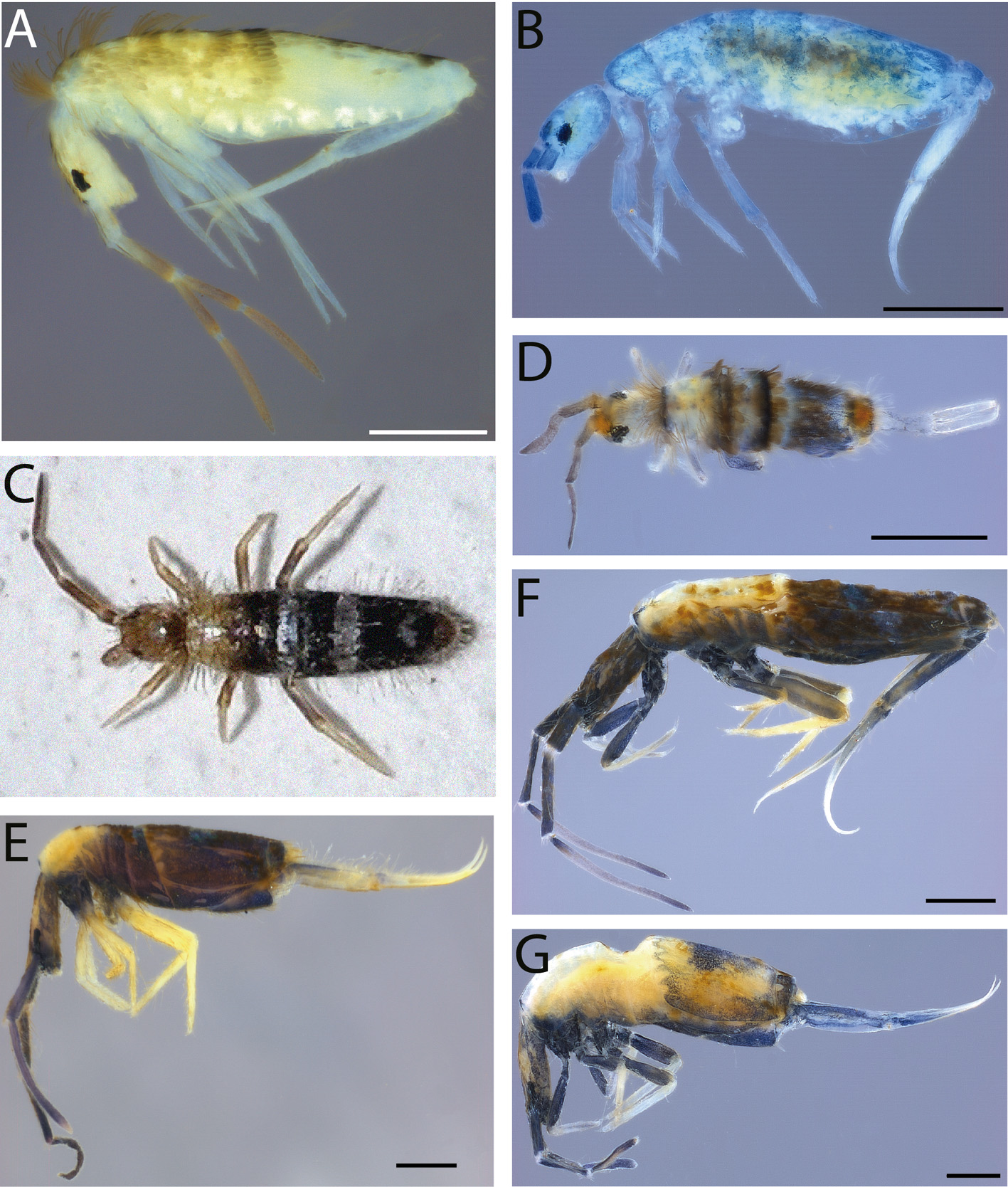
FIGURE 2A–G. Seira spp., habitus: A, S. domestica; B, S. dinizi; C‒D, S. ferrarii: C, in natural habitat, courtesy of Francisco Rodríguez (http://www.biodiversidadvirtual.org/insecta rium/Seira-ferrarii-img750580.html), D, in alcohol; E‒G, S. pini: E, paratype, F, specimen with pigmentation in legs from Monegros (Spain), G, specimen depigmented on Th II to Abd III and with one median spot on Abd IV from Monegros (Spain). Scale bars: 0.5mm.

FIGURE 3A–E. Seira spp., habitus (lateral view, except A in dorsal): A‒B, in natural habitat, A, S. betica sp. nov., courtesy of André Burgers (http://www.biodiversidadvirtual.org/insectar ium/Seira-betica-img961392.html), B, S. burgersi sp. nov., courtesy of André Burgers (http://www.biodiversidadvirtual.org/insectarium/Seira-burgersi-img961393.html); C‒E, preserved in alcohol: C, S. barrai sp. nov., D, S. burgersi sp. nov., E, S. betica sp. nov. Scale bars: 0.5mm.
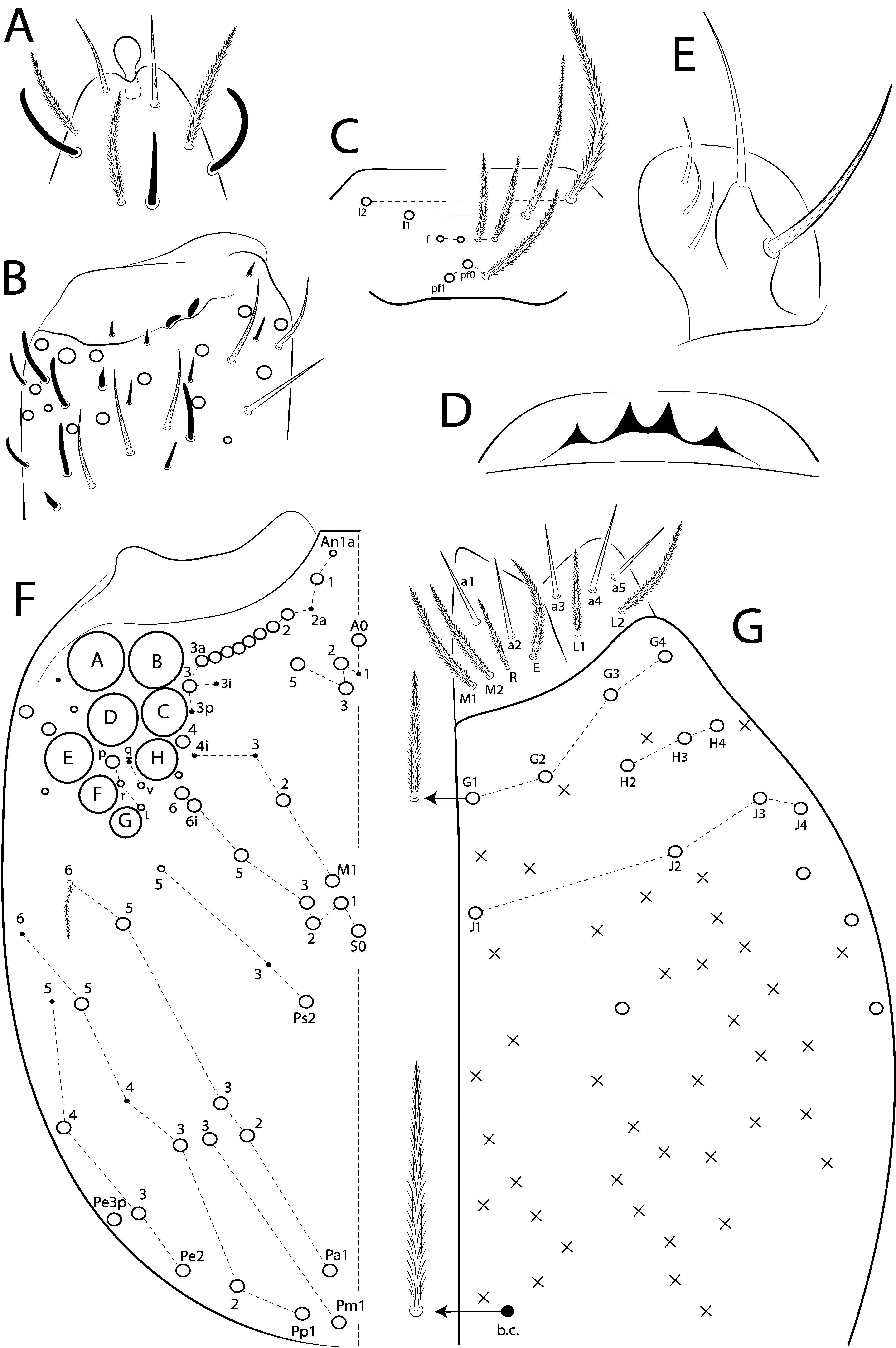
FIGURE 5A–G. Seira domestica: head; A, apex of Ant IV; B, Ant III apical organ; C, clypeal chaetotaxy; D, labral papillae; E, maxillary outer lobe; F, dorsal cephalic chaetotaxy (valid also for S. ferrari, except for interocular chaeta q); G, ventral head and basomedian and basolateral labial fields, arrows indicate normal ciliated chaetae and basal chaeta (b.c.), respectively.
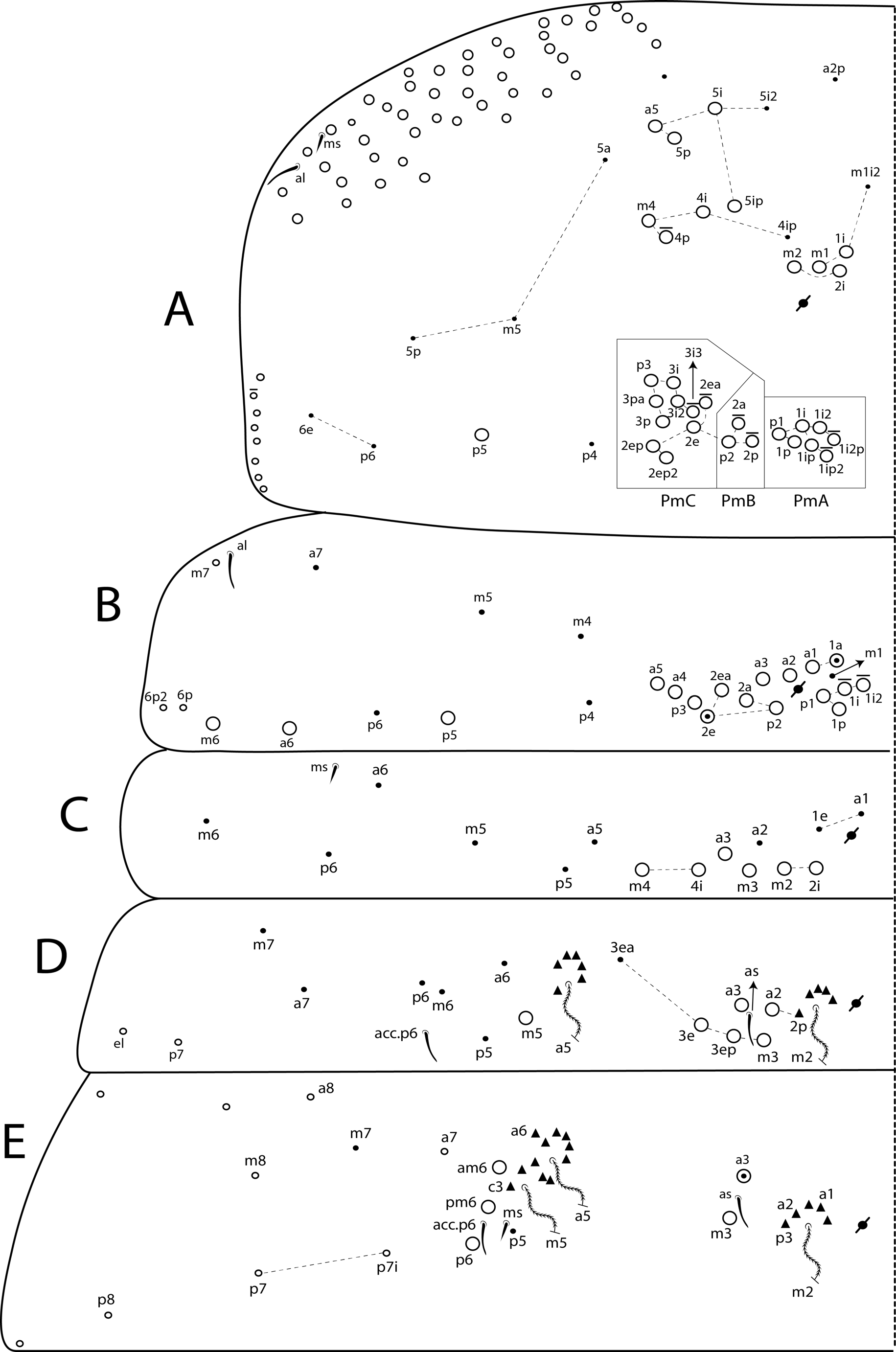
FIGURE 6A–E. Seira domestica: dorsal chaetotaxy; A, Th II; B, Th III; C, Abd I; D, Abd II; E, Abd III.
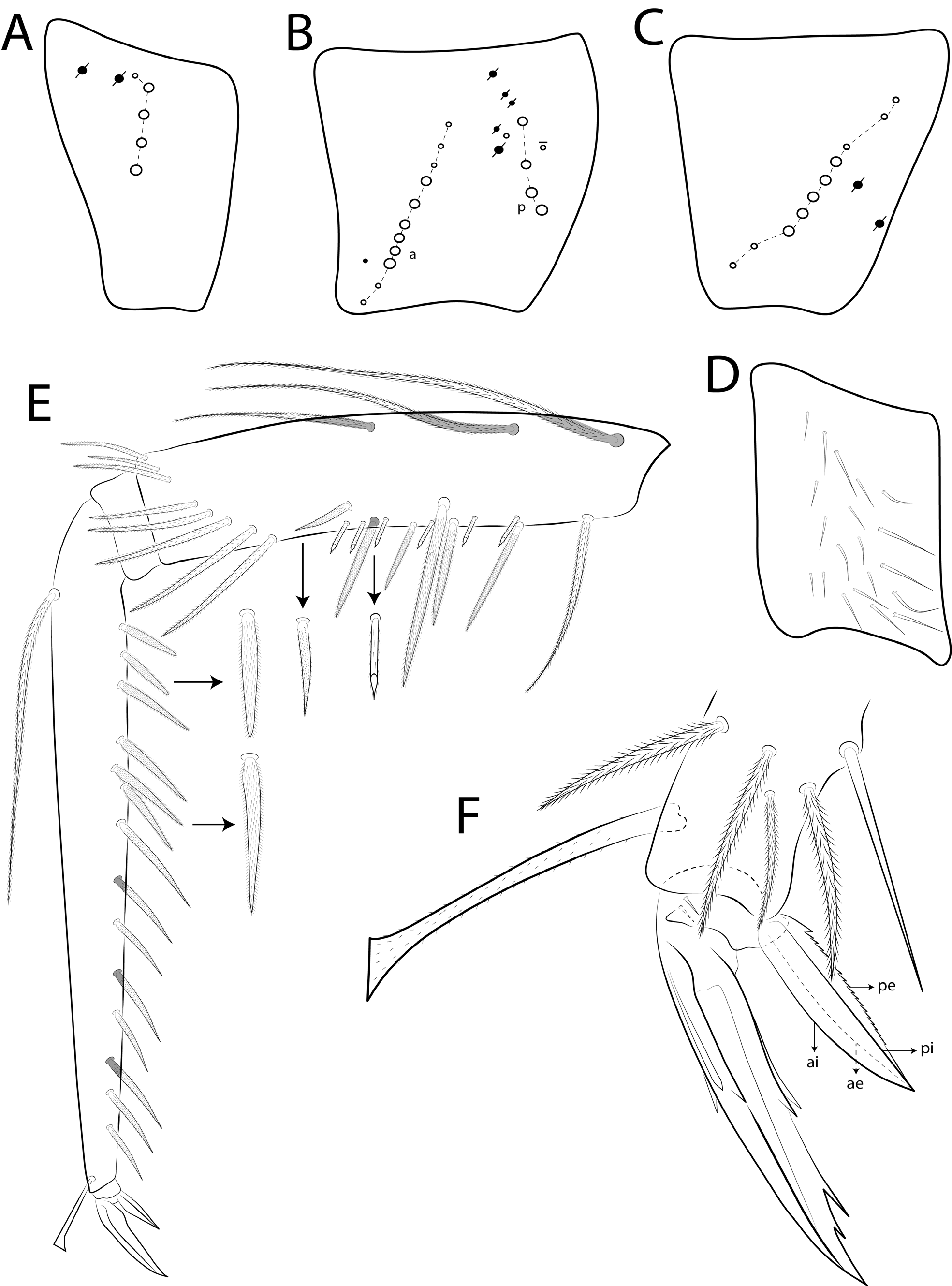
FIGURE 8A–H. Seira domestica: A, subcoxa I; B, subcoxa II; C, subcoxa III; D, trochanteral organ; E, chaetotaxy of femur and tibiotarsus I of male (anterior view), arrows indicate mac finely ciliate, small truncate chaetae, robust spine-like chaeta (in femur) and two types of tibiotarsal spine-like chaetae finely ciliate apically rounded and acuminate; F, distal tibiotarsus and empodial complex III (posterior view).
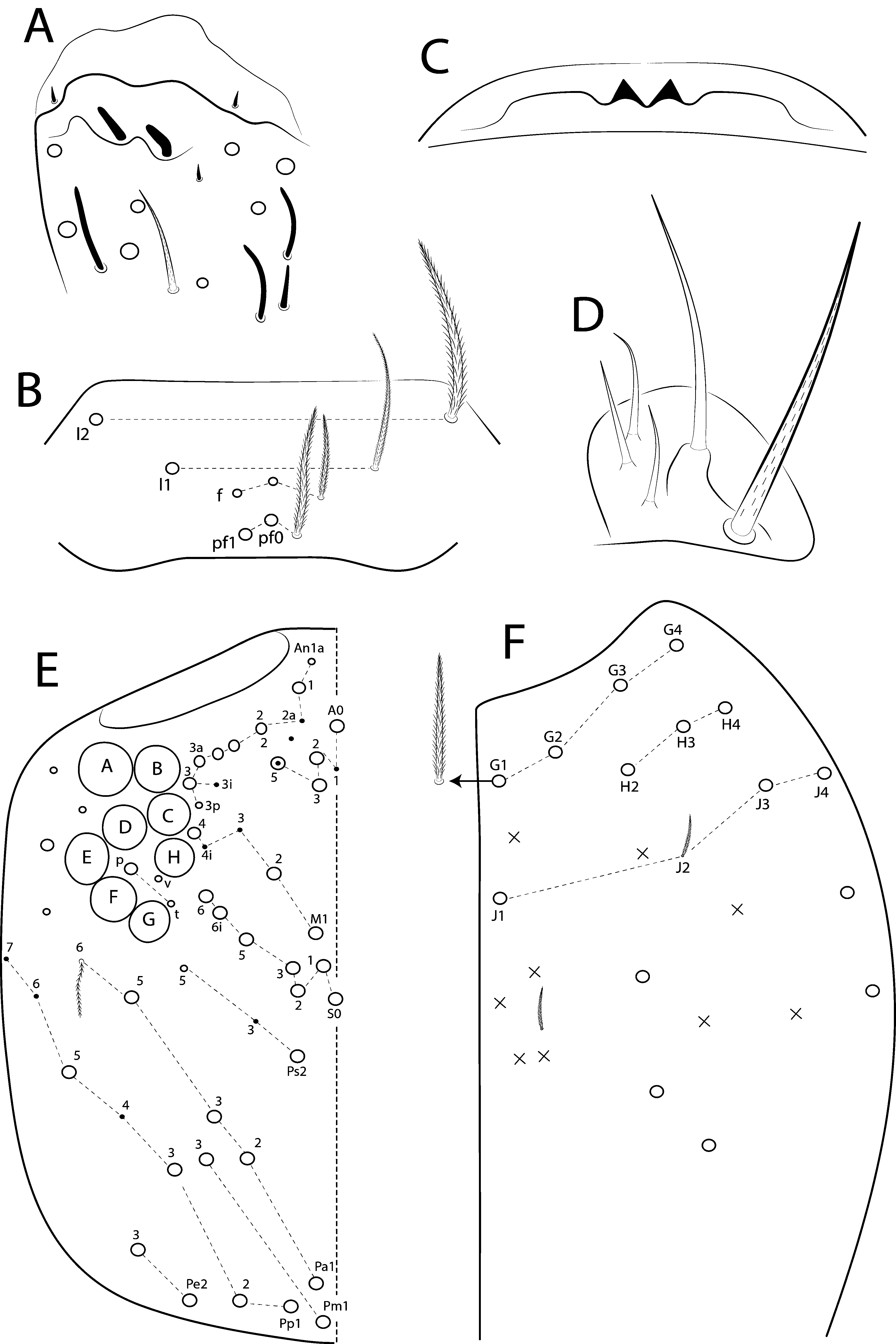
FIGURE 10A–F. Seira dinizi: head; A, Ant III apical organ; B, clypeal chaetotaxy; C, labral papillae; D, maxillary outer lobe; E, dorsal cephalic chaetotaxy; F, postlabial ventral head, arrow indicates normal ciliated chaetae.
IMAGES