AnimaliaNot EvaluatedacceptedspeciesAccepted
Seira betica

Seira betica

Cipola, Arbea, Baquero, Jordana, Morais & Bellini, 2018

GBIF:148692417

0year

ABOUT

Descriptions(5)

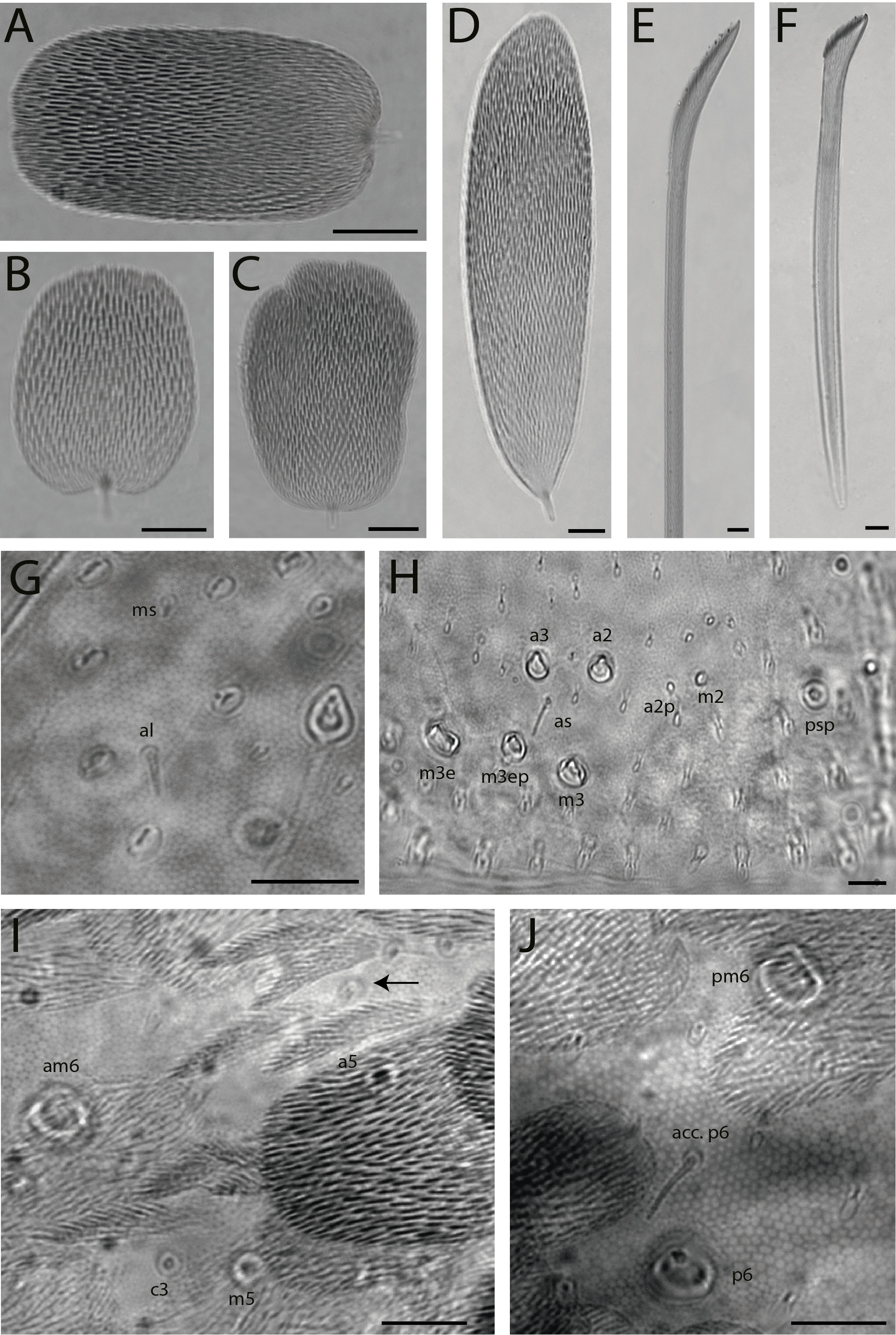
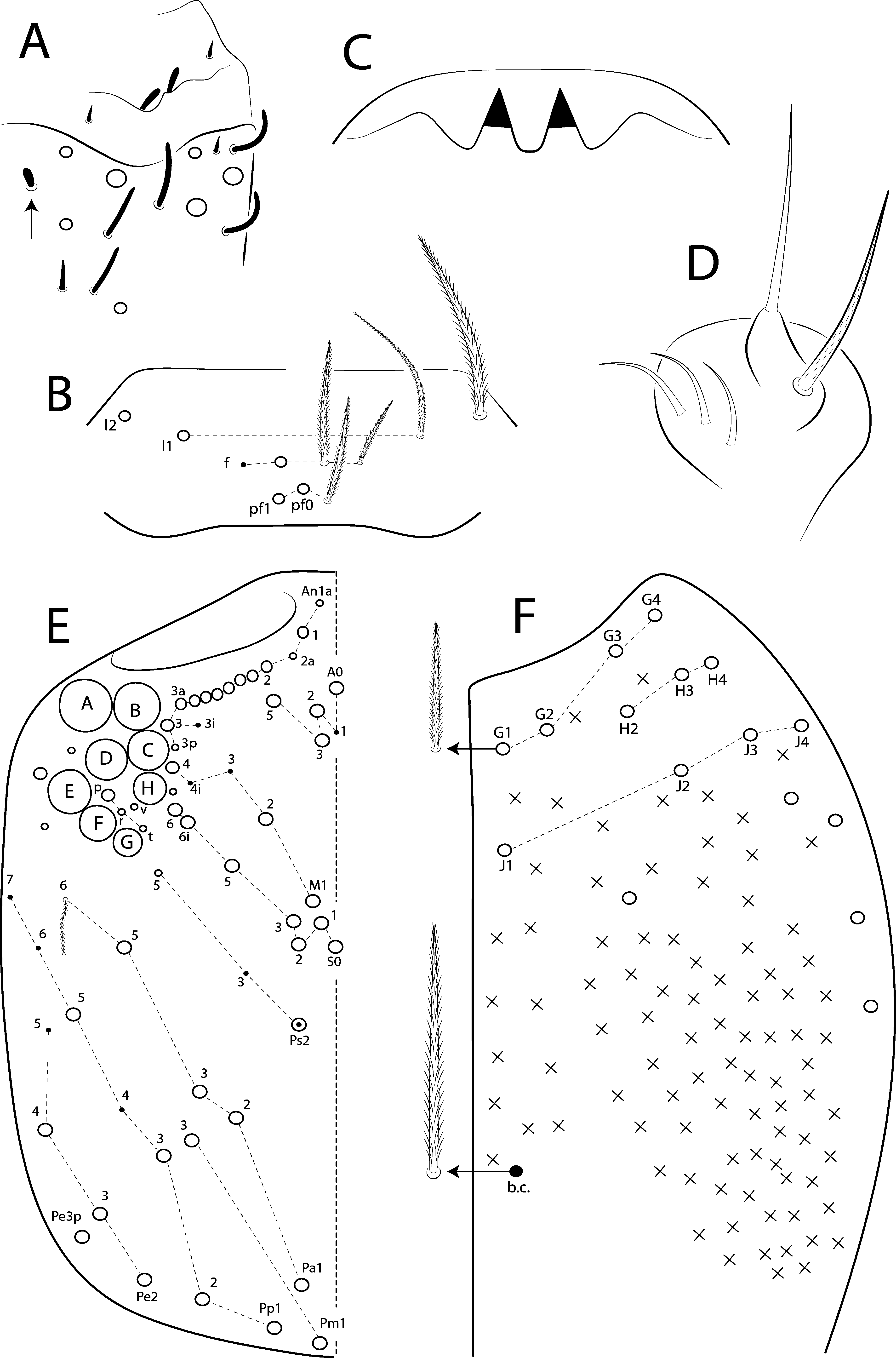
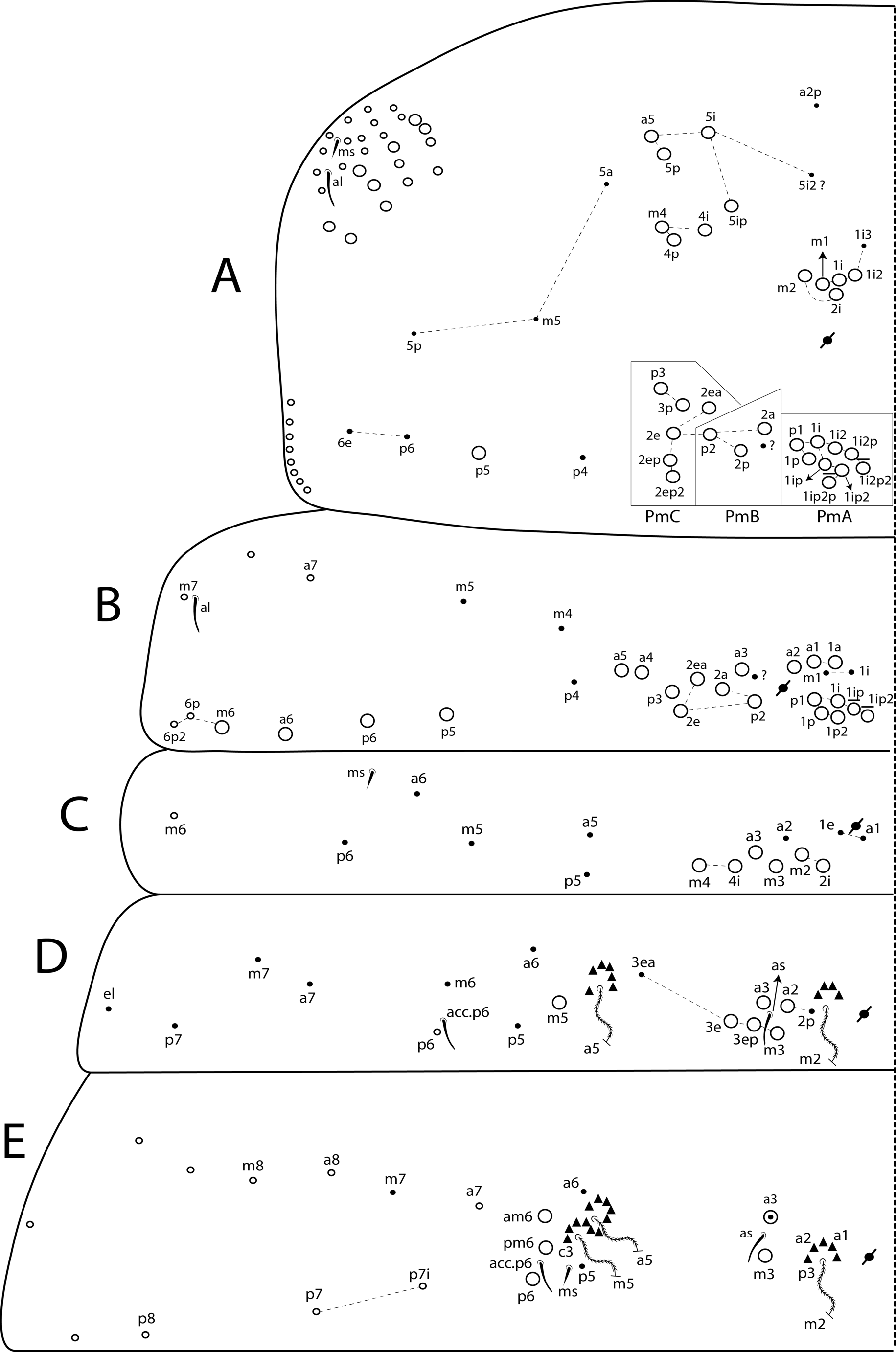
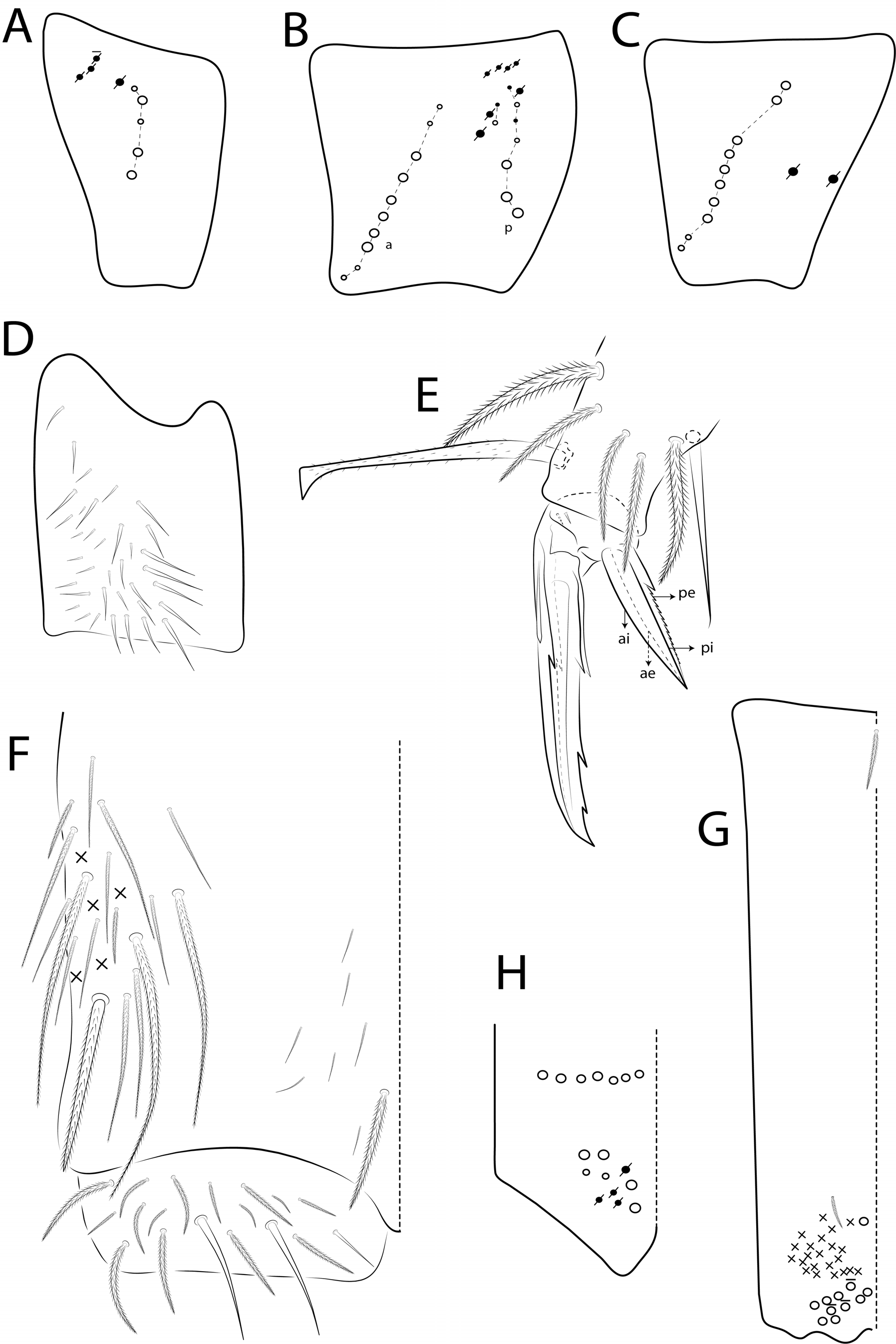
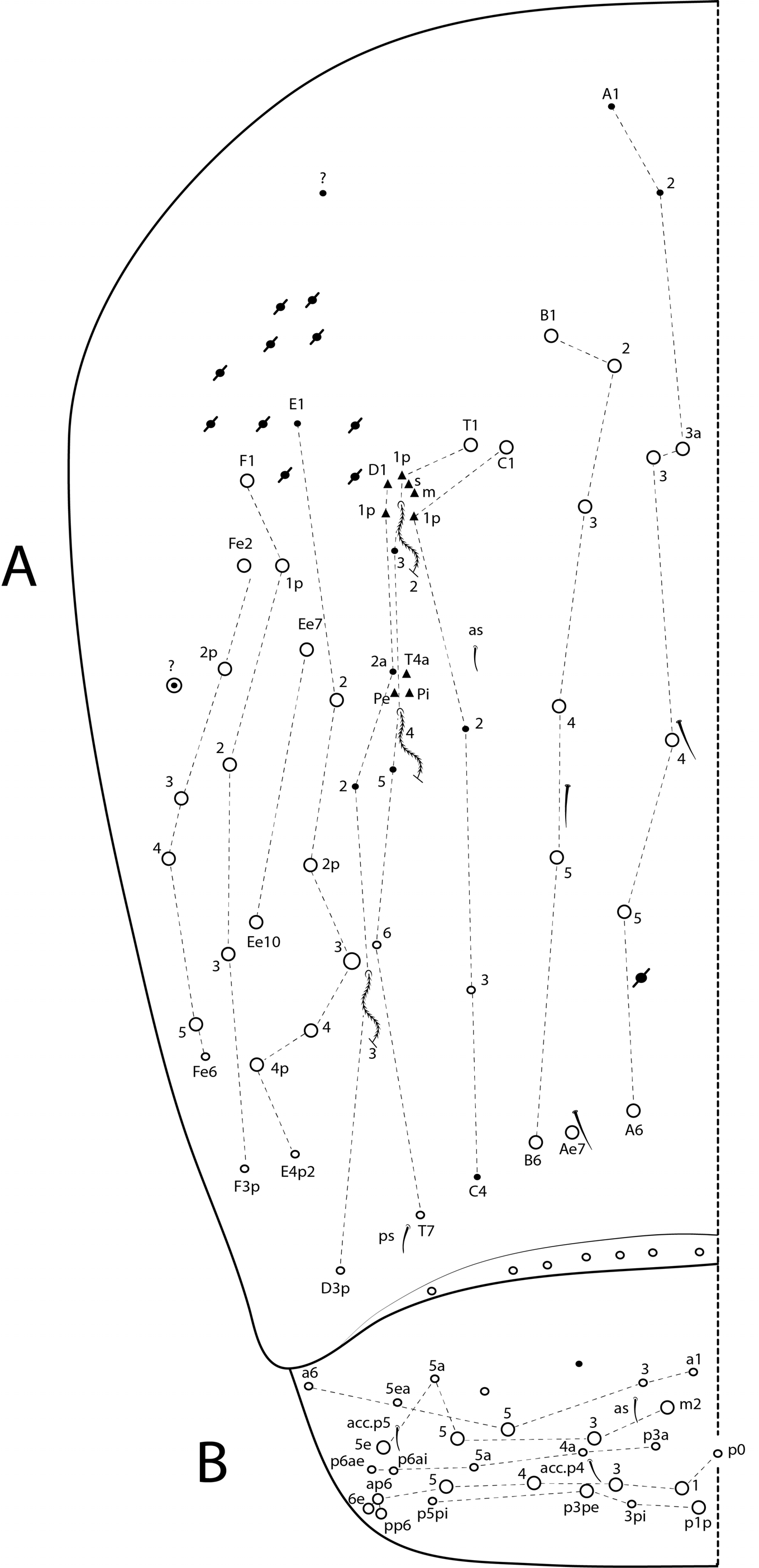
Description. Total length (head + trunk) of adult specimens 2.79 ‒ 3.44 mm (n = 4), holotype 2.89 mm. Alive specimens with Ant III ‒ IV and legs brownish, Ant I ‒ II, head and body black (formed by scales) with two dorsal white longitudinal bands (formed by scales) that extend from Th II to Abd II, plus irregular transverse spots on Abd III and two spots on Abd IV (Fig. 3 A). Specimens in alcohol pale white with dark blue pigment on apex of Ant IV, anterior head, Th I, coxae to basal half of femora, collophore, and Abd I ‒ IV laterally; eyepatches black (Fig. 3 E). Scales present on Ant I to basal half of Ant III, ventral and dorsal head, thorax and abdomen dorsally, legs (except empodia), anterior collophore, and manubrium and dentes ventrally (Figs 30 A ‒ D, I ‒ J). Head. Antennae shorter than body length, antennal ratio as I: II: III: IV = 1: 1.6 0 ‒ 1.78: 1.57 ‒ 1.99: 2.38 ‒ 2.95 (n = 4), holotype 1: 1.69: 1.80: 2.72 (Fig. 3 A, E). Ant IV annulated, with simple apical bulb retractile and blunt sens. Ant III apical organ with two rod-like sens, 3 guard sens, one atypical rounded bulb and several blunt sens of different sizes (Fig. 31 A). Clypeal formula with 4 (l 1 ‒ 2), 4 (f), 3 (pf 0 ‒ 1) ciliate chaetae, l 1 acuminate, l 2 largest, and 2 outer frontal smaller (Fig. 31 B). Two inner labral papillae conical, outer papillae reduced to conical projections (Fig. 31 C). Maxillary palp with smooth apical appendage (a. a.) and basal chaeta (b. c.) weakly ciliated, thicker and 1.08 longer than apical (Fig. 31 D). Eyes A and B larger, G smaller, with 4 interocular chaetae (v, p, r, t); head dorsal chaetotaxy (Fig. 31 E) with 10 ‘ An’ mac (An 1, An 2 ‒ 3), 4 ‘ A’ mac (A 0, A 2 ‒ 3, A 5), 3 ‘ M’ mac (M 1 ‒ 2, M 4), 7 ‘ S’ mac (S 0 ‒ 3, S 5 ‒ 6), 1 ‘ Ps’ mac (Ps 2, rarely as mic), 4 ‘ Pa’ mac (Pa 1 ‒ 3, Pa 5), 2 ‘ Pm’ mac (Pm 1, Pm 3), 4 ‘ Pp’ mac (Pp 1 ‒ 3, Pp 5), and 4 ‘ Pe’ mac (Pe 2 ‒ 4 plus Pe 3 p). Basomedian and basolateral labial fields with M 1 ‒ 2, R (smaller), E, L 1 ‒ 2. Postlabial ventral chaetotaxy with about 17 ciliate chaetae, postlabial formula 4 (G 1 ‒ 4), 3 (H 2 ‒ 4), 4 (J 1 ‒ 4), basal chaeta (b. c.) largest (Fig. 31 F). Thorax chaetotaxy (Figs 32 A ‒ B). Th II, series ‘ a’ with 4 mac (a 5 ip ‒ 5 p); series ‘ m’ with 8 mac (m 1 i 2 ‒ 2, m 4 i ‒ 4 p); series ‘ p’ with 17 ‒ 19 mac (p 1 i 2 p 2 ‒ 1 p, p 2 a – 2 ep 2, p 3 ‒ 3 p, p 5), p 1 i 2 p 2 and p 1 ip 2 p present or absent. Th III, series ‘ a’ with 7 mac (a 1 i ‒ 6); series ‘ m’ with 1 mac (m 6); series ‘ p’ with 11 ‒ 13 mac (p 1 ip 2 ‒ 1 p 2, p 2 a ‒ 2 ea, p 3, p 5 ‒ 6), p 1 ip and p 1 ip 2 present or absent. Th ratio as II: III = 1: 0.49 ‒ 0.61 (n = 4), holotype 1: 0.49. Abdomen chaetotaxy (Figs 32 C ‒ E, 33 A ‒ B). Abd I, series ‘ a’ with 1 mac (a 3); series ‘ m’ with 5 mac (m 2 i ‒ 4). Abd II, series ‘ a’ with 2 mac (a 2 ‒ 3); series ‘ m’ with 4 mac (m 3 ‒ 3 e, m 5). Abd III, series ‘ a’ with a 3 rarely as mac; series ‘ m’ with 3 mac (m 3, am 6, pm 6); series ‘ p’ with 1 mac (p 6). Abd IV with 14 central mac of series ‘ A’ to ‘ T’ (A 3 a ‒ 6, Ae 7, B 1 ‒ 6, C 1, T 1), and 16 ‒ 17 lateral mac of series ‘ E’ to ‘ Fe’ (E 2 ‒ 4 p, Ee 7, Ee 10, F 1 ‒ 3, Fe 2 ‒ 5 and one unnamed as mac or mic); 10 psp (atypical) anteriorly, at least 5 sens (as and ps type I and 3 type II), and posteriorly with 7 mes present. Abd V, series ‘ a’ with 1 mac (a 5); series ‘ m’ with 4 mac (m 2 ‒ 3, m 5 ‒ 5 e); series ‘ p’ with 7 mac (p 1, p 3 ‒ 5, ap 6 – 6 e, pp 6); series ‘ pp’ with 2 mac (p 1 p, p 3 pe). Abd ratio as III: IV = 1: 4.40 ‒ 5.43 (n = 4), holotype 1: 4.98. Legs. Subcoxa I with 5 chaetae and 3 ‒ 4 psp; subcoxa II with an anterior row of 10 chaetae, posterior row with 7 chaetae, 2 anterior chaetae and 7 psp; subcoxa III with one row of 10 chaetae and 2 posterior psp (Figs 34 A ‒ C). Trochanteral organ with about 36 spine-like chaetae (Fig. 34 D). Unguis with basal and median teeth with the same length, apical tooth smaller. Unguiculus with all lamellae acuminate, pe lamella serrated and with small proximal tooth, other lamellae (ai, ae, pi) smooth; ratio unguis: unguiculus = 1: 0.49 (Fig. 34 E). Tibiotarsus III distally with inner smooth chaeta 1.15 larger than unguiculus; and outer tenent hair capitate, discretely ciliate, and 0.81 smaller than unguis. Collophore (Fig. 34 F). Anterior side with 17 ciliate chaetae, including 1 distal mac and 3 large acuminate long chaetae; posterior side with 8 ciliate chaetae, of which one distal thickest; lateral flap with 3 smooth chaetae (one smaller posteriorly) and 15 ciliate chaetae. Furcula (Figs 34 G ‒ H). Manubrium ventrally with formula 1, 0, 0, 2 / 2 (subapical), 14 ‒ 20 (apical) ciliate chaetae and approximately 22 elongated apical scales per side; manubrium dorsally with 7 subapical ciliate chaetae, manubrial plate with 6 ciliate chaetaeand 4 psp.
Cipola, Nikolas Gioia, Arbea, Javier, Baquero, Enrique, Jordana, Rafael, Morais, José Wellington De, Bellini, Bruno Cavalcante (2018): The survey of Seira Lubbock, 1870 (Collembola, Entomobryidae, Seirinae) from Iberian Peninsula and Canary Islands, including three new species. Zootaxa 4458 (1): 1-66, DOI: 10.11646/Zootaxa.4458.1.1

Diagnosis. Body with two longitudinal bands on Th II ‒ Abd II, and Abd III ‒ IV with irregular transverse spots or restricted on head and thorax laterally when preserved in alcohol (Figs 3 A, E); head mac M 4 i, S 4, Pa 4 and Pp 6 absent, eyepatches with 4 interocular chaetae (q absent) (Fig. 31 E); labral papillae conical, outer papillae reduced to conical projections (Fig. 31 C); Th II with 5 medio-central mac (m 1 ‒ 1 i 2, m 2 ‒ 2 i) and PmA ‒ PmC groups with 7 ‒ 9, 3 and 6 mac respectively (Fig. 32 A); Th III ‒ Abd III with 15 ‒ 17, 6, 5 and 1 ‒ 2 (rarely a 3 as mac) central mac, respectively (Figs 32 B ‒ E); Abd IV with 14 central mac, 16 ‒ 17 lateral mac and about 10 psp anteriorly (Fig. 33 A); unguis apical tooth present (Fig. 34 E); unguiculus outer edge serrated and with proximal tooth (Fig. 34 E); manubrium ventrally with 2 / 2 subapical and 14 ‒ 20 apical chaetae (Fig. 34 G).
Cipola, Nikolas Gioia, Arbea, Javier, Baquero, Enrique, Jordana, Rafael, Morais, José Wellington De, Bellini, Bruno Cavalcante (2018): The survey of Seira Lubbock, 1870 (Collembola, Entomobryidae, Seirinae) from Iberian Peninsula and Canary Islands, including three new species. Zootaxa 4458 (1): 1-66, DOI: 10.11646/Zootaxa.4458.1.1
Remarks. Seira betica sp. nov. resembles S. dagamae Dallai, 1973 and S. stachi Loksa, 1990 by color pattern of body on two longitudinal white bands on Th II ‒ Abd II, Abd IV with irregular transverse spots, and most dorsal macrochaetotaxy pattern (at least of S. dagamae). However, S. betica sp. nov. differs from S. dagamae by Th II with 5 medio-central mac (4 in S. dagamae) and PmA and PmC groups with 7 ‒ 9 and 6 mac, respectively (7 and 5 in S. dagamae); Th III with 7 ‒ 9 mac inner to psp (6 in S. dagamae); and Abd IV with mac B 1 ‒ 2 (absent in S. dagamae). Seira betica sp. nov. differs at this time from S. stachi more clearly by unguiculus outer edge serrated (smooth in S. stachi). The original description of S. stachi does not present the dorsal macrochaetotaxy, as well as several other characteristics, which makes difficult to compare the species (see Loksa 1990: 274). In addition, in the description of unguis 3 internal teeth are reported (proximal, median and apical), probably wrongly, since the proximal tooth is always paired in Seira (Christiansen & Bellinger 2000; Barra 2004 a, 2004 b; Bellini et al. 2010; Cipola et al. 2014 a, 2014 b; Godeiro & Bellini 2014, 2015), therefore this can not be used to compare the species. The presence of a subapical rounded bulb on Ant III (Fig. 31 A) and anterolateral psp in Abd IV (Fig. 33 A) of S. betica sp. nov. are exclusive features registered here for the first time in Seira, which can help distinguish this species from other related taxa. Other comparisons among species are presented in Tables 1 and 2.
Cipola, Nikolas Gioia, Arbea, Javier, Baquero, Enrique, Jordana, Rafael, Morais, José Wellington De, Bellini, Bruno Cavalcante (2018): The survey of Seira Lubbock, 1870 (Collembola, Entomobryidae, Seirinae) from Iberian Peninsula and Canary Islands, including three new species. Zootaxa 4458 (1): 1-66, DOI: 10.11646/Zootaxa.4458.1.1
Etymology. The species is named after the Betica Region (approximately corresponds to modern Andalucia) where it has been found.
Cipola, Nikolas Gioia, Arbea, Javier, Baquero, Enrique, Jordana, Rafael, Morais, José Wellington De, Bellini, Bruno Cavalcante (2018): The survey of Seira Lubbock, 1870 (Collembola, Entomobryidae, Seirinae) from Iberian Peninsula and Canary Islands, including three new species. Zootaxa 4458 (1): 1-66, DOI: 10.11646/Zootaxa.4458.1.1
Type material. Holotype female on slide (EHL 0005 / MNCN): Spain, Huelva Province, Minas de Riotinto municipality (37 ° 39 ' 11 '' N; 06 ° 37 ' 10 '' W), on wood, 445 m, 11. x. 2015, A. Burgers coll. Paratypes on slides (INPA and MNCN): 3 females and 2 specimens in alcohol, same data as holotype. Other material. 2 females and 1 juvenile on slides (EAL 0001 / JIAP), Spain, Almería province, Vera municipality, Playa de Vera (37 ° 12 ' 09 '' N; 01 ° 48 ' 42 '' W), back of the beach, 1 m, 27. ix. 2005, pitfall trap, J. I. Arbea coll.
Cipola, Nikolas Gioia, Arbea, Javier, Baquero, Enrique, Jordana, Rafael, Morais, José Wellington De, Bellini, Bruno Cavalcante (2018): The survey of Seira Lubbock, 1870 (Collembola, Entomobryidae, Seirinae) from Iberian Peninsula and Canary Islands, including three new species. Zootaxa 4458 (1): 1-66, DOI: 10.11646/Zootaxa.4458.1.1

Export occurrence data

Darwin Core Archive (ZIP)

CLASSIFICATION

Taxonomic Classification Tree

MULTIMEDIA

Media Files(6)

FIGURE 3A–E. Seira spp., habitus (lateral view, except A in dorsal): A‒B, in natural habitat, A, S. betica sp. nov., courtesy of André Burgers (http://www.biodiversidadvirtual.org/insectar ium/Seira-betica-img961392.html), B, S. burgersi sp. nov., courtesy of André Burgers (http://www.biodiversidadvirtual.org/insectarium/Seira-burgersi-img961393.html); C‒E, preserved in alcohol: C, S. barrai sp. nov., D, S. burgersi sp. nov., E, S. betica sp. nov. Scale bars: 0.5mm.

Imageimage/png© Cipola, Nikolas Gioia;Arbea, Javier;Baquero, Enrique;Jordana, Rafael;Morais, José Wellington De;Bellini, Bruno CavalcanteCipola, Nikolas Gioia;Arbea, Javier;Baquero, Enrique;Jordana, Rafael;Morais, José Wellington De;Bellini, Bruno Cavalcante

FIGURE 30A–J. Seira betica sp. nov., different shapes of scales and tergal chaetae; A‒D, scales: A, rounded, B, truncate, C, irregular, D, elongated; E‒F, macrochaetae apically foot-shaped: E strongly projected, F, lightly projected; G‒J, tergal chaetotaxy (left side): G, Th II, ‘al’ is anterolateral sens and ‘ms’ specialized microchaeta; H, Abd II medially, a2‒3 and m3‒3e are mac, as anterosubmedial sens, a2p accessory chaeta of bothriotricum, m2 bothriotricum, psp pseudopore; I–J, Abd III laterally: I, anteriorly, J, posteriorly, am6, pm6 and p6 are mac, a5 and m5 bothriotricha, c3 mic, acc.p6 accessory sens of p6 chaeta, arrow indicates accessory chaeta of bothriotricha. Scale bars: 10 µm.

Imageimage/png© Cipola, Nikolas Gioia;Arbea, Javier;Baquero, Enrique;Jordana, Rafael;Morais, José Wellington De;Bellini, Bruno CavalcanteCipola, Nikolas Gioia;Arbea, Javier;Baquero, Enrique;Jordana, Rafael;Morais, José Wellington De;Bellini, Bruno Cavalcante

FIGURE 31A–F. Seira betica sp. nov.: head; A, Ant III apical organ; B, clypeal chaetotaxy; C, labral papillae; D, maxillary outer lobe; E, dorsal cephalic chaetotaxy; F, postlabial ventral head, arrows indicate normal ciliated chaetae and basal chaeta (b.c.), respectively.

Imageimage/png© Cipola, Nikolas Gioia;Arbea, Javier;Baquero, Enrique;Jordana, Rafael;Morais, José Wellington De;Bellini, Bruno CavalcanteCipola, Nikolas Gioia;Arbea, Javier;Baquero, Enrique;Jordana, Rafael;Morais, José Wellington De;Bellini, Bruno Cavalcante

FIGURE 32A–E. Seira betica sp. nov.: dorsal chaetotaxy; A, Th II; B, Th III; C, Abd I; D, Abd II; E, Abd III.

Imageimage/png© Cipola, Nikolas Gioia;Arbea, Javier;Baquero, Enrique;Jordana, Rafael;Morais, José Wellington De;Bellini, Bruno CavalcanteCipola, Nikolas Gioia;Arbea, Javier;Baquero, Enrique;Jordana, Rafael;Morais, José Wellington De;Bellini, Bruno Cavalcante

FIGURE 34A–H. Seira betica sp. nov.: A, subcoxa I; B, subcoxa II; C, subcoxa III; D, trochanteral organ; E, distal tibiotarsus and empodial complex III (posterior view); F, collophore chaetotaxy (lateral view); G, manubrium ventral chaetotaxy; H, manubrial plate and subapical chaetae (dorsal view).

Imageimage/png© Cipola, Nikolas Gioia;Arbea, Javier;Baquero, Enrique;Jordana, Rafael;Morais, José Wellington De;Bellini, Bruno CavalcanteCipola, Nikolas Gioia;Arbea, Javier;Baquero, Enrique;Jordana, Rafael;Morais, José Wellington De;Bellini, Bruno Cavalcante

FIGURE 33A–B. Seira betica sp. nov.: dorsal chaetotaxy; A, Abd IV; B, Abd V.

Imageimage/png© Cipola, Nikolas Gioia;Arbea, Javier;Baquero, Enrique;Jordana, Rafael;Morais, José Wellington De;Bellini, Bruno CavalcanteCipola, Nikolas Gioia;Arbea, Javier;Baquero, Enrique;Jordana, Rafael;Morais, José Wellington De;Bellini, Bruno Cavalcante

IMAGES

Gallery(6)

See Gallery

Occurrences with images

Source Information

The survey of Seira Lubbock, 1870 (Collembola, Entomobryidae, Seirinae) from Iberian Peninsula and Canary Islands, including three new species

checklist

This dataset contains the digitized treatments in Plazi based on the original journal article Cipola, Nikolas Gioia, Arbea, Javier, Baquero, Enrique, Jordana, Rafael, Morais, José Wellington De, Bellini, Bruno Cavalcante (2018): The survey of Seira Lubbock, 1870 (Collembola, Entomobryidae, Seirinae) from Iberian Peninsula and Canary Islands, including three new species. Zootaxa 4458 (1): 1-66, DOI: 10.11646/Zootaxa.4458.1.1

Abstract

Here we present a survey of Seira fauna from Iberian Peninsula and Canary Islands, including the description of three new species from Spain: Seira barrai sp. nov., Seira betica sp. nov. and Seira burgersi sp. nov., the latter with unprecedented antennal morphology for Seira. Five species from Western Europe are redescribed and their dorsal detailed chaetotaxy is revealed for the first time: S. domestica (Nicolet), S. dinizi Gama, S. ferrarii Parona, S. mantis Zeppelini & Bellini and S. pini Jordana & Arbea, the first two from type locality, and the latter two based on analysis of the type material. A note on chaetal interpretation of the first abdominal segment for Seira is presented. An identification key to 31 species with known dorsal chaetotaxy from Western Palearctic region is also provided, including a discussion on dense macrochaetotaxy present in Palearctic and Oriental species and its reduction in species from others biogeographic regions.

Cipola N G, Arbea J, Baquero E, Jordana R, Morais J W D, Bellini B C, plazi (2018). The survey of Seira Lubbock, 1870 (Collembola, Entomobryidae, Seirinae) from Iberian Peninsula and Canary Islands, including three new species. Plazi.org taxonomic treatments database. Checklist dataset https://doi.org/10.11646/zootaxa.4458.1.1 accessed via GBIF.org on 2026-06-15.

CC0Published 8/13/2018View dataset
GBIF Usage Key
148692417
Dataset Key
05a90c4a-a1f4-4726-ae24-3bdfdf4da586
Origin
source
Backbone Key
10421700
Taxon ID
B83E8799FFD6155896AFE22723B5D1A5.taxon
Last Crawled
6/10/2026
Last Interpreted
6/10/2026