
AnimaliaacceptedgenusAccepted
Archaebranchinecta

Archaebranchinecta

Rogers & Coronel, 2011

GBIF:159654548

0datasets
0year

0

Descendants

0

Children

0

Species

ABOUT

Descriptions(2)

Distribution and ecology. Present in high-mountain (3,550 – 4,225 m a. s. l.) temporary ponds, medium to small sized, shallow, turbid or clear, with or without macrophytes, which freeze during winter and bear high levels of solar radiation (Halloy 1979). The occurrence of adult and juvenile anostracans, coexisting with the Spinicaudatan Leptestheria tucumanensis was reported by Halloy (1979) in Laguna Circular of Huaca Huasi (15 – 20 m in diameter, 0 – 70 cm deep), from February to April. In 2012, the first author examined the above mentioned FML – CRUST 01045 sample, reporting the presence of two adult males of an undetermined species, herein assigned to Archaebranchinecta. Besides, Cohen (2010, 2012) identified two other high altitude Branchinectidae from Huaca Huasi: Branchinecta brushi Hegna & Lazo-Wasem, 2010 (from a temporary pond), and B. papillata Rogers, De los Ríos & Zúñiga, 2008 (from peat-bog pools of Vega del Matadero, north of Laguna Circular).
Cohen, Rosa Graciela, Marinone, María Cristina, Adamowicz, Sarah J. (2019): A new species of Archaebranchinecta (Anostraca: Branchinectidae) from the South American Altiplano. Zootaxa 4683 (1): 55-83, DOI: 10.11646/zootaxa.4683.1.3
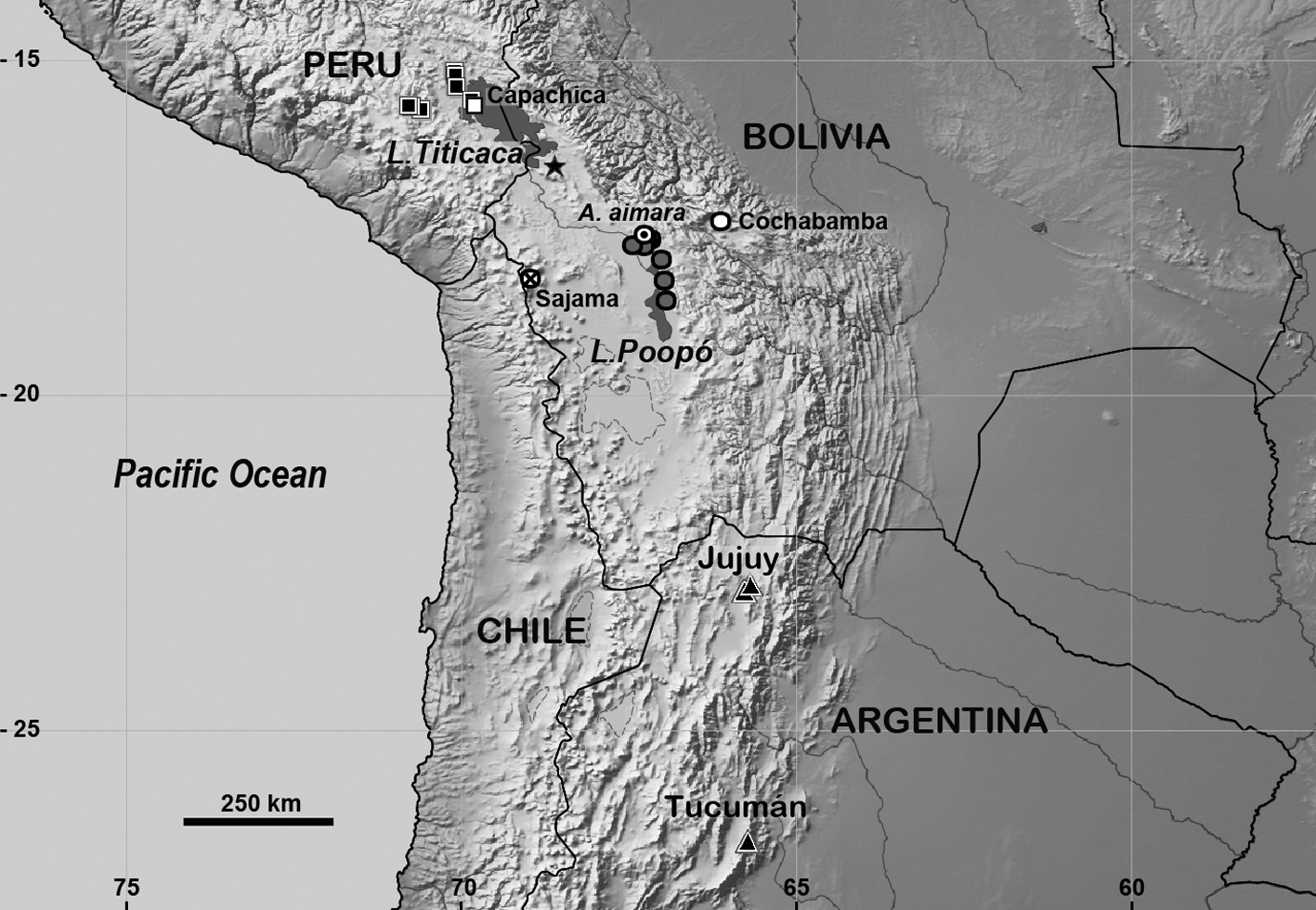
Examined material. Samples from 4 Punenian and high-Andean temporary ponds from northwestern Argentina (Table 1, Fig. 1), deposited in the Fundación Miguel Lillo, Crustacean Collection: FML – CRUST 01148, Jujuy Province, roadside pond between Abra Pampa and Tres Cruces, colls. C. Locascio de Mitrovich and A. Villagra, April 10, 2000 (juveniles of both sexes); FML – CRUST 01092 and FML – CRUST 01149, Jujuy Province, Laguna Sayate, provincial road 79 (road 71 in label), 20 km southwest of Abra Pampa, colls. C. Locascio de Mitrovich and A. Villagra, November 8, 1999 (juveniles of both sexes); FML – CRUST 01045, Tucumán Province, Huaca Huasi, Laguna Circular, coll. S. Halloy, April 9, 1977 (two males poorly preserved). Identification. The juveniles in three samples from Jujuy were merely identified as Archaebranchinecta. The two adult males from Tucumán were also allocated to Archaebranchinecta based on the very long gonopods bearing a pair of medial projections with two processes in their non-eversible part, and the presence of prominent bulging evaginations close together in the ventral midline of the genital segments, in lateral view. Since the second antenna basal antennomere was quite distorted in both males, the diagnostic characters of the processes were hardly visible for specific identification.
Cohen, Rosa Graciela, Marinone, María Cristina, Adamowicz, Sarah J. (2019): A new species of Archaebranchinecta (Anostraca: Branchinectidae) from the South American Altiplano. Zootaxa 4683 (1): 55-83, DOI: 10.11646/zootaxa.4683.1.3

Export occurrence data

Darwin Core Archive (ZIP)

CLASSIFICATION

Taxonomic Classification Tree

MULTIMEDIA

Media Files(1)

FIGURE 1. Distribution of Archaebranchinecta in the South American Altiplano. Grey circles: new sites for A. aimara sp. nov.; white circle with a black dot: type locality for A. aimara sp. nov.(Bo-44); black star: new site near Tiwanaku for A. aimara sp. nov. (Bo-18); black squares: new sites for A. pollicifera. Published localities: white square: type locality for A. pollicifera in Capachica Peninsula; white circle: paratype locality for A. pollicifera in Cochabamba by Harding (1940), which most probably belongs to A. aimara sp. nov.; crossed white circle: redescription site for A. pollicifera in Sajama National Park by Rogers & Coronel (2011), herein assigned to A. aimara sp. nov.; and black triangles: first report sites for Archaebranchinecta in northern Argentina.

Imageimage/png© Cohen, Rosa Graciela;Marinone, María Cristina;Adamowicz, Sarah J.Cohen, Rosa Graciela;Marinone, María Cristina;Adamowicz, Sarah J.

IMAGES

Gallery(1)

See Gallery

Occurrences with images

Source Information

A new species of Archaebranchinecta (Anostraca: Branchinectidae) from the South American Altiplano

checklist

This dataset contains the digitized treatments in Plazi based on the original journal article Cohen, Rosa Graciela, Marinone, María Cristina, Adamowicz, Sarah J. (2019): A new species of Archaebranchinecta (Anostraca: Branchinectidae) from the South American Altiplano. Zootaxa 4683 (1): 55-83, DOI: 10.11646/zootaxa.4683.1.3

Abstract

A detailed morphological comparison was carried out among specimens of several samples of Archaebranchinecta Rogers & Coronel, 2011 from the Altiplano of Peru, Bolivia, and Argentina. Surprisingly, striking differences were found between Peruvian samples collected near the western shore of Lake Titicaca, and those from Bolivia taken southwardly, near the east coasts of River Desaguadero and Lake Poopó. Accordingly, the new species Archaebranchinecta aimara sp. nov. is described, representing the second specific entity of a genus that so far included only A. pollicifera (Harding, 1940). The main differential features between both species include: (a) size and shape of the three processes of basal segment of the male second antenna; (b) shape and protrusion degree of the pair of medioventral bulges in the male genital segments; (c) presence or absence of strong ventrolateral spine on the second genital segment of female; and (d) presence or absence of a pair of ventrolateral outgrowths in the brood pouch. This research contributes to our understanding of the biodiversity and endemism of the unique Altiplano region of South America.

Cohen R G, Marinone M C, Adamowicz S J, plazi (2019). A new species of Archaebranchinecta (Anostraca: Branchinectidae) from the South American Altiplano. Plazi.org taxonomic treatments database. Checklist dataset https://doi.org/10.11646/zootaxa.4683.1.3 accessed via GBIF.org on 2026-06-14.

CC0Published 10/7/2019View dataset
GBIF Usage Key
159654548
Dataset Key
2be87c77-f417-48ed-bb1c-3fe9fca4d1e5
Origin
source
Backbone Key
9313611
Taxon ID
03D1879AFF843767CABF6345FA67F95A.taxon
Last Crawled
6/10/2026
Last Interpreted
6/10/2026