AnimaliaNot EvaluatedacceptedspeciesAccepted
Acanthocyrtus pallidus

Acanthocyrtus pallidus

Cipola & Greenslade, 2022

GBIF:194444125

0year

ABOUT

Descriptions(6)

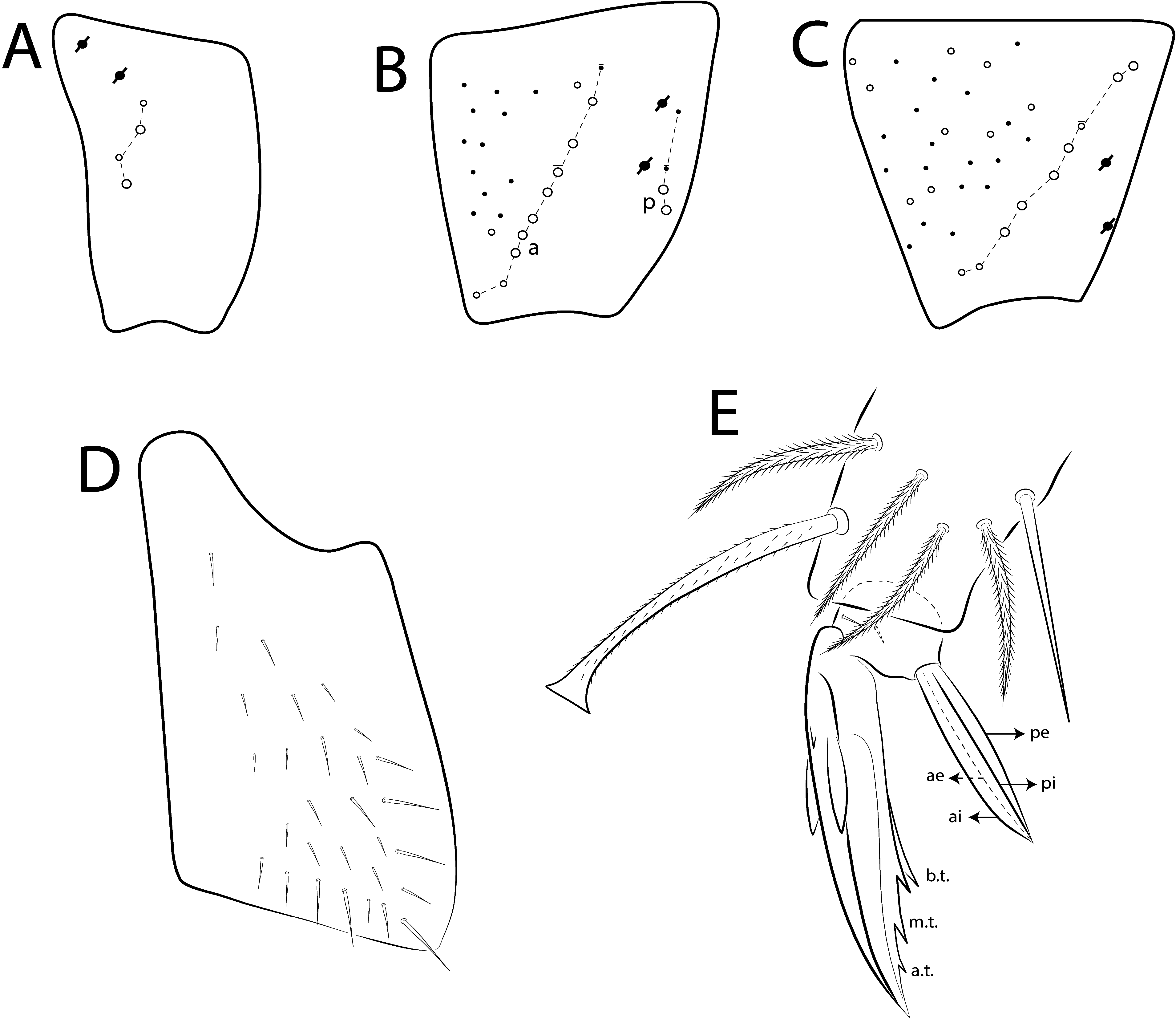
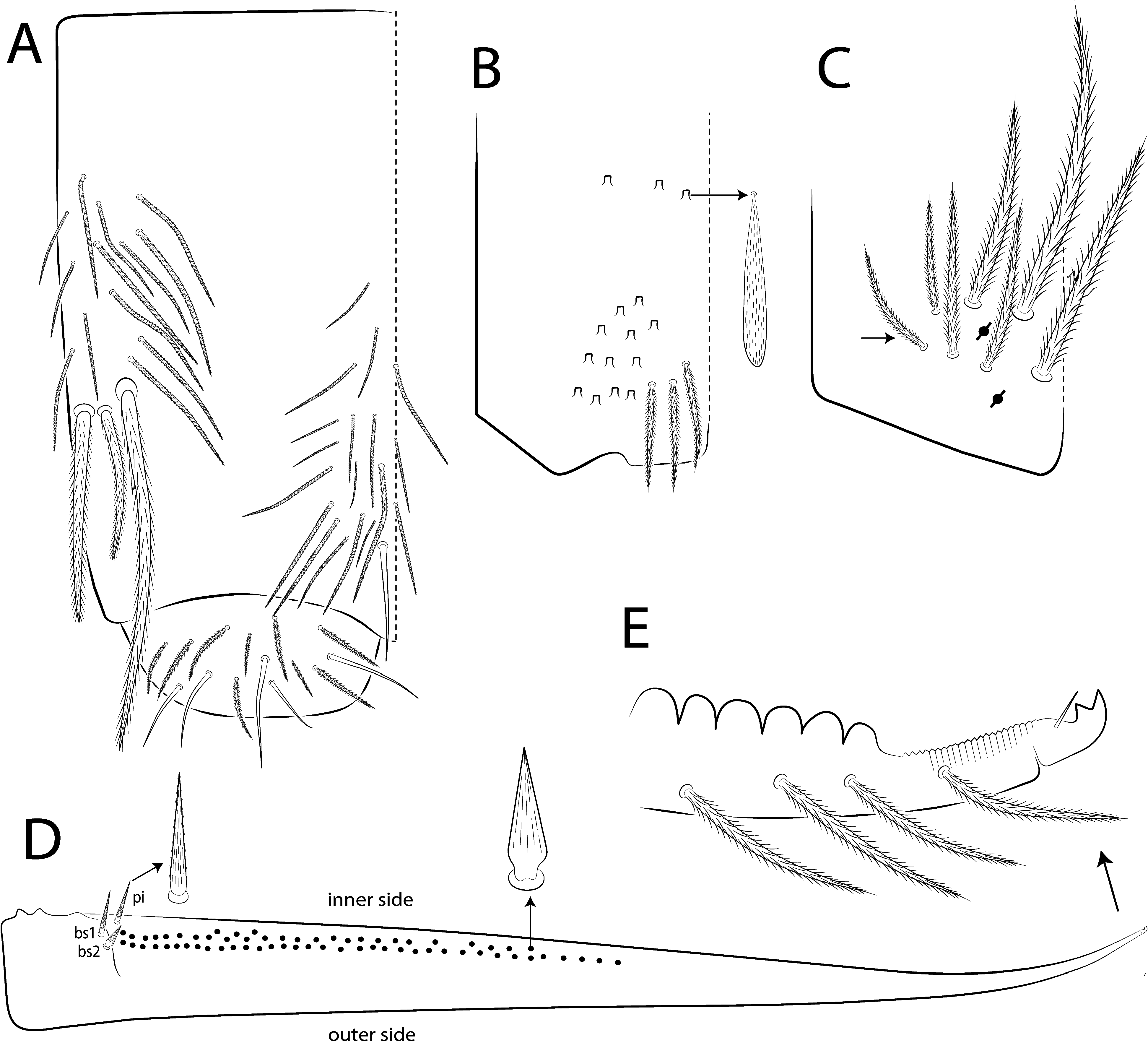
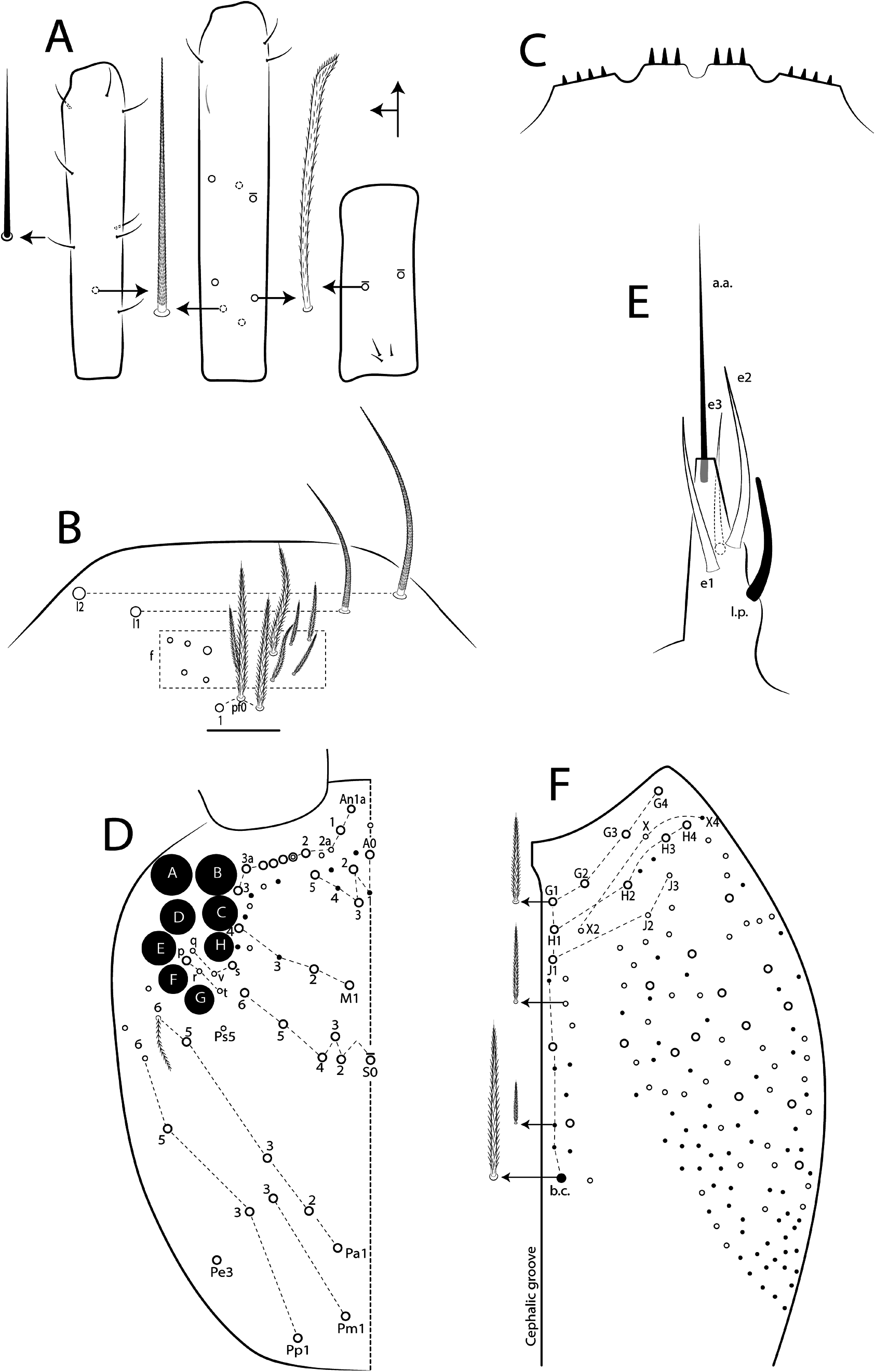
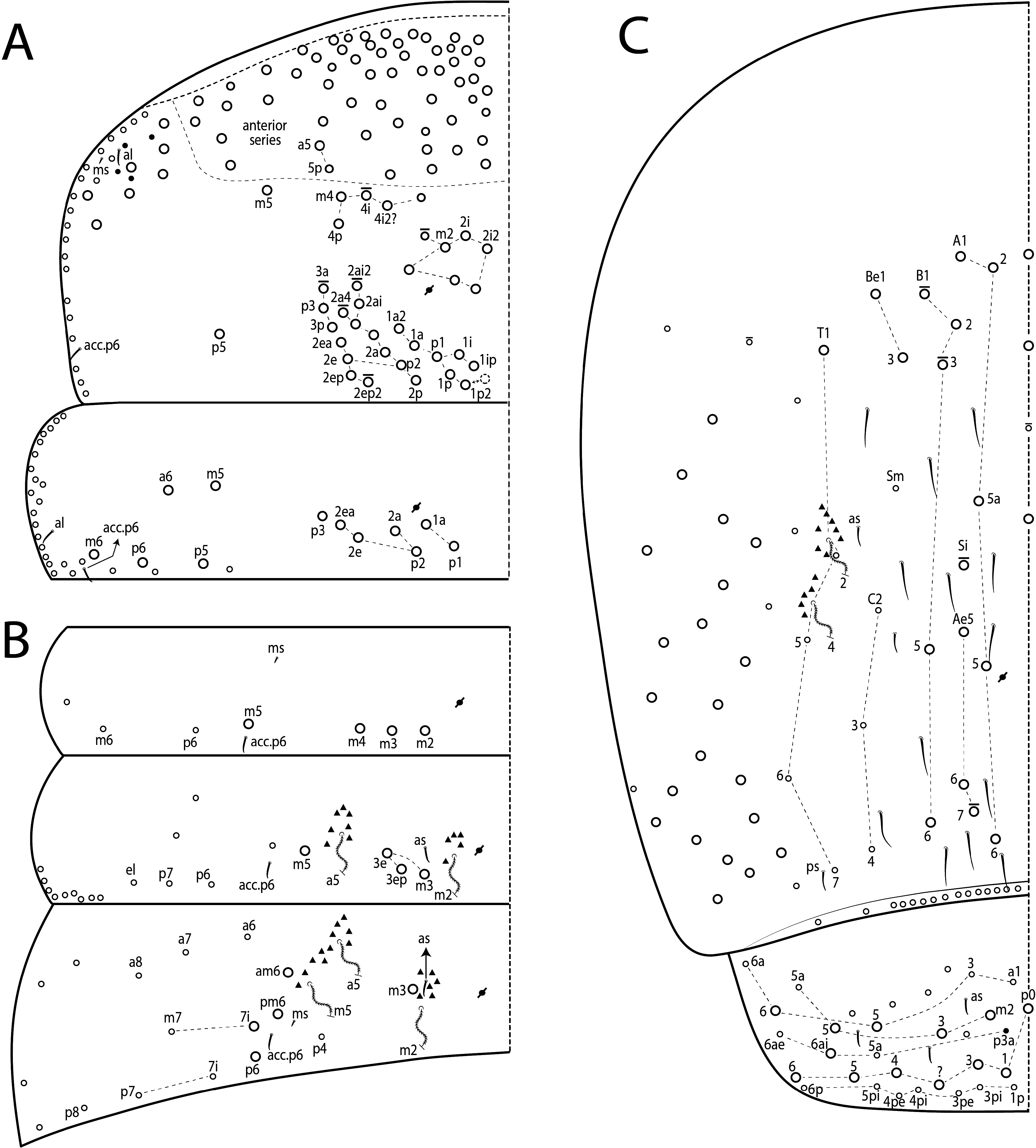
Description. Total length (head + trunk) of specimens 2.14 – 2.86 mm (n = 4), holotype 2.32 mm. Specimens yellowish with violet pigment present from Ant I – IV and weakly of the distal half of femur to proximal two thirds of tibiotarsus; eyespatches black (Fig. 8). Scales heavily ciliate, oval or elongated and apically rounded (rarely truncate or irregular) present on Ant I to proximal half of Ant II, dorsal head, dorsal thorax and abdomen, legs (except empodia), and manubrium and dens ventrally. Head. Antennae gently larger than trunk length (Fig. 8); ratio antennae: trunk = 1: 1.06 – 1.42 (n = 4), holotype 1: 1.29; antennal segments ratio as I: II: III: IV = 1: 1.91 – 2.11: 1.52 – 1.84: 2.19 – 2.39, holotype 1: 2.0: 1.52: 2.25. Ant IV annulated on distal ¾, with apical bulb apically bilobed, at least 4 sens types, 3 conical, 6 in finger-shape, 3 rods and numerous pointed sens (similar to Fig. 3 A). Ant III sense organ with 2 club-shaped sens, 3 spiny guard sens, 1 conical and 1 finger-shape sens, at least 6 pointed sens and ciliated chaetae (similar to Fig. 3 B); dorsally with about 6 elongated thin sens; ventrally with 2 elongated thin sens and 1 proximal mac apically acuminate (Fig. 9 A). Ant II dorsally with 3 – 4 mac and 3 elongated thin sens distally; ventrally with 1 elongated thin sens 3 mac apically acuminate (Fig. 9 A). Ant I dorsally with 0 – 2 median mac and 3 smooth mic at base (Fig. 9 A). Clypeal formula with 4 (l 1 – 2), 9 (f), 3 (pf 0 – 1) ciliate chaetae, l 1 – 2 larger and apically acuminate, 4 f smaller, 1 fr unpaired, others subequal (Fig. 9 B). Labral a 1 chaeta normal and p 0 – 2 larger. Labral inner papillae with 3 projections; outer papillae with 4 projections, both on a square projection (Fig. 9 C). Eyes subequals, except F, G and H gently smaller, others subequal, and with 6 ’ IO’ chaetae (p, r, t, q, v, s); head dorsal macrochaetotaxy with 8 – 9 An, 4 A, 3 M, 5 – 6 S, 4 Pa, 2 Pm, 3 Pp, and 1 Pe mac (Fig. 9 D). Labial papilla E with l. p. finger-shape and not reach the base of a. a. (Fig. 9 E). Maxillary palp with smooth t. a. and b. c. smooth and subequal in length. Basolateral and basomedian labial fields with chaetae M 1 – 2, R, E, L 1 – 2 ciliate, M 2 and R smaller. Ventral head with at least 146 ciliate chaetae, 24 larger and thicker, about 73 smaller, and 48 subequals, plus 1 elongated and larger b. c.; postlabial formula with 4 (G 1 – 4), 3 (X 2, X, X 4), 4 (H 1 – 4), 4 (J 1 – 3) chaetae; cephalic groove with 16 chaetae (Fig. 9 F). Thorax chaetotaxy (Fig. 10 A). Th II a, m and p series with about 57 (anterior chaetal collar omitted), 11 – 13 and 19 – 23 mac, respectively. Th III a, m and p series with 1, 2 and 9 mac, respectively. Ratio Th II: III = 1.86 – 1.23: 1 (n = 4), holotype 1.56: 1. Abdomen chaetotaxy (Figs 10 B – C). Abd I a, m and p series with 0, 4 and 0 mac, respectively. Abd II a, m and p series with 0, 4 and 0 mac, respectively; a 5 and m 2 bothriotricha with 7 and 5 accessory chaetae respectively. Abd III a, m and p series with 0, 4 and 1 mac, respectively; m 2 bothriotrichum with 6 accessory chaetae, and a 5 and m 5 bothriotricha with 11 accessory chaetae between them. Abd IV with 3 unpaired mac (atypical), 13 – 17 central mac of A – T series and 21 lateral mac of E – Fe series; 16 sens (as, ps and other type I, and 13 type II) and posteriorly about 15 posterior mes. Abd V a, m, pa and p series with 2, 3, 1 and 7 mac, respectively. Ratio Abd III: IV = 1: 3.98 – 5.67 (n = 4), holotype 1: 4.68. Legs. Subcoxa I with one row of 6 – 7 chaetae and 2 psp; subcoxa II with an anterior row of 10 chaetae and about 26 anterior chaetae; posterior row of 4 – 5 and 5 psp; subcoxa III with one row of 10 chaetae, about 30 anterior chaetae and 2 posterior psp (Figs 11 A – C). Trochanteral organ with about 64 spine-like chaetae (Fig. 11 D). Tibiotarsus I – III subdivided on distal two third; tibiotarsal smooth chaeta 0.85 smaller than the unguiculus, tenent hair capitate and 0.83 smaller than the unguis outer edge; pretarsus with one minute anterior and one posterior smooth chaeta (similar to Fig. 6 E). Unguis I – III with 4 inner teeth, b. t. subequal to m. t. and on almost distal ⅓ of unguis inner side, m. t. on distal ¼, a. t. minute and on distal 1 / 7; outer side with 3 teeth, 2 paired large laterobasal teeth and one unpaired proximal tooth. Unguiculus I – III with all lamellae (ae, ai, pe, pi) smooth and acuminate (similar to Fig. 6 E); ratio unguis: unguiculus = 1: 0.59 in holotype. Collophore (Fig. 11 E). Anterior side with about 41 ciliate chaetae, 38 widely distributed of subequal length (3 distal mic), distally 3 subequal mac acuminate; posterior side with about 23 chaetae, 22 ciliate chaetae (3 unpaired) widely distributed of unequal length, and 1 distal smooth chaeta; lateral flap with about 15 – 16 chaetae, 4 – 5 smooth and 11 ciliate. Furcula. Manubrium ventral with 3 subapical and 16 – 18 apical scales elongated plus 2 inner ciliate chaetae per side (11 F); manubrial plate with 9 – 12 ciliate chaetae of different sizes (4 – 5 mac) and 2 – 3 psp (11 G). Dens basal half with 66 – 81 (holotype with about 70) dorsal spines striated on 4 – 2 inner rows (sometimes 4 proximal rows); bs 2 chaeta as spine, pi as spine-like chaetae, bs 1 absent (Figs 11 H).
Cipola, Nikolas Gioia, Greenslade, Penelope (2022): Two new species of Acanthocyrtus Handschin, 1925 (Collembola, Entomobryidae Entomobryinae) from Western Australia. Zootaxa 5124 (3): 341-358, DOI: 10.11646/zootaxa.5124.3.4

Figs 8 – 12, and Table 1
Cipola, Nikolas Gioia, Greenslade, Penelope (2022): Two new species of Acanthocyrtus Handschin, 1925 (Collembola, Entomobryidae Entomobryinae) from Western Australia. Zootaxa 5124 (3): 341-358, DOI: 10.11646/zootaxa.5124.3.4
Diagnosis. Body depigmented, except antennae and femur and tibiotarsus (Fig. 8); prelabral chaetae smooth (Fig. 3 D); head sutural series with 6 mac (S 0, S 2 – 6) and 6 interocellar chaetae (Fig. 9 D); labral outer and inner papillae with 3 and 4 projections, respectively (Fig. 9 C); labial papilla E with l. p. finger-shape and not reach the base of a. a. (Fig. 9 E); basolateral labial field with chaetae M 2 and R ciliate and smaller than the others (Fig. 4 C); Th II a, m and p series with about 57, 11 – 13 and 19 – 23 mac, respectively; Th III – Abd I with 12, 4, 3 + 1 and 1 + 4 mac respectively; Abd IV with 16 – 20 (3 unpaired) central and 21 lateral mac (Fig. 10); unguis b. t. subequal to m. t. and on almost distal in ⅓ of the unguis, and a. t. present; unguiculus with all lamella smooth and acuminate (Fig. 6 E); collophore anteriorly with 3 subequals distal mac (Fig. 11 E); manubrium ventro-distal with 2 inner chaetae (Fig. 11 F); dens with 66 – 81 spines on two-four rows, dens bs 2 chaeta absent (Fig. 11 H). Mucro teeth subequals, basal spine surpassing the apex of the proximal tooth (Fig. 7 E).
Cipola, Nikolas Gioia, Greenslade, Penelope (2022): Two new species of Acanthocyrtus Handschin, 1925 (Collembola, Entomobryidae Entomobryinae) from Western Australia. Zootaxa 5124 (3): 341-358, DOI: 10.11646/zootaxa.5124.3.4
Remarks. The new species A. necropolitanus sp. nov. and A. pallidus sp. nov. resemble other Australian species (in Zhang et al. 2009) as A. barrowensis Zhang, 2009, A. loftyensis Zhang, 2009 and A. yolngui Zhang, 2009, by prelabral chaetae smooth, labial papilla E with l. p. finger-shape, Th II with 5 – 6 mac in m 2 complex, Th III with 7 central mac, and Abd I – II with 3 + 1 and 3 central mac, respectively (Table 1). However, the new species also differ from the other species of the genus by the presence of labial papillae (According to Zhang et al. (2009), apparently absent in all other Australian species), although this feature is unknown in Acanthocyrtus lineatus Womersley, 1934 (Table 1). In A. necropolitanus sp. nov. the labral inner papillae are conical and with one apical projection and outer papillae has only a small rounded projection, while in A. pallidus sp. nov. has 3 and 4 projections on inner and outer papillae, respectively (Figs 3 E and 9 C). Still on the head, the new species differ from the other species by Ant IV apical bulb bilobed (absent in A. loftyensis and A. yolngui), head sutural series with 6 mac (8 in A. barrowensis, 7 in A. loftyensis and 5 in A. yolngui), and basomedian and basolateral labial fields with M 2 and R chaetae smaller and Rs absent (R normal in A. yolngui and Rs present in A. loftyensis). They also differ by unguis b. t. on almost distal ⅓ (on half in A. loftyensis and proximal ⅓ in A. yolngui) and a. t. present (absent in A. loftyensis), and mucronal teeth subequal in size (apical tooth larger in A. barrowensis) with basal spine surpassing the apex of the proximal tooth (not surpassing the apex of the proximal tooth in A. loftyensis and A. yolngui). The color pattern of A. necropolitanus sp. nov. differs by having lateral spots on head and Abd III – IV, A. pallidus sp. nov. has pigment restricted on antennae and partially on femur and tibiotarsus, while the other species have distinct patterns of pigment (see Schött 1917; Zhang et al. 2009). In addition to these differences, the new species differ from each other by annulations of Ant IV (absent in A. necropolitanus sp. nov. and present in A. pallidus sp. nov.), number of interocellar chaetae (5 in A. necropolitanus sp. nov. and 6 in A. pallidus sp. nov.), size of labial papilla E l. p. (surpass the base of a. a. in A. necropolitanus sp. nov. and not reaching the base of a. a. in A. pallidus sp. nov.); number of spine-like chaetae on trochanteral organ (29 in A. necropolitanus sp. nov. and 64 in A. pallidus sp. nov.), and distal chaetae on manubrium ventrally (3 in A. necropolitanus sp. nov. and 2 in A. pallidus sp. nov.). For other differences between Australian species see table 1.
Cipola, Nikolas Gioia, Greenslade, Penelope (2022): Two new species of Acanthocyrtus Handschin, 1925 (Collembola, Entomobryidae Entomobryinae) from Western Australia. Zootaxa 5124 (3): 341-358, DOI: 10.11646/zootaxa.5124.3.4
Etymology. Refers to pigments absent on body (head and trunk) of the new species (Fig. 8).
Cipola, Nikolas Gioia, Greenslade, Penelope (2022): Two new species of Acanthocyrtus Handschin, 1925 (Collembola, Entomobryidae Entomobryinae) from Western Australia. Zootaxa 5124 (3): 341-358, DOI: 10.11646/zootaxa.5124.3.4
Type Material. Holotype female in slide (NMV): Australia, Western Australia, Widgiemooltha municipality, St. Ives Gold Mine, mining area near Lake Lefroy, 31 ° 20 ’ 13 ” S, 121 ° 45 ’ 58 ” E (Fig. 12), 315 m., 2011, pitfalltrap, unknown collector (provided by the mining company). 14 paratypes: 3 males and 3 females on slides and 4 specimens in alcohol (NMV) and 1 male and 2 females on slides (INPA-CLL 000125 - 27), same date as holotype.
Cipola, Nikolas Gioia, Greenslade, Penelope (2022): Two new species of Acanthocyrtus Handschin, 1925 (Collembola, Entomobryidae Entomobryinae) from Western Australia. Zootaxa 5124 (3): 341-358, DOI: 10.11646/zootaxa.5124.3.4

Export occurrence data

Darwin Core Archive (ZIP)

CLASSIFICATION

Taxonomic Classification Tree

MULTIMEDIA

Media Files(9)

FIGURE 4A–D. Acanthocyrtus necropolitanus sp. nov., ventral head (right side); A, labial papillae E (right side); B, maxillary palp and sublobal plate (right side); C, basomedian and basolateral labial fields and proximal chaetae; D, complete postlabial chaetotaxy.

Imageimage/png© Cipola, Nikolas Gioia;Greenslade, PenelopeCipola, Nikolas Gioia;Greenslade, Penelope

FIGURE 6A–E. Acanthocyrtus necropolitanus sp. nov., legs; A–C, chaetotaxy of left subcoxa I–III respectively (outer side); D, trochanteral organ (posterior side); E, distal tibiotarsus and empodial complex III (posterior view).

Imageimage/png© Cipola, Nikolas Gioia;Greenslade, PenelopeCipola, Nikolas Gioia;Greenslade, Penelope

FIGURE 7A–E. Acanthocyrtus necropolitanus sp. nov., abdominal appendages; A, collophore (lateral view); B, distal manubrium (ventral view); C, manubrial plate (dorsal view), arrow indicates chaeta present or absent; D, dens spines chaetotaxy (dorsal view), E, distal dens and mucro (dorsal view).

Imageimage/png© Cipola, Nikolas Gioia;Greenslade, PenelopeCipola, Nikolas Gioia;Greenslade, Penelope

FIGURE 8. Acanthocyrtus pallidus sp. nov., habitus of specimens fixed in ethanol (lateral view). Scale bars: 0.5mm.

Imageimage/png© Cipola, Nikolas Gioia;Greenslade, PenelopeCipola, Nikolas Gioia;Greenslade, Penelope

FIGURE 9A–F. Acanthocyrtus pallidus sp. nov., antennae and head; A, chaetotaxy (mac and elongated sens) of left Ant III–I (dorsal view, from left to right), respectively; B, chaetotaxy of clypeus (dorsal view); C, labral papillae (ventral view); D, head dorsal chaetotaxy and eyes (dorsal view, left side); E, labial papillae E (ventral view, right side); F, complete postlabial chaetotaxy (ventral view, right side).

Imageimage/png© Cipola, Nikolas Gioia;Greenslade, PenelopeCipola, Nikolas Gioia;Greenslade, Penelope

FIGURE 10A–C. Acanthocyrtus pallidus sp. nov., dorsal chaetotaxy (left side); A, Th II–III; B, Abd I–III; C, Abd IV–V.

Imageimage/png© Cipola, Nikolas Gioia;Greenslade, PenelopeCipola, Nikolas Gioia;Greenslade, Penelope

IMAGES

Gallery(9)

See Gallery

Occurrences with images

Source Information

Two new species of Acanthocyrtus Handschin, 1925 (Collembola, Entomobryidae Entomobryinae) from Western Australia

checklist

This dataset contains the digitized treatments in Plazi based on the original journal article Cipola, Nikolas Gioia, Greenslade, Penelope (2022): Two new species of Acanthocyrtus Handschin, 1925 (Collembola, Entomobryidae Entomobryinae) from Western Australia. Zootaxa 5124 (3): 341-358, DOI: 10.11646/zootaxa.5124.3.4

Abstract

Two new species of Acanthocyrtus Handschin from Western Australia are described and illustrated here. Acanthocyrtus necropolitanus sp. nov. and A. pallidus sp. nov. resemble other congenerics by having smooth prelabral chaetae and a unique dorsal chaetotaxy pattern from the third thoracic segment to the third abdominal segment, but both new species are distinguished from others by the presence of labral papillae, a feature is revealed here for the first time in the genus. An identification key for all species in the genus is provided. The description of these two Acanthocyrtus species now increased from six to eight and is now known from southwestern Australia.

Cipola N G, Greenslade P, plazi (2022). Two new species of Acanthocyrtus Handschin, 1925 (Collembola, Entomobryidae Entomobryinae) from Western Australia. Plazi.org taxonomic treatments database. Checklist dataset https://doi.org/10.15468/q7uebm accessed via GBIF.org on 2026-06-15.

CC0Published 4/4/2022View dataset
GBIF Usage Key
194444125
Dataset Key
c82bdeba-416d-4289-8874-fc342820735e
Origin
source
Backbone Key
11707625
Taxon ID
0A09D803FF88242CFF621F26FEE29CBE.taxon
Last Crawled
6/9/2026
Last Interpreted
6/9/2026