AnimaliaNot EvaluatedacceptedclassAccepted
Aves

Aves

birds(+40)

GBIF:212

0countries
0datasets

0

Descendants

0

Children

0

Species

0

Genera

0

Families

PROFILE

Species Profile

Characteristics

Extant

ABOUT

Descriptions(19)

Cor biloculare, biauritum; Sanguine calido, rubro. Pulmones respirantes reciproce. Maxiilae incumbentes, nudae, exsertae, edentulae. Penis subintrans absque scroto oviparas crusta calcarea. Sensus: Lingua, Nares, Oculi, Aures absque auriculis. Tegmenta: Pennae incumbentes, imbricatae. Fulcra: Pedes bini. Alae binae. Uropygium cordatum.
Systema naturae per regna tria naturae: secundum classes, ordines, genera, species, cum characteribus, differentiis, synonymis, locis

Ipsi laetitia voces ad sidera mittunt Intonsi montes, ipsae jam eannina rupes, Ipsa sonant arbusta. V IRGIL. ecl. V. 62. AEREAE vocales Volucres pulcherrimae, Mandibulis protraƐtis nudis, Corpore pennis imbricato, Alis duabus pennatis volitantes bipedes dignoscuntur. AVES leviimae modici ponderis & magnitudinis, teƐtae pennis plumisque, destitutae Auriculis, Labiis, Cauda, Scroto, Dentibus, Utero, Epiglottide, Fornice, Corporecalloso, Diaphragmate. PENNAE avibus propriae imbricatim in quincuncem dispoitae, intertinƐtae Plumis, distinƐtae a Remigibus ReƐtribusque, omnes supra convexae, subtus concavae: latere exteriore angutiores; interiore latiores; anteriore laxiores, poteriore triƐtiores; scilicet e baseos cylindro tubuloso, referto vase lymphaticis simili, Rachi elongatae, bifariam radiis parallelisapproximatis distinƐtis itidem pinnatis ancipites. Colore ludunt, sed variant aetate, sexu, tempetate, climate; contantiores Remiges & Retrices, quae attente notandae (*). Nuda cutis utrinque ad colli latera a capite versus interscapulium; ab axillis per latera peƐtoris fere ad inguina, & ad femora potica. OVA his, animalibus communia (pag. 15. n. 4.) numero diveris vario, sed majora pro mora exclusionis siccae, semper putamine calcareo obteƐta, incubatu calido excludenda Parentis, in Nido artificioso. DIVIDITUR Avium corpus in Caput, Truncum, Artus. CAPUT tegitur supra Pileo e Vertice, Fronte, Occipiteque unitis, cingens rostrum antice Capistro, in quo Lora e lineis duabus nudis a rotro ad oculos duƐta; Orbitae ambiunt oculos, supra quos Supercilia; inter oculos & aures Tempora; inter oculos vero & gulam Genae sunt. Rostrum in variis varium: ReƐtum, Incurvum, Recurvatum, Teres, Compressum, Depressum, Conicum, Subulatum, Cylindricum, Angulatum, Cultratum, Fornicatum, Uncinatum. Mandibula nudae, edentulae, quibusdam pone apicem emarginatae, paucis ferratae, exporreƐtae in Rostrum corneum, Naribus pertusum, superioris basi quibusdam Cera nuda vestita, Vibrissis peƐtinatim ciliatis ad faucis exterioris margines. Lingua carnosa, cartilaginea, emarginata, lacera, pennacea, ciliata, integra s. acuta. Oculi laterales Palpebris Membranaque niƐtitante detergendi; Superciliorum loco interdum linea piƐta, rarius carunculata. Aures truncatae absque auriculis, quarum loco pennae Strigibus longae. Barba Mystacea ad mandibulas inferiores, mobilis Momotae. Pendulino; in ipso PeƐtore pendula Meleagridi adulto; at Capistrum reversum tegit basin rostri Corvis, Picis, Strigibus. Crista pennacea pilei Frontalis, Verticalis, Occipitalis, EreƐta, Recurvata, Deflexa, Plicatilis, Compressa. Carunculae vero carnosae nudaeque Frontis, Verticis, Nuchae, Superciliorum, Gulae, Juguli, sunt ornamenta capitis in variis. Collum elongatum, eretiusculum, teres, supra incipit Nucha, continuatur Cervice; infra vero incipit Gula, continuatur Jugulo. TRUNCUS ovatus constans Dorso coadunato macro, subtus supra Sternum magnumcarinatum musculosissimo PeƐtore, Claviculis coadunatis in Furcam, Abdomine minore, potice sub uropygio perforato Ano, genitalibus communi, & terminato Crisso. ARTUS sunt Brachiales Alae, veri Podes, Caudale Uropygium. ALAE compressae, Ossium articulis mobiles, teƐtae Pennis, demum TeƐtricibus primis secundisque, postice ciliatae Remigibus; explicantur hae in fornicatum ventilabrum volitanti; complicantur tabulanti primoribus subeuntibus secundarias, ut hae latere antico depingant specificum speculum nitidum Anatum; nec deficiunt nisi in Impennibus pelagicis (Diomedea demersa, inundata, Al ca impenni) vel volatu ponderosioribus (Struthione, Dido) Ossa: α. Brachii 1 elongatum. β. Cubiti 2 elongata. γ. Carpi 2 brevissima. δ. Metacarpi 2 connexa mediocria. ε. Digiti 2 attenuata, altero majore biarticulato, compresso; altero minuto. ζ. Pollicis vero 1 minutum, insidens basi anteriori metacarpi, raro spina evadens (Parris, Charadrio, Struthioni) adjacente spina setacea. Remiges Primores X: quorum 1 — 4 Digiti, 5 — 10 Metacarpi; Secundarii 10 — 20 s. 28 Cubiti, nulli vero Brachii; at Alula spuria pennis 3 s. 5 Pollici inidet. PEDES ex Femore, Tibia, Digitis, Unguibus: Femora exOsseFemoris, Crurisque binis altero setaceo, carnosa, pennisteƐta, praeterquam cruribus denudatis in vadantibusGrallis; ceterum plerisque aequilibrio supposita, nisi in Conpedibusambularenesciis, quibus intra commune abdoministegmenrecondita (Alcis, Colymbis); nonnullisArmillae supragenuacinguntcoloratae. Tibiae ex Osse Tarsi elongato, maeres, angustae, tendinosae, nudae, rariusvevillosaeplumosaeve, paucis postice Spina calcatae, imprimismasculis. Digitie Metatarsiphalangibus, plerumque IV, quorum unus posticusbreviorque, intermediusanterior vero longior, sed Scanoriisdigitiantici 2. poticique 2; Cursoriae vero postico destituunturtridaƐtylae (Charadrius, Haematopus, Otis, Casuarius), rarissimedidaƐtylae (StruthioCamelus). Sunt vero Digiti distinƐti Fissipedibusplerisque; velintermedius adnatus laterali Gressoriis; velanterioresintertextimembrana integra Natatoriis; quaefi ssainLobatis; velbasitantum intertextaSemipalmatisvadantibus; velarticulus membranula marginali Pinnatis. Ungues acuti, quibusdam obtusi, paucis marginati, paucissimis muticisnulli. UROPYGIUM sessile, cordatum, glandula gemina caudae brevi adposita tumidum, supra pertusum Poro oleifero, cinƐto penicillo; ambitu ciliatum ReƐtricibus Caudae: Rectrices saepe XII (1, 2,3,4, 5,6,6, 5,4,3, 2, 1); plures (18) Gallinis, pauciores (10) Picis (Pico, Certhiae, Cuculo, Yungi, Bucero, Ramphasto, Trochilo). Cauda inde vel Pedibus brevior brachyura, vel longior macroura; ex ReƐtrcibus aequalibus integra; vel ad latera per gradus brevioribus cuneata, aut lateralibus longioribus sorsi cata; in quibus omnibus Re tricibus complicatis s ubeunt la ­ terales intermedi ae. VOLATILES hae, Telluris vigiles libidinoique musici; pleraeque Diurna; paucae NoƐturnae (Striges, Caprimulgi), quarum variae Notu cantant (Luscinia, Turdi) & Mane (Tetraones, Gallinacei), pleraeque inermes funt, cum Aiarum remigibus se facile in aethera recipiant ab hotibus terretribus, & Caudae retricibus aëreos diverso volatu eludant, nisi in terra negotiari necesse sit, quibus odor vel ingratus hotes arcet, vel abolitus occultat; dum aliae speculantur hostem appropinquantem indicantque aliis: Lanius, Yunx, Parra, Haematopus, Meleagris, Hirundo purpurea & c. ARMA paucis, praeter Rostrum & Ungues plerisque. Cornua Meleagridi cornutae, Palamedeae. Calcaria Pavoni, Phasiano, Tetraoni. Spinae (pollicares) Struthioni Camelo, Par ­ rae, Charadrio spinoso, Palamedeae. VENERE monogama junguntur pleraeque Aves, polygama pauciores, ut Gallinae, Anates. Illae utriusque sexus conjuntis viribus struunt nidum saepe artificiosissimum, (pendulum, natans, concameratum, argillosum, foraminosum, nullumve) uteri succedaneum, incubant sedulae ovis, (1 Alca, 2 Colymbus, 3 Larus, 4 Corvus, 5 - 8 Hirundo, pluribus Anates, Gallinae) pullos famelicae alunt (ostendendo, porrigendo, regurgitando,) fovent, curant, pro aris & focis defendunt), dum in his otientur mares. Nuptias celebrant vestitu, musica, ludibus pleraeque. MIGRATIONES annuas inter septentrionales aestivas & australes hybernas plagas arƐticae Telluris plures intituunt internuncii hi naturae, ne hyeme demergerentur boreales omnes inseƐtivorae. Sic migrant plurimi Passeres, imprimis tenuirostres, ob defeƐtum inseƐtorum; Grallae ob denegatum glacie aditum vermibus & amphibiis; Anseres ob congelatas aquas includentes pisces & c. Revocant vero easdem Dies aestatis longiores, ciborum copia, densiores vestitus, nuptiae paratae. HABITANT aliae intra Tropicos, ut Phaëton; intra Polos, Procellaria glacialis; aliae alibi, Procellaria capensis; In India orientali Paradiseae, Pavones; Africa Struthio 1, Pelecanus 1; America Palamedea, Psophia. In Pelago impennes compeditae; Mari Procellariae; Lacubus Colymbi; Fluviis Mergi; CataraƐtis Cincius; Littoribus Charadrii; Paludibus Scolopaces, Tringae; Campis Otis; Sylvis infaustus; Arboribus Passeres; Rupibus Bubo; PagisPica, Hirundo; Alpibus Turdus roseus, Emberiza nivalis. VICTUS cuique suus. Aliae Carnivorae: vorant Cadavera Accipitres, Corvi; Pisces Anseres; InseƐta Passeres tenuirotres; Larvas Cerambycum Pici; Lepidopterorum Cuculus; Ricinos Crotophaga; Oejtros Buphaga; Onifcos Cincius; Phryganeas Hirundines; Conchas Haematopus; Cancros MyƐteria, Cancroma; Squillas Recurvirostra; Lumbricos Crex. AliaePhytiphagae: viƐitant Plantis Anseres; Pomis Psittaci; Na cibus CaryocataƐtes; Nucleis Coccothrautes; StrobilisCurvirostra, Enucleator; neƐtareflorumTrochilus. OPERA; nec sine fruƐtu, peragunt sua singulae: sedentes Accipitres Cadavera auferunt, ut vivis parcant; incedentes Pic ae Quisquilias impuras vermino s asque devorant; natantes An s eres Aquarum nim i os ho s pites minuunt; vadantes Gral l ae inquirunt in Paludum animalcula; currentes Gallin ae decidua Grana le ­ gunt; s allentes Pa ss eres arbu st orum herb irumque Semina InseƐtaque carpunt; eoque varia semina Piscium, InfeƐtorum Plantarumque sae ius in remotissima loca deferunt naturae diss eminatores. Conquiruntur Ve natu; F alconaria; Aucupio ins tituuntur Falcones ad venatum, Parr ae ad pa st oritiam, Pele ­ cani ad pi s caturam, Pa ss eres ad mu s icam. Ma ns ve s cunt Gal lina, Anates, Pa ss eresque varii. In Ornithone s. Aviario co ­ luntur ob carnes, ova, plumas, pennas, pulchritudinem, s onum. HISTORIA Avium ab s olvitur De s criptione, Habitatione, Volatu, Migratione, Nuptiis, Nidificatione, Ovatione, Incubatione, Educatione, V i Ɛ t u. GNURM CharaƐteres desumendi a Rostro, Lingua, Naribus, Cera, Caruncula, reliquisque partibus denudatis. ORNITHOLOGI eminentiores in Veteres & Recentiores dispeseuntur. Veterum Bellonius 1557 & Gesnerus 1555 patres artis; horumaves collegit & auxit Aldrovandus 1599, Brasilienses novas addente Marcgravio 1648; has omnes digessit & auxit Willughby 1676, cum suoRajo 1713, iconesque varias dedit Marsiglius 1726. Recentiores vivis Coloribus nova luce illutrarunt artem: Germanicas Frischius 1734, Europaeas Albinus 1731, at rariorum novarumque Avium centuriam unam Catesby 1731, sed tres & ultracenturias eximius Edwards 1745, quibus in arte nihil pulchrius. Systematicam in formam aves reducere tentavit de Svecicis Fauna mea 1746, Systemaque Naturae 1758; omnes collegit & digeit Brissonus 1760, cui integrum exercitum & notarum & novarum obtulere labores & museum magni Reaumurii. Sic duplo plures innotuere nuper aves, indefesso studio Edwardi & Reaumurii, quam quae antea cognitae erant. ASSERVANTUR vel in Spiritu vini integrae, vel exuviis integris farƐtis aut dimidiatis gypso fixato repletis, methodo Schaefferi.
Systema naturae per regna tria naturae: secundum classes, ordines, genera, species, cum characteribus, differentiis, synonymis, locis
DESCRIPTION Among the recovered vertebrate remains, a total of 35 bone fragments could be attributed to birds, all small-sized, and 30 of them belonging to small passerines. Unfortunately, these bone remains lack diagnostic features allowing a more precise taxonomic ascription. Among the recovered bones is a proximal part of humerus, but its poor preservation state prevents its identification. The remaining five bones belonged to seabirds. Three fragments of pedal phalanges belonged to shearwaters (Procellariidae), and a wing phalanx and a cranial part of scapula to very small species of other families within the procellariiforms group. All the recovered bones correspond to adult individuals.
Squamates, rodents, and birds from Holocene deposits of the Illa Grossa Island (Columbretes Islands, Castellón, Spain): an unexpected diverse assemblage
REMARKS The recovered avian fossils comprise at least six undetermined species of birds (two of seabirds and four passerines). Currently, many of the birds that make their migratory trips along the eastern coast of the Iberian Peninsula arrive to the Columbretes due to adverse weather conditions, particularly, with westerly winds. For this reason and despite their small surface, these islands are home to a varied ornithocenosis, made up of dozens of passerine species. They constitute also a safe place for breeding colonies of several marine species of birds (Díaz et al. 1996). It can be assumed that the avian ranges did not undergo major changes in the region during the late Holocene.
Squamates, rodents, and birds from Holocene deposits of the Illa Grossa Island (Columbretes Islands, Castellón, Spain): an unexpected diverse assemblage
MATERIAL EXAMINED. — 58 undetermined remains (COLT- 58 to 92).
Squamates, rodents, and birds from Holocene deposits of the Illa Grossa Island (Columbretes Islands, Castellón, Spain): an unexpected diverse assemblage
un os long sans épiphyses (MHNO. PAZ. 2011.2.80), un lot de 3 petits os longs sans épiphyses (coll. DL).
Révision des données sédimentologiques et biostratigraphiques des gisements à vertébrés des sables de l’Orléanais, à Beaugency, Tavers et Le Bardon (Miocène Moyen; Loiret, France)
Material: 1 radius proximal fragment (Figure 3 / 4) Dimensions (in mm): radius: C — 3.1, D — 1.9, E — 1.6. Description: This proximal radius cannot be identified to species, but judging by its size and character, may belong to a species of a songbird. Location and age: Egyházasdengeleg, Late Miocene (MN 12 – 13) Material: 1 ungual phalanx (from Egyházasdengeleg) (Figure 3 / 5) Dimensions (in mm): ungual phalanx: A — 7.7, B — 5.0, C — 3.0. Location and age: Hidas, Middle Miocene (MN 7 – 8) Material: pedal phalanx II. 1 (Figure 3 / 6). Dimensions (in mm): phalanges pedis: A — 10.9, C — 3.4, E — 1.6, F — 2.8, G — 1.9, F — 4.5, G — 1.5. Location and age: Alsótelekes; Late Miocene (MN 12 – 13). Material: part ungual phalanx (Figure 3 / 7) Dimensions (in mm): A — 11.7, B — 5.1. Location and age: Alsótelekes; Late Miocene (MN 12 – 13) Material: partial manal phalanx proximalis digiti majoris (Figure 3 / 8) Dimensions (in mm): A — ca. 25.0, E — 7.2.
New records of fossil bird bones from the Neogene in Hungary
Cor biloculare, biauritum, Sanguine calido, rubro. Pulmones refpırantes reciproce. Maxille incumbentes, nudae, exfertœ, edentulœ. Penis fubintrans absque fcroto ovıparas crufta calcarea. Senfus Lingua, Nares, Oculi, Aures absque auriculis. Tegmenta Penna: incumbentes, imbricatœ. Fulcra: Pedes duo. Ala: duae.
Regnum Animale
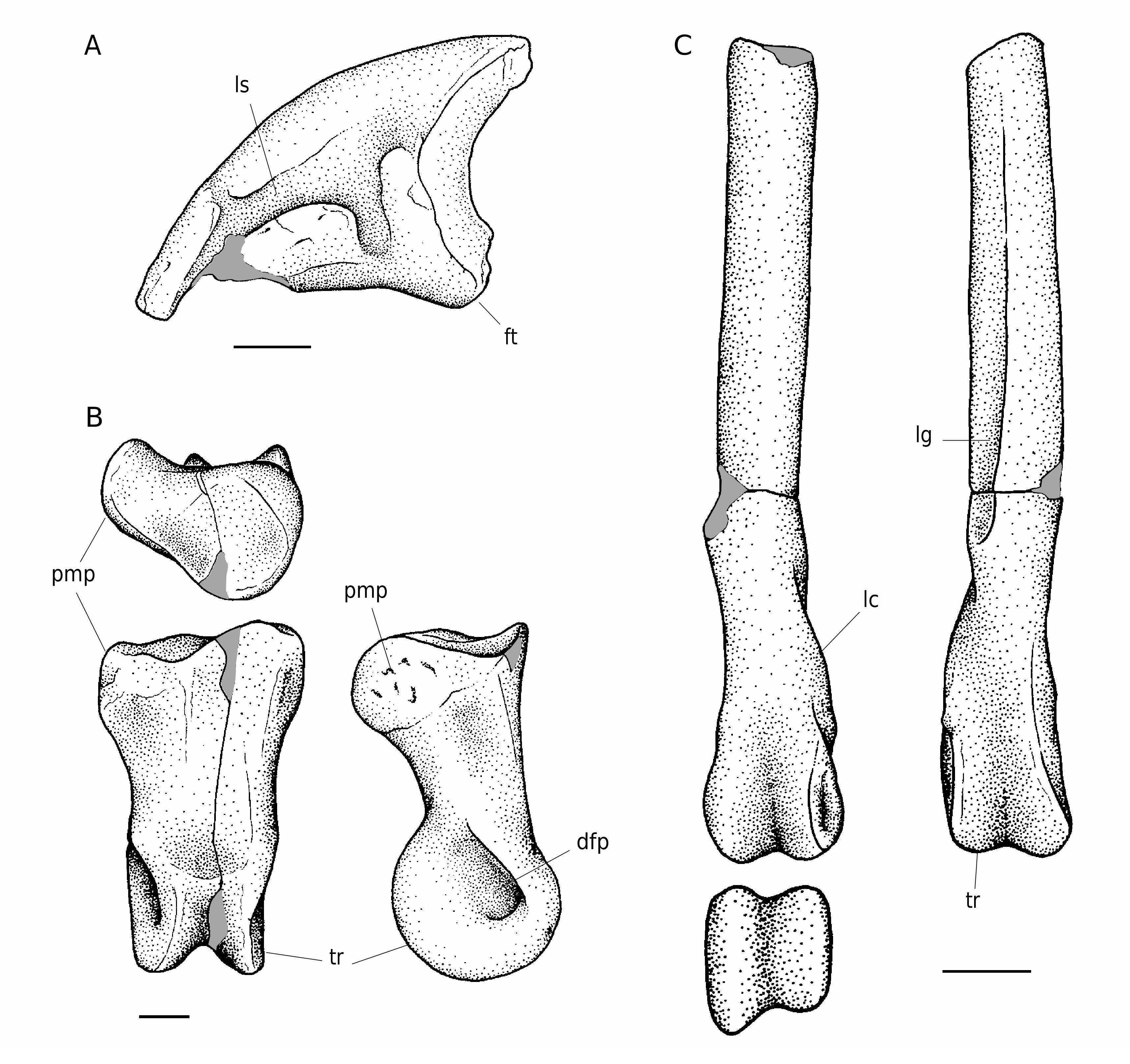
REFERRED MATERIAL. — CPP 481, isolated pedal ungual phalanx lacking its proximal end (Fig. 1 A). — CPP 470, isolated pedal phalanx 1 of left digit II (Fig. 1 B). PROVENANCE. — “ Ponto 1 do Price ” (see Candeiro et al. 2008), Peirópolis locality, Uberaba, Minas Gerais State, Brazil. Serra da Galga Member; Marilia Formation; Bauru Group (Fernandes & Coimbra 1996). DESCRIPTION CPP 481 is a small pedal ungual of unknown position on the pes (Fig. 1 A). The ungual is laterally compressed and dorsoventrally deep. The lateral sulcus is notorious and well defined, and is both dorsally and plantarly delimited by thin bony rims; regrettably, the eroded nature of bone surface precludes a detailed description of lateral sulci. Close to the plantar margin of the ungual there are small nutrient foramina. The proximal articular surface is dorsoventrally deep and laterally compressed, with well defined articular cotylae that are separated by a vertical and well defined ridge. The flexor tubercle is a low, rounded protuberance. CPP 470 consists of a complete, robust pedal phalanx 1 of left digit II (Fig. 1 B). It is dorsoventrally flat and transversely wide, and lacks a marked constriction of the shaft. It bears a well developed proximomedial process. In medial view, the process has a broad, circular surface for ligament attachment. The proximal articular surface is round and bordered by a small, proximodorsal rim. The distal trochlea is prominent, with the trochlear edges diverging ventrally. The trochlear rings are acute and tall, especially in the medial portion. The distal articular sulcus is deep and has a “ V ” - shaped section. The distal flexor pits are deep and bordered caudodorsally by an osseous rim.
First bird remains from the Upper Cretaceous of the Peirópolis site, Minas Gerais state, Brazil
REMARKS CPP 481 is identified as a possible pedal ungual because it shows a poorly curved blade, symmetrically arranged lateral sulci, and its proximal articular surface ellipsoidal with a well-defined median keel (see Agnolin & Martinelli 2009). Regrettably, the incomplete nature of CPP 481 does not allow to identify to which digit it belongs. CPP 481 may be identified as a bird because it differs from derived coelurosaurian dinosaurs (i. e. Dromaeosauridae Matthew & Brown, 1922, Troodontidae Gilmore, 1924, Rahonavis; Paul 2002), and resembles basal Aves in having greatly reduced flexor tubercle, such as most members of the Enanthiornithes (e. g., Soroavisaurus australis Chiappe, 1993, Neuquenornis volans Chiappe & Calvo, 1994, Sinornis santensis Sereno & Rao, 1992; Chiappe 1993; Chiappe & Calvo 1994; Sereno et al. 2002), Archaeopteryx Meyer, 1861 (Mayr et al. 2007), Zhongornis Gao et al., 2008 (Gao et al. 2008), Jeholornis Zhou & Zhang, 2002 (Zhou & Zhang 2003) and Zhongjianornis Zhou, Zhang & Li, 2010 (Zhou et al. 2009), among others. Moreover, CPP 481 also resembles birds and differs from derived coelurosaurian dinosaurs in having a relatively un-curved ungual blade. In fact, in basal birds most pedal unguals (with the single exception of the second one) show a nearly straight blade, as can be observed in some Enantiornithes and basal ornithurines (e. g., Sinornis santensis Sereno & Rao, 1992; Sereno et al. 2002), Archaeopteryx (Mayr et al. 2007), Zhongornis (Gao et al. 2008), Jeholornis (Zhou & Zhang 2002), and Zhongjianornis (Zhou et al. 2009). On the other hand, in derived deinonychosaurian coelurosaurian dinosaurs (e. g., Buitreraptor Makovicky, Apesteguía & Agnolín, 2005, Rahonavis Forster, Sampson, Chiappe & Krause, 1998, Deinonychus Ostrom, 1969, Microraptor Xu, Zhou & Wang, 2000, Troodontidae; Ostrom 1969; Rauhut & Werner 1995; Xu 2002; Makovicky et al. 2005) the ungual blade is extremely curved (Zheng et al. 2009). Both features in combination may be employed to assign CPP 481 to Aves. Within this clade, a more precise referral of the available specimen is not possible due to the poorly informative and incomplete nature of the available material. The specimen CPP 470 resembles basal birds, such as Enantiornithes, in having a subcircular distal trochlear ring, with dorsally displaced and small distal flexor pits that are ellipsoidal in contour, features that allow us to identify this element as pertaining to a bird (Agnolin & Martinelli 2009). A similar, but larger, element (MACN-PV-RN 1107) was described by Agnolin & Martinelli (2009) from the Upper Cretaceous Los Alamitos Formation of Río Negro Province, Argentina. They noted that the well developed proximomedial process and laterally expanded and dorsoventrally compressed shaft are features present in MACN-PV-RN 1107 and reminiscent of derived neornithine predatorial birds, such as Falconiformes (Agnolin & Martinelli 2009); these features are also present in CPP 470. Nevertheless, given the incomplete nature of CPP 470, we identify it only as Aves indet. Clade ORNITHOTHORACES Chiappe, 1996 cf. Enantiornithes Walker, 1981
First bird remains from the Upper Cretaceous of the Peirópolis site, Minas Gerais state, Brazil
AVES. AEREAE vocales Volucres pulcherrimae, Mandibulis protractis nudis, Corpore pennis imbricato, Alis duabus pennatis volitantes bipedes dignoscuntur. AVES levissimae modicae magnitudinis, tectae pennis plumisque, destitutae Auriculis, Labiis, Cauda, Scroto, Dentibus, Utero, Epiglottide, Fornice, Corpore calloso, Diaphragmate. PENNAE avibus propriae imbricatim in quincuncem dispositae, interstinctae Plumis, distinctae a Remigibus Rectricibusque, omnes, e basi cylindro concavo vasi lymphaticis simili, elongatae bifariam radiis parallelis approximatis distinctis itidem pinnatis. Colore ludunt, sed variant aetate, sexu, tempestate; constantiores Remiges & Rectrices, quae attente notandae. (*) OVA his, animalibus communia (pag. 9. n. 3.) numero diversis vario, sed majora pro mora exclusionis siccae, semper putamine calcareo obtecta, incubatu calido excludenda plerumque Parentis. DIVIDITUR Avium corpus in Caput, Truncum, Artus. CAPUT impositum Collo elongato, erectiusculo, teretiusculo. Mandibulae nudae, edentulae, exporrectae in Rostrum corneum, Naribus pertusum, basi quibusdam Cera nuda vestitum, Vibrissis pectinatim digestis ad faucis exterioris margines. Lingua carnosa, cartilaginea, emarginata, lacera, ciliata, integra s. acuta. Oculi laterales palpebris, Membranaque nictitante. Aures truncatae absque auriculis Ornamenta verticis e Crista pennacea s. Caruncula frontis gulaeve. TRUNCUS ovatus constans Dorso coadunato macro, subtus Sterno magno carinato musculosissimo, Claviculis coadunatis in Furcam, Abdomine minore postice sub uropygio perforato ano, genitalibus communi. ARTUS comprehendunt Alas, Caudam, Pedes. Alae 2 ex Brachio & Cubito manibus privato constant, quae postice fornicato-ciliatae Pennis Remigibus: exterioribus Primoribus Cubiti, posterioribus Secundariis brachii, ala notha supplente rudimentum Pollicis. Hae remiges proxime teguntur Tectricibus alarum proximis & ultra. Cauda ex Uropygio cordato, gemina glandula foeto, supra pertuso, poro penicillo cincto, ambitu ciliato Pennis Rectricibus saepius 12: pede longioribus in Macrouris, brevioribus in Brachyuris, suntque vel aequales (C. integra), vel ad latera breviores (cuneata), vel ad latera longiores (forficata). Pedes 2, ex Femore, Tibia, Digitis & Unguibus. Femora carnosa, pennis tecta, sed seminuda in Grallis. Tibiae tendinosae, plerisque nudae, angustae, rarius hirsutae, paucis Calcari postice cornutae. Digitis pedes insistentes saepius 4, anterioribus plerisque tribus, pollice unico postico, nisi in scandentibus digitis anticis duobus totidemque posticis, vel cursoriis absque postico. Fissi sunt & distincti Digiti in plerisque terrestribus (Fissipedes); semipalmati in palustribus; membranis vel Lobati, aut membrana toti Palmati (Palmipedes) in natantibus. Unguibus instruuntur Digiti plerumque, rarius posticus absque articulo est. VOLATILIA haec, Telluris vigiles libidinosique musici, plerumque inermia sunt, cum Alarum remigibus se facile in aethera recipiant ab hostibus terrestribus, & Caudae rectricibus a � reos diverso volatu eludant, nisi in terra negotiari necesse sit, dum odor vel ingratus hostes arcet, vel abolitus occultat; dum aliae speculantur hostemque appropinquantem indicantque aliis. ARMA paucis: Cornua Meleagridi cornutae, Anhimae. Calcaria Pavoni, Phasiano. Spinae (axillares) Struthione Camelo, Fulicae spinosae, Charadrio spinosi, Anhimae. VENERE monogama junguntur pleraeque Aves, polygama pauciores, ut Gallinae, Anates. Illae utriusque sexus conjunctis viribus struunt nidum saepe artificiosissimum, uteri succedaneum, incubant sedulae ovis, pullos famelicae alunt, fovent, curant, pro aris & focis defendunt (*), dum in his otientur mares. MIGRATIONES annuas inter septentrionales aestivas & australes hybernas plagas arcticae Telluris instituunt non paucae, ne hyeme demergerentur boreales omnes apud nos insectivorae; sic migrant plurimi Passeres, inprimis tenuirostres ob desectum insectorum; Grallae ob denegatum glacie aditum vermibus & amphibiis; Anseres ob congelatas aquas includentes pisces & c. Revocant vero easdem Dies aestatis longiores, ciborum copia, densiores, vestitus, nuptiae paratae. OPERA nec sine fructu peragunt sua singulae: sedentes Accipitres cadavera auferunt, ut vivis parcant; incedentes Picae quisquilias impuras verminosasque devorant; natantes Anseres aquarum nimios hospites minuunt; vadantes Grallae inquirunt in paludum animalcula; currentes Gallinae decidua Grana legunt; salientes Passeres arbustarum herbarumque semina insectaque carpunt; eoque varia semina Piscium, Insectorum Plantarumque saepius in remotissima loca serunt. Conquiruntur venatu, Falconaria; Aucupio instituuntur Falcones ad venatum, Diomedeae ad piscaturam, Passeres ad Musicam. Mansuescunt Gallinae, Anates, Passeresque varii: in ornithone s. Aviario coluntur ob carnes, ova, plumas, pennas, pulchritudinem, sonum. Asservantur exuviae, siccatae, spiritu contentae. ORNITHOLOGI eminent inter veteres Bellonius, Gesnerus, Aldrovandus; inter recentiores Willugbaeus; inter recentissimos Marsigli, Albinus, Seba, Catesbaeus, eximiusque Edwardus. Systematici Rajus, Barrere, Kleinius, Moehringius. ORDINUM Characteres. I. ACCIPITRES. Rostrum (Uncus trahens) subincurvatum: Mandibula superiore pone apicem utrinque dente armata: Naribus patulis. Pedes insidentes, breves, robusti: Digitis sub geniculis verrucosis; Unguibus arcuatis, acutissimis. Corpus capite Colloque musculosis; Cute tenaci. Impurum. Victus: Laniena rapinaque e cadaveribus. Nidus in altis; Ova circiter 4; Femina praestantior; Monogamia. II. PICAE. Rostrum (Cuneus sarriens) cultratum dorso convexo. Pedes ambulantes, breves, validiusculi. Corpus tenaciusculum, Impurum. Victus e Quisquiliis. Nidus in Arboribus; Mas alens feminam incubantem; Monogamia. III. ANSERES. Rostrum (Cribrum colans) laeve, epidermide tectum, apice auctum. Pedes natatorii digitis membrana palmatis; Tibiis compressis, brevibus. Corpus pingue, Cute tenaci, Plumis praestantioribus. Rancescens. Victus in Aquis ex plantis, piscibus, & c. Nidus saepius terrestris; Mater non porrigit pullis; frequentius Polygamia. IV. GRALLAE. Rostrum (Bacillus tentans) subcylindricum. Pedes vadantes Femoribus seminudis. Corpus compressum pelle tenuissima; Cauda brevi. Sapidum. Victus in Paludibus ex Animalculis. Nidus in terra saepius; Nuptiis variis. V. GALLINAE. Rostrum (Harpa colligens) convexum: Mandibula superiore fornicata supra inferiorem; Naribus membrana cartilaginea fornicatis. Pedes cursorii Digitis subtus scabris. Corpus sebaceum, musculosum. Purum. Victus e Granis in ingluvie macerandis. Pulveratrices. Nidus in Terra absque arte. Ovis numerosis. Pullis cibus demonstrandus. Polygamia. VI. PASSERES. Rostrum (Forceps excipiens) conico-acuminatum. Pedes salientes, teneri, fissi. Corpus tenellum: Granivoris Purum. Insectivoris Impurum. Victus e Seminibus aut Insectis. Nidus artificiosus; Pullis cibus inculcandus. Monogamia. CHARACTERES AVIUM. I. ACCIPITRES. 40. Vultur Rostrum aduncum. Caput denudatum. 41. Falco Rostrum aduncum basi Cera tectum. 42. Strix Rostrum aduncum basi Setis tectum. 43. Lanius Rostrum rectiusculum. II. PICAE. * Digitis anticis 2, posticis 2. 44. Psittacus Lingua carnosa. Mandibula superior adunca. 45. Ramphastos Lingua pennacea. Mandibula superior inanis. 52 Cuculus Lingua cartilaginea. Mandibula superior naribus marginatis. 53. Jynx Lingua lumbriciformis. Mandibula superior teretiuscula. 54. Picus Lingua lumbriciformis. Mandibula superior prismatica. * Digitis anticis 3, postico 1. Lingua mcisa. 48. Corvus Mandibula superior cultrata basi setis tecta. 49. Coracias Mandibula superior cultrata basi nuda. 55. Sitta Rostrum porrectum, rectum. 57. Merops Rostrum arcuatum, carinatum. 60. Trochilus Rostrum filiforme, capite longius. * Digitis anticis 3, postico 1, Lingua integra. 46. Buceros Mandibula superior fronte osseo-gibbosa. 47. Crotophaga Mandibula superior compressa, infracta, transverse sulcata. 50. Gracula Mandibula superior compressa, laevis, basi nuda. 51. Paradisea Mandibula superior ad medium usque plu- moso-holosericea. 56 Alcedo Mandibula superior angulata. Lingua brevissima. 58. Upupa Rostrum arcuatum. Lingua obtusa. 59. Certhia Rostrum arcuatum. Lingua acuta. III. ANSERES. * Rostro apice unguiculato. 61. Anas Nares ovales. Dentes lamellosi. 62. Mergus Nares ovales. Dentes subulati. 64. Procellaria Nares in cylindrum connatae. 65. Diomedea Nares subcylindricae, distantes. 66. Pelecanus Nares lineares. Facies nuda. Pedes Digitis omnibus palmatis. * Rostro apice simplici. 67. Ph � ethon Rostrum cultrato-subulatum, fauce ampliore. Pedes Digitis 4 anticis. 63. Alca Rostrum transverse fasciatum. Pedes absque postico.
Systema Naturae per regna tria naturae: secundum classes, ordines, genera, species, cum characteribus, differentiis, synonymis, locis

Definition. Following Padian and Chiappe (1998), and in contrast to Gauthier (1986), Aves are defined here with their fossil stem-group representatives included. Thus, Aves may be defined as Archaeopteryx and Neornithes, and all descendants of their most recent common ancestor.
The interrelationships and evolution of basal theropod dinosaurs
Diagnosis. Asymmetric, aerodynamic contour feathers; humerus longer than femur; radius longer than humerus.
The interrelationships and evolution of basal theropod dinosaurs
Remarks. Birds are the only living group of dinosaurs. More than 9000 extant species of birds are known, and our knowledge of their fossil history is increasing rapidly. In 1960, Brodkorb estimated the total number of bird species that have existed as more than 1 - 5 million; of course, such estimates are rather speculative, but they might give an idea of the disparity in taxonomic diversity between this OTU and others. Unfortunately, improved knowledge of the anatomy of advanced theropods and the discovery of connecting links has made a formal diagnosis of Aves increasingly difficult, since the acquisition of avian characters in theropod evolution was gradual. The matter is further complicated by the high diversity of birds; the characters listed in the diagnosis above are lost in many avian lineages, and the first reversals might have occurred soon after the origin of this group (see Chiappe 1995; Chiappe et al. 1996; Padian and Chiappe 1998). However, it is assumed here that flight arose only once in birds, and it is the main diagnostic feature of this group, as expressed by aerodynamic feathers and forelimb proportions. Following Chiappe et al. (1996) and Novas (1996 Z?), alvarezsaurids are regarded here as basal birds (see Sereno, 1999, for an alternative view) and are thus not treated as a separate OTU. Since Archaeopteryx (Text-fig. 5 f) is the most basal bird (Chiappe 1995), character codings are mainly based on this taxon; only if character states cannot be determined in Archaeopteryx is information from other basal birds used, mainly Rahonavis (UA 8656; Forster et al. 1998), Confuciusomis (GPI, JM, three unnumbered specimens), Hesperomis, and Ichthyornis (Marsh 1880; Elzanowski 1991).
The interrelationships and evolution of basal theropod dinosaurs
Temporal range. Tithonian-Recent. Distribution. Global.
The interrelationships and evolution of basal theropod dinosaurs
Description: Mayr (2002) identified six morphological synapomorphies of Daedalornithes: (i) os palatinum with greatly protruding angulus caudolateralis; (ii) processus basipterygoidei reduced; (iii) pneumatic foramina on the caudal surface of the processus oticus; (iv) extremitas omalis of coracoid hooked and processus lateralis greatly reduced; (v) musculus splenius capitis with cruciform origin; (vi) caeca absent. Mayr et al. (2003) identified two additional morphological synapomorphies: (vii) processus terminalis ischii of pelvis very narrow and slender, touching pubis at an angle of 45 – 90 °, fenestra ischiopubica very wide; (viii) musculus fibularis longus absent. They identified character (v) as an unambiguous synapomorphy and characters (iii), (iv) and (vi) to (viii) as synapomorphies that, although not unique to Daedalornithes, are optimized in their phylogenetic analysis as independently derived in the common ancestor of this clade.
A name for the clade formed by owlet­nightjars, swifts and hummingbirds (Aves)
Definition: The name Daedalornithes, as defined here, refers to the least inclusive clade comprising Aegotheles cristatus (White) and Apus apus (Linnaeus). Aegotheles cristatus and Apus apus are selected as reference taxa because these are the type species of Aegotheles and Apus, respectively, on which the names Aegothelidae, and Apodidae and Apodiformes, respectively, are based. The definition is based on the principles of phylogenetic taxonomy (de Queiroz & Gauthier 1992). Use of two reference taxa, an owlet­nightjar and a swift, guarantees that the name always refers to a monophyletic group that minimally includes Aegotheles owlet­nightjars and Apus swifts. Because the definition refers to the least inclusive (i. e. smallest) monophyletic group specified by these two taxa, it excludes all taxa that are placed outside this clade. A node­ rather than a stem­based definition of Daedalornithes is selected because its sister­taxon is not resolved (see below), as recommended by Sereno (1999).
A name for the clade formed by owlet­nightjars, swifts and hummingbirds (Aves)
Taxonomic content: Based on current knowledge (Mayr 2002; Mayr et al. 2003; Cracraft et al. 2004), the name Daedalornithes refers to a clade that, among extant taxa, only includes Aegothelidae (owlet­nightjars), Hemiprocnidae (tree swifts), Apodidae (swifts) and Trochilidae (hummingbirds). The extinct Scaniacypselus, Jungornis, Argornis and Parargornis are not currently regarded as (crown­group) members of Aegothelidae, Hemiprocnidae, Apodidae or Trochilidae but are part of Daedalornithes based on phylogenetic analysis or the possession of shared derived characters (see Mayr & Manegold 2002; Mayr 2003 a, 2003 b). The position of the extinct Aegialornis and Eocypselus relative to Aegothelidae, Apodiformes and Podargidae and, hence their inclusion in Daedalornithes, is unresolved (Mayr 2003 a). Two other extinct taxa, Laputavis and Primapus, were included in Apodiformes by Dyke (2001) but the relationships suggested in this study are considered to be doubtful due to problems with character coding (Mayr 2001). Phylogenetic relationships: The relationships of Daedalornithes with other birds are as yet unresolved. A morphological study (Mayr 2002) suggested that Daedalornithes is the sister­group of (Nyctibiiidae + Caprimulgidae). This study included only eight ingroup taxa and was therefore not designed to exclude other taxa as potential sister­groups of Daedalornithes. Analysis of an expanded data set (Mayr et al. 2003) also identified (Nyctibiidae + Caprimulgidae) as the sister taxon of Daedalornithes but bootstrap support for this grouping was less than 50 %. Maximum Parsimony analysis of DNA sequences of three nuclear genes placed Daedalornithes in an unresolved polytomy with Passeriformes and numerous non­passerine groups. Bayesian analysis of the same molecular data set identified Podargidae as the sister taxon of Daedalornithes but with low posterior probability (58 %). Combined analysis of morphological and molecular data sets placed Daedalornithes in an unresolved trichotomy with Nyctibiidae and Caprimulgidae, again with low support (50 %). A study based on the nuclear gene c­myc (Harshman, Braun & Huddleston in Cracraft et al. 2004) suggested that Trogonidae is the sister­group of Daedalornithes but bootstrap support was not indicated. Two other studies (summarized in Cracraft et al. 2004) could not resolve the sister­group of Daedalornithes. Daedalornithes is therefore best considered as incertae sedis among the ‘ higher land bird’ assemblage. Taxonomic sequence: Due to the unresolved relationships among ‘ higher land birds’, no changes are warranted in the position of Daedalornithes in linear sequences. Thus, I suggest that Daedalornithes is listed after Steatornithidae, Nyctibiidae and Caprimulgidae (cf Dickinson 2003). To reflect their phylogenetic relationships, the taxa included in Daedalornithes are best arranged in the following sequence: Aegothelidae, Hemiprocnidae, Apodidae, Trochilidae.
A name for the clade formed by owlet­nightjars, swifts and hummingbirds (Aves)
Etymology: The clade is named after Daedalus, the Greek mythological figure who fabricated wings and improved these until these allowed him and his son Icarus to soar upwards into the air. The name is appropriate in view of the great flight capabilities that evolved within the clade.
A name for the clade formed by owlet­nightjars, swifts and hummingbirds (Aves)

Export occurrence data

Darwin Core Archive (ZIP)

GEOGRAPHY

Distribution Map

Occurrence Map

Loading map…

Tiles © GBIF Maps API | Map powered by MapLibre GL

REGIONS

Geographic Distribution(4)

DK
not evaluated
NO
SE
Vermont-US(US)

DATA

Occurrence Datasets

Loading datasets…

Common names used for this species across different languages and regions. Available in 13 languages and 9 countries. 6 preferred.

engbirdsengengbirdsengNOfuglarnnoNOfuglernobSEfåglarswe+36 more

Vernacular (common) names are the everyday names used for a species in different languages and regions. A single species may have dozens of common names worldwide. This taxon has names in 13 languages. 6 names preferred.

USBird
engUS
Source: Checklist of Vermont SpeciesSource taxon #160795592
USBird
engUS
Source: Martha's Vineyard species checklistSource taxon #202603664
engBirds
eng
Source: Integrated Taxonomic Information System (ITIS)Source taxon #102085317
engBirds
eng
Source: Checklist of Vermont SpeciesSource taxon #160795592
engBirds
eng
Source: Martha's Vineyard species checklistSource taxon #202603664
engBirds
eng
Source: Catalogue of LifeSource taxon #273109407
engBirds
eng
Source: Phthiraptera.myspecies.infoSource taxon #116891945
engBirds
eng
Source: Catalogue of LifeSource taxon #299343440
DKFugle
danDK
Source: National Checklist of all species occurring in DenmarkSource taxon #307208855
FROiseaux
fraFRfra
DEVogel
deuDE
Source: Taxon list of pest organisms for IPM at natural history collections compiled at the SNSBSource taxon #321145086
engbird
eng
Source: The Paleobiology DatabaseSource taxon #121497163
engbird
eng
Source: The Paleobiology DatabaseSource taxon #137384408
GBbird
engGB
Source: Taxon list of pest organisms for IPM at natural history collections compiled at the SNSBSource taxon #321145086
GBbirds
engGBeng
FIlinnut
finFI
Source: The FinBIF checklist of Finnish speciesSource taxon #257959090
fraoiseaux
fra
Source: Catalogue of LifeSource taxon #299343440
fraoiseaux
fra
Source: Integrated Taxonomic Information System (ITIS)Source taxon #102085317
fraoiseaux
fra
Source: Catalogue of LifeSource taxon #273109407
BEvogels
nldBE
Source: Belgian Species ListSource taxon #100480458
engbirds
engpreferred
Source: World Register of Marine SpeciesSource taxon #155304455
engbirds
engpreferred
NOfuglar
nnopreferredNO
NOfugler
nobpreferredNO
SEfåglar
swepreferredSE
Source: Dyntaxa. Svensk taxonomisk databasSource taxon #159935840
NOlottit
smepreferredNO
engBird
eng
Source: United Kingdom Species Inventory (UKSI)Source taxon #180172524
GBBirds
engGB
Source: Dyntaxa. Svensk taxonomisk databasSource taxon #159935840
engBirds
eng
Source: United Kingdom Species Inventory (UKSI)Source taxon #180172524
eun
gla
Source: United Kingdom Species Inventory (UKSI)Source taxon #180172524
eòin
gla
Source: United Kingdom Species Inventory (UKSI)Source taxon #180172524
swefåglar
swe
Source: World Register of Marine SpeciesSource taxon #155304455
swefåglar
swe
isean
gla
Source: United Kingdom Species Inventory (UKSI)Source taxon #180172524
iseanan
gla
Source: United Kingdom Species Inventory (UKSI)Source taxon #180172524
nldvogels
nld
Source: World Register of Marine SpeciesSource taxon #155304455
nldvogels
nld
ukrПтахи
ukr
Source: World Register of Marine SpeciesSource taxon #155304455
ukrПтахи
ukr
jpn鳥綱
jpn
jpn鳥綱
jpn
Source: World Register of Marine SpeciesSource taxon #155304455

CLASSIFICATION

Taxonomic Classification Tree

RELATED

Related Name Usages(20)

Matching names from other GBIF-indexed checklists and datasets.

MULTIMEDIA

Media Files(3)

FIGURE 3. 1—Muscicapidae gen. et sp. indet.—Beremend 26—ungual phalanx, lateral view; 2—Turdus sp. Indet.— Beremend 26—left ulna distal fragment, ventral view; 3—Turdus sp. indet.—Beremend 38—ungual phalanx, lateral view; 4— Aves indet.—Beremend 26—radius proximal fragment, caudal view; 5—Aves indet.—Egyházasdengeleg—ungual phalanx, lateral view; 6—Aves indet.—Hidas—pedal phalanx II.1, lateral view; 7—Aves indet.—Alsótelekes—ungual phalanx, lateral view; 8—Aves indet.—Alsótelekes—partial manal phalanx proximalis digiti majoris, ventral view.

Imageimage/png© Horváth, IdaNew records of fossil bird bones from the Neogene in Hungary

FIG. 1. — A, B, Aves genera and species indet.: A, CPP 481, isolated pedal ungual phalanx in lateral view; B, CPP 470, isolated pedal phalanx 1 of left digit II in dorsal (left), lateral (right) and proximal (top) views; C, cf. Enantiornithes indet. (CPP 482), incomplete left metatarsal III in dorsal (left), ventral (right), and distal (below) views. Grey areas indicate broken surfaces. Abbreviations: dfp, distal flexor pit; ft, flexor tubercle; lc, lateral crest; lg, lateral groove; ls, lateral sulcus; pmp, proximomedial process; tr, trochlear ridge. Scale bars: A, B, 1 mm; C, 2 mm.

Imageimage/png© Candeiro, Carlos Roberto A.;Agnolin, Federico;Martinelli, Agustín G.;Buckup, Paulo AndreasFirst bird remains from the Upper Cretaceous of the Peirópolis site, Minas Gerais state, Brazil

text-fig. 5. Skull reconstructions of representatives of Jurassic OTUs in left lateral view, a, Dilophosaurus wetherilli, Early Jurassic (Sinemurian-Pliensbachian), Kayenta Formation, Arizona, USA; based on UCMP V 4214 and V 6468. B, Syntarsus rhodesiensis, Early Jurassic (Hettangian-Sinemurian), Forest Sandstone, Zimbabwe; composite reconstruction based on many isolated skull elements from the National Museum of Natural History in Harare (see Appendix), c, Magnosaurus oxoniensis, Middle Jurassic (Callovian), Oxford Clay, England; based on OUM J 13558, unpreserved elements shaded. D, Monolophosaurus jiangi, Middle Jurassic, Wucaiwan Formation, China; redrawn from Zhao and Currie (1993b). E, Allosaurus fragilis, Late Jurassic (Kimmeridgian-Tithonian), Morrison Formation, USA; based on MOR 693. f, basal bird Archaeopteryx sp., Late Jurassic (Tithonian), lithographic limestones of Solnhofen, Germany; based on Wellnhofer (1974), Elzanowski and Wellnhofer (1996), and the Berlin, Eichstätt, and Munich specimens. G, Ceratosaurus sp., Late Jurassic (Kimmeridgian-Tithonian), Morrison Formation, USA; based on USNM 4735 and UMNH VP 5278. H, Ornitholestes hermanni, Late Jurassic (Kimmeridgian-Tithonian), Morrison Formation, USA, based on AMNH 619. Abbreviations as in Text-figure 4, and: If, lacrimal fenestra; mf, maxillary fenestra; nf, nasal foramen; pmf, promaxillary fenestra. Scale bars represent 10 mm (b, f, h), 50 mm (c) and 100 mm (a, d, e, g).

Imageimage/png© Rauhut, Oliver W. M.The interrelationships and evolution of basal theropod dinosaurs

IMAGES

Gallery(3)

See Gallery

Occurrences with images

CITATIONS

References(15)

  • 1

    (2014) The Howard and Moore Complete Checklist of the Birds of the World. Vol 1: Non-passerines

    Dyntaxa. Svensk taxonomisk databas
  • 2

    Banks, R. C., R. W. McDiarmid, and A. L. Gardner, 1987: Checklist of Vertebrates of the United States, the U.S. Territories, and Canada. Resource Publication, no. 166. 79.

    Integrated Taxonomic Information System (ITIS)
  • 3

    Daniel González-Acuña,John M. Kinsella,Carlos Barrientos,L. Moreno,Sergey Mironov,Armando Conrado Cicchino,Valdebenito, José Osvaldo,Alexandra Grandón-Ojeda,Mabel Mena: Gastrointestinal and ectoparasites of plumbeous rail, <i>Pardirallus sanguinolentus</i> (Aves: Rallidae) in Central Chile

    journal articlePhthiraptera.myspecies.info
  • 4

    Larsson, Ekström, Larsson & Gandemo (2007) Birds of the World [CD]

    Dyntaxa. Svensk taxonomisk databas
  • 5

    Linnæus (Linnaeus) (1758) Systema naturae. Ed. 10. Tomus I, Regnum Animale

    Dyntaxa. Svensk taxonomisk databas
  • Source Information

    GBIF Backbone Taxonomy

    GBIF Backbone Taxonomy

    checklist

    The GBIF Backbone Taxonomy is a single, synthetic management classification with the goal of covering all names GBIF is dealing with. It's the taxonomic backbone that allows GBIF to integrate name based information from different resources, no matter if these are occurrence datasets, species pages, names from nomenclators or external sources like EOL, Genbank or IUCN. This backbone allows taxonomic search, browse and reporting operations across all those resources in a consistent way and to provide means to crosswalk names from one source to another.

    It is updated regulary through an automated process in which the Catalogue of Life acts as a starting point also providing the complete higher classification above families. Additional scientific names only found in other authoritative nomenclatural and taxonomic datasets are then merged into the tree, thus extending the original catalogue and broadening the backbones name coverage. The GBIF Backbone taxonomy also includes identifiers for Operational Taxonomic Units (OTUs) drawn from the barcoding resources iBOL and UNITE.

    International Barcode of Life project (iBOL), Barcode Index Numbers (BINs). BINs are connected to a taxon name and its classification by taking into account all names applied to the BIN and picking names with at least 80% consensus. If there is no consensus of name at the species level, the selection process is repeated moving up the major Linnaean ranks until consensus is achieved.

    UNITE - Unified system for the DNA based fungal species, Species Hypotheses (SHs). SHs are connected to a taxon name and its classification based on the determination of the RefS (reference sequence) if present or the RepS (representative sequence). In the latter case, if there is no match in the UNITE taxonomy, the lowest rank with 100% consensus within the SH will be used.

    The GBIF Backbone Taxonomy is available for download at https://hosted-datasets.gbif.org/datasets/backbone/ in different formats together with an archive of all previous versions.

    The following 105 sources have been used to assemble the GBIF backbone with number of names given in brackets:

    • Catalogue of Life Checklist - 4766428 names
    • International Barcode of Life project (iBOL) Barcode Index Numbers (BINs) - 635951 names
    • UNITE - Unified system for the DNA based fungal species linked to the classification - 611208 names
    • The Paleobiology Database - 212054 names
    • World Register of Marine Species - 188857 names
    • The Interim Register of Marine and Nonmarine Genera - 183894 names
    • The World Checklist of Vascular Plants (WCVP) - 131891 names
    • GBIF Backbone Taxonomy - 114350 names
    • TAXREF - 109374 names
    • The Leipzig catalogue of vascular plants - 75380 names
    • ZooBank - 73549 names
    • Integrated Taxonomic Information System (ITIS) - 68377 names
    • Plazi.org taxonomic treatments database - 61346 names
    • Genome Taxonomy Database r207 - 60545 names
    • International Plant Names Index - 52329 names
    • Fauna Europaea - 45077 names
    • The National Checklist of Taiwan (Catalogue of Life in Taiwan, TaiCoL) - 36193 names
    • Dyntaxa. Svensk taxonomisk databas - 35892 names
    • The Plant List with literature - 32692 names
    • United Kingdom Species Inventory (UKSI) - 29643 names
    • Artsnavnebasen - 29208 names
    • The IUCN Red List of Threatened Species - 21221 names
    • Afromoths, online database of Afrotropical moth species (Lepidoptera) - 13961 names
    • Brazilian Flora 2020 project - Projeto Flora do Brasil 2020 - 13829 names
    • Prokaryotic Nomenclature Up-to-Date (PNU) - 10079 names
    • Checklist Dutch Species Register - Nederlands Soortenregister - 8814 names
    • ICTV Master Species List (MSL) - 7852 names
    • Cockroach Species File - 6020 names
    • GRIN Taxonomy - 5882 names
    • Taxon list of fungi and fungal-like organisms from Germany compiled by the DGfM - 4570 names
    • Catalogue of Afrotropical Bees - 3623 names
    • Catalogue of Tenebrionidae (Coleoptera) of North America - 3327 names
    • Checklist of Beetles (Coleoptera) of Canada and Alaska. Second Edition. - 3312 names
    • Systema Dipterorum - 2850 names
    • Catalogue of the Pterophoroidea of the World - 2807 names
    • The Clements Checklist - 2675 names
    • Taxon list of Hymenoptera from Germany compiled in the context of the GBOL project - 2496 names
    • IOC World Bird List, v13.2 - 2366 names
    • Official Lists and Indexes of Names in Zoology - 2310 names
    • National checklist of all species occurring in Denmark - 1922 names
    • Myriatrix - 1876 names
    • Database of Vascular Plants of Canada (VASCAN) - 1822 names
    • Taxon list of vascular plants from Bavaria, Germany compiled in the context of the BFL project - 1771 names
    • Orthoptera Species File - 1742 names
    • A list of the terrestrial fungi, flora and fauna of Madeira and Selvagens archipelagos - 1602 names
    • Aphid Species File - 1565 names
    • World Spider Catalog - 1561 names
    • Taxon list of Jurassic Pisces of the Tethys Palaeo-Environment compiled at the SNSB-JME - 1270 names
    • Backbone Family Classification Patch - 1143 names
    • GBIF Algae Classification - 1100 names
    • International Cichorieae Network (ICN): Cichorieae Portal - 975 names
    • Psocodea Species File - 803 names
    • New Zealand Marine Macroalgae Species Checklist - 787 names
    • Annotated checklist of endemic species from the Western Balkans - 754 names
    • Taxon list of animals with German names (worldwide) compiled at the SMNS - 503 names
    • Catalogue of the Alucitoidea of the World - 472 names
    • Lygaeoidea Species File - 462 names
    • Catálogo de Plantas y Líquenes de Colombia - 422 names
    • GBIF Backbone Patch - 317 names
    • Phasmida Species File - 259 names
    • Cortinariaceae fetched from the Index Fungorum API - 234 names
    • Coreoidea Species File - 233 names
    • GTDB supplement - 139 names
    • Mantodea Species File - 119 names
    • Endemic species in Taiwan - 93 names
    • Taxon list of Araneae from Germany compiled in the context of the GBOL project - 88 names
    • Species of Hominidae - 78 names
    • Taxon list of Sternorrhyncha from Germany compiled in the context of the GBOL project - 77 names
    • Taxon list of mosses from Germany compiled in the context of the GBOL project - 75 names
    • Mammal Species of the World - 73 names
    • Plecoptera Species File - 71 names
    • Species Fungorum Plus - 64 names
    • Catalogue of the type specimens of Cosmopterigidae (Lepidoptera: Gelechioidea) from research collections of the Zoological Institute, Russian Academy of Sciences - 47 names
    • Species named after famous people - 41 names
    • Dermaptera Species File - 36 names
    • Taxon list of Trichoptera from Germany compiled in the context of the GBOL project - 34 names
    • True Fruit Flies (Diptera, Tephritidae) of the Afrotropical Region - 33 names
    • Range and Regularities in the Distribution of Earthworms of the Earthworms of the USSR Fauna. Perel, 1979 - 32 names
    • Taxon list of Diplura from Germany compiled in the context of the GBOL project - 30 names
    • Lista de referencia de especies de aves de Colombia - 2022 - 24 names
    • Taxon list of Auchenorrhyncha from Germany compiled in the context of the GBOL project - 20 names
    • Catalogue of the type specimens of Polycestinae (Coleoptera: Buprestidae) from research collections of the Zoological Institute, Russian Academy of Sciences - 19 names
    • Taxon list of Thysanoptera from Germany compiled in the context of the GBOL project - 19 names
    • Lista de especies de vertebrados registrados en jurisdicción del Departamento del Huila - 18 names
    • Taxon list of Microcoryphia (Archaeognatha) from Germany compiled in the context of the GBOL project - 15 names
    • Catalogue of the type specimens of Bufonidae and Megophryidae (Amphibia: Anura) from research collections of the Zoological Institute, Russian Academy of Sciences - 12 names
    • Grylloblattodea Species File - 11 names
    • Coleorrhyncha Species File - 9 names
    • Taxon list of liverworts from Germany compiled in the context of the GBOL project - 9 names
    • Embioptera Species File - 7 names
    • Taxon list of Pisces and Cyclostoma from Germany compiled in the context of the GBOL project - 6 names
    • Taxon list of Pteridophyta from Germany compiled in the context of the GBOL project - 6 names
    • Taxon list of Siphonaptera from Germany compiled in the context of the GBOL project - 5 names
    • The Earthworms of the Fauna of Russia. Perel, 1997 - 5 names
    • Taxon list of Zygentoma from Germany compiled in the context of the GBOL project - 4 names
    • Asiloid Flies: new taxa of Diptera: Apioceridae, Asilidae, and Mydidae - 3 names
    • Taxon list of Protura from Germany compiled in the context of the GBOL project - 3 names
    • Taxon list of hornworts from Germany compiled in the context of the GBOL project - 2 names
    • Chrysididae Species File - 1 names
    • Taxon list of Dermaptera from Germany compiled in the context of the GBOL project - 1 names
    • Taxon list of Diplopoda from Germany in the context of the GBOL project - 1 names
    • Taxon list of Orthoptera (Grashoppers) from Germany compiled at the SNSB - 1 names
    • Taxon list of Pscoptera from Germany compiled in the context of the GBOL project - 1 names
    • Taxon list of Pseudoscorpiones from Germany compiled in the context of the GBOL project - 1 names
    • Taxon list of Raphidioptera from Germany compiled in the context of the GBOL project - 1 names

    GBIF Secretariat (2023). GBIF Backbone Taxonomy. Checklist dataset https://doi.org/10.15468/39omei accessed via GBIF.org on 2026-06-14.

    CC BYPublished 8/28/2023View dataset
    GBIF Usage Key
    212
    Dataset Key
    d7dddbf4-2cf0-4f39-9b2a-bb099caae36c
    Origin
    source
    Backbone Key
    212
    Taxon ID
    gbif:212
    Last Crawled
    8/22/2023
    Last Interpreted
    8/22/2023