
AnimaliaacceptedgenusAccepted
Arrhopalites

Arrhopalites

Blegkuglespringere(+2)·C.Börner, 1906

GBIF:2122170

0countries
0datasets
0year

0

Descendants

0

Synonyms

0

Children

0

Species

PROFILE

Species Profile

Characteristics

Extant

ABOUT

Descriptions(16)

Key for identification of neotropical Arrhopalites

1 Anal valve cuticular spines absent ................................................................................ 2

­ Anal valve cuticular spines present............................................................................... 8

2 Ant IV not subdivided, all unguis with a filamentous inner tooth ................ A. diversus

­ Ant IV subdivided, inner teeth not filamentous when present ..................................... 3

3 Ant IV subdivided into 5 subsegments ......................................................................... 4

­ Ant IV subdivided into 6 or more subsegments............................................................ 7

4 Ant III basal swelling present........................................................................................ 5

­ Ant III basal swelling absent......................................................................................... 6

5 Female subanal appendages spoon shaped with fringed edges (4d) ............ A. plectrifer

­ Female subanal appendages a simple rod withfringed apex (14a) ................... A. dubius

6 Female subanal appendages branche or deeply serrated (5c) ......................... A. benitus

­ Female subanal appendages simple rod with fringed apex (1ad) ................ A. pygmaeus

7 Ant IV subdivided into 6 subsegments, eyes 1+1 ........................................... A. amarus

­ Ant IV subdivided into 7 subsegments, eyes 2+2 ....................................... A. bellingeri

8 Eyes 2+2....................................................................................................................... 9

­ Eyes 1+1..................................................................................................................... 10

9 Ant IV subdivided into 4 ringed subsegments, anal valve C1 lamelate ........ A. amorimi

­ Ant IV subdivided into 6 ringed subsegments, C1 swollen basally................................ ...................................................................................................... A. heteroculatus sp.n.

10 Ant IV not subdivided. ............................................................................................... 11

­ Ant IV subdivided ....................................................................................................... 14

11 Dental id3 present, medial ve1 spinelike. .................................................................. 12

­ Dental id3 absent, ve1 normal..................................................................................... 13

12 Anal valve C3–C6 lamellate, all ungues with tunica and inner tooth .............. A. caecus

­ C3–C6 swollen basally, first unguis without inner tooth, tunica absent ............ A. millsi

13 Anal valve upper flap with 4 cuticular spines (s0 absent), tunica absent ........ A. harveyi

­ anal valve upper flap with 5 spines (s0 present), tunica present. A. alambariensis sp.n.

14 Ant IV subdivided into 5 ringed subsegments ........................................................... 15

­ Ant IV subdivided into 6 ringed subsegments ............................................................ 16

15 Anal valve C1 lamellate, first unguis without tunica ................... A. botuveraensis sp.n.

­ Anal valve C1 swollen basally, all unguis with tunica ............................... A. vazquezae

16 Tunica absent, anal valve C1 swollen basally ............................................. A. lawrencei

­ Tunica present, anal valve C1 lamellate...................................................................... 17

17 Cephalic setae M3–5 not spinelike, dental E4–5 spinelike, third unguiculus without apical filament .............................................................................................. A. gnaspinii

­ Cephalic M3–5 spinelike, dental E4–5 normal, third unguiculus with short apical fila­ ment not exceeding theunguis tip................................................... A. paranaensis sp.n.

The genus Arrhopalites Börner, 1906 (Collembola, Appendiciphora, Arrhopalitidae) in the Neotropical Region, with description of four new cave species from BrazilMagnoliaPress via PlaziNo known copyright restrictions apply. See Agosti, D., Egloff, W., 2009. Taxonomic information exchange and copyright: the Plazi approach. BMC Research Notes 2009, 2:53 for further explanation.

Genus Arrhopalites Börner, 1906

Syn.: Pseudarrhopalites Stach, 1945: 7

Coecarrhopalites Yosii, 1954: 68

The genus Arrhopalites Börner, 1906 (Collembola, Appendiciphora, Arrhopalitidae) in the Neotropical Region, with description of four new cave species from BrazilMagnoliaPress via PlaziNo known copyright restrictions apply. See Agosti, D., Egloff, W., 2009. Taxonomic information exchange and copyright: the Plazi approach. BMC Research Notes 2009, 2:53 for further explanation.
One species recorded in Vietnam, and some unidentified specimens from Phú Th ọ (Xuân Sõn national park) (EC: Nguy ễn H. T. & Nguy ễn T. T. 2011 b), Hà N ội (Ba Vì national park) (EC: Nguy ễn V. Q. & Nguy ễn T. T. 2014. CI: Nguy ễn T. T. A. et al. 2021), Hýng Yên (Ðông Mai) (CI: Nguy ễn T. T. A. 2009), Đ ồng Nai (Cát Tiên national park) (EC: Shveenkova 2011), Kiên Giang (Hòn Chông) (CI: Deharveng et al. 2009).
Catalogue of Vietnamese springtails (Hexapoda, Collembola)
Type species. Sminthurus caecus Tullberg, 1871.
Catalogue of Vietnamese springtails (Hexapoda, Collembola)

Key to species of the Caucasian Arrhopalites Börner, 1906

1 Spine-like setae on head dorsum present; cuticular spines on female Abd VI present; claws without clear modifications; tip of mucro swollen....................................................................................... 2

- Spine-like setae on head dorsum absent; cuticular spines on female Abd VI absent; claws much elongated; tip of mucro not swollen............................................................................................. 3

2 Head dorsum with 13 spine-like setae; antenna about 1,5× head length; Ant III not modified; Ant IV without distinct subsegmentation; claw III with inner tooth and tunica......................... A. caecus (Tullberg, 1871) (troglophile)

- Head dorsum with 9 spine-like setae; antenna 2× head length; Ant III with basal swelling; Ant IV with 5–7 subsegments separated by several weakly developed annuli; claw III without inner tooth and tunica.............................................................................................. A. abchasicus Vargovitsh, 2013 (troglobiont)

3 Head dorsum with three axial setae; empodium III without corner tooth; dorsal valve of female Abd VI with 11 + 2 axial setae per side........................................................... A. colchicus Vargovitsh, 2025 (troglobiont)

- Head dorsum with four axial setae; empodium III with corner tooth; dorsal valve of female Abd VI with 10 + 2 axial setae per side................................................................................................ 4

4 Circumanal setae broadened, finely denticulated, and laterally serrated; appendices anales smooth and acuminate; femur II with 12 setae; claws I and II without inner tooth............................. A. macronyx Vargovitsh, 2012 (troglobiont)

- Circumanal setae ordinary; appendices anales apically denticulated; femur II with 13 setae; claws I and II with minute inner tooth............................................................ A. profundus Vargovitsh, 2022 (troglobiont)

Antennal troglomorphy in Arrhopalitidae (Collembola: Symphypleona) with the description of two new cave Pygmarrhopalites Vargovitsh, 2009 species from the Arabika Massif in the CaucasusMagnoliaPress via PlaziNo known copyright restrictions apply. See Agosti, D., Egloff, W., 2009. Taxonomic information exchange and copyright: the Plazi approach. BMC Research Notes 2009, 2:53 for further explanation.

KEY FOR IDENTIFICATION OF THE ASIAN Arrhopalites .

1 Ventral dental seta ve5 present ...................................................................................... 2

­ Ve5 never present .......................................................................................................... 7

2 Anal valve spines 3+2 on each side ............................................................................. 3

­ Anal valve spines 2+2 or 2+1 or absent ........................................................................ 4

3 Seta E10­11 of the anal valve absent, dorsal dental setae E6­7 present, L4 spinelike, ventral setae of dens 3:2:1:1:1, ant. iv with 5 ringed subsegments. A. antrobius (fig. 2)

­ Setae E10­11 of the anal valve present, dorsal dental setae E7 absent, L4 absent, ventral setae of dens 3:2:2:1:1, ant. Iv with 6 ringed subsegments, first unguis without tunica A. anulifer

4 Anal valve spines absent ............................................................................................... 5

­ Anal valve spines present.............................................................................................. 6

5 Ant. iv not subsegmented, all ungues with inner tooth, all unguiculi with corner tooth, dental Id2­3 absent, eyes absent............................................................... A. pukouensis

­ Ant. iv with 7 ringed subsegments, no inner tooth, no corner tooth, dental Id2­3 present, 1+1 eyes present ....................................................................................... A. gul

6 Anal valve spines 2+2 on each side, ventral dental setae 3:2:1:1, anal valve setae C3­6 basally swollen or weakly lamellate, tenaculum with one seta on anterior process, unguis I without inner tooth...................................................................…....... A. nivalis

­ Anal valve spines 2+1 on each side, ventral dental setae 3:2:1:1:1, anal valve setae C3­ 6 clearly lamellate, tenaculum with two setae on anterior process, unguis I with a small inner tooth .......................................................................................... A. minutus (fig. 6)

7 Anal valve seta C1 forked,.............................................................................................8

­ Anal valve seta C1 not forked ...................................................................................... 9

8 Female subanal appendage rod­like, flattened and barbed in distal two thirds, C2­6 swollen basally, D5, E9­10 present, no tunica................................…... A. habei (fig. 4)

­ Female subanal appendage forked and laterally serrated, C2­6 as normal setae, D5, E9­10 absent, ungues II and III with tunica.......................................….. A. carpathicus

9 Eyes absent, ant. iv with 15 subsegments........................................….. A. uenoi (fig. 8)

­ Eyes present, ant. Iv with 8 subsegments or less.............................….........................10

10 Dental seta E2 not spinelike, E3 strongly spinelike ................................................... 11

­ Dental seta E2 and E3 spinelike..............................................................…….............14

11 AnalvalvesetaeC1­6notswollenbasally,subanalappendageforkedandexternallyserrated A. chiangdaoensis

­ Anal valve setae C1­6 swollen basally, subanal appendage not forked ..................... 12

12 AnalvalvesetaC7­8basallyswollen,D5absent,dentalId2­3present,ant.iiibasallyswollen A. alticola (fig. 1)

­ Anal valve setae C7­8 not swollen basally, D5 present, dental Id2­3 absent, ant. Iii not swollen basally ........................................................................................................... 13

13 Ant. iv with 7 subsegments, cephalic spines absent, anal valve setae C2­6 slightly swollen basally, subanal appendage broadly flattened with distal half serrated ............ ................................................................................................................ A. nanjingensis

­ Ant. iv with 5 subsegments, cephalic spines present, anal valve setae C2­6 strongly swollen basally, subanal appendage deeply serrate in palmate fashion ... A. kolymensis

14 Ant. iii without basal swelling......................................................….........................15

­ Ant. iii with basal swelling................................................................……...................16

15 All unguiculi with corner tooth, supplementary IL present in posterior part of head, ant. iv with 7 subsegments, female subanal appendage deeply serrate .......................... ....................................................................................................... A. yosii sp. n. (fig. 9)

­ Third unguiculus without corner tooth, supplementary IL absent in the posterior part of head, ant. iv with 5 subsegments, female subanal appendage rod­like and laterally serrated at the distal third ................................................................................. A. ruseki

16 Anal valve setae C3­6 laterally branched or serrate..................... A. changbaishanensis

­ Anal valve setae not branched or serrate laterally....................................................... 17

17 Anal valve setae C2­6 slightly swollen basally, D5, E8 and E10­11 absent, D7 present, female subanal appendage rod­like, straight with serrate apex, ant. iv not subsegmented A. enzoensis sp. n. (fig. 3)

­ Anal valve setae C2­6 clearly swollen basally, D5, E8 and E11 present, D7 absent, female subanal appendage deeply serrate, ant. iv subsegmented............................... 18

18 Ant. iv 7 subdivided, cephalic M5 spinelike, female subanal appendage deeply serrate at the apex, dental L4, E7 and Id3 absent, no corner teeth, anal valve C3­4 weakly lamellate, E10 present ................................................................ A. octacanthus (fig. 7)

­ Ant. iv 8 subdivided, cephalic M5 absent, female subanal appendage serrate from the second third towards the tip, dental L4, E7 and Id3 present, anal valve C3­4 not lamellate E10 absent ................................................................................ A. japonicus (fig. 5)

The genus Arrhopalites (Collembola, Arrhopalitidae) in Asia, with the description of two new Japanese species of Yosiis collectionMagnoliaPress via PlaziNo known copyright restrictions apply. See Agosti, D., Egloff, W., 2009. Taxonomic information exchange and copyright: the Plazi approach. BMC Research Notes 2009, 2:53 for further explanation.

Genus Arrhopalites Börner, 1906

Syn.: Coecarrhopalites Yosii, 1954: 68

The genus Arrhopalites (Collembola, Arrhopalitidae) in Asia, with the description of two new Japanese species of Yosiis collectionMagnoliaPress via PlaziNo known copyright restrictions apply. See Agosti, D., Egloff, W., 2009. Taxonomic information exchange and copyright: the Plazi approach. BMC Research Notes 2009, 2:53 for further explanation.
Remark. Seven morphospecies of which four in Doi Inthanon (Bedos 1994), one in Chiang Rai province (Deharveng 1987 c), one in Phang Nga province (Deharveng & Bedos 1988), one in Nakhon Ratchasima province (Wiwatwitaya & Takeda 2005). The taxonomic status of the different forms is not known, except the morphospecies of Doi Inthanon.
An annotated checklist of the Collembolan fauna of Thailand
Distribution in Thailand. Chiang Mai, Chiang Rai (N), Nakhon Ratchasima (NE), Phang Nga (P). Habitat: cave in Chiang Rai and Phang Nga province; mostly above 1700 m in Doi Inthanon forest; soil s. l. in dry evergreen lowland forest in Nakhon Ratchasima province (Wiwatwitaya & Takeda 2005).
An annotated checklist of the Collembolan fauna of Thailand
Diagnosis. Genus of Arrhopalitidae with characters: trichobothrial pattern of caecus - type (ABC form an angle towards 90 º, AB ≥ BC); secondary seta FS is absent in fore and mid tibiotarsi; cuticular spines on anal valves present or in some species secondarily lost; anterior surface of dens with 5 (seldom with 4) transversal rows of setae, anterodistal seta as a spine or simple; shape of mucronal apex more or less globular; Ant IV often undivided or indistinctly divided on subsegments; head with single exceptions bears spine-like setae.
New Cave Arrhopalitidae (Collembola: Symphypleona) from the Crimea (Ukraine)
Type species: Sminthurus caecus Tullberg, 1871
New Cave Arrhopalitidae (Collembola: Symphypleona) from the Crimea (Ukraine)
Gisin (1960: 270) regarded Coecarrhopalites Yosii, 1954 as a synonym of Arrhopalites Börner, 1906: “ ungultig weil ohne Typus ” = invalid as without type species. As can be read in Yosii (1967: 66) “ Coecarrhopalites Yosii, 1953 (should be 1954) has been established as a subgenus of Arrhopalites. Later on Delamare et Massoud (1963) have regarded it an independent genus. The genotypical species must be Sminthurus coecus Tullberg, 1871 ”. Apparently this should mean that Yosii admited generic status for Coecarrhopalites and that for two genera –– Arrhopalites and Coecarrhopalites the same type species was chosen. Gough (1973: 208) supported synonymy of Coecarrhopalites: “ In Gisin (1960) Coecarrhopalites is treated as a synonym of Arrhopalites Börner … This is correct because Börner named A. caecus as the type species of Arrhopalites and Yosii, 1954 … chose the same species as the type of Coecarrhopalites. By the rules of nomenclature … Coecarrhopalites immediately becomes a junior synonym of Arrhopalites ”. Ellis and Bellinger (1973: 13) defined name “ Coecarrhopalites Yosii, 1967 ” as a “ junior objective synonym of Arrhopalites Börner, 1906 ” and therefore not an available name. Stebaeva (1988: 188), Christiansen and Bellinger (1998: 1229), and Bretfeld (1999: 62) also regard Coecarrhopalites Yosii, 1967 as synonym of Arrhopalites. From above citations it comes that statements of Gisin (1960) and Gough (1973) are not precisely accurate, as they synonymize subgeneric name Coecarrhopalites Yosii, 1954 of genus Arrhopalites with generic name Arrhopalites. Meanwhile Coecarrhopalites became a generic name only in 1967, thus the correct synonymization should be that of Ellis and Bellinger (1973).
New Cave Arrhopalitidae (Collembola: Symphypleona) from the Crimea (Ukraine)
1. Chaetotaxy of great abdomen. Trichobothrial pattern in Symphypleona is a feature of high taxonomic value even on suprageneric level (Richards 1968; Betsch & Waller 1989, 1994; Bretfeld 1999). For the genus Arrhopalites the pattern was defined as triangular or forming an angle ABC opening anteriorly (Richards 1968; Betsch 1980; Betsch & Waller 1989; Christiansen & Bellinger 1998; Bretfeld 1999), although, it was rarely mentioned and drawn in species descriptions. Concerning Arrhopalites Betsch and Waller (1989) in the work devoted to trichobothrial arrangement in Symphypleona describe only Arrhopalites gr. pygmaeus pattern. However, the examination of trichobothrial complex (localization of trichobothria and associated setae) in species of caecus and pygmaeus groups shows that the patterns are different. 1.1. Pattern of caecus type (Figs 4, 36): trichobothria ABC form an angle towards 90 º, trichobothrium B stands remarkably out of line AC. Additional characters: single p seta of p-row of Abd I is located above the level of trichobothrium B (marked with arrow); seta b 1 lies far behind the line BC; seta c 1 lies above and seta c 2 – below trichobothrium C. Two modifications of this pattern were observed: a) trichobothrium A is more distant from B than B from C. Such pattern is presently known for A. caecus (Tullberg, 1871) (see in: Christiansen & Bellinger 1992: Fig. 142 H; Fjellberg 2007: Fig. 111 A; also my observation of Ukrainian material), A. ulehlovae Rusek, 1970 (see in: Rusek 1970: Figs 14, 28), and for A. karabiensis sp. nov. described here (Fig. 4); b) AB and BC are equidistant: shown for A. diversus (Mills, 1934) (see in: Zeppelini 1999: Fig. 1), A. minor Park & Kang, 2007, A. coreanus Park & Kang, 2007 (see in: Park & Kang 2007: Figs 1 b, 3 b) and A. peculiaris sp. nov. described in this paper (Fig. 36). 1.2. Pattern of pygmaeus type (Figs 65, 93, 120, 146): trichobothria ABC form a very obtuse angle, often up to linear mode (trichobothrium B is only slightly out of line AC or in line with AC). AB and BC are equidistant or AB may be somewhat shorter than BC. Additional characters: single p seta of p-row of Abd I is located below the level of trichobothrium B anteriorly to the trichobothrial complex (marked with arrow); seta b 1 lies close to the line between trichobothria B and C; seta c 1 of thichobothrial complex lies on the level or below the level of trichobothrium C. This pattern was observed in species from pygmaeus - group sensu lato (further divisions of species groups followed by Bretfeld 1999: 66):
New Cave Arrhopalitidae (Collembola: Symphypleona) from the Crimea (Ukraine)
This definition seems somewhat strain: one can suppose that if inside this group the tendency of secondarily losing of cuticular spines on Abd VI or transforming anterior distal spine on dens into ordinary seta occurs, why both of these characters can not occur together (without cuticular spines on Abd VI and without anterior distal spine on dens but belonging to the caecus - group). In other words, existence of species from the caecus - group but without any distinctive characters defined for this group is supposed to be quite possible. For example, Arrhopalites pukouensis Wu & Christiansen, 1997 satisfies this condition. Accordingly, understanding the caecus - group as a monophyletic composition requires looking for more constant synapomorphies and taking into account a wider complex of characters.
New Cave Arrhopalitidae (Collembola: Symphypleona) from the Crimea (Ukraine)
cochlaerifer - group: A. spinosus Rusek, 1967 (specimens from Slovakia and Ukraine), A. gisini Nosek, 1960 (see in: Nosek 1960: Fig. 6). In this group the pattern is the farthest from linear and ABC angle is about 130 – 140 º. postumicus - group: A. nigripes Park & Kang, 2007 (see in: Park & Kang 2007: Fig. 2 b). Pattern is almost linear, AB ≤ BC. 2. Tibiotarsal chaetotaxy of Symphypleona and particularly of Arrhopalites was studied by Nayrolles (1988) (on example of A. terricola) and for this genus had been poorly known before. Since then several authors have described the chaetotaxy of tibiotarsi (Baquero et al. 2005; Christiansen & Bellinger 1996 (only metatibiotarsi); Lin & Chen 1997; Nayrolles 1990 a; Park & Kang 2007 (only metatibiotarsi); Vargovich 1999, 2005; Wu & Christiansen 1997). This literature data together with my own observation allow concluding that: 2.1. Secondary seta FS on fore and mid tibiotarsi is absent in the caecus - group (as in Figs 26, 27, 56, 57). 2.2. Species of the pygmaeus - group bear FS seta on all tibiotarsi (as in Figs 85, 86, 112, 113, 138, 139, 164, 165), however, one exception is known in A. chiangdaoensis Nayrolles, 1990 (see in: Nayrolles 1990 a: Table 1). 3. Anterior dens chaetotaxy has been justifiably used for determination of caecus and pygmaeus - group. 3.1. For the caecus - group it is very typical to have 5 setal rows on anterior dens, often with thickened or heavy spine-like (but in most species with simple) anterodistal seta (Figs 32, 33, 61). However, 4 - rows pattern is also known in species which possess cuticular spines on anal valves and undoubtedly belong to the caecus - group: A. nivalis Yosii, 1966 a, A. baccettii Dallai, 1969. Besides, intraspecific variations (4 or even 6 rows with normally 5 rows) also were observed (see variability in A. karabiensis sp. nov. and A. peculiaris sp. nov.). 3.2. Species of the pygmaeus - group possess 4 setal rows on anterior dens and anterodistal seta never as a spine. However, exception is also known: A. slovacicus Nosek, 1975 placed in pygmaeus - group s. str. (Bretfeld 1999) possibly has 5 rows on anterior dens (see in: Nosek 1975: Fig. 6). Moreover, the cases of variability also occur: the same aberrant specimen of A. kristiani which undoubtedly belongs to the pygmaeus - group, shows 4 setal rows on anterior surface of one dens and 5 rows on another dens (Vargovich 2005). It seems that pygmaeus pattern (4 rows) of anterior dens chaetotaxy is an apomorphy in relation to caecus pattern (5 rows) –– the result of loosing of 1 anterior seta. 4. Cuticular spines. Their presence on small abdomen is remarkable but often variable and not obligate character for caecus - group species (for example, as in A. ulehlovae, A. pukouensis, A. diversus, A. minor, A. coreanus and described here A. peculiaris). None of species from pygmaeus - group has such spines. 5. Globular apex of mucro is the character of most species from the caecus - group, however, similar mucronal apex also was described in A. longicornis Cassagnau & Delamare, 1953 (see in: Cassagnau & Delamare 1953: Fig. 6 G) from the pygmaeus - group. Some other poorly known features may also serve as additional differential traits between considered groups: details of head chaetotaxy (clypeal area seems to be different in caecus- and pygmaeus - group: see descriptions below), etc. In my opinion, despite some exceptions, the set of differences listed above is sufficient for splitting genus Arrhopalites into two separate genera. Actually, it is proposed to reanimate separate generic level for caecus and pygmaeus (s. l.) groups on the base of newly defined and previously known diagnostic characters. However, as it was already mentioned, the name Coecarrhopalites introduced by Yosii as a subgenus and later as a genus (Yosii 1954, 1967) is an objective synonym of Arrhopalites Börner, 1906 because the same type species was designated for both genera. Consequently, it is proposed to save generic name Arrhopalites only for caecus - group with type species Sminthurus caecus Tullberg, 1871 as it was originally designated by Börner, and to assign a new genus under the name Pygmarrhopalites for pygmaeus - group sensu lato with type species Dicyrtoma pygmaea Wankel, 1860.
New Cave Arrhopalitidae (Collembola: Symphypleona) from the Crimea (Ukraine)

Genus Arrhopalites Börner, 1906

Cavernicolous Arrhopalites abchasicus sp. nov. (Collembola: Symphypleona: Arrhopalitidae) from the West Caucasus with a key to the World species of the genusMagnoliaPress via PlaziNo known copyright restrictions apply. See Agosti, D., Egloff, W., 2009. Taxonomic information exchange and copyright: the Plazi approach. BMC Research Notes 2009, 2:53 for further explanation.

Export occurrence data

Darwin Core Archive (ZIP)

GEOGRAPHY

Distribution Map

Occurrence Map

Loading map…

Tiles © GBIF Maps API | Map powered by MapLibre GL

REGIONS

Geographic Distribution(49)

Arctic & Sub-arctic
native
Caribbean mainland
native
Central Australia
native
Continental S.E. Asia
native
E. African Steppe
native
Europe
native
Hawaiian
native
Himalayan
native
Macaronesian
native
Malaysian
native
Mediterranean
native
N. & E. Australia
native
N. Eurasia
native
N.E. & Central Brazilian
native
N.North American
native
New Zealand
native
Pacific North American
native
Pampas
native
Polynesia
native
S.North American
native
S.W. Australia
native
Sino-Japanese
native
W. & Central Asia
native
Europe
native
Pacific North American
native
N.North American
native
N.E. & Central Brazilian
native
E. African Steppe
native
Malaysian
native
W. & Central Asia
native
Sino-Japanese
native
Arctic & Sub-arctic
native
N. Eurasia
native
Mediterranean
native
Macaronesian
native
Hawaiian
native
Polynesia
native
N. & E. Australia
native
S.W. Australia
native
Central Australia
native
New Zealand
native
Himalayan
native
Pampas
native
S.North American
native
Caribbean mainland
native
Continental S.E. Asia
native
DK
not evaluated
NO
SE

DATA

Occurrence Datasets

Loading datasets…

Common names used for this species across different languages and regions. Available in 2 languages and 1 country.

DKBlegkuglespringeredandanBlegkuglespringeredankor장님알톡토기속kor

Vernacular (common) names are the everyday names used for a species in different languages and regions. A single species may have dozens of common names worldwide. This taxon has names in 2 languages.

DKBlegkuglespringere
danDK
Source: National Checklist of all species occurring in DenmarkSource taxon #307201526
danBlegkuglespringere
dan
Source: Catalogue of LifeSource taxon #296414468
kor장님알톡토기속
kor
Source: Catalogue of LifeSource taxon #296414468

CLASSIFICATION

Taxonomic Classification Tree

RELATED

Related Name Usages(20)

Matching names from other GBIF-indexed checklists and datasets.

MULTIMEDIA

Media Files(7)

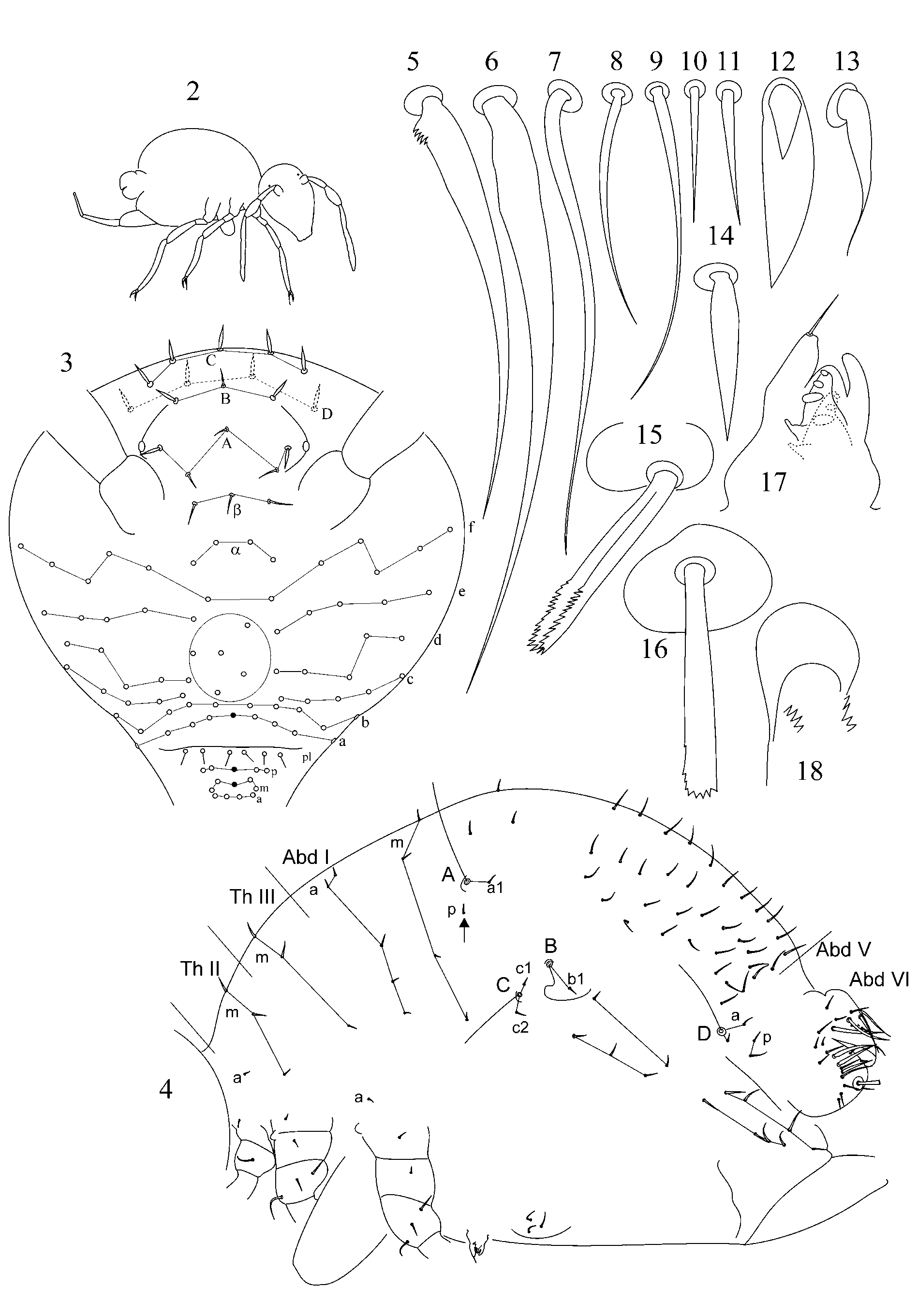
FIGURES 2 – 18. Arrhopalites karabiensis sp. nov.: 2, outline of habitus; 3, chaetotaxy of head, frontal view; 4, chaetotaxy of great abdomen, lateral view; 5 – 16, shape of setae: (mpi 1) of Abd VI (5), (mps 2) of Abd VI (6), (ms 1) of Abd VI (7), posterior dorsal seta of great abdomen (8), (dI- 1) of great abdomen (9), anterior dorsal seta of abdomen (10), dorsal seta of mesothorax (11), spine-like (Ia) seta of dens (12), spine-like (Ipe) seta of dens (13), spine-like seta of head vertex (14), appendices anales, lateral view (15) and dorsal view (16); 17, tenaculum; 18, apex of mucro.

Imageimage/png© Vargovitsh, Robert S.New Cave Arrhopalitidae (Collembola: Symphypleona) from the Crimea (Ukraine)

FIGURES 34 – 49. Arrhopalites peculiaris sp. nov.: 34, outline of habitus; 35, chaetotaxy of head, frontal view; 36, chaetotaxy of great abdomen of juv. specimen, lateral view; 37 – 47, shape of setae: (ms 1) of Abd VI (37), (mps 2) of Abd VI (38), (dI- 1) of great abdomen (39), posterior dorsal seta of great abdomen (40), anterior dorsal seta of abdomen (41), dorsal seta of mesothorax (42), (Ie) of dens (43), (Ia) of dens (44), spine-like seta of head vertex (45), appendices anales, dorsal view (46) and lateral view (47); 48, tenaculum; 49, apex of mucro.
Imageimage/png© Vargovitsh, Robert S.New Cave Arrhopalitidae (Collembola: Symphypleona) from the Crimea (Ukraine)

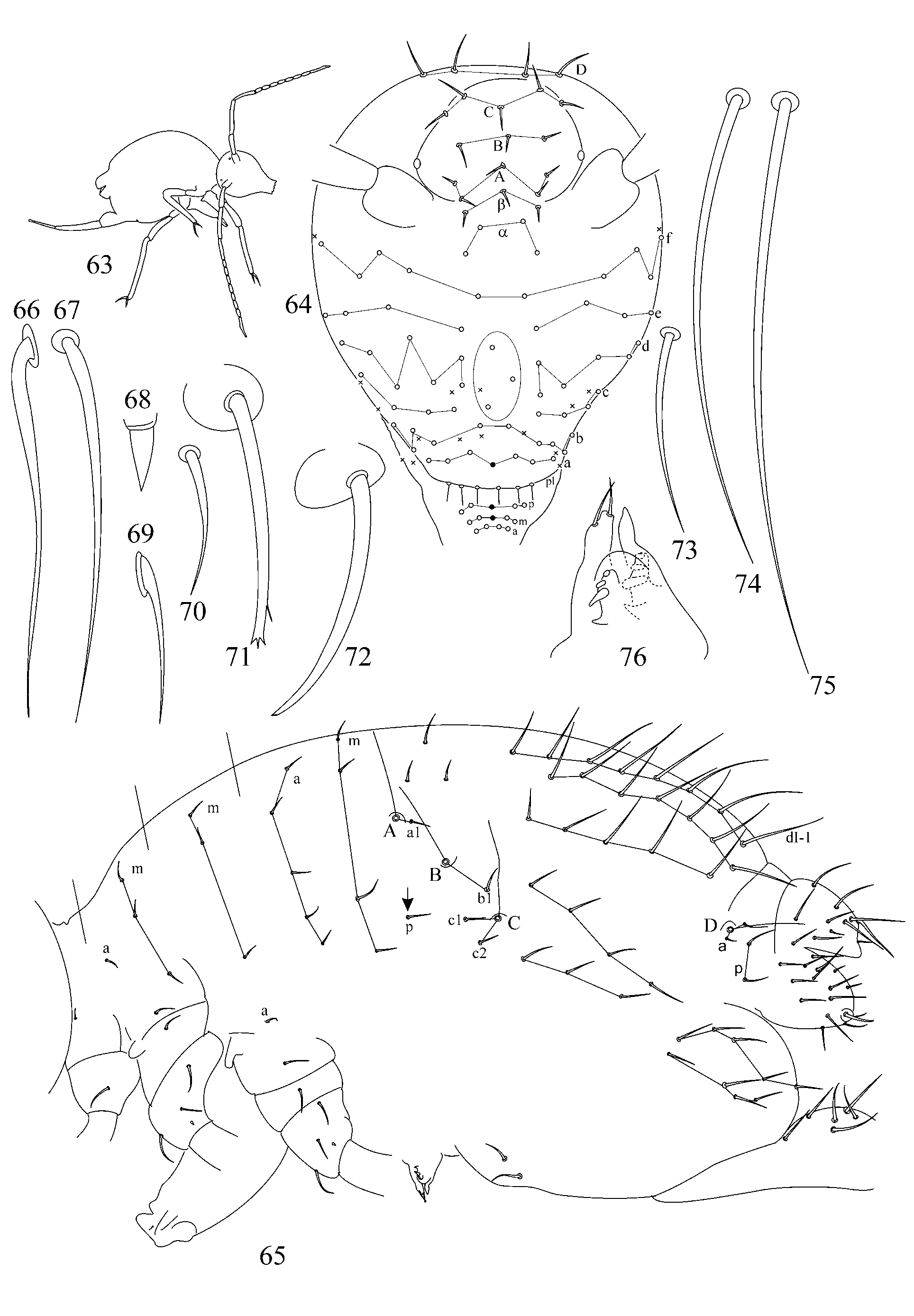
FIGURES 63 – 76. Pygmarrhopalites tauricus sp. nov.: 63, outline of habitus; 64, chaetotaxy of head, frontal view; 65, chaetotaxy of great abdomen, lateral view; 66 – 75, shape of setae: (ms 1) of Abd VI (66), (mps 3) of Abd VI (67), (Ie) of dens (68), (Ia) of dens (69), seta of head vertex (70), appendices anales, dorsal view (71) and lateral view (72), dorsal seta of mesothorax (73), posterior dorsal seta of great abdomen (74), (dI- 1) of great abdomen (75); 76, tenaculum.
Imageimage/png© Vargovitsh, Robert S.New Cave Arrhopalitidae (Collembola: Symphypleona) from the Crimea (Ukraine)

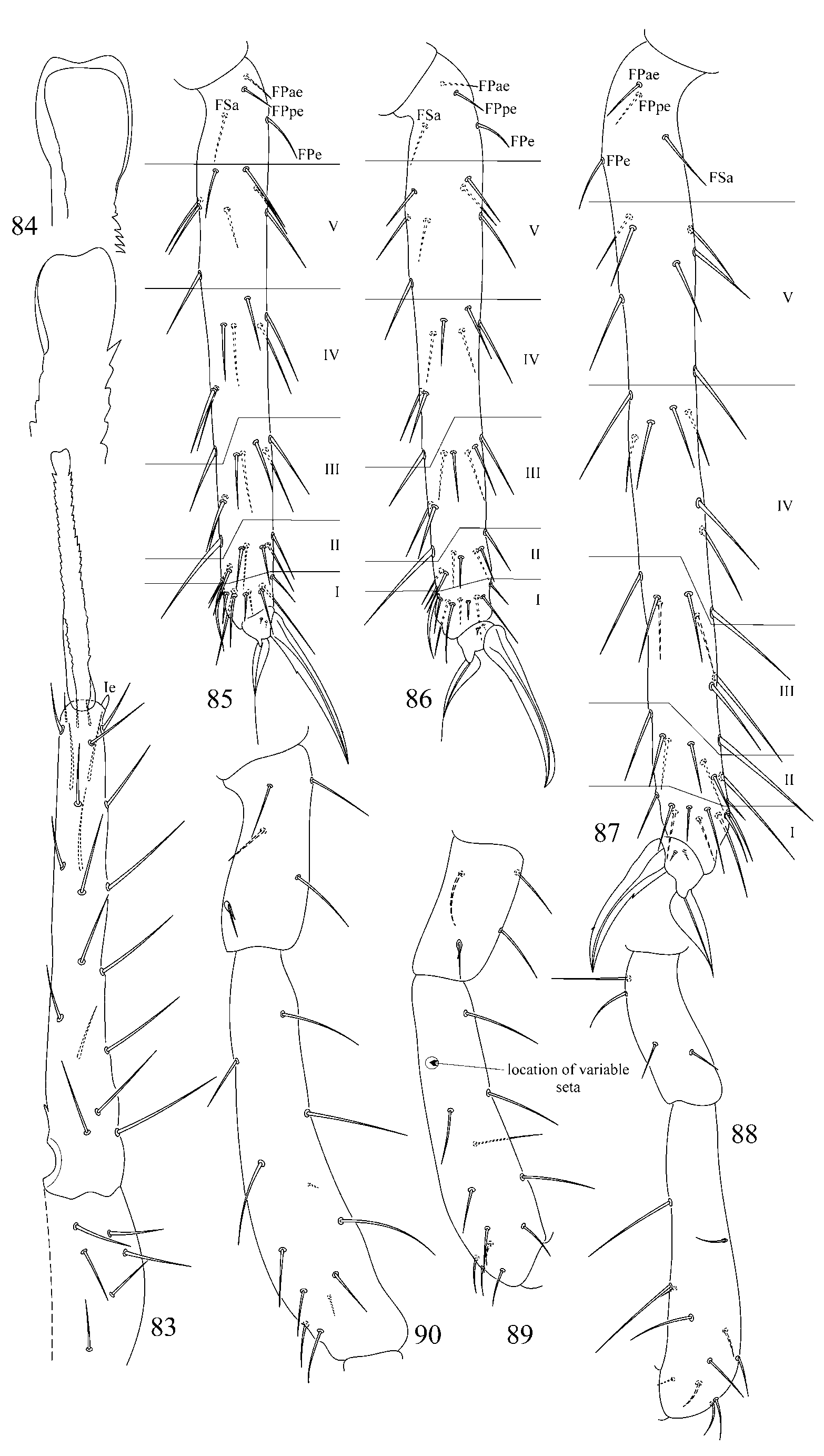
FIGURES 83 – 90. Pygmarrhopalites tauricus sp. nov.: 83, chaetotaxy of furca, posterior view; 84, apex of mucro; 85 – 87, chaetotaxy of tibiotarsus and foot complex: foreleg, posterior view (85), mid leg, posterior view (86), hind leg, anterior view (87); 88 – 90, chaetotaxy of trochanter and femur, anterior view: foreleg (88), mid leg (89), hind leg (90).
Imageimage/png© Vargovitsh, Robert S.New Cave Arrhopalitidae (Collembola: Symphypleona) from the Crimea (Ukraine)

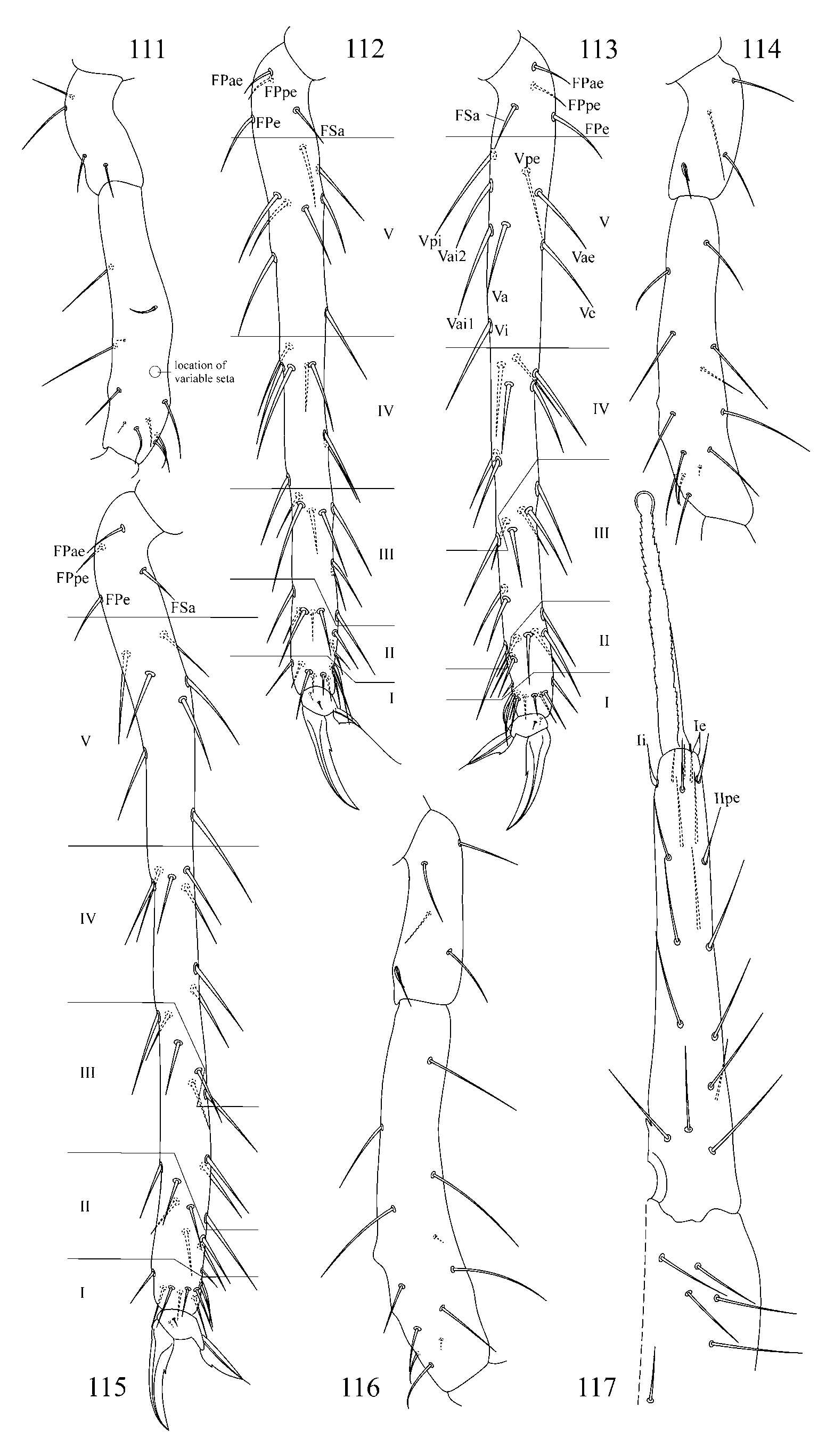
FIGURES 111 – 117. Pygmarrhopalites kaprusi sp. nov.: 111 – 112, chaetotaxy of foreleg, anterior view: trochanter and femur (111), tibiotarsus and foot complex (112); 113 – 114, chaetotaxy of mid leg, anterior view: tibiotarsus and foot complex (113), trochanter and femur (114); 115 – 116, chaetotaxy of hind leg, anterior view: tibiotarsus and foot complex (115), trochanter and femur (116); 117, chaetotaxy of furca, posterior view.
Imageimage/png© Vargovitsh, Robert S.New Cave Arrhopalitidae (Collembola: Symphypleona) from the Crimea (Ukraine)

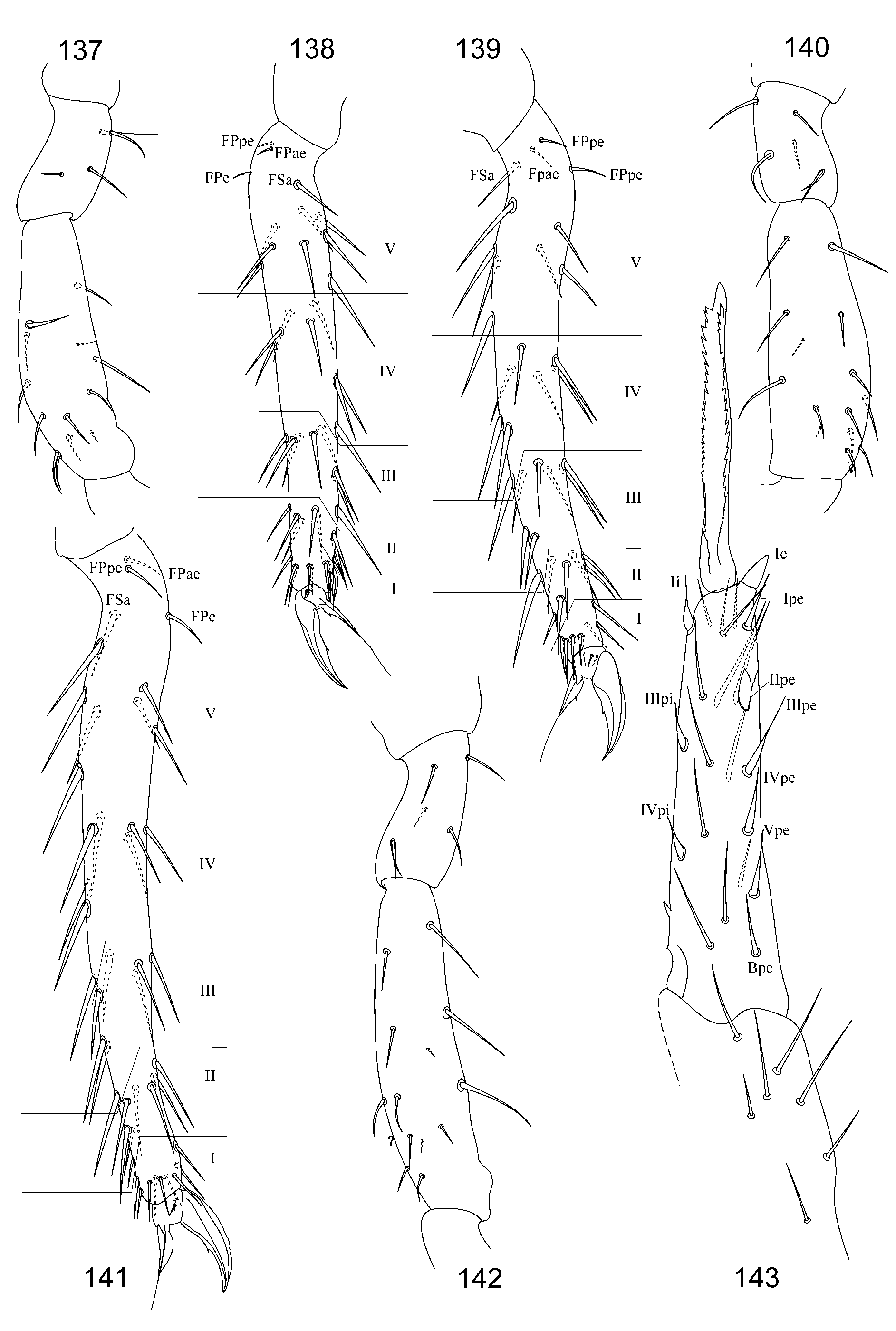
FIGURES 137 – 143. Pygmarrhopalites pseudoprincipalis sp. nov.: 137, 140, 142, chaetotaxy of trochanter and femur, anterior view: foreleg (137), mid leg (140), hind leg (142); 138 – 139, 141, chaetotaxy of tibiotarsus and foot complex: fore leg, anterior view (138), mid- (139) and hind leg (141), posterior view; 143, chaetotaxy of furca, posterior view.

Imageimage/png© Vargovitsh, Robert S.New Cave Arrhopalitidae (Collembola: Symphypleona) from the Crimea (Ukraine)

IMAGES

Gallery(7)

See Gallery

Occurrences with images

CITATIONS

References(9)

  • 1

    Bellinger, P. F.; Christiansen, K. A.; Janssens, F. (1996-current)). Checklist of the Collembola of the World (2023 version).

    verified source for familyThe Interim Register of Marine and Nonmarine Genera
  • 2

    Brands, S. J. (compiler). (1989-2005). Systema Naturae 2000. Amsterdam, The Netherlands (2006 version). Originally available online at http://sn2000.taxonomy.nl/; for current information, refer http://taxonomicon.taxonomy.nl/ProjectDescription.aspx .

    extant flag sourceThe Interim Register of Marine and Nonmarine Genera
  • 3

    Brands, S. J. (compiler). (1989-2005). Systema Naturae 2000. Amsterdam, The Netherlands (2006 version). Originally available online at http://sn2000.taxonomy.nl/; for current information, refer http://taxonomicon.taxonomy.nl/ProjectDescription.aspx .

    basis of recordThe Interim Register of Marine and Nonmarine Genera
  • 4

    CoL 2006

    current name sourceThe Interim Register of Marine and Nonmarine Genera
  • 5

    Fjellberg (2008) Nordic checklist of Collembola. Excelfil till Per Alström 080303. Inkluderar fynd från Island och Färöarna samt nya fynd från Finland (Huhta/Pietikainen 2007)

    Dyntaxa. Svensk taxonomisk databas
  • Source Information

    GBIF Backbone Taxonomy

    GBIF Backbone Taxonomy

    checklist

    The GBIF Backbone Taxonomy is a single, synthetic management classification with the goal of covering all names GBIF is dealing with. It's the taxonomic backbone that allows GBIF to integrate name based information from different resources, no matter if these are occurrence datasets, species pages, names from nomenclators or external sources like EOL, Genbank or IUCN. This backbone allows taxonomic search, browse and reporting operations across all those resources in a consistent way and to provide means to crosswalk names from one source to another.

    It is updated regulary through an automated process in which the Catalogue of Life acts as a starting point also providing the complete higher classification above families. Additional scientific names only found in other authoritative nomenclatural and taxonomic datasets are then merged into the tree, thus extending the original catalogue and broadening the backbones name coverage. The GBIF Backbone taxonomy also includes identifiers for Operational Taxonomic Units (OTUs) drawn from the barcoding resources iBOL and UNITE.

    International Barcode of Life project (iBOL), Barcode Index Numbers (BINs). BINs are connected to a taxon name and its classification by taking into account all names applied to the BIN and picking names with at least 80% consensus. If there is no consensus of name at the species level, the selection process is repeated moving up the major Linnaean ranks until consensus is achieved.

    UNITE - Unified system for the DNA based fungal species, Species Hypotheses (SHs). SHs are connected to a taxon name and its classification based on the determination of the RefS (reference sequence) if present or the RepS (representative sequence). In the latter case, if there is no match in the UNITE taxonomy, the lowest rank with 100% consensus within the SH will be used.

    The GBIF Backbone Taxonomy is available for download at https://hosted-datasets.gbif.org/datasets/backbone/ in different formats together with an archive of all previous versions.

    The following 105 sources have been used to assemble the GBIF backbone with number of names given in brackets:

    • Catalogue of Life Checklist - 4766428 names
    • International Barcode of Life project (iBOL) Barcode Index Numbers (BINs) - 635951 names
    • UNITE - Unified system for the DNA based fungal species linked to the classification - 611208 names
    • The Paleobiology Database - 212054 names
    • World Register of Marine Species - 188857 names
    • The Interim Register of Marine and Nonmarine Genera - 183894 names
    • The World Checklist of Vascular Plants (WCVP) - 131891 names
    • GBIF Backbone Taxonomy - 114350 names
    • TAXREF - 109374 names
    • The Leipzig catalogue of vascular plants - 75380 names
    • ZooBank - 73549 names
    • Integrated Taxonomic Information System (ITIS) - 68377 names
    • Plazi.org taxonomic treatments database - 61346 names
    • Genome Taxonomy Database r207 - 60545 names
    • International Plant Names Index - 52329 names
    • Fauna Europaea - 45077 names
    • The National Checklist of Taiwan (Catalogue of Life in Taiwan, TaiCoL) - 36193 names
    • Dyntaxa. Svensk taxonomisk databas - 35892 names
    • The Plant List with literature - 32692 names
    • United Kingdom Species Inventory (UKSI) - 29643 names
    • Artsnavnebasen - 29208 names
    • The IUCN Red List of Threatened Species - 21221 names
    • Afromoths, online database of Afrotropical moth species (Lepidoptera) - 13961 names
    • Brazilian Flora 2020 project - Projeto Flora do Brasil 2020 - 13829 names
    • Prokaryotic Nomenclature Up-to-Date (PNU) - 10079 names
    • Checklist Dutch Species Register - Nederlands Soortenregister - 8814 names
    • ICTV Master Species List (MSL) - 7852 names
    • Cockroach Species File - 6020 names
    • GRIN Taxonomy - 5882 names
    • Taxon list of fungi and fungal-like organisms from Germany compiled by the DGfM - 4570 names
    • Catalogue of Afrotropical Bees - 3623 names
    • Catalogue of Tenebrionidae (Coleoptera) of North America - 3327 names
    • Checklist of Beetles (Coleoptera) of Canada and Alaska. Second Edition. - 3312 names
    • Systema Dipterorum - 2850 names
    • Catalogue of the Pterophoroidea of the World - 2807 names
    • The Clements Checklist - 2675 names
    • Taxon list of Hymenoptera from Germany compiled in the context of the GBOL project - 2496 names
    • IOC World Bird List, v13.2 - 2366 names
    • Official Lists and Indexes of Names in Zoology - 2310 names
    • National checklist of all species occurring in Denmark - 1922 names
    • Myriatrix - 1876 names
    • Database of Vascular Plants of Canada (VASCAN) - 1822 names
    • Taxon list of vascular plants from Bavaria, Germany compiled in the context of the BFL project - 1771 names
    • Orthoptera Species File - 1742 names
    • A list of the terrestrial fungi, flora and fauna of Madeira and Selvagens archipelagos - 1602 names
    • Aphid Species File - 1565 names
    • World Spider Catalog - 1561 names
    • Taxon list of Jurassic Pisces of the Tethys Palaeo-Environment compiled at the SNSB-JME - 1270 names
    • Backbone Family Classification Patch - 1143 names
    • GBIF Algae Classification - 1100 names
    • International Cichorieae Network (ICN): Cichorieae Portal - 975 names
    • Psocodea Species File - 803 names
    • New Zealand Marine Macroalgae Species Checklist - 787 names
    • Annotated checklist of endemic species from the Western Balkans - 754 names
    • Taxon list of animals with German names (worldwide) compiled at the SMNS - 503 names
    • Catalogue of the Alucitoidea of the World - 472 names
    • Lygaeoidea Species File - 462 names
    • Catálogo de Plantas y Líquenes de Colombia - 422 names
    • GBIF Backbone Patch - 317 names
    • Phasmida Species File - 259 names
    • Cortinariaceae fetched from the Index Fungorum API - 234 names
    • Coreoidea Species File - 233 names
    • GTDB supplement - 139 names
    • Mantodea Species File - 119 names
    • Endemic species in Taiwan - 93 names
    • Taxon list of Araneae from Germany compiled in the context of the GBOL project - 88 names
    • Species of Hominidae - 78 names
    • Taxon list of Sternorrhyncha from Germany compiled in the context of the GBOL project - 77 names
    • Taxon list of mosses from Germany compiled in the context of the GBOL project - 75 names
    • Mammal Species of the World - 73 names
    • Plecoptera Species File - 71 names
    • Species Fungorum Plus - 64 names
    • Catalogue of the type specimens of Cosmopterigidae (Lepidoptera: Gelechioidea) from research collections of the Zoological Institute, Russian Academy of Sciences - 47 names
    • Species named after famous people - 41 names
    • Dermaptera Species File - 36 names
    • Taxon list of Trichoptera from Germany compiled in the context of the GBOL project - 34 names
    • True Fruit Flies (Diptera, Tephritidae) of the Afrotropical Region - 33 names
    • Range and Regularities in the Distribution of Earthworms of the Earthworms of the USSR Fauna. Perel, 1979 - 32 names
    • Taxon list of Diplura from Germany compiled in the context of the GBOL project - 30 names
    • Lista de referencia de especies de aves de Colombia - 2022 - 24 names
    • Taxon list of Auchenorrhyncha from Germany compiled in the context of the GBOL project - 20 names
    • Catalogue of the type specimens of Polycestinae (Coleoptera: Buprestidae) from research collections of the Zoological Institute, Russian Academy of Sciences - 19 names
    • Taxon list of Thysanoptera from Germany compiled in the context of the GBOL project - 19 names
    • Lista de especies de vertebrados registrados en jurisdicción del Departamento del Huila - 18 names
    • Taxon list of Microcoryphia (Archaeognatha) from Germany compiled in the context of the GBOL project - 15 names
    • Catalogue of the type specimens of Bufonidae and Megophryidae (Amphibia: Anura) from research collections of the Zoological Institute, Russian Academy of Sciences - 12 names
    • Grylloblattodea Species File - 11 names
    • Coleorrhyncha Species File - 9 names
    • Taxon list of liverworts from Germany compiled in the context of the GBOL project - 9 names
    • Embioptera Species File - 7 names
    • Taxon list of Pisces and Cyclostoma from Germany compiled in the context of the GBOL project - 6 names
    • Taxon list of Pteridophyta from Germany compiled in the context of the GBOL project - 6 names
    • Taxon list of Siphonaptera from Germany compiled in the context of the GBOL project - 5 names
    • The Earthworms of the Fauna of Russia. Perel, 1997 - 5 names
    • Taxon list of Zygentoma from Germany compiled in the context of the GBOL project - 4 names
    • Asiloid Flies: new taxa of Diptera: Apioceridae, Asilidae, and Mydidae - 3 names
    • Taxon list of Protura from Germany compiled in the context of the GBOL project - 3 names
    • Taxon list of hornworts from Germany compiled in the context of the GBOL project - 2 names
    • Chrysididae Species File - 1 names
    • Taxon list of Dermaptera from Germany compiled in the context of the GBOL project - 1 names
    • Taxon list of Diplopoda from Germany in the context of the GBOL project - 1 names
    • Taxon list of Orthoptera (Grashoppers) from Germany compiled at the SNSB - 1 names
    • Taxon list of Pscoptera from Germany compiled in the context of the GBOL project - 1 names
    • Taxon list of Pseudoscorpiones from Germany compiled in the context of the GBOL project - 1 names
    • Taxon list of Raphidioptera from Germany compiled in the context of the GBOL project - 1 names

    GBIF Secretariat (2023). GBIF Backbone Taxonomy. Checklist dataset https://doi.org/10.15468/39omei accessed via GBIF.org on 2026-06-14.

    CC BYPublished 8/28/2023View dataset
    GBIF Usage Key
    2122170
    Dataset Key
    d7dddbf4-2cf0-4f39-9b2a-bb099caae36c
    Origin
    source
    Backbone Key
    2122170
    Taxon ID
    gbif:2122170
    Last Crawled
    8/22/2023
    Last Interpreted
    8/22/2023