
AnimaliaacceptedgenusAccepted
Actinopus

Actinopus

Perty, 1833

GBIF:2179712

0datasets
0year

0

Descendants

0

Synonyms

0

Children

0

Species

PROFILE

Species Profile

Characteristics

Extant

ABOUT

Descriptions(26)

Type species: Actinopus tarsalis Perty, 1833: 198, pl. 39, fig. 6 (male holotype from Piauí, Brazil).
Description of the female of Actinopus balcarce Ríos-Tamayo & Goloboff, 2018 (Araneae, Actinopodidae), with comments on its natural history

Key to known species of Actinopus with Type I Morphology

1. Males.............................................................................................. 2 - Females............................................................................................. 6 2. Small size (body length <11.00 mm); color light brown or beige; spiniform bristles on dorsum of femora III and P on trochanter III................................................................................................. 3 - Larger size (body length>12.00), color dark reddish brown, without spiniform bristles on dorsum of femora III or P on trochanter III........................................................ A. reycali Ríos-Tamayo & Goloboff, 2018 . 3. Bulb keels and ATA very small, scarcely visible........................... A. clavero Ríos-Tamayo & Goloboff, 2018 . - Bulb keels and ATA developed, remarkably visible........................................................... 4 4. Chelicerae with small anterior retrolateral keels; PA very developed (Fig 4D....................................... ........................................................... A. septemtrionalis Ríos-Tamayo & Goloboff, 2018 . - Chelicerae without keels; PA developed (Fig 4C, 4E .......................................................... 5 5. Two bulb keels (Fig 4E); fovea wide (>1.80).................................... A. cochabamba Ríos-Tamayo, 2016 . - Three bulb keels (Fig 4C); fovea narrow (<1.00)............................................... A. chilikuti sp. nov. 6. Spermathecae elongated (fig 7D, E in Ríos-Tamayo & Goloboff, 2018, p. 19).............................. A. reycali - Spermathecae short (Fig 3D)............................................................................ 6 6. Apical portion of the spermathecae broad (fig 9D, E in Ríos-Tamayo & Goloboff, 2018, p. 24, fig. 2E in Ríos-Tamayo, 2016, p. 187).............................................................................................. 7 - Apical portion of the spermathecae slender................................................................. 8 7. Few retrolateral spines on tibia II (<20)....................................................... A. septemtrionalis - Many retrolateral spines on tibia II (>30)........................................................ A. cochabamba 8. Few retrolateral spines on tibia I.................................................................. A. clavero - Absence of retrolateral spines on tibia I..................................................... A. chilikuti sp. nov.

A new trapdoor spider of the genus Actinopus (Araneae: Mygalomorphae: Actinopodidae) from ArgentinaMagnoliaPress via PlaziNo known copyright restrictions apply. See Agosti, D., Egloff, W., 2009. Taxonomic information exchange and copyright: the Plazi approach. BMC Research Notes 2009, 2:53 for further explanation.
Diagnosis. The species in the group tutu are recognized by the small total length; embolus with three keels; serrated area on prolateral embolus small or, when large, representedbysparsesmalldenticles; patternsofcoloration on legs and palp, when present, inconspicuous. Species included. Actinopus tutu sp. nov.; Actinopus azaghal n. sp; Actinopus itacolomi sp. nov.; Actinopus longipalpis C. L. Koch, 1842; Actinopus pindapoy sp. nov., A. argenteus Ríos-Tamayo & Goloboff, 2018; A. pampa Ríos-Tamayo & Goloboff, 2018; Actinopus ariasi Ríos-Tamayo & Goloboff, 2018; Actinopus cordobensis Ríos-Tamayo & Goloboff, 2018; and Actinopus coylei Ríos-Tamayo & Goloboff, 2018.
Taxonomic Revision of the Spider Genus Actinopus Perty, 1833 (Araneae, Mygalomorphae, Actinopodidae)
Diagnosis. The species in the group osbournei are recognized by the small total length; legs with metatarsi and tarsi paler than other articles; abdomen without scutum; sigilla converging to middle of sternum but separated; embolus with three keels; tegulum thin and elongated; BTA developed and placed medially on prolateral tegular surface; PA continuous to PAc. Species included. Actinopus osbournei sp. nov.; Actinopus dioi n. sp; and Actinopus patagonia Ríos-Tamayo & Goloboff, 2018.
Taxonomic Revision of the Spider Genus Actinopus Perty, 1833 (Araneae, Mygalomorphae, Actinopodidae)
Diagnosis. The species in the group reznori are recognized by the small total length; tibia of palp paler than other articles; abdomen without scutum and with spots of unpigmentation on dorsal surface; tegulum and embolus thin and elongated along longitidunal line; BTA developed and displaced dorsally in relation to a middle longitudinal line along prolateral tegular surface; embolus with only two keels (PS and PI). Serrated area represented by few cusps widespread along embolus. Species included. Actinopus reznori sp. nov.; and Actinopus anselmoi sp. nov.
Taxonomic Revision of the Spider Genus Actinopus Perty, 1833 (Araneae, Mygalomorphae, Actinopodidae)
Diagnosis. The species included in group parafundulus are unique in the embolar keels restricted to median sector of embolus, being represented by short prominent lamellae in prolateral view. Additional diagnostic characters are: small total length; abdomen without scutum; tegulum short and rounded; BTA developed, placed medially on prolateral tegular surface; serrated area represented by a small and bounded area on embolus bases, above the last keel (PI in A. parafundulus, and PAc in A. urucui). Species included. A. parafundulus sp. nov.; and A. urucui sp. nov.
Taxonomic Revision of the Spider Genus Actinopus Perty, 1833 (Araneae, Mygalomorphae, Actinopodidae)
Diagnosis. The species in the group goloboffi are readily recognized by discontinuous thoracic fovea that is interrupted in middle (Ríos-Tamayo & Goloboff, 2018, fig. 42 A) and the sternum with a deep central depression (Ríos-Tamayo & Goloboff, 2018, fig. 42 B). The resemble all other species of type II morphology proposed by Ríos-Tamayo & Goloboff, 2018 (which include most species described here) by triangular shape of the post-labial sigilla, sternal sigilla I – II elongated, and, in females, by the abundant retrolateral thorns on tibia II and by the lobed spermathecae. They resemble A. crassipes (Fig. 107 A), A. dubiomaculatus (Fig. 112 A) and A. laventana (Fig. 129 A), included on group crassipes ¸ by the PA continuous to PI. Females of group goloboffi share with A. dubiomaculatus (Fig. 112 D – H) and A. laventana (Fig. 129 D) the similar shape of receptacles. They differ from A. laventana by the absence of lateral swelling on receptacles. Species included. Actinopus goloboffi Ríos, 2014; Actinopus balcarce Ríos-Tamayo & Goloboff, 2018; Actinopus excavatus Ríos-Tamayo & Goloboff, 2018.
Taxonomic Revision of the Spider Genus Actinopus Perty, 1833 (Araneae, Mygalomorphae, Actinopodidae)
Description. See Ríos-Tamayo (2019: 526).
Taxonomic Revision of the Spider Genus Actinopus Perty, 1833 (Araneae, Mygalomorphae, Actinopodidae)
Diagnosis. The single known specimen of A. coboi shares with females of A. laventana the well-developed, diagonally directed external lobes of spermathecae. They can be distinguished by the absence of internal lobes (Ríos-Tamayo, 2019, fig. 2 D), which are present in A. laventana (Fig. 129 D).
Taxonomic Revision of the Spider Genus Actinopus Perty, 1833 (Araneae, Mygalomorphae, Actinopodidae)
Distribution. URUGUAY: Colonia.
Taxonomic Revision of the Spider Genus Actinopus Perty, 1833 (Araneae, Mygalomorphae, Actinopodidae)
Description. See Ríos-Tamayo (2019: 533).
Taxonomic Revision of the Spider Genus Actinopus Perty, 1833 (Araneae, Mygalomorphae, Actinopodidae)
Diagnosis. Males of A. uruguayense (Ríos-Tamayo, 2019, fig. 8 I – J) resemble those of A. dubiomaculatus by shape of the palpal bulb but can be distinguished by uniform leg article coloration. Females are similar to those of A. paraitinga by the shape of the spermathecal lateral swellings and external lobes (Fig. 59 D) but can be recognized by the larger, more pronounced internal lobes (Ríos-Tamayo, 2019, fig. 9 E).
Taxonomic Revision of the Spider Genus Actinopus Perty, 1833 (Araneae, Mygalomorphae, Actinopodidae)
Distribution. URUGUAY: Colonia, Maldonado, Cerro Largo.
Taxonomic Revision of the Spider Genus Actinopus Perty, 1833 (Araneae, Mygalomorphae, Actinopodidae)
Description. See Ríos-Tamayo (2019: 527).
Taxonomic Revision of the Spider Genus Actinopus Perty, 1833 (Araneae, Mygalomorphae, Actinopodidae)
Diagnosis. Males of A. fernandezi (Ríos-Tamayo, 2019, fig. 3 F – H) differ from all other members of the crassipes group by the legs tibiae lighter that the other articles and by the absence of basal denticles on the base of the embolus (Ríos-Tamayo, 2019, fig. 3 F, H).
Taxonomic Revision of the Spider Genus Actinopus Perty, 1833 (Araneae, Mygalomorphae, Actinopodidae)
Distribution. URUGUAY: Salto.
Taxonomic Revision of the Spider Genus Actinopus Perty, 1833 (Araneae, Mygalomorphae, Actinopodidae)
Diagnosis. The group tarsalis is recognized by the following combination of characters: medium total length; legs and palps without coloration patterns; bulb with three keels; serrated area distal to PAc in prolateral view of copulatory bulb absent or small; BTA absent; embolus inserted in a right angle; embolar apex flattened and expanded, arrow-shaped in dorsal view. Species included. Actinopus tarsalis Perty, 1833; Actinopus castelo sp. nov.
Taxonomic Revision of the Spider Genus Actinopus Perty, 1833 (Araneae, Mygalomorphae, Actinopodidae)
Description. Total length (males and females) from 7.0 to 35.9 mm. Carapace. Anterior prolateral angle of carapace tapered (Fig. 172 B) or subquadrate (Fig. 5 F). Carapace subquadrate in dorsal view, smooth with strongly demarcated radial grooves and wider at coxae III, anterior median ocular tubercle absent, with delimited cephalic area and strong inclination at fovea level, anterior margin rounded; fovea U-shaped, strongly procurved, deep, sharply demarcated (Figs 5 E); in lateral view, thoracic area with abrupt anterior slope and gradual posterior slope. Clypeus, anteriorly less sclerotized than posteriorly, height from 1.0 – 1.5 times diameter of ALE. Anterior eyes row slightly procurved; posterior eyes row recurved d in dorsal view (Fig. 5 F). No or few bristles between AME-clypeus; no or few bristles between PME – PME and PLE – PLE. Ocular quadrangle wider than long; ALE diameter bigger than that of other eyes. Interdistances: Males: PME – PME separated by more than four diameters of PME, ALE – AME separated by ca. twice diameter of AME, ALE – PLE separated by less than twice diameter of ALE, AME – PME separated by ca. twice diameter of AME (Fig. 4 A). Females: PME – PME separated by ca. three times interdistance of PME – PLE, PLE – PME separated by half diameter of PME, AME – AME separated by half the diameter of ALE, ALE – AME separated by four times diameter of AME, ALE – PLE separated by twice diameter of PLE, AME – PME separated by four times diameter of AME (Fig. 5 F). Chelicerae not geniculate, longer than half carapace length, with apical rastellum. Rastellum smooth, with bristles (Fig. 13 C) or spines (Fig. 108 F). Females with very conspicuous crown of thorns bordering rastellum (Fig. 210 F). Cheliceral teeth, in ventral view, arranged in two rows, prolateral and retrolateral. Prolateral teeth row bordered by denticles (Fig. 5 G). Labium fused to sternum. Labium and maxillae longer than wide. Males without labial and maxillary cuspules (Figs 4 B, 6 A); females with numerous cuspules and bristles (Fig. 5 H). Sternum longer than wide. Sternum with 6 – 10 hardly distinguishable sigilla, strongly fused at center of sternum. Pre-coxal triangles absent (Fig. 24 C). Legs. Males: Long, smooth (Fig. 6 B) or covered with few simple and sparse hairs (Figs 14 D, 31 A – D); Many prolateral spines on the sides of the patellae III and IV, forming crown spines on dorsal surface of Patella and tibia III (Fig. 14 A, C); tibiae, metatarsi and tarsi with filiform dorsal trichobothria, with high bases (Fig. 6 C, D); clavate tarsal trichobothria absent. Tarsi and metatarsi III and IV with compact pseudoscopula (Fig. 6 E – F), subapical chemosensitive fissures present (Fig. 6 E – H) or absent. Inferior tarsal claws without teeth; superior tarsal claws with one tooth, one tooth and one denticle or one tooth and two denticles (Fig. 4 G – H). Subinguinal tufts absent; all trochanters with a fissure. Females: Legs short, robust and covered by several short and strong spines, with many long bristles (Fig. 7 A), rows of strong spines on prolateral and retrolateral surfaces of distal articles (tibiae, metatarsi and tarsi) in all legs (Fig. 7 B), except leg IV, with rows only on prolateral surface; many spines on prolateral patellae III and IV, forming a crown of spines on dorsal surface of patella and tibia III; ventrally, spines replacing pseudoscopula on tarsi III and IV; tibiae, metatarsi and tarsi with filiform dorsal trichobothria with a high bases (Fig. 7 C), tricoma with large fixation base (Fig. 7 D); Clavate tarsal trichobothria absent. Inferior and superior tarsal claws without teeth. Subinguinal tufs absent. All trochanters with fissure. Abdomen. Long, oval, homogeneously covered with simple setae and dorsally with long simple setae (Fig. 10 A); male and female dorsal scutum, when present, restricted to anterior half of abdomen, whole or divided; scutal bristles with more sclerotized bases that those of ordinary tegument bristles (Fig. 13 A). Four spinnerets (Fig. 7 E). Posterior median spinnerets (PMS) small or medium-sized, with one segment; posterior lateral spinnerets (PLE) with three bigger segments; spigot types: principal ampullary fusule and secondary ampullary fusule (Fig. 7 D – E), tartipores (Fig. 7 D) as remnants of small ampular in some segments; apical digitiform article of PLS. Male Palp. Femur, patella and tibia without or with few spines. Tibia without retrolateral tibial apophysis, more thickened at base than apically (Fig. 7 H); cymbium rounded, without spines and scopula; subtegulum subrectangular, sclerotized, turned laterally (Fig. 8 A); tegulum large, sclerotized, reservoir with two or three loops in prolateral view; distal region of tegulum with prolateral paraembolic apophysis; apical tegulum with prolateral keels; embolus inserted in angle relative to tegulum, sclerotized, with visible duct (Figs 9 A – C and 12 A – C). Generally, keels represented by three paraembolic apophyses in prolateral view of embolus (Actinopus paranensis, A. pinhao, A. ducke, A. hirsutus, A. jaboticatubas, A. confusus, A. pampulha, A. candango, A. paraitinga, A. cornelli, A. nattereri, A. rufipes, A. vilhena, A. harveyi, A. itapitocai, A. ipioca, A. itaqui, A. xingu, A. mesa, A. caxiuana, A. utinga, A. crassipes, A. dubiomaculatus, A. pusillus, A. emas, A. bocaina, A. laventana, A. osbournei, A. dioi, A. longipalpis, A. tutu, A. azaghal, A. itacolomi, A. tarsalis, A. castelo, A. parafundulus, A. urucui and A. panguana). In A. panguana (Fig. 206 A – C), a dorsal tegular process (DTP); in A. cucutaensis (Fig. 176 A – C), A. robustus, A. lomalinda, A. palmar and A. guajara, an apical tegular process (ATP); basal tegular apophysis (BTA) absent in A. tarsalis and A. castelo (Fig. 12 A – C). Spermathecae. Spermatic ducts robust, short (Fig. 217 B – D), well separated from base by a membranous region or strongly fused to it (Figs 26 D, 181 D); each receptacle without or with one or three lobes (Fig. 220 A), lobes quite sclerotized, apically covered by pores (Fig. 8 B).
Taxonomic Revision of the Spider Genus Actinopus Perty, 1833 (Araneae, Mygalomorphae, Actinopodidae)
Figs 1 – 225, Maps 1 – 19
Taxonomic Revision of the Spider Genus Actinopus Perty, 1833 (Araneae, Mygalomorphae, Actinopodidae)
Diagnosis. Within Actinopodidae, species of Actinopus are recognized by the procurved anterior row of eyes, with the lateral eyes aligned antero-posteriorly (Fig. 4 A, F); labium elongated antero-posteriorly, without cuspules on males and with an average of 15 – 30 cuspules on females (Fig. 4 B – C); sternal sigilla close together, positioned in a deep median common depression (Fig. 4 D). Additionally, males and females of Actinopus differ from those of Missulena by the pronounced rastellum (Fig. 4 E), sternum not rebordered (Fig. 10 C) and superior tarsal claws with a tooth and one or two denticles (Fig. 4 G – H). They differ from those of Plesiolena by the flattened cheliceral apex (Fig. 10 E – F) and by the crown of robust spines on the dorsal, apical surface of the patella and tibia III (Fig. 11 A, C). Males of Actinopus differ from those of Plesiolena by the ventral pseudoscopula in metatarsi and tarsi (Fig. 5 A) and from those of Missulena by the cymbium without ventral incision. They differ from males of both genera by the copulatory bulb with paraembolic apophysis (Fig. 5 B) and with twisted keels in prolateral view of embolus (Fig. 5 C). Females of Actinopus differ from those of Missulena by tarsi I and II with strong and sharp spines and spermathecae with robust receptacles; differ from those of both genera by the short spermathecal receptacles (Fig. 5 D).
Taxonomic Revision of the Spider Genus Actinopus Perty, 1833 (Araneae, Mygalomorphae, Actinopodidae)
Composition. Eighty species, 42 of which are newly described. Ten old species names are herein considered species inquirendae: A. rojasi (Simon, 1889) and A. valencianus (Simon, 1889) were described from juveniles. The type of A. pertyi Lucas, 1843, originally deposited at Muséum National d´Histoire Naturelle (MNHN), Paris, France, is lost. The holotype female of A. rufibarbis Mello-Leit „ o, 1930, deposited at Museu Nacional do Rio de Janeiro, Rio de Janeiro, Brazil, is without spermathecae and in poor condition. The types of A. nigripes (Lucas, 1834), A. piceus (Ausserer, 1871) and A. liodon (Ausserer, 1875), all originally deposited at Naturhistorisches Museum, Wien, Austria, and A. harti Pocock, 1895 originally deposited at The Natural History Museum, London, England, were not found and are considered lost. Specimens identified as A. caraiba (Simon, 1889) and A. scalops (Simon, 1889) were examined and photographed by J. P. Guadanucci at Muséum National d´Histoire Naturelle (MNHN), Paris, France, but the localities on the labels are slightly different from the respective published type localities reported in the original descriptions and the specimens were not labelled as types. These specimens were not considered as types in the present paper by all prior knowledge about Simon’s specimens deposited at MNHN and the totally absence of any other type evidence on labels of other specimens deposited in the Paris Museum.
Taxonomic Revision of the Spider Genus Actinopus Perty, 1833 (Araneae, Mygalomorphae, Actinopodidae)
Diagnosis. The group apalai is recognized by the following combination of characters: Medium total length; PA pronounced, continuous to PI; two embolar keels, PAc absent; prolateral embolus without serrated area, represented by few (two – four) cusps distal to PAc. Species included. Actinopus apalai sp. nov.; Actinopus mairinquensis sp. nov.; and Actinopus szumikae Ríos-Tamayo & Goloboff, 2018
Taxonomic Revision of the Spider Genus Actinopus Perty, 1833 (Araneae, Mygalomorphae, Actinopodidae)
Diagnosis. The group pinhao is recognized by the following combination of characters: Medium total length; serrated area distal to PAc large; BTA present; embolus with three long keels. Females are recognized by the spermathecae with two asymmetric receptacles, with 75 % – 100 % of each receptacle filled by pores.
Taxonomic Revision of the Spider Genus Actinopus Perty, 1833 (Araneae, Mygalomorphae, Actinopodidae)
Species included. Actinopus pinhao sp. nov.; Actinopus ducke sp. nov.; Actinopus hirsutus sp. nov.; Actinopus jaboticatubas sp. nov.; Actinopus confusus sp. nov.; Actinopus pampulha sp. nov.; Actinopus candango sp. nov.; Actinopus paraitinga sp. nov.; Actinopus cornelli sp. nov.; Actinopus insignis (Holmberg, 1881); and Actinopus ramirezi Ríos-Tamayo & Goloboff, 2018.
Taxonomic Revision of the Spider Genus Actinopus Perty, 1833 (Araneae, Mygalomorphae, Actinopodidae)
Diagnosis. The species in the group nattereri are recognized by the following combination of characters: Medium to large in total length; embolus with three keels; BTA developed; serrated area above PAc in prolateral view reduced. Females are recognized by the spermathecae with two receptacles, without lateral swelling. Species included. Actinopus nattereri (Doleschall, 1871); Actinopus rufipes (Lucas, 1834); Actinopus vilhena sp. nov.; Actinopus harveyi sp. nov.; Actinopus itapitocai sp. nov.; Actinopus ipioca sp. nov.; Actinopus itaqui sp. nov.; Actinopus xingu sp. nov.; Actinopus mesa sp. nov.; Actinopus caxiuana sp. nov.; Actinopus utinga sp. nov.; Actinopus reycali Ríos-Tamayo & Goloboff, 2018; and Actinopus septemtrionalis Ríos-Tamayo & Goloboff, 2018.
Taxonomic Revision of the Spider Genus Actinopus Perty, 1833 (Araneae, Mygalomorphae, Actinopodidae)
Type species: Actinopus tarsalis Perty, 1833: 198, pl. 39, fig. 6 (holotype ♂, Piauí, Brasil, not located in MNHN, Paris, France, probably lost); C. L. Koch, 1842: 101, fig. 753; Simon, 1892: 80, figs 80, 82; Lucas et al., 1978 / 1979: 133, figs 3 – 6; Platnick, 2014; Miglio et al., 2012: 375 – 379, figs 1 – 12; Ríos – Tamayo & Goloboff, 2018: 84, figs 1 – 46.
Four new species of Actinopus (Mygalomorphae: Actinopodidae) from Uruguay

Export occurrence data

Darwin Core Archive (ZIP)

CLASSIFICATION

Taxonomic Classification Tree

RELATED

Related Name Usages(20)

Matching names from other GBIF-indexed checklists and datasets.

MULTIMEDIA

Media Files(50)

FIGURE 3. Actinopus chilikuti sp. nov., female paratype. A, cephalothorax, dorsal view, arrows indicate the presence of mites; B, sternum, ventral view; C, abdomen, dorsal view; D, spermathecae; E, abdomen, ventral view; F, ocular pattern, dorsal view; G, right tibia II, retrolateral view. Scale bars: 1 mm.

Imageimage/png© Ríos-Tamayo, Duniesky;Goloboff, Pablo A.A new trapdoor spider of the genus Actinopus (Araneae: Mygalomorphae: Actinopodidae) from Argentina

FIGURE 4. Copulatory bulbs with type I morphology inArgentina, dorsal views. A, Actinopus clavero Ríos-Tamayo & Goloboff 2018; B, Actinopus reycali Ríos-Tamayo & Goloboff 2018; C, Actinopus chilikuti sp. nov.; D, Actinopus septemtrionalis Ríos- Tamayo & Goloboff 2018. Arrows indicate the paraembolic apophysis (PA). Scale bars: 1 mm.

Imageimage/png© Ríos-Tamayo, Duniesky;Goloboff, Pablo A.A new trapdoor spider of the genus Actinopus (Araneae: Mygalomorphae: Actinopodidae) from Argentina

FIGURE 5. Known distribution of the species with Type I morphology in Argentina.
Imageimage/png© Ríos-Tamayo, Duniesky;Goloboff, Pablo A.A new trapdoor spider of the genus Actinopus (Araneae: Mygalomorphae: Actinopodidae) from Argentina

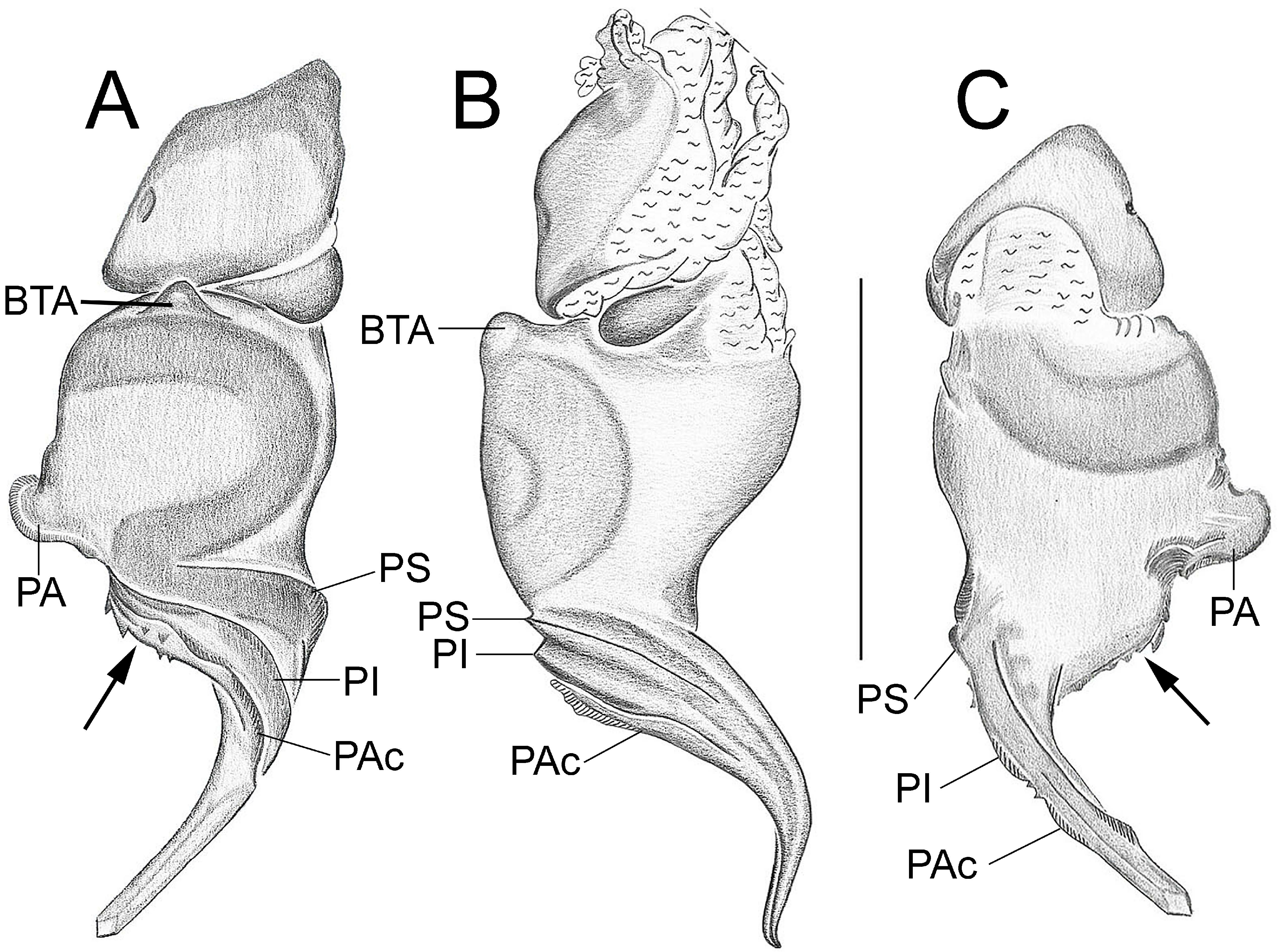
FIGURE 107. Actinopus crassipes (Keyserling, 1891), male: A–C MCN 30740: A. Copulatory bulb, prolateral; B. Copulatory bulb, dorsal; C. Copulatory bulb, retrolateral.PA-Paraembolic apophysis; BTA-Basal TegularApophysis; PAc-ProlateralAccessory keel; PI-Prolateral Inferior keel; PS-Prolateral Superior keel; Arrows: Serrated area. Scale line: 1 mm.
Imageimage/png© Miglio, Laura Tavares;Pérez-Miles, Fernando;Bonaldo, Alexandre B.Taxonomic Revision of the Spider Genus Actinopus Perty, 1833 (Araneae, Mygalomorphae, Actinopodidae)

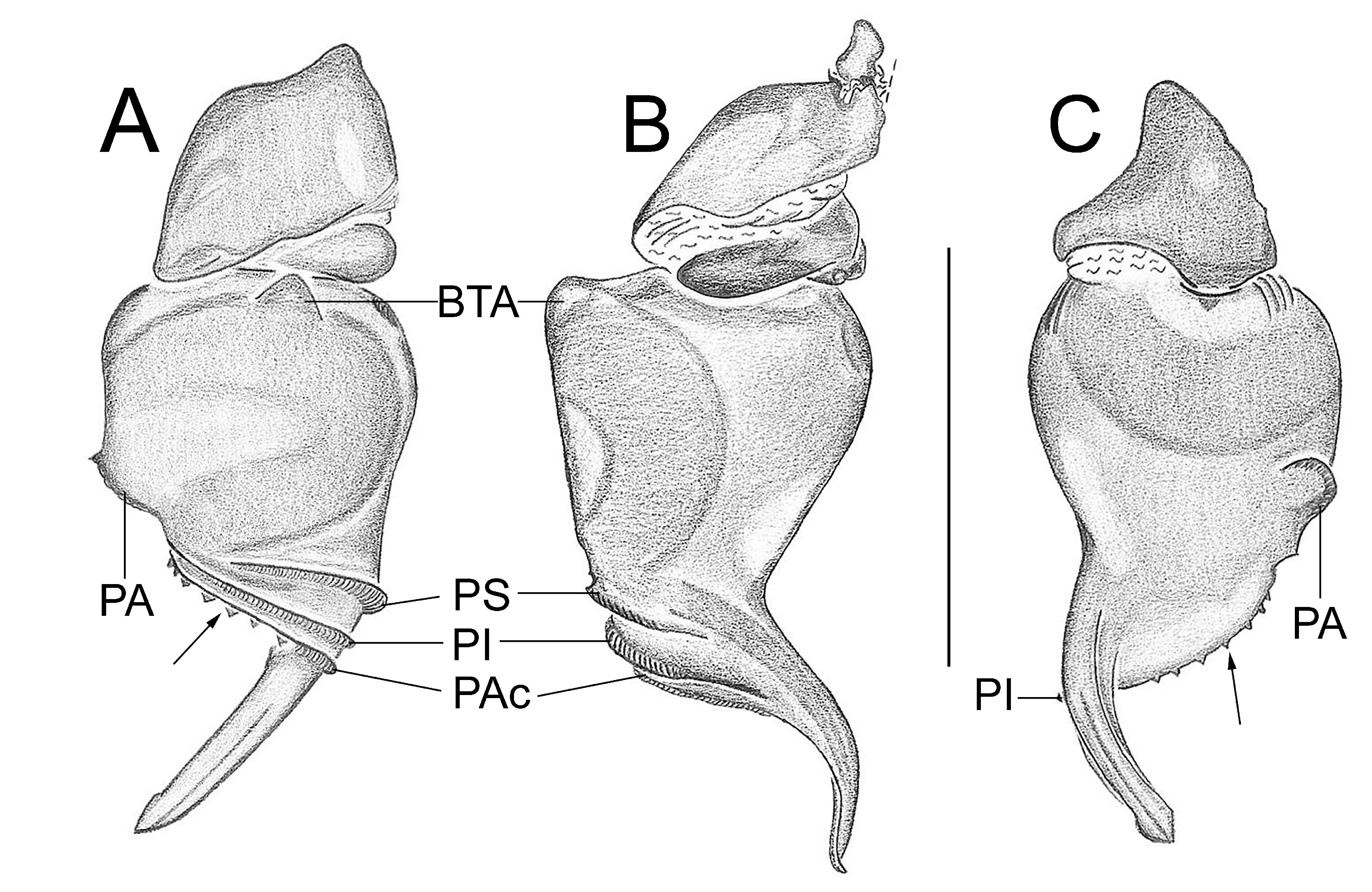
FIGURE 112 A–C. Actinopus dubiomaculatus Mello-Leit„o, 1923, male: A–C MZSP 7636: A. Copulatory bulb, prolateral; B. Copulatory bulb, dorsal; C. Copulatory bulb, retrolateral. PA-Paraembolic apophysis; BTA-Basal Tegular Apophysis; PAc- Prolateral Accessory keel; PI-Prolateral Inferior keel; PS-Prolateral Superior keel; Arrows: Serrated area. Scale line: 1 mm.
Imageimage/png© Miglio, Laura Tavares;Pérez-Miles, Fernando;Bonaldo, Alexandre B.Taxonomic Revision of the Spider Genus Actinopus Perty, 1833 (Araneae, Mygalomorphae, Actinopodidae)

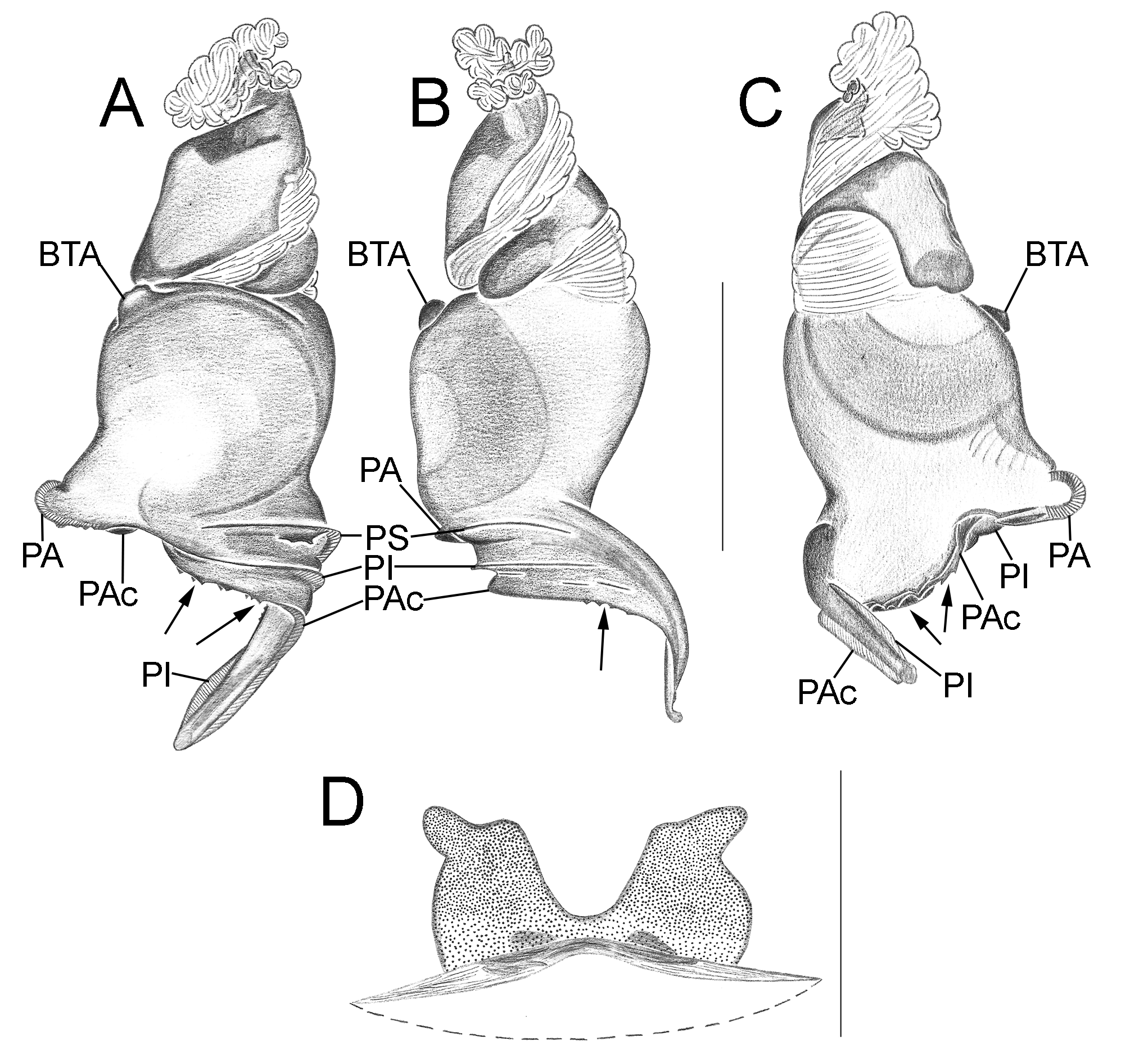
FIGURE 129. Actinopus laventana sp. nov., male: A–C LZI M135: A. Copulatory bulb, prolateral; B. Copulatory bulb, dorsal; C. Copulatory bulb, retrolateral. PA-Paraembolic apophysis; BTA-Basal Tegular Apophysis; PAc-Prolateral Accessory keel; PI- Prolateral Inferior keel; PS-Prolateral Superior keel; Arrows: Serrated area. Paratype, female: D FCE-MY 977: D. Spermathecae, dorsal view. Scales lines: 1 mm.

Imageimage/png© Miglio, Laura Tavares;Pérez-Miles, Fernando;Bonaldo, Alexandre B.Taxonomic Revision of the Spider Genus Actinopus Perty, 1833 (Araneae, Mygalomorphae, Actinopodidae)

IMAGES

Gallery(50)

See Gallery

Occurrences with images

CITATIONS

References(8)

  • 1

    CoL 2006

    current name sourceThe Interim Register of Marine and Nonmarine Genera
  • 2

    Hallan, J. (2000-2017). Biology Catalog (2012 version), http://bug.tamu.edu/research/collection/hallan/ (as at 2012).

    verified source for familyThe Interim Register of Marine and Nonmarine Genera
  • 3

    Neave, S. A. and successors. (1939-2004). Nomenclator Zoologicus, vols. 1-10 online. [developed by uBio, hosted online at MBLWHOI Library]. Previously at http://ubio.org/NomenclatorZoologicus/ (URL no longer current).

    name verified sourceThe Interim Register of Marine and Nonmarine Genera
  • 4

    Neave, S. A. and successors. (1939-2004). Nomenclator Zoologicus, vols. 1-10 online. [developed by uBio, hosted online at MBLWHOI Library]. Previously at http://ubio.org/NomenclatorZoologicus/ (URL no longer current).

    basis of recordThe Interim Register of Marine and Nonmarine Genera
  • 5

    Perty, M. (1830-1833). Delectus Animalium Articulatorum. Frid. Fleischer, Monachii. 224pp. (1-60: 1830; 61-124: 1832; 125-224: 1833).

    original descriptionThe Interim Register of Marine and Nonmarine Genera
  • Source Information

    GBIF Backbone Taxonomy

    GBIF Backbone Taxonomy

    checklist

    The GBIF Backbone Taxonomy is a single, synthetic management classification with the goal of covering all names GBIF is dealing with. It's the taxonomic backbone that allows GBIF to integrate name based information from different resources, no matter if these are occurrence datasets, species pages, names from nomenclators or external sources like EOL, Genbank or IUCN. This backbone allows taxonomic search, browse and reporting operations across all those resources in a consistent way and to provide means to crosswalk names from one source to another.

    It is updated regulary through an automated process in which the Catalogue of Life acts as a starting point also providing the complete higher classification above families. Additional scientific names only found in other authoritative nomenclatural and taxonomic datasets are then merged into the tree, thus extending the original catalogue and broadening the backbones name coverage. The GBIF Backbone taxonomy also includes identifiers for Operational Taxonomic Units (OTUs) drawn from the barcoding resources iBOL and UNITE.

    International Barcode of Life project (iBOL), Barcode Index Numbers (BINs). BINs are connected to a taxon name and its classification by taking into account all names applied to the BIN and picking names with at least 80% consensus. If there is no consensus of name at the species level, the selection process is repeated moving up the major Linnaean ranks until consensus is achieved.

    UNITE - Unified system for the DNA based fungal species, Species Hypotheses (SHs). SHs are connected to a taxon name and its classification based on the determination of the RefS (reference sequence) if present or the RepS (representative sequence). In the latter case, if there is no match in the UNITE taxonomy, the lowest rank with 100% consensus within the SH will be used.

    The GBIF Backbone Taxonomy is available for download at https://hosted-datasets.gbif.org/datasets/backbone/ in different formats together with an archive of all previous versions.

    The following 105 sources have been used to assemble the GBIF backbone with number of names given in brackets:

    • Catalogue of Life Checklist - 4766428 names
    • International Barcode of Life project (iBOL) Barcode Index Numbers (BINs) - 635951 names
    • UNITE - Unified system for the DNA based fungal species linked to the classification - 611208 names
    • The Paleobiology Database - 212054 names
    • World Register of Marine Species - 188857 names
    • The Interim Register of Marine and Nonmarine Genera - 183894 names
    • The World Checklist of Vascular Plants (WCVP) - 131891 names
    • GBIF Backbone Taxonomy - 114350 names
    • TAXREF - 109374 names
    • The Leipzig catalogue of vascular plants - 75380 names
    • ZooBank - 73549 names
    • Integrated Taxonomic Information System (ITIS) - 68377 names
    • Plazi.org taxonomic treatments database - 61346 names
    • Genome Taxonomy Database r207 - 60545 names
    • International Plant Names Index - 52329 names
    • Fauna Europaea - 45077 names
    • The National Checklist of Taiwan (Catalogue of Life in Taiwan, TaiCoL) - 36193 names
    • Dyntaxa. Svensk taxonomisk databas - 35892 names
    • The Plant List with literature - 32692 names
    • United Kingdom Species Inventory (UKSI) - 29643 names
    • Artsnavnebasen - 29208 names
    • The IUCN Red List of Threatened Species - 21221 names
    • Afromoths, online database of Afrotropical moth species (Lepidoptera) - 13961 names
    • Brazilian Flora 2020 project - Projeto Flora do Brasil 2020 - 13829 names
    • Prokaryotic Nomenclature Up-to-Date (PNU) - 10079 names
    • Checklist Dutch Species Register - Nederlands Soortenregister - 8814 names
    • ICTV Master Species List (MSL) - 7852 names
    • Cockroach Species File - 6020 names
    • GRIN Taxonomy - 5882 names
    • Taxon list of fungi and fungal-like organisms from Germany compiled by the DGfM - 4570 names
    • Catalogue of Afrotropical Bees - 3623 names
    • Catalogue of Tenebrionidae (Coleoptera) of North America - 3327 names
    • Checklist of Beetles (Coleoptera) of Canada and Alaska. Second Edition. - 3312 names
    • Systema Dipterorum - 2850 names
    • Catalogue of the Pterophoroidea of the World - 2807 names
    • The Clements Checklist - 2675 names
    • Taxon list of Hymenoptera from Germany compiled in the context of the GBOL project - 2496 names
    • IOC World Bird List, v13.2 - 2366 names
    • Official Lists and Indexes of Names in Zoology - 2310 names
    • National checklist of all species occurring in Denmark - 1922 names
    • Myriatrix - 1876 names
    • Database of Vascular Plants of Canada (VASCAN) - 1822 names
    • Taxon list of vascular plants from Bavaria, Germany compiled in the context of the BFL project - 1771 names
    • Orthoptera Species File - 1742 names
    • A list of the terrestrial fungi, flora and fauna of Madeira and Selvagens archipelagos - 1602 names
    • Aphid Species File - 1565 names
    • World Spider Catalog - 1561 names
    • Taxon list of Jurassic Pisces of the Tethys Palaeo-Environment compiled at the SNSB-JME - 1270 names
    • Backbone Family Classification Patch - 1143 names
    • GBIF Algae Classification - 1100 names
    • International Cichorieae Network (ICN): Cichorieae Portal - 975 names
    • Psocodea Species File - 803 names
    • New Zealand Marine Macroalgae Species Checklist - 787 names
    • Annotated checklist of endemic species from the Western Balkans - 754 names
    • Taxon list of animals with German names (worldwide) compiled at the SMNS - 503 names
    • Catalogue of the Alucitoidea of the World - 472 names
    • Lygaeoidea Species File - 462 names
    • Catálogo de Plantas y Líquenes de Colombia - 422 names
    • GBIF Backbone Patch - 317 names
    • Phasmida Species File - 259 names
    • Cortinariaceae fetched from the Index Fungorum API - 234 names
    • Coreoidea Species File - 233 names
    • GTDB supplement - 139 names
    • Mantodea Species File - 119 names
    • Endemic species in Taiwan - 93 names
    • Taxon list of Araneae from Germany compiled in the context of the GBOL project - 88 names
    • Species of Hominidae - 78 names
    • Taxon list of Sternorrhyncha from Germany compiled in the context of the GBOL project - 77 names
    • Taxon list of mosses from Germany compiled in the context of the GBOL project - 75 names
    • Mammal Species of the World - 73 names
    • Plecoptera Species File - 71 names
    • Species Fungorum Plus - 64 names
    • Catalogue of the type specimens of Cosmopterigidae (Lepidoptera: Gelechioidea) from research collections of the Zoological Institute, Russian Academy of Sciences - 47 names
    • Species named after famous people - 41 names
    • Dermaptera Species File - 36 names
    • Taxon list of Trichoptera from Germany compiled in the context of the GBOL project - 34 names
    • True Fruit Flies (Diptera, Tephritidae) of the Afrotropical Region - 33 names
    • Range and Regularities in the Distribution of Earthworms of the Earthworms of the USSR Fauna. Perel, 1979 - 32 names
    • Taxon list of Diplura from Germany compiled in the context of the GBOL project - 30 names
    • Lista de referencia de especies de aves de Colombia - 2022 - 24 names
    • Taxon list of Auchenorrhyncha from Germany compiled in the context of the GBOL project - 20 names
    • Catalogue of the type specimens of Polycestinae (Coleoptera: Buprestidae) from research collections of the Zoological Institute, Russian Academy of Sciences - 19 names
    • Taxon list of Thysanoptera from Germany compiled in the context of the GBOL project - 19 names
    • Lista de especies de vertebrados registrados en jurisdicción del Departamento del Huila - 18 names
    • Taxon list of Microcoryphia (Archaeognatha) from Germany compiled in the context of the GBOL project - 15 names
    • Catalogue of the type specimens of Bufonidae and Megophryidae (Amphibia: Anura) from research collections of the Zoological Institute, Russian Academy of Sciences - 12 names
    • Grylloblattodea Species File - 11 names
    • Coleorrhyncha Species File - 9 names
    • Taxon list of liverworts from Germany compiled in the context of the GBOL project - 9 names
    • Embioptera Species File - 7 names
    • Taxon list of Pisces and Cyclostoma from Germany compiled in the context of the GBOL project - 6 names
    • Taxon list of Pteridophyta from Germany compiled in the context of the GBOL project - 6 names
    • Taxon list of Siphonaptera from Germany compiled in the context of the GBOL project - 5 names
    • The Earthworms of the Fauna of Russia. Perel, 1997 - 5 names
    • Taxon list of Zygentoma from Germany compiled in the context of the GBOL project - 4 names
    • Asiloid Flies: new taxa of Diptera: Apioceridae, Asilidae, and Mydidae - 3 names
    • Taxon list of Protura from Germany compiled in the context of the GBOL project - 3 names
    • Taxon list of hornworts from Germany compiled in the context of the GBOL project - 2 names
    • Chrysididae Species File - 1 names
    • Taxon list of Dermaptera from Germany compiled in the context of the GBOL project - 1 names
    • Taxon list of Diplopoda from Germany in the context of the GBOL project - 1 names
    • Taxon list of Orthoptera (Grashoppers) from Germany compiled at the SNSB - 1 names
    • Taxon list of Pscoptera from Germany compiled in the context of the GBOL project - 1 names
    • Taxon list of Pseudoscorpiones from Germany compiled in the context of the GBOL project - 1 names
    • Taxon list of Raphidioptera from Germany compiled in the context of the GBOL project - 1 names

    GBIF Secretariat (2023). GBIF Backbone Taxonomy. Checklist dataset https://doi.org/10.15468/39omei accessed via GBIF.org on 2026-06-14.

    CC BYPublished 8/28/2023View dataset
    GBIF Usage Key
    2179712
    Dataset Key
    d7dddbf4-2cf0-4f39-9b2a-bb099caae36c
    Origin
    source
    Backbone Key
    2179712
    Taxon ID
    gbif:2179712
    Last Crawled
    8/22/2023
    Last Interpreted
    8/22/2023