
AnimaliaNot EvaluatedacceptedspeciesAccepted
Dignathodon microcephalus

Dignathodon microcephalus

Dignathodon à petite tête(+1)·Lucas, 1846

GBIF:2233024

0countries
0datasets
0year

0

Descendants

0

Synonyms

0

Children

PROFILE

Species Profile

Characteristics

Extant

ABOUT

Descriptions(16)

RÉPARTITION ET HABITAT. — Cette espèce est assez largement répartie en Europe méridionale jusqu’au Proche- et Moyen-Orient; au nord, elle remonte jusqu’en Autriche (Attems & Würmli 1972). En France, D. microcephalus n’était connu quasiment que dans des départements du pourtour méditerranéen (Brölemann 1930; Iorio & Berg 2007; Iorio 2008, 2014; Zapparoli & Iorio 2012) et considéré comme xérophile (Geoffroy & Iorio 2009), ce qui est assez rare chez les chilopodes. Nous l’avons trouvé dans les Hautes-Alpes (Réotier (05), en lisière rocailleuse de pinèdes et d’une pelouse xérophile, 950 m, 44,677208 N, 6,602819 E, 28. VII. 2010, réc. / dét. EI; La Roche de Rame (05), Chapelle de Rame, en lisière pierreuse de pelouses sèches, 930 m, 44,741501 N, 6,575972 E, 20. IV. 2011, réc. / dét. EI). Dans les Alpes-Maritimes (Iorio 2008; présent travail), cette espèce est citée en garrigue (une station), en lisière d’une pelouse et de conifères (une station), dans une forêt à dominante de châtaigniers (une station), dans le parc d’un château (une station) et « de préférence dans les terrains secs » par Caziot (1925). Généralement, elle vit de 0 à 1200 mètres d’altitude (Minelli & Iovane 1987; Iorio 2014).
Les myriapodes chilopodes (Chilopoda) du Parc national du Mercantour, du département des Alpes-Maritimes et de leurs environs: description d’une nouvelle espèce du genre Lithobius Leach, 1814 s. s., synthèse des connaissances et espèces menacées
LOCALITÉ TYPE. — Algérie, environs d’Oran, d’Alger, de Philippeville et du cercle de La Calle. MATÉRIEL EXAMINÉ. — Allos (04), PNM, 11 - 17. VI. 1899, réc. HWB / dét. EI: 1 ♂ à 71 pp; Beuil (06), PNM, Les Launes, conifères et lisière pelouse, 1600 m, 7. VI. 2008, réc. / dét. EI: 1 ♂ à 73 pp; Nice (06), parc de la Colline du Château, 18. XI. 2011, réc. JML / dét. EI: 1 ♂ à 71 pp. Spécimens conservés en éthanol à 70 ° dans la collection personnelle de l’auteur (EI).
Les myriapodes chilopodes (Chilopoda) du Parc national du Mercantour, du département des Alpes-Maritimes et de leurs environs: description d’une nouvelle espèce du genre Lithobius Leach, 1814 s. s., synthèse des connaissances et espèces menacées
SPAIN: Guadalupe, 1 ♀, 1 ♂ (PD G 5001).
Revision of the Neotropical species of Aphilodontinae (Geophilomorpha, Geophilidae), with eight new species and a first phylogenetic analysis of the subfamily

19. Dignathodon microcephalus (Lucas, 1846)

Dignathodon microcephalum [sic] Lucas: Léger and Duboscq 1903: 311. (1)

Dignathodon microcephalum [sic] Luc.: Verhoeff 1925a: 655. (2)

Dignathodon clavigerum Verhoeff 1943: 12, fig. 14. (3)

Dignathodon clavigerum Verh.: Attems 1947: 138. (4)

Dignathodon microcephalum [sic] (Lucas, 1846): Minelli 1978: 159. (5)

Dignathodon microcephalus (Lucas, 1846): Foddai et al. 1996: 361, Tab. I. (6)

Dignathodon microcephalus (Lucas, 1846): Geoffroy and Iorio 2009: 682. (7)

Literature records.

General. Sardinia-Corsica (5). Corsica (2, 6, 7). Epigeic. Corse-du-Sud, 2A - Ajaccio (1) [I]. Haute-Corse, 2B - Bastia (1) [I]. Corte (1) [I]. Marine de Sisco, "nahe dem Meer" (3, 4, loc. typ. of Dignathodon clavigerum Verhoeff, 1943) [I]. Giraglia Is. (5) [I].

Material examined.

Epigeic. Corse-du-Sud, 2A - N Ajaccio, Golfe de Lava, 10-200 m, (code 74-6): 28.IX.1974, KT, 1 ♂ 77 lp MZ det. (NHMW) [I]. Haute-Corse, 2B - Patrimonio: 26.XI.1967, PB, 1 ♂ 79 lp EI det. (MNHN) [I].

General distribution.

Europe: Albania, Austria, Bosnia and Herzegovina, Bulgaria, Croatia, Czech Republic, France (mainland, Corsica), Greece (mainland, insular including Crete), Italy (mainland, Sicily, Sardinia), Luxembourg (introduced?), Montenegro, Portugal, Romania, Serbia, Slovak Republic, Spain (mainland, Balearic Is.), Ukraine (Crimea); North Africa: Algeria, Morocco, Tunisia; West Asia: Jordan, Israel, Syria, Turkey.

Chorotype.

Mediterranean.

Ecological notes.

10-200 m; thermophilous species, recorded only from localities in the Mesomediterranean belt; common in Mediterranean habitats (Minelli and Iovane 1987, Zapparoli 2002, 2006, 2009). There are no records for the habitat preferences of the local populations except for that of Verhoeff (1942), "nahe dem Meer".

Remarks.

The synonymy of Dignathodon clavigerum with this species is according to Minelli (2006).

The centipedes (Chilopoda) of Corsica: catalogue of species with faunistic, zoogeographical and ecological remarksPensoft via PlaziNo known copyright restrictions apply. See Agosti, D., Egloff, W., 2009. Taxonomic information exchange and copyright: the Plazi approach. BMC Research Notes 2009, 2:53 for further explanation.
Remarks. This is the fourth record of the species in the country, and the first one outside the Black sea — Sakar area (Stoev 2002).
New records of millipedes and centipedes from Bulgaria, with an annotated checklist of the Bulgarian myriapods
Material examined (NMNHS): 2 ♂♂, Pirin Mts., Goleshevo village, N 41.255683, E 23.352698, 800 – 1000 m alt., 18. VI. 1988, leg. P. Beron, det. PS.
New records of millipedes and centipedes from Bulgaria, with an annotated checklist of the Bulgarian myriapods

19. Dignathodon microcephalus (Lucas, 1846)

Dignathodon microcephalum [sic] Lucas: Léger and Duboscq 1903: 311. (1)

Dignathodon microcephalum [sic] Luc.: Verhoeff 1925a: 655. (2)

Dignathodon clavigerum Verhoeff 1943: 12, fig. 14. (3)

Dignathodon clavigerum Verh.: Attems 1947: 138. (4)

Dignathodon microcephalum [sic] (Lucas, 1846): Minelli 1978: 159. (5)

Dignathodon microcephalus (Lucas, 1846): Foddai et al. 1996: 361, Tab. I. (6)

Dignathodon microcephalus (Lucas, 1846): Geoffroy and Iorio 2009: 682. (7)

Literature records.

General. Sardinia-Corsica (5). Corsica (2, 6, 7). Epigeic. Corse-du-Sud, 2A - Ajaccio (1) [I]. Haute-Corse, 2B - Bastia (1) [I]. Corte (1) [I]. Marine de Sisco, "nahe dem Meer" (3, 4, loc. typ. of Dignathodon clavigerum Verhoeff, 1943) [I]. Giraglia Is. (5) [I].

Material examined.

Epigeic. Corse-du-Sud, 2A - N Ajaccio, Golfe de Lava, 10-200 m, (code 74-6): 28.IX.1974, KT, 1 ♂ 77 lp MZ det. (NHMW) [I]. Haute-Corse, 2B - Patrimonio: 26.XI.1967, PB, 1 ♂ 79 lp EI det. (MNHN) [I].

General distribution.

Europe: Albania, Austria, Bosnia and Herzegovina, Bulgaria, Croatia, Czech Republic, France (mainland, Corsica), Greece (mainland, insular including Crete), Italy (mainland, Sicily, Sardinia), Luxembourg (introduced?), Montenegro, Portugal, Romania, Serbia, Slovak Republic, Spain (mainland, Balearic Is.), Ukraine (Crimea); North Africa: Algeria, Morocco, Tunisia; West Asia: Jordan, Israel, Syria, Turkey.

Chorotype.

Mediterranean.

Ecological notes.

10-200 m; thermophilous species, recorded only from localities in the Mesomediterranean belt; common in Mediterranean habitats (Minelli and Iovane 1987, Zapparoli 2002, 2006, 2009). There are no records for the habitat preferences of the local populations except for that of Verhoeff (1942), "nahe dem Meer".

Remarks.

The synonymy of Dignathodon clavigerum with this species is according to Minelli (2006).

The centipedes (Chilopoda) of Corsica: catalogue of species with faunistic, zoogeographical and ecological remarksPensoft via PlaziNo known copyright restrictions apply. See Agosti, D., Egloff, W., 2009. Taxonomic information exchange and copyright: the Plazi approach. BMC Research Notes 2009, 2:53 for further explanation.
Ecological notes. Generally 0 – 900, one record from Mt Parnasus, 2200 – 2400 m, needs to be confirmed (Zapparoli 2002); a thermophilous species, generally in phrygana and in open Mediterranean habitats; few records from caves (Chamberlin 1956; Matic et al. 1968; Zapparoli 1994, 1996).
The centipedes of Peloponnisos and first records of genus Eurygeophilus in the East Mediterranean (Myriapoda: Chilopoda)
General distribution. Europe: Albania, Austria, Bosnia Herzegovina, Bulgaria, Croatia, Czech Republic, France (incl. Corsica), Greece (incl. Crete), Italy (incl. Sardinia and Sicily), Luxembourg, Montenegro, Portugal, Romania, Serbia, Slovakia, Spain (incl. Balearic Is.), Ukraine. West Asia: Jordan, Israel, Syria, Turkey. North Africa: Algeria, Morocco, Tunisia (Zapparoli 2002; Minelli et al. 2006). Chorotype. Mediterranean (MED).
The centipedes of Peloponnisos and first records of genus Eurygeophilus in the East Mediterranean (Myriapoda: Chilopoda)
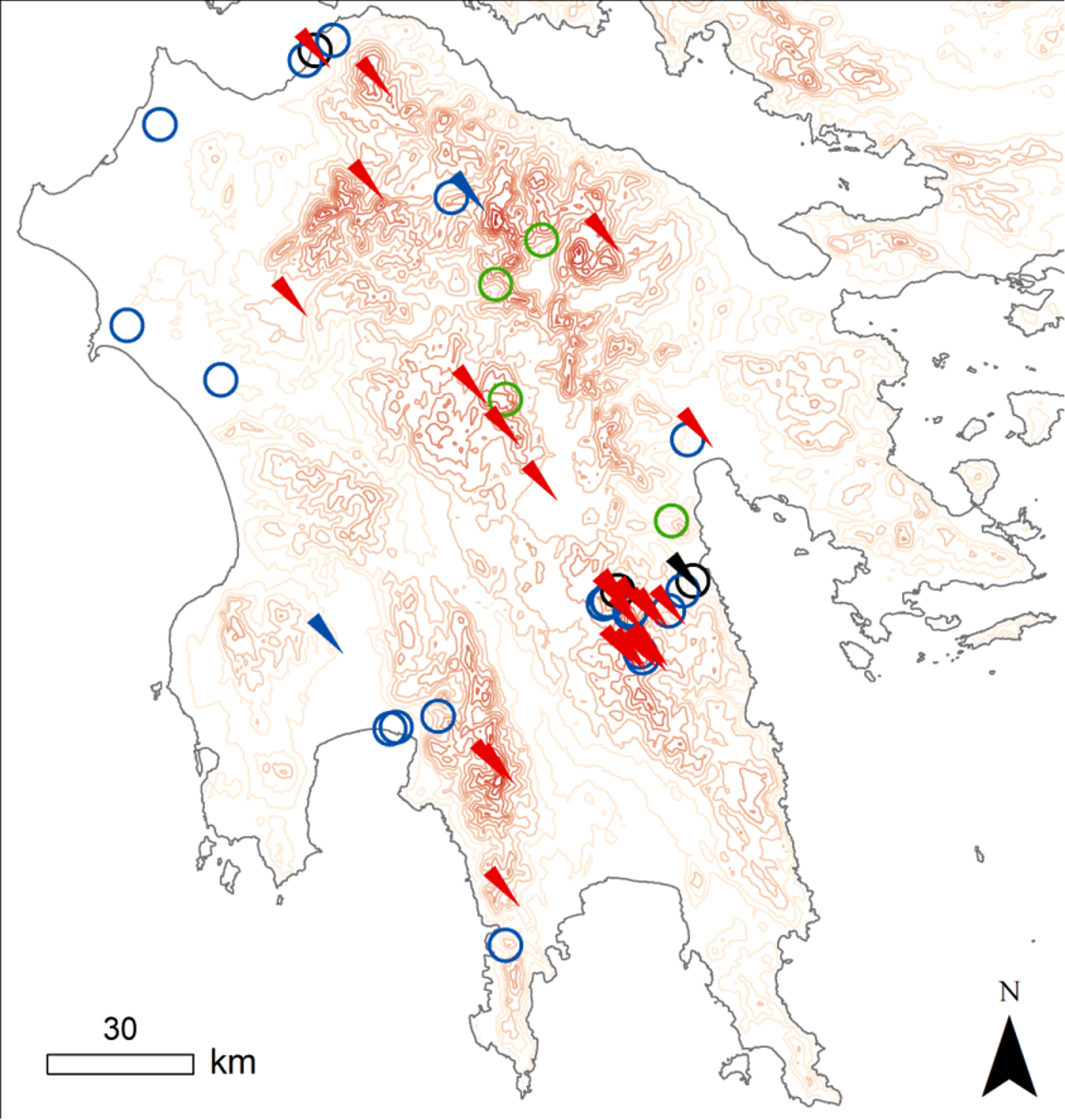
Records in Peloponnisos (2) (Fig. 11). Ahaia: Patra (1, 3, 4). New records from Mt. Parnonas (Fig. 11). 1 ex., Arkadia, Moni Panagias Malevis (loc. 11), 880 m, N 37.328907 / E 22.572301, 27 Oct. 2014; 1 ex., Arkadia, Neochori to Agios Charalampos church, phrygana (loc. 30), 50 m, N 37.361966 / E 22.741903, 31 Oct. 2014.
The centipedes of Peloponnisos and first records of genus Eurygeophilus in the East Mediterranean (Myriapoda: Chilopoda)
1) Geophilus crassicauda A. Costa 1883: 81, 105. 2) Geophilus crassicauda: A. Costa 1884 a: 340. 3) Dignathodon microcephalum (Luc.) Mein.: Berlese 1888 c: 1. 4) Dignathodon microcephalum (Lucas): Silvestri 1898: 685. 5) Dignathodon microcephalum Lucas [sic]: Attems 1903: 273. 6) Dignathodon microcephalum Luc. [sic]: Verhoeff 1925 a: 655. 7) Dignathodon microcephalum Luc. [sic]: Attems 1949: 110. 8) Dignathodon microcephalum (Lucas, 1846): Minelli 1978 a: 159. 9) Dignathodon microcephalus (Lucas, 1846): Minelli 1983 a: 10. 10) Geophilus crassicauda A. Costa, 1888 [sic]: Minelli 1983 b: 402. 11) Dignathodon microcephalus Lucas 1846 [sic]: Minelli 1983 b: 407. 12) Dignathodon microcephalus: Minelli & Iovane 1987: 28, 30. 13) Dignathodon microcephalus (Lucas, 1846): Minelli et al. 1994: 494. 14) Dignathodon microcephalus (Lucas, 1846): Foddai et al. 1995: 8. 15) Dignathodon microcephalus (Lucas, 1846): Foddai et al. 1996: 361, tab. I. 16) Dignathodon microcephalus (Lucas, 1846): Zapparoli & Minelli 2005: CD.
An annotated catalogue of the epigeic and cave centipedes (Chilopoda) of Sardinia *
Taxonomic and nomenclatural notes. Dignathodon pachypus Verhoeff, 1943 is recognized here as a junior synonym of Dignathodon microcephalus (Lucas, 1846) (new syn.). The taxonomic distinction of D. pachypus had been already doubted by Minelli (1982), nevertheless the name was applied unwarrantedly to specimens found in Crete and Cyprus (Simaiakis et al. 2 006). After re-assessing all the information provided by Verhoeff (1943, 1951) on the morphology of D. pachypus, and after examining specimens collected close to the type locality of D. pachypus, we can not confirm any of the putative differences described between D. pachypus and D. microcephalus, including shape and elongation of the first and terminal articles of the antennae, shape of the anterior margin of the forcipular coxosternite, direction of denticles on the forcipules, degree of swelling and elongation of the articles of the ultimate legs, evidence of the articulations between the tarsal articles of the ultimate legs, and degree of reduction of the ultimate claws. Within geophilomorphs, most of these characters are known to be affected by individual variation and therefore are not currently given any taxonomic significance. Moreover, the characters referring to the ultimate legs are known to be variable in D. microcephalus throughout most of its range, as acknowledged by the same Verhoeff (1943).
Diversity and biogeography of Israeli geophilomorph centipedes (Chilopoda: Geophilomorpha)
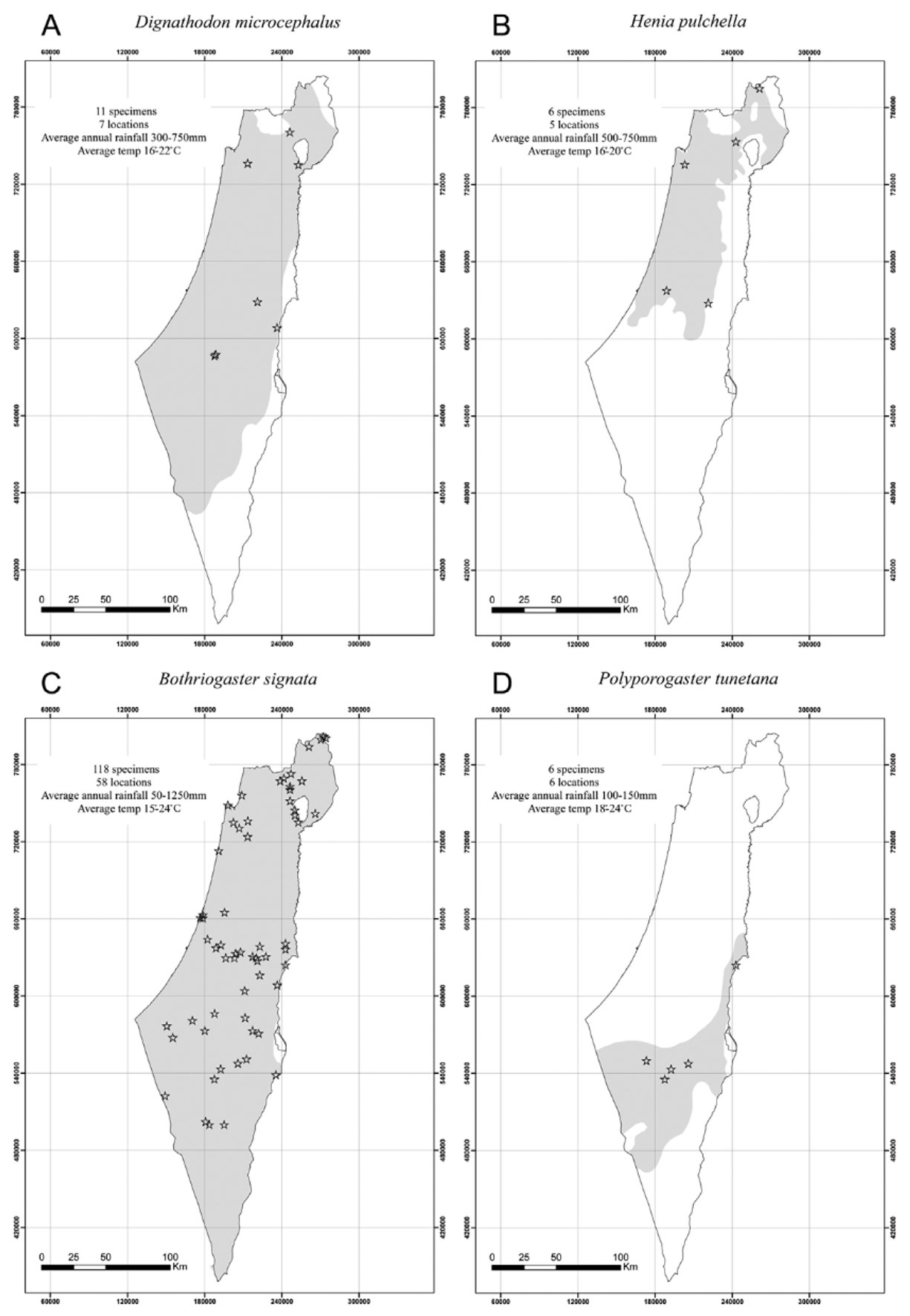
Distribution in Israel: most specimens are from Mediterranean regions ranging from the Judean plains to the Lower Galilee, with average annual temperatures ranging from 16 – 22 ˚ C and annual precipitation between 300 – 750 mm. A published record from near the Dead Sea in 1890 (Porat 1893) is from an extreme desert habitat and requires confirmation (Figure 2 A). Global Distribution: the species is widespread around the Mediterranean Sea, both in continental lands and islands.
Diversity and biogeography of Israeli geophilomorph centipedes (Chilopoda: Geophilomorpha)
New records: Eshkolot check point, East of Lahav (2 specimens 2012); Jerusalem-Talpiot (3 specimens 1957); Lahav (1 specimen 1964); Upper Nahal ‘ Amud (2 specimens 2011).
Diversity and biogeography of Israeli geophilomorph centipedes (Chilopoda: Geophilomorpha)
General distribution. Europe: Albania, Austria, Bosnia and Herzegovina, Bulgaria, Croatia, Czech Republic, France (mainland, Corsica), Greece (mainland, Crete, Cyclades, Dodecanese), Italy (mainland, Sicily, Sardinia), Luxembourg (introduced?), Montenegro, Portugal, Romania, Serbia, Slovak Republic, Spain (mainland, Balearic Isl.), Ukraine (Crimea); North Africa: Algeria, Morocco, Tunisia; West Asia: Cyprus, Israel, Jordan, Syria, Turkey (Brölemann 1921, 1930, 1932; Attems 1929; Machado 1952; Dobroruka 1956; Matic 1972; Negrea & Matic 1973; Zapparoli 1991, 1995, 1999; Kos 1992; Foddai et al. 1995, 1996; Stoev 1997; Simaiakis et al. 2005). Chorotype. Mediterranean. Habitats. Phryganic formations, fields with Ceratonia, pastures, patches with Pinus. Altitudinal range: 20 – 1000 m. Range of leg pairs recorded in Cyprus. 67 – 75 (3) and 73 – 77 (ƤƤ).
The centipede fauna (Chilopoda) of the island of Cyprus, with one new lithobiomorph species
Material examined: 10 3, 10 ƤƤ. Sites: 32, 55, 78, 79, 121, 146 (Fig. 17).
The centipede fauna (Chilopoda) of the island of Cyprus, with one new lithobiomorph species

Export occurrence data

Darwin Core Archive (ZIP)

GEOGRAPHY

Distribution Map

Occurrence Map

Loading map…

Tiles © GBIF Maps API | Map powered by MapLibre GL

REGIONS

Geographic Distribution(5)

Africa
North Africa
native
South Europe
native
South Europe
native
North Africa
native

DATA

Occurrence Datasets

Loading datasets…

Common names used for this species across different languages and regions. From 1 country.

FRDignathodon à petite têtefrafraDignathodon à petite têtefra

Vernacular (common) names are the everyday names used for a species in different languages and regions. A single species may have dozens of common names worldwide.

FRDignathodon à petite tête
fraFRfra
fraDignathodon à petite tête
fra
Source: Catalogue of LifeSource taxon #296400452

CLASSIFICATION

Taxonomic Classification Tree

HIERARCHY

Child Taxa(1)

MULTIMEDIA

Media Files(3)

FIGURE 11. Dignathodon microcephalum (black circle), Henia athenarum (green circles), H. devia (blue circles), H. illyrica (red arrows), H. bicarinata (blue arrows) and H. pulchella (black arrow), distribution records in Peloponnisos.
Imageimage/png© Simaiakis, Stylianos Michail;Akkari, Nesrine;Zapparoli, MarzioThe centipedes of Peloponnisos and first records of genus Eurygeophilus in the East Mediterranean (Myriapoda: Chilopoda)

FIGURE 2. Sampling locations and presumptive distribution sites for members of the Dignathodontidae and Himantariidae. A) Dignathodon microcephalus. B) Henia pulchella. D) Bothriogaster signata. D) Polyporogaster tunetana.

Imageimage/png© Chipman, Ariel D.;Dor, Neta;Bonato, LucioDiversity and biogeography of Israeli geophilomorph centipedes (Chilopoda: Geophilomorpha)

FIGURE 17. Dignathodon microcephalus and Henia bicarinata, distribution in Cyprus.

Imageimage/png© Simaiakis, Stylianos Michail;Zapparoli, Marzio;Minelli, Alessandro;Bonato, LucioThe centipede fauna (Chilopoda) of the island of Cyprus, with one new lithobiomorph species

IMAGES

Gallery(3)

See Gallery

Occurrences with images

Source Information

GBIF Backbone Taxonomy

GBIF Backbone Taxonomy

checklist

The GBIF Backbone Taxonomy is a single, synthetic management classification with the goal of covering all names GBIF is dealing with. It's the taxonomic backbone that allows GBIF to integrate name based information from different resources, no matter if these are occurrence datasets, species pages, names from nomenclators or external sources like EOL, Genbank or IUCN. This backbone allows taxonomic search, browse and reporting operations across all those resources in a consistent way and to provide means to crosswalk names from one source to another.

It is updated regulary through an automated process in which the Catalogue of Life acts as a starting point also providing the complete higher classification above families. Additional scientific names only found in other authoritative nomenclatural and taxonomic datasets are then merged into the tree, thus extending the original catalogue and broadening the backbones name coverage. The GBIF Backbone taxonomy also includes identifiers for Operational Taxonomic Units (OTUs) drawn from the barcoding resources iBOL and UNITE.

International Barcode of Life project (iBOL), Barcode Index Numbers (BINs). BINs are connected to a taxon name and its classification by taking into account all names applied to the BIN and picking names with at least 80% consensus. If there is no consensus of name at the species level, the selection process is repeated moving up the major Linnaean ranks until consensus is achieved.

UNITE - Unified system for the DNA based fungal species, Species Hypotheses (SHs). SHs are connected to a taxon name and its classification based on the determination of the RefS (reference sequence) if present or the RepS (representative sequence). In the latter case, if there is no match in the UNITE taxonomy, the lowest rank with 100% consensus within the SH will be used.

The GBIF Backbone Taxonomy is available for download at https://hosted-datasets.gbif.org/datasets/backbone/ in different formats together with an archive of all previous versions.

The following 105 sources have been used to assemble the GBIF backbone with number of names given in brackets:

  • Catalogue of Life Checklist - 4766428 names
  • International Barcode of Life project (iBOL) Barcode Index Numbers (BINs) - 635951 names
  • UNITE - Unified system for the DNA based fungal species linked to the classification - 611208 names
  • The Paleobiology Database - 212054 names
  • World Register of Marine Species - 188857 names
  • The Interim Register of Marine and Nonmarine Genera - 183894 names
  • The World Checklist of Vascular Plants (WCVP) - 131891 names
  • GBIF Backbone Taxonomy - 114350 names
  • TAXREF - 109374 names
  • The Leipzig catalogue of vascular plants - 75380 names
  • ZooBank - 73549 names
  • Integrated Taxonomic Information System (ITIS) - 68377 names
  • Plazi.org taxonomic treatments database - 61346 names
  • Genome Taxonomy Database r207 - 60545 names
  • International Plant Names Index - 52329 names
  • Fauna Europaea - 45077 names
  • The National Checklist of Taiwan (Catalogue of Life in Taiwan, TaiCoL) - 36193 names
  • Dyntaxa. Svensk taxonomisk databas - 35892 names
  • The Plant List with literature - 32692 names
  • United Kingdom Species Inventory (UKSI) - 29643 names
  • Artsnavnebasen - 29208 names
  • The IUCN Red List of Threatened Species - 21221 names
  • Afromoths, online database of Afrotropical moth species (Lepidoptera) - 13961 names
  • Brazilian Flora 2020 project - Projeto Flora do Brasil 2020 - 13829 names
  • Prokaryotic Nomenclature Up-to-Date (PNU) - 10079 names
  • Checklist Dutch Species Register - Nederlands Soortenregister - 8814 names
  • ICTV Master Species List (MSL) - 7852 names
  • Cockroach Species File - 6020 names
  • GRIN Taxonomy - 5882 names
  • Taxon list of fungi and fungal-like organisms from Germany compiled by the DGfM - 4570 names
  • Catalogue of Afrotropical Bees - 3623 names
  • Catalogue of Tenebrionidae (Coleoptera) of North America - 3327 names
  • Checklist of Beetles (Coleoptera) of Canada and Alaska. Second Edition. - 3312 names
  • Systema Dipterorum - 2850 names
  • Catalogue of the Pterophoroidea of the World - 2807 names
  • The Clements Checklist - 2675 names
  • Taxon list of Hymenoptera from Germany compiled in the context of the GBOL project - 2496 names
  • IOC World Bird List, v13.2 - 2366 names
  • Official Lists and Indexes of Names in Zoology - 2310 names
  • National checklist of all species occurring in Denmark - 1922 names
  • Myriatrix - 1876 names
  • Database of Vascular Plants of Canada (VASCAN) - 1822 names
  • Taxon list of vascular plants from Bavaria, Germany compiled in the context of the BFL project - 1771 names
  • Orthoptera Species File - 1742 names
  • A list of the terrestrial fungi, flora and fauna of Madeira and Selvagens archipelagos - 1602 names
  • Aphid Species File - 1565 names
  • World Spider Catalog - 1561 names
  • Taxon list of Jurassic Pisces of the Tethys Palaeo-Environment compiled at the SNSB-JME - 1270 names
  • Backbone Family Classification Patch - 1143 names
  • GBIF Algae Classification - 1100 names
  • International Cichorieae Network (ICN): Cichorieae Portal - 975 names
  • Psocodea Species File - 803 names
  • New Zealand Marine Macroalgae Species Checklist - 787 names
  • Annotated checklist of endemic species from the Western Balkans - 754 names
  • Taxon list of animals with German names (worldwide) compiled at the SMNS - 503 names
  • Catalogue of the Alucitoidea of the World - 472 names
  • Lygaeoidea Species File - 462 names
  • Catálogo de Plantas y Líquenes de Colombia - 422 names
  • GBIF Backbone Patch - 317 names
  • Phasmida Species File - 259 names
  • Cortinariaceae fetched from the Index Fungorum API - 234 names
  • Coreoidea Species File - 233 names
  • GTDB supplement - 139 names
  • Mantodea Species File - 119 names
  • Endemic species in Taiwan - 93 names
  • Taxon list of Araneae from Germany compiled in the context of the GBOL project - 88 names
  • Species of Hominidae - 78 names
  • Taxon list of Sternorrhyncha from Germany compiled in the context of the GBOL project - 77 names
  • Taxon list of mosses from Germany compiled in the context of the GBOL project - 75 names
  • Mammal Species of the World - 73 names
  • Plecoptera Species File - 71 names
  • Species Fungorum Plus - 64 names
  • Catalogue of the type specimens of Cosmopterigidae (Lepidoptera: Gelechioidea) from research collections of the Zoological Institute, Russian Academy of Sciences - 47 names
  • Species named after famous people - 41 names
  • Dermaptera Species File - 36 names
  • Taxon list of Trichoptera from Germany compiled in the context of the GBOL project - 34 names
  • True Fruit Flies (Diptera, Tephritidae) of the Afrotropical Region - 33 names
  • Range and Regularities in the Distribution of Earthworms of the Earthworms of the USSR Fauna. Perel, 1979 - 32 names
  • Taxon list of Diplura from Germany compiled in the context of the GBOL project - 30 names
  • Lista de referencia de especies de aves de Colombia - 2022 - 24 names
  • Taxon list of Auchenorrhyncha from Germany compiled in the context of the GBOL project - 20 names
  • Catalogue of the type specimens of Polycestinae (Coleoptera: Buprestidae) from research collections of the Zoological Institute, Russian Academy of Sciences - 19 names
  • Taxon list of Thysanoptera from Germany compiled in the context of the GBOL project - 19 names
  • Lista de especies de vertebrados registrados en jurisdicción del Departamento del Huila - 18 names
  • Taxon list of Microcoryphia (Archaeognatha) from Germany compiled in the context of the GBOL project - 15 names
  • Catalogue of the type specimens of Bufonidae and Megophryidae (Amphibia: Anura) from research collections of the Zoological Institute, Russian Academy of Sciences - 12 names
  • Grylloblattodea Species File - 11 names
  • Coleorrhyncha Species File - 9 names
  • Taxon list of liverworts from Germany compiled in the context of the GBOL project - 9 names
  • Embioptera Species File - 7 names
  • Taxon list of Pisces and Cyclostoma from Germany compiled in the context of the GBOL project - 6 names
  • Taxon list of Pteridophyta from Germany compiled in the context of the GBOL project - 6 names
  • Taxon list of Siphonaptera from Germany compiled in the context of the GBOL project - 5 names
  • The Earthworms of the Fauna of Russia. Perel, 1997 - 5 names
  • Taxon list of Zygentoma from Germany compiled in the context of the GBOL project - 4 names
  • Asiloid Flies: new taxa of Diptera: Apioceridae, Asilidae, and Mydidae - 3 names
  • Taxon list of Protura from Germany compiled in the context of the GBOL project - 3 names
  • Taxon list of hornworts from Germany compiled in the context of the GBOL project - 2 names
  • Chrysididae Species File - 1 names
  • Taxon list of Dermaptera from Germany compiled in the context of the GBOL project - 1 names
  • Taxon list of Diplopoda from Germany in the context of the GBOL project - 1 names
  • Taxon list of Orthoptera (Grashoppers) from Germany compiled at the SNSB - 1 names
  • Taxon list of Pscoptera from Germany compiled in the context of the GBOL project - 1 names
  • Taxon list of Pseudoscorpiones from Germany compiled in the context of the GBOL project - 1 names
  • Taxon list of Raphidioptera from Germany compiled in the context of the GBOL project - 1 names

GBIF Secretariat (2023). GBIF Backbone Taxonomy. Checklist dataset https://doi.org/10.15468/39omei accessed via GBIF.org on 2026-06-14.

CC BYPublished 8/28/2023View dataset
GBIF Usage Key
2233024
Dataset Key
d7dddbf4-2cf0-4f39-9b2a-bb099caae36c
Origin
source
Backbone Key
2233024
Taxon ID
gbif:2233024
Last Crawled
8/22/2023
Last Interpreted
8/22/2023