AnimaliaNot EvaluatedacceptedspeciesAcceptedRestricted
Arachnopathes ericoides

Arachnopathes ericoides

(Pallas, 1766)

GBIF:2258339

0countries
0year

0

Synonyms

PROFILE

Species Profile

Habitat

Marine

Characteristics

Extant

ABOUT

Descriptions(4)

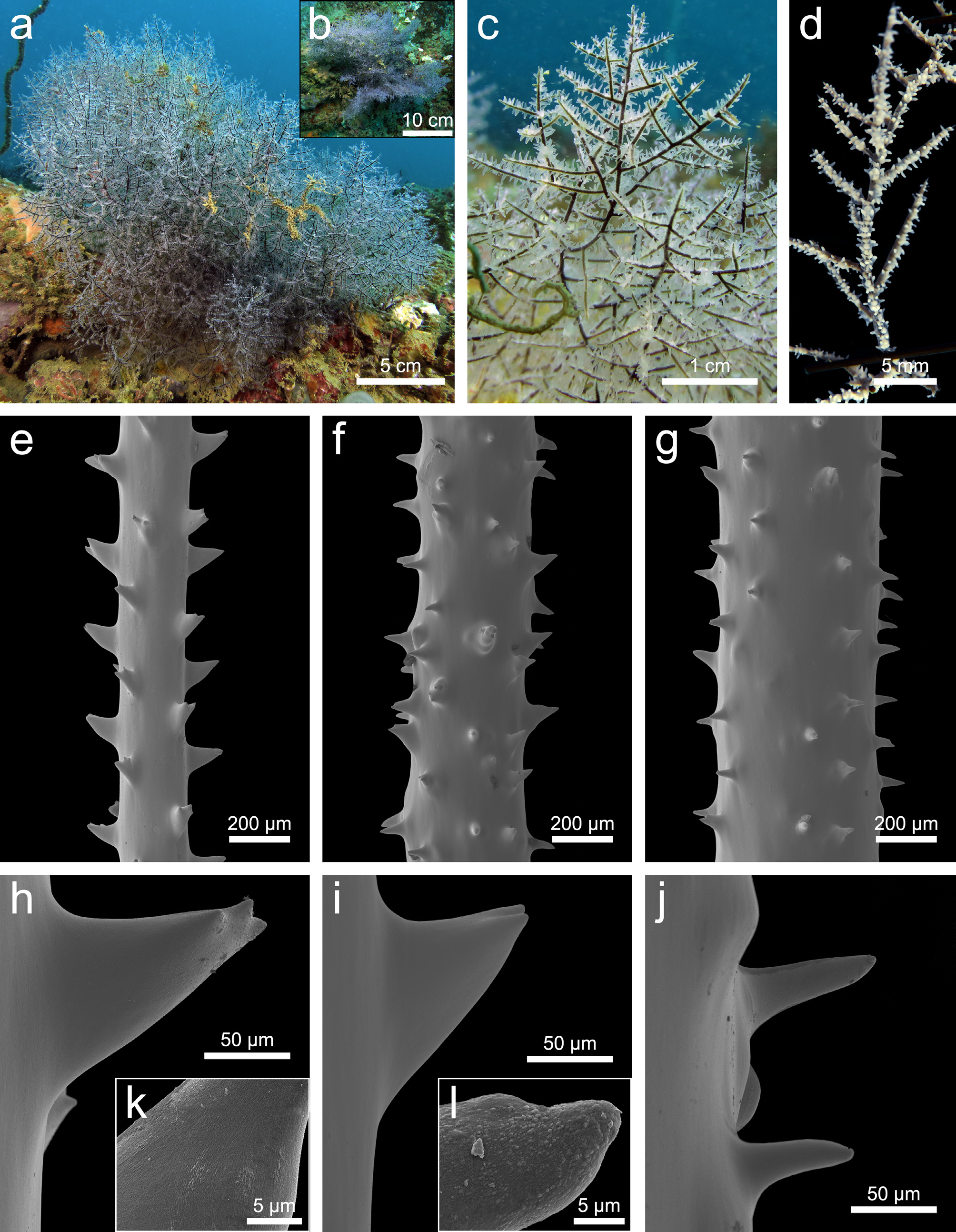
Description. A branched, bushy and highly anastomosed colony measuring 25 cm in width and 20 cm in height, with basal diameter of 4 mm (Fig. 13, a), but larger colonies up to 40 cm in height can be found. The colony forms distinct thick masses of branches when seen from the top (Fig. 13, b). When lower thick branches are close to the substrate, they can form new basal plates. The basal part of the colony shows highly anastomosed, curved thick branches that arise from the main stem. Adjacent branches and branchlets tend to fuse together in a flabellate shape, and then the flabellate parts are fused together by the branchlets sitting out of the plane. This branching pattern is less visible in large colonies where the fusions are numerous, but rather seen in young, small colonies. The diameter of the branches and branchlets appears to be similar, the latter only tapering at their end and giving a spiny appearance to the colony (Fig. 13, c). The branchlets are growing in four directions and are inserted at an angle of 60 – 90 °. Branchlets are either straight or slightly curved upwards (Fig. 13, c). The longest measure up to 4 cm and are always curved upwards, 3 to 7 are found per cm counting those on every side (mostly 5 – 7). Branchlets are irregularly spaced (1 – 7 mm) and arranged, some being inserted opposite one another (Fig. 13, c, d). This irregular arrangement makes it difficult to determine the length at which a branchlet becomes a branch, as these long branchlets can bear a second order of branchlets. These are usually uniserial, short and straight, but some of them are divided. The polyps are white, thick with rounded tentacles and measure up to 1.2 mm in transverse diameter. They occur in a single row on the branches and branchlets with 9 – 10 polyps per cm, but on thicker branches they are found all around the axis (Fig. 13, c, d). Smaller polyps occur between larger ones, the mutual distance is irregular: either they sit close to each other, or they are spaced up to 0.8 mm apart (Fig. 13, d). The spines are varying in size and shape depending on the branch where they occur (Fig. 13, e – j). On a branch measuring 0.23 mm in diameter, the spines are slightly inclined upwards and there is no difference between polypar and abpolypar spines. The spines appear smooth, triangular and some of them are forked at their apex (Fig. 13, e, h), but regardless of the branch and the polypar / abopolypar side, extremely faint striations (Fig. 13, k) or small papillae (Fig. 13, l) are sometimes visible. Four longitudinal rows are seen from one aspect, they measure 0.10 – 0.12 mm and are spaced 0.21 – 0.34 mm apart. On larger branches, the spines are smooth, and their morphology is either triangular, conical, hooked or almost cylindrical (Fig. 13, f, g, i, j). Some of them are forked at their apex (Fig. 13, f). They are inclined in different directions (Fig. 13, f, g) and they measure 0.07 – 0.11 mm in height. On such branches, the longitudinal arrangement is lost, and some bumps are seen on the axial surface, often at the base of the spines (Fig. 13, g, j). Taxonomic remarks. The species assigned to the genus Arachnopathes are differentiated based on the thickness of the branchlets, the extent of anastomosing and the size and morphology of the spines. Only the features of the spines are well-defined taxonomic traits, and the original descriptions of Ar. ericoides and Ar. clathrata made by Pallas (1766) lack valuable taxonomic information to clearly separate these two species. To date, only Brook’s descriptions of non-type material have enough information to define both, as well as Ar. aculeata (Brook 1889). Arachnopathes aculeata is characterized branchlets varying in length and density and by spines measuring up to 0.06 mm. Two to four delicate branchlets, measuring 0.5 – 1.5 cm, are found per cm, but they are longer, thicker and more numerous in the middle of the colony (Brook 1889). Arachnopathes clathrata is differentiated from Ar. ericoides solely by having a marked contrast between the thickness of the branches and those of the branchlets defined as “ needle-like ” by Brook (1889), which is not the case for the present specimen. The latter closely matches the descriptions made by Brook (1889) and van Pesch (1914). The only noticeable differences are the spiral arrangement of the branchlets described by Brook (1889), which is not clearly seen in the material from Madagascar, as well as the lack of information regarding which branch he was analyzing when he described the spines as “ laterally compressed, ending in a blunt point formed by the lower margin taking a sharp curve upwards to join the upper margin ”. Information about the polyps was missing from Brook’s description and is given here for the first time.
Shallow-water black corals (Cnidaria: Anthozoa: Hexacorallia: Antipatharia) from SW Madagascar

Fig. 13
Shallow-water black corals (Cnidaria: Anthozoa: Hexacorallia: Antipatharia) from SW Madagascar
Distribution. Indian Ocean (type locality, Pallas 1766), Indonesia (van Pesch 1914); Singapore (Pax & Muller 1955); Madagascar (present study). Genus Cirrhipathes de Blainville, 1834 Cirrhipathes was established amongst antipatharians by de Blainville (1834). It is characterized by unbranched and unpinnulated corallums, with polyps irregularly found on all sides of the stem. The colonies can be straight, slightly to highly contorted, curved, coiled or forming spirals. The spines on the skeleton are not arranged in verticils (Brook 1889; Bo et al. 2009; Wagner 2015 a). They can be variously papillose and may be knobbed or lobed at the apex. This genus currently encompasses 16 nominal species, of which four type specimens are lost or missing, including the type of Cirrhipathes spiralis (Linnaeus, 1758). All species have been described from the Indian and Pacific Oceans, except Cirrhipathes secchini Echeverria, 2002 from the SW Atlantic. However, a redescription of the type material is needed for the latter as it might be related to the genus Stichopathes rather than Cirrhipathes due to the arrangement of the polyps and the occurrence of secondary spines.
Shallow-water black corals (Cnidaria: Anthozoa: Hexacorallia: Antipatharia) from SW Madagascar

Material examined. Toliara, 23 m. Entire colony, specimen INV. 131342. Depth range. 15 – 35 m.
Shallow-water black corals (Cnidaria: Anthozoa: Hexacorallia: Antipatharia) from SW Madagascar

Export occurrence data

Darwin Core Archive (ZIP)

GEOGRAPHY

Distribution Map

Occurrence Map

Loading map…

Tiles © GBIF Maps API | Map powered by MapLibre GL

REGIONS

Geographic Distribution(3)

Indo-Pacific
Indo-Pacific Ocean
Indo-Pacific

DATA

Occurrence Datasets

Loading datasets…

CLASSIFICATION

Taxonomic Classification Tree

MULTIMEDIA

Media Files(1)

FIGURE 13. Arachnopathes ericoides (Pallas, 1766) specimen INV.131342. (a) In situ colony in lateral view. (b) The same colony seen from above. (c) Close-up view of the branchlets on a distal branch. (d) Close-up view of the polyps stored in 70% ethanol. (e) Section of a branchlet 0.23 mm in diameter, the polypar side is on the right. (f) Section of a branch 0.38 mm in diameter. (g) Section of a branch 0.55 mm in diameter. (h–j) Different morphologies of the spines.

Imageimage/png© Terrana, Lucas;Bo, Marzia;Opresko, Dennis M.;Eeckhaut, IgorShallow-water black corals (Cnidaria: Anthozoa: Hexacorallia: Antipatharia) from SW Madagascar

IMAGES

Gallery(1)

See Gallery

Occurrences with images

CITATIONS

References(3)

  • 1

    Brook, G. (1889). Report on the Antipatharia collected by H.M.S. Challenger during the years 1873-76. <em>Report on the Scientific Results of the Voyage of H.M.S. Challenger during the years 1873–76. Zoology.</em> 32 (part 80): i-iii,1-222, pl. 1-15.

    additional sourceWorld Register of Marine Species
  • 2

    D.M.Opresko and J. van der Land (eds), update 10-2007, as a contribution to UNESCO-IOC Register of Marine Organisms

    basis of recordWorld Register of Marine Species
  • 3

    Milne Edwards H,. (1857). Histoire naturelle des coralliaires, ou polypes proprement dits. 1. <em>Librairie Encyclopédique de Roret, Paris.</em> 326 pp.

    additional sourceWorld Register of Marine Species
  • Source Information

    GBIF Backbone Taxonomy

    GBIF Backbone Taxonomy

    checklist

    The GBIF Backbone Taxonomy is a single, synthetic management classification with the goal of covering all names GBIF is dealing with. It's the taxonomic backbone that allows GBIF to integrate name based information from different resources, no matter if these are occurrence datasets, species pages, names from nomenclators or external sources like EOL, Genbank or IUCN. This backbone allows taxonomic search, browse and reporting operations across all those resources in a consistent way and to provide means to crosswalk names from one source to another.

    It is updated regulary through an automated process in which the Catalogue of Life acts as a starting point also providing the complete higher classification above families. Additional scientific names only found in other authoritative nomenclatural and taxonomic datasets are then merged into the tree, thus extending the original catalogue and broadening the backbones name coverage. The GBIF Backbone taxonomy also includes identifiers for Operational Taxonomic Units (OTUs) drawn from the barcoding resources iBOL and UNITE.

    International Barcode of Life project (iBOL), Barcode Index Numbers (BINs). BINs are connected to a taxon name and its classification by taking into account all names applied to the BIN and picking names with at least 80% consensus. If there is no consensus of name at the species level, the selection process is repeated moving up the major Linnaean ranks until consensus is achieved.

    UNITE - Unified system for the DNA based fungal species, Species Hypotheses (SHs). SHs are connected to a taxon name and its classification based on the determination of the RefS (reference sequence) if present or the RepS (representative sequence). In the latter case, if there is no match in the UNITE taxonomy, the lowest rank with 100% consensus within the SH will be used.

    The GBIF Backbone Taxonomy is available for download at https://hosted-datasets.gbif.org/datasets/backbone/ in different formats together with an archive of all previous versions.

    The following 105 sources have been used to assemble the GBIF backbone with number of names given in brackets:

    • Catalogue of Life Checklist - 4766428 names
    • International Barcode of Life project (iBOL) Barcode Index Numbers (BINs) - 635951 names
    • UNITE - Unified system for the DNA based fungal species linked to the classification - 611208 names
    • The Paleobiology Database - 212054 names
    • World Register of Marine Species - 188857 names
    • The Interim Register of Marine and Nonmarine Genera - 183894 names
    • The World Checklist of Vascular Plants (WCVP) - 131891 names
    • GBIF Backbone Taxonomy - 114350 names
    • TAXREF - 109374 names
    • The Leipzig catalogue of vascular plants - 75380 names
    • ZooBank - 73549 names
    • Integrated Taxonomic Information System (ITIS) - 68377 names
    • Plazi.org taxonomic treatments database - 61346 names
    • Genome Taxonomy Database r207 - 60545 names
    • International Plant Names Index - 52329 names
    • Fauna Europaea - 45077 names
    • The National Checklist of Taiwan (Catalogue of Life in Taiwan, TaiCoL) - 36193 names
    • Dyntaxa. Svensk taxonomisk databas - 35892 names
    • The Plant List with literature - 32692 names
    • United Kingdom Species Inventory (UKSI) - 29643 names
    • Artsnavnebasen - 29208 names
    • The IUCN Red List of Threatened Species - 21221 names
    • Afromoths, online database of Afrotropical moth species (Lepidoptera) - 13961 names
    • Brazilian Flora 2020 project - Projeto Flora do Brasil 2020 - 13829 names
    • Prokaryotic Nomenclature Up-to-Date (PNU) - 10079 names
    • Checklist Dutch Species Register - Nederlands Soortenregister - 8814 names
    • ICTV Master Species List (MSL) - 7852 names
    • Cockroach Species File - 6020 names
    • GRIN Taxonomy - 5882 names
    • Taxon list of fungi and fungal-like organisms from Germany compiled by the DGfM - 4570 names
    • Catalogue of Afrotropical Bees - 3623 names
    • Catalogue of Tenebrionidae (Coleoptera) of North America - 3327 names
    • Checklist of Beetles (Coleoptera) of Canada and Alaska. Second Edition. - 3312 names
    • Systema Dipterorum - 2850 names
    • Catalogue of the Pterophoroidea of the World - 2807 names
    • The Clements Checklist - 2675 names
    • Taxon list of Hymenoptera from Germany compiled in the context of the GBOL project - 2496 names
    • IOC World Bird List, v13.2 - 2366 names
    • Official Lists and Indexes of Names in Zoology - 2310 names
    • National checklist of all species occurring in Denmark - 1922 names
    • Myriatrix - 1876 names
    • Database of Vascular Plants of Canada (VASCAN) - 1822 names
    • Taxon list of vascular plants from Bavaria, Germany compiled in the context of the BFL project - 1771 names
    • Orthoptera Species File - 1742 names
    • A list of the terrestrial fungi, flora and fauna of Madeira and Selvagens archipelagos - 1602 names
    • Aphid Species File - 1565 names
    • World Spider Catalog - 1561 names
    • Taxon list of Jurassic Pisces of the Tethys Palaeo-Environment compiled at the SNSB-JME - 1270 names
    • Backbone Family Classification Patch - 1143 names
    • GBIF Algae Classification - 1100 names
    • International Cichorieae Network (ICN): Cichorieae Portal - 975 names
    • Psocodea Species File - 803 names
    • New Zealand Marine Macroalgae Species Checklist - 787 names
    • Annotated checklist of endemic species from the Western Balkans - 754 names
    • Taxon list of animals with German names (worldwide) compiled at the SMNS - 503 names
    • Catalogue of the Alucitoidea of the World - 472 names
    • Lygaeoidea Species File - 462 names
    • Catálogo de Plantas y Líquenes de Colombia - 422 names
    • GBIF Backbone Patch - 317 names
    • Phasmida Species File - 259 names
    • Cortinariaceae fetched from the Index Fungorum API - 234 names
    • Coreoidea Species File - 233 names
    • GTDB supplement - 139 names
    • Mantodea Species File - 119 names
    • Endemic species in Taiwan - 93 names
    • Taxon list of Araneae from Germany compiled in the context of the GBOL project - 88 names
    • Species of Hominidae - 78 names
    • Taxon list of Sternorrhyncha from Germany compiled in the context of the GBOL project - 77 names
    • Taxon list of mosses from Germany compiled in the context of the GBOL project - 75 names
    • Mammal Species of the World - 73 names
    • Plecoptera Species File - 71 names
    • Species Fungorum Plus - 64 names
    • Catalogue of the type specimens of Cosmopterigidae (Lepidoptera: Gelechioidea) from research collections of the Zoological Institute, Russian Academy of Sciences - 47 names
    • Species named after famous people - 41 names
    • Dermaptera Species File - 36 names
    • Taxon list of Trichoptera from Germany compiled in the context of the GBOL project - 34 names
    • True Fruit Flies (Diptera, Tephritidae) of the Afrotropical Region - 33 names
    • Range and Regularities in the Distribution of Earthworms of the Earthworms of the USSR Fauna. Perel, 1979 - 32 names
    • Taxon list of Diplura from Germany compiled in the context of the GBOL project - 30 names
    • Lista de referencia de especies de aves de Colombia - 2022 - 24 names
    • Taxon list of Auchenorrhyncha from Germany compiled in the context of the GBOL project - 20 names
    • Catalogue of the type specimens of Polycestinae (Coleoptera: Buprestidae) from research collections of the Zoological Institute, Russian Academy of Sciences - 19 names
    • Taxon list of Thysanoptera from Germany compiled in the context of the GBOL project - 19 names
    • Lista de especies de vertebrados registrados en jurisdicción del Departamento del Huila - 18 names
    • Taxon list of Microcoryphia (Archaeognatha) from Germany compiled in the context of the GBOL project - 15 names
    • Catalogue of the type specimens of Bufonidae and Megophryidae (Amphibia: Anura) from research collections of the Zoological Institute, Russian Academy of Sciences - 12 names
    • Grylloblattodea Species File - 11 names
    • Coleorrhyncha Species File - 9 names
    • Taxon list of liverworts from Germany compiled in the context of the GBOL project - 9 names
    • Embioptera Species File - 7 names
    • Taxon list of Pisces and Cyclostoma from Germany compiled in the context of the GBOL project - 6 names
    • Taxon list of Pteridophyta from Germany compiled in the context of the GBOL project - 6 names
    • Taxon list of Siphonaptera from Germany compiled in the context of the GBOL project - 5 names
    • The Earthworms of the Fauna of Russia. Perel, 1997 - 5 names
    • Taxon list of Zygentoma from Germany compiled in the context of the GBOL project - 4 names
    • Asiloid Flies: new taxa of Diptera: Apioceridae, Asilidae, and Mydidae - 3 names
    • Taxon list of Protura from Germany compiled in the context of the GBOL project - 3 names
    • Taxon list of hornworts from Germany compiled in the context of the GBOL project - 2 names
    • Chrysididae Species File - 1 names
    • Taxon list of Dermaptera from Germany compiled in the context of the GBOL project - 1 names
    • Taxon list of Diplopoda from Germany in the context of the GBOL project - 1 names
    • Taxon list of Orthoptera (Grashoppers) from Germany compiled at the SNSB - 1 names
    • Taxon list of Pscoptera from Germany compiled in the context of the GBOL project - 1 names
    • Taxon list of Pseudoscorpiones from Germany compiled in the context of the GBOL project - 1 names
    • Taxon list of Raphidioptera from Germany compiled in the context of the GBOL project - 1 names

    GBIF Secretariat (2023). GBIF Backbone Taxonomy. Checklist dataset https://doi.org/10.15468/39omei accessed via GBIF.org on 2026-06-16.

    CC BYPublished 8/28/2023View dataset
    GBIF Usage Key
    2258339
    Dataset Key
    d7dddbf4-2cf0-4f39-9b2a-bb099caae36c
    Origin
    source
    Backbone Key
    2258339
    Taxon ID
    gbif:2258339
    Last Crawled
    8/22/2023
    Last Interpreted
    8/22/2023