
AnimaliaLeast ConcernacceptedspeciesAccepted
Anthothela grandiflora

Anthothela grandiflora

rosenknoppskorall(+8)·(Sars, 1856)

GBIF:2262167

0countries
0year

0

Synonyms

PROFILE

Species Profile

Habitat

Marine

ABOUT

Descriptions(6)

Anthothela aldersladei n. sp. from Western Australia differs from A. grandiflora by having short, bent, spiky thorn clubs in the calyces and cortex, giving the colony a very spiky appearance, and has very large sclerites (relative to the polyp head) in the points (Figs. 43; 46).
A taxonomic revision of Anthothela (Octocorallia: Scleraxonia: Anthothelidae) and related genera, with the addition of new taxa, using morphological and molecular data
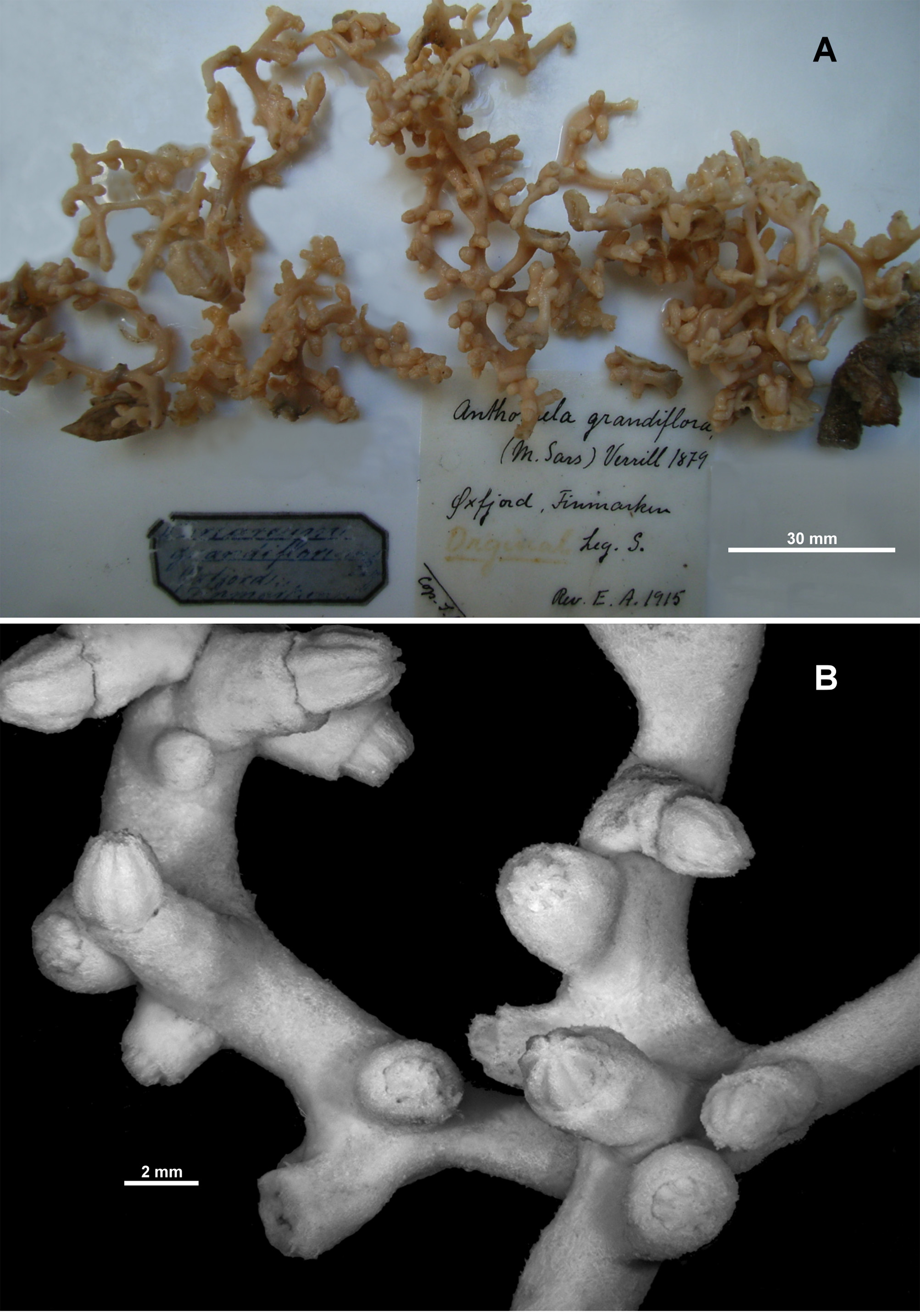
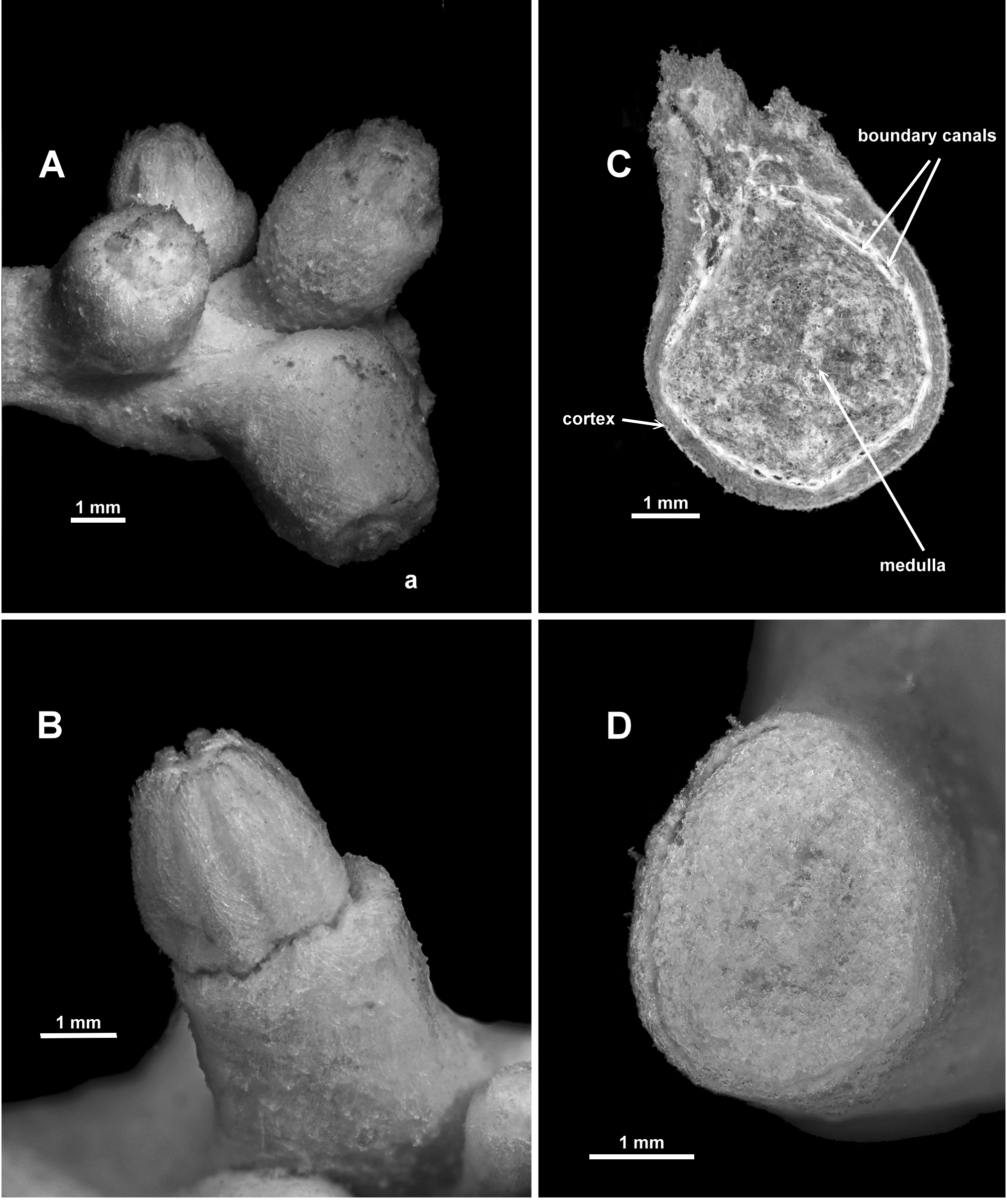
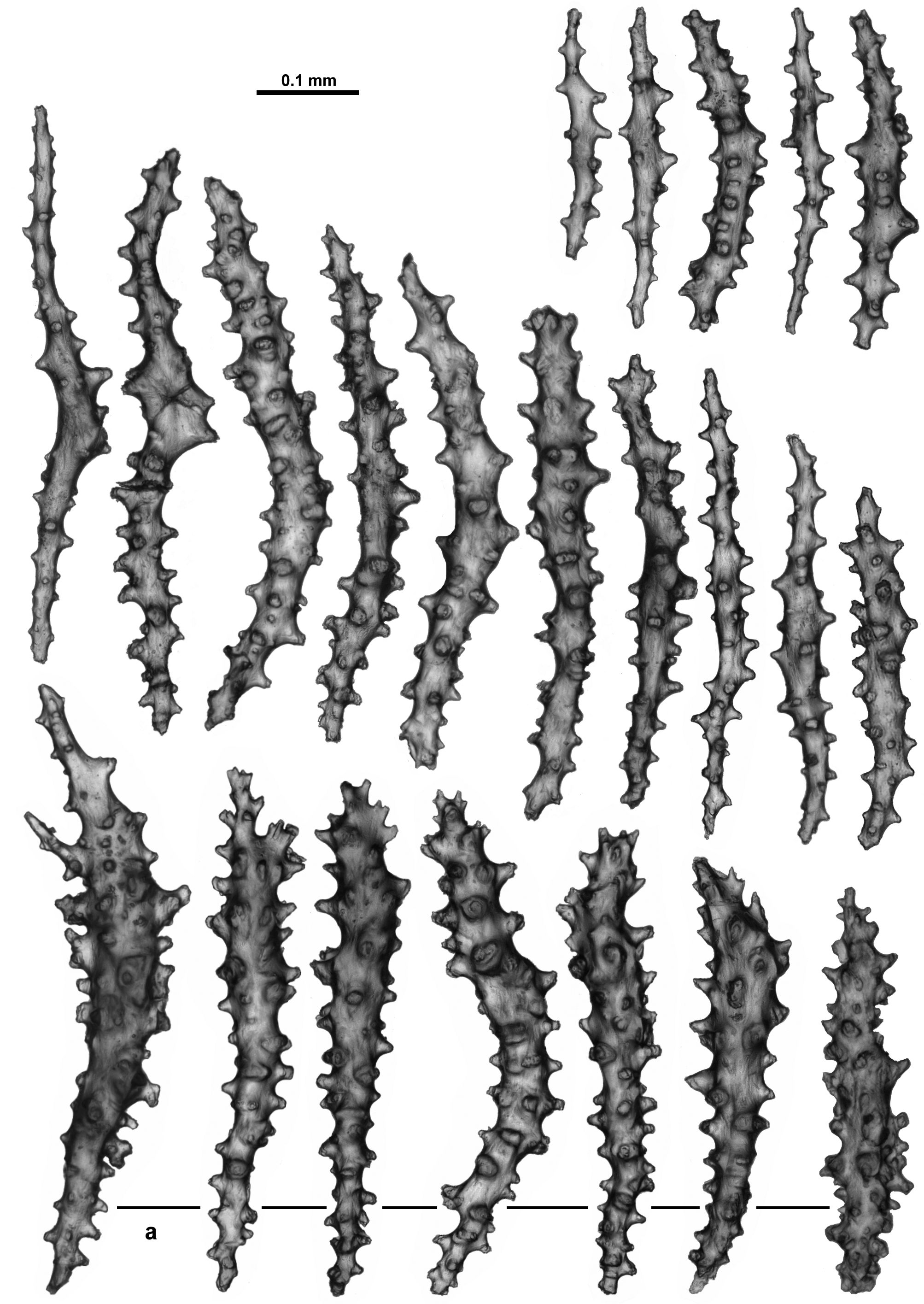
Description: Colony form: The holotype is made up of many fragments of a tangled colony which once was described as “ die Grösse eines Menschenkopfes ” (translated as “ the size of a human head ”) (Broch 1912 b) (Fig. 4 A). There is no central trunk or evidence of main branches and there is no consistent arrangement of branching. In Sars’ original description, he made it clear (“ D'ailleurs il n'y a aucune différence entre les tiges et les branches: elles ont la même apparence, la même forme, la même grosseur “) that there is no difference between stems or branches: they have the same appearance, same form and same size. Many of the fragments are small pieces of narrow branches which are often twisted and tangled so it is impossible to reconstruct the colony into the original shape. There are also multiple anastomoses and bifurcations throughout the colony fragments (Fig. 4 B). Examples of membranous portions of the colony are evident including the holdfast which is encrusting a piece of coral rubble. Several branches emanate from the membranous parts of the colony. Most branches are of a relatively uniform diameter (approximately 2.2 – 3.4 mm), although there are some outside this range (1.3 – 4.2 mm), and they are basically circular in cross-section, although calyces and bifurcation points tend to cause some distortion. Calyces occur with no apparent order along and all around the branches throughout the colony. The greatest distance between calyces is approximately 12 mm although they are more commonly closer together. Tight bunches of calyces occur on the branch tips where there is very little or no space between them (Fig. 5 A). Isolated calyces are also evident on the membranous parts of the colony. The colony is in good condition, albeit in many fragments, with many polyps still attached and, in general, the cortex is complete. Colour: In the original description no mention was made regarding the live colour, although Sars did comment that the medulla is a darker colour than the cortex. The holotype is now light brown to cream in alcohol. Other specimens recently collected are creamy pink (Fig. 13 B, C). Polyps and calyces: Calyces are tall, flat-topped, robust cylinders which protrude basically at right angles from the branches (Fig. 5 B). They are usually between 2.2 – 3.2 mm high although there are some larger ones up to 4.5 mm. Polyps may extend 1.4 – 2.6 mm above the lip of the calyx and are approximately 2 – 3 mm wide. Calyces and polyps are usually taller than they are wide. Sars considered the relatively large size of the calyces and polyp as a distinguishing factor, mentioning that the height of the “ cellules polypifères ” is generally twice the diameter of the branches. The calyces do not have obvious longitudinal ridges although there can be slight bulges where the base of the tentacles meet the calyx lip. Most of the polyps are partly retracted such that the base of the polyp head rests on the lip of the calyx and the polyp neck is not visible (Fig. 5 B) but there are some examples where polyps are fully retracted into their calyx (Fig. 5 Aa) despite Sars stating that he did not observe any in this state. Occasionally fully exsert polyps occur, with the polyp neck visible — a polyp and calyx combined then being up to 6.5 mm high. All polyp heads are well protected by crowded sclerites arranged as points and an indistinct collaret, and the visible polyp necks are also covered in sclerites. The tentacles fold into the polyp mouth so the polyp heads are rounded mounds with eight distinct furrows (Fig. 5 B). There are approximately 12 pinnules along each side of the tentacles with a fan of pinnules around the tip. Medulla and Cortex: The central medulla is made up of tightly packed, longitudinally and obliquely placed sclerites, surrounded by a thin cortex which is separated from the medulla by a ring of longitudinal boundary canals (Fig. 5 C). The canals run parallel and close together throughout the colony and remain identifiable as individual canals. They do not extensively anastomose or form a boundary space as such but do provide a clear separation of the medulla from the cortex. In the thickest branches, presumably older and from closer to the base of the colony, there may be some patches where the density of medulla sclerites lessens. These patches appear as indistinct canals in the central medulla (Fig. 5 D) and are easily deformed or obscured by sclerites during the making of a crosssection. In thinner branches, presumably younger and farther from the base of the colony, the ill-defined canals in the centre of the medulla are only occasionally visible in cross-section. For polyps along the branches, body cavities truncate abruptly forming a flat base where they abut the medulla, while polyps which are clumped at the branch tips have a body cavity which extends somewhat deeper within the branch, eventually finishing at the start of the medulla proper. Sclerites: Polyps, calyces and cortex are all covered in crowded sclerites. On the polyp head transversely arranged sclerites form an indistinct collaret approximately 8 sclerites deep, while above they are arranged en chevron grading to longitudinal in the points (Fig. 5 B). These sclerites are mostly straight or slightly curved sticks and spindles with simple tubercles (Fig. 6). Sizes can range from 0.4 – 1.3 mm but most are between 0.45 – 0.85 mm. Some sclerites have the distal tip with mildly more developed tubercles or spines (Fig. 6 a). Very occasionally, sclerites can have complex warts. Below the collaret, similar sclerites are arranged obliquely on the polyp neck, sparser than on the polyp head, presumably to allow the polyp to invaginate at the neck area. Along the aboral side of the tentacle, sclerites are arranged longitudinally (Fig. 7 A) and are all mostly similar to the sclerites from the points although shorter. They are straight or slightly curved tuberculate sticks and spindles with complex warts occurring occasionally and processes slightly more developed on one end (Fig. 7 B). Sclerites grade in size from longest (0.5 mm) at the proximal end of the tentacle to shortest (0.25 mm) at the distal end. Long, thin, spatulate clubs extend longitudinally most of the way down the pinnules (Fig. 8 A). These sclerites are crowded, with the spatulate tip toward the distal end of the pinnules, and are easily broken during dissection. The spatulate clubs have long, narrow handles and flattened, occasionally forked, tips and are usually straight but can be curved or with bent tips (Fig. 8 Ba). There are also short rods with sparse tubercles, narrow sticks and spindles without a flattened tip and very small spindles in the pinnules (Fig. 8 Bb). The size of the spatulate clubs ranges from 0.34 – 0.5 mm while the smaller rods and spindles are approximately 0.08 – 0.21 mm long. Small rods (0.08 – 0.24 mm long) with cone-like prominences and sparse warts occur in the pharynx (Fig. 9 A). These sclerites are arranged in ill-defined lines in the pharynx corresponding to the mesenterial insertions and are not crowded (Fig. 9 B). The sclerites of the calyx are arranged in a dense layer, longitudinally to obliquely in the wall. They are short, straight or slightly curved sticks and spindles mostly with simple tubercles (Fig. 10). Occasionally more complex warts occur and some sclerites have a clavate tip with slightly flared or foliose spines (Fig. 10 a) but they do not form true thorn clubs. The sclerites have a small size range, only varying from approximately 0.23 – 0.45 mm long. The sclerites from the cortex are similar to those in the calyces — small, straight, tuberculate sticks and spindles of a fairly uniform shape and size (Fig. 11). Most of the sclerites are between 0.16 and 0.38 mm in length but slightly longer sclerites also occur. Occasionally, sclerites with more complex warts occur but more commonly the tubercles are simple and relatively sparse. Some sclerites can have one marginally more complex tip making them slightly clavate (Fig. 11 a). The medulla is composed of tightly packed sclerites, mainly sticks and spindles with simple to complex tubercles (Fig. 12). There are examples of fusion, branching and forking among the sclerites resulting in quite complex forms. The length of the sclerites can vary considerably (0.2 – 0.9 mm) and the longest are probably underrepresented in the figure as it is difficult to sample them without breakage. All sclerites are transparent and colourless under transmitted light. Variability: Variability of sclerite development within this species appears to be quite substantial. The holotype is from the northern tip of Norway, at the extreme northern point of the distribution of the specimens examined, and it is a specimen with a very consistent form of sclerites (sticks and spindles with simple tubercles) from the aboral side of the tentacles, points, collaret, calyx and the cortex (unfortunately no specimens which are geographically close to the holotype were available). Other specimens have considerable variation in the complexity and shape of the sclerites. One specimen, NTNU-VM 67149, from Trondheimsfjord, Norway, has sclerites from the calyx which are more often club-shaped with very complex warts and spines in addition to the sticks and spindles with simple tubercles like those in the holotype (Fig. 13 A). Such complex sclerites in the calyx are common in other specimens investigated, particularly in specimens from the Trondheimsfjord, yet the colony, polyp form and the other sclerites are similar to those in the holotype. Photographs of two specimens from Trondheimsfjord taken soon after collection (NTNU-VM 67149 and NTNU-VM 67148) demonstrate the live colour to be creamy pink (Fig. 13 B, C). In addition, there are many specimens with more complex and larger sclerites from the tentacles, points and surface than those observed in the holotype. In particular, despite much similarity with the holotype in other areas, the sclerites from the tentacles of ZMUC-ANT- 000470 and NTNU-VM 40338 have more developed processes on the distal tips (Fig. 14 A, B). At this stage, it is assumed they are more complex versions of those in the tentacle rachis of the holotype, although further collections may allow a definitive delimitation within these degrees of complexity. Similarly, the colony surface of sample NTNU-VM 63139, along with small sticks and spindles like those of the holotype, has numerous short, straight, club-shaped forms with smooth areas as well as more developed spines and warts (Fig. 15). These surface sclerites were recorded in lesser amounts in other specimens as well, but not the holotype.
A taxonomic revision of Anthothela (Octocorallia: Scleraxonia: Anthothelidae) and related genera, with the addition of new taxa, using morphological and molecular data
NOT: Anthothela grandiflora (Sars, 1856): Grieg 1890: 11 [thought to be Paramuricea sp.] NOT: Anthothela grandiflora (Sars, 1856): Grieg 1894: 3, Pl. I Figs. 1 – 2 [found to be Lateothela grandiflora n. comb.]
A taxonomic revision of Anthothela (Octocorallia: Scleraxonia: Anthothelidae) and related genera, with the addition of new taxa, using morphological and molecular data
Remarks: There has been much confusion over many years between A. grandiflora and material that has herein been assigned to the new genus Lateothela. In every collection examined which contained specimens of A. grandiflora, specimens of Lateothela n. gen. were also found, almost always erroneously determined as A. grandiflora. In Broch’s (1912 b) extensive re-description of A. grandiflora it now seems clear that he included more than one specimen in his description, and at least one of these was likely to have been a specimen of Lateothela grandiflora n. comb. The figure of the small, warty rodlets from the calyces and cortex (Broch 1912 b Fig. 2 a, b), which are common in L. grandiflora n. comb. but do not occur in any significant number in A. grandiflora, perpetuated the confusion between the two genera. One of the chief morphological differences between these two species is the preponderance of these rodlets in the calyces and cortex of L. grandiflora n. comb. (mixed with tuberculate sticks and spindles) compared with their rarity in A. grandiflora. Other differences between the two species are colony form and differences in the pinnule and tentacle sclerites. Much of the subsequent literature perpetuated Broch’s (1912 b) incorrect description, thus some later determinations and descriptions of specimens are clearly incorrect or cannot be confirmed (Verrill 1922; Stiasny 1937; Verseveldt 1940; Madsen 1944) and many specimens remain incorrectly identified. For example, Verrill (1922) when describing A. grandiflora stated the figures are “ from the type described in 1869 ”, but Plate VI Fig. 1 in particular, and his description of the appearance of the calyces, appears to depict L. grandiflora n. comb. with the small warty rodlets in the calyx and surface. However, the colony depicted in Verrill’s Text Figure 2 is more like the holotype of A. grandiflora and not of a colony of L. grandiflora n. comb. There is no way to confirm exactly which specimen (or specimens?) Verrill figured in this paper, however it is possible it may not have been the holotype of A. grandiflora, or perhaps he used more than one specimen to assemble the description. Additionally, this current research has confirmed that of the specimens listed as A. grandiflora in Madsen (1944) three are valid, but one specimen (‘ Thor’ Stat 168) is an example of L. grandiflora n. comb. — another instance of the confusion of the two species. The variation observed amongst specimens of A. grandiflora shows the holotype to be a specimen with minimal complexity in the warts and tubercles of the sclerites and in the shape of the sclerites themselves. Nevertheless, the tangled colony form, long thin spatulate clubs in the pinnules and generally simple tuberculate sticks and spindles with a tendency to be clavate seem to be consistent across the specimens examined. At this stage there are not enough consistent differences to reliably delimit other species within the sample set, however, considering the large geographic range which is currently recorded for this species it would not be surprising if future studies can confidently define other Anthothela species within this group. A. grandiflora as detailed here appears to be reasonably wide-spread in the deep waters of the Atlantic Ocean. Anthothela tropicalis and Anthothela quattriniae n. sp. also occur in the Atlantic, although A. quattriniae n. sp. is currently only recorded from the Gulf of Mexico. Both of these species have large thorn clubs, which are thorny in A. tropicalis (Fig. 38) and bulbous in A. quattriniae n. sp. (Fig. 63), and both have colonies with very prickly surfaces with the thorn clubs projecting outwards. A. grandiflora lacks true thorn clubs and has a relatively smooth surface. Anthothela pacifica has currently only been recorded from the northern Pacific Ocean, and has small, straight sticks, spindles and clubs in the calyces and cortex which are smaller than those recorded in A. grandiflora. Specimens of another species herein assigned to Anthothela, A. vickersi n. comb., carry the same haplotype as specimens of A. grandiflora using two mitochondrial gene regions (mtMutS and igr 1 – cox 1). However, the morphological and geographical differences between these populations were deemed enough to maintain separation into two species. Chiefly, the sclerites in a calyx of A. vickersi n. comb. are large, bent thorn clubs which project out from the calyx wall (Figs. 21; 27), while the smaller sclerites in a calyx of A. grandiflora, although at times complex, do not consistently have spear tips which project out of the colony. Additionally A. vickersi n. comb. has short, relatively broad, tuberculate rods that are common in the cortex (Fig. 31), and long, narrow sticks and spindles in the tentacle rachis and pinnules (Fig. 25), both of which are not common in A. grandiflora; the branches of the colonies of A. vickersi n. comb. are not as narrow or flexible as A. grandiflora; and A. vickersi n. comb. has been recorded from southern Australia and New Zealand while A. grandiflora is only known from the Atlantic Ocean.
A taxonomic revision of Anthothela (Octocorallia: Scleraxonia: Anthothelidae) and related genera, with the addition of new taxa, using morphological and molecular data
Distribution: Confirmed records are from the north eastern Atlantic Ocean in deep coastal waters and fjords of Norway and Iceland; north western Atlantic Ocean, in deep waters off the coast of Canada and USA; the Gulf of Biscay, off the west coast of France; and the south western Atlantic Ocean off the coast of southern Brazil. Depth: Confirmed specimens 100 – 960 metres; most commonly between 100 – 500 metres.
A taxonomic revision of Anthothela (Octocorallia: Scleraxonia: Anthothelidae) and related genera, with the addition of new taxa, using morphological and molecular data
Material examined. Holotype: NHM, UIOslo B 1365, Öxford, Finmark, northern Norway, depth 365 m, no date recorded; ZMUC ANT- 000470, same data as holotype and labelled as a “ co-type ”. Other material: NTNU-VM 63139, Agdeneståa, Trondheimsfjord, Norway, 63.646 ° N, 9.752 ° E, depth 100 – 250 m, Torkild Bakken, 21 st June 2001; NTNU-VM 63141, Rødberg, Trondheimsfjord, Norway, 63.468 ° N, 9.999 ° E, depth 200 – 300 m, Torkild Bakken, 5 th December 2006; NTNU-VM 40341 (part), Dyrviknes 27, Trondheimsfjord, Norway, 63.603 ° N, 9.757 ° E, depth 120 m, 18 th May 1965; NTNU-VM 67148 & 67149, Brettingen, Trondheimsfjord, Norway, RV Gunnerus, stn. 2011022, 63.659 ° N, 9.798 ° E, depth 200 – 100 m, Torkild Bakken, 14 th June 2011; NTNU-VM 40338 & 40339, unknown locality, determined by Broch 1912; ZMUB 17759 (part), Skarnsundet, Trondheimsfjord, Norway, August 1899; ZMUB 12187, Molde, Julneset, Midfjord, Norway, RV G. O. Sars, stn. 101, depth 275 m; ZMUB 60328, Langenuen, Klinkholmen, Tysnes, Norway, August 1894; ZMUB 455, Haakonsund, Norway, determined by Danielessen & Koren; NHM, UIOslo B 1366, Selsövik, Norway, depth 182 m; ZMUC-ANT- 000470, Brettingsnes, Trondhjemsfjord, Norway, depth 150 m, 21 st September 1934; ZMUC-ANT- 000469, Rødberg, Trondhjemsfjord, Norway, depth 150 – 300 m, 17 th July 1911; ZMB 5527 (part), Rødberg, Trondheimsfjord, Norway, depth 300 – 350 m, 1913; MCZ 51047, Banquereau Bank, off Nova Scotia, Canada, U. S. Fish Commission no. 5705, Gloucester Fisheries Lot 418, 44.217 ° N, 58.033 ° W, depth 320 m, 1973; MCZ 51048, unknown locality; MCZ 50734, Browns Bank, east coast of Canada, schooner Chester B. Lawrence, 42.517 ° N, 64.333 ° W, depth 300 f (feet or fathoms), Capt. Wm. H. Greenleaf; MOVI 20919, east coast of Rio Grande do Sul, Brazil, 34.324 ° S, 51.572 ° W, depth 822 m, 5 th March 2002; unregistered specimen, NEREIDA 0 610, zone NAFO, tow DR 72, 46.0239 ° N, 46.686 ° W, depth 710 m, collected by Tina Molodtsova thanks to Mar Sacau and Javier Murillo Perez (IEO, Vigo, Spain) and sampling program NEREIDA, 28 th June 2010.
A taxonomic revision of Anthothela (Octocorallia: Scleraxonia: Anthothelidae) and related genera, with the addition of new taxa, using morphological and molecular data

Export occurrence data

Darwin Core Archive (ZIP)

GEOGRAPHY

Distribution Map

Occurrence Map

Loading map…

Tiles © GBIF Maps API | Map powered by MapLibre GL

REGIONS

Geographic Distribution(36)

Western Atlantic Ocean
Atlantic Ocean
Mediterranean Sea
Swedish Exclusive Economic Zone
European waters (ERMS scope)
North West Atlantic
North West Atlantic
Gulf of Maine
East Atlantic
North West Atlantic
Eastern Atlantic
Mediterranean Sea
European Marine Waters
North West Atlantic
Atlantic Ocean
Gulf of Maine
Atlantic Ocean
Swedish Exclusive Economic Zone
East Atlantic
Gulf of Maine
European waters (ERMS scope)
North West Atlantic
North West Atlantic
Mediterranean Sea
Global
least concern
BR
native
BR
native
CV
native
DK
not evaluated
NO
PT
native
SE
nativecritically endangered
SE
nativecritically endangered
SE
nativecritically endangered
Swedish Exclusive Economic Zone(SE)
US
native

DATA

Occurrence Datasets

Loading datasets…

Common names used for this species across different languages and regions. Available in 3 languages and 1 country. 2 preferred.

SErosenknoppskorallsweSErosenknoppskorallswefracorail à grandes fleursfrafracorail à grandes fleursfraenggreater flowerbud coraleng+4 more

Vernacular (common) names are the everyday names used for a species in different languages and regions. A single species may have dozens of common names worldwide. This taxon has names in 3 languages. 2 names preferred.

fracorail à grandes fleurs
fra
Source: Catalogue of LifeSource taxon #273090216
fracorail à grandes fleurs
fra
Source: Catalogue of LifeSource taxon #299622417
enggreater flowerbud coral
eng
Source: Catalogue of LifeSource taxon #273090216
enggreater flowerbud coral
eng
Source: Catalogue of LifeSource taxon #299622417
swerosenknoppskorall
swe
Source: Catalogue of LifeSource taxon #299622417
SErosenknoppskorall
swepreferredSE
Source: The Swedish Red List 2025Source taxon #320319501
SErosenknoppskorall
swepreferredSE
Source: Dyntaxa. Svensk taxonomisk databasSource taxon #159996671
fracorail à grandes fleurs
fra
Source: World Register of Marine SpeciesSource taxon #155450836
enggreater flowerbud coral
eng
Source: World Register of Marine SpeciesSource taxon #155450836

CLASSIFICATION

Taxonomic Classification Tree

MULTIMEDIA

Media Files(27)

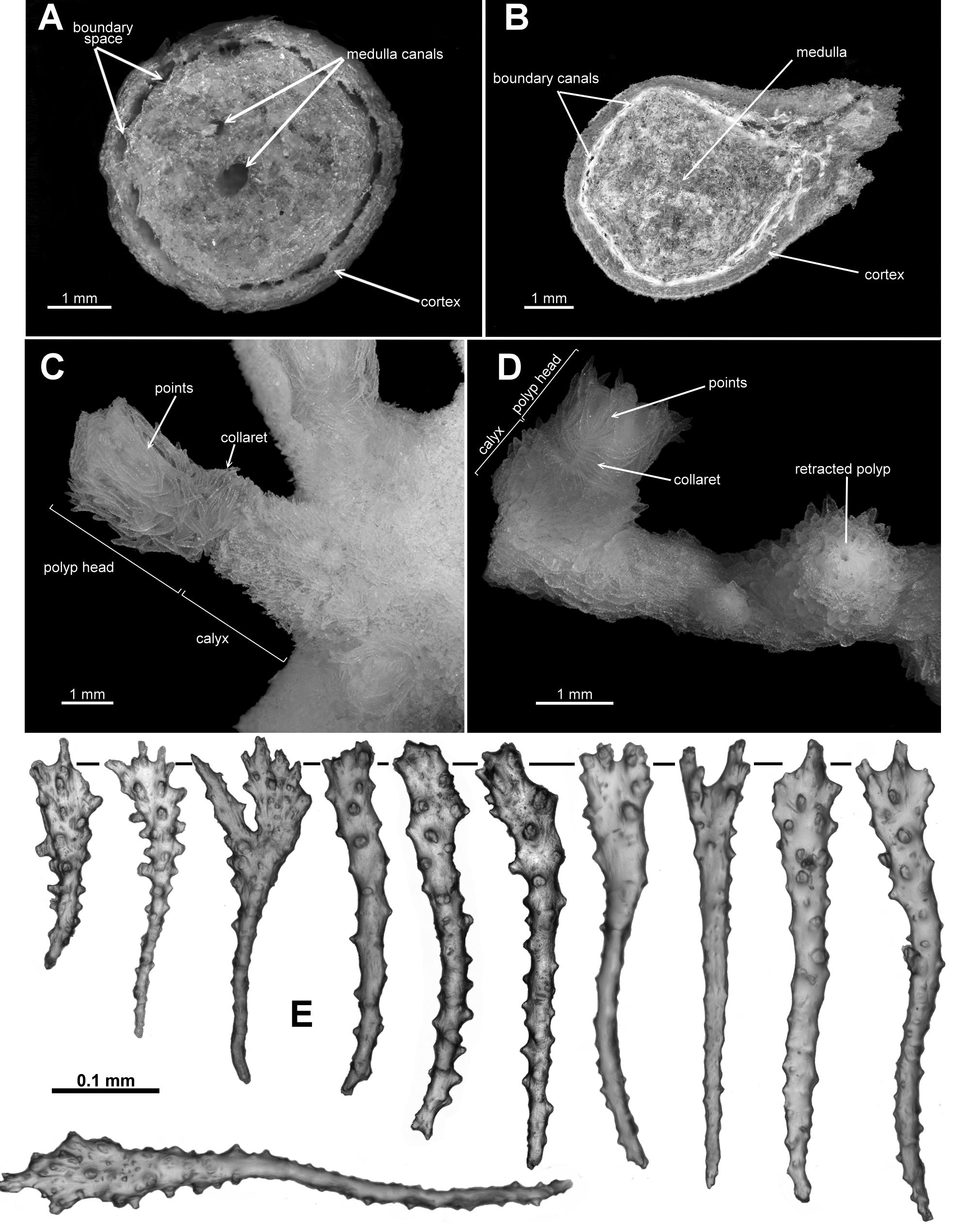
FIGURE 1. A. Cross-section of the holotype of Ƒictorgorgia eminens n. sp. showing extensive boundary canals which frequently anastomose and distinct central canals in the medulla; B. Cross-section of the holotype of Anthothela grandiflora showing boundary canals, adjacent but separate, and a medulla lacking any obvious central canals; C. Extended polyp of the holotype of A. aldersladei n. sp. showing polyp, calyx, points and collaret; D. Partly extended polyp of A. quattriniae n. sp. showing polyp head, calyx, points and collaret and, on right, a fully retracted polyp; E. Spatulate clubs found in Anthothela.
Imageimage/png© Moore, Kirrily M.;Alderslade, Philip;Miller, Karen J.A taxonomic revision of Anthothela (Octocorallia: Scleraxonia: Anthothelidae) and related genera, with the addition of new taxa, using morphological and molecular data

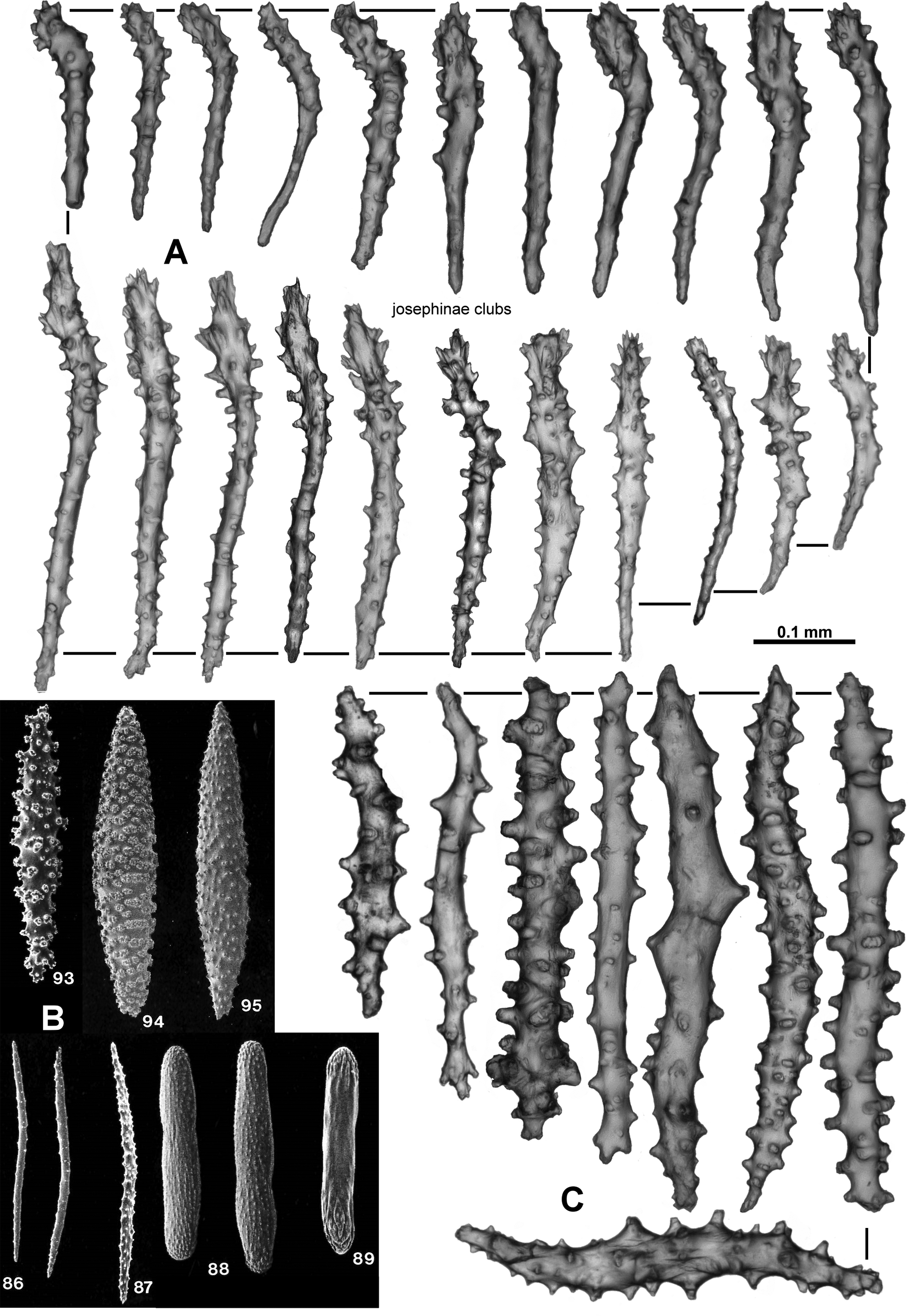
FIGURE 2. A. Josephinae clubs found in the pinnules and tentacle rachis of Ƒictorgorgia and Lateothela n. gen.; B. Spindles (93 – 95), needles (86 – 87) and bars (88 – 89) from Bayer et al. 1983, Plate 16; C. Sticks.
Imageimage/png© Moore, Kirrily M.;Alderslade, Philip;Miller, Karen J.A taxonomic revision of Anthothela (Octocorallia: Scleraxonia: Anthothelidae) and related genera, with the addition of new taxa, using morphological and molecular data

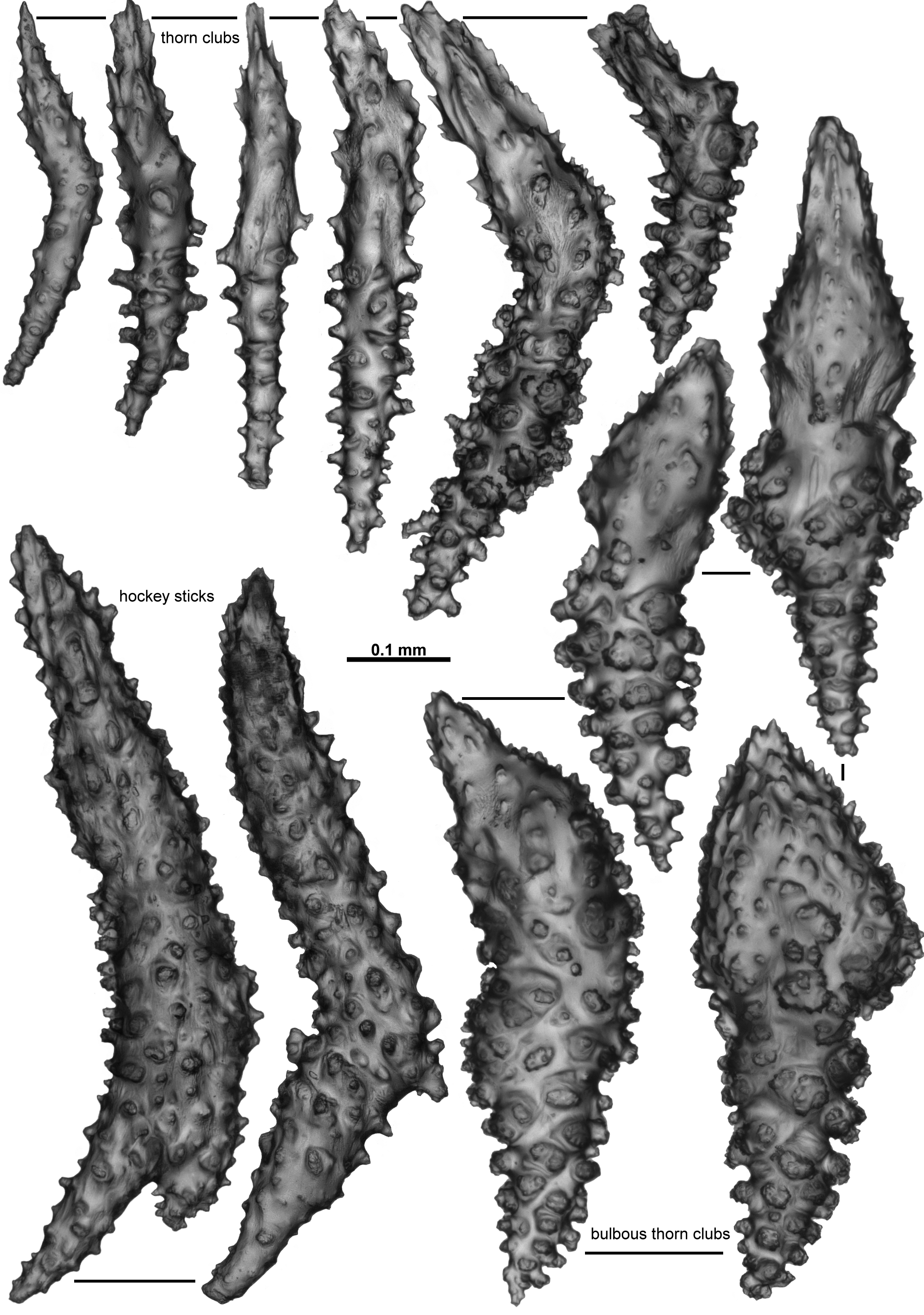
FIGURE 3. Sclerite forms found in the points, calyx and cortex of Anthothela and Ƒictorgorgia species.
Imageimage/png© Moore, Kirrily M.;Alderslade, Philip;Miller, Karen J.A taxonomic revision of Anthothela (Octocorallia: Scleraxonia: Anthothelidae) and related genera, with the addition of new taxa, using morphological and molecular data

FIGURE 4. Anthothela grandiflora (Sars, 1856), holotype: A. Holotype fragments; B. Polyps and branches.
Imageimage/png© Moore, Kirrily M.;Alderslade, Philip;Miller, Karen J.A taxonomic revision of Anthothela (Octocorallia: Scleraxonia: Anthothelidae) and related genera, with the addition of new taxa, using morphological and molecular data

FIGURE 5. Anthothela grandiflora (Sars, 1856), holotype: A. Terminal polyp bunch (a. fully retracted polyp); B. Partly retracted polyp; C. Cross-section of decalcified medulla; D. Cross-section of medulla.
Imageimage/png© Moore, Kirrily M.;Alderslade, Philip;Miller, Karen J.A taxonomic revision of Anthothela (Octocorallia: Scleraxonia: Anthothelidae) and related genera, with the addition of new taxa, using morphological and molecular data

FIGURE 6. Anthothela grandiflora (Sars, 1856), holotype, sclerites: Point and collaret (a. sclerites with slightly more developed tips).

Imageimage/png© Moore, Kirrily M.;Alderslade, Philip;Miller, Karen J.A taxonomic revision of Anthothela (Octocorallia: Scleraxonia: Anthothelidae) and related genera, with the addition of new taxa, using morphological and molecular data

IMAGES

Gallery(27)

See Gallery

Occurrences with images

CITATIONS

References(22)

  • 1

    (2010) Rödlistade arter i Sverige 2010

    Dyntaxa. Svensk taxonomisk databas
  • 2

    Bayer, F.M. (1961). The shallow-water Octocorallia of the West Indian region. A manual for marine biologists. <em>Studies on the Fauna of Curacao and Other Caribbean Islands.</em> 12:1-373, pls. 1-23.

    additional sourceWorld Register of Marine Species
  • 3

    Breeze, H., D.S. Davis, M. Butler, and V. Kostylev. 1997. Distribution and status of deep sea corals off Nova Scotia. Ecology Action Centre. Halifax. 58 p.

    additional sourceWorld Register of Marine Species
  • 4

    Cairns, Stephen D., Dale R. Calder, Anita Brinckmann-Voss, Clovis B. Castro, Daphne G. Fautin,..., 2002: Common and Scientific Names of Aquatic Invertebrates from the United States and Canada: Cnidaria and Ctenophora, Second Edition, 2002. American Fisheries Society Special Publication 28. xi + 115.

    Integrated Taxonomic Information System (ITIS)
  • 5

    Carlgren, O. (1940). A contribution to the knowledge of the structure and distribution of the cnidae in the Anthozoa. Kungliga Fysiografiska Sällskapets Handlingar, 51, N.F., (3): 1-62

    additional sourceWorld Register of Marine Species
  • Source Information

    GBIF Backbone Taxonomy

    GBIF Backbone Taxonomy

    checklist

    The GBIF Backbone Taxonomy is a single, synthetic management classification with the goal of covering all names GBIF is dealing with. It's the taxonomic backbone that allows GBIF to integrate name based information from different resources, no matter if these are occurrence datasets, species pages, names from nomenclators or external sources like EOL, Genbank or IUCN. This backbone allows taxonomic search, browse and reporting operations across all those resources in a consistent way and to provide means to crosswalk names from one source to another.

    It is updated regulary through an automated process in which the Catalogue of Life acts as a starting point also providing the complete higher classification above families. Additional scientific names only found in other authoritative nomenclatural and taxonomic datasets are then merged into the tree, thus extending the original catalogue and broadening the backbones name coverage. The GBIF Backbone taxonomy also includes identifiers for Operational Taxonomic Units (OTUs) drawn from the barcoding resources iBOL and UNITE.

    International Barcode of Life project (iBOL), Barcode Index Numbers (BINs). BINs are connected to a taxon name and its classification by taking into account all names applied to the BIN and picking names with at least 80% consensus. If there is no consensus of name at the species level, the selection process is repeated moving up the major Linnaean ranks until consensus is achieved.

    UNITE - Unified system for the DNA based fungal species, Species Hypotheses (SHs). SHs are connected to a taxon name and its classification based on the determination of the RefS (reference sequence) if present or the RepS (representative sequence). In the latter case, if there is no match in the UNITE taxonomy, the lowest rank with 100% consensus within the SH will be used.

    The GBIF Backbone Taxonomy is available for download at https://hosted-datasets.gbif.org/datasets/backbone/ in different formats together with an archive of all previous versions.

    The following 105 sources have been used to assemble the GBIF backbone with number of names given in brackets:

    • Catalogue of Life Checklist - 4766428 names
    • International Barcode of Life project (iBOL) Barcode Index Numbers (BINs) - 635951 names
    • UNITE - Unified system for the DNA based fungal species linked to the classification - 611208 names
    • The Paleobiology Database - 212054 names
    • World Register of Marine Species - 188857 names
    • The Interim Register of Marine and Nonmarine Genera - 183894 names
    • The World Checklist of Vascular Plants (WCVP) - 131891 names
    • GBIF Backbone Taxonomy - 114350 names
    • TAXREF - 109374 names
    • The Leipzig catalogue of vascular plants - 75380 names
    • ZooBank - 73549 names
    • Integrated Taxonomic Information System (ITIS) - 68377 names
    • Plazi.org taxonomic treatments database - 61346 names
    • Genome Taxonomy Database r207 - 60545 names
    • International Plant Names Index - 52329 names
    • Fauna Europaea - 45077 names
    • The National Checklist of Taiwan (Catalogue of Life in Taiwan, TaiCoL) - 36193 names
    • Dyntaxa. Svensk taxonomisk databas - 35892 names
    • The Plant List with literature - 32692 names
    • United Kingdom Species Inventory (UKSI) - 29643 names
    • Artsnavnebasen - 29208 names
    • The IUCN Red List of Threatened Species - 21221 names
    • Afromoths, online database of Afrotropical moth species (Lepidoptera) - 13961 names
    • Brazilian Flora 2020 project - Projeto Flora do Brasil 2020 - 13829 names
    • Prokaryotic Nomenclature Up-to-Date (PNU) - 10079 names
    • Checklist Dutch Species Register - Nederlands Soortenregister - 8814 names
    • ICTV Master Species List (MSL) - 7852 names
    • Cockroach Species File - 6020 names
    • GRIN Taxonomy - 5882 names
    • Taxon list of fungi and fungal-like organisms from Germany compiled by the DGfM - 4570 names
    • Catalogue of Afrotropical Bees - 3623 names
    • Catalogue of Tenebrionidae (Coleoptera) of North America - 3327 names
    • Checklist of Beetles (Coleoptera) of Canada and Alaska. Second Edition. - 3312 names
    • Systema Dipterorum - 2850 names
    • Catalogue of the Pterophoroidea of the World - 2807 names
    • The Clements Checklist - 2675 names
    • Taxon list of Hymenoptera from Germany compiled in the context of the GBOL project - 2496 names
    • IOC World Bird List, v13.2 - 2366 names
    • Official Lists and Indexes of Names in Zoology - 2310 names
    • National checklist of all species occurring in Denmark - 1922 names
    • Myriatrix - 1876 names
    • Database of Vascular Plants of Canada (VASCAN) - 1822 names
    • Taxon list of vascular plants from Bavaria, Germany compiled in the context of the BFL project - 1771 names
    • Orthoptera Species File - 1742 names
    • A list of the terrestrial fungi, flora and fauna of Madeira and Selvagens archipelagos - 1602 names
    • Aphid Species File - 1565 names
    • World Spider Catalog - 1561 names
    • Taxon list of Jurassic Pisces of the Tethys Palaeo-Environment compiled at the SNSB-JME - 1270 names
    • Backbone Family Classification Patch - 1143 names
    • GBIF Algae Classification - 1100 names
    • International Cichorieae Network (ICN): Cichorieae Portal - 975 names
    • Psocodea Species File - 803 names
    • New Zealand Marine Macroalgae Species Checklist - 787 names
    • Annotated checklist of endemic species from the Western Balkans - 754 names
    • Taxon list of animals with German names (worldwide) compiled at the SMNS - 503 names
    • Catalogue of the Alucitoidea of the World - 472 names
    • Lygaeoidea Species File - 462 names
    • Catálogo de Plantas y Líquenes de Colombia - 422 names
    • GBIF Backbone Patch - 317 names
    • Phasmida Species File - 259 names
    • Cortinariaceae fetched from the Index Fungorum API - 234 names
    • Coreoidea Species File - 233 names
    • GTDB supplement - 139 names
    • Mantodea Species File - 119 names
    • Endemic species in Taiwan - 93 names
    • Taxon list of Araneae from Germany compiled in the context of the GBOL project - 88 names
    • Species of Hominidae - 78 names
    • Taxon list of Sternorrhyncha from Germany compiled in the context of the GBOL project - 77 names
    • Taxon list of mosses from Germany compiled in the context of the GBOL project - 75 names
    • Mammal Species of the World - 73 names
    • Plecoptera Species File - 71 names
    • Species Fungorum Plus - 64 names
    • Catalogue of the type specimens of Cosmopterigidae (Lepidoptera: Gelechioidea) from research collections of the Zoological Institute, Russian Academy of Sciences - 47 names
    • Species named after famous people - 41 names
    • Dermaptera Species File - 36 names
    • Taxon list of Trichoptera from Germany compiled in the context of the GBOL project - 34 names
    • True Fruit Flies (Diptera, Tephritidae) of the Afrotropical Region - 33 names
    • Range and Regularities in the Distribution of Earthworms of the Earthworms of the USSR Fauna. Perel, 1979 - 32 names
    • Taxon list of Diplura from Germany compiled in the context of the GBOL project - 30 names
    • Lista de referencia de especies de aves de Colombia - 2022 - 24 names
    • Taxon list of Auchenorrhyncha from Germany compiled in the context of the GBOL project - 20 names
    • Catalogue of the type specimens of Polycestinae (Coleoptera: Buprestidae) from research collections of the Zoological Institute, Russian Academy of Sciences - 19 names
    • Taxon list of Thysanoptera from Germany compiled in the context of the GBOL project - 19 names
    • Lista de especies de vertebrados registrados en jurisdicción del Departamento del Huila - 18 names
    • Taxon list of Microcoryphia (Archaeognatha) from Germany compiled in the context of the GBOL project - 15 names
    • Catalogue of the type specimens of Bufonidae and Megophryidae (Amphibia: Anura) from research collections of the Zoological Institute, Russian Academy of Sciences - 12 names
    • Grylloblattodea Species File - 11 names
    • Coleorrhyncha Species File - 9 names
    • Taxon list of liverworts from Germany compiled in the context of the GBOL project - 9 names
    • Embioptera Species File - 7 names
    • Taxon list of Pisces and Cyclostoma from Germany compiled in the context of the GBOL project - 6 names
    • Taxon list of Pteridophyta from Germany compiled in the context of the GBOL project - 6 names
    • Taxon list of Siphonaptera from Germany compiled in the context of the GBOL project - 5 names
    • The Earthworms of the Fauna of Russia. Perel, 1997 - 5 names
    • Taxon list of Zygentoma from Germany compiled in the context of the GBOL project - 4 names
    • Asiloid Flies: new taxa of Diptera: Apioceridae, Asilidae, and Mydidae - 3 names
    • Taxon list of Protura from Germany compiled in the context of the GBOL project - 3 names
    • Taxon list of hornworts from Germany compiled in the context of the GBOL project - 2 names
    • Chrysididae Species File - 1 names
    • Taxon list of Dermaptera from Germany compiled in the context of the GBOL project - 1 names
    • Taxon list of Diplopoda from Germany in the context of the GBOL project - 1 names
    • Taxon list of Orthoptera (Grashoppers) from Germany compiled at the SNSB - 1 names
    • Taxon list of Pscoptera from Germany compiled in the context of the GBOL project - 1 names
    • Taxon list of Pseudoscorpiones from Germany compiled in the context of the GBOL project - 1 names
    • Taxon list of Raphidioptera from Germany compiled in the context of the GBOL project - 1 names

    GBIF Secretariat (2023). GBIF Backbone Taxonomy. Checklist dataset https://doi.org/10.15468/39omei accessed via GBIF.org on 2026-06-15.

    CC BYPublished 8/28/2023View dataset
    GBIF Usage Key
    2262167
    Dataset Key
    d7dddbf4-2cf0-4f39-9b2a-bb099caae36c
    Origin
    source
    Backbone Key
    2262167
    Taxon ID
    gbif:2262167
    Last Crawled
    8/22/2023
    Last Interpreted
    8/22/2023