AnimaliaacceptedgenusAcceptedRestricted
Ceratomyxa

Ceratomyxa

ミカヅキムシ属·Thélohan, 1892

GBIF:2269597

0countries
0datasets
0year

0

Descendants

0

Synonyms

0

Children

0

Species

PROFILE

Species Profile

Habitat

Marine Freshwater

ABOUT

Descriptions(19)

Host: Serranus scriba Linnaeus, 1758 painted comber (Perciformes: Serranidae). Locality: Mediterranean off Tunisia, Sidi Daoud, Gulf of Tunis (37 ° 01 ’ N 10 ° 55 ’ E). Site of infection: Within gall bladder. Prevalence: The overall prevalence is 11.7 % (21 / 180). The frequency of infection is distributed as following, 03 / 2012: 3.3 % (1 / 30); 04 / 2012: 6.7 % (2 / 30); 05 / 2012: 20 % (6 / 30); 06 / 2012: 20 % (6 / 30); 07 / 2012: 13.3 % (4 / 30); 08 / 2012: 6.7 % (2 / 30) (Table 10).
Myxosporea (Cnidaria: Myxozoa) infecting the saddled seabream Oblada melanura (L. 1758) (Teleostei: Sparidae) and the painted comber Serranus scriba (L. 1758) (Teleostei: Serranidae) in Tunisia
Cestracion tiburo
Myxosporea (Cnidaria: Myxozoa) infecting the saddled seabream Oblada melanura (L. 1758) (Teleostei: Sparidae) and the painted comber Serranus scriba (L. 1758) (Teleostei: Serranidae) in Tunisia
Lepidopsetta mochgorei Microstomus kitt
Myxosporea (Cnidaria: Myxozoa) infecting the saddled seabream Oblada melanura (L. 1758) (Teleostei: Sparidae) and the painted comber Serranus scriba (L. 1758) (Teleostei: Serranidae) in Tunisia
Limanda aspera Microstomus kitt orientalis Dogiel (1948) Shulman * Sardinops sagax Russia (Sea of Japan) (7 / 11) (33 / 72) 3 3.3 1966) melanosticta Clupea harengus pallasi porrecta Dogiel (1948) Shulman * Gymnacanthus Russia (Sea of Japan) (4 / 6) (50 / 60) 3 3 1966) herzensteini Myoxocephalus brandti Bero elegans
Myxosporea (Cnidaria: Myxozoa) infecting the saddled seabream Oblada melanura (L. 1758) (Teleostei: Sparidae) and the painted comber Serranus scriba (L. 1758) (Teleostei: Serranidae) in Tunisia
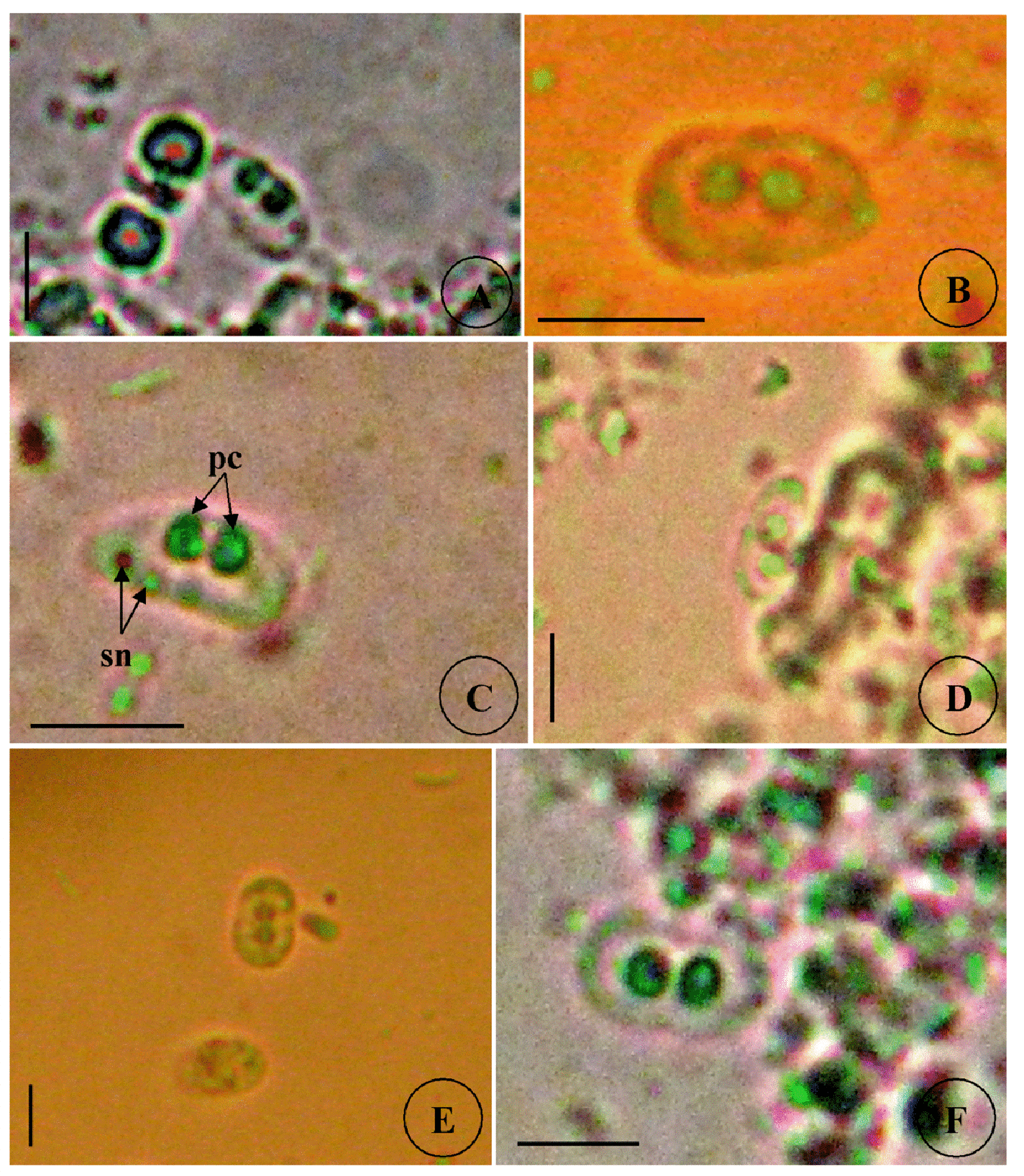
Mean intensity: 154 ± 44 spores / 20 µl bile / infected fish (++++++) (Table 10). Vouchers: Digitized photos of spores are deposited in the parasitological collection of the Museum National d’Histoire Naturelle (MNHN), Paris, Coll. No. ZS 136. Morphological description. Vegetative stages. No vegetative stages are observed. The bile is turbid due to the presence of large number of free floating spores with bile salts and cell debris. Infrequently, the spores of this parasite are remarked in the bile mixed with scarce Triangula sp. infection (Fig. 3 H). Myxospores. Spores typical for the genus Ceratomyxa (n = 30 fresh spores). Mature spores are crescentshaped to arched with anterior margin convex and posterior slightly concave one in sutural view, transversely elongate in lateral view (Figs. 3 A – I, 8 A – B) measuring 8.6 ± 1.1 (7.0 – 10.8) µm in length and 52.6 ± 5.8 (42.8 – 61.1) µm in thickness. Posterior angle is slightly concave to slightly convex 153.8 ± 16.9 (120 – 174 °). Two elongated shell valves strikingly attenuate towards the extremities with pointed ends in sutural view (Figs. 3 A – H, 8 A) and with rounded ends in lateral view (Figs. 3 I, 8 B). They are sub-equal in some spores but the most, are unequal in size, with one tapering to a significantly greater degree than the other (Figs. 3 A – I, 8 A – B). The longer valve measuring 34.5 ± 3.0 (30.6 – 40.5) µm while the shorter one 27.7 ± 3.8 (20.6 – 33.2) µm. The suture line is straight and visible TABLE ³. Comparison of the spore measurements of the present Ceratomyxa sp.] ex S. scriba with taxonomic affinities species (measurements are in µm). Abbreviations: SL, Spore Length;, Spore Thickness; PCL, Polar Capsule Length; PCW, Polar Capsule Wiđth; ND, Not Determineđ. Species Host (s) Locality Spore Polar capsule SL ST PCL PCW Ceratomyxa sp.] (Present stuđy) Serranus scriba Tunisia (Gulf of Tunis) 8.6 52.6 4.2 3.6 (7 / 10.8) (42.8 / 61.1) (4 / 4.5) (3.2 / 4) sphaerulosa Thélohan (1892) * Mustelus vulgaris France (Roscoff, Monaco) (10 / 12) (90 / 100) (6 / 7) 5 * Galeus canis Clupea harengus Scullium canicula
Myxosporea (Cnidaria: Myxozoa) infecting the saddled seabream Oblada melanura (L. 1758) (Teleostei: Sparidae) and the painted comber Serranus scriba (L. 1758) (Teleostei: Serranidae) in Tunisia
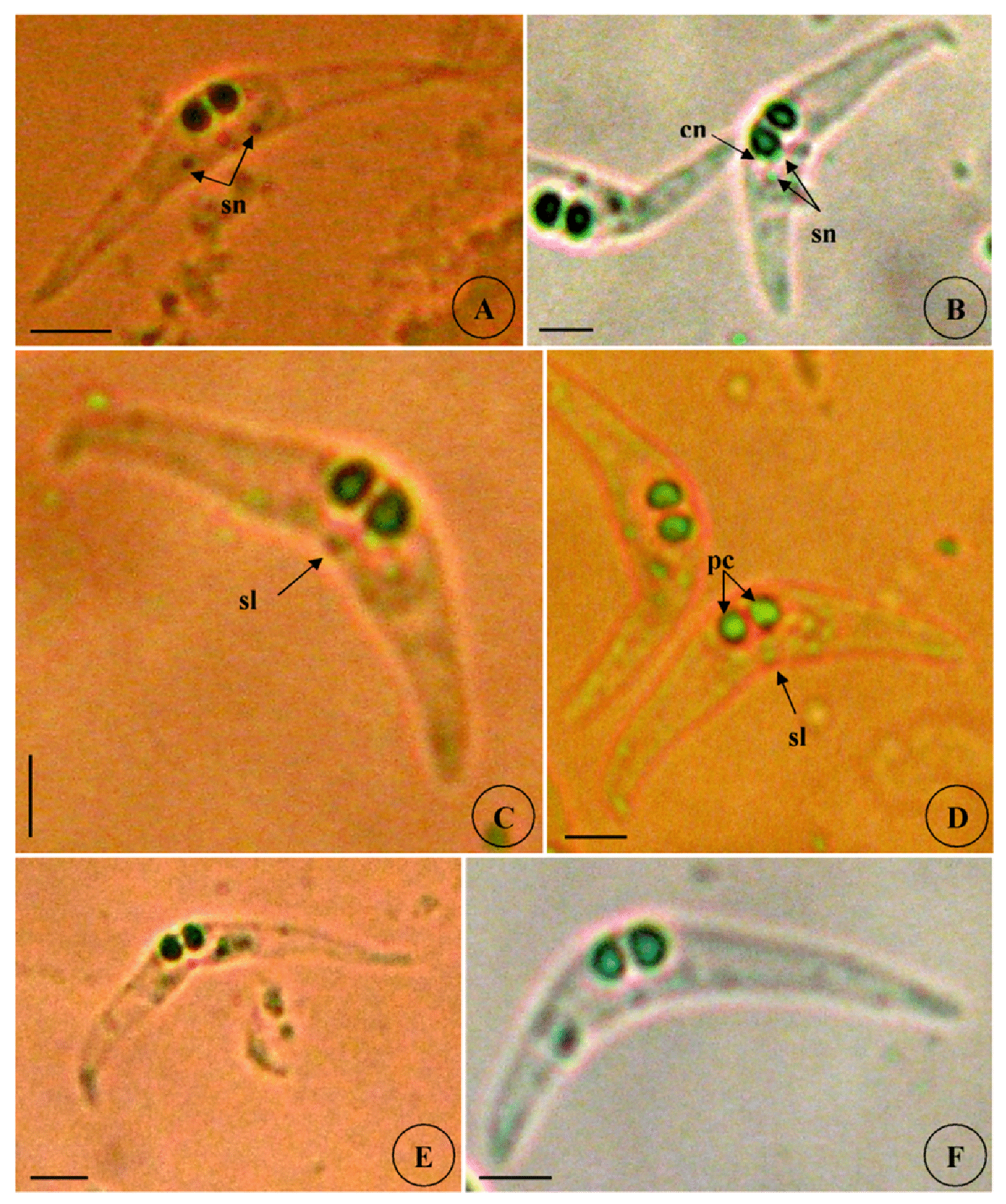
between valves (Figs. 3 C – D). Sporoplasm homogenous with numerous sporoplasmosomes, are symmetrically situated, but extending only a short distance into each valve and contain two nuclei which each one occupied one side and rarely migrated both to one side (Figs. 3 A – B). One capsulogenic nucleus is situated beneath one of the polar capsules (Fig. 3 B). Two polar capsules are pyriform conspicuously separated from each other and measuring 4.2 ± 0.2 (4.0 – 4.5) µm in length equaling 52.5 % of spore length and 3.6 ± 0.2 (3.2 – 4.0) µm in width (n = 30), they are positioned medially in the apex of spore in sutural view (Figs. 3 A – I, 8 A) and centrally of spore cavity in apical view. The polar filament forms four to five turns arranged along the longitudinal axis of the capsule. Occasionally, aberrant spores with 3 polar capsules and 3 valves are observed among the spores (Fig. 3 J). Taxonomic affinities. Our attempts at identification of the recent finding species follow the same considerations mentioned in the preceding species. In Mediterranean Sea, none of the Ceratomyxa spp. recorded in the study of Siau & Sakiti (1981) from some serranids in Southeast Tunisian coasts resemble morphologically or overlap within the measurements range of the current species (Table 6). The only Mediterranean marine Ceratomyxa that shows some superficial similarity in shape and form to our species, is C. sphaerulosa Thélohan, 1892 reported from the gall bladders of numerous unrelated fishes hosts from Bergen in Norway and from Roscoff and Mediterranean off Monaco, France (Table 3). The recent species distinguishes from C. sphaerulosa by having two unequal shell valves and smaller spores and polar capsules. Furthermore, the sporoplasm deposits asymmetrically within the spores of this species on the contrary to the current studied form. According to the parasitological reports, several species of Ceratomyxa have been properly reported from Serranidae family among the wide word; C. angusta, C. gemmaphora Meglitsch, 1960, C. epinephela, C. reniforma, C. guishanensis Wu, Wu & Dingke, 1993, C. brayi, C. whippsi, C. gleesoni, C. hooperi, C. nolani, C. yokoyamai Gunter & Adlard, 2009, C. hamour Mansour, Al-Qahtani, Al-Quraishy & Abdel-Baki, 2014 and most recently C. husseini Abdel-Baki, Mansour, Al-Qahtani, Al Omar & Al-Quraishy, 2015 (Table 6). From all these above mentioned congeneric species, the recent species is superficially similar in form to C. angusta, C. epinephela and C. yokoyamai. Nevertheless, only C. angusta has unequal shell valves as the present species, but its spores and spherical polar capsules seem to be significantly smaller. Likewise, both C. epinephela and C. yokoyamai are thinner in all levels and posses each one two spherical polar capsules. Among the remaining Ceratomyxa spp. from clearly distinct geographical areas and hosts, C. sp. 1 is superficially closer to numerous species from unrelated marine fishes: C. attenuata, C. flagellifera, C. mesospora, C. streptospora Davis, 1917, C. robusta, C. tenuis Fujita, 1923, C. orientalis and C. porrecta Dogiel, 1948 (cited from Shulman 1966), C. lepidopusi Meglitsch, 1960 (previously C. elongata, see Gunter & Adlard 2010), C. auerbachi Kabata, 1962, C. swaisi Abdel-Ghaffar, Ali, Al-Quraishy, Al-Rasheid, Al-Farraj, Abdel-Baki & Bashtar, 2008 a and C. cacharhini Gleeson & Adlard, 2011 (Table 3). However, every time the recent finding myxosporean exhibits one or more distinguishing characteristics. It differentiates from C. attenuata by having thinner spores and two pyriform polar capsules. Furthermore, the shell valves of this later species are unequal and dissimilar while one being about 15 shorter than the other and ending abruptly, the longer valve tapering gradually to a point disagreeing with the morphological features of our species. C. flagellifera is the closest to the current species in form and shape, however it has larger and thicker spores. Besides, its polar capsules are typically spherical and bigger. Although, most of the morphometric measurements coincide between the present species and C. mesospora, this later possess two equal valves and two spherical polar capsules. Furthermore, the sporoplasm are asymmetrically situated within its spores and sometimes being entirely confined to the larger valve on the contrary to the current finding. C. streptospora appears to have shorter and thinner spores compared to those of the present species and its polar capsules are spherical. C. robusta resembles to our species only in shape but no measurements overlap between both species. The spores of C. tenuis are much bigger. C. orientalis has two smaller polar capsules. The spores of C. porrecta are shorter, its shell valves are thinner and contain two spherical smaller polar capsules. The spores of both C. lepidopusi and C. auerbachi are thicker than those of our species, its valves are equal in size and its polar capsules are spherical. C. swaisi is separated from the current species by having smaller polar capsules. Moreover, the shell valves of the present finding are unequal in size and much narrower than those of C. swaisi. The average range of spores of C. carcharhini is bigger than that of our species and their polar capsules are spherical. In addition, C. carcharhini has morphologically a strongly convex anterior end and more concave posterior one compared to the slightly convex anterior end and slightly posterior one of the recent finding and is, therefore a distinct species. In light of these differences with closely related species and since no Ceratomyxa species recorded thus so far is identical, we propose to mention the recent myxozoan Ceratomyxa sp. 1 as a special species has found infecting, by the first time, the gall bladder of S. scriba in Mediterranean Sea.
Myxosporea (Cnidaria: Myxozoa) infecting the saddled seabream Oblada melanura (L. 1758) (Teleostei: Sparidae) and the painted comber Serranus scriba (L. 1758) (Teleostei: Serranidae) in Tunisia
Host: Serranus scriba Linnaeus, 1758 painted comber (Perciformes: Serranidae). Locality: Mediterranean off Tunisia, Sidi Daoud, Gulf of Tunis (37 ° 01 ’ N 10 ° 55 ’ E).
Myxosporea (Cnidaria: Myxozoa) infecting the saddled seabream Oblada melanura (L. 1758) (Teleostei: Sparidae) and the painted comber Serranus scriba (L. 1758) (Teleostei: Serranidae) in Tunisia
Site of infection: Within gall bladder. Prevalence: The overall prevalence is 6.7 % (12 / 180). The infection rate is distributed as following, 03 / 2012: 0 % (0 / 30); 04 / 2012: 0 % (0 / 30); 05 / 2012: 13.3 % (4 / 30); 06 / 2012: 13.3 % (4 / 30); 07 / 2012: 6.7 % (2 / 30); 08 / 2012: 3.3 % (1 / 30) (Table 10). Mean intensity: 71.8 ± 14.5 spores / 20 µl bile / infected fish (+++++) (Table 10). Vouchers: Digitized photos of syntype spores are deposited in the parasitological collection of the Museum National d’Histoire Naturelle (MNHN), Paris, Coll. No. ZS 137. Morphological description. Vegetative stages. No early developmental or sporogonic stages are seen for this parasite. The bile is very turbid with cell debris mixed with white grease that bordered at the external wall side of the gall bladder. Myxospores. Spores typical for the genus Ceratomyxa (n = 30 fresh spores). Mature spores are reniform, broadly oval to globular in sutural view with anterior margin convex and posterior straight one, cylindrical in apical view (Figs. 4 A – B, D – F, 8 C – D). They are small in size, measuring 6.2 ± 0.6 (5.2 – 7.2) µm in length and 12.2 ± 1.4 (10.2 – 14.0) µm in thickness. Posterior angle is slightly concave to straight 169.8 ± 3.1 (165 – 173 °). In some spores, the posterior margin is nearly parallel to the anterior one with very little valvular taper (Figs. 4 B, 8 D). The two shell valves are almost equal in size, smoothly ovoid in lateral view with rounded ends. The suture line is straight, visible between valves but not very conspicuous. Sporoplasm, homogenous with sporoplasmosomes, are symmetrically situated and do not fill the entire spore cavity (Figs. 4 A – F, 8 C – D). It contains two nuclei placed in one side (Fig. 4 C). The two polar capsules are in the most cases pyriform, measuring 3.1 ± 0.3 (2.6 – 3.5) µm in length equaling 49.7 % of spore length and 2.5 ± 0.1 (2.3 – 2.6) µm in width (n = 30), they are placed medially in anterior part of spore in sutural view (Figs. 4 A – B, 8 C) and centrally of spore cavity in apical view (Figs. 4 D – F). The polar filament forms three turns arranged along the longitudinal axis of the capsule. Taxonomic affinities. Numerous Ceratomyxa spp. share with the current isolate species one or more morphological similitude especially after the review of genus Leptotheca (Gunter & Adlard 2010) as we mentioned above. Firstly in the Mediterranean Sea, Ceratomyxa sp. 2 resembles superficially in shape, form and size to 5 Ceratomyxa: C. agilis Thélohan, 1892, C. hepseti Thélohan, 1895, Ceratomyxa sp. type 2 ex Epinephelus guaza Siau & Sakiti, 1981, C. lubati Lubat, Radujkovic, Marques & Bouix, 1989 and Ceratomyxa sp. 2 ex Sparus aurata Alama-Bermejo, Raga & Holzer, 2011 (Table 4). Species Host (s) Locality Spore Polar capsule SL ST PCL PCW Ceratomyxa sp. 2 Serranus scriba Tunisia (Gulf of Tunis) 6.2 12.2 3.1 2.5 Present stuđy) (5.2 / 7.2) (10.2 / 14) (2.6 / 3.5) (2.3 / 2.6)
Myxosporea (Cnidaria: Myxozoa) infecting the saddled seabream Oblada melanura (L. 1758) (Teleostei: Sparidae) and the painted comber Serranus scriba (L. 1758) (Teleostei: Serranidae) in Tunisia
coelorhyncha Yoshino & Noble Coelorhinchus off Irelanđ 6.7 (6 / 8) 11.34 2.01 2.01 1973) coelorhinchus (9 / 13) (1.5 / 3) (1.5 / 3) Ceratomyxa sp. type 2 Siau & Sakiti Epinephelus guaza Međiterranean off Tunisia 5.1 9.3 1.2 1.2 1981) anđ French ovalis Kovaljova & Gaevskaya Trachurus murphyi Pacific Ocean (6 / 6.65) (9.97 / 10.64) (2 / 2.66) (2 / 2.66) 1983)
Myxosporea (Cnidaria: Myxozoa) infecting the saddled seabream Oblada melanura (L. 1758) (Teleostei: Sparidae) and the painted comber Serranus scriba (L. 1758) (Teleostei: Serranidae) in Tunisia
ernsti Gunter et al. (2009) Sillago ciliata Australia (Great Barrier Reef) 5.76 (4.67 / 6.84) 11.94 (9.47 / 14.79) 1.66 (1.3 / 2.13) 1.58 (1.3 / 2) jonesi Gunter et al. (2009) Pseudolabrus guentheri Australia (Great Barrier Reef) 5.1 (4.1 / 6.08) 12.99 (11.17 / 16.45) 1.92 (1.55 / 2.3) 1.81 (1.42 / 2.29) reidi Gunter et al. (2010 a) Chaetodon vagabundus Australia (Great Barrier Reef) 6.8 (5.8 / 7.5) 17.5 (14.3 / 20.7) 2.1 (1.7 / 2.4) 2 (1.7 / 2.5) sp 2 Alama-Bermejo et al. (2011) Sparus aurata Spain 9.9 (8.7 / 11.4) 20 (16.7 / 24.7) 3.8 (3.2 / 4.5) 3.8 (3.2 / 4.5) Original host. Although, the dimensions of the polar capsules of C. agilis have not been given, the available measurements of Ceratomyxa sp. 2 and this species overlap. However, the spores of C. agilis are less globular to elongate in shape, its suture line are oblique and its sporoplasm fill the whole spore cavity (specific feature of Leptotheca spp.). Generally, the average range of spores of C. hepseti is larger. Furthermore, according to the original description of this species, it was noted that C. hepseti had a triangular shape in sutural view (no available illustration), so it cannot be identical to the under studied species. The recent species separates from Ceratomyxa sp. type 2 ex. E. guaza by having bigger spores and larger pyriform polar capsules. Except the width of the polar capsules, all the measurements between the current species and C. lubati overlap, but the shape of this later is more arched compared to the globular one of the recent species. Moreover, the sporoplasm of C. lubati fill the entire spore cavity. C. sp 2 ex S. aurata can be distinguished from the present species in having larger spores and bigger spherical polar capsules. Throughout the world, under consideration of the morphological characteristics of the current finding species, 15 representatives of the genus Ceratomyxa infecting marine fishes are compared to our species. These species are: C. fisheri Jameson, 1929 (formerly L. fisheri), C. subelegans Laird, 1953 (formerly L. subelegans), C. mylionis Ishizaki, 1960 (syn. L. mylionis), C. declivis C. faba and C. pinguis (syn. L. pinguis) Meglitsch, 1960, C. coelorhyncha Yoshino & Noble, 1973 (previously L. coelorhyncha), C. ovalis Kovaljova & Gaevskaya, 1983, C. buri Yokoyama & Fukuda, 2001, C. cottoidii Reed, Basson, Van As & Dyková, 2007, C. cutmorei Gunter & Adlard, 2009, C. ernsti and C. jonesi Gunter, Whipps & Adlard, 2009, C. reidi Gunter, Burger & Adlard, 2010 and C. hamour Mansour, Al-Qahtani, Al-Quraishy & Abdel-Baki, 2014 (Tables 4, 6). Comparative study of morphological and morphometric characteristics of the spore and polar capsule with the mentioned above species confirm that the recent species C. sp. 2 differentiates from all of them. Although, the measurements of polar capsules of C. fisheri are not given, the range size of body spores for both species overlap. However, according to the original illustration of C. fisheri, its sporoplasm fill the entire spore cavity and its polar capsules appear to be spherical unlike those of the current species. The spores of C. subelegans are bigger and possess two spherical polar capsules. The recent finding separates from all species C. mylionis, C. declivis, C. faba, C. pinguis, C. coelorhyncha, C. ovalis, C. lubati, and C. buri by having bigger and / or pyriform polar capsules. Furthermore, the posterior margin of C. declivis is more concave compared to the slightly concave to straight of the present form, C. pinguis have a bigger spores while those of C. cottoidii and C. cutmorei are thicker. Moreover, the polar capsules of the latter are either spherical. C. ernsti and C. jonesi differ from the recent species in having almost spherical and smaller polar capsules. The thickness of C. reidi is larger and its polar capsules are spherical and smaller. The spores of C. hamour are thicker and less globular in shape than those of our species. Therefore, taking into account all the differences with the closely related species, host and locality new records, the recent myxosporean Ceratomyxa sp. 2 is designated as a different species, has not previously described from S. scriba in the Mediterranean Sea.
Myxosporea (Cnidaria: Myxozoa) infecting the saddled seabream Oblada melanura (L. 1758) (Teleostei: Sparidae) and the painted comber Serranus scriba (L. 1758) (Teleostei: Serranidae) in Tunisia
Host: Oblada melanura Linnaeus, 1758 saddled seabream (Perciformes: Sparidae). Locality: Mediterranean off Tunisia, Bay of Bizerte (37 ° 20 ’ N, 9 ° 53 ’ E).
Myxosporea (Cnidaria: Myxozoa) infecting the saddled seabream Oblada melanura (L. 1758) (Teleostei: Sparidae) and the painted comber Serranus scriba (L. 1758) (Teleostei: Serranidae) in Tunisia
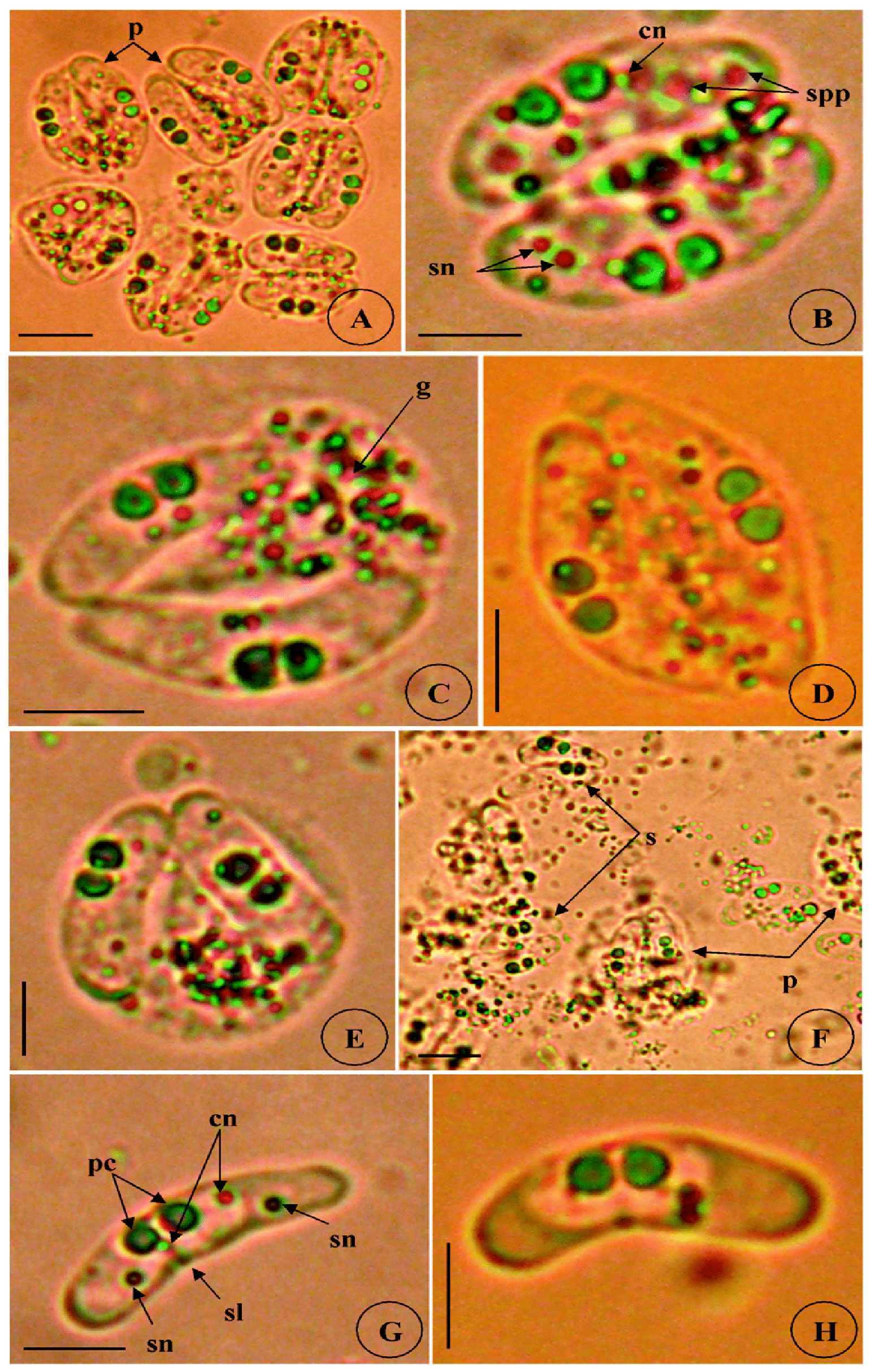
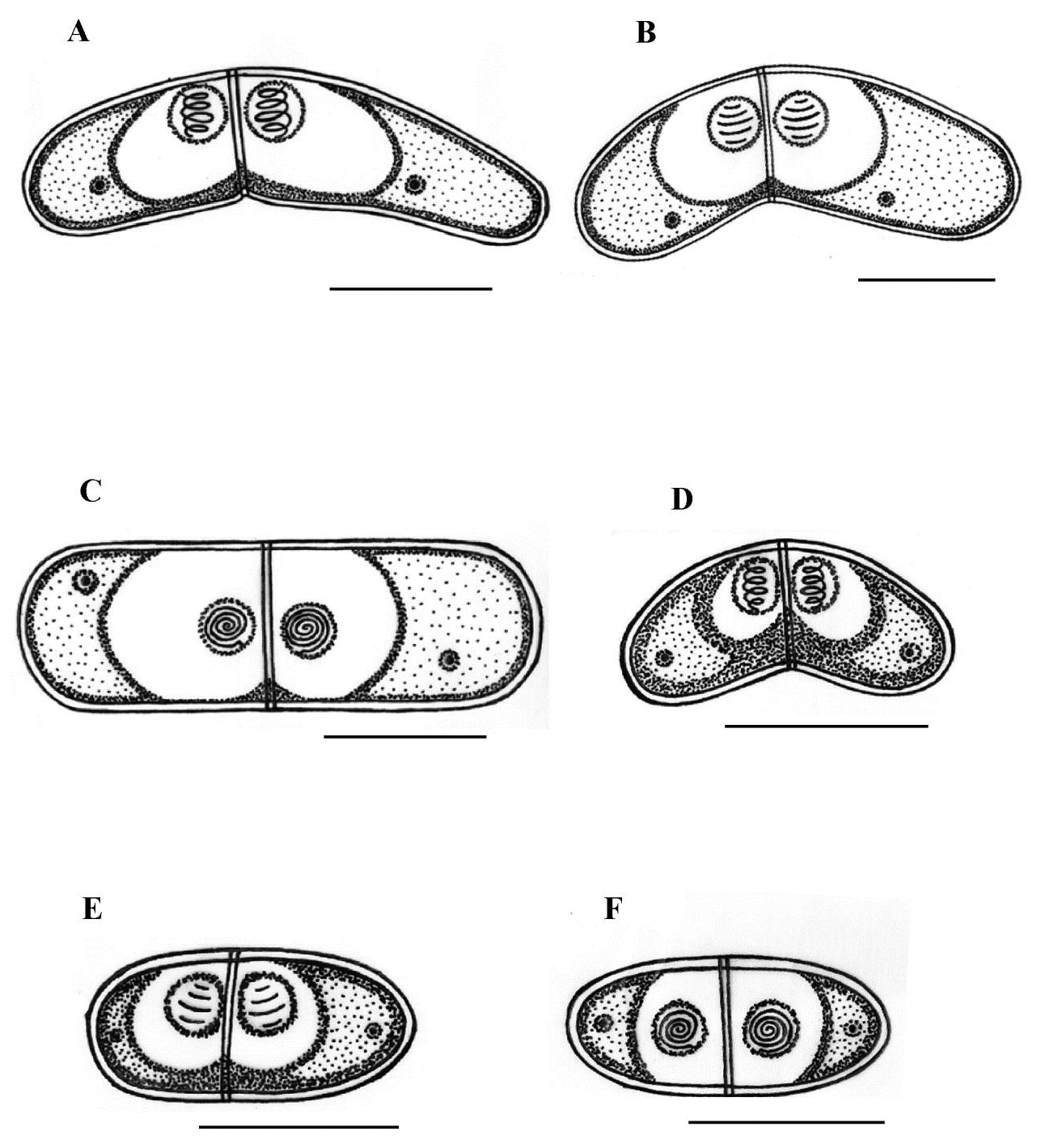
Site of infestation: Within gall bladder. Prevalence: The overall prevalence is 36 % (36 / 100). The infection rate is distributed as following, 05 / 2012: 30 % (3 / 10); 06 / 2012: 33.3 % (5 / 15); 07 / 2012: 46.7 % (7 / 15); 08 / 2012: 50 % (5 / 10); 04 / 2013: 20 % (5 / 25); 05 / 2013: 44 % (11 / 25) (Table 10). Mean intensity: 129 ± 58 spores / 20 µl bile / infected fish (++++++) (Table 10). Vouchers: Digitized photos of spores are deposited in the parasitological collection of the Museum National d’Histoire Naturelle (MNHN), Paris, Coll. No. ZS 135. Morphological description. Vegetative stages. Coelozoic trophozoïtes (n = 30 live trophozoites) floating freely in the bile at different stages of maturation, Plasmodia are disporous, spherical to sub-spherical and measuring 25.4 ± 1.8 (21.6 – 28.3) µm in length and 29.1 ± 2.5 (25.7 – 33.8) µm in width (Figs. 1 A – F). Each plasmodium contains two identical spores with very refractive granules (Figs. 1 A – E). Pansporoblast pseudopodia are not detected (Figs. 1 A – F). Myxopores. Spores typical for the genus Ceratomyxa (n = 60 fresh spores). Mature spores are transversely elongate and narrowly crescent-shaped with slightly convex anterior margin and concave posterior one in sutural and lateral views (Figs. 1 F – H, 7 A, B) measuring 7.9 ± 0.7 (7.2 – 9.0) µm in length and 27.7 ± 2.6 (24.4 – 31.0) µm in thickness. They are cylindrical in the apical view and measuring 7.3 ± 0.8 (6.4 – 8.4) µm in width (n = 10) (Figs. 1 E, 7 C). Posterior angle is slightly concave to slightly convex 155.4 ± 6.8 (140 – 164 °). The two shell valves, with rounded ends, are unequal in size, with one tapering to a significantly greater degree than the other (Figs. 1 G, 7 A). The pointed one measuring 19.5 ± 1.1 (17.7 – 21.6) µm while the more rounded one 14.3 ± 1.1 (12.2 – 16.1) µm. In the lateral view, they are ovoid and superficially smooth with bluntly rounded ends (Figs. 1 H, 7 B). The suture line is straight, non protruding. Homogenous Sporoplasms with numerous sporoplasmosomes do not fill the spore cavity and contain two nuclei, each one occupies one side. Rarely, both nuclei occur at one side (Figs. 1 B, G, 7 A – C). Two capsulogenic nuclei are situated beneath or sometimes between the polar capsules (Figs. 1 B, G). The two polar capsules are spherical, equal in size and measuring 3.2 ± 0.46 (2.7 – 3.6) µm in length equaling 40.5 % of spore length and 3.2 ± 0.46 (2.7 – 3.6) µm in width (n = 30), They are positioned medially in anterior part of spore in sutural and lateral views (Figs. 1 A – H, 7 A, B) and in the central plane in apical view (Figs. 1 E, 7 C). The polar filament forms four to five turns arranged along the longitudinal axis of the capsule. Taxonomic affinities. Since Ceratomyxa sp. 1 discriminates by having two unequal shell valves, we exclude from comparison all Ceratomyxa spp. that possess equal ones. According to the best of our knowledge, no Ceratomyxa species with unequal valves has been described from Mediterranean sparids. However, C. globulifera Thélohan, 1895, C. inaequalis Doflein, 1898 (cited from Kudo 1920) and C. cretensis Kalatsis, Kokkari & Katharios, 2013 from Mediterranean off France, Italy and Greece respectively, have unequal valves. These species infects unrelated hosts (Table 1). C. globulifera and C. cretensis differ from Ceratomyxa sp. 1. in shape and size. C. inaequalis is distinguished by having smaller spores and polar capsules than those of the recent species (Table 1). Eight more species, with unequal valves, have been recorded from diverse type of fishes elsewhere (Eiras 2006): C. undulata Davis, 1917, C. intexua Meglitsch, 1960, C. platichtys Fujita, 1923, C. allantoidea Gaevskaya & Kovaleva, 1984, C. etroplusi Rajendran & Janardanan, 1992, C. sympetala Aseeva, 1992, C. fistulariae and C. syacii Kpatcha, Diebakate, Faye & Toguebaye, 1996 (Table 1). Morphologically, spores of C. undulata are significantly shorter compared to our species (6 µm vs 7.9 µm). Although C. intexua and C. sp. 1 are similar in shape, their measurements differ significantly. C. platichtys separates from the recent species by having longer and wider spores and polar capsules. The spores of C. allantoidea are shorter in length but thicker, with smaller and pyriform polar capsules. However, both spores and polar capsules of C. sympetala are so larger. The species under study is relatively similar in shape of the spores to that of spores of C. etropusi and C. fistulariae, however their dimensions have not matching. Besides, the polar capsules of C. etropusi are smaller and pyriform while those of C. fistulariae are significantly larger than those of the current species. The spores of C. syacii are longer but with smaller polar capsules. Therefore, taking into account the mentioned above differences in morphology, dimensions, host and area of distribution, the present myxosporean Ceratomyxa sp. 1 is designated as a different species, not previously identified neither in O. melanura nor in the Mediterranean Sea. TABLE]. Comparison of the spore measurements of the present Ceratomyxa sp.] ex O. melanura with taxonomic affinities species (measurements are in µm). Abbreviations: SL, Spore Length; ST, Spore Thickness; SW, Spore Wiđth; PCL, Polar Capsule Length; PCW, Polar Capsule Wiđth; ND, Not Determineđ. Species Host (s) Locality Spore Polar capsule SL ST SW PCL PCW
Myxosporea (Cnidaria: Myxozoa) infecting the saddled seabream Oblada melanura (L. 1758) (Teleostei: Sparidae) and the painted comber Serranus scriba (L. 1758) (Teleostei: Serranidae) in Tunisia
Host: Oblada melanura Linnaeus, 1758 saddled seabream (Perciformes: Sparidae). Locality: Mediterranean off Tunisia, Bay of Bizerte (37 ° 20 ’ N, 9 ° 53 ’ E).
Myxosporea (Cnidaria: Myxozoa) infecting the saddled seabream Oblada melanura (L. 1758) (Teleostei: Sparidae) and the painted comber Serranus scriba (L. 1758) (Teleostei: Serranidae) in Tunisia
(4.67 / 6.84) (9.47 / 14.79) (1.3 / 2.13) (1.3 / 2). jonesi Gunter et al. (2009) Pseudolabrus GBR (Australia) 5.1 12.99 ND 1.92 1.81 guentheri (4.1 / 6.08) (11.17 / 16.45) (1.55 / 2.3) (1.42 / 2.29). reidi Gunter et al. (2010 a) Chaetodon vagabundus GBR (Australia) 6.8 17.5 6.5 2.1 2 (5.8 / 7.5) (14.3 / 20.7) (6.0 / 7.0) (1.7 / 2.4) (1.7 / 2.5)) Original host. correspondent studied species. The spores of C. faba are less wider and its polar capsules are spherical. Moreover, the posterior angle of this species is strongly concave. The recent finding species separates from C. coelorhyncha by having a broader spores with a pyriform polar capsules. The polar capsules of both C. buri and C. acanthopagri are spherical. Besides, the spores of C. acanthopagri and C. cottoidii are bigger in length and thickness. The spores ranges of C. sp. 2 and all species C. cutmorei, C. ernsti, C. jonesi overlap however their polar capsules are the most spherical. The average thickness and width of spores of C. reidi are larger than those of the recent species and its trophozoïtes are monosporous whereas those of the current species are ordinarily disporous and therefore they are two distinct species. No available details concerning the vegetative stages of C. cutmorei, C. ernsti and C. jonesi or their development into the host organ for further comparison. In light of these differences with closely related species, the present myxozoan Ceratomyxa sp. 2 should be established as a different species, has been recorded for the first time in O. melanura from the Mediterranean Sea.
Myxosporea (Cnidaria: Myxozoa) infecting the saddled seabream Oblada melanura (L. 1758) (Teleostei: Sparidae) and the painted comber Serranus scriba (L. 1758) (Teleostei: Serranidae) in Tunisia
. buri, Yokoyama & Fukuđa Seriola quinqueradiata Japan 6.5 14.3 ND 2.4 2.4 2001) (5.5 / 7.5) (11 / 16.5) (2 / 3) (2 / 3)
Myxosporea (Cnidaria: Myxozoa) infecting the saddled seabream Oblada melanura (L. 1758) (Teleostei: Sparidae) and the painted comber Serranus scriba (L. 1758) (Teleostei: Serranidae) in Tunisia
Noble, 1973 coelorhinchus (6 / 8) (9 / 13) (1.5 / 3) (1.5 / 3)
Myxosporea (Cnidaria: Myxozoa) infecting the saddled seabream Oblada melanura (L. 1758) (Teleostei: Sparidae) and the painted comber Serranus scriba (L. 1758) (Teleostei: Serranidae) in Tunisia
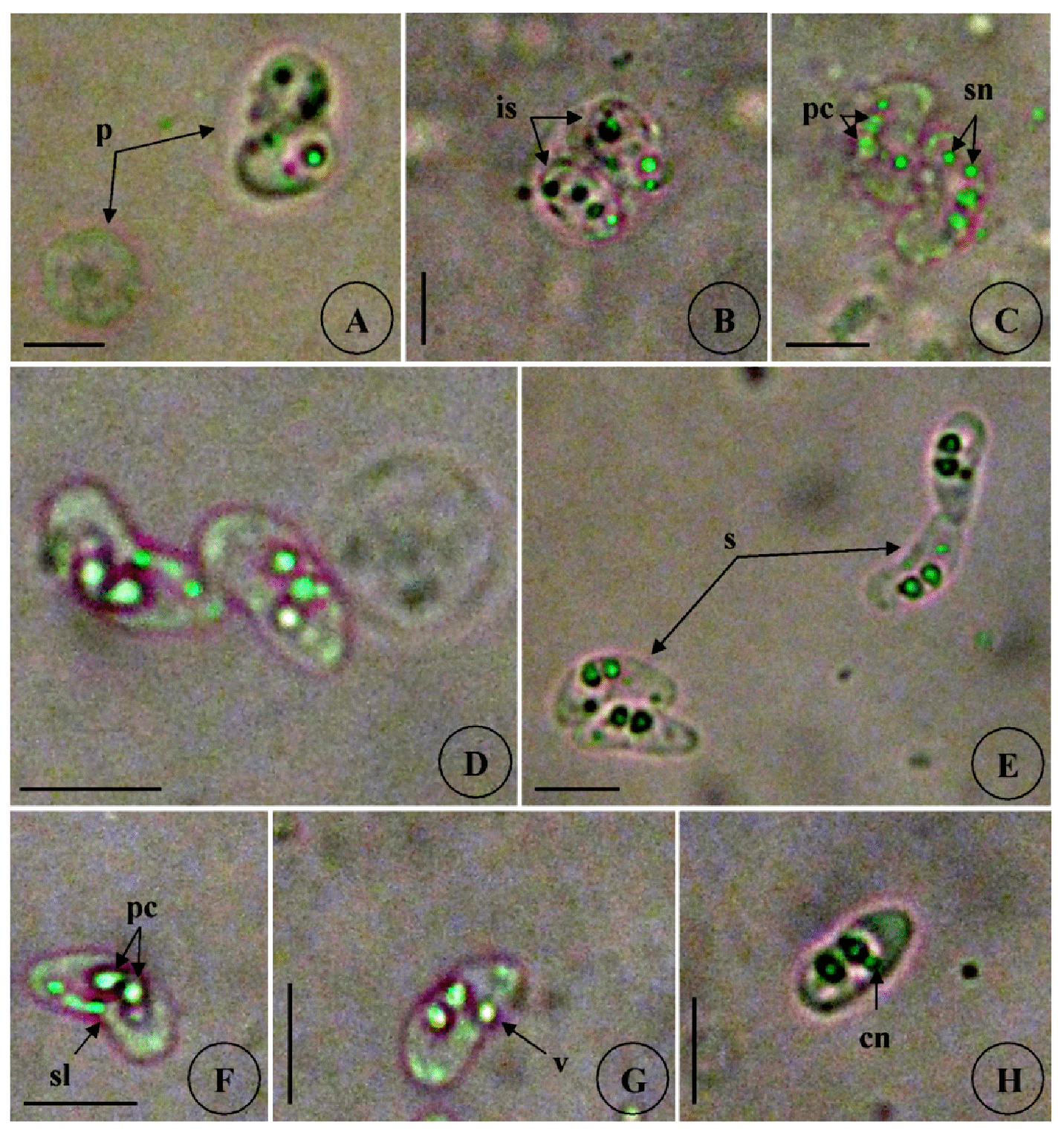
Site of infestation: Within gall bladder. Prevalence: The overall prevalence is 13 % (13 / 100). The frequency of infection is distributed as following, 05 / 2012: 0 % (0 / 10); 06 / 2012: 0 % (0 / 15); 07 / 2012: 20 % (3 / 15); 08 / 2012: 30 % (3 / 10); 04 / 2013: 12 % (3 / 25); 05 / 2013: 16 % (4 / 25) (Table 10). Mean intensity: 70.1 ± 18.4 spores / 20 µl bile / infected fish (+++++) (Table 10). Vouchers: Digitized photos of spores are deposited in the parasitological collection of the Museum National d’Histoire Naturelle (MNHN), Paris, Coll. No. ZS 134. Morphological description. Vegetative stages. Coelozoic trophozoïtes (n = 30 live trophozoïtes) are floating freely in the bile of the gall bladder without existing of any type of pseudopodia. Plasmodia are disporous, globular in shape and measured 20.8 ± 3.5 (17.0 – 24.2) µm in length and 18.7 ± 1.8 (16.5 – 20.2) µm in width (Fig 2 A – C). Each plasmodium contains two identical spores and clear endoplasm, sometimes pale with few refractive granules and inner generative cells (Figs. 2 A – C). Myxospores. Spores typical for the genus Ceratomyxa (n = 60 fresh spores). Mature spores are crescentshaped with anterior margin concave and posterior convex one in sutural view (Figs. 2 D – I) small in size, measuring 5.6 ± 0.2 (5.4 – 6.0) µm in length and 14.6 ± 0.9 (13.0 – 15.6) µm in thickness (n = 30). They are cylindrical in apical view and measuring 5.1 ± 0.3 (4.7 – 5.4) µm in width (n = 6) (Fig. 7 F). Posterior angle is slightly concave to slightly convex 152 ± 14 (126 – 172 °). The two shell valves, with rounded ends, are equal in size smoothly ovoid in lateral view (Figs. 2 D – I, 7 E). The suture line is straight, visible between valves but not conspicuous. An homogenous sporoplasm occupy most of spore cavity with numerous sporoplasmosomes. Two sporoplasm nuclei are rather small, stained symmetrically and sometimes are migrating both in one side of the shell valves (Figs. 2 C, D, G, 7 D – F). One capsulogenic nucleus is observed and presented below the polar capsule (Fig. 2 I). The two polar capsules are sub-spherical to pyriform and measuring 2.2 ± 0.3 (1.9 – 2.7) µm in length equaling 39.5 % of spore length and 1.9 ± 0.3 (1.5 – 2.4) µm in width (n = 30), they are positioned medially in anterior part of spore in sutural and lateral views (Figs. 2 D – I, 7 D – E) and centrally of spore cavity in apical view (Fig. 7 F). The polar filament wounds into three to four turns, slightly oblique to the longitudinal axis of the capsule. Taxonomic affinities. After the demise of 42 Leptotheca species to Ceratomyxa on the basis of morphometric similarities and locality in the host tissues (Gunter & Adlard 2010), several species from the Mediterranean Sea, have worth to be compared to Ceratomyxa sp. 2: C. agilis (previously Leptotheca agilis) Thélohan, 1892, C. hepseti (previously L. hepseti) Thélohan, 1895, C. lubati (Syn. L. chromis) Lubat, Radujkovic, Marques & Bouix, 1989, C. sparusaurati Sitjà-Bobadilla, Palenzuela & Alvarez-Pellitero, 1995 and Ceratomyxa sp. 2 ex Sparus aurata Alama-Bermejo, Raga & Holzer, 2011 (Tables 2,5). Based on spore morphology, the spores of C. agilis are bigger in length and smaller in thickness. The spores of C. elongata are much bigger in all levels than those of current species. C. hepseti has a larger spores. The polar capsules of C. lubati are bigger compared to those of our form. The recent species differentiates from both C. sparusaurati and C. sp 2 ex. S. aurata by having a pyriform polar capsules. Furthermore, their spores have a posterior end more concave compared with the slightly concave slightly convex one of the present species. Besides, spores and polar capsules of C. sp 2 ex. S. aurata have a large dimensions (Table 5). In other areas amongst the world, the current species is compared to 11 representatives of the genus Ceratomyxa infecting marine fishes: C. informis (syn. L. informis) Auerbach, 1910, C. declivis C. faba and C. pinguis (formerly L. pinguis) Meglitsch, 1960, C. coelorhyncha (formerly L. coelorhyncha) Yoshino & Noble, 1973, C. buri Yokoyama & Fukuda, 2001, C. cottoidii Reed, Basson, Van As & Dyková, 2007, C. cutmorei Gunter & Adlard, 2009, C. ernsti and C. jonesi Gunter, Whipps & Adlard, 2009 and C. reidi Gunter, Burger & Adlard, 2010 (Table 2). C. informis and C. pinguis are only similar in form to the present species but no measurements are matched between all of them. For C. declivis, the polar capsules are more ovoid and subspherical. Besides, according to Meglitsch (1960), the anterior margin of C. declivis was convex in sutural view, curving smoothly over the suture line and its trophozoïtes were characterized by pseudopodia-like lobopodia which are lacking at the present Species Host (s) Locality Spore Polar capsule SL ST SW PCL PCW Ceratomyxa sp. 2 (Present Oblada melanura Bay of Bizerte (Tunisia) 5.6 (5.4 / 6) 14.6 (13 / 15.6) 5.1 2.2 1.9 stuđy) (4.7 / 5.4) (1.9 / 2.7) (1.5 / 2.4). agilis Thélohan (1892) Dasyatis pastinaca Međiterranean anđ (6 / 7) (11 / 12) ND ND ND Tyrrhenian coasts
Myxosporea (Cnidaria: Myxozoa) infecting the saddled seabream Oblada melanura (L. 1758) (Teleostei: Sparidae) and the painted comber Serranus scriba (L. 1758) (Teleostei: Serranidae) in Tunisia
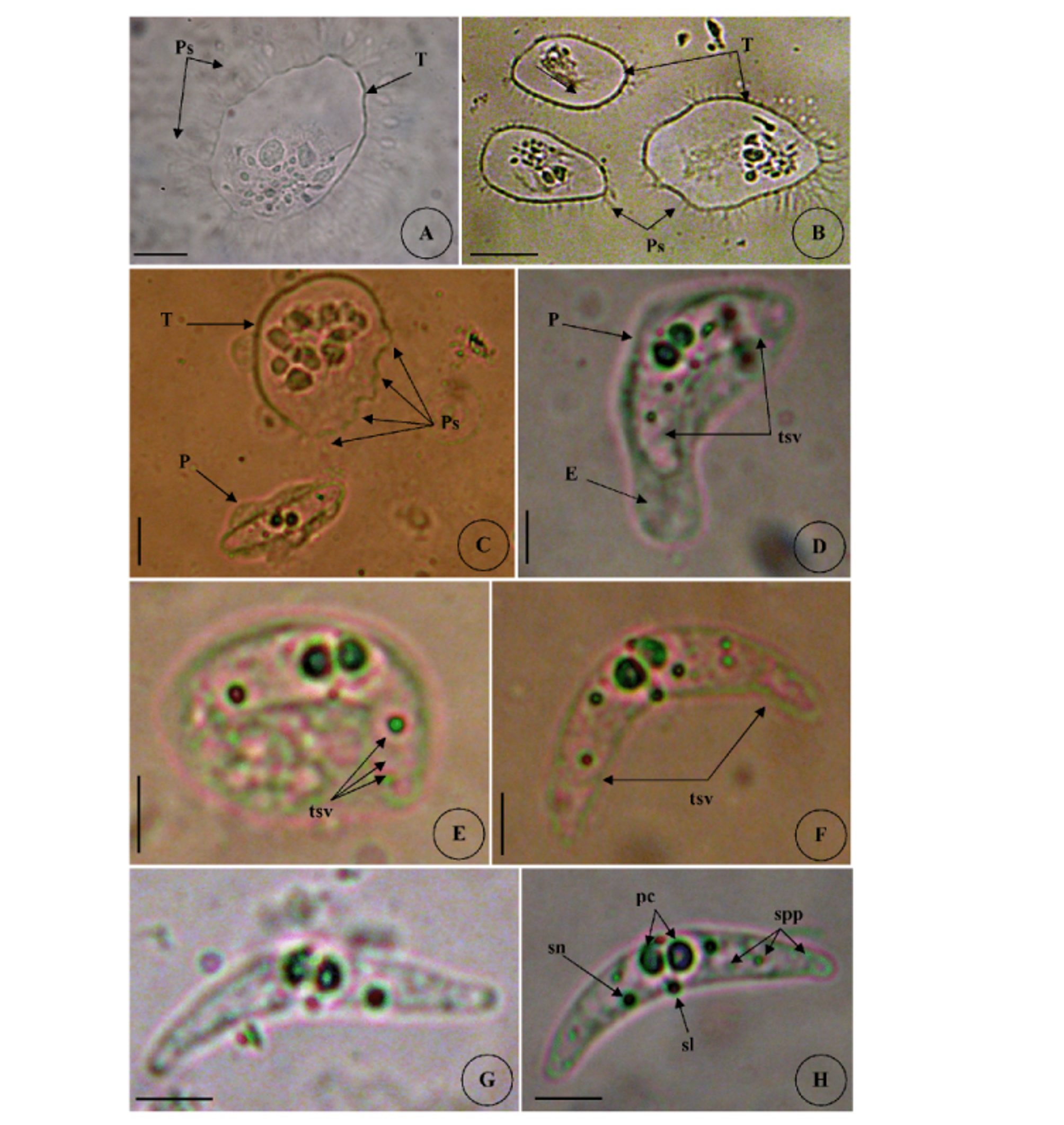
Type host: Sarpa salpa Linnaeus, 1758, goldline sea bream (Perciformes: Sparidae) Type locality: Mediterranean off Tunisia, Gulf of Tunis (36 ° 45 ’ N, 10 ° 15 ’ E). Site of infection: Within gall bladder Prevalence: The overall prevalence is 8.8 % (29 / 330) (Fig. 9). 0 % (0 / 120) fish infected in the Bay of Bizerte. The infection was confined only at Gulf of Tunis with prevalence 13.8 % (29 / 210) distributed as following, 03 / 2012: 16.7 % (5 / 30); 04 / 2012: 20 % (6 / 30); 05 / 2012: 10 % (3 / 30); 06 / 2012: 10 % (3 / 30); 07 / 2012: 20 % (6 / 30); 08 / 2012: 10 % (3 / 30); 05 / 2013: 15 % (3 / 20); 06 / 2013: 0 % (0 / 10) (see Table 4). Mean intensity: 98.5 ± 25.7 spores / infected fish (+++++) (Fig. 10) (see Table 4). Type-material: Digitized photos of syntype spores were deposited in the parasitological collection of the Museum National d’Histoire Naturelle (MNHN), Paris, Coll. No. ZS 127. Description Vegetative stages. Trophozoïtes were sub-spherical to pyriform (Figs. 5 A, B), floating freely in the bile. Some live trophozoïtes were seen with a long pseudopodia, extending on all it periphery and containing numerous refractile granules and inner generative cells (Fig. 5 A, B). Monosporic plasmodia (n = 30), measuring 23.1 ± 3.25 (18 – 27) µm in length and 38.94 ± 5.72 (32 – 48) µm in width. Each plasmodium presented one spore which the extreme part of each shell valves are twisted and surrounded with very granular endoplasm (Figs. 5 D, E). Spores (n = 30 fresh spores). Spores typical of the genus Ceratomyxa. Mature spores were elongated, arcuate to crescent-shaped in sutural view (figs. 7 A – B, 8 E) measuring 9.73 ± 0.63 (9 - 10.5) µm in length and 40.32 ± 3.83 (35 – 45) µm in thickness. Posterior angle was concave 150.2 ± 2.9 (146 – 155 °). The valves were almost equal with rounded ends and smoothly ovoid in lateral view. Anterior and posterior margins of shell valves tapered gradually to the end. A binucleate sporoplasm contained numerous sporoplasmosomes and occupied most of the spore cavity and separated by straight sutural line visible between the valves (Fig. 5 F, H). Polar capsules were pyriform 4.2 ± 0.2 (4 – 4.5) µm in length and 3.51 ± 0.39 (3 – 4) µm in width (n = 30). The polar filament formed four to five turns arranged along the longitudinal axis of the capsule. Taxonomic affinities Among the Ceratomyxa spp. reported from the Mediterranean Sea and throughout the world and under consideration of the morphological and measures characteristics of the studied species, several species seem superficially closer to the current finding. These species are: C. arcuata Thélohan, 1892 described in different hosts and localities (see Table 5). C. elongata (syn. C. lepidopusi, see Gunter & Adlard 2010), C. subtilis Meglitsch, 1960 found in the gall bladders of Lepidopus caudatus (Euphrasen, 1788) and Coelorhynchus australis (Richardson, 1838) respectively from New Zealand waters, C. rohdei Moser, Kent & Dennis, 1989 found in the gall bladder of Petroscrites fallax (Smith-Vaniz, 1976) from Australia, C. durusa Aseeva, 2003 described from the gall bladders of Limanda aspera (Pallas, 1814) and L. herzensteini (Jordan & Snyder, 1901) in Russia (Sea of Japan) and C. anko Freeman, Yokoyama & Ogawa, 2008 found in the gall bladder of the Lophius litulon (Jordan, 1902) from the Pacific coast of Japan (see Table 2). Comparative study of morphological and morphometric characteristics of the spores and polar capsules with the mentioned above species shows that the present species distinguishes from C. arcuata by having thicker spores with two shell valves narrower toward their ends compared to those of C. arcuata. The spores of C. elongata and C. durusa appear to be much thicker than those of isolate species and their polar capsules are ordinarily spherical on the contrary to the present form. For C. subtilis, only the shape of spore is closely similar to recent species, however no measurements overlap between both species. The spores of C. rohdei are shorter in length and possess two spherical polar capsules while those of the current species are pyriform. the recent finding is separated from C. anko by having two polar capsules pyriform while those of C. anko are typically spherical. Besides, the valves of the present isolate are narrower than those of C. anko. In light of these differences with closely related species, we believe that present myxozoan under study found infecting the gall bladder of S. scriba, is a morphologically a distinct species reported by the first time in S. salpa from the Mediterranean Sea. Ecological notes During this study, infection by Ceratomyxa sp. 2 was observed only at Gulf of Tunis. The overall prevalence is 8.8 %. This myxosporean has a parasitic status as satellite species. Infection by C. sp. 2 started from March to August. Prevalence and mean intensity values fluctuated with months and the maximum rate of infection was noted in April and July with 20 % (see Table 4). Overally, the mean intensity was moderate with 98.5 ± 25.7 spores per infected fish (Fig. 10). Species Host (s) Localiity Spore Polar capsule Length Thickness Length Width Ceratomyxa sp. 2 Sarpa salpa Tunisia (Gulf of 9.73 (9 – 10.5) 40.32 4.2 3.51 (Present study) Tunis) (35 – 45) (4 – 4.5) (3 – 4) Type host: Sarpa salpa Linnaeus, 1758, goldline sea bream (Perciformes: Sparidae) Type locality: Mediterranean off Tunisia, Bay of Bizerte, Tunisia (37 ° 20 ’ N, 9 ° 53 ’ E). Site of infection: Within gall bladder Prevalence: The overall prevalence is 3 % (10 / 330) (Fig. 9). None fish caught from Gulf of Tunis was parasitized with C. sp. 3. The infection was recorded only at Bay of Bizerte with prevalence 8.33 % (10 / 120) distributed as following, 03 / 2013: 0 % (0 / 30); 04 / 2013: 0 % (0 / 30); 05 / 2013: 33.3 % (10 / 30); 06 / 2013: 0 % (0 / 30) (see Table 4). Mean intensity: 35.5 ± 8.4 spores / infected fish (++++) (Fig. 10) (see Table 4). Type-material: Digitized photos of syntype spores were deposited in the parasitological collection of the Museum National d’Histoire Naturelle (MNHN), Paris, Coll. No. ZS 128. Description Vegetative stages. Trophozoïtes (n = 30) were pyriform, floating freely in the bile and measured 19.6 ± 2.05 (16.9 – 22.8) µm in length and 32.68 ± 2.57 (29.5 – 36.4) µm in width. Disporous, each plasmodium contained two identical spores with fine granules (Fig. 6 A, B). Spores (n = 30 fresh spores). Spores typical of the genus Ceratomyxa. Mature spores were narrowly crescentshaped and transversely elongate, with anterior margin slightly convex and posterior slightly concave in sutural view (Figs. 6 C – E, 8 F), measuring 7.4 ± 0.8 (6.5 – 8.5) µm in length and 30 ± 1.8 (28 – 33) µm in thickness. Posterior angle was slightly concave to straight 168.5 ± 4.2 (162 – 172 °). Two shell valves equal in size and straight sutural line visible between valves (Figs. 6 C – F). The most attractive feature was a binucleate sporoplasm not filling all the spore cavity so that the space around each polar capsule was completely free (Figs. 6 C – F). Polar capsules were typically spherical, 3 ± 0.41 (2.5 – 3.5) µm in length and 3 ± 0.41 (2.5 - 3.5) µm in width (n = 30). The polar filament coiled with four to five turns, situated perpendicularly to the longitudinal axis of the capsule. Taxonomic affinities In Mediterranean Sea, Ceratomyxa sp. 3 shows morphological resemblances to four species of Ceratomyxa which are C. pallida Thélohan, 1895 described from the gall bladders of S. salpa and B. boops in France, C. puntazzi and C. sp 1 Alama-Bermejo, Raga & Holzer, 2011 described from the gall bladders of Diplodus puntazzo (Walbaum, 1792) and Sparus aurata (Linnaeus, 1758) respectively in Spain and C. filamentosi Kalatzis, Kokkari & Katharios, 2013 described recently from the gall bladder of Aulopus filamentosus (Bloch, 1792) in Greece (Cretan sea) (see Tables 3 and 5). The comparison between mentioned above species and current isolate proves that all the measurements of C. pallida, C. puntazzi, C. filamentosi and recent species overlap, however, the difference between all of these species and the present finding is transflated in the shape and the place of sporoplasm within current spores whose does not occupy the entire spore cavity. Besides, the only species that has a disporic plasmodia as recent form, is C. puntazzi that characterized by plasmodia with very granular protoplasm and motile pseudopodia-like filopodia which are both lacking at current species. In addition, the present finding differs from C. sp. 1 ex S. aurata by having spores larger in length and much thicker. In others areas around the world, the recent species is superficially similar to C. moenei Meglitsch, 1960 found in the gall bladder of Polyprionum moene (Phillips) from New Zealand, C. seriolae Yokoyama & Fukuda, 2001 found in the gallbladder of Seriola quinqueradiata (Temminck & Schlegel, 1845) from Japan, C. azonusi Asseva, 2003 found in the gall bladder of Pleurogrammus azonus (Jordan & Metz, 1913) from Russia (Sea of Japan) and C. milleri Gunter, Whipps & Adlard, 2009 found in the gall bladder of Lutjanus fulviflamma (Forsskål, 1775) from Great Barrier Reef (Australia) (see Table 3). From the first evaluation, it was clearly that recent isolate is differentiated from all 4 species by the shape and place of sporoplasm inside the spore. Furthermore, C. moenei has a posterior margin that is more strongly concave than that of the present species. C. azonusi differs from current finding by having a pyriform polar capsules while those of the present species are typically spherical. The spores of C. milleri appear to be thinner than those of the current species besides no measurements overlap between both species. The spores of C. seriolae are shorter in length and have a smaller polar capsules compared to those of recent form. Therefore, taking account all the revealed differences with closely related congeneric species, the present myxosporean has a dissimilar morphological characteristics and it designated as a different species, not previously identified in S. salpa from the Mediterranean Sea. Ecological notes During this study, the overall prevalence is 3 %. This myxosporean has a parasitic status as scarce species. Infection by Ceratomyxa sp. 3 was restricted only in Bay of Bizerte and this species was detected only in May with prevalence 33.3 % and mean intensity 35.5 ± 8.4 spores per infected fish (see Table 4). Species Host (s) Locality Spore Polar capsule Length thickness Length Width
New observations on Myxozoa of the goldline sea bream Sarpa salpa L. 1758 (Teleostei: Sparidae) from the Mediterranean coast of Tunisia

Type host: Sarpa salpa Linnaeus, 1758 goldline sea bream (Perciformes: Sparidae) Type locality: Mediterranean off Tunisia, Gulf of Tunis (36 ° 45 ’ N, 10 ° 15 ’ E). Site of infection: Within gall bladder Prevalence: The overall prevalence is 2.1 % (7 / 330) (Fig. 9). 0 % (0 / 120) fish infected in the Bay of Bizerte. The infection was restricted to the Gulf of Tunis with prevalence 3.33 % (7 / 210) distributed as following, 03 / 2012: 0 % (0 / 30); 04 / 2012: 23.3 % (7 / 30); 05 / 2012: 0 % (0 / 30); 06 / 2012: 0 % (0 / 30); 07 / 2012: 0 % (0 / 30); 08 / 2012: 0 % (0 / 30); 05 / 2013: 0 % (0 / 20); 06 / 2013: 0 % (0 / 10) (see Table 4). Mean intensity: 47.1 ± 11.5 spores / infected fish (++++) (Fig. 10) (see Table 4). Type-material: Digitized photos of syntype spores were deposited in the parasitological collection of the Museum National d’Histoire Naturelle (MNHN), Paris, Coll. No ZS 118. Description Vegetative stages. Trophozoïtes were freely floating in bile of the gallbladder in different stages of maturation and some seen attached to each others with their pseudopodia mostly short (Fig. 4 A), Plasmodia (n = 30) were both monosporous and disporous (Figs. 4 A – E), spherical to sub-spherical with variety of size, measuring 22.5 ± 4.23 (18.9 – 29.4) µm in length and 28.6 ± 6.43 (20.5 – 37.5) µm in width. Each plasmodium occupied one or two identical spores with some refractive granules. Spores (n = 30 fresh spores). Spores typical of the genus Ceratomyxa. Mature spores were elongated in sutural view (Fig. 4 F, 8 D) measuring in 7.32 ± 0.52 (6.52 – 7.92) µm in length and in 29.32 ± 1.5 (27.8 – 31.8) µm in breadth of central portion and 67.98 ± 2.44 (64.9 – 70.1) µm in total thickness. Enlarged valves were greatly extended and presented almost the half of the length of the spore. They are twisted forming with the basal plane of the spore an angle high-pitched in each side α = 35.6 ± 12.3 (28 – 57 °) (Fig. 4 F). Polar capsules were spherical and convergent 3.26 ± 0.23 (3 – 3.5) µm in length and 3.26 ± 0.23 (3 – 3.5) µm in width (n = 30). Numbers of turns of polar filament coil appeared to be 4 – 5. Sporoplasm finely granular and suture line perpendicular to the basal plane. Rarely, atypical spores with three valves, possessing three polar capsules, were observed (Fig. 4 H). Taxonomic affinities The recent isolate species has a specific feature with the presence of enlarged valves “ appendages ” which make it distinguishable from other confamiliar known Ceratomyxa spp. Over all the species of Ceratomyxa described in Mediterranean Sea or from different part of the world, the current species appears to be morphologically similar only to one species C. taenia Davis, 1917 described from the gall bladder of elasmobranch species Scoliodon terra-novae (Richardson, 1836) from the Atlantic Ocean (USA) (see Table 1). However, the present finding can be clearly separated from C. taenia by having spores larger in length and smaller in both breath of central part and total thickness. Furthermore, the average range of polar capsules of the current species is bigger than those of C. taenia and the angle between the shell valves and the basal plane is high-pitched for present form while it is right for C. taenia. On the other hand, the original report of C. taenia noted that this species has merely a disporic plasmodia on the contrary to the present form. In view of the morphological differences, host and locality records, this species is considered distinct and designated as unknown species identified by the first time in sparid host S. salpa from the Mediterranean Sea. Ecological notes During this study, the overall prevalence is 2.1 %. This myxosporean has a parasitic status as satellite species. Infection by Ceratomyxa sp. 1 was restricted only in Gulf of Tunis and this species was detected only in April with prevalence 23.3 % and mean intensity 47.1 ± 11.5 spores per infected fish (see Table 4). (measurements are in micrometer). Species Host Locality Spore Polar capsule Length Breadth of Thickness Length Width central portion Ceratomyxa sp. 1 Sarpa salpa Tunisia (Gulf of 7.32 29.32 67.98 3.26 3.26 (Present study) Tunis) (6.52 – 7.92) (27.8 – 31.8) (64.9 – 70.1) (3 – 3.5) (3 – 3.5)
New observations on Myxozoa of the goldline sea bream Sarpa salpa L. 1758 (Teleostei: Sparidae) from the Mediterranean coast of Tunisia

Export occurrence data

Darwin Core Archive (ZIP)

GEOGRAPHY

Distribution Map

Occurrence Map

Loading map…

Tiles © GBIF Maps API | Map powered by MapLibre GL

REGIONS

Geographic Distribution(2)

DK
not evaluated
NO

DATA

Occurrence Datasets

Loading datasets…

Common names used for this species across different languages and regions.

jpnミカヅキムシ属jpn

Vernacular (common) names are the everyday names used for a species in different languages and regions. A single species may have dozens of common names worldwide.

jpnミカヅキムシ属
jpn
Source: Catalogue of LifeSource taxon #299621559

CLASSIFICATION

Taxonomic Classification Tree

RELATED

Related Name Usages(20)

Matching names from other GBIF-indexed checklists and datasets.

MULTIMEDIA

Media Files(12)

FIGURE 3. Photomicrographs of Ceratomyxa sp. 1 from the gall bladder of Serranus scriba. (A – F) Variable forms of fresh mature spores in sutural view presenting the pyriform polar capsules (pc), the straight suture line (sl), the sporoplasmic nuclei (sn), the capsulogenic nucleus (cn) and the unequal valves. Scale bar = 10 µm.

Imageimage/png© Laamiri, SayefMyxosporea (Cnidaria: Myxozoa) infecting the saddled seabream Oblada melanura (L. 1758) (Teleostei: Sparidae) and the painted comber Serranus scriba (L. 1758) (Teleostei: Serranidae) in Tunisia

FIGURE 4. Photomicrographs of Ceratomyxa sp. 2 from the gall bladder of Serranus scriba. (A – B) Fresh mature spores in sutural view. (C) Mature spore in lateral view with two pyriform polar capsules (pc) and two sporoplasmic nuclei (sn). (D – F) Mature spores in apical view. Scale bar = 10 µm.

Imageimage/png© Laamiri, SayefMyxosporea (Cnidaria: Myxozoa) infecting the saddled seabream Oblada melanura (L. 1758) (Teleostei: Sparidae) and the painted comber Serranus scriba (L. 1758) (Teleostei: Serranidae) in Tunisia

FIGURE 1. Photomicrographs of Ceratomyxa sp. 1 from the gall bladder of Oblada melanura. (A – E) Disporic sub-spherical to spherical plasmodia (p) containing each one two identical spores surrounded with vary refractive granules (g), Notice the presence of two capsulogenic nuclei (cn) and numerous sporoplasmosomes (spp). (F) Fresh smear contains disporic plasmodia (p) and Mature spores (s). (G) mature spore in sutural view showing the spherical polar capsules (pc), the straight suture line (sl), the sporoplasmic nuclei (sn), the capsulogenic nuclei (cn) and the unequal shell valves. (H) mature spore in lateral view. Scale bar = 20 µm in F; 10 µm in A – E, G – H.

Imageimage/png© Laamiri, SayefMyxosporea (Cnidaria: Myxozoa) infecting the saddled seabream Oblada melanura (L. 1758) (Teleostei: Sparidae) and the painted comber Serranus scriba (L. 1758) (Teleostei: Serranidae) in Tunisia

FIGURE 2. Photomicrographs of Ceratomyxa sp. 2 from the gall bladder of Oblada melanura. (A – C) Globular to subspherical disporic plasmodia (p), notice the presence of immature spores (is) within plasmodium in B and the migration of two sporoplasmic nuclei (sn) in one side of pre – mature spore in C. (D – E) Fresh smears of mature spores. (F – H) Variable forms of mature spores in sutural view showing the pyriform polar capsules (pc), the suture line (sl) and an iodinophilous vacuole (v). (H) Mature spore in lateral view presented one capsulogenic nucleus (cn) below the polar capsule. Scale bar = 10 µm.

Imageimage/png© Laamiri, SayefMyxosporea (Cnidaria: Myxozoa) infecting the saddled seabream Oblada melanura (L. 1758) (Teleostei: Sparidae) and the painted comber Serranus scriba (L. 1758) (Teleostei: Serranidae) in Tunisia

FIGURE 7. Line drawing of Myxozoan species infecting the saddle seabream Oblada melanura from the Bay of Bizerte, Tunisia. (A – C) Variable forms of Ceratomyxa sp. 1 in sutural view (A), in lateral view (B), in apical view (C). (D – F) Variable forms of Ceratomyxa sp. 2 in sutural view (D), in lateral view (E), in apical view (F). Scale bar = 10 µm.

Imageimage/png© Laamiri, SayefMyxosporea (Cnidaria: Myxozoa) infecting the saddled seabream Oblada melanura (L. 1758) (Teleostei: Sparidae) and the painted comber Serranus scriba (L. 1758) (Teleostei: Serranidae) in Tunisia

FIGURE 5. Photomicrographs of Ceratomyxa sp. 2 from the gall bladder of Sarpa salpa. (A – B) Live multinucleate trophozoites (T) with different size floating in the bile with their long pseudopodia that extended fromall it periphery (Ps). (C) Round multinucleate trophozoite (T) with short pseudopodia (Ps), notice a monosporic plasmodium (P) contained one spore in apical view. (D – E) Live monosporic plasmodia with very granular endoplasm. The arrows show the twist of the shell valves. (F) Mature spore which the twisted shell valves (tsv) started to extend. (G) Fresh mature spore in lateral view. (H) Fresh mature spore in sutural view, showing the distinct pyriform polar capsules (pc) and the straight suture line (sl). Scale bar = 20 µm in A – C; 10 µm in D – H.

Imageimage/png© Laamiri, SayefNew observations on Myxozoa of the goldline sea bream Sarpa salpa L. 1758 (Teleostei: Sparidae) from the Mediterranean coast of Tunisia

IMAGES

Gallery(12)

See Gallery

Occurrences with images

CITATIONS

References(19)

  • 1

    Aphia 2006

    habitat flag sourceThe Interim Register of Marine and Nonmarine Genera
  • 2

    Bull. Soc. Philom. Paris, (8) 4, 171

    original descriptionThe Interim Register of Marine and Nonmarine Genera
  • 3

    Cairns, S.D., L. Gershwin, F.J. Brook, P. Pugh, E.W. Dawson, O.V. Ocaña, W. Vervoort, G. Williams, J.E. Watson, D.M. Opresko, P. Schuchert, P.M. Hine, D.P. Gordon, H.I. Campbell, A.J. Wright, J.A.Sánchez & D.G. Fautin. (2009). Phylum Cnidaria: corals, medusae, hydroids, myxozoans. <em>in: Gordon, D.P. (Ed.) (2009). New Zealand inventory of biodiversity: 1. Kingdom Animalia: Radiata, Lophotrochozoa, Deuterostomia.</em> :59-101.

    additional sourceWorld Register of Marine Species
  • 4

    Eiras, J. C. (2006). Synopsis of the species of Ceratomyxa Thélohan, 1892 (Myxozoa: Myxosporea: Ceratomyxidae). <em>Systematic Parasitology.</em> 65(1): 49-71.

    additional sourceWorld Register of Marine SpeciesDOI: 10.1007/s11230-006-9039-5
  • 5

    Fiala, I.; Bartošová-Sojková, P.; Whipps, C. M. (2015). Classification and phylogenetics of Myxozoa. <em>In: B. Okamura et al. (eds.), Myxozoan Evolution, Ecology and Development. Springer, Switzerland.</em> pp. 85-110.

    additional sourceWorld Register of Marine SpeciesDOI: 10.1007/978-3-319-14753-6_5
  • Source Information

    GBIF Backbone Taxonomy

    GBIF Backbone Taxonomy

    checklist

    The GBIF Backbone Taxonomy is a single, synthetic management classification with the goal of covering all names GBIF is dealing with. It's the taxonomic backbone that allows GBIF to integrate name based information from different resources, no matter if these are occurrence datasets, species pages, names from nomenclators or external sources like EOL, Genbank or IUCN. This backbone allows taxonomic search, browse and reporting operations across all those resources in a consistent way and to provide means to crosswalk names from one source to another.

    It is updated regulary through an automated process in which the Catalogue of Life acts as a starting point also providing the complete higher classification above families. Additional scientific names only found in other authoritative nomenclatural and taxonomic datasets are then merged into the tree, thus extending the original catalogue and broadening the backbones name coverage. The GBIF Backbone taxonomy also includes identifiers for Operational Taxonomic Units (OTUs) drawn from the barcoding resources iBOL and UNITE.

    International Barcode of Life project (iBOL), Barcode Index Numbers (BINs). BINs are connected to a taxon name and its classification by taking into account all names applied to the BIN and picking names with at least 80% consensus. If there is no consensus of name at the species level, the selection process is repeated moving up the major Linnaean ranks until consensus is achieved.

    UNITE - Unified system for the DNA based fungal species, Species Hypotheses (SHs). SHs are connected to a taxon name and its classification based on the determination of the RefS (reference sequence) if present or the RepS (representative sequence). In the latter case, if there is no match in the UNITE taxonomy, the lowest rank with 100% consensus within the SH will be used.

    The GBIF Backbone Taxonomy is available for download at https://hosted-datasets.gbif.org/datasets/backbone/ in different formats together with an archive of all previous versions.

    The following 105 sources have been used to assemble the GBIF backbone with number of names given in brackets:

    • Catalogue of Life Checklist - 4766428 names
    • International Barcode of Life project (iBOL) Barcode Index Numbers (BINs) - 635951 names
    • UNITE - Unified system for the DNA based fungal species linked to the classification - 611208 names
    • The Paleobiology Database - 212054 names
    • World Register of Marine Species - 188857 names
    • The Interim Register of Marine and Nonmarine Genera - 183894 names
    • The World Checklist of Vascular Plants (WCVP) - 131891 names
    • GBIF Backbone Taxonomy - 114350 names
    • TAXREF - 109374 names
    • The Leipzig catalogue of vascular plants - 75380 names
    • ZooBank - 73549 names
    • Integrated Taxonomic Information System (ITIS) - 68377 names
    • Plazi.org taxonomic treatments database - 61346 names
    • Genome Taxonomy Database r207 - 60545 names
    • International Plant Names Index - 52329 names
    • Fauna Europaea - 45077 names
    • The National Checklist of Taiwan (Catalogue of Life in Taiwan, TaiCoL) - 36193 names
    • Dyntaxa. Svensk taxonomisk databas - 35892 names
    • The Plant List with literature - 32692 names
    • United Kingdom Species Inventory (UKSI) - 29643 names
    • Artsnavnebasen - 29208 names
    • The IUCN Red List of Threatened Species - 21221 names
    • Afromoths, online database of Afrotropical moth species (Lepidoptera) - 13961 names
    • Brazilian Flora 2020 project - Projeto Flora do Brasil 2020 - 13829 names
    • Prokaryotic Nomenclature Up-to-Date (PNU) - 10079 names
    • Checklist Dutch Species Register - Nederlands Soortenregister - 8814 names
    • ICTV Master Species List (MSL) - 7852 names
    • Cockroach Species File - 6020 names
    • GRIN Taxonomy - 5882 names
    • Taxon list of fungi and fungal-like organisms from Germany compiled by the DGfM - 4570 names
    • Catalogue of Afrotropical Bees - 3623 names
    • Catalogue of Tenebrionidae (Coleoptera) of North America - 3327 names
    • Checklist of Beetles (Coleoptera) of Canada and Alaska. Second Edition. - 3312 names
    • Systema Dipterorum - 2850 names
    • Catalogue of the Pterophoroidea of the World - 2807 names
    • The Clements Checklist - 2675 names
    • Taxon list of Hymenoptera from Germany compiled in the context of the GBOL project - 2496 names
    • IOC World Bird List, v13.2 - 2366 names
    • Official Lists and Indexes of Names in Zoology - 2310 names
    • National checklist of all species occurring in Denmark - 1922 names
    • Myriatrix - 1876 names
    • Database of Vascular Plants of Canada (VASCAN) - 1822 names
    • Taxon list of vascular plants from Bavaria, Germany compiled in the context of the BFL project - 1771 names
    • Orthoptera Species File - 1742 names
    • A list of the terrestrial fungi, flora and fauna of Madeira and Selvagens archipelagos - 1602 names
    • Aphid Species File - 1565 names
    • World Spider Catalog - 1561 names
    • Taxon list of Jurassic Pisces of the Tethys Palaeo-Environment compiled at the SNSB-JME - 1270 names
    • Backbone Family Classification Patch - 1143 names
    • GBIF Algae Classification - 1100 names
    • International Cichorieae Network (ICN): Cichorieae Portal - 975 names
    • Psocodea Species File - 803 names
    • New Zealand Marine Macroalgae Species Checklist - 787 names
    • Annotated checklist of endemic species from the Western Balkans - 754 names
    • Taxon list of animals with German names (worldwide) compiled at the SMNS - 503 names
    • Catalogue of the Alucitoidea of the World - 472 names
    • Lygaeoidea Species File - 462 names
    • Catálogo de Plantas y Líquenes de Colombia - 422 names
    • GBIF Backbone Patch - 317 names
    • Phasmida Species File - 259 names
    • Cortinariaceae fetched from the Index Fungorum API - 234 names
    • Coreoidea Species File - 233 names
    • GTDB supplement - 139 names
    • Mantodea Species File - 119 names
    • Endemic species in Taiwan - 93 names
    • Taxon list of Araneae from Germany compiled in the context of the GBOL project - 88 names
    • Species of Hominidae - 78 names
    • Taxon list of Sternorrhyncha from Germany compiled in the context of the GBOL project - 77 names
    • Taxon list of mosses from Germany compiled in the context of the GBOL project - 75 names
    • Mammal Species of the World - 73 names
    • Plecoptera Species File - 71 names
    • Species Fungorum Plus - 64 names
    • Catalogue of the type specimens of Cosmopterigidae (Lepidoptera: Gelechioidea) from research collections of the Zoological Institute, Russian Academy of Sciences - 47 names
    • Species named after famous people - 41 names
    • Dermaptera Species File - 36 names
    • Taxon list of Trichoptera from Germany compiled in the context of the GBOL project - 34 names
    • True Fruit Flies (Diptera, Tephritidae) of the Afrotropical Region - 33 names
    • Range and Regularities in the Distribution of Earthworms of the Earthworms of the USSR Fauna. Perel, 1979 - 32 names
    • Taxon list of Diplura from Germany compiled in the context of the GBOL project - 30 names
    • Lista de referencia de especies de aves de Colombia - 2022 - 24 names
    • Taxon list of Auchenorrhyncha from Germany compiled in the context of the GBOL project - 20 names
    • Catalogue of the type specimens of Polycestinae (Coleoptera: Buprestidae) from research collections of the Zoological Institute, Russian Academy of Sciences - 19 names
    • Taxon list of Thysanoptera from Germany compiled in the context of the GBOL project - 19 names
    • Lista de especies de vertebrados registrados en jurisdicción del Departamento del Huila - 18 names
    • Taxon list of Microcoryphia (Archaeognatha) from Germany compiled in the context of the GBOL project - 15 names
    • Catalogue of the type specimens of Bufonidae and Megophryidae (Amphibia: Anura) from research collections of the Zoological Institute, Russian Academy of Sciences - 12 names
    • Grylloblattodea Species File - 11 names
    • Coleorrhyncha Species File - 9 names
    • Taxon list of liverworts from Germany compiled in the context of the GBOL project - 9 names
    • Embioptera Species File - 7 names
    • Taxon list of Pisces and Cyclostoma from Germany compiled in the context of the GBOL project - 6 names
    • Taxon list of Pteridophyta from Germany compiled in the context of the GBOL project - 6 names
    • Taxon list of Siphonaptera from Germany compiled in the context of the GBOL project - 5 names
    • The Earthworms of the Fauna of Russia. Perel, 1997 - 5 names
    • Taxon list of Zygentoma from Germany compiled in the context of the GBOL project - 4 names
    • Asiloid Flies: new taxa of Diptera: Apioceridae, Asilidae, and Mydidae - 3 names
    • Taxon list of Protura from Germany compiled in the context of the GBOL project - 3 names
    • Taxon list of hornworts from Germany compiled in the context of the GBOL project - 2 names
    • Chrysididae Species File - 1 names
    • Taxon list of Dermaptera from Germany compiled in the context of the GBOL project - 1 names
    • Taxon list of Diplopoda from Germany in the context of the GBOL project - 1 names
    • Taxon list of Orthoptera (Grashoppers) from Germany compiled at the SNSB - 1 names
    • Taxon list of Pscoptera from Germany compiled in the context of the GBOL project - 1 names
    • Taxon list of Pseudoscorpiones from Germany compiled in the context of the GBOL project - 1 names
    • Taxon list of Raphidioptera from Germany compiled in the context of the GBOL project - 1 names

    GBIF Secretariat (2023). GBIF Backbone Taxonomy. Checklist dataset https://doi.org/10.15468/39omei accessed via GBIF.org on 2026-06-16.

    CC BYPublished 8/28/2023View dataset
    GBIF Usage Key
    2269597
    Dataset Key
    d7dddbf4-2cf0-4f39-9b2a-bb099caae36c
    Origin
    source
    Backbone Key
    2269597
    Taxon ID
    gbif:2269597
    Last Crawled
    8/22/2023
    Last Interpreted
    8/22/2023