
Styelidae
sjöknoppar(+10)
GBIF:2331886
0
Descendants
0
Synonyms
0
Children
0
Species
0
Genera
PROFILE
Species Profile
Habitat
ABOUT
Descriptions(1)
Styelidae
Cnemidocarpa acanthifera Monniot n. sp. (Figures 17–18)
Station 80: 820 m.
Ethymology: in Greek acantha = spine.
The holotype fixed in alcohol, 15 mm in body length, has a short narrow peduncle ending in rhizoids (Fig. 17 B), a naked tunic, except a belt of tunic filaments at 1/3 of the body length at the base of the siphons (Fig. 17 B). Both siphons are long, close to each other with a cross-shaped opening. Thicker on the siphons, the tunic is paper-like elsewhere and adheres to the body wall. The internal lining and the external surface of the siphons are covered with dense spinules. The spinules (Fig. 17 A) are 120 µm long and sharp reminding of those of the Pyuridae family. The body wall (Fig. 18 C) is entirely filled with dense transverse and longitudinal muscle fibres regularly distributed. Few short oral tentacles (Fig. 18 B) in two orders of size are inserted at the base of a thick blade; this membrane has minute folds resulting in a scalloped image (Fig. 18 B). The dorsal tubercle is erect in a protruding button with a circular opening (Fig. 18 B). The branchial sac was partly extruded through a hole of the body wall. The dorsal lamina is tall and smooth edged. There are 4 low branchial folds on each side, but the distinction between the vessels belonging to the folds and the intermediate vessels is not obvious. A tentative formula on the right side is:
E- 4 – 8 – 6 – 8 – 5 - 9 – 5 – 14 -6 –DL.
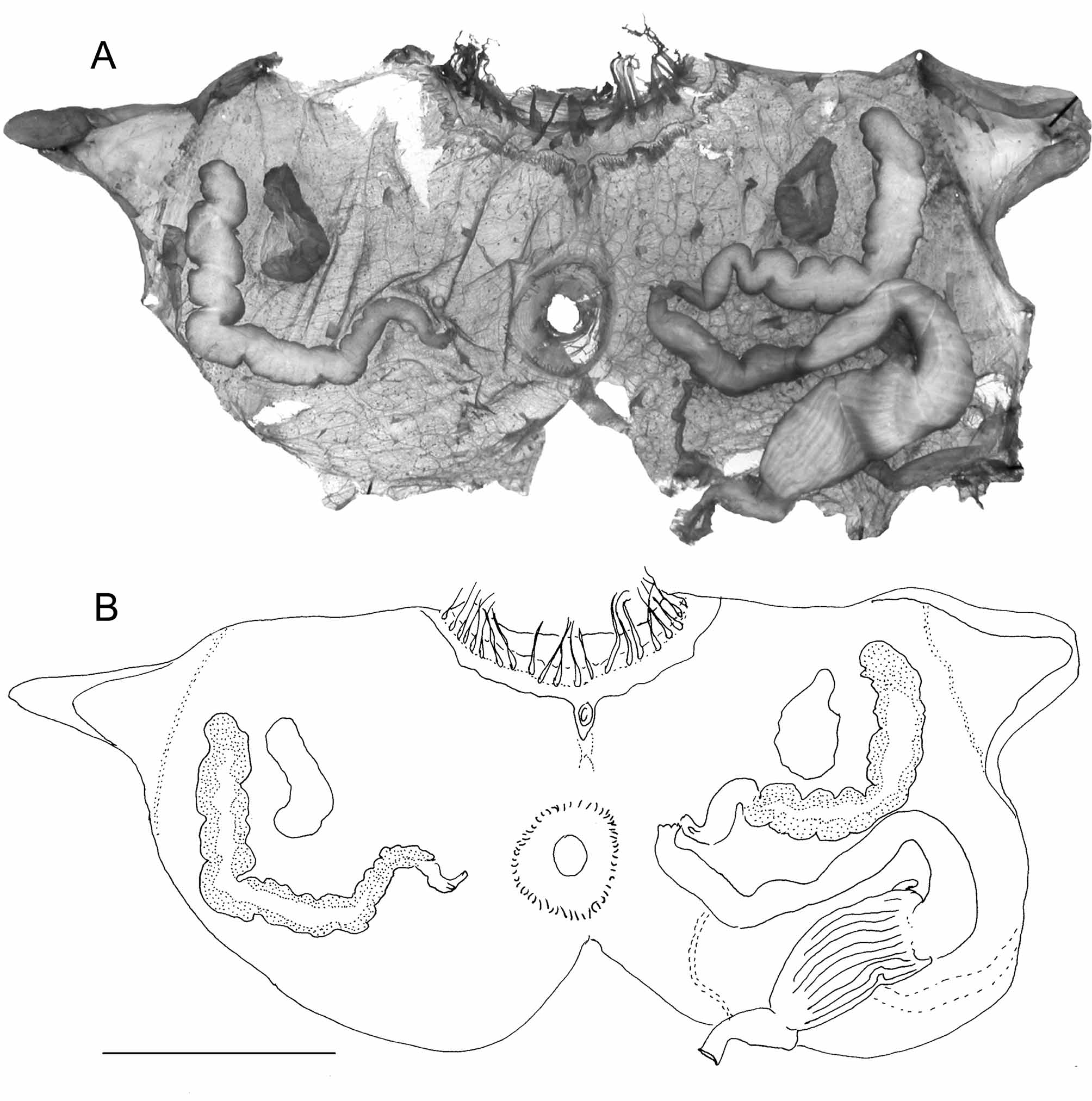
There are 4 long stigmata per mesh between the folds. Thin transverse vessels cross the stigmata and in some parts cut them into two rows. The digestive tract (Fig. 18 AC) is located in the posterior part of the left body side. A short tubular oesophagus enters in a globular stomach, internally folded. The primary intestinal loop is short and closed. The secondary loop forms a right angle and ends in a lobed anus. The intestine is linked to the oesophagus by a bridle at the level of the secondary intestinal curve. There are 2 sinuous elongated gonads on each side (Fig. 18 AC).The testis lobes line the central ovary on both sides. The sperm duct runs along the internal side of the ovary ending in a protruding papilla erect above a short apical oviduct. The endocarps are not numerous: on the right side two of them are between the gonads and 4 others more posteriorly; on the left side there is one endocarp on each side of the most posterior gonad and 2 smaller ones posterior to the gut (Fig. 18 AC). The atrial aperture begins with a ring of filiform papillae (Fig. 18 A).
The elongate body shape, the gut and the gonads remind the structure of the tropical species Cnemidocarpa aculeata Kott, 1985 . The latter differs in having sessile apertures, no peduncle, no spinules and more branchial sinuses on the folds. The geographic and bathymetric distances also lead to separate the species.
The sequence for the holotype (S1 CNE 231) is deposited in BOLD under ASCAN032-10. No close hit in BOLD (best: 78.8%).
Cnemidocarpa drygalskii (Hartmeyer, 1911)
Tethyum drygalskii Hartmeyer, 1911: 452 . Cnemidocarpa drygalskii: Monniot C. 1978: 190 figs 3D, 8. Monniot & Monniot 1983: 69 fig. 13C, D, and synonymy. Sanamyan & Sanamyan 1999: 1850; 2002: 341.
Station: 65(322).
Of the two collected specimens one is in better condition, 24 x 15 mm, with a reticulated surface. The sessile siphons are well separated the body wall is thin. Twenty longer tentacles are intercalated with shorter ones. The dorsal tubercle in a C opens to the left side, inserted in a deep V of the peripharyngeal band. In its anterior part the dorsal lamina has a dented edge, farther its height increases and takes a plain edge. The most dorsal of the 4 branchial folds is thicker. Six to 8 longitudinal vessels were counted between the folds and an average of 3 stigmata in a mesh. The stomach has longitudinal folds, 8 to 9 were seen on its internal side. No gastric caecum was found. The long rectum ends in a lobed anus. The long and sinuous gonad on each side has testis follicles lying beneath the ovary. The gonoducts are joined and long, they reach the base of the atrial opening. Numerous foliated endocarps only cover the half ventral side of the body and are present inside the gut loop.
One sequence for specimen S1 CNE 227 (BOLD: ASCAN033-10). No close hit in BOLD (best: 80.73%). C. drygalskii is recorded from the Antarctic and Sub-Antarctic regions with a large bathymetric range.
Cnemidocarpa nordenskjoldi (Michaelsen, 1898)
Styela nordenskjoldi, Michaelsen, 1898: 565 . Cnemidocarpa nordenskjoldi: Millar 1960: 101 fig. 36A, C, D. Monniot & Monniot, 1983: 70 fig. 13 A, B and synonymy.
Station: 35.
Hemispherical, 18 mm in diameter, the single specimen was attached by a flat base. The apertures are distant from 1/3 of the body width. The strong tunic is granulated. The body wall is very muscular in the anterior part and posteriorly becomes thin without muscles. The oral tentacles are very numerous. The dorsal tubercle opens in a C to the left side. The dorsal lamina is a high blade. Four large folds are on each side of the branchial sac. The gut is only linked to the body wall by thin ligaments. The stomach has no caecum. The long intestine ends in a lobed anus. The digestive loop overpasses the ventral line toward the right body side. A long gonad lies on each side of the body, lined with 8 to 10 endocarps, as drawn by Monniot & Monniot (1983 Fig. 13 A). The whole internal surface of the atrial velum is covered with long filiform papillae.
All the observed characters of this single specimen correspond to previous descriptions; C. nordenskjoldi was only recorded from the Magellan region and Falkland Islands at low depth. Its presence in Terre Adélie widely increases its geographic distribution.
Cnemidocarpa pfefferi (Michaelsen, 1898) (Figure 19)
Styela pfefferi, Michaelsen, 1918: 367 . Cnemidocarpa pfefferi: Millar 1960: 100 fig. 35A, B, C. Monniot & Monniot 1983:69 and synonymy; 1994: 32. Primo & Vazquez 2007: 1798.
Stations (events when several per station): 2-42-62-65(322).
The specimens are oval and fixed by a narrow base. Both siphons are sessile, well apart, with 4 lobes. The tunic is white with a smooth surface. In Terre Adélie the body size varies from 14 to 45 mm. The thin body wall has uniformly distributed muscular fibres, regularly crossed (Fig. 19 A). The oral tentacles are numerous, thin and long. The dorsal tubercle opens in a U with horns poorly curved. The dorsal lamina is a plain high membrane. The branchial formula on the right side of the largest specimen is:
E - 7- 20 – 17 – 30 – 16 – 27 – 16 – 24 – 4 – DL.
Parastigmatic vessels cross the long stigmata. The oesophagus is long and narrow, the stomach is also long (Fig. 19 A), and has about 20 folds and a small caecum. The anus with round lobes is linked to the oesophagus.The simple gut loop is only attached to the body wall by ligaments. Two gonads lie on each side (Fig. 19 A, B): they have a characteristic shape with a central branched ovary and testis vesicles covering the apex of each ovarian lobe as drawn by Millar (1960 Fig. 35 A).The male gonoducts join in a single sperm duct running above the ovary and opening close to the female papilla. Numerous foliated endocarps are distributed on the whole internal body wall (Fig. 19 B). A ring of papillae circles the atrial opening.
Two identical sequences for specimen S1 CNE 225 (BOLD: ASCAN036-10) and specimen S1 CNE 223 (BOLD: ASCAN035-10). No close hit in BOLD (best: 77.64%).
C. pfefferi has a wide distribution in the Southern Ocean. Maximal depth of collection was in Terre Adélie with 770 m.
Cnemidocarpa univesica Monniot n. sp. (Figures 20, 21)
Cnemidocarpa sp. Monniot & Monniot, 1983: 70.
Stations: 32–80.
The general shape of both specimens is ovoid, ending in a short thick peduncle (Fig. 20 A). The atrial siphon is apical, the oral siphon opens at mid-length of the body, and both are sessile with an external ring of round papillae similar to those found in some Culeolus species. The whole surface of the tunic is granular (Fig. 20 A).The branchial tissue bursts through the body wall in one of the specimens. The body wall strongly adheres to the thin tunic. The musculature is made of thin criss-crossed fibres on the body but both apertures have true sphincters. About 28 oral tentacles are intercalated with smaller ones. They arise at the base of a short velum. The peripharyngeal band is dorsally curved in a deep narrow V. The dorsal tubercle has a C-shaped slit opening to the left. The long dorsal lamina becomes progressively higher toward the oesophagus (Fig. 20 B). The branchial tissue is thin with 4 well separated folds on each side (Fig. 20 B). In both specimens the first fold on the right side of the dorsal lamina is thicker (Fig. 20 B). The branchial formula on the right side in the holotype is:
E - 4 - 8 - 5 – 14 -5 – 14 – 5 – 20 – 4- DL
The stigmata are rarely cut by parastigmatic vessels. A long oesophagus and a long stomach constitute the main part of the ascending limb of the gut loop (Fig. 21). A small coma-like caecum is at the pyloric end of the stomach. The stomach is linked to the body wall by a strong bridle. The intestine draws a wide secondary loop and ends in an anus with 6 lobes. There is one long sinuous gonad on each side curved in an arc (Fig. 21). Each of them is made of a central ovary flanked on each side by compact testis vesicles. The genital papillae are terminal, close to the anus on the left side. A single large endocarp takes place into the curve of each gonad (Fig. 21). A ring of tentacles lines the atrial aperture.
Cnemidocarpa univesica is very similar to the damaged specimen of Cnemidocarpa sp. Monniot and Monniot, 1983. They have in common the body shape, the same branchial structure, a long gonad and a single endocarp on each side. Collected in the same geographic area they certainly belong to the same species.
One sequence for the paratype specimen S1 CNE 229 (BOLD: ASCAN037-10). No close hit in BOLD (best: 76.94%).
Cnemidocarpa verrucosa (Lesson, 1830)
Cynthia verrucosa, Lesson, 1830: 151 . Cnemidocarpa verrucosa: Van Name 1945: 272 . Kott 1969: 107. Monniot & Monniot, 1983: 68 and synonymy. Primo & Vazquez 2007: 1798.
Stations (events when several trawling operations per station): 5-11(424)- 12-17-42 -65(322)-79-80.
This species is named after the spines of the tunic, but these protrusions are less developed on the very large specimens. The body is attached to the substrate either by a narrow or larger base or with irregular extensions of the tunic. The siphons are distant from each other at angles of a triangular body. The musculature of the body wall is dense with regularly crossed fibres. The dorsal tubercle opens anteriorly with internally curled horns. The short dorsal lamina is prolonged behind the oesophagus entrance by a high blade. The 4 branchial folds are high and 4 to 5 longitudinal vessels between the folds separate large meshes without parastigmatic vessels. The gut is a simple loop with a long stomach and a multilobed anus. There is no gastric caecum. There are generally 2 long gonads on each side but sometimes only one on the left. Numerous endocarps are distributed on each side of the body wall. A ring of filiform tentacles is at the base of the atrial opening.
No close hit in BOLD for the sequence from specimen S1 CNE 221 (BOLD: ASCAN039-10), although there is another sequence identified as the same species. Additional work with more specimens would be necessary.
C. verrucosa is a very common species from the Antarctic and Sub-Antarctic shallow and bathyal depths. It reaches here 770 m depth.
Export occurrence data
Darwin Core Archive (ZIP)
GEOGRAPHY
Distribution Map
REGIONS
Geographic Distribution(3)
DATA
Occurrence Datasets
Common names used for this species across different languages and regions. Available in 5 languages and 1 country. 1 preferred.
Vernacular (common) names are the everyday names used for a species in different languages and regions. A single species may have dozens of common names worldwide. This taxon has names in 5 languages. 1 name preferred.
CLASSIFICATION
Taxonomic Classification Tree

NOMENCLATURE
Synonyms(2)
RELATED
Related Name Usages(20)
Matching names from other GBIF-indexed checklists and datasets.
MULTIMEDIA
Media Files(7)
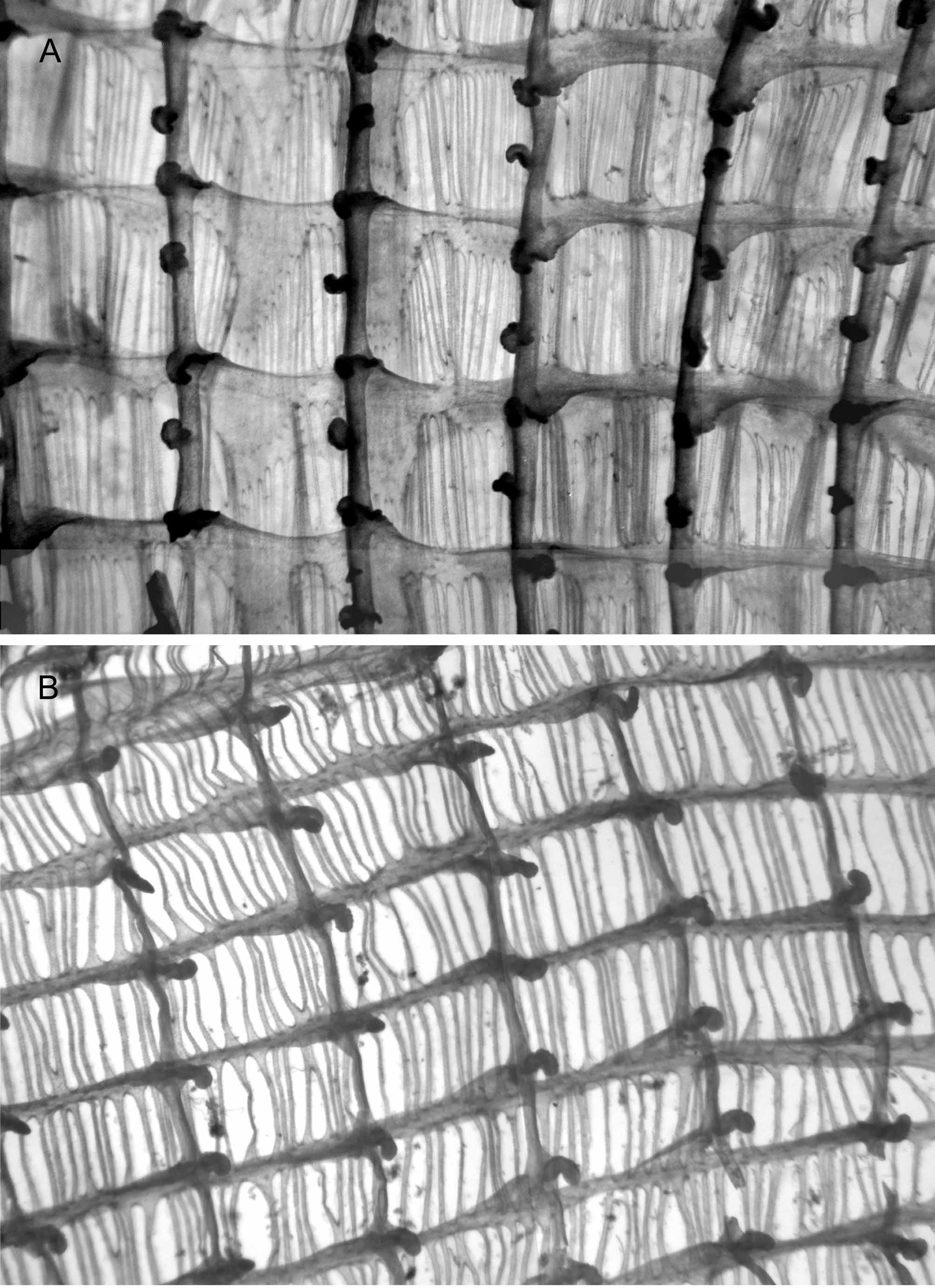
FIGURE 13. Branchial tissues: A, Ascidia challengeri; B, Ascidia meridionalis.
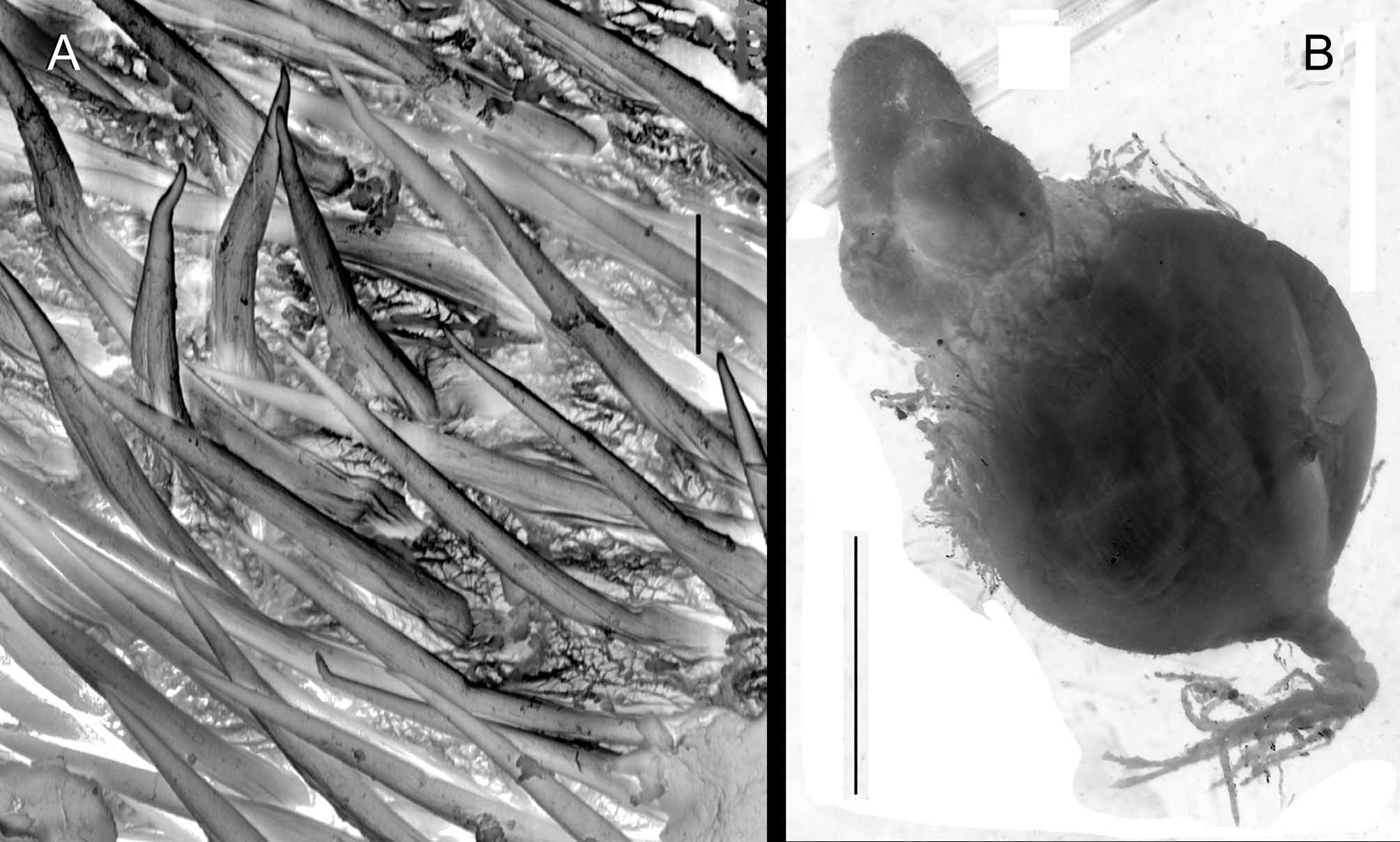
FIGURE 17. Cnemidocarpa acanthifera n. sp. A, siphonal spinules; B, holotype. Scale bars: A = 30 µm; B = 5 mm.

FIGURE 18. Cnemidocarpa acanthifera n. sp. A, C, body ventrally opened, scale bar A = 5 mm; B, neural area.
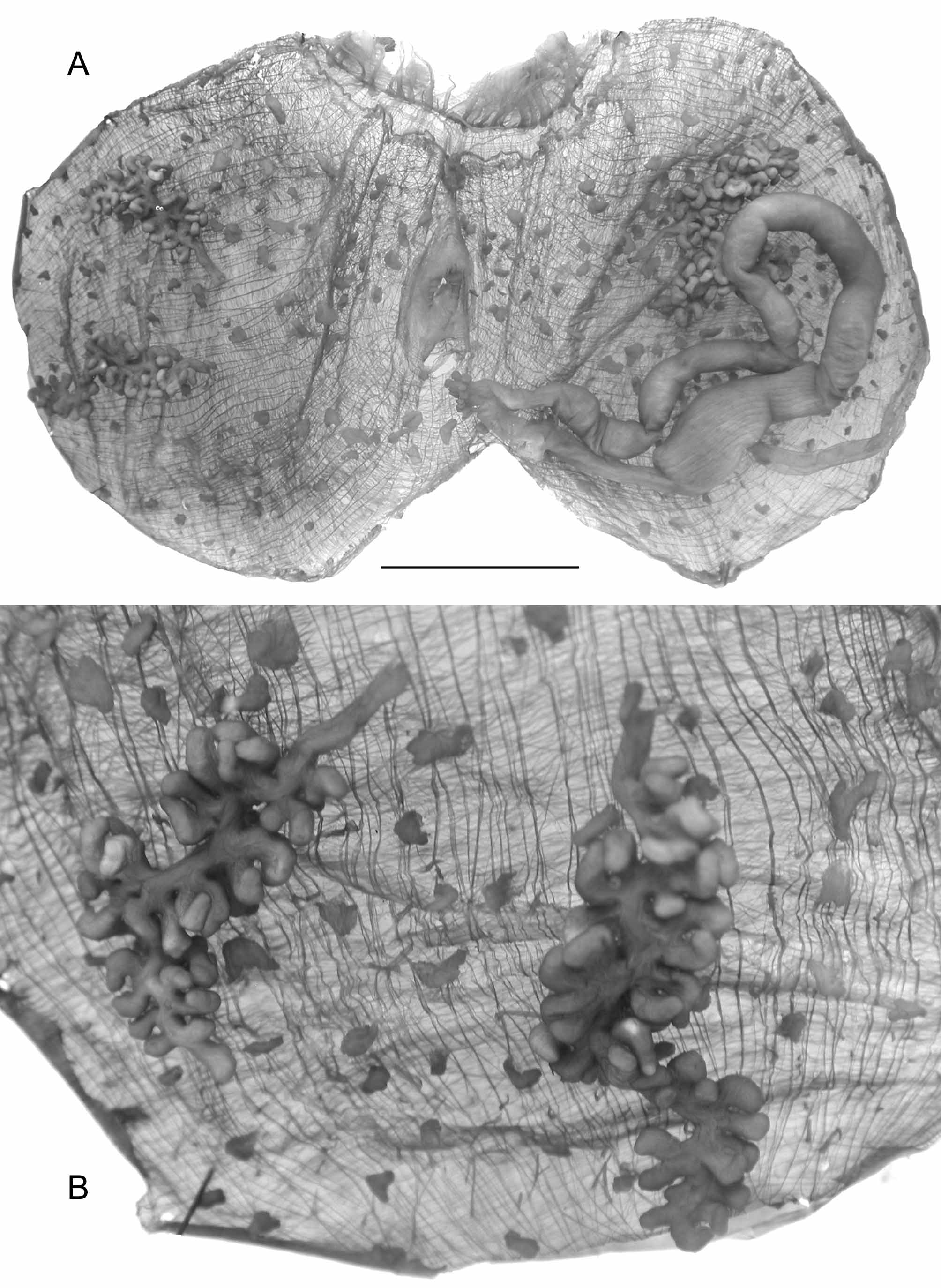
FIGURE 19. Cnemidocarpa pfefferi: Body ventrally opened scale bar = 1 cm; B, gonad.

IMAGES
Gallery(7)
Occurrences with images
CITATIONS
References(19)
Gärdenfors, Hall, Hallingbäck, Hansson & Hedström (2003) Djur, svampar och växter i Sverige 2003. Förteckning över antal arter per familj.
Hayward, P.J. & J.S. Ryland (Eds.). (1990). The marine fauna of the British Isles and North-West Europe: 1. Introduction and protozoans to arthropods. <em>Clarendon Press: Oxford, UK.</em> 627 pp.
Hayward, P.J. & J.S. Ryland (Eds.). (1990). The marine fauna of the British Isles and North-West Europe: 1. Introduction and protozoans to arthropods. <em>Clarendon Press: Oxford, UK.</em> 627 pp.
Hayward, P.J. & Ryland, J.S. (2002)
Herdman, W. A. (1881). Preliminary report on the Tunicata of the Challenger expedition. Cynthiidae. <em>Proceeding of the Royal Society of Edinburgh.</em> 11(3): 52-88.