AnimaliaLeast ConcernacceptedspeciesAccepted
Acrochordus granulatus

Acrochordus granulatus

Wart Snake(+44)·(Schneider, 1799)

GBIF:2472757

0countries
0datasets
0year

0

Descendants

0

Synonyms

0

Children

PROFILE

Species Profile

Habitat

Marine

ABOUT

Descriptions(12)

CONSERVATION STATUS [IUCN]. — Least Concern [2016] ver. 3.1.
Synopsis of the Snakes of the Philippines A Synthesis of Data from Biodiversity Repositories, Field Studies, and the Literature
PHILIPPINE DISTRIBUTION (Map 2 A [p. 113]). — Bantanyan, Calamian Ids. (Calauit), Cebu, Guimaras, Luzon (Prov.: Batangas, Cavite, Ilocos Norte, Laguna, Manila, [Manila Bay], Quezon, Rizal), Masbate, Negros (Prov.: Negros Occidental, Negros Oriental), Palawan, Panay (Prov.: Iloilo), Siquijor. GENERAL DISTRIBUTION (OTHER THAN PHILIPPINES). — Coastal waters from west coast of India (as far north as Bombay), Sri Lanka, east coast of India, coasts of Myanmar, Malaysia, and east throught the Indonesian Archipelago to the north coast of Australia and the Solomon Islands.
Synopsis of the Snakes of the Philippines A Synthesis of Data from Biodiversity Repositories, Field Studies, and the Literature
TYPE LOCALITY AND TYPE SPECIMEN (S). — India (restricted by Smith [1943: 134]). Type un-known.
Synopsis of the Snakes of the Philippines A Synthesis of Data from Biodiversity Repositories, Field Studies, and the Literature
Marine File Snake; Little File Snake; Wart Snake
Synopsis of the Snakes of the Philippines A Synthesis of Data from Biodiversity Repositories, Field Studies, and the Literature
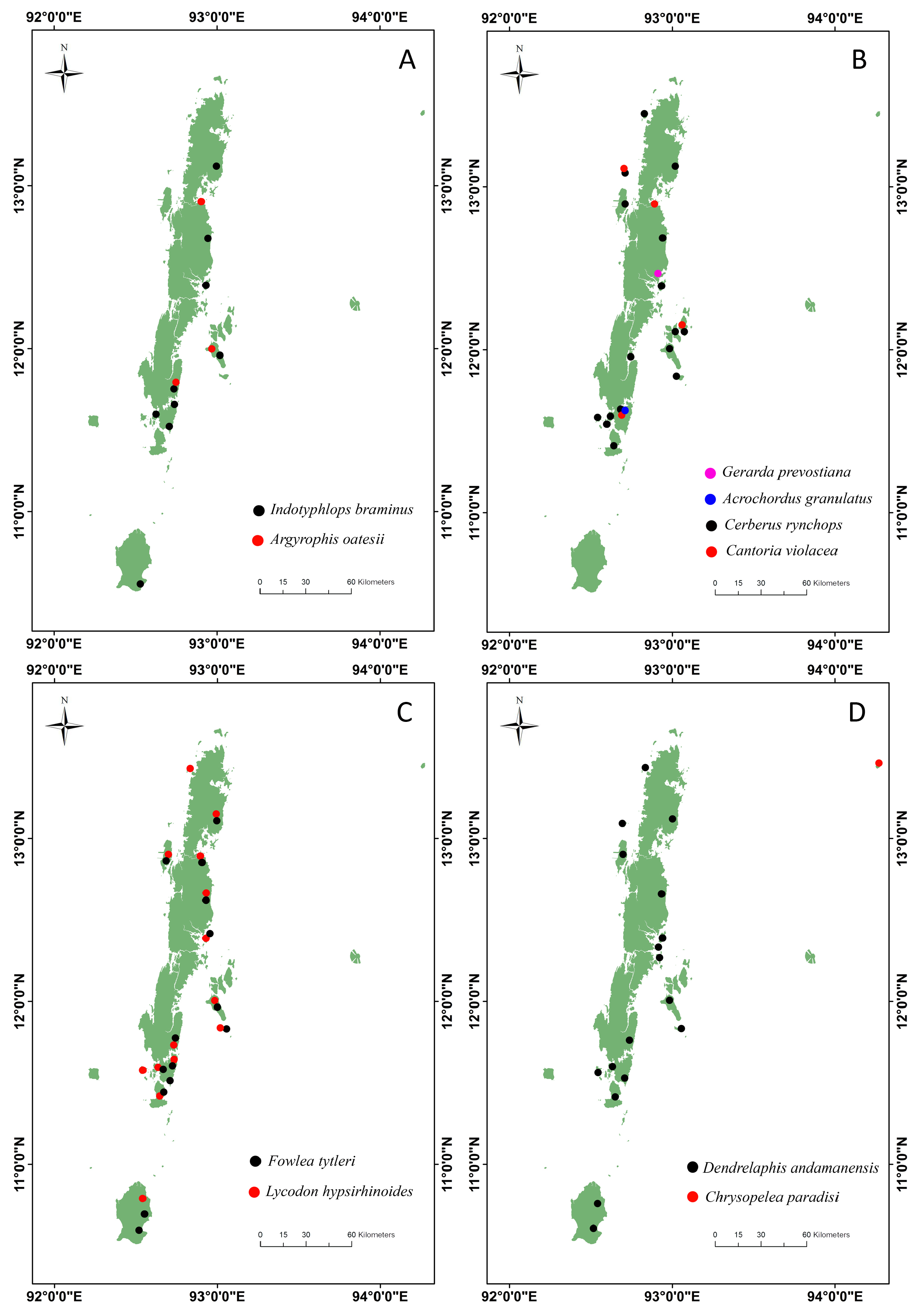
(Fig. 3 C, 11 B) Material: One adult, CSPT / S 75 from Port Blair, South Andaman. Morphology: Supralabials 14; infralabials 12; nasals in contact with each other, nostrils distinctly large; scales in 128 rows at midbody. Body with alternate grey and 67 white bands; ventrals small and indistinguishable from the rest of the scales. SVL 670 mm, TaL 80 mm, HL 14.5 mm, HW 12.5 mm, HD 11 mm, ED 1.5 mm, EN 3.5 mm, ES 4.0 mm. Distribution: One adult was recorded at Sippighat, Port Blair. Occurs throughout the coast of the Andaman Islands Status: Uncommon. Although only a single individual was recorded during the study, it is frequently encountered by fishermen (pers. comm.)
Snake fauna of the Andaman Islands, Bay of Bengal-A review of species richness taxonomy, distribution, natural history and conservation status
Remarks. Gray (1842 b) first reported A. granulatus in Singapore based on a museum specimen deposited at NHMUK by Hardwicke (Gray 1849). Gray (1849) later used the specimen as the type (syntype) specimen to describe Chersydrus annulatus (Table 1), a subjective synonym of A. granulatus. Additional early specimens include a specimen at ZSI (Sclater 1891 a), at SMF (Boettger 1898), one Ridley (1899) received that was collected from a road near SBG, and one Sworder (1924 a) collected at Pulau Sudong on 24 May 1923. The next report for A. granulatus comes 57 years later (Table 2) when Chou (1980) comments that it is found in mangroves. Concurrently, Voris and Jeffries collected numerous specimens from Jurong Prawn Pond, a kelong off Lim Chu Kang, and from Tuas during their sea snake study during the early 1980 s (see Elapidae below). Their data shows that A. granulatus is common in Singapore, having caught upwards of 22 specimens in one day. Primarily an occupant of marine habitats, freshwater populations exist in Singapore due to the creation of reservoirs (Ng 2011; Teo & Khoo 2016). A recently reported record documented mating behaviour of this species at Pasir Ris Beach on 15 August 2021 (Iesa 2021). Occurrence. Wide-ranging. Common.
Singapore’s herpetofauna: updated and annotated checklist, history, conservation, and distribution
Singapore conservation status. Near-Threatened. Conservation priority. Lowest. IUCN conservation status. Least Concern [2022]. LKCNHM & NHMUK Museum specimens. Singapore (no locality): BMNH 1946.1. 1.40 (no date [syntype of Chersydrus annulatus); Changi Beach: ZRC. 2.6081 (19 - Jan- 2004), ZRC. 2.7400 (04 - Jul- 2019); Kranji: ZRC. 2.2253 (25 - Mar- 1964); Kranji Mangroves: ZRC. 2.2252 (no date); Lim Chu Kang: ZRC. 2.5373 (30 - Mar- 1982); Lim Chu Kang Mangroves: ZRC. 2.3466 – ZRC. 2.3468 (27 - Dec- 1995); Lower Seletar Reservoir: ZRC. 2.6808 (25 - Feb- 2009); Mandai Mangroves: ZRC. 2.3278 (28 - Aug- 1991), ZRC. 2.7087 (05 - Jul- 2014) [mudflats]; Pulau Sudong: ZRC. 2.3120 (24 - May- 1923); Punggol: ZRC. 2.2254 (15 - Jan- 1982); Siglap: BMNH (no #) (no date), ZRC. 2.3115 – ZRC. 2.3117 (27 - Jun- 1933), ZRC. 2.3118 (1938); Simpang: ZRC. 2.6082 (13 - Aug- 2004); Sungei Buloh Wetland Reserve: ZRC. 2.6936 – ZRC. 2.6937 (20 - May- 2011); Tanjong Katong: ZRC. 2.3113 – ZRC. 2.3114 (03 - Nov- 1919); Telok Kurau: ZRC. 2.3119 (29 - Jun- 1933); Tuas: ZRC. 2.2183 – ZRC. 2.2190, ZRC. 2.2612 – ZRC. 2.2662 (20 - Mar- 1984). Additional Singapore museum specimens. Singapore (no locality): BPBM, FMNH, MCZ, NMW, QM, UMMZ; Siglap: CAS; Tuas: LSUMZ. Singapore localities. Changi Beach — Jurong Prawn Ponds — Kranji — Kranji Mangroves — Lim Chu Kang — Lim Chu Kang Mangroves — Lower Seletar Reservoir — Mandai Mangroves — Marina Reservoir — Pasir Ris Beach — Pasir Ris Park Mangroves — Pulau Semakau — Pulau Sudong — Pulau Ubin — Punggol — Sembawang Park — Siglap — Simpang — Singapore Botanic Gardens * — Sungei Buloh Wetland Reserve — Sungei Mandai Kechil — Tanjong Katong — Telok Kurau — Tuas — Yishun.
Singapore’s herpetofauna: updated and annotated checklist, history, conservation, and distribution
Description. Table 1 shows the measurement. Measurements shown in Table 1. Total length, 571 mm; tail length, 68 mm. Head short and rounded, with same width as neck; eyes small; nostrils tubular (Fig. 2). Skin of both body and venter with folds; no enlarged scales on venter; entire body covered with fine scales of about same size (Fig. 3); 156 mid-body scales; 10 scales eye – eye; 5 scales eye – lip on each side; 5 / 6 (left / right) scales naris – eye; 14 supralabial scales on each side; 18 infralabial scales on each side. Multiple tumors on body surface. Head dark brown with pale yellow spots (Fig. 2); body to tail alternating blackish-brown and pale yellow bands; dark brown bands longer at dorsal midline than toward venter (Fig. 3).
First Record of the Marine File Snake Acrochordus granulatus (Squamata: Acrochordidae) from Japan Based on the Specimen of the Third Higher School
[English name: Marine File Snake; Japanese name: Hime-yasuri-hebi] (Figs 1 – 3; Table 1)
First Record of the Marine File Snake Acrochordus granulatus (Squamata: Acrochordidae) from Japan Based on the Specimen of the Third Higher School
Remarks. This specimen agrees well with the morphological characteristics of A. granulatus described by Sanders et al. (2010) (Table 1). It was identified as “ Sea snake ” (including Laticauda) and as H. annandalei in the past. However, the sea snakes including H. annandalei are usually characterized by a flat tail and a head covered with relatively large scales (Stuebing et al. 2014), which do not correspond to the characteristics of the specimen. This misidentification may be due to the absence of occurrence records of file snakes in Japan, and also their similarity to sea snakes in both body coloration and habitat. Acrochordus granulatus is known to have ecologically adapted to shallow water habitats such as mangrove areas (Lillywhite 2020), while they were reported to be captured as far as 10 km from the coast (Voris and Glodek 1980). It is quite possible that the natural dispersal by the Kuroshio Current carried this species to Amamioshima Island. The nearest habitat of this species from Japan is the Philippine Islands or Hainan Island (Huang 1963; Dunson and Minton 1978; Bernstein and Bautista 2020). However, since there is only one record from Hainan Island (Huang 1963; Shi et al. 2011), it is more likely that this individual came from a larger and more stable population in the Philippines. In addition, since many typhoons in June track toward Japan after approaching the Philippines (Japan Metrological Agency 2022), it is possible that a typhoon carried this specimen from the Philippines to Amamioshima Island. On the other hand, A. javanicus, a closely related species of A. granulatus, has been reported to have been accidentally transported to Japan by hiding in wood from Indonesia (Kagei and Shogaki 1977), so we could not rule out the possibility that this individual was artificially transported to Japan. In either case, there are no solid records of A. granulatus in Japan from 1938 to the present. Thus, it is highly likely that A. granulatus is very rare in Japan, and it would be difficult to establish a stable population in the archipelago.
First Record of the Marine File Snake Acrochordus granulatus (Squamata: Acrochordidae) from Japan Based on the Specimen of the Third Higher School
Distribution. Acrochordus granulatus is distributed in northern Australia (Cogger 2014), continental coastal areas from the Indian Peninsula to the Malay Peninsula and Indochina Peninsula (Cox et al. 1998; Nguyen et al. 2009; Murthy 2010), Hainan Island (Huang 1963), the Sunda Islands (de Rooij 1917; Stuebing et al. 2014) and the Philippine Islands (Dunson and Minton 1978; Bernstein and Bautista 2020).
First Record of the Marine File Snake Acrochordus granulatus (Squamata: Acrochordidae) from Japan Based on the Specimen of the Third Higher School
Materials examined. Third Higher School collection at KUM (No. 3250 of Biological Laboratory, Yoshida College, Kyoto University), collected from Amamioshima Island, Kagoshima Prefecture, Japan in June 1938. Formalin-preserved specimens. Collector: unknown; preparing specimen: Niki Biological Institute.
First Record of the Marine File Snake Acrochordus granulatus (Squamata: Acrochordidae) from Japan Based on the Specimen of the Third Higher School

Export occurrence data

Darwin Core Archive (ZIP)

GEOGRAPHY

Distribution Map

Occurrence Map

Loading map…

Tiles © GBIF Maps API | Map powered by MapLibre GL

REGIONS

Geographic Distribution(5)

Australia
Southern Asia
China (Hainan),
China (Hainan),
Global
least concern

DATA

Occurrence Datasets

Loading datasets…

Common names used for this species across different languages and regions. Available in 15 languages and 1 country. 1 preferred.

engWart SnakeengitaAcrocordo granulatoitapolBrodawkowiec małypolengFile snake/Wart SnakeengindKadutind+40 more

Vernacular (common) names are the everyday names used for a species in different languages and regions. A single species may have dozens of common names worldwide. This taxon has names in 15 languages. 1 name preferred.

itaAcrocordo granulato
ita
Source: Catalogue of LifeSource taxon #299404450
polBrodawkowiec mały
pol
Source: Catalogue of LifeSource taxon #299404450
engFile snake/Wart Snake
eng
Source: Reptilia.mySource taxon #115121795
indKadut
ind
Source: Catalogue of LifeSource taxon #299404450
deuKleine Warzenschlange
deu
Source: Catalogue of LifeSource taxon #299404450
danLille Vorteslange
dan
Source: Catalogue of LifeSource taxon #299404450
engLittle Filesnake
eng
Source: Integrated Taxonomic Information System (ITIS)Source taxon #102127305
engLittle Wartsnake
eng
Source: Catalogue of LifeSource taxon #299404450
engLittle file snake
eng
Source: The Paleobiology DatabaseSource taxon #185024959
engLittle filesnake
eng
Source: Catalogue of LifeSource taxon #299404450
engLittle filesnake
eng
Source: Catalogue of LifeSource taxon #273310327
engMarine File Snake
eng
Source: Catalogue of LifeSource taxon #299404450
engMarine File Snake
eng
Source: Integrated Taxonomic Information System (ITIS)Source taxon #102127305
engMarine File Snake
eng
Source: Catalogue of LifeSource taxon #273310327
itaSerpente lima minore
ita
Source: Catalogue of LifeSource taxon #299404450
spaSerpiente de Agua con Quilla
spa
Source: Catalogue of LifeSource taxon #299404450
engSmall Warty Snake
eng
Source: Catalogue of LifeSource taxon #299404450
deuSüdostasiatische Warzenschlange
deu
Source: Catalogue of LifeSource taxon #299404450
deuSüdostasiatische Warzenschlange
deu
Source: Catalogue of LifeSource taxon #273310327
indUlar Karung Belang
ind
Source: Catalogue of LifeSource taxon #299404450
engWart Snake
eng
Source: Catalogue of LifeSource taxon #299404450
engWart Snake
eng
Source: Catalogue of LifeSource taxon #273310327
engWart Snake
eng
Source: Integrated Taxonomic Information System (ITIS)Source taxon #102127305
deuWarzenschlange
deu
Source: Catalogue of LifeSource taxon #299404450
deuWarzenschlange
deu
Source: Catalogue of LifeSource taxon #273310327
deuZwerg-Warzenschlange
deu
Source: Catalogue of LifeSource taxon #299404450
cesbradavičník malý
ces
Source: Catalogue of LifeSource taxon #299404450
enggranulated file snake
eng
Source: Catalogue of LifeSource taxon #299404450
rusИндийская бородавчатая змея
rus
Source: Catalogue of LifeSource taxon #299404450
કાનસીયો
guj
Source: Catalogue of LifeSource taxon #299404450
sinදියගොයා
sin
Source: Catalogue of LifeSource taxon #299404450
sinරෙදි නයා
sin
Source: Catalogue of LifeSource taxon #299404450
thaงูผ้าขี้ริ้ว
tha
Source: Catalogue of LifeSource taxon #299404450
KHពស់ដែក
khmKH
Source: Checklist of extant species recorded in Chhaeb Wildlife Sanctuary, CambodiaSource taxon #183199505
jpnヒメヤスリヘビ
jpn
Source: Catalogue of LifeSource taxon #299404450
zho瘰鱗蛇
zho
Source: Catalogue of LifeSource taxon #299404450
zho瘰鳞蛇
zho
Source: Catalogue of LifeSource taxon #299404450
zho瘰鳞蛇
zho
Source: Catalogue of LifeSource taxon #273310327
engWart Snake
engpreferred
Source: The IUCN Red List of Threatened SpeciesSource taxon #176717505
engLittle Filesnake
eng
Source: The IUCN Red List of Threatened SpeciesSource taxon #176717505
engLittle Wartsnake
eng
Source: The IUCN Red List of Threatened SpeciesSource taxon #176717505
engMarine File Snake
eng
Source: The IUCN Red List of Threatened SpeciesSource taxon #176717505
engSmall Warty Snake
eng
Source: The IUCN Red List of Threatened SpeciesSource taxon #176717505
enggranulated file snake
eng
Source: World Register of Marine SpeciesSource taxon #155300260
englittle file snake
eng
Source: World Register of Marine SpeciesSource taxon #155300260

CLASSIFICATION

Taxonomic Classification Tree

MULTIMEDIA

Media Files(7)

FIGURE 9. Acrochordus granulatus (locality unknown, Philippine Ids.) (KU 327186). Photo © CDS.

Imageimage/png© Leviton, Alan E.;Siler, Cameron D.;Weinell, Jeffrey L.;Brown, Rafe M.Synopsis of the Snakes of the Philippines A Synthesis of Data from Biodiversity Repositories, Field Studies, and the Literature

FIGURE 3. Specimens studied: (A) Indotyphlops braminus (CIARI uncat.), (B) Gerrhopilus andamanensis (NMW 15427), (C) Acrochordus granulatus (CSPT/S-75), (D) Fowlea tytleri (CIARI uncat.), (E) Lycodon hypsirhinoides (ZSI 8145, inset: CIARI uncat.), (F) Dendrelaphis andamanensis (CIARI uncat.), (G) Boiga andamanensis (CIARI uncat.), (H) Chrysopelea paradisi (photo: O.D. Adhikari)

Imageimage/png© Chandramouli, S. R.Snake fauna of the Andaman Islands, Bay of Bengal-A review of species richness taxonomy, distribution, natural history and conservation status

FIGURE 11. Locality records of (A): Indotyphlops braminus and Argyrophis oatesii (B) Gerarda prevostiana, Acrochordus granulatus, Cerberus rynchops and Cantoria violacea (C) Fowlea tytleri and Lycodon hypsirhinoides (D) Dendrelaphis andamanensis and Chrysopelea paradisi

Imageimage/png© Chandramouli, S. R.Snake fauna of the Andaman Islands, Bay of Bengal-A review of species richness taxonomy, distribution, natural history and conservation status

FIGURE 15. A) Lipinia vittigera, B) Subdoluseps bowringii, C) Tytthoscincus temasekensis, D) Varanus dumerilii, E) Varanus nebulosus, F) Varanus salvator, G) Acrochordus granulatus, and H) Ahaetulla fasciolata. Photographs by:Alex Figueroa [A–B, F], Shivaram Rasu [C], Law Ing Sind [D, G], Thio Hui Bing [E], and Lena S.Y. Chow [H].

Imageimage/png© Figueroa, Alex;Low, Martyn E. Y.;Lim, Kelvin K. P.Singapore’s herpetofauna: updated and annotated checklist, history, conservation, and distribution

Fig. 1. Specimen labels and condition of Acrochordus granulatus, Third Higher School collection No. 3250 at KUM. (a) Original label; (b) specimen condition and the latest label (No. 3520).

Imageimage/png© Takata, Kento;Shen, Yanpeng;Nishikawa, Kanto;Motokawa, MasaharuFirst Record of the Marine File Snake Acrochordus granulatus (Squamata: Acrochordidae) from Japan Based on the Specimen of the Third Higher School

Fig. 2. Enlarged view of the head of Acrochordus granulatus, Third Higher School collection No. 3250 at KUM. (a) Lateral, (b) dorsal, and (c) ventral.

Imageimage/png© Takata, Kento;Shen, Yanpeng;Nishikawa, Kanto;Motokawa, MasaharuFirst Record of the Marine File Snake Acrochordus granulatus (Squamata: Acrochordidae) from Japan Based on the Specimen of the Third Higher School

IMAGES

Gallery(7)

See Gallery

Occurrences with images

CITATIONS

References(4)

  • 1

    Liu, J.Y. [Ruiyu] (ed.). (2008). [Checklist of marine biota of China seas]. <em>China Science Press.</em> 1267 pp.

    additional sourceWorld Register of Marine Species
  • 2

    Looby, A.; Erbe, C.; Bravo, S.; Cox, K.; Davies, H. L.; Di Iorio, L.; Jézéquel, Y.; Juanes, F.; Martin, C. W.; Mooney, T. A.; Radford, C.; Reynolds, L. K.; Rice, A. N.; Riera, A.; Rountree, R.; Spriel, B.; Stanley, J.; Vela, S.; Parsons, M. J. G. (2023). Global inventory of species categorized by known underwater sonifery. <em>Scientific Data.</em> 10(1).

    ecology sourceWorld Register of Marine SpeciesDOI: 10.1038/s41597-023-02745-4
  • 3

    McDiarmid, Roy W., Jonathan A. Campbell, and T'Shaka A. Touré, 1999: null. Snake Species of the World: A Taxonomic and Geographic Reference, vol. 1. xi + 511.

    Integrated Taxonomic Information System (ITIS)
  • 4

    van der Land, J. (ed). (2008). UNESCO-IOC Register of Marine Organisms (URMO).

    basis of recordWorld Register of Marine Species
  • Source Information

    GBIF Backbone Taxonomy

    GBIF Backbone Taxonomy

    checklist

    The GBIF Backbone Taxonomy is a single, synthetic management classification with the goal of covering all names GBIF is dealing with. It's the taxonomic backbone that allows GBIF to integrate name based information from different resources, no matter if these are occurrence datasets, species pages, names from nomenclators or external sources like EOL, Genbank or IUCN. This backbone allows taxonomic search, browse and reporting operations across all those resources in a consistent way and to provide means to crosswalk names from one source to another.

    It is updated regulary through an automated process in which the Catalogue of Life acts as a starting point also providing the complete higher classification above families. Additional scientific names only found in other authoritative nomenclatural and taxonomic datasets are then merged into the tree, thus extending the original catalogue and broadening the backbones name coverage. The GBIF Backbone taxonomy also includes identifiers for Operational Taxonomic Units (OTUs) drawn from the barcoding resources iBOL and UNITE.

    International Barcode of Life project (iBOL), Barcode Index Numbers (BINs). BINs are connected to a taxon name and its classification by taking into account all names applied to the BIN and picking names with at least 80% consensus. If there is no consensus of name at the species level, the selection process is repeated moving up the major Linnaean ranks until consensus is achieved.

    UNITE - Unified system for the DNA based fungal species, Species Hypotheses (SHs). SHs are connected to a taxon name and its classification based on the determination of the RefS (reference sequence) if present or the RepS (representative sequence). In the latter case, if there is no match in the UNITE taxonomy, the lowest rank with 100% consensus within the SH will be used.

    The GBIF Backbone Taxonomy is available for download at https://hosted-datasets.gbif.org/datasets/backbone/ in different formats together with an archive of all previous versions.

    The following 105 sources have been used to assemble the GBIF backbone with number of names given in brackets:

    • Catalogue of Life Checklist - 4766428 names
    • International Barcode of Life project (iBOL) Barcode Index Numbers (BINs) - 635951 names
    • UNITE - Unified system for the DNA based fungal species linked to the classification - 611208 names
    • The Paleobiology Database - 212054 names
    • World Register of Marine Species - 188857 names
    • The Interim Register of Marine and Nonmarine Genera - 183894 names
    • The World Checklist of Vascular Plants (WCVP) - 131891 names
    • GBIF Backbone Taxonomy - 114350 names
    • TAXREF - 109374 names
    • The Leipzig catalogue of vascular plants - 75380 names
    • ZooBank - 73549 names
    • Integrated Taxonomic Information System (ITIS) - 68377 names
    • Plazi.org taxonomic treatments database - 61346 names
    • Genome Taxonomy Database r207 - 60545 names
    • International Plant Names Index - 52329 names
    • Fauna Europaea - 45077 names
    • The National Checklist of Taiwan (Catalogue of Life in Taiwan, TaiCoL) - 36193 names
    • Dyntaxa. Svensk taxonomisk databas - 35892 names
    • The Plant List with literature - 32692 names
    • United Kingdom Species Inventory (UKSI) - 29643 names
    • Artsnavnebasen - 29208 names
    • The IUCN Red List of Threatened Species - 21221 names
    • Afromoths, online database of Afrotropical moth species (Lepidoptera) - 13961 names
    • Brazilian Flora 2020 project - Projeto Flora do Brasil 2020 - 13829 names
    • Prokaryotic Nomenclature Up-to-Date (PNU) - 10079 names
    • Checklist Dutch Species Register - Nederlands Soortenregister - 8814 names
    • ICTV Master Species List (MSL) - 7852 names
    • Cockroach Species File - 6020 names
    • GRIN Taxonomy - 5882 names
    • Taxon list of fungi and fungal-like organisms from Germany compiled by the DGfM - 4570 names
    • Catalogue of Afrotropical Bees - 3623 names
    • Catalogue of Tenebrionidae (Coleoptera) of North America - 3327 names
    • Checklist of Beetles (Coleoptera) of Canada and Alaska. Second Edition. - 3312 names
    • Systema Dipterorum - 2850 names
    • Catalogue of the Pterophoroidea of the World - 2807 names
    • The Clements Checklist - 2675 names
    • Taxon list of Hymenoptera from Germany compiled in the context of the GBOL project - 2496 names
    • IOC World Bird List, v13.2 - 2366 names
    • Official Lists and Indexes of Names in Zoology - 2310 names
    • National checklist of all species occurring in Denmark - 1922 names
    • Myriatrix - 1876 names
    • Database of Vascular Plants of Canada (VASCAN) - 1822 names
    • Taxon list of vascular plants from Bavaria, Germany compiled in the context of the BFL project - 1771 names
    • Orthoptera Species File - 1742 names
    • A list of the terrestrial fungi, flora and fauna of Madeira and Selvagens archipelagos - 1602 names
    • Aphid Species File - 1565 names
    • World Spider Catalog - 1561 names
    • Taxon list of Jurassic Pisces of the Tethys Palaeo-Environment compiled at the SNSB-JME - 1270 names
    • Backbone Family Classification Patch - 1143 names
    • GBIF Algae Classification - 1100 names
    • International Cichorieae Network (ICN): Cichorieae Portal - 975 names
    • Psocodea Species File - 803 names
    • New Zealand Marine Macroalgae Species Checklist - 787 names
    • Annotated checklist of endemic species from the Western Balkans - 754 names
    • Taxon list of animals with German names (worldwide) compiled at the SMNS - 503 names
    • Catalogue of the Alucitoidea of the World - 472 names
    • Lygaeoidea Species File - 462 names
    • Catálogo de Plantas y Líquenes de Colombia - 422 names
    • GBIF Backbone Patch - 317 names
    • Phasmida Species File - 259 names
    • Cortinariaceae fetched from the Index Fungorum API - 234 names
    • Coreoidea Species File - 233 names
    • GTDB supplement - 139 names
    • Mantodea Species File - 119 names
    • Endemic species in Taiwan - 93 names
    • Taxon list of Araneae from Germany compiled in the context of the GBOL project - 88 names
    • Species of Hominidae - 78 names
    • Taxon list of Sternorrhyncha from Germany compiled in the context of the GBOL project - 77 names
    • Taxon list of mosses from Germany compiled in the context of the GBOL project - 75 names
    • Mammal Species of the World - 73 names
    • Plecoptera Species File - 71 names
    • Species Fungorum Plus - 64 names
    • Catalogue of the type specimens of Cosmopterigidae (Lepidoptera: Gelechioidea) from research collections of the Zoological Institute, Russian Academy of Sciences - 47 names
    • Species named after famous people - 41 names
    • Dermaptera Species File - 36 names
    • Taxon list of Trichoptera from Germany compiled in the context of the GBOL project - 34 names
    • True Fruit Flies (Diptera, Tephritidae) of the Afrotropical Region - 33 names
    • Range and Regularities in the Distribution of Earthworms of the Earthworms of the USSR Fauna. Perel, 1979 - 32 names
    • Taxon list of Diplura from Germany compiled in the context of the GBOL project - 30 names
    • Lista de referencia de especies de aves de Colombia - 2022 - 24 names
    • Taxon list of Auchenorrhyncha from Germany compiled in the context of the GBOL project - 20 names
    • Catalogue of the type specimens of Polycestinae (Coleoptera: Buprestidae) from research collections of the Zoological Institute, Russian Academy of Sciences - 19 names
    • Taxon list of Thysanoptera from Germany compiled in the context of the GBOL project - 19 names
    • Lista de especies de vertebrados registrados en jurisdicción del Departamento del Huila - 18 names
    • Taxon list of Microcoryphia (Archaeognatha) from Germany compiled in the context of the GBOL project - 15 names
    • Catalogue of the type specimens of Bufonidae and Megophryidae (Amphibia: Anura) from research collections of the Zoological Institute, Russian Academy of Sciences - 12 names
    • Grylloblattodea Species File - 11 names
    • Coleorrhyncha Species File - 9 names
    • Taxon list of liverworts from Germany compiled in the context of the GBOL project - 9 names
    • Embioptera Species File - 7 names
    • Taxon list of Pisces and Cyclostoma from Germany compiled in the context of the GBOL project - 6 names
    • Taxon list of Pteridophyta from Germany compiled in the context of the GBOL project - 6 names
    • Taxon list of Siphonaptera from Germany compiled in the context of the GBOL project - 5 names
    • The Earthworms of the Fauna of Russia. Perel, 1997 - 5 names
    • Taxon list of Zygentoma from Germany compiled in the context of the GBOL project - 4 names
    • Asiloid Flies: new taxa of Diptera: Apioceridae, Asilidae, and Mydidae - 3 names
    • Taxon list of Protura from Germany compiled in the context of the GBOL project - 3 names
    • Taxon list of hornworts from Germany compiled in the context of the GBOL project - 2 names
    • Chrysididae Species File - 1 names
    • Taxon list of Dermaptera from Germany compiled in the context of the GBOL project - 1 names
    • Taxon list of Diplopoda from Germany in the context of the GBOL project - 1 names
    • Taxon list of Orthoptera (Grashoppers) from Germany compiled at the SNSB - 1 names
    • Taxon list of Pscoptera from Germany compiled in the context of the GBOL project - 1 names
    • Taxon list of Pseudoscorpiones from Germany compiled in the context of the GBOL project - 1 names
    • Taxon list of Raphidioptera from Germany compiled in the context of the GBOL project - 1 names

    GBIF Secretariat (2023). GBIF Backbone Taxonomy. Checklist dataset https://doi.org/10.15468/39omei accessed via GBIF.org on 2026-06-14.

    CC BYPublished 8/28/2023View dataset
    GBIF Usage Key
    2472757
    Dataset Key
    d7dddbf4-2cf0-4f39-9b2a-bb099caae36c
    Origin
    source
    Backbone Key
    2472757
    Taxon ID
    gbif:2472757
    Last Crawled
    8/22/2023
    Last Interpreted
    8/22/2023