AnimaliaacceptedfamilyAccepted
Brachystomellidae

Brachystomellidae

Kortmundspringhaler(+2)

GBIF:2990

0countries
0datasets

0

Descendants

0

Children

0

Species

0

Genera

PROFILE

Species Profile

Characteristics

Extant 83.5 to 70.6 Ma

ABOUT

Descriptions(3)

FAMILY BRACHYSTOMELLIDAE Stach, 1949

Brachystomellidae Stach, 1949a: 254 .

Catalogue of Vietnamese springtails (Hexapoda, Collembola)MagnoliaPress via PlaziNo known copyright restrictions apply. See Agosti, D., Egloff, W., 2009. Taxonomic information exchange and copyright: the Plazi approach. BMC Research Notes 2009, 2:53 for further explanation.
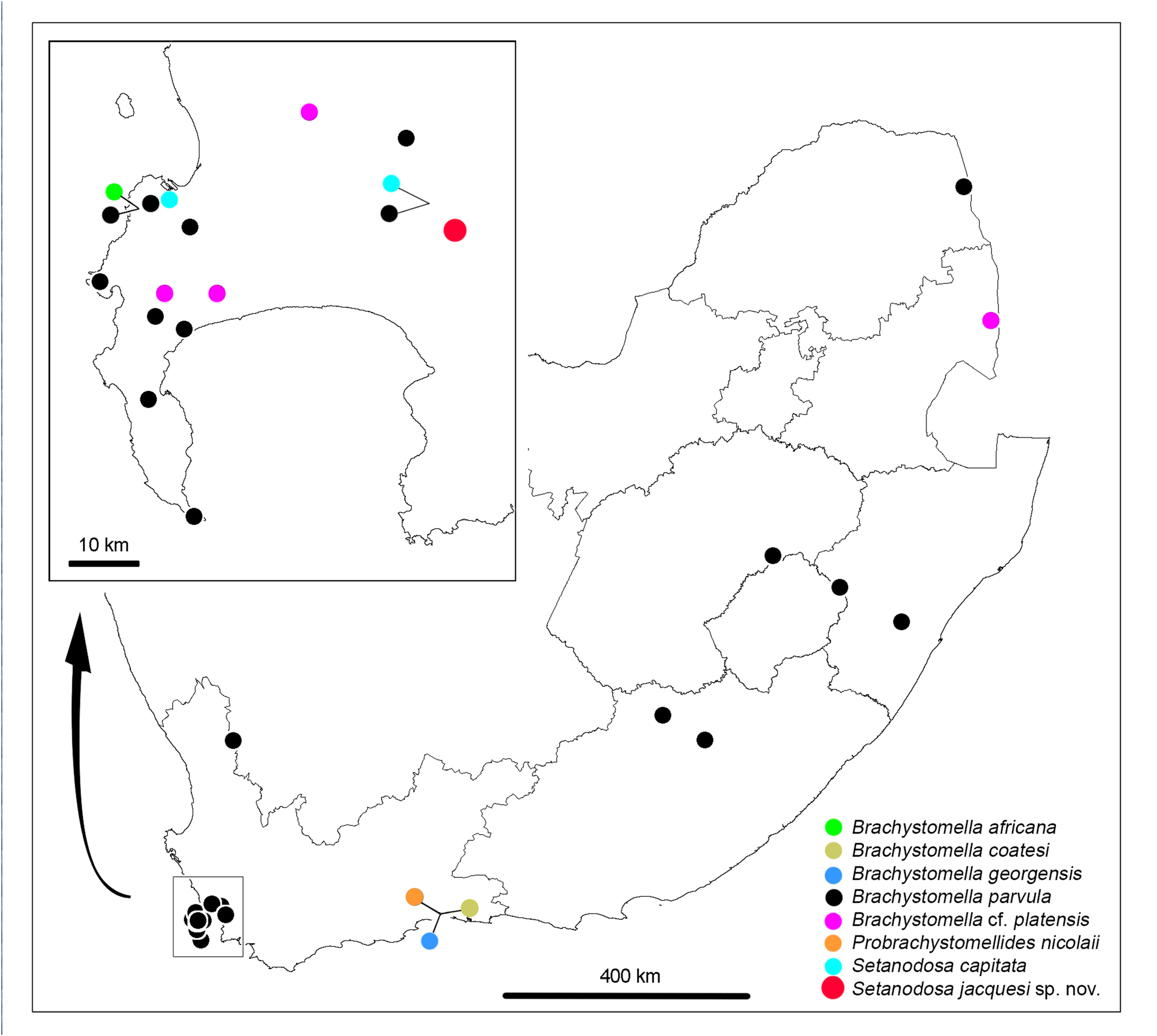
At present, three genera and seven species of Brachystomellidae are known from South Africa including S. jacquesi sp. nov. The map (Fig. 9) indicates the geographical locations of published records (Janion-Scheepers et al. 2015) and barcoded specimen records of this study. It highlights large geographical gaps, which are not real, as Brachystomella is widespread and common in most regions of South Africa. All species are known from the southern part of the country as most collection efforts have been concentrated in this area (Janion-Scheepers et al. 2015). Interestingly, a single record of Brachystomellidae has been published for the whole Ethiopian region outside South Africa (Thibaud 2013), Brachystomella contorta Denis, 1931 from Ivory Coast, a species considered as pantropical (Zon et al. 2013). This species was not present in the material examined so far from South Africa. Despite the paucity of distributional data, the rarity of the family Brachystomellidae north of southern South Africa may reflect the wellknown global pattern of a southern hemisphere distribution of the family, which is extensively documented in the literature (Najt & Weiner 1996, Weiner & Najt 2001, Greenslade 2018). One genus (Probrachystomellides) and four species of Brachystomellidae (P. nicolaii, Brachystomella parvula africana, B. coatesi and B. georgensis) are endemic to South Africa. One additional species of Brachystomella, B. parvula (Schäffer, 1896), has a wider distribution and is possibly introduced. This species, considered cosmopolitan in distribution (Fjellberg 1998), is the most frequently cited from South Africa, but these ancient records need confirmation, as we have not found it so far in our samples (since 2008). According to Weiner & Najt (1991), Brachystomella platensis Najt & Massoud, 1974, described from South America (Najt & Massoud 1974) where it was probably introduced, but mostly present in Australia (Greenslade & Najt 1987, Najt & Weiner 1996, Greenslade 2018), is closely related to B. georgensis from which it differs by a few characters. We provisionally assigned the specimens of most South African populations that we have barcoded to this species, as cf. platensis (Table 1). A most interesting side-result of our study is that COI sequences of specimens of this species from Australia (Melbourne) are identical to those of specimens from South Africa. Brachystomella cf. platensis is therefore present in both regions. Its identity is however uncertain, given in particular its similarity with B. georgensis. This will be checked in further morphological and molecular studies which are beyond the scope of this paper. The only species of Setanodosa described from South Africa, S. capitata, has also been recorded from Australia by Womersley (1939), a record which seeks confirmation (Greenslade 1994). The genus Brachystomella is by far the most common in soils of southern South Africa, with several unpublished records of unidentified species that were not considered in this paper. Ecologically, it is present in soil, less frequently in more xeric habitats. The genus Setanodosa is much less frequently observed. Morphologically, it corresponds to the “ hemiedaphon xerophil ” biological form of Gisin (1943), with its very developed and strongly clavate tenent hairs. The genus is found on rocks but is also present in litter. However, the number of records, most of unidentified species, is not enough to speculate on the ecology of Setanodosa species. The third genus, Probrachystomellides, is only known so far from the type locality (Probrachystomellides nicolaii).
A shocking-red new species of Setanodosa Salmon, 1942 (Collembola: Brachystomellidae) from South Africa

Key to species of Brachystomellidae from South Africa

1 Furca present........................................................................................ 3

- Furca absent......................................................................................... 2

2 Tibiotarsi with 4 clavate tenent hairs, PAO with 5-8 lobes, shocking red in colour................................................................................................... Setanodosa jacquesi sp. nov. (South Africa)

- Tibiotarsi with 5 clavate tenent hairs, PAO with 4 lobes, brown in colour......................................................................................... Setanodosa capitata (Womersley, 1934) (South Africa, Australia)

3 Mandible present................................ Probrachystomellides nicolaii Weiner & Najt, 1991 (South Africa)

- Mandible absent...................................................................................... 4

4 Th. I with 2+2 chaetae................................................................................. 5

- Th. I with more than 2+2 chaetae........................................................................ 6

5 PAO with 6-7 lobes, apical bulb simple................. Brachystomella georgensis Weiner & Najt, 1991 (South Africa)

- PAO with 5 lobes, apical bulb bi- or trilobed................................................................................. Brachystomella platensis Najt & Massoud, 1974 (Argentina, Australia; South Africa as B. cf. platensis)

6 Th. I with 3+3 chaetae, dens with 5 chaetae, PAO with 6-8 lobes..................................................................................................... Brachystomella parvula (Schäffer, 1896) * (cosmopolitan)

- Th. I with 4+4 chaetae, dens with 6 chaetae, PAO with 4 lobes.. Brachystomella coatesi Weiner & Najt, 1991 (South Africa)

A shocking-red new species of Setanodosa Salmon, 1942 (Collembola: Brachystomellidae) from South AfricaMagnoliaPress via PlaziNo known copyright restrictions apply. See Agosti, D., Egloff, W., 2009. Taxonomic information exchange and copyright: the Plazi approach. BMC Research Notes 2009, 2:53 for further explanation.

Export occurrence data

Darwin Core Archive (ZIP)

GEOGRAPHY

Distribution Map

Occurrence Map

Loading map…

Tiles © GBIF Maps API | Map powered by MapLibre GL

REGIONS

Geographic Distribution(77)

African Indian Desert
native
Amazon
native
Andean
native
Antarctic & Subantarctic
native
Antillean & S. Florida
native
Arctic & Sub-arctic
native
Cape
native
Caribbean mainland
native
Central Australia
native
E. African Steppe
native
Europe
native
Hawaiian
native
Himalayan
native
Indian
native
Macaronesian
native
Malaysian
native
Mediterranean
native
Melanesia & Micronesia
native
N. & E. Australia
native
N. Eurasia
native
N.E. & Central Brazilian
native
N.E. African Highland
native
N.North American
native
New Caledonia
native
New Zealand
native
Pacific North American
native
Pampas
native
Patagonian
native
Polynesia
native
S.North American
native
S.W. Australia
native
Sino-Japanese
native
South African
native
Sudanese Park Steppe
native
Venezuela & Guiana
native
W. & Central Asia
native
W. African Rain Forest
native
N. & E. Australia
native
Central Australia
native
Pacific North American
native
S.W. Australia
native
N.North American
native
S.North American
native
Malaysian
native
Melanesia & Micronesia
native
Macaronesian
native
Cape
native
Caribbean mainland
native
Venezuela & Guiana
native
Amazon
native
N.E. & Central Brazilian
native
Pampas
native
Patagonian
native
Andean
native
Antillean & S. Florida
native
African Indian Desert
native
Sudanese Park Steppe
native
W. African Rain Forest
native
Indian
native
Hawaiian
native
Europe
native
Mediterranean
native
Sino-Japanese
native
New Caledonia
native
W. & Central Asia
native
Arctic & Sub-arctic
native
N. Eurasia
native
Himalayan
native
E. African Steppe
native
Polynesia
native
South African
native
New Zealand
native
N.E. African Highland
native
Antarctic & Subantarctic
native
DK
not evaluated
NO
SE

DATA

Occurrence Datasets

Loading datasets…

Common names used for this species across different languages and regions. Available in 2 languages and 1 country.

DKKortmundspringhalerdandanKortmundspringhalerdankor둥근턱톡토기과kor

Vernacular (common) names are the everyday names used for a species in different languages and regions. A single species may have dozens of common names worldwide. This taxon has names in 2 languages.

DKKortmundspringhaler
danDK
Source: National Checklist of all species occurring in DenmarkSource taxon #307201257
danKortmundspringhaler
dan
Source: Catalogue of LifeSource taxon #296427599
kor둥근턱톡토기과
kor
Source: Catalogue of LifeSource taxon #296427599

CLASSIFICATION

Taxonomic Classification Tree

MULTIMEDIA

Media Files(1)

FIGURE 9. Distribution map of Setanodosa jacquesi sp. nov. and Brachystomellidae recorded to date from South Africa based on the checklist of South African Collembola (Janion-Scheepers et al. 2015) and barcoded material (Table 1).

Imageimage/png© Janion-Scheepers, Charlene;Deharveng, LouisA shocking-red new species of Setanodosa Salmon, 1942 (Collembola: Brachystomellidae) from South Africa

IMAGES

Gallery(1)

See Gallery

Occurrences with images

CITATIONS

References(6)

  • 1

    Australian Faunal Directory, 2007 version. Available online at https://biodiversity.org.au/afd/home.

    habitat flag sourceThe Interim Register of Marine and Nonmarine Genera
  • 2

    Australian Faunal Directory, 2007 version. Available online at https://biodiversity.org.au/afd/home.

    extant flag sourceThe Interim Register of Marine and Nonmarine Genera
  • 3

    Australian Faunal Directory, 2007 version. Available online at https://biodiversity.org.au/afd/home.

    basis of recordThe Interim Register of Marine and Nonmarine Genera
  • 4

    Gärdenfors, Hall, Hallingbäck, Hansson & Hedström (2003) Djur, svampar och växter i Sverige 2003. Förteckning över antal arter per familj.

    Dyntaxa. Svensk taxonomisk databas
  • 5

    Ruggiero, M. A. (2014). Families of All Living Organisms, Version 2.0.a.15, (4/26/14). Expert Solutions International, LLC, Reston, VA. 420 pp.

    current name sourceThe Interim Register of Marine and Nonmarine Genera
  • Source Information

    GBIF Backbone Taxonomy

    GBIF Backbone Taxonomy

    checklist

    The GBIF Backbone Taxonomy is a single, synthetic management classification with the goal of covering all names GBIF is dealing with. It's the taxonomic backbone that allows GBIF to integrate name based information from different resources, no matter if these are occurrence datasets, species pages, names from nomenclators or external sources like EOL, Genbank or IUCN. This backbone allows taxonomic search, browse and reporting operations across all those resources in a consistent way and to provide means to crosswalk names from one source to another.

    It is updated regulary through an automated process in which the Catalogue of Life acts as a starting point also providing the complete higher classification above families. Additional scientific names only found in other authoritative nomenclatural and taxonomic datasets are then merged into the tree, thus extending the original catalogue and broadening the backbones name coverage. The GBIF Backbone taxonomy also includes identifiers for Operational Taxonomic Units (OTUs) drawn from the barcoding resources iBOL and UNITE.

    International Barcode of Life project (iBOL), Barcode Index Numbers (BINs). BINs are connected to a taxon name and its classification by taking into account all names applied to the BIN and picking names with at least 80% consensus. If there is no consensus of name at the species level, the selection process is repeated moving up the major Linnaean ranks until consensus is achieved.

    UNITE - Unified system for the DNA based fungal species, Species Hypotheses (SHs). SHs are connected to a taxon name and its classification based on the determination of the RefS (reference sequence) if present or the RepS (representative sequence). In the latter case, if there is no match in the UNITE taxonomy, the lowest rank with 100% consensus within the SH will be used.

    The GBIF Backbone Taxonomy is available for download at https://hosted-datasets.gbif.org/datasets/backbone/ in different formats together with an archive of all previous versions.

    The following 105 sources have been used to assemble the GBIF backbone with number of names given in brackets:

    • Catalogue of Life Checklist - 4766428 names
    • International Barcode of Life project (iBOL) Barcode Index Numbers (BINs) - 635951 names
    • UNITE - Unified system for the DNA based fungal species linked to the classification - 611208 names
    • The Paleobiology Database - 212054 names
    • World Register of Marine Species - 188857 names
    • The Interim Register of Marine and Nonmarine Genera - 183894 names
    • The World Checklist of Vascular Plants (WCVP) - 131891 names
    • GBIF Backbone Taxonomy - 114350 names
    • TAXREF - 109374 names
    • The Leipzig catalogue of vascular plants - 75380 names
    • ZooBank - 73549 names
    • Integrated Taxonomic Information System (ITIS) - 68377 names
    • Plazi.org taxonomic treatments database - 61346 names
    • Genome Taxonomy Database r207 - 60545 names
    • International Plant Names Index - 52329 names
    • Fauna Europaea - 45077 names
    • The National Checklist of Taiwan (Catalogue of Life in Taiwan, TaiCoL) - 36193 names
    • Dyntaxa. Svensk taxonomisk databas - 35892 names
    • The Plant List with literature - 32692 names
    • United Kingdom Species Inventory (UKSI) - 29643 names
    • Artsnavnebasen - 29208 names
    • The IUCN Red List of Threatened Species - 21221 names
    • Afromoths, online database of Afrotropical moth species (Lepidoptera) - 13961 names
    • Brazilian Flora 2020 project - Projeto Flora do Brasil 2020 - 13829 names
    • Prokaryotic Nomenclature Up-to-Date (PNU) - 10079 names
    • Checklist Dutch Species Register - Nederlands Soortenregister - 8814 names
    • ICTV Master Species List (MSL) - 7852 names
    • Cockroach Species File - 6020 names
    • GRIN Taxonomy - 5882 names
    • Taxon list of fungi and fungal-like organisms from Germany compiled by the DGfM - 4570 names
    • Catalogue of Afrotropical Bees - 3623 names
    • Catalogue of Tenebrionidae (Coleoptera) of North America - 3327 names
    • Checklist of Beetles (Coleoptera) of Canada and Alaska. Second Edition. - 3312 names
    • Systema Dipterorum - 2850 names
    • Catalogue of the Pterophoroidea of the World - 2807 names
    • The Clements Checklist - 2675 names
    • Taxon list of Hymenoptera from Germany compiled in the context of the GBOL project - 2496 names
    • IOC World Bird List, v13.2 - 2366 names
    • Official Lists and Indexes of Names in Zoology - 2310 names
    • National checklist of all species occurring in Denmark - 1922 names
    • Myriatrix - 1876 names
    • Database of Vascular Plants of Canada (VASCAN) - 1822 names
    • Taxon list of vascular plants from Bavaria, Germany compiled in the context of the BFL project - 1771 names
    • Orthoptera Species File - 1742 names
    • A list of the terrestrial fungi, flora and fauna of Madeira and Selvagens archipelagos - 1602 names
    • Aphid Species File - 1565 names
    • World Spider Catalog - 1561 names
    • Taxon list of Jurassic Pisces of the Tethys Palaeo-Environment compiled at the SNSB-JME - 1270 names
    • Backbone Family Classification Patch - 1143 names
    • GBIF Algae Classification - 1100 names
    • International Cichorieae Network (ICN): Cichorieae Portal - 975 names
    • Psocodea Species File - 803 names
    • New Zealand Marine Macroalgae Species Checklist - 787 names
    • Annotated checklist of endemic species from the Western Balkans - 754 names
    • Taxon list of animals with German names (worldwide) compiled at the SMNS - 503 names
    • Catalogue of the Alucitoidea of the World - 472 names
    • Lygaeoidea Species File - 462 names
    • Catálogo de Plantas y Líquenes de Colombia - 422 names
    • GBIF Backbone Patch - 317 names
    • Phasmida Species File - 259 names
    • Cortinariaceae fetched from the Index Fungorum API - 234 names
    • Coreoidea Species File - 233 names
    • GTDB supplement - 139 names
    • Mantodea Species File - 119 names
    • Endemic species in Taiwan - 93 names
    • Taxon list of Araneae from Germany compiled in the context of the GBOL project - 88 names
    • Species of Hominidae - 78 names
    • Taxon list of Sternorrhyncha from Germany compiled in the context of the GBOL project - 77 names
    • Taxon list of mosses from Germany compiled in the context of the GBOL project - 75 names
    • Mammal Species of the World - 73 names
    • Plecoptera Species File - 71 names
    • Species Fungorum Plus - 64 names
    • Catalogue of the type specimens of Cosmopterigidae (Lepidoptera: Gelechioidea) from research collections of the Zoological Institute, Russian Academy of Sciences - 47 names
    • Species named after famous people - 41 names
    • Dermaptera Species File - 36 names
    • Taxon list of Trichoptera from Germany compiled in the context of the GBOL project - 34 names
    • True Fruit Flies (Diptera, Tephritidae) of the Afrotropical Region - 33 names
    • Range and Regularities in the Distribution of Earthworms of the Earthworms of the USSR Fauna. Perel, 1979 - 32 names
    • Taxon list of Diplura from Germany compiled in the context of the GBOL project - 30 names
    • Lista de referencia de especies de aves de Colombia - 2022 - 24 names
    • Taxon list of Auchenorrhyncha from Germany compiled in the context of the GBOL project - 20 names
    • Catalogue of the type specimens of Polycestinae (Coleoptera: Buprestidae) from research collections of the Zoological Institute, Russian Academy of Sciences - 19 names
    • Taxon list of Thysanoptera from Germany compiled in the context of the GBOL project - 19 names
    • Lista de especies de vertebrados registrados en jurisdicción del Departamento del Huila - 18 names
    • Taxon list of Microcoryphia (Archaeognatha) from Germany compiled in the context of the GBOL project - 15 names
    • Catalogue of the type specimens of Bufonidae and Megophryidae (Amphibia: Anura) from research collections of the Zoological Institute, Russian Academy of Sciences - 12 names
    • Grylloblattodea Species File - 11 names
    • Coleorrhyncha Species File - 9 names
    • Taxon list of liverworts from Germany compiled in the context of the GBOL project - 9 names
    • Embioptera Species File - 7 names
    • Taxon list of Pisces and Cyclostoma from Germany compiled in the context of the GBOL project - 6 names
    • Taxon list of Pteridophyta from Germany compiled in the context of the GBOL project - 6 names
    • Taxon list of Siphonaptera from Germany compiled in the context of the GBOL project - 5 names
    • The Earthworms of the Fauna of Russia. Perel, 1997 - 5 names
    • Taxon list of Zygentoma from Germany compiled in the context of the GBOL project - 4 names
    • Asiloid Flies: new taxa of Diptera: Apioceridae, Asilidae, and Mydidae - 3 names
    • Taxon list of Protura from Germany compiled in the context of the GBOL project - 3 names
    • Taxon list of hornworts from Germany compiled in the context of the GBOL project - 2 names
    • Chrysididae Species File - 1 names
    • Taxon list of Dermaptera from Germany compiled in the context of the GBOL project - 1 names
    • Taxon list of Diplopoda from Germany in the context of the GBOL project - 1 names
    • Taxon list of Orthoptera (Grashoppers) from Germany compiled at the SNSB - 1 names
    • Taxon list of Pscoptera from Germany compiled in the context of the GBOL project - 1 names
    • Taxon list of Pseudoscorpiones from Germany compiled in the context of the GBOL project - 1 names
    • Taxon list of Raphidioptera from Germany compiled in the context of the GBOL project - 1 names

    GBIF Secretariat (2023). GBIF Backbone Taxonomy. Checklist dataset https://doi.org/10.15468/39omei accessed via GBIF.org on 2026-06-14.

    CC BYPublished 8/28/2023View dataset
    GBIF Usage Key
    2990
    Dataset Key
    d7dddbf4-2cf0-4f39-9b2a-bb099caae36c
    Origin
    source
    Backbone Key
    2990
    Taxon ID
    gbif:2990
    Last Crawled
    8/22/2023
    Last Interpreted
    8/22/2023
