AnimaliaNot EvaluatedacceptedfamilyAcceptedRestricted
Branchipodidae

Branchipodidae

GBIF:3676

0countries
0datasets

0

Descendants

0

Synonyms

0

Children

0

Species

0

Genera

PROFILE

Species Profile

Habitat

Freshwater

ABOUT

Descriptions(11)

Description. Male. Head rounded. First antennae as long as clypeus, apex directed laterally, and bearing a few small aesthetascs. Eyes large, about half as wide as head. Frontal appendages present, fused proximally, and separating into two distinct branches extending beyond distomedial clypeal margin. Each frontal appendage branch spinose apically, and bearing one lateral spinose ramus. Frontal appendage spines digitiform, becoming subconical apically. Distal part of clypeus chitinized and simple. Clypeus with pair of anteroposteriorly flattened ventral projections broadly separated and each bearing a lateral ridge on the anterior surface. Second antennal distal antennomere arcuate, curving posteriorly in the basal fourth and medially in the medial third. Distal antennomere distal fifth anterolaterally and posteromedially expanded with rounded margins, tapering to apex, which is slightly curved laterally. Praeepipodites evenly rounded. Epipodites oblong and rounded. Exopodites oval, and margined with long setae. Endopodites arcuate, margined with long setae, and a few small spines apically. Endites with long setae. Thorax and abdomen smooth except for segmentation. Cercopods broad and triangular, lateral and medial margins with long spines, each bearing a setose fringe. Female. Head rounded. Eyes large, more than half the width of the head. First antennae 1.5 times as long as second antennae. Second antennae lamelliform, abruptly narrowing to an acute apex. Labrum truncate, with medial process explanate. Thoracopods as in male. Amplexial groove present laterally and dorsolaterally as a deep fold between thoracic segments XI and XII. Thoracic segment 11 slightly chitinized dorsally with rows of small spinules. Thoracic segment X with a ventrolateral rounded lobe, slightly chitinized, with rows of small spinules, and directed posteriorly. Thoracic segment IX with a smaller ventrolateral protrusion. Brood pouch broadly ovate, fused entirely to thorax, gonopore projecting over base of abdominal segment I. Abdomen and cercopods as in male. Egg. Resting eggs have an irregular spherical shape with polygonal sculpturing characterized by sharp upstanding ridges. Diameter: 250 μm.
A new genus and species of branchipodid fairy shrimp (Crustacea: Branchiopoda: Anostraca) from Australia
Description. Male. Head rounded. First antennae as long as clypeus, apex directed laterally, and bearing a few small aesthetascs. Eyes large, about half as wide as head. Frontal appendages present, fused proximally, and separating into two distinct branches extending beyond distomedial clypeal margin. Each frontal appendage branch spinose apically, and bearing two lateral spinose rami. Frontal appendage spines subconical. Clypeus rhomboidal. Distal part of clypeus chitinized and simple. Clypeus with pair of anteroposteriorly flattened ventral projections fused medially. Second antennal distal antennomere arcuate, curving medially and posteriorly, with distal most portion bent 90 degrees laterally, and apex slightly hooked posteriolaterally. Praeepipodites evenly rounded. Epipodites oblong and rounded. Exopodites arcuate, apically rounded, and margined with long setae. Endopodites bilobed, each lobe broadly rounded; medial lobe slightly smaller than lateral lobe. Endopodite lateral lobe margined with long fine setae as long as the endopodite or longer; medial lobe margined with stout, straight spines. Endites with long setae. Thorax and abdomen smooth except for segmentation. Gonopods as for the genus. Cercopods broad and triangular, lateral and medial margins with long spines, each bearing a setose fringe. Female. Head rounded. Eyes large, more than half the width of the head. First antennae as long as second antennae. Second antennae lamelliform, abruptly narrowing to an acute apex. Labrum truncate, with medial process explanate. Thoracopods as in male, except endopodite reduced, especially the medial lobe with its spines greatly reduced. Amplexial groove present laterally as a deep fold between thoracic segments XI and XII. Thoracic segment X with a ventrolateral protrusion, slightly chitinized, and directed posteriorly. Thoracic segment IX with a smaller ventrolateral protrusion. Brood pouch broadly ovate, fused entirely to thorax, gonopore projecting over base of abdominal segment I. Abdomen and cercopods as in male. Egg. Resting eggs have an irregular spherical shape with polygonal sculpturing characterized by sharp upstanding ridges (Figures 10, 11, 12 & 13 in Timms et al. 2004). Diameter: 250 μm.
A new genus and species of branchipodid fairy shrimp (Crustacea: Branchiopoda: Anostraca) from Australia
Synonymy. Undescribed branchipodid genus and species. Timms, Shepard & Hill, 2004; New Genus A. Timms, 2004.
A new genus and species of branchipodid fairy shrimp (Crustacea: Branchiopoda: Anostraca) from Australia
Diagnosis. Rigid portion of gonopods inflated, slightly expanded over genital segments. Everted gonopods extending to third or fourth abdominal segment. Rigid basal portion of each gonopod subcylindrical, smooth, bearing a single medial rounded projection. Distal eversible portion of each gonopod subcylindrical with an anteriolateral longitudinal row and a posteriolateral longitudinal row of flattened, posteriorly directed spines, which unite at the apex of the gonopod at the gonopore. Gonopod with an anteriomedial and a posteriomedial longitudinal row of flattened, posteriorly directed spines on the distal quarter. Frontal appendages present. Female with brood pouch sub-cylindrical not extending beyond second abdominal segment. Amplexial groove present, more pronounced laterally. Female with rudimentary dorsal ornamentation. Cercopods margined with spines. Two species from eastern Australia. Differential diagnosis. The family Branchipodidae contains six genera: Australobranchipus gen. nov., Branchipus Schaeffer, 1766, Branchipodopsis Sars, 1989, Rhinobranchipus Brendonck, 1995, Metabranchipus Masi, 1925, and Pumilibranchipus Hamer & Brendonck, 1995. Australobranchipus lacks the ornamentation of the rigid proximal portions of the gonopods that characterize Metabranchipus and Rhinobranchipus. The basal portions of the gonopods in Metabranchipus bear lateral protrusions that are covered with fine spines and the ventromedial processes have a serrated medial margin (Brendonck 1995 a, Brendonck & Belk 1997). Conversely, in Rhinobranchipus, in addition to the ventromedial process, a lobiform ventral projection tipped with a small spine is also present. Otherwise the gonopod rigid basal portions of Australobranchipus are similar to Branchipus, Branchipodopsis, and Pumilibranchipus. In Branchipus the medial process tends to be elongated, curved, and apically acute, whereas in Branchipodopsis the medial process may be a small rounded protuberance, or an acute projection (Brendonck 1995 a, Brendonck and Belk 1997). Pumilibranchipus has an acute medial projection, and just posterior to the first projection is a small spiniform projection (Hamer 1994, 1999, Brendonck 1995 b, Brendonck & Belk 1997). In Australobranchipus the medial projection is short and hemispherical, similar to some Branchipodopsis. The distal eversible portion of the gonopods in Australobranchipus bears four distinct, separated longitudinal rows of small denticuliform spines, whereas Rhinobranchipus, Branchipus, Branchipodopsis, and Metabranchipus have different arrangements of large papilliform spines. The form of Australobranchipus gonopods is most similar to Pumilibranchipus. The eversible portion of the gonopod in Pumilibranchipus is subequal in length to the rigid basal portion, and bears a single, longitudinal row of 4 to 5 posteriorly directed subconical spines, each with a serrate apex (Hamer 1994, 1999, Brendonck 1995 b, Brendonck & Belk 1997). In contrast, Australobranchipus has the distal eversible portion twice as long as the basal portion, and four longitudinal rows of ten or more small, flattened, smooth spines. Australobranchipus parooensis sp. nov. (Figures 1, 2)
A new genus and species of branchipodid fairy shrimp (Crustacea: Branchiopoda: Anostraca) from Australia
Etymology. The genus name underlines the Australian occurrence of this branchipodid genus. The name Branchipus refers to the type genus of the family. Gender is male.
A new genus and species of branchipodid fairy shrimp (Crustacea: Branchiopoda: Anostraca) from Australia
Etymology. The species name refers to the Paroo region in eastern Australia where most collections of this new taxon came from.
A new genus and species of branchipodid fairy shrimp (Crustacea: Branchiopoda: Anostraca) from Australia
Etymology. The species name refers to the typical wetland habitat (gilgai, a native Australian word) and lover of (philios, from Greek) where this species is found in eastern Australia.
A new genus and species of branchipodid fairy shrimp (Crustacea: Branchiopoda: Anostraca) from Australia
Type locality. Marsilea pool on Bloodwood Station 130 km northwest of Bourke, NSW (29 ° 33 ’ S, 144 ° 52 ’ E), an oval shaped depression 33 m by 25 m and normally filling to 20 – 35 cm deep. This pool may fill twice a year in wet years (La Niña years) but then be dry for many years (during El Niño events); from 1987 - 2004 it filled six times, but had some water about twice as frequently. When filled, water usually persists for only two to six weeks. Pool waters are generally clear, though on windy days may become turbid due to suspended clays (Secchi depth 15 cm). Water is always fresh and of very low conductivity (<100 uS / cm). The pond is dominated by Nardoo, Marsilea drummondii A. Braun, 1853. Other branchiopods present were Branchinella arborea Geddes, 1981 (matures two to three weeks after filling) and B. australiensis (Richters, 1876) (matures three to five weeks after filling). With A. parooensis maturing four to eight days after filling (see below), these three species usually form a succession of dominant species. Other large branchiopods present included Eulimnadia sp., Caenestheriella packardi (Brady, 1886) and Triops sp. There was also an abundance of coleopterans, culicids, chironomids and various notonectids and corixids. Odonates, ephemeropterans, plecopterans and molluscs have never been found in this pond. Branchinella wellardi Milner, 1929 has previously been reported from this pond (Timms & Sanders, 2002) Australobranchipus gilgaiphila sp. nov. (Figures 3, 4) Type material. Holotype, QUEENSLAND: Eringibba National Park SSE of Glenmrogan, gilgai pool along western boundary, 2 km N of SW corner of park (27 ° 17.85 ’ S, 149 ° 41.316 ’ E) male, 1 December 2001, Craig Eddie, QM W 28232, Allotype, same collecting data as holotype QM W 28233 female (ovigerous). Paratypes, same collecting data as holotype QM W 28234 two males and two females. All specimens very small, <10 mm long. Other material. QUEENSLAND: 25 km west of Bollon, pool besides Balonne Highway (28 ° 01 ’ S, 147 ° 03 ’ E), 26 June 2005, B. V. Timms, QM W 27983. QUEENSLAND: Southwood National Park, 30 km WSW of Moonie, gilgai pool (27 ° 48.372 ’ S, 150 ° 05.028 ’ E), three males, 9 females, 8 December 2005, R. Johnson, QM W W 28235.
A new genus and species of branchipodid fairy shrimp (Crustacea: Branchiopoda: Anostraca) from Australia
Type locality. The type locality is a gilgai pool about 20 m in diameter and <50 cm deep in Brigalow (Acacia harpophylla F. Müller ex Bentham, 1864) woodland. It contains clear water of low conductivity. No other large branchiopods were present at the time of collection. The roadside pool near Bollon had Branchinella arborea and juvenile B. australiensis present as well as the new fairy shrimp. Little is known of the ecology of Australobranchious gilgaiphila. In the Bollon pool adults were collected within two weeks of rain, so its life cycle is probably short also. So far it has been found only in clear water pools, thus joining a small number of Branchinella species (Timms & Sanders, 2002) that prefer clear waters compared to the ubiquitous turbid waters of the inland.
A new genus and species of branchipodid fairy shrimp (Crustacea: Branchiopoda: Anostraca) from Australia
Type material. Holotype, NEW SOUTH WALES: Bloodwood Station, 130 km nw of Bourke, Marsilea Pond (29 ° 33 ’ S, 144 ° 52 ’ E), male 5 August 1998, B. V. Timms, AM P 67196; Allotype, same collecting data as holotype, female (ovigerous), AM P 67197. Paratypes, same collecting data as holotype, one male and four females, P 67198. All specimens very small, <10 mm long. Other material. Same locality as holotype, eight males and eight females, 7 October 1999, B. V. Timms, AM P 67199. NEW SOUTH WALES, Muella Station, 125 km NW of Bourke, pond near homestead, (29 ° 31 ’ S, 144 ° 56 ’ E), 20 specimens, 7 October 1999, B. V. Timms, AM P 67200. QUEENSLAND: Currawinya National Park, via Hungerford, ‘ KA’ claypan (28 ° 51 ’ S, 144 ° 27 ’ E), one male, 9 December 1996, B. V. Timms, QM W 27982. SOUTH AUSTRALIA: Katarapko Island, Murray River near Loxton, (34 o 22 ’ S, 140 o 35 ’ E) 19 October 1984, C. Madden.
A new genus and species of branchipodid fairy shrimp (Crustacea: Branchiopoda: Anostraca) from Australia
Type species. Australobranchipus parooensis sp. nov. Synonymy. Undescribed branchipodid genus and species. Timms, et al. 2004; New Genus A. Timms, 2004
A new genus and species of branchipodid fairy shrimp (Crustacea: Branchiopoda: Anostraca) from Australia

Export occurrence data

Darwin Core Archive (ZIP)

GEOGRAPHY

Distribution Map

Occurrence Map

Loading map…

Tiles © GBIF Maps API | Map powered by MapLibre GL

REGIONS

Geographic Distribution(2)

DK
not evaluated
NO

DATA

Occurrence Datasets

Loading datasets…

CLASSIFICATION

Taxonomic Classification Tree

MULTIMEDIA

Media Files(4)

FIGURE 1. Australobranchipus parooensis n. sp.: male, head, left side, anterior view.

Imageimage/png© Rogers, Christopher;Timms, Brian V;Jocquè, Merlijn;Brendonck, LucA new genus and species of branchipodid fairy shrimp (Crustacea: Branchiopoda: Anostraca) from Australia

FIGURE 2. Australobranchipus parooensis n. sp., A-F male, G egg: A) head, anterioventral view; B) head and anterior portion of thorax left lateral view; C) right second antenna, detail of apex, dorsal view; D) cercopods, ventral view; E) detail of coiled frontal appendage rami, right lateral view; F) gonopods, retracted, left lateral view; G) egg.

Imageimage/png© Rogers, Christopher;Timms, Brian V;Jocquè, Merlijn;Brendonck, LucA new genus and species of branchipodid fairy shrimp (Crustacea: Branchiopoda: Anostraca) from Australia

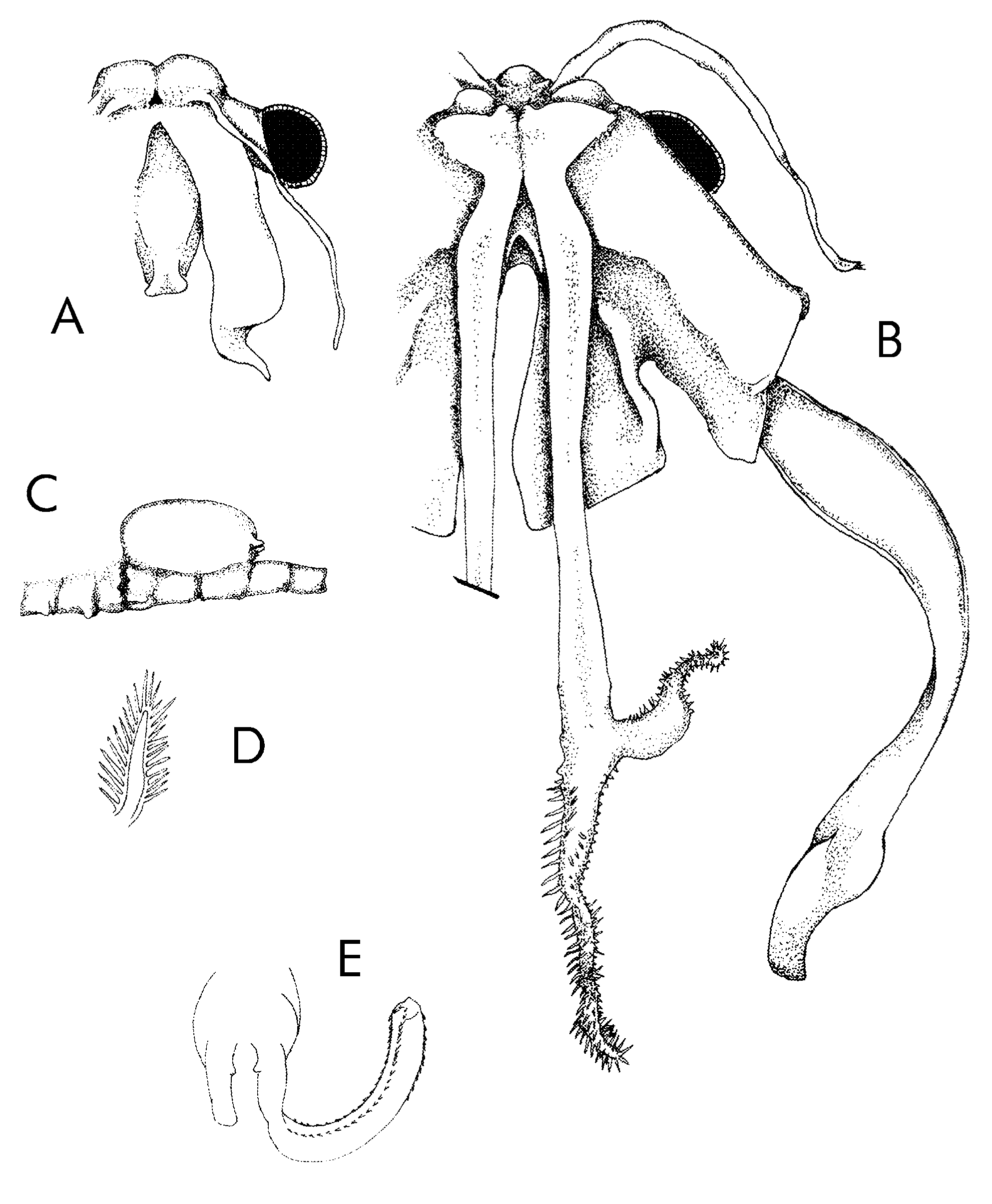
FIGURE 3. Australobranchipus gilgaiphila n. sp.: A) female, head, left side, anterior view; B) male, head, left side, anterior view; C) female brood pouch; D) male right cercopods, ventral view; E) male gonopods (left gonopod everted), ventral view.

Imageimage/png© Rogers, Christopher;Timms, Brian V;Jocquè, Merlijn;Brendonck, LucA new genus and species of branchipodid fairy shrimp (Crustacea: Branchiopoda: Anostraca) from Australia

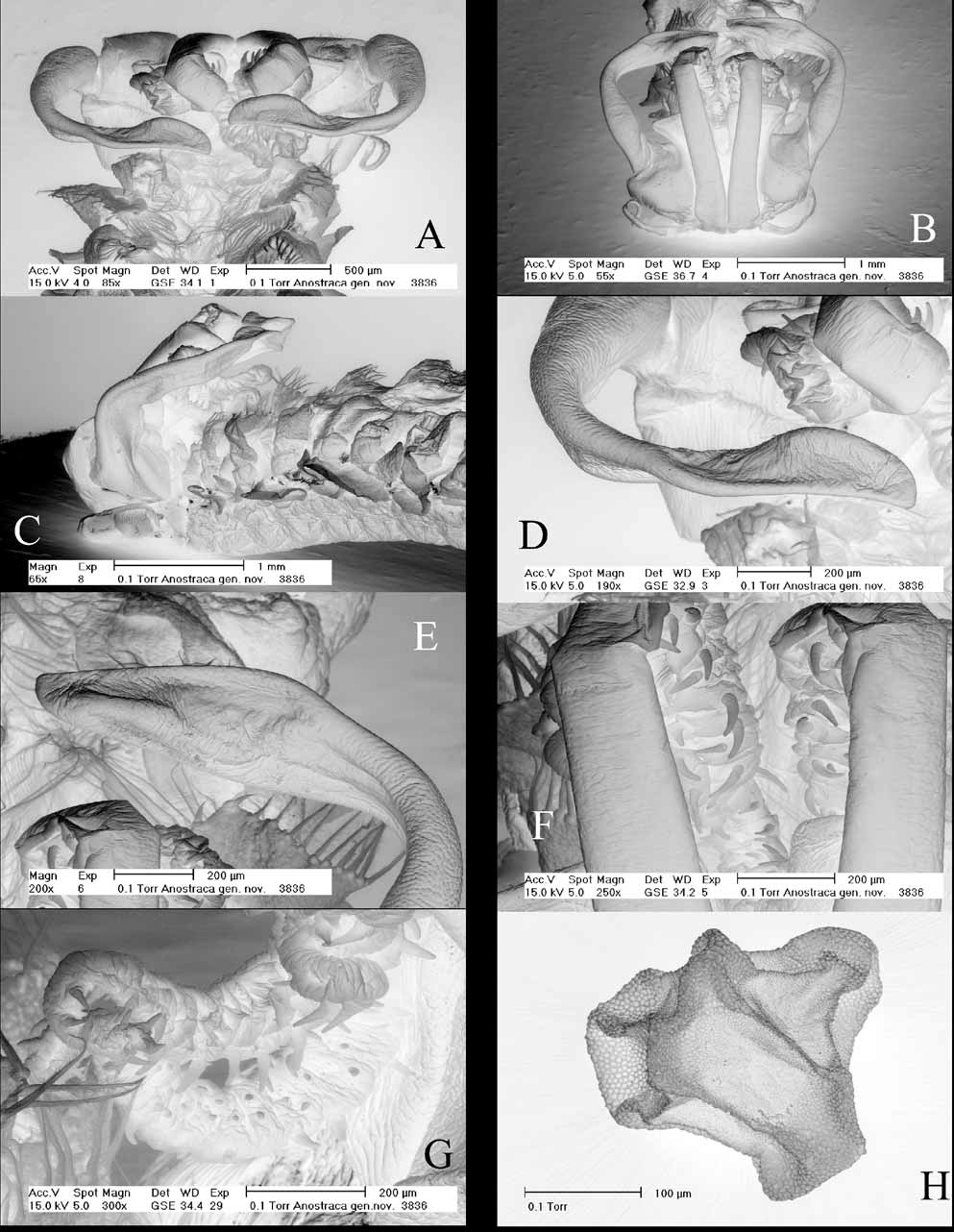
FIGURE 4. Australobranchipus gilgaiphila n. sp., A-G male, H egg: A) head, posterioventral view; B) head, anterioventral view; C) head and anterior portion of thorax right lateral view; D) right second antenna, detail of apex, anterior view; E) right second antenna, detail of apex, dorsal view; F) detail of coiled frontal appendage branches, anterior view; G) detail of coiled frontal appendage rami, right lateral view; H) egg.

Imageimage/png© Rogers, Christopher;Timms, Brian V;Jocquè, Merlijn;Brendonck, LucA new genus and species of branchipodid fairy shrimp (Crustacea: Branchiopoda: Anostraca) from Australia

IMAGES

Gallery(4)

See Gallery

Occurrences with images

CITATIONS

References(11)

  • 1

    Baird, W. (1852). Monograph of the Family Branchiopodidae, a family of crustaceans belonging to the division Entomostraca, with a description of a new genus and species of the Family, and two new species belonging to the Family Limnadidae. <em>Proceedings of the Zoological Society of London.</em> 23:18-31, 2 pls.

    original descriptionWorld Register of Marine Species
  • 2

    Brtek, Ján, 1997: Checklist of the valid and invalid names of the "large branchiopods" (Anostraca, Notostraca, Spinicaudata and Laevicaudata), with a survey of the taxonomy of all Branchiopoda. Zborník Slovenského Národného Múzea, Prírodné Vedy, vol. 43. 1-66.

    Integrated Taxonomic Information System (ITIS)
  • 3

    Brtek, Ján, and Graziella Mura, 2000: Revised key to families and genera of the Anostraca with notes on their geographical distribution. Crustaceana, vol. 73, no. 9. 1037-1088.

    Integrated Taxonomic Information System (ITIS)
  • 4

    Dumont & Negrea 2002

    habitat flag sourceThe Interim Register of Marine and Nonmarine Genera
  • 5

    Martin, J. W.; Davis, G. E. (2001). An updated classification of the recent Crustacea. Science Series (Los Angeles), 39. Natural History Museum of Los Angeles County: Los Angeles. VII, 123 pp.

    current name sourceThe Interim Register of Marine and Nonmarine Genera
  • Source Information

    GBIF Backbone Taxonomy

    GBIF Backbone Taxonomy

    checklist

    The GBIF Backbone Taxonomy is a single, synthetic management classification with the goal of covering all names GBIF is dealing with. It's the taxonomic backbone that allows GBIF to integrate name based information from different resources, no matter if these are occurrence datasets, species pages, names from nomenclators or external sources like EOL, Genbank or IUCN. This backbone allows taxonomic search, browse and reporting operations across all those resources in a consistent way and to provide means to crosswalk names from one source to another.

    It is updated regulary through an automated process in which the Catalogue of Life acts as a starting point also providing the complete higher classification above families. Additional scientific names only found in other authoritative nomenclatural and taxonomic datasets are then merged into the tree, thus extending the original catalogue and broadening the backbones name coverage. The GBIF Backbone taxonomy also includes identifiers for Operational Taxonomic Units (OTUs) drawn from the barcoding resources iBOL and UNITE.

    International Barcode of Life project (iBOL), Barcode Index Numbers (BINs). BINs are connected to a taxon name and its classification by taking into account all names applied to the BIN and picking names with at least 80% consensus. If there is no consensus of name at the species level, the selection process is repeated moving up the major Linnaean ranks until consensus is achieved.

    UNITE - Unified system for the DNA based fungal species, Species Hypotheses (SHs). SHs are connected to a taxon name and its classification based on the determination of the RefS (reference sequence) if present or the RepS (representative sequence). In the latter case, if there is no match in the UNITE taxonomy, the lowest rank with 100% consensus within the SH will be used.

    The GBIF Backbone Taxonomy is available for download at https://hosted-datasets.gbif.org/datasets/backbone/ in different formats together with an archive of all previous versions.

    The following 105 sources have been used to assemble the GBIF backbone with number of names given in brackets:

    • Catalogue of Life Checklist - 4766428 names
    • International Barcode of Life project (iBOL) Barcode Index Numbers (BINs) - 635951 names
    • UNITE - Unified system for the DNA based fungal species linked to the classification - 611208 names
    • The Paleobiology Database - 212054 names
    • World Register of Marine Species - 188857 names
    • The Interim Register of Marine and Nonmarine Genera - 183894 names
    • The World Checklist of Vascular Plants (WCVP) - 131891 names
    • GBIF Backbone Taxonomy - 114350 names
    • TAXREF - 109374 names
    • The Leipzig catalogue of vascular plants - 75380 names
    • ZooBank - 73549 names
    • Integrated Taxonomic Information System (ITIS) - 68377 names
    • Plazi.org taxonomic treatments database - 61346 names
    • Genome Taxonomy Database r207 - 60545 names
    • International Plant Names Index - 52329 names
    • Fauna Europaea - 45077 names
    • The National Checklist of Taiwan (Catalogue of Life in Taiwan, TaiCoL) - 36193 names
    • Dyntaxa. Svensk taxonomisk databas - 35892 names
    • The Plant List with literature - 32692 names
    • United Kingdom Species Inventory (UKSI) - 29643 names
    • Artsnavnebasen - 29208 names
    • The IUCN Red List of Threatened Species - 21221 names
    • Afromoths, online database of Afrotropical moth species (Lepidoptera) - 13961 names
    • Brazilian Flora 2020 project - Projeto Flora do Brasil 2020 - 13829 names
    • Prokaryotic Nomenclature Up-to-Date (PNU) - 10079 names
    • Checklist Dutch Species Register - Nederlands Soortenregister - 8814 names
    • ICTV Master Species List (MSL) - 7852 names
    • Cockroach Species File - 6020 names
    • GRIN Taxonomy - 5882 names
    • Taxon list of fungi and fungal-like organisms from Germany compiled by the DGfM - 4570 names
    • Catalogue of Afrotropical Bees - 3623 names
    • Catalogue of Tenebrionidae (Coleoptera) of North America - 3327 names
    • Checklist of Beetles (Coleoptera) of Canada and Alaska. Second Edition. - 3312 names
    • Systema Dipterorum - 2850 names
    • Catalogue of the Pterophoroidea of the World - 2807 names
    • The Clements Checklist - 2675 names
    • Taxon list of Hymenoptera from Germany compiled in the context of the GBOL project - 2496 names
    • IOC World Bird List, v13.2 - 2366 names
    • Official Lists and Indexes of Names in Zoology - 2310 names
    • National checklist of all species occurring in Denmark - 1922 names
    • Myriatrix - 1876 names
    • Database of Vascular Plants of Canada (VASCAN) - 1822 names
    • Taxon list of vascular plants from Bavaria, Germany compiled in the context of the BFL project - 1771 names
    • Orthoptera Species File - 1742 names
    • A list of the terrestrial fungi, flora and fauna of Madeira and Selvagens archipelagos - 1602 names
    • Aphid Species File - 1565 names
    • World Spider Catalog - 1561 names
    • Taxon list of Jurassic Pisces of the Tethys Palaeo-Environment compiled at the SNSB-JME - 1270 names
    • Backbone Family Classification Patch - 1143 names
    • GBIF Algae Classification - 1100 names
    • International Cichorieae Network (ICN): Cichorieae Portal - 975 names
    • Psocodea Species File - 803 names
    • New Zealand Marine Macroalgae Species Checklist - 787 names
    • Annotated checklist of endemic species from the Western Balkans - 754 names
    • Taxon list of animals with German names (worldwide) compiled at the SMNS - 503 names
    • Catalogue of the Alucitoidea of the World - 472 names
    • Lygaeoidea Species File - 462 names
    • Catálogo de Plantas y Líquenes de Colombia - 422 names
    • GBIF Backbone Patch - 317 names
    • Phasmida Species File - 259 names
    • Cortinariaceae fetched from the Index Fungorum API - 234 names
    • Coreoidea Species File - 233 names
    • GTDB supplement - 139 names
    • Mantodea Species File - 119 names
    • Endemic species in Taiwan - 93 names
    • Taxon list of Araneae from Germany compiled in the context of the GBOL project - 88 names
    • Species of Hominidae - 78 names
    • Taxon list of Sternorrhyncha from Germany compiled in the context of the GBOL project - 77 names
    • Taxon list of mosses from Germany compiled in the context of the GBOL project - 75 names
    • Mammal Species of the World - 73 names
    • Plecoptera Species File - 71 names
    • Species Fungorum Plus - 64 names
    • Catalogue of the type specimens of Cosmopterigidae (Lepidoptera: Gelechioidea) from research collections of the Zoological Institute, Russian Academy of Sciences - 47 names
    • Species named after famous people - 41 names
    • Dermaptera Species File - 36 names
    • Taxon list of Trichoptera from Germany compiled in the context of the GBOL project - 34 names
    • True Fruit Flies (Diptera, Tephritidae) of the Afrotropical Region - 33 names
    • Range and Regularities in the Distribution of Earthworms of the Earthworms of the USSR Fauna. Perel, 1979 - 32 names
    • Taxon list of Diplura from Germany compiled in the context of the GBOL project - 30 names
    • Lista de referencia de especies de aves de Colombia - 2022 - 24 names
    • Taxon list of Auchenorrhyncha from Germany compiled in the context of the GBOL project - 20 names
    • Catalogue of the type specimens of Polycestinae (Coleoptera: Buprestidae) from research collections of the Zoological Institute, Russian Academy of Sciences - 19 names
    • Taxon list of Thysanoptera from Germany compiled in the context of the GBOL project - 19 names
    • Lista de especies de vertebrados registrados en jurisdicción del Departamento del Huila - 18 names
    • Taxon list of Microcoryphia (Archaeognatha) from Germany compiled in the context of the GBOL project - 15 names
    • Catalogue of the type specimens of Bufonidae and Megophryidae (Amphibia: Anura) from research collections of the Zoological Institute, Russian Academy of Sciences - 12 names
    • Grylloblattodea Species File - 11 names
    • Coleorrhyncha Species File - 9 names
    • Taxon list of liverworts from Germany compiled in the context of the GBOL project - 9 names
    • Embioptera Species File - 7 names
    • Taxon list of Pisces and Cyclostoma from Germany compiled in the context of the GBOL project - 6 names
    • Taxon list of Pteridophyta from Germany compiled in the context of the GBOL project - 6 names
    • Taxon list of Siphonaptera from Germany compiled in the context of the GBOL project - 5 names
    • The Earthworms of the Fauna of Russia. Perel, 1997 - 5 names
    • Taxon list of Zygentoma from Germany compiled in the context of the GBOL project - 4 names
    • Asiloid Flies: new taxa of Diptera: Apioceridae, Asilidae, and Mydidae - 3 names
    • Taxon list of Protura from Germany compiled in the context of the GBOL project - 3 names
    • Taxon list of hornworts from Germany compiled in the context of the GBOL project - 2 names
    • Chrysididae Species File - 1 names
    • Taxon list of Dermaptera from Germany compiled in the context of the GBOL project - 1 names
    • Taxon list of Diplopoda from Germany in the context of the GBOL project - 1 names
    • Taxon list of Orthoptera (Grashoppers) from Germany compiled at the SNSB - 1 names
    • Taxon list of Pscoptera from Germany compiled in the context of the GBOL project - 1 names
    • Taxon list of Pseudoscorpiones from Germany compiled in the context of the GBOL project - 1 names
    • Taxon list of Raphidioptera from Germany compiled in the context of the GBOL project - 1 names

    GBIF Secretariat (2023). GBIF Backbone Taxonomy. Checklist dataset https://doi.org/10.15468/39omei accessed via GBIF.org on 2026-06-14.

    CC BYPublished 8/28/2023View dataset
    GBIF Usage Key
    3676
    Dataset Key
    d7dddbf4-2cf0-4f39-9b2a-bb099caae36c
    Origin
    source
    Backbone Key
    3676
    Taxon ID
    gbif:3676
    Last Crawled
    8/22/2023
    Last Interpreted
    8/22/2023