AnimaliaNot EvaluatedacceptedfamilyAcceptedRestricted
Cryptopidae

Cryptopidae

Bark Centipedes(+5)

GBIF:4085

0countries
0datasets

0

Descendants

0

Children

0

Species

0

Genera

PROFILE

Species Profile

Habitat

Terrestrial

ABOUT

Descriptions(7)

Sexual dimorphism. Unknown.
An overview of the extant genera and subgenera of the order Scolopendromorpha (Chilopoda): a new identification key and updated diagnoses
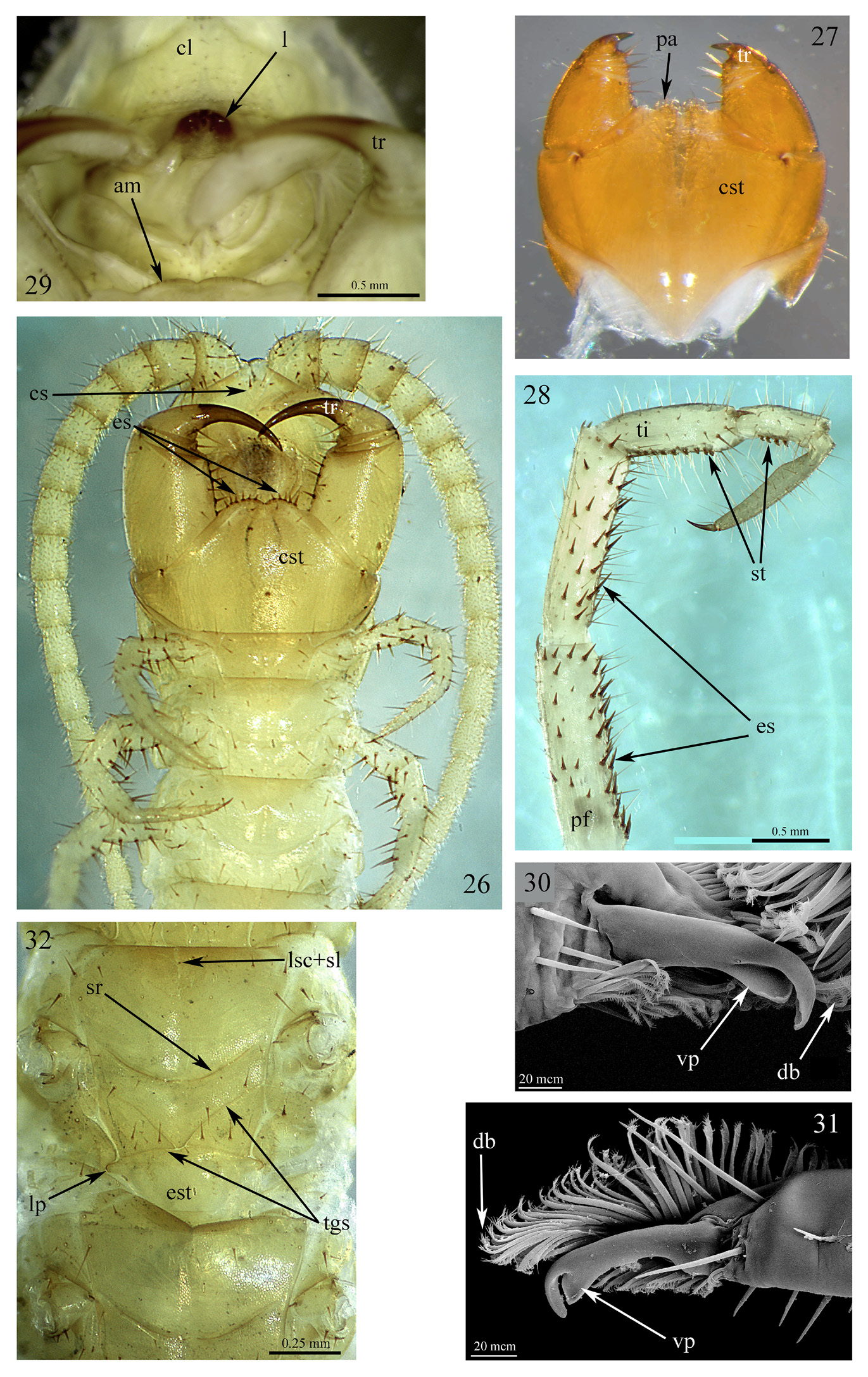
Diagnosis. Eyes absent. Labrum with a single median tooth (only in a few species of Cryptops (Cryptops) with two additional lateral teeth; Fig. 29). Slender pretarsus of maxillae 2 not pectinate, more or less curved (Figs 30, 31), pointed (figs 3 C, 6 C in Ázara & Ferreira 2013) or lobe-shaped (fig. 69 in Verhoeff 1934). Maxillary pretarsus in most species is accompanied by a ventral projection (“ flange ” sensu Edgecombe & Bonato 2011, Figs 30, 31) but never by accessory spine (s). Anterior margin of forcipular coxosternite in most species bilobed, with some long enlarged marginal setae (Fig. 26); rarely is this margin additionally chitinised or with short rounded projections (in Cryptops (Paracryptops), Fig. 27), but never with tooth-plates. Forcipular trochantero-prefemur never with process. Sternites never with paramedian sutures, but usually with “ cruciform ” sutures (Fig. 32), i. e. with well-developed transverse suture (sometimes with skeletal transverse ridge / thickening at its place) and with a single median longitudinal suture (more rarely sulcus) developed to varying degrees. 21 LBS; spiracles on macrosegments except for LBS 7; spiracles open, lacking flaps (fig. 4 A in Vahtera et al. 2012 b). Ultimate LBS considerably shorter than the penultimate one; coxopleuron without a process. Tarsal articles of locomotory legs (Fig. 26) in most species fused in a solid tarsus (with or without visible traces of an articulation between them); legs lack both tibial and tarsal spurs. Relatively short ultimate legs (Fig. 28) of “ pocket knife ” shape (sensu Schileyko 2009) forming a kind of clasping apparatus, their femur (not always), tibia and tarsus 1 in overwhelming majority of species with characteristic saw teeth, pretarsus not enlarged. Prefemur of the ultimate legs without processes (spinous ones or saw teeth), sometimes with short enlarged setae (Fig. 28). Edgecombe & Bonato (2011: 393) also wrote: “ Median cluster of sensilla coeloconica on clypeal part of epipharynx rhomboid, with lids covering the distal edge of the sensilla … Gizzard with stiff anteriorly-directed projections; projections without a distinct kink near their midlength ”.
An overview of the extant genera and subgenera of the order Scolopendromorpha (Chilopoda): a new identification key and updated diagnoses
Number of subtaxa. 1 genus, 4 subgenera.
An overview of the extant genera and subgenera of the order Scolopendromorpha (Chilopoda): a new identification key and updated diagnoses
Remarks. Treated as a family in Edgecombe & Bonato (2011: 393), Vahtera et al. (2012 a: 6), Edgecombe et al. (2012: 770), Lewis (2013: 1), Lewis (2016 a: 575), Stojanović, Mitić & Makarov (2019: 21). Edgecombe and Bonato (2011: 393) divided this family into two closely related genera — Cryptops and Paracryptops, and Vahtera et al. (2012 a: 13) suggested (without formalizing; see below) the latter to be a synonym of the former; so at the moment this family is monotypic. According to both Edgecombe & Bonato (2011: 393) and Lewis (2016 a: 575) the genus Cryptops comprises four subgenera: Cryptops (Cryptops), Trigonocryptops Verhoeff, 1906, Haplocryptops Verhoeff, 1934 and Chromatanops Verhoeff, 1906, but we regard the latter to be a synonym of Cryptops (Cryptops) (see below). There is certain confusion concerning structure of the pretarsus of maxillae 2 in this family (i. e. in genus Cryptops). Attems (1930: 7) only wrote that this structure is “ schlank ” (slim / slender) and gave a drawing (fig. 285) of a slightly [!] curved and apically pointed claw accompanied by a well-developed and apically rounded ventral projection. In 1934 Verhoeff, describing the new subgenus C. (Haplocryptops), noted two types of maxillary pretarsus in Cryptops (see below). Recent authors (Edgecombe & Koch 2008: 883, Koch et al. 2010: 77, Edgecombe & Bonato 2011: 393) describe this pretarsus only as a “ hook-like and flanged ”, confirming these terms by corresponding drawings or SEMs (Figs 30, 31). We note, however, that this character is not stable in Cryptops, not even being subgenus-specific as five adults of C. (C.) caucasius Verhoef, 1934 (Rc 6430, 8004) and two adults of C. (C.) anomalans Newport, 1844 (Rc 7450) show this pretarsus to be slightly curved (i. e. not hooked), apically pointed and lacking any ventral projection (see also Remarks to C. (Paracryptops) below). Thus there should be at least four types of this pretarsus in Cryptopidae: 1. slightly curved, apically pointed, without ventral projection, 2. slightly curved, apically pointed, with ventral projection, 3. slightly curved, lobe-shaped, with ventral projection, 4. hooklike, with ventral projection.
An overview of the extant genera and subgenera of the order Scolopendromorpha (Chilopoda): a new identification key and updated diagnoses
Range. All tropical, subtropical and warm temperate regions.
An overview of the extant genera and subgenera of the order Scolopendromorpha (Chilopoda): a new identification key and updated diagnoses
Synonyms. Cryptopsidae in Machado (1953: 83)
An overview of the extant genera and subgenera of the order Scolopendromorpha (Chilopoda): a new identification key and updated diagnoses

FAMILY CRYPTOPIDAE KOHLRAUSCH, 1881

An annotated checklist of centipedes (Chilopoda) of VietnamMagnoliaPress via PlaziNo known copyright restrictions apply. See Agosti, D., Egloff, W., 2009. Taxonomic information exchange and copyright: the Plazi approach. BMC Research Notes 2009, 2:53 for further explanation.

Export occurrence data

Darwin Core Archive (ZIP)

GEOGRAPHY

Distribution Map

Occurrence Map

Loading map…

Tiles © GBIF Maps API | Map powered by MapLibre GL

REGIONS

Geographic Distribution(2)

Bosque Renace(CO)
DK
not evaluated

DATA

Occurrence Datasets

Loading datasets…

Common names used for this species across different languages and regions. Available in 6 languages.

engBark CentipedesenghunVakszkolopendra-félékhunrusСлепые сколопендрыrusthaวงศ์ ตะขาบไม่มีตาthajpnメナシムカデ科jpn+1 more

Vernacular (common) names are the everyday names used for a species in different languages and regions. A single species may have dozens of common names worldwide. This taxon has names in 6 languages.

engBark Centipedes
eng
Source: Catalogue of LifeSource taxon #304076261
hunVakszkolopendra-félék
hun
Source: Catalogue of LifeSource taxon #304076261
rusСлепые сколопендры
rus
Source: Catalogue of LifeSource taxon #304076261
thaวงศ์ ตะขาบไม่มีตา
tha
Source: Catalogue of LifeSource taxon #304076261
jpnメナシムカデ科
jpn
Source: Catalogue of LifeSource taxon #304076261
zho盲蜈蚣科
zho
Source: Catalogue of LifeSource taxon #304076261

CLASSIFICATION

Taxonomic Classification Tree

RELATED

Related Name Usages(20)

Matching names from other GBIF-indexed checklists and datasets.

MULTIMEDIA

Media Files(1)

FIGURES 26–32. Cryptops (Trigonocryptops) martinicensis Schileyko, Iorio & Coulis, 2018; Ad. paratype CIRAD P8A 26 head, forcipular segment + LBS 1–3 ventrally; Cryptops (Paracryptops) weberi Pocock, 1891; MCZ DNA 102459 27 forcipular segment ventrally; Cryptops (Trigonocryptops) martinicensis Schileyko, Iorio & Coulis, 2018; Ad. holotype MNHN 459 28 right ultimate leg medially; Cryptops (C.) caucasius Verhoeff, 1934; Ad. Rc 8003 29 cephalic plate + anterior margin of forcipular coxosternite ventrally; Cryptops australis (Newport, 1845); AM KS 30 apical part of maxilla 2 laterally; Cryptops (Paracryptops) weberi Pocock, 1891; MCZ DNA 102459 31 apical part of of maxilla 2 laterally; Cryptops (Trigonocryptops) martinicensis Schileyko, Iorio & Coulis, 2018; Ad. holotype MNHN 459 32 LBS 3 ventrally; (am)—anterior margin of forcipular coxosternite, (cl)—clypeus, (cs)—clypeal setose plate, (cst)—forcipular coxosternite, (db)—apical setae of dorsal brush, (es)—enlarged (spiniform) setae, (est)—endosternite, (l)—labrum, (lp)—lateral projection of endosternite, (ls)—long setae, (lsc)—sternal median longitudinal sulcus, (pa)—short rounded projection of anterior margin of forcipular coxosternite, (pf)—prefemur, (sl)—sternal median longitudinal suture, (sr)—sternal transverse ridge, (st)—saw teeth, (sts)—sternal transverse suture, (tgs)—sternal trigonal sutures, (ti)—tibia, (tr)—tarsungula, (vp)—ventral projection of pretarsus of maxilla 2.

Imageimage/png© Schileyko, Arkady A.;Vahtera, Varpu;Edgecombe, Gregory D.An overview of the extant genera and subgenera of the order Scolopendromorpha (Chilopoda): a new identification key and updated diagnoses

IMAGES

Gallery(1)

See Gallery

Occurrences with images

CITATIONS

References(8)

  • 1

    Barber, A. D. (2009). Littoral myriapods: a review. <em>Soil Organisms.</em> 81(3): 735-760.

    habitat flag sourceThe Interim Register of Marine and Nonmarine Genera
  • 2

    Benton, M.J. (ed). (1993). The Fossil Record 2. Chapman & Hall, London, 845 pp.

    extant flag sourceThe Interim Register of Marine and Nonmarine Genera
  • 3

    Benton, M.J. (ed). (1993). The Fossil Record 2. Chapman & Hall, London, 845 pp.

    habitat flag sourceThe Interim Register of Marine and Nonmarine Genera
  • 4

    Bonato, L., G. D. Edgecombe, and M. Zapparoli / Minelli, A., ed., 2011: Chilopoda - Taxonomic overview. Treatise on Zoology - The Myriapoda, vol. 1. 363-443.

    Integrated Taxonomic Information System (ITIS)
  • 5

    Chamberlin, Ralph V. (07/1918) The Chilopoda and Diplopoda of the West Indies

    journal articleMyriatrix
  • Source Information

    GBIF Backbone Taxonomy

    GBIF Backbone Taxonomy

    checklist

    The GBIF Backbone Taxonomy is a single, synthetic management classification with the goal of covering all names GBIF is dealing with. It's the taxonomic backbone that allows GBIF to integrate name based information from different resources, no matter if these are occurrence datasets, species pages, names from nomenclators or external sources like EOL, Genbank or IUCN. This backbone allows taxonomic search, browse and reporting operations across all those resources in a consistent way and to provide means to crosswalk names from one source to another.

    It is updated regulary through an automated process in which the Catalogue of Life acts as a starting point also providing the complete higher classification above families. Additional scientific names only found in other authoritative nomenclatural and taxonomic datasets are then merged into the tree, thus extending the original catalogue and broadening the backbones name coverage. The GBIF Backbone taxonomy also includes identifiers for Operational Taxonomic Units (OTUs) drawn from the barcoding resources iBOL and UNITE.

    International Barcode of Life project (iBOL), Barcode Index Numbers (BINs). BINs are connected to a taxon name and its classification by taking into account all names applied to the BIN and picking names with at least 80% consensus. If there is no consensus of name at the species level, the selection process is repeated moving up the major Linnaean ranks until consensus is achieved.

    UNITE - Unified system for the DNA based fungal species, Species Hypotheses (SHs). SHs are connected to a taxon name and its classification based on the determination of the RefS (reference sequence) if present or the RepS (representative sequence). In the latter case, if there is no match in the UNITE taxonomy, the lowest rank with 100% consensus within the SH will be used.

    The GBIF Backbone Taxonomy is available for download at https://hosted-datasets.gbif.org/datasets/backbone/ in different formats together with an archive of all previous versions.

    The following 105 sources have been used to assemble the GBIF backbone with number of names given in brackets:

    • Catalogue of Life Checklist - 4766428 names
    • International Barcode of Life project (iBOL) Barcode Index Numbers (BINs) - 635951 names
    • UNITE - Unified system for the DNA based fungal species linked to the classification - 611208 names
    • The Paleobiology Database - 212054 names
    • World Register of Marine Species - 188857 names
    • The Interim Register of Marine and Nonmarine Genera - 183894 names
    • The World Checklist of Vascular Plants (WCVP) - 131891 names
    • GBIF Backbone Taxonomy - 114350 names
    • TAXREF - 109374 names
    • The Leipzig catalogue of vascular plants - 75380 names
    • ZooBank - 73549 names
    • Integrated Taxonomic Information System (ITIS) - 68377 names
    • Plazi.org taxonomic treatments database - 61346 names
    • Genome Taxonomy Database r207 - 60545 names
    • International Plant Names Index - 52329 names
    • Fauna Europaea - 45077 names
    • The National Checklist of Taiwan (Catalogue of Life in Taiwan, TaiCoL) - 36193 names
    • Dyntaxa. Svensk taxonomisk databas - 35892 names
    • The Plant List with literature - 32692 names
    • United Kingdom Species Inventory (UKSI) - 29643 names
    • Artsnavnebasen - 29208 names
    • The IUCN Red List of Threatened Species - 21221 names
    • Afromoths, online database of Afrotropical moth species (Lepidoptera) - 13961 names
    • Brazilian Flora 2020 project - Projeto Flora do Brasil 2020 - 13829 names
    • Prokaryotic Nomenclature Up-to-Date (PNU) - 10079 names
    • Checklist Dutch Species Register - Nederlands Soortenregister - 8814 names
    • ICTV Master Species List (MSL) - 7852 names
    • Cockroach Species File - 6020 names
    • GRIN Taxonomy - 5882 names
    • Taxon list of fungi and fungal-like organisms from Germany compiled by the DGfM - 4570 names
    • Catalogue of Afrotropical Bees - 3623 names
    • Catalogue of Tenebrionidae (Coleoptera) of North America - 3327 names
    • Checklist of Beetles (Coleoptera) of Canada and Alaska. Second Edition. - 3312 names
    • Systema Dipterorum - 2850 names
    • Catalogue of the Pterophoroidea of the World - 2807 names
    • The Clements Checklist - 2675 names
    • Taxon list of Hymenoptera from Germany compiled in the context of the GBOL project - 2496 names
    • IOC World Bird List, v13.2 - 2366 names
    • Official Lists and Indexes of Names in Zoology - 2310 names
    • National checklist of all species occurring in Denmark - 1922 names
    • Myriatrix - 1876 names
    • Database of Vascular Plants of Canada (VASCAN) - 1822 names
    • Taxon list of vascular plants from Bavaria, Germany compiled in the context of the BFL project - 1771 names
    • Orthoptera Species File - 1742 names
    • A list of the terrestrial fungi, flora and fauna of Madeira and Selvagens archipelagos - 1602 names
    • Aphid Species File - 1565 names
    • World Spider Catalog - 1561 names
    • Taxon list of Jurassic Pisces of the Tethys Palaeo-Environment compiled at the SNSB-JME - 1270 names
    • Backbone Family Classification Patch - 1143 names
    • GBIF Algae Classification - 1100 names
    • International Cichorieae Network (ICN): Cichorieae Portal - 975 names
    • Psocodea Species File - 803 names
    • New Zealand Marine Macroalgae Species Checklist - 787 names
    • Annotated checklist of endemic species from the Western Balkans - 754 names
    • Taxon list of animals with German names (worldwide) compiled at the SMNS - 503 names
    • Catalogue of the Alucitoidea of the World - 472 names
    • Lygaeoidea Species File - 462 names
    • Catálogo de Plantas y Líquenes de Colombia - 422 names
    • GBIF Backbone Patch - 317 names
    • Phasmida Species File - 259 names
    • Cortinariaceae fetched from the Index Fungorum API - 234 names
    • Coreoidea Species File - 233 names
    • GTDB supplement - 139 names
    • Mantodea Species File - 119 names
    • Endemic species in Taiwan - 93 names
    • Taxon list of Araneae from Germany compiled in the context of the GBOL project - 88 names
    • Species of Hominidae - 78 names
    • Taxon list of Sternorrhyncha from Germany compiled in the context of the GBOL project - 77 names
    • Taxon list of mosses from Germany compiled in the context of the GBOL project - 75 names
    • Mammal Species of the World - 73 names
    • Plecoptera Species File - 71 names
    • Species Fungorum Plus - 64 names
    • Catalogue of the type specimens of Cosmopterigidae (Lepidoptera: Gelechioidea) from research collections of the Zoological Institute, Russian Academy of Sciences - 47 names
    • Species named after famous people - 41 names
    • Dermaptera Species File - 36 names
    • Taxon list of Trichoptera from Germany compiled in the context of the GBOL project - 34 names
    • True Fruit Flies (Diptera, Tephritidae) of the Afrotropical Region - 33 names
    • Range and Regularities in the Distribution of Earthworms of the Earthworms of the USSR Fauna. Perel, 1979 - 32 names
    • Taxon list of Diplura from Germany compiled in the context of the GBOL project - 30 names
    • Lista de referencia de especies de aves de Colombia - 2022 - 24 names
    • Taxon list of Auchenorrhyncha from Germany compiled in the context of the GBOL project - 20 names
    • Catalogue of the type specimens of Polycestinae (Coleoptera: Buprestidae) from research collections of the Zoological Institute, Russian Academy of Sciences - 19 names
    • Taxon list of Thysanoptera from Germany compiled in the context of the GBOL project - 19 names
    • Lista de especies de vertebrados registrados en jurisdicción del Departamento del Huila - 18 names
    • Taxon list of Microcoryphia (Archaeognatha) from Germany compiled in the context of the GBOL project - 15 names
    • Catalogue of the type specimens of Bufonidae and Megophryidae (Amphibia: Anura) from research collections of the Zoological Institute, Russian Academy of Sciences - 12 names
    • Grylloblattodea Species File - 11 names
    • Coleorrhyncha Species File - 9 names
    • Taxon list of liverworts from Germany compiled in the context of the GBOL project - 9 names
    • Embioptera Species File - 7 names
    • Taxon list of Pisces and Cyclostoma from Germany compiled in the context of the GBOL project - 6 names
    • Taxon list of Pteridophyta from Germany compiled in the context of the GBOL project - 6 names
    • Taxon list of Siphonaptera from Germany compiled in the context of the GBOL project - 5 names
    • The Earthworms of the Fauna of Russia. Perel, 1997 - 5 names
    • Taxon list of Zygentoma from Germany compiled in the context of the GBOL project - 4 names
    • Asiloid Flies: new taxa of Diptera: Apioceridae, Asilidae, and Mydidae - 3 names
    • Taxon list of Protura from Germany compiled in the context of the GBOL project - 3 names
    • Taxon list of hornworts from Germany compiled in the context of the GBOL project - 2 names
    • Chrysididae Species File - 1 names
    • Taxon list of Dermaptera from Germany compiled in the context of the GBOL project - 1 names
    • Taxon list of Diplopoda from Germany in the context of the GBOL project - 1 names
    • Taxon list of Orthoptera (Grashoppers) from Germany compiled at the SNSB - 1 names
    • Taxon list of Pscoptera from Germany compiled in the context of the GBOL project - 1 names
    • Taxon list of Pseudoscorpiones from Germany compiled in the context of the GBOL project - 1 names
    • Taxon list of Raphidioptera from Germany compiled in the context of the GBOL project - 1 names

    GBIF Secretariat (2023). GBIF Backbone Taxonomy. Checklist dataset https://doi.org/10.15468/39omei accessed via GBIF.org on 2026-06-14.

    CC BYPublished 8/28/2023View dataset
    GBIF Usage Key
    4085
    Dataset Key
    d7dddbf4-2cf0-4f39-9b2a-bb099caae36c
    Origin
    source
    Backbone Key
    4085
    Taxon ID
    gbif:4085
    Last Crawled
    8/22/2023
    Last Interpreted
    8/22/2023
