
Annelida
lađasmáđut(+57)
GBIF:42
0
Descendants
0
Children
0
Species
0
Genera
0
Families
PROFILE
Species Profile
Characteristics
ABOUT
Descriptions(13)
Export occurrence data
Darwin Core Archive (ZIP)
GEOGRAPHY
Distribution Map
REGIONS
Geographic Distribution(4)
DATA
Occurrence Datasets
Common names used for this species across different languages and regions. Available in 13 languages and 8 countries. 6 preferred.
Vernacular (common) names are the everyday names used for a species in different languages and regions. A single species may have dozens of common names worldwide. This taxon has names in 13 languages. 6 names preferred.
CLASSIFICATION
Taxonomic Classification Tree

HIERARCHY
Child Taxa(50)
RELATED
Related Name Usages(20)
Matching names from other GBIF-indexed checklists and datasets.
MULTIMEDIA
Media Files(9)
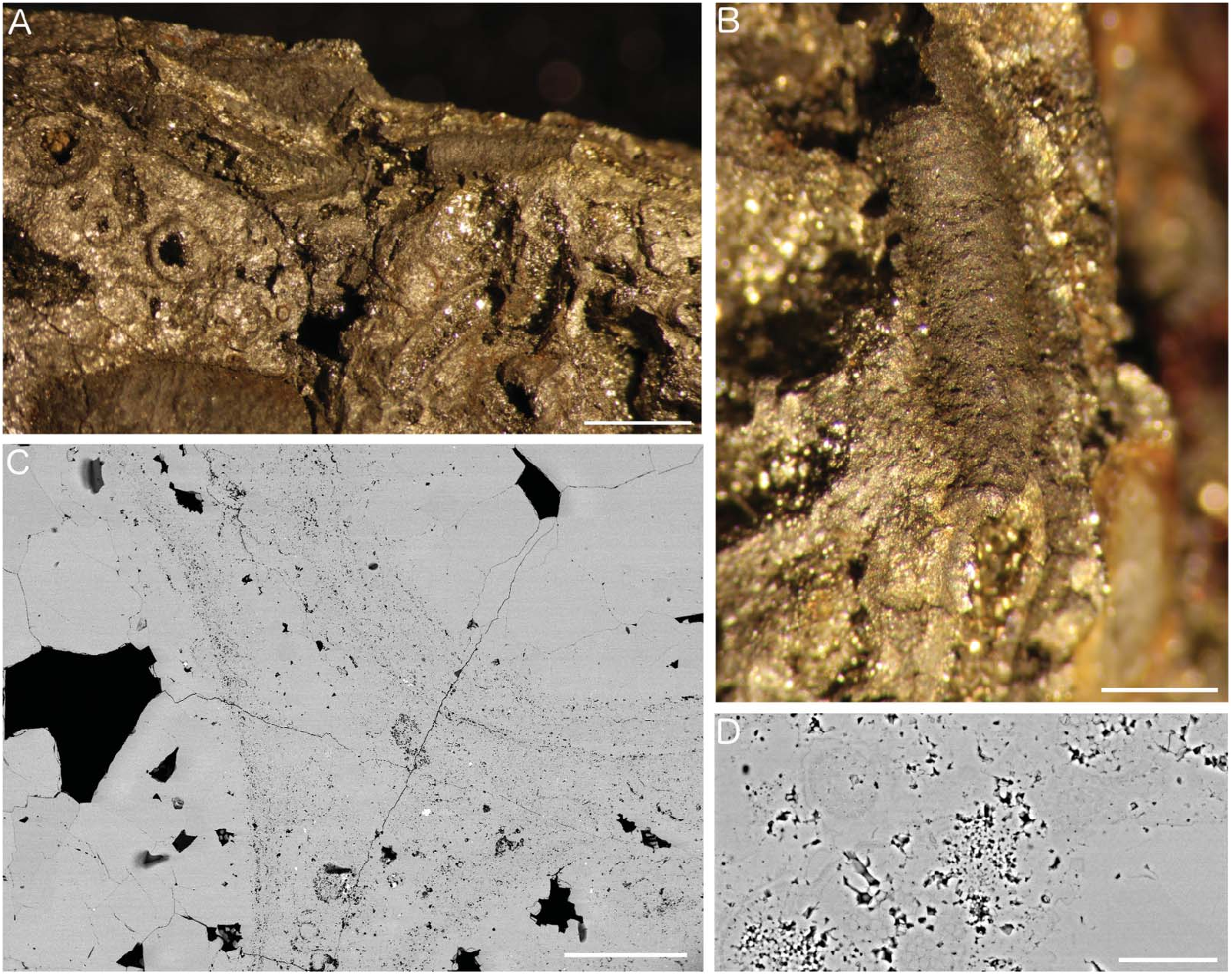
Figure 17. ‘Sibay tubes’, NHMUK VF71, Devonian, Sibay, Russia. A, hand specimen showing cluster of tubes in various orientations. B, detail of tube wall showing smooth appearance. C, detail of the walls of three adjacent tubes in transverse section; walls appear thick and multi-layered. D, detail of framboidal pyrite preserving tube walls. Scale bars: A = 3 mm; B = 1 mm; C = 500 µm; D = 10 µm.
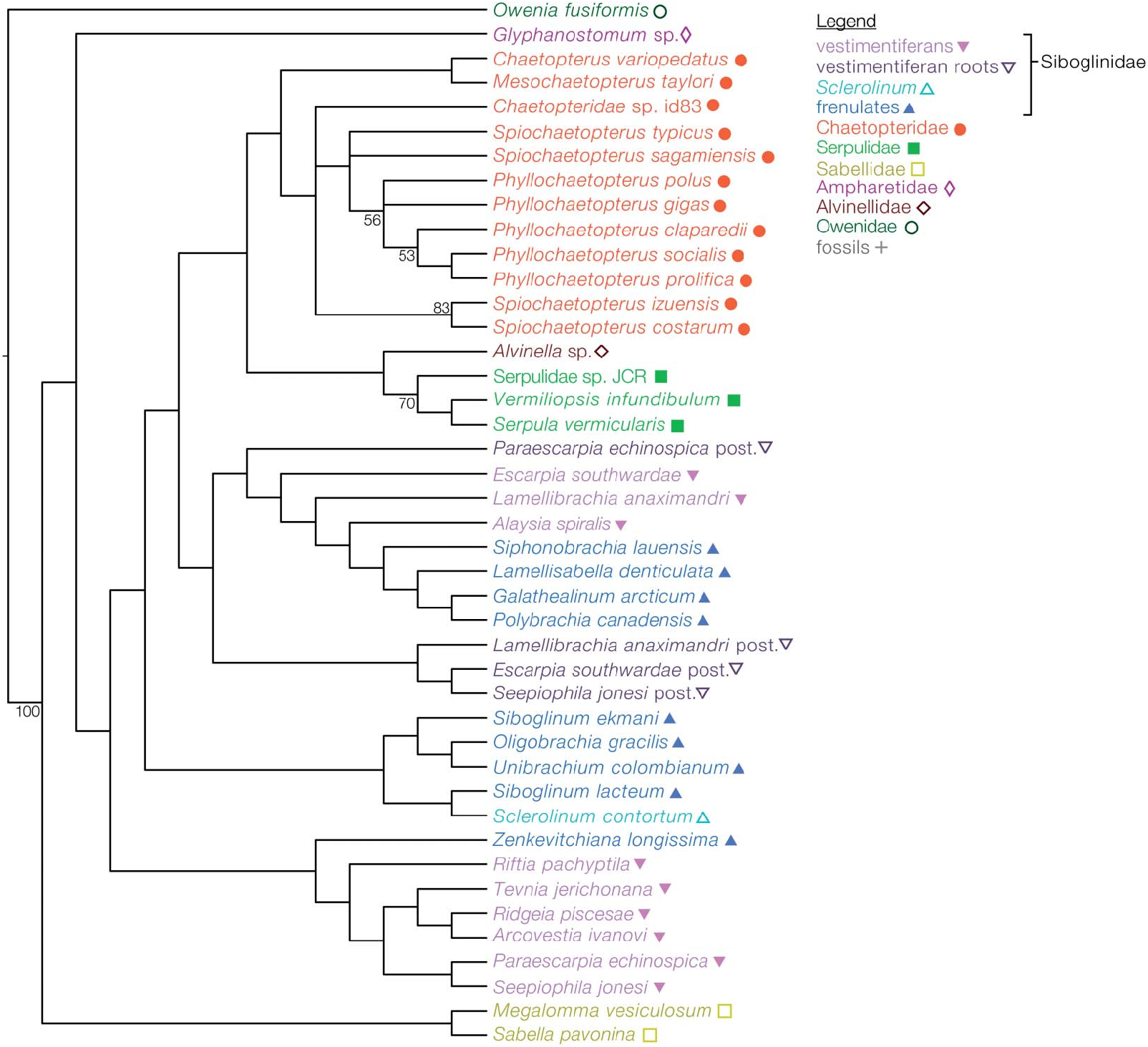
Figure 22. Strict consensus cladogram of the three most parsimonious trees of tubes built by a total of 43 modern annelid taxa (best score = 14.344, consistency index = 0.308, retention index = 0.629). The analysis was based on the 48 mostly morphological tube characters and was performed using implied character weighting (k = 3). Numbers on nodes represent groups present/contradicted support values. Symbols/colours indicate taxonomic affinities.
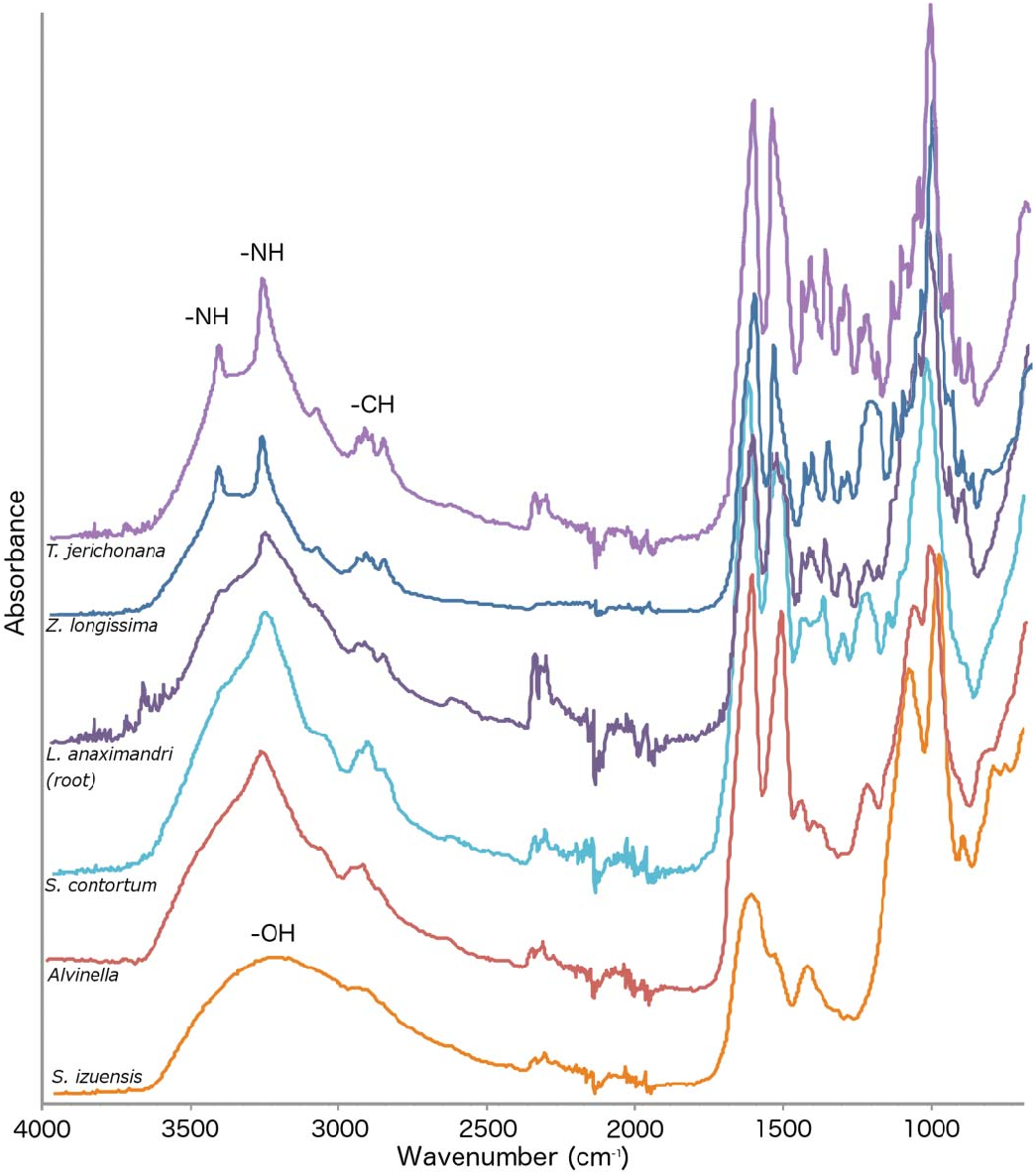
Figure 24. Fourier transform infrared (FTIR) spectroscopy spectra of the organic tubes of vent and seep annelids. Spectra are offset on the absorbance axis, and key spectral absorbance peaks are labelled with the types of chemical bonds they represent: -NH, nitrogenhydrogen; -CH, carbon-hydrogen; -OH, oxygen-hydrogen. The regions of the tube analysed are as follows: Tevnia jerichonana (anterior, inner tube wall); Zenkevitchiana longissimi (middle, outer tube wall); Lamellibrachia anaximandri (posterior, outer tube wall); Sclerolinum contortum (anterior, outer tube wall); Alvinella sp. (middle); Spiochaetopterus izuensis (middle, outer tube wall).
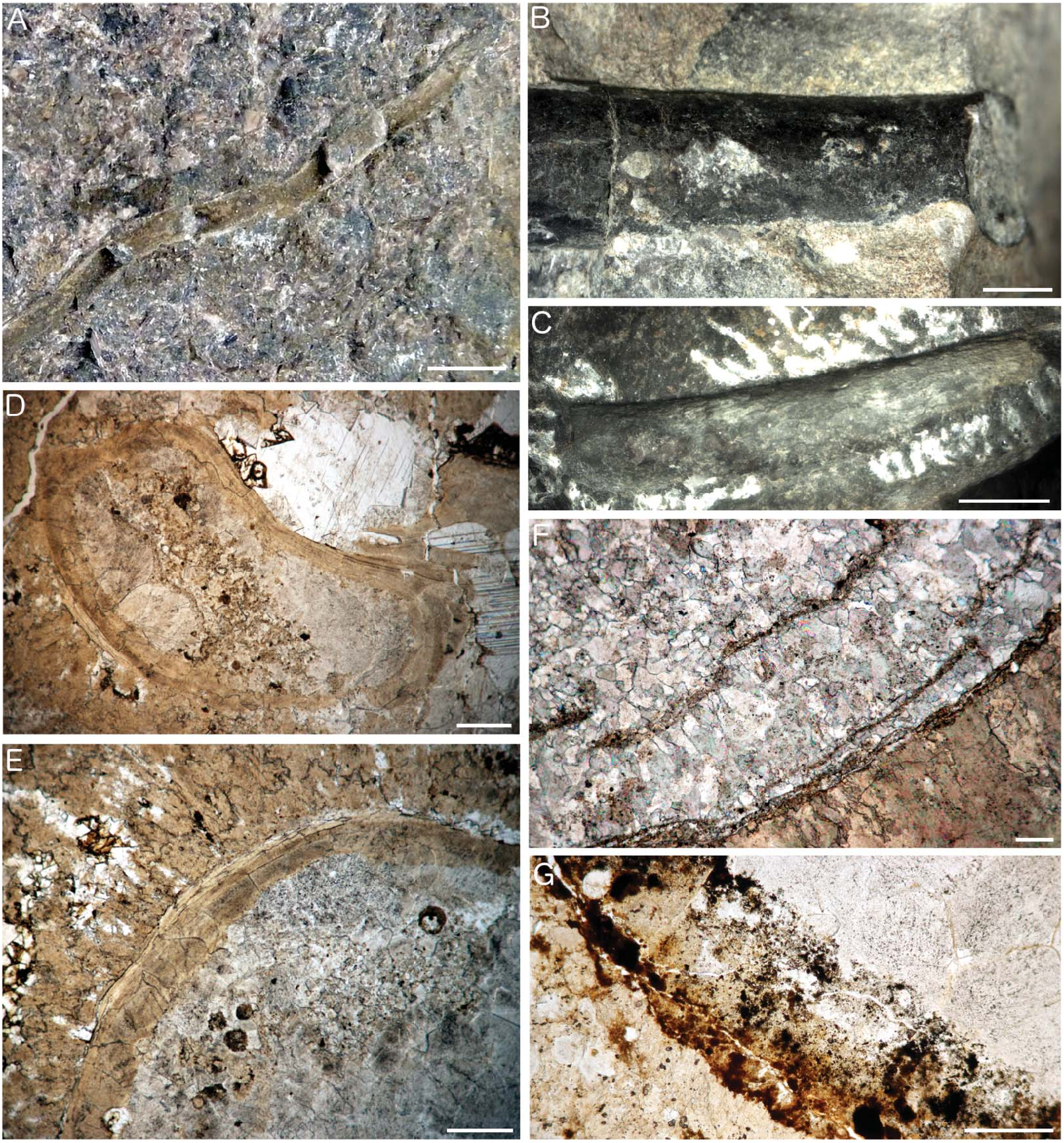
Figure 14. ‘Sassenfjorden area tubes’, Volgian–Ryazanian, Svalbard. A–C, hand specimens of tubes; A, Svalbard 2007-03, long tube with poorly preserved walls; B, PMO 2009-01, smooth-walled tube possibly with a small collar; C, PMO 2009-03, tube with possible longitudinal wrinkles. D, E, 171.002D, near-transverse sections of tubes with thick, neatly-multi-layered walls. F, 170.996, detail from transverse section of a tube where the tube exhibits curving layers that have separated. G, 171.027, tube with poorly preserved walls. Scale bars: A = 10 mm; B = 2 mm; C = 5 mm; D, E = 300 µm; F = 100 µm; G = 200 µm.
Figure 22. Strict consensus cladogram of the three most parsimonious trees of tubes built by a total of 43 modern annelid taxa (best score = 14.344, consistency index = 0.308, retention index = 0.629). The analysis was based on the 48 mostly morphological tube characters and was performed using implied character weighting (k = 3). Numbers on nodes represent groups present/contradicted support values. Symbols/colours indicate taxonomic affinities.
Figure 24. Fourier transform infrared (FTIR) spectroscopy spectra of the organic tubes of vent and seep annelids. Spectra are offset on the absorbance axis, and key spectral absorbance peaks are labelled with the types of chemical bonds they represent: -NH, nitrogenhydrogen; -CH, carbon-hydrogen; -OH, oxygen-hydrogen. The regions of the tube analysed are as follows: Tevnia jerichonana (anterior, inner tube wall); Zenkevitchiana longissimi (middle, outer tube wall); Lamellibrachia anaximandri (posterior, outer tube wall); Sclerolinum contortum (anterior, outer tube wall); Alvinella sp. (middle); Spiochaetopterus izuensis (middle, outer tube wall).
IMAGES
Gallery(9)
Occurrences with images
CITATIONS
References(26)
Brusca, Richard C., and Gary J. Brusca, 1990: null. Invertebrates. xiii + 992.
Glasby, Christopher J.; Biriukova, Olga; Martin, Patrick; Dyne, Geoffrey R.; Utevsky, Serge; Wilson, Robin S. (2025). ANNiKEY Linear – diagnoses, descriptions, and a single-access identification key to Annelida family-level taxa. <em>ZooKeys.</em> 1247: 217-403.
Glasby, Christopher J.; Biriukova, Olga; Martin, Patrick; Dyne, Geoffrey R.; Utevsky, Serge; Wilson, Robin S. (2025). ANNiKEY Linear – diagnoses, descriptions, and a single-access identification key to Annelida family-level taxa. <em>ZooKeys.</em> 1247: 217-403.
Gärdenfors, Hall, Hallingbäck, Hansson & Hedström (2003) Djur, svampar och växter i Sverige 2003. Förteckning över antal arter per familj.
Hayward, P.J. & J.S. Ryland (Eds.). (1990). The marine fauna of the British Isles and North-West Europe: 1. Introduction and protozoans to arthropods. <em>Clarendon Press: Oxford, UK.</em> 627 pp.