
Agrenia
ケントビムシ属(+1)·C.Börner, 1906
GBIF:4289831
0
Descendants
0
Children
0
Species
PROFILE
Species Profile
Characteristics
ABOUT
Descriptions(2)
Genus Agrenia Börner
The genus is well defined and was reviewed by Fjellberg (1986) and Fjellberg & Bernard (2009). In the course of our study of neustonic fauna two species were collected. One of them, supposedly a new species, belonged to ' bidenticulata ' group and differed from the widely distributed arctic species A. bidenticulata by longer claws. To clarify the independence of the Buryatian form we have studied other populations of A. bidenticulata from Russian Arctic and Siberian mountains.
Key to the species of Agrenia
1. Mucro withlateral seta absent ....................................................................................................................................... 2
- Mucro with lateral seta present..................................................................................................................................... 9
2. Ventral tube in adults with six or fewer anterior setae on each side............................................................................. 3
- Ventral tube in adults with ten or more anterior setae on each side.............................................................................. 7
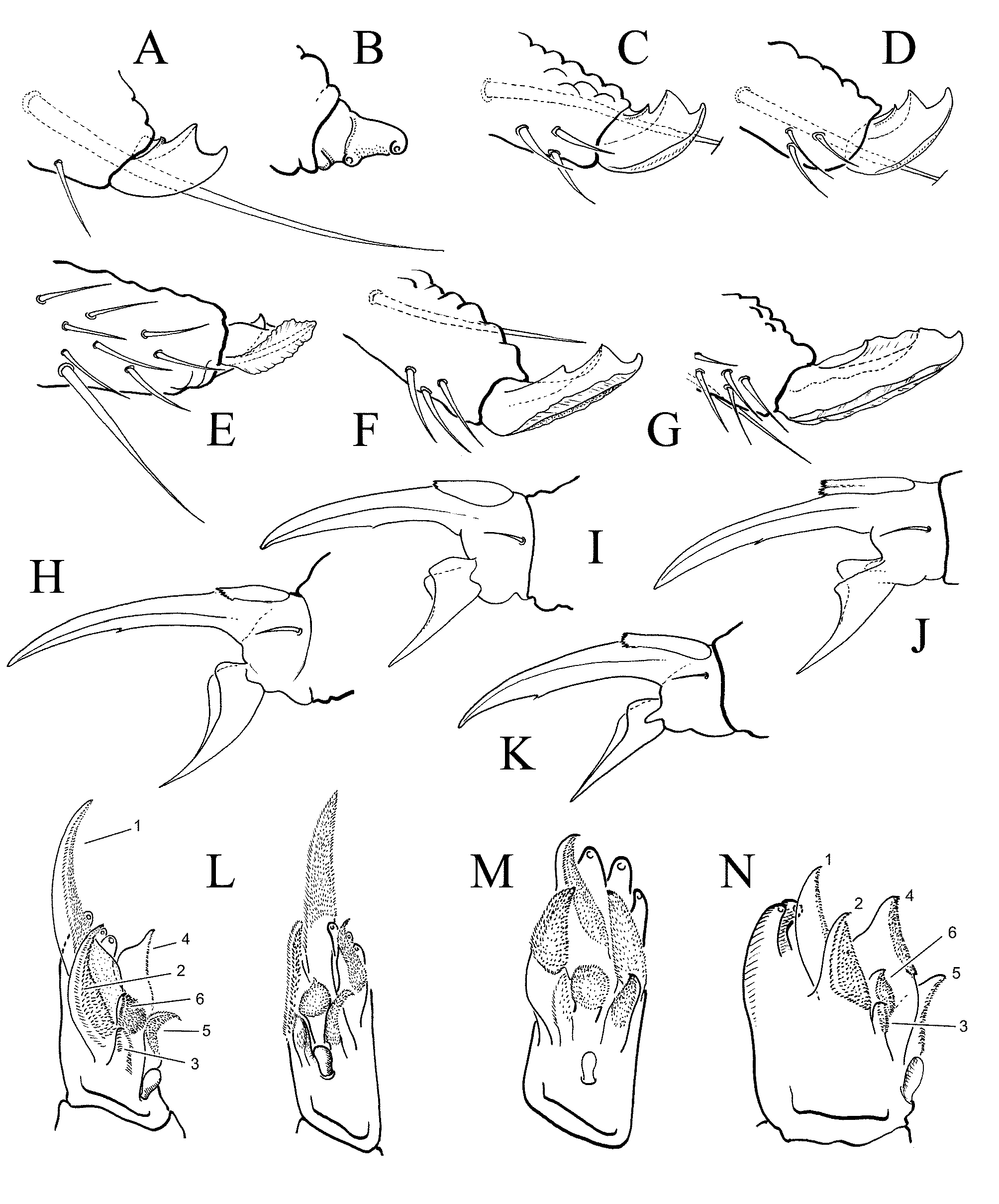
3. Subapical seta on dens reaching well beyond tip of mucro (Fig. 1 A) .......................................................................... 5
- Subapical seta on dens short, not reaching beyond tip of mucro (Figs. 1 E–G)........................................................... 4
4. Claws very long and slender, claw index 3.0 or more; body setae thin, sparse, uniform; outer dorsal lamella of mucro not prominent (Fig. 1 F) .................................................................................................. falcula n. sp. (Appalachians)
- Claws shorter, claw index less than 3.0; body setae strong, on head and thorax with mixed short and long setae; outer dorsal lamella of mucro high and distinct (Fig. 1 G)............................................. tarashchukae n. sp. (Appalachians)
5. Colour deep greenish black; ventral tube without anterior setae .................................................. atroviridis (Rockies)
- Colour olive; ventral tube with or without anterior setae ........................................................................................... 6
6. Antennae no more than 1.8 times the length of head diagonal; anterior setae on ventral tube usually absent, occa- sionally 1–2 on each side; claw index in summer specimens 2.1–2.5, in winter specimens 1.2–1.3 ............................. .......................................................................................................................................................... riparia (Holarctic)
- Antennae in adults more than 1.8 times the length of head diagonal, in large males up to 2.7 times as long; ventral tube usually with 4–5 anterior setae on each side, rarely absent; claw index 2.8–4.5 (summer) and 2.0–2.7 (winter)..
........................................................................................................................................ parkeri n. sp. (Appalachians) 7. Mucro elongate, apical tooth larger than subapical tooth (Fig. 6 B); maxilla with short, unmodified lamellae (Fig. 1 M) ............................................................................................................................................................................... 8 - Mucro short and compact, apical tooth not larger than subapical tooth (Fig. 1 A); maxilla with long, modified lamellae (Fig. 1 L) ............................................................................................................................. extrema n. sp. (Rockies)
8. Claws long and slender, claw index 2.8 or more; head markedly prognathous; abdominal setae of normal density ... ........................................................................................................................................... agilis (Pacific Coast Range)
- Claws shorter, shape normal; claw index 2.3 or less; head shape normal, not markedly prognathous; abdominal setae dense, Isotomurus -like ..................................................................................................................... cyanura (Rockies)
9. Ventral tube with fewer than 20 anterior setae on each side; setae along anterior edge of frontoclypeus normal, not differentiated into a "moustache" ............................................................................................................................... 10
- Ventral tube in adults with more than 30 anterior setae on each side; frontoclypeal field with a distinct "moustache" ................................................................................................................................................................ pilosa (Japan)
10. Mucro short and compact, with narrow ventral lamella .......................................................................................... 11
- Mucro elongate, with broad ventral lamella (as in Fig. 1 E–F) ............................................ lamellosa (Appalachians)
11. Body usually with some segments, or parts of segments, darker than rest; reproductive specimens unmodified ........ ............................................................................................................................................... bidenticulata (Holarctic)
- Body colour uniform, without distinctly darker sections; large reproductive specimens with modified setae on tip of abdomen .................................................................................................................................... polymorpha (Rockies)
Export occurrence data
Darwin Core Archive (ZIP)
GEOGRAPHY
Distribution Map
REGIONS
Geographic Distribution(20)
DATA
Occurrence Datasets
Common names used for this species across different languages and regions. Available in 2 languages.
Vernacular (common) names are the everyday names used for a species in different languages and regions. A single species may have dozens of common names worldwide. This taxon has names in 2 languages.
CLASSIFICATION
Taxonomic Classification Tree

RELATED
Related Name Usages(20)
Matching names from other GBIF-indexed checklists and datasets.
MULTIMEDIA
Media Files(2)
FIGURE 1. A-G, mucro shapes of Agrenia spp. A. A. extrema n. sp., lateral view; B. A. extrema n. sp., dorsal view; C. A. parkeri n. sp., winter form; D. A. parkeri n. sp., summer form; E. A. falcula n. sp., ventral view showing the broad ventral lamella; F. A. falcula n. sp., lateral view; G. A. tarashchukae n. sp. H-K, claws of hind legs. H. A. falcula n. sp.; I. A. tarashchukae n. sp.; J. A. parkeri n. sp., winter form; K. A. extrema n. sp. L-N, maxillae. L. A. extrema n. sp., ventral side (left) and inner side (right); M. A. agilis, inner side; N. A. falcula n. sp., ventral side.

FIGURE 6. Agrenia spp. A-C, mucrones. A. A. tarashchukae n. sp.; B. A. agilis; C. A. falcula n. sp.; D-E. Tips of Ant. IV. D. A. extrema n. sp.; E. A. agilis. Scale bars = 20 μm.
IMAGES
Gallery(2)
Occurrences with images
CITATIONS
References(8)
Brands, S. J. (compiler). (1989-2005). Systema Naturae 2000. Amsterdam, The Netherlands (2006 version). Originally available online at http://sn2000.taxonomy.nl/; for current information, refer http://taxonomicon.taxonomy.nl/ProjectDescription.aspx .
Brands, S. J. (compiler). (1989-2005). Systema Naturae 2000. Amsterdam, The Netherlands (2006 version). Originally available online at http://sn2000.taxonomy.nl/; for current information, refer http://taxonomicon.taxonomy.nl/ProjectDescription.aspx .
Brands, S. J. (compiler). (1989-2005). Systema Naturae 2000. Amsterdam, The Netherlands (2006 version). Originally available online at http://sn2000.taxonomy.nl/; for current information, refer http://taxonomicon.taxonomy.nl/ProjectDescription.aspx .
Fjellberg (2008) Nordic checklist of Collembola. Excelfil till Per Alström 080303. Inkluderar fynd från Island och Färöarna samt nya fynd från Finland (Huhta/Pietikainen 2007)
Mitt. Mus. Hamburg, 23