
AnimaliaNot EvaluatedacceptedspeciesAcceptedRestricted
Chironex yamaguchii

Chironex yamaguchii

Hub Jelly(+8)·Lewis & Bentlage, 2009

GBIF:4340380

0countries
0datasets
0year

0

Descendants

0

Children

PROFILE

Species Profile

Habitat

Marine

ABOUT

Descriptions(5)

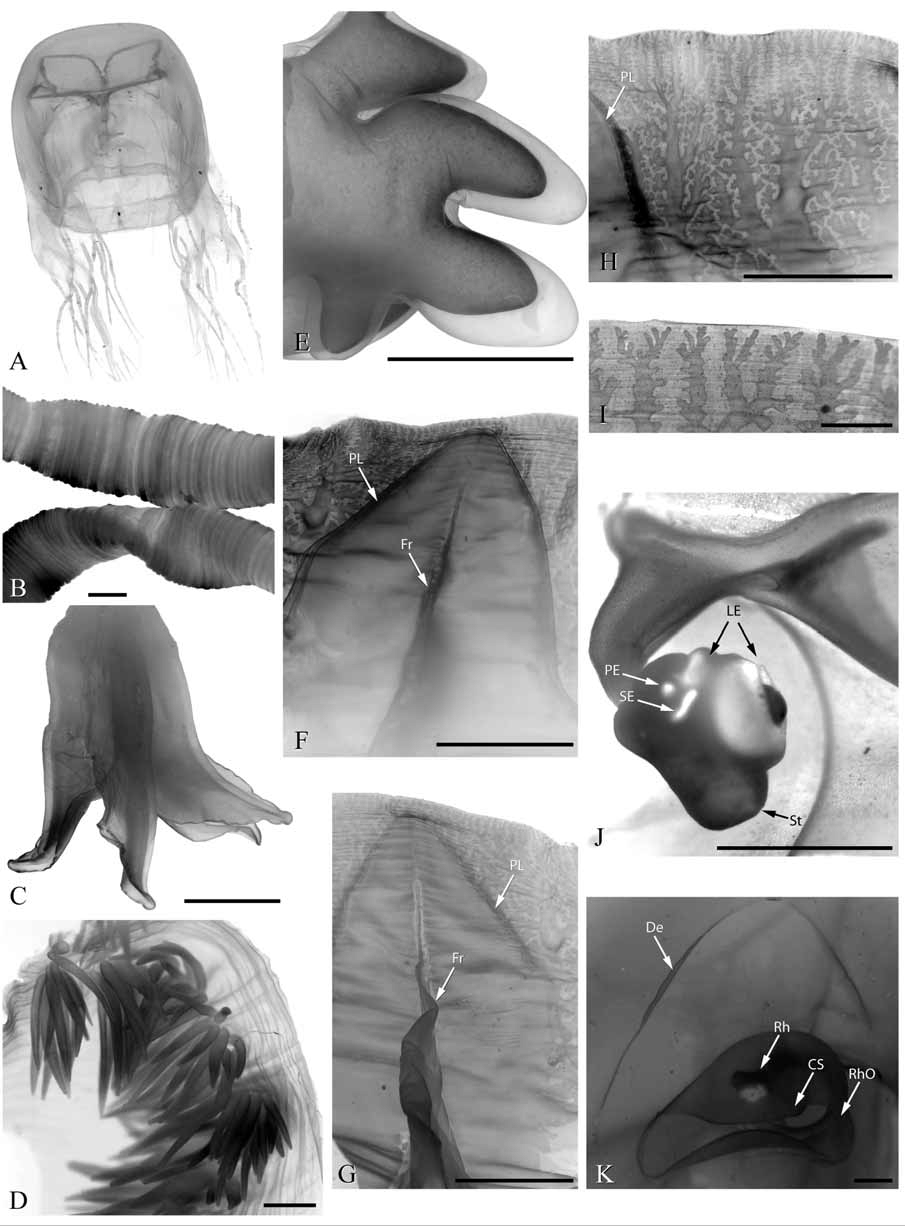
Description. Chirodropid medusae with smooth exumbrella (Fig. 2 A), maximum BH about 110 mm (average about 60 mm) and maximum IRW about 95 mm. Pedalia claw-like, each bearing up to nine tentacles, but usually only seven; proximal pedalial canal bend volcano-shaped sensu Fenner (1997) (Fig. 1 C). Extended trailing tentacles in life appearing flat and broad as in Chironex fleckeri; up to nine tentacles per pedalium with lavender-colored nematocyst bands. Upon contraction, or in preserved specimens, tentacles tending to be thicker and rounded, like sausage-links (Fig. 2 B). Manubrium cruciform with four narrow, lanceolate lips (Fig. 2 C); about 2 / 3 to 3 / 4 as long as bell height. Gastric phacellae V-shaped in each corner of stomach as in most other chirodropids (Fig. 2 A); gastric cirri simple and unbranched (Fig. 2 D). Gastric saccules (superior gonads) cock’s-comb shaped / grape-cluster-like and opaque in mature specimens (Fig. 2 E). Development of gonads following sequence described for Chironex fleckeri by Barnes (1966). Gastric saccules developing from small, smooth, kidney-shaped bulges at ceiling of subumbrella into large, grapecluster-like swellings by elongation and successive addition of numerous swellings until they occupy much of subumbrellar cavity. Perradial lappets smooth, broad, triangular, extending almost to subumbrellar edge of velarium (Fig. 2 F). Four perradial muscular brackets (frenulae) brace the right-angle connection from tip of rhopalial niche to 3 / 4 the distance between velarial turnover and its margin (Fig. 2 G). Each frenulum consisting of a single, thick gelatinous sheet (Fig. 2 G). Velarial canals numerous and highly branched, as in Chironex fleckeri (Fig. 2 H, 2 I). Each of the four rhopalia bearing a set of six eyes, with the two median possessing prominent lenses and the four lateral ones adjacent to the lens eyes being pigment pits and slits (Fig. 2 J). Statolith oval, transversally mounted at base of rhopalium (Fig. 2 J). As in other chirodropids, rhopalial niche ostium dome-shaped with a single upper covering scale (Fig. 2 K); rhopalial niche located in a triangular depression of exumbrella (Fig. 2 K). The cnidome of Chironex yamaguchii and its transformation throughout the course of development was described in detail based on specimens from Japan by Oba et al. (2004; as Chiropsalmus quadrigatus).
Clarifying the identity of the Japanese Habu-kurage, Chironex yamaguchii, sp. nov. (Cnidaria: Cubozoa: Chirodropida)
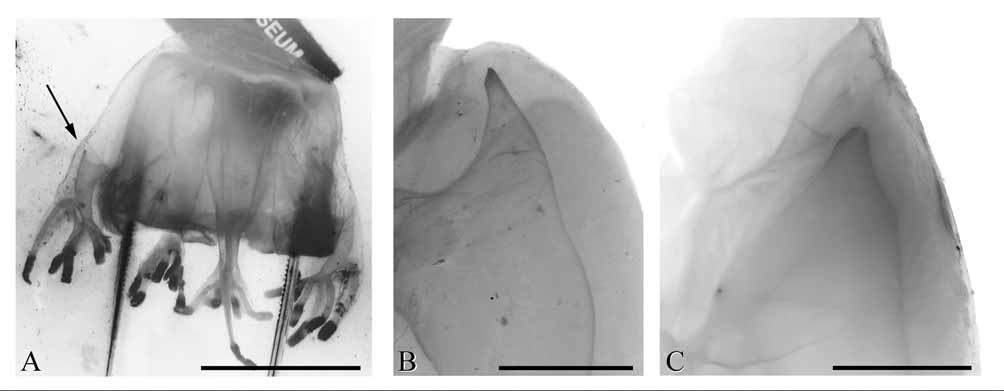
Diagnosis. Chironex yamaguchii, sp. nov., has a maximum bell height of about 110 mm (about 1 / 2 to 1 / 3 that of its congener Chironex fleckeri); up to nine tentacles per pedalium (versus up to 15 in Chironex fleckeri); proximal pedalial canal bend volcano-shaped (Fig. 1 B) (in contrast to the “ upswept corniculum ” in Chironex fleckeri; Fig. 1 B).
Clarifying the identity of the Japanese Habu-kurage, Chironex yamaguchii, sp. nov. (Cnidaria: Cubozoa: Chirodropida)
Remarks. Earlier misidentifications of Chironex yamaguchii can be attributed to Mayer’s (1910: 516 – 517) redescription of this species, under the name Chiropsalmus quadrigatus Haeckel, 1880, from the Philippines. Chiropsoides quadrigatus (Haeckel, 1880: 447, as Chiropsalmus quadrigatus) was described from Burma and is easily distinguishable from Chironex yamaguchii. Members of the genus Chiropsoides have laterally compressed pedalia and their gastric saccules are long, finger-shaped and smooth, whereas the pedalia in Chironex are claw-like and the gastric saccules in mature specimens are cock’s-comb shaped / grapecluster-like. Both Thiel (1928) and Stiasny (1937) noted the discrepancies between Mayer’s description of what he thought was Chiropsoides quadrigatus from the Philippines and Haeckel’s original description of the species from Burma. Stiasny (1937) nevertheless believed that the descriptions pertained to the same species. Rather than rectifying this taxonomic problem, he provided yet another redescription of Chiropsoides quadrigatus (as Chiropsalmus quadrigatus) by reconstructing the species from Haeckel’s (1880) and Mayer’s (1910) descriptions, as well as a specimen from the Maldive Archipelago. By doing so he perpetuated the confused identity of the chirodropids from the Philippines and, ultimately, from Japan. Our examinations of Mayer’s (1910) material at the National Museum of Natural History, Smithsonian Institution, revealed that the specimens belong to the genus Chironex, and they agree in their morphological characteristics with material examined from Japan. Specimens from the Philippines appear to be a developmental series displaying numerous stages in the maturation process from juvenile to adult in Chironex yamaguchii. Mayer (1910: 516, Fig. 331) depicted two stages in the development of Chironex yamaguchii, even though he did not explicitly state so. The oral view of the stomach shows the well-developed, cock’scomb shaped gonads typical of Chironex, whereas the side view of the animal depicts an immature specimen that has not yet fully developed. There is little doubt that what Mayer observed was a species of Chironex. Since Chironex was not described until some 45 years later (Southcott 1956), he did not recognize his mistake and believed that he had an opportunity to add to the arguably insufficient original description of Chiropsoides quadrigatus (see Gershwin 2006 b, for discussion). Morphological differences between Chironex fleckeri and Chironex yamaguchii are few, and the shape of the pedalial canal bend seems to be the most reliable character to distinguish the two. However, we believe that they represent different species, and geographic distance among the collection sites of Chironex fleckeri and Chironex yamaguchii lends additional credibility to this interpretation. In addition to morphological differences and allopatric distributions of Chironex fleckeri and Chironex yamaguchii, we observed a strong genetic differentiation among the two. We calculated uncorrected pairwise distances among mitochondrial COI sequences from the Ishigaki type material of Chironex yamaguchii (GenBank nos. FJ 665180 and FJ 665182) and an unvouchered specimen of Chironex fleckeri from Weipa, Queensland, Australia (GenBank no. FJ 665182). Both sequences of Chironex yamaguchii were identical, but differed from Chironex fleckeri by 16.7 %. In a medical thesis, Fenner (1997) identified close affinities between Chironex fleckeri and the deadly venomous chirodropid known from both Japanese and Philippine waters. Dr. Fenner’s familiarity with morphological characters of the latter was garnered through correspondence with Y. Araki and the first author of this manuscript, and his study of Mayer’s specimens. He also pointed out the distinguishing feature of the pedalial canal bend, but did not describe it as a new species. He noted many more fatalities related to jellyfish envenomations in the Indo-West Pacific. Future sampling will probably lead to additional records of Chironex species or probably even new, distinct species. In general, there appears to be a tendency for morphological conservativeness in Cubozoa and probably Medusozoa in general. Given these considerations, future studies may show that Philippine and Japanese specimens of Chironex yamaguchii represent two distinct species, but our current data do not support such an interpretation.
Clarifying the identity of the Japanese Habu-kurage, Chironex yamaguchii, sp. nov. (Cnidaria: Cubozoa: Chirodropida)
Etymology. The specific name honors Prof. Masashi Yamaguchi, who has contributed much to an understanding of Japanese cubozoans and the early life history of Chironex fleckeri.
Clarifying the identity of the Japanese Habu-kurage, Chironex yamaguchii, sp. nov. (Cnidaria: Cubozoa: Chirodropida)
Material examined. Holotype: USNM 1121554, female with fully developed gastric saccules and oocytes, 92 mm BH, 80 mm IRW, NT 6, Ishigaki Island, Ryukyu Archipelago, Okinawa Prefecture, Japan, 24 September 2007. Paratypes: USNM 1121555, female with fully developed gastric saccules but oocytes not fully developed, 90 mm BH, 85 mm IRW, NT 6, Ishigaki Island, Ryukyu Archipelago, Okinawa Prefecture, Japan, 24 September 2007; USNM 1121556, 70 mm BH, 60 mm IRW, NT 7, initially fixed in EtOH and subsequently transferred into formalin, gastric saccules fully developed, Okinawa Island, 26 º 20.9 ’ N 127 º 45 ’ E, 19 September 1988; QM G 317050, juvenile preserved in EtOH, 20 mm BH, 16 mm IRW, NT 5, Nakagusuku, Okinawa Island, 18 July 1992. Other material: Mayer’s Philippine lots USNM 27911 and 27915, Subig Bay, Luzon; USNM 27913, Cataingan Bay, Masbate; USNM 27914, Pujada Bay, Mindanao; USNM 27916, Panabutan Bay, Mindanao; USNM 27917 and 27918, Mansalay Bay, Mindoro; USNM 28691, Ulugan Bay, Palawan; USNM 28692 and 28696, Malcochim, Linapacan Strait, Palawan; USNM 28694 and 28697, Bolinao Bay, Luzon; USNM 28695 and 28701, San Miguel Bay, Luzon; USNM 28698, Tilik Bay, Lubang Island, Mindoro; USNM 28700, Hamilo Point, Luzon; USNM 38019 Taytay, Palawan [lots USNM 27912, 28693, 28699, and 38016 could not be located]; 232 unregistered specimens collected from 1978 to 1996 by Y. Araki, M. Yamaguchi, and the first author at Ginowan Marina, Ginowan Tropical Beach, Chatan Beach, and Motobu Port (Okinawa Island), and Sukuji Beach on Ishigaki Island; QM G 317051, Kana Beach, Ginoza, Okinawa Island. Type locality. Ishigaki Island, Ryukyu Archipelago, Okinawa Prefecture, Japan.
Clarifying the identity of the Japanese Habu-kurage, Chironex yamaguchii, sp. nov. (Cnidaria: Cubozoa: Chirodropida)

Export occurrence data

Darwin Core Archive (ZIP)

GEOGRAPHY

Distribution Map

Occurrence Map

Loading map…

Tiles © GBIF Maps API | Map powered by MapLibre GL

REGIONS

Geographic Distribution(3)

Okinawa
Okinawa
Okinawa(JP)

DATA

Occurrence Datasets

Loading datasets…

Common names used for this species across different languages and regions. Available in 3 languages.

engHub JellyengporVespa-do-mar-víboraporengViper Jellyengjpnhabu-kuragejpnjpnhabu-kuragejpn+4 more

Vernacular (common) names are the everyday names used for a species in different languages and regions. A single species may have dozens of common names worldwide. This taxon has names in 3 languages.

engHub Jelly
eng
Source: Catalogue of LifeSource taxon #299604215
porVespa-do-mar-víbora
por
Source: Catalogue of LifeSource taxon #299604215
engViper Jelly
eng
Source: Catalogue of LifeSource taxon #299604215
jpnhabu-kurage
jpn
Source: Catalogue of LifeSource taxon #273074579
jpnhabu-kurage
jpn
Source: Catalogue of LifeSource taxon #299604215
jpnハブクラゲ
jpn
Source: Catalogue of LifeSource taxon #299604215
jpnハブクラゲ
jpn
Source: Catalogue of LifeSource taxon #273074579
jpnhabu-kurage
jpn
Source: World Register of Marine SpeciesSource taxon #155436800
jpnハブクラゲ
jpn
Source: World Register of Marine SpeciesSource taxon #155436800

CLASSIFICATION

Taxonomic Classification Tree

HIERARCHY

Child Taxa(1)

MULTIMEDIA

Media Files(2)

FIGURE 1. Comparison between the pedalial canal bend of Chironex fleckeri (B; QM G 322755) and Chironex yamaguchii, sp. nov. (C; USNM 1121555); the location of the pedalial canal bend at the proximal end of the pedalium is indicated in A (Chironex fleckeri; QM G 322298). Note the sharp tip as well as the concave slope of the bend (“ upswept corniculum ”) in Chironex fleckeri; in Chironex yamaguchii the slope is more gradual and the tip of the bend less sharp (“ volcano-like ”). Scale bars: 1 cm.
Imageimage/png© Lewis, Cheryl;Bentlage, BastianClarifying the identity of the Japanese Habu-kurage, Chironex yamaguchii, sp. nov. (Cnidaria: Cubozoa: Chirodropida)

FIGURE 2. Chironex yamaguchii, sp. nov. A. juvenile specimen (bell height approximately 5 cm) displayed at Enoshima Aquarium, Japan; B. preserved tentacles; C. manubrium with four lips; D. gastric cirri; E. gastric saccules; F. perradial lappet as seen from below the subumbrellar opening; G. perradial lappet and frenulum as seen from inside the subumbrellar cavity; H. velarial canals; I. tips of velarial canals; J. rhopalium; K. rhopalial niche (note the triangular depression around the niche). Scale bars: 1 mm (B, D, I, J, K), 1 cm (C, E, F, G, H); CS: covering scale; De: triangular shaped depression; Fr: frenulum; LE: lens eye; PE: pit eye; PL: perradial lappet; Rh: rhopalium; RhO: rhopalial niche ostium; SE: slit eye; St: statolith. All photographs except A and B are taken from paratype USNM 1121555; B is taken from the holotype.

Imageimage/png© Lewis, Cheryl;Bentlage, BastianClarifying the identity of the Japanese Habu-kurage, Chironex yamaguchii, sp. nov. (Cnidaria: Cubozoa: Chirodropida)

IMAGES

Gallery(2)

See Gallery

Occurrences with images

CITATIONS

References(1)

  • 1

    Lewis, C. & Bentlage, B. 2009. Clarifying the identity of the Japanese Habu-kurage, Chironex yamaguchii, sp. nov. (Cnidaria: Cubozoa: Chirodropida), Zootaxa, 2030: 59–65.

    original descriptionWorld Register of Marine Species
  • Source Information

    GBIF Backbone Taxonomy

    GBIF Backbone Taxonomy

    checklist

    The GBIF Backbone Taxonomy is a single, synthetic management classification with the goal of covering all names GBIF is dealing with. It's the taxonomic backbone that allows GBIF to integrate name based information from different resources, no matter if these are occurrence datasets, species pages, names from nomenclators or external sources like EOL, Genbank or IUCN. This backbone allows taxonomic search, browse and reporting operations across all those resources in a consistent way and to provide means to crosswalk names from one source to another.

    It is updated regulary through an automated process in which the Catalogue of Life acts as a starting point also providing the complete higher classification above families. Additional scientific names only found in other authoritative nomenclatural and taxonomic datasets are then merged into the tree, thus extending the original catalogue and broadening the backbones name coverage. The GBIF Backbone taxonomy also includes identifiers for Operational Taxonomic Units (OTUs) drawn from the barcoding resources iBOL and UNITE.

    International Barcode of Life project (iBOL), Barcode Index Numbers (BINs). BINs are connected to a taxon name and its classification by taking into account all names applied to the BIN and picking names with at least 80% consensus. If there is no consensus of name at the species level, the selection process is repeated moving up the major Linnaean ranks until consensus is achieved.

    UNITE - Unified system for the DNA based fungal species, Species Hypotheses (SHs). SHs are connected to a taxon name and its classification based on the determination of the RefS (reference sequence) if present or the RepS (representative sequence). In the latter case, if there is no match in the UNITE taxonomy, the lowest rank with 100% consensus within the SH will be used.

    The GBIF Backbone Taxonomy is available for download at https://hosted-datasets.gbif.org/datasets/backbone/ in different formats together with an archive of all previous versions.

    The following 105 sources have been used to assemble the GBIF backbone with number of names given in brackets:

    • Catalogue of Life Checklist - 4766428 names
    • International Barcode of Life project (iBOL) Barcode Index Numbers (BINs) - 635951 names
    • UNITE - Unified system for the DNA based fungal species linked to the classification - 611208 names
    • The Paleobiology Database - 212054 names
    • World Register of Marine Species - 188857 names
    • The Interim Register of Marine and Nonmarine Genera - 183894 names
    • The World Checklist of Vascular Plants (WCVP) - 131891 names
    • GBIF Backbone Taxonomy - 114350 names
    • TAXREF - 109374 names
    • The Leipzig catalogue of vascular plants - 75380 names
    • ZooBank - 73549 names
    • Integrated Taxonomic Information System (ITIS) - 68377 names
    • Plazi.org taxonomic treatments database - 61346 names
    • Genome Taxonomy Database r207 - 60545 names
    • International Plant Names Index - 52329 names
    • Fauna Europaea - 45077 names
    • The National Checklist of Taiwan (Catalogue of Life in Taiwan, TaiCoL) - 36193 names
    • Dyntaxa. Svensk taxonomisk databas - 35892 names
    • The Plant List with literature - 32692 names
    • United Kingdom Species Inventory (UKSI) - 29643 names
    • Artsnavnebasen - 29208 names
    • The IUCN Red List of Threatened Species - 21221 names
    • Afromoths, online database of Afrotropical moth species (Lepidoptera) - 13961 names
    • Brazilian Flora 2020 project - Projeto Flora do Brasil 2020 - 13829 names
    • Prokaryotic Nomenclature Up-to-Date (PNU) - 10079 names
    • Checklist Dutch Species Register - Nederlands Soortenregister - 8814 names
    • ICTV Master Species List (MSL) - 7852 names
    • Cockroach Species File - 6020 names
    • GRIN Taxonomy - 5882 names
    • Taxon list of fungi and fungal-like organisms from Germany compiled by the DGfM - 4570 names
    • Catalogue of Afrotropical Bees - 3623 names
    • Catalogue of Tenebrionidae (Coleoptera) of North America - 3327 names
    • Checklist of Beetles (Coleoptera) of Canada and Alaska. Second Edition. - 3312 names
    • Systema Dipterorum - 2850 names
    • Catalogue of the Pterophoroidea of the World - 2807 names
    • The Clements Checklist - 2675 names
    • Taxon list of Hymenoptera from Germany compiled in the context of the GBOL project - 2496 names
    • IOC World Bird List, v13.2 - 2366 names
    • Official Lists and Indexes of Names in Zoology - 2310 names
    • National checklist of all species occurring in Denmark - 1922 names
    • Myriatrix - 1876 names
    • Database of Vascular Plants of Canada (VASCAN) - 1822 names
    • Taxon list of vascular plants from Bavaria, Germany compiled in the context of the BFL project - 1771 names
    • Orthoptera Species File - 1742 names
    • A list of the terrestrial fungi, flora and fauna of Madeira and Selvagens archipelagos - 1602 names
    • Aphid Species File - 1565 names
    • World Spider Catalog - 1561 names
    • Taxon list of Jurassic Pisces of the Tethys Palaeo-Environment compiled at the SNSB-JME - 1270 names
    • Backbone Family Classification Patch - 1143 names
    • GBIF Algae Classification - 1100 names
    • International Cichorieae Network (ICN): Cichorieae Portal - 975 names
    • Psocodea Species File - 803 names
    • New Zealand Marine Macroalgae Species Checklist - 787 names
    • Annotated checklist of endemic species from the Western Balkans - 754 names
    • Taxon list of animals with German names (worldwide) compiled at the SMNS - 503 names
    • Catalogue of the Alucitoidea of the World - 472 names
    • Lygaeoidea Species File - 462 names
    • Catálogo de Plantas y Líquenes de Colombia - 422 names
    • GBIF Backbone Patch - 317 names
    • Phasmida Species File - 259 names
    • Cortinariaceae fetched from the Index Fungorum API - 234 names
    • Coreoidea Species File - 233 names
    • GTDB supplement - 139 names
    • Mantodea Species File - 119 names
    • Endemic species in Taiwan - 93 names
    • Taxon list of Araneae from Germany compiled in the context of the GBOL project - 88 names
    • Species of Hominidae - 78 names
    • Taxon list of Sternorrhyncha from Germany compiled in the context of the GBOL project - 77 names
    • Taxon list of mosses from Germany compiled in the context of the GBOL project - 75 names
    • Mammal Species of the World - 73 names
    • Plecoptera Species File - 71 names
    • Species Fungorum Plus - 64 names
    • Catalogue of the type specimens of Cosmopterigidae (Lepidoptera: Gelechioidea) from research collections of the Zoological Institute, Russian Academy of Sciences - 47 names
    • Species named after famous people - 41 names
    • Dermaptera Species File - 36 names
    • Taxon list of Trichoptera from Germany compiled in the context of the GBOL project - 34 names
    • True Fruit Flies (Diptera, Tephritidae) of the Afrotropical Region - 33 names
    • Range and Regularities in the Distribution of Earthworms of the Earthworms of the USSR Fauna. Perel, 1979 - 32 names
    • Taxon list of Diplura from Germany compiled in the context of the GBOL project - 30 names
    • Lista de referencia de especies de aves de Colombia - 2022 - 24 names
    • Taxon list of Auchenorrhyncha from Germany compiled in the context of the GBOL project - 20 names
    • Catalogue of the type specimens of Polycestinae (Coleoptera: Buprestidae) from research collections of the Zoological Institute, Russian Academy of Sciences - 19 names
    • Taxon list of Thysanoptera from Germany compiled in the context of the GBOL project - 19 names
    • Lista de especies de vertebrados registrados en jurisdicción del Departamento del Huila - 18 names
    • Taxon list of Microcoryphia (Archaeognatha) from Germany compiled in the context of the GBOL project - 15 names
    • Catalogue of the type specimens of Bufonidae and Megophryidae (Amphibia: Anura) from research collections of the Zoological Institute, Russian Academy of Sciences - 12 names
    • Grylloblattodea Species File - 11 names
    • Coleorrhyncha Species File - 9 names
    • Taxon list of liverworts from Germany compiled in the context of the GBOL project - 9 names
    • Embioptera Species File - 7 names
    • Taxon list of Pisces and Cyclostoma from Germany compiled in the context of the GBOL project - 6 names
    • Taxon list of Pteridophyta from Germany compiled in the context of the GBOL project - 6 names
    • Taxon list of Siphonaptera from Germany compiled in the context of the GBOL project - 5 names
    • The Earthworms of the Fauna of Russia. Perel, 1997 - 5 names
    • Taxon list of Zygentoma from Germany compiled in the context of the GBOL project - 4 names
    • Asiloid Flies: new taxa of Diptera: Apioceridae, Asilidae, and Mydidae - 3 names
    • Taxon list of Protura from Germany compiled in the context of the GBOL project - 3 names
    • Taxon list of hornworts from Germany compiled in the context of the GBOL project - 2 names
    • Chrysididae Species File - 1 names
    • Taxon list of Dermaptera from Germany compiled in the context of the GBOL project - 1 names
    • Taxon list of Diplopoda from Germany in the context of the GBOL project - 1 names
    • Taxon list of Orthoptera (Grashoppers) from Germany compiled at the SNSB - 1 names
    • Taxon list of Pscoptera from Germany compiled in the context of the GBOL project - 1 names
    • Taxon list of Pseudoscorpiones from Germany compiled in the context of the GBOL project - 1 names
    • Taxon list of Raphidioptera from Germany compiled in the context of the GBOL project - 1 names

    GBIF Secretariat (2023). GBIF Backbone Taxonomy. Checklist dataset https://doi.org/10.15468/39omei accessed via GBIF.org on 2026-06-18.

    CC BYPublished 8/28/2023View dataset
    GBIF Usage Key
    4340380
    Dataset Key
    d7dddbf4-2cf0-4f39-9b2a-bb099caae36c
    Origin
    source
    Backbone Key
    4340380
    Taxon ID
    gbif:4340380
    Last Crawled
    8/22/2023
    Last Interpreted
    8/22/2023