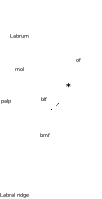
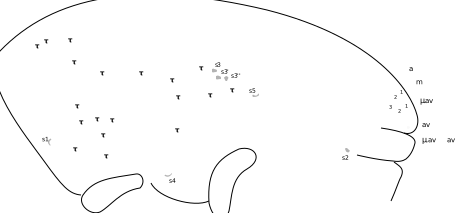
Description. Adult (Figs 1 a, 2 A, 3 A, 4 A 5, 9 A, 22 – 31). Size. Length from labrum to anus of the biggest specimens ~ 600 µm. Pigmentation. Dorsal pigmentation from blue-gray to deep black, spotted with small patches of bright yellow and with a pale yellow dorso-median line from thorax to middle of the abdominal area. Ventral side pale yellow. Body shape and segmentation. Habitus as in Fig. 22 A, B. Orthognathous. Head rather round and short, ratio height: length ~ 0.67 (Fig. 22 A – D). Antennae pointed anteriorly, with four distinct antennomeres, with an internal curve and abrupt narrowing between Ant. III and IV (Figs 22 A – D, 27 A, B). Total length of antenna ~ 77.6 µm; max width (Ant. III) ~ 20 µm; ratio width: length ~ 0.25; ratio length of Ant. I: Ant. II: Ant. III: Ant. IV ~ 0.26: 0.60: 0.92: 1. Th. I diameter reduced, with steep curves between head – Th. I and Th. I – II (Fig. 22 A, B, E). Connection of Th. I with head as a well-developed neck (Fig. 22 A, B, E, F). Insertion of the neck on head moved ventrally creating a posterior apex of the vertex. Th. I with a posterior transversal fold subdivided laterally in two folds respectively reaching the anterior and posterior limits of the subcoxa; neck with a pair of slanted folds connected laterally with the posterior folds and converging dorsally toward the head (Fig. 22 E, F). Terga from Th. II to Abd. VI completely fused, with no other delimitation marks than legs insertions. Trunk bumpy (observed on specimens dryed for SEM, Fig. 22 B, E), with slight folds but no marks of segmentation. Dorso-median line as a slight crest well defined on Th. I, becoming more and more indistinct until Th. III (Fig. 22 B, E). Posterior granule T of the line missing. Precoxal areas of Th. II and III each with a pair of large lobes which cover the subcoxae anteriorly (Figs 22 A, B, E, 28 A, 29 F). Each coxa long and bended (Figs 22 A, B, 29 A, C, F). On legs I length of coxa> tibiotarsus> femur ~ trochanter. On leg II and III length of coxa> tibiotarsus ~ femur ~ trochanter. All sterna fused together except Abd. VI sternum. Abd. VI sternum clearly separated posteriorly from Abd. VI tergum by anal aperture; separated anteriorly from Abd. V sternum by a steep curve (Fig. 24 A, B); fused laterally with the great abdomen without any distinction in the integumentary granulation (Fig. 24 A, B). Abd. V sternum with genital plate cryptic, enclosed deeply between Abd. IV and Abd. VI sterna. Abd. IV sternum enlarged forming a large ventro-posterior side bearing the furca (Fig. 22 A, B). Abd. I – III sterna reduced with tenaculum being stuck to ventral tube (Fig. 31 I). Ratio length of head: length of thorax (distance from anterior insertion point of subcoxa I to posterior insertion point of subcoxa III): length of abdomen (distance from posterior insertion point of subcoxa III to anus) = 1.1: 1.8: 1. Manubrium / dens articular processes: strong, with a concave tip on manubrium; as a cavity (external side) sided with a small convex process (internal side) on dens (Figs 24 B, 31 G). Dens with a proximal part (dp) wider than the distal part (dd) (Figs 24 B, 31 G). No suture or articular process between dp and dd but dens flexible at this point (fixed specimens often exhibit a flexion of the dens between dp and dd with subsequent folds in the integument, Fig. 24 B). Length of manubrium: dp: dd: mucro ~ 0.33: 0.56: 1: 0.78. Granulation. Primary granulation made of ordinary hexagonal pattern (six primary granules connected with bridges). Three morphological variations of primary granules pattern observed: (i) ordinary; (ii) thickening of all the granules of the hexagon — width increased but not height, bridges shortened and visible surface of the base of the integument reduced — occurs on the labrum around m- and p-rows of chaetae (Fig. 23 A, C); (iii) enlargement of only a few granules of the hexagon — width and height increased, those granules being brighter than the other in SEM and visible as dark dots in light microscopy (= secondary granules sensu Dallai 1979). Enlarged granules with two kinds of pattern. First kind is a random distribution of two or three enlarged granules by hexagon, such pattern occurs on clypeus (Fig. 23 A – C), distal part of Ant. III, anal valves (Fig. 31 C), most of Ant. IV sternum (Fig. 24 A – C), posterior side of manubrium and dens (Fig. 24 B), and moderately on leg. Second kind is a new hexagonal (sometimes pentagonal) pattern of enlarged granules, the center of those hexagons devoid of primary granules but the base of the integument bears about seven small protuberances (six around a central one, also see the accurate description of Dallai 1979), this pattern covers the head dorsally and laterally with an anterior limit matching the position of the unpaired chaeta of cl. p-row (Figs 3 A, 22 D), the whole trunk terga (e. g. Fig. 23 E, F), the Abd. VI sternum (Fig. 24 A, B), the basal part of the legs down to basal part of coxae and Ant. I – III. Enlarged granules with random pattern being larger than those with hexagonal pattern. Presence of dermastra typical of the genus (e. g. Fig. 23 E, F). From the commonest dermastra with five edges, up to eight edges can be observed. The areas of repartition of the dermastra perfectly match the areas of repartition of the hexagonal pattern of enlarged granules. Integumentary channels. Presence of a simple integumentary channel surrounding the head in the clypeal area, connecting linea ventralis at the base of basomedian fields of labium (Figs 23 B, D, 26 A – C). A pair of fingershaped cuticular processes cover the channel at basolateral fields of labium level (Figs 23 B, D, 26 A, C). The bed of the channel is devoid of granulation and shallow (as deep as a the height of a primary grain), the channel edges are thin and smooth, without granule (Fig. 23 D). Integumentary channels absent on posterior part of head and on trunk. Chaetae. Eight morphological variations of chaetae on head and trunk: (i) ordinary chaetae mostly found on antennae, ventrally and laterally on head, dorsally and laterally on forehead and legs (e. g. Fig. 1 c); (ii) setulae, peculiarly thin variety of microchaetae (4 – 6 µm), weakly contrasted in light microscopy mostly found on the vertex of the head and dorsally on trunk (e. g. Figs 1 a, 28 B); (iii) s-chaetae, short and swollen special chaetae (s 1 – s 5) found on trunk (e. g. Fig. 23 F); (iv) τ-chaetae, flexible mesochaetae (~ 10 µm) with rounded apex, basal ring implanted in a small depression of the integument, weakly contrasted in light microscopy, found on trunk (Figs 23 E, 28 D); (v) primary wax secretory rods (WR) (~ 6 µm); (vi) secondary wax secretory rods (wr), (~ 3 µm); (vii) tertiary wax secretory rods (from 2 to 4 µm); (viii) neosminthuroid chaetae (Figs 24 C, 28 F) (from 8 to 10 µm). Wax secretory rods. Presence of three kinds of chaetae associated with the secretion of rods (putatively wax): primary (WR), secondary (wr) and tertiary rods. The primary rods (WR) are straight mesochaetae (~ 6 µm) with a round apex and with a basal ring implanted in a small depression of the integument. The depression is surrounded with an integumentary bulge on which lies an orifice (putative pore of a secretory gland according to Dallai 1979). The secondary wax rods are similar to the primary wax rods but shorter and thinner (~ 3 µm), with a more conical shape. The basal ring is not so deep in the integument than for the primary rods. The integumentary bulge is either weak or not visible but a secretory pore is apparently present. A primary rod is generally associated with one or more secondary rods (Figs 25 C, 28 A). The tertiary rods are very short, conical microchaetae with a round apex (Fig. 28 C). The basal ring is only weakly sunk in the integument, there is no integumentary bulge nor visible secretory pore. There is some small variation in size and thickness among the numerous tertiary rods of a same specimen (from 2 to 4 µm). Sensory fields. Four pairs of sensory fields can be recognized, three on head and one on Th. II, being depressions with more or less clear edges, each with a patch devoid of dermastra and associated with one primary rod. Each preantennal field with primary rod on posterior edge, the latter creating a cornice that overhang a flat area devoid of secondary hexagons, this area as a cliff in the slope of the forehead (Fig. 25 A). Postantennal anterior fields as simple depressions, edge marked only on the dorsal side (Fig. 25 B). Postantennal posterior fields as simple depressions with no clear edge. Fields on Th. II with no clear edge, with three secondary wax rods in addition to the primary wax rods (Fig. 25 C). Mouth parts. Left mandibula with about five apical teeth (Fig. 25 D), right mandibula with six teeth and two processes between apex and molar plate (Fig. 25 E). Molar plate with anterior process bearing teeth (Fig. 25 D – F). Maxilla with five lamellae. Labium. Basomedian field with three mesochaetae, basolateral field with two ventral mesochaetae and a dorsal mesochaeta on tubercle (Figs 23 D, 26 A). Basomedian field separated from basolateral field by a furrow (Fig. 23 D). Palp with three strong chaetae in proximal field (Fig. 25 H) and four strong papillate chaetae (H, B, D, E). B, D, E each with three guard mesohairs, H with two guard mesohairs (Fig. 25 I). The papilla B in anterior position in regard to the hypostomal papilla (H). Chaeta H is long, with a curved an pointed apex (Fig. 25 I). Maxillary outer lobe and oral fold. Maxillary palp with a mesochaeta (12 µm) in the sub-basal papilla, a strong, straight macrochaeta (20 µm) in the apical papilla (Fig. 25 J). Apical papilla with a strong hair (8 – 9 µm) in sub-apical, dorso-lateral position (Fig. 25 J). Sublobal plate with a micro-hair on a small papilla (Fig. 25 J). Oral fold with two mesochaetae (Figs 23 D, 26 A). Labrum. Labrum rather plane despite some bumps on which the chaetae of the a-, m and p-rows are implanted (Figs 2 E, 23 A – C, 25 J). a-row with two pairs of mesochaetae (a 1, a 2), sub-apical and in dorsal position. a 1, a 2 around 10 µm. m- and p-rows each with two pairs of mesochaetae (respectively m 1, 2 and p 1, 2) and an unpaired mesochaeta (respectively m 0 and p 0). Chaetae p 0 – p 2 and m 0 – m 2 curved with tip pointed upward, subtlety longer than chaetae a 1, 2. Chaetae a 1, a 2 clearly thicker than m 0 – m 2, m 0 – m 2 slightly thicker than p 0 – p 2, all of them with smooth edges. Labral ridge sclerotized, bearing two rows of apical hairs, the dorsal row apparently made of a lateral pair of finger-shaped hairs, an axial pair of hand-shaped hairs (large body with around five fingers) and an unpaired forked hair (Fig. 25 K), the ventral row apparently as a comb of simple, thin hairs (Fig. 25 L). Head chaetotaxy. Postero-dorsal area with 13 + 13 setulae, an unpaired setula and two pairs of primary rods (sensory fields). Postero-lateral area with 1 + 1 setulae and 5 + 5 mesochaetae (Figs 3 A, 26 C). Antero-dorsal area with a pair of setulae (inter-antennal position, Fig. 26 C), eight pairs of mesochaetae, two unpaired mesochaetae and a pair of primary rods (sensory fields). Antero-lateral area with five pairs of mesochaetae (Figs 3 A, 26 A – C). Ventral area with 1 + 1 post-labial mesochaetae (Figs 4 A, 26 A). Antenna chaetotaxy. Ant. I with a setula on antero-dorsal side (Fig. 27 B). Ant. II with four mesochaetae in a whorl, dorsal side (Fig. 27 A, B). Ant. III with 14 mesochaetae in three rough whorls (repartition from base to apex: 3, 4 and 7 chaetae); with five apical S-chaetae (S 1 – S 5), S 1 and S 4 long and tubular, S 2 and S 3 as two short bulbs, S 5 short and flam-shaped (Fig. 27 A, B). Ant. IV with 22 chaetae, size decreasing from the basal mesochaetae (10 µm) to the apical microchaetae (4 µm), whorls unclear; with seven S-chaetae, five long (8 – 10 µm), one short (6 µm) and thicker than the other (Sy), another shorter than the other (5 µm) (Sx); with seven sensory rods with truncated apex in apical (a) and sub-apical position (sa), one of which half as long as the others (6 µm and 3 µm); sub-apical organite short (1 – 2 µm), in basal position to the rods sa, and apical position to the S-chaeta Sx (Fig. 27 A – C). S-chaetae of Ant. III and IV without ornamentation. Th. II – Abd. V terga chaetotaxy. Th. II – Abd. V terga with a total of 23 + 23 setulae, 7 + 7 mesochaetae, 20 + 20 τ-chaetae all in the thoracic region, 7 + 7 s-chaetae (s 1, s 2, s 3, s 3 ’, s 3 ”, s 4, s 5), 9 + 9 primary rods (WR), 21 + 21 secondary rods (wr) including 2 + 2 rather large (Figs 9 A, 28 A – E). Dorso-lateral area of Th. II with: 8 + 8 setulae; 11 + 11 τ-chaetae; 2 + 2 primary rods, dorsal and lateral, attended respectively by 3 + 3 and 2 + 2 secondary rods (Figs 9 A, 28 A); 1 + 1 s-chaetae s 1 (Fig. 28 E), next to the lateral rods. Precoxal areas of Th. II with 2 + 2 mesochaetae, 1 + 1 τ-chaetae, 1 + 1 primary rods and 1 + 1 secondary rods (Figs 9 A, 28 A). Dorso-lateral area of Th. III – anterior abdomen with 8 + 8 setulae, 7 + 7 τ-chaetae, 4 + 4 primary rods, 11 + 11 secondary rods and 4 + 4 s-chaetae (s 3, s 3 ’, s 3 ”, s 5; Figs 9 A, 28 A); all wax rods, τ- and s-chaetae restricted to the lateral part of the area (i. e. far from dorsal axis). Position of primary rods and number of associated secondary rods as follows: (i) anterodorsal with four secondary rods, (ii) antero-ventral with one secondary rod, (iii) postero-dorsal with three secondary rods and (iv) postero-ventral with one secondary rod (Figs 9 A, 28 A). Precoxal areas of Th. III with 5 + 5 mesochaetae, 1 + 1 τ-chaetae, 1 + 1 s-chaetae s 4, 1 + 1 primary rods and 1 + 1 secondary rods (Figs 9 A, 28 A). Posterior region of the abdomen (until Abd. V included) with 7 + 7 setulae, 1 + 1 primary rods, 3 + 3 secondary rods, about 31 + 31 tertiary rods and 1 + 1 s-chaetae (s 2; Figs 9 A, 28 A). The primary rods, one of the pair of secondary rods, s 2 and one of the pair of setulae are positioned at the limit of Abd. VI tergum and sternum (Figs 9 A, 24 A, 28 A). s 1 and s 5 tubular with apex cut on a slant (Fig. 28 E), s 5 flam-shaped, s 2, s 3, s 3 ’ and s 3 ” beanshaped (Figs 23 F, 24 A). Legs chaetotaxy. On leg I: subcoxa 1, subcoxa 2 and coxa each with a mesochaeta (Fig. 29 A); trochanter with two proximal microchaetae and two distal mesochaetae (Fig. 29 A); femur with seven chaetae with strong base (a microchaeta, six mesochaetae) and three s-chaetae that differ from the other in shape and light refraction — a thicker s-chaeta (5 µm) with rounded apex in postero-median position, a thinner (5 µm) with pointed apex and a short one (1 µm) both in postero-distal position (Fig. 29 B); tibiotarsus with 21 chaetae with strong base in four whorls distributed from the most proximal to the most distal as 2, 5, 5, 9, size ranging from 4 to 10 µm (Fig. 29 B). On leg II: subcoxa 1, subcoxa 2 each with a mesochaeta (Fig. 29 C); coxa with three chaetae (two mesochaetae proximal and median, a median microchaeta, Fig. 29 C); trochanter with five mesochaeta (2 proximal, 1 median, 2 distal, Fig. 29 D); femur with 10 micro / mesochaetae (3 median, 7 distal, Fig. 29 D); tibiotarsus with 20 chaetae with strong base in three whorls distributed from the most proximal to the most distal as 5, 6, 9, size ranging from 4 to 10 µm (Fig. 29 D). On leg III: subcoxa 1 with two chaetae (a microchaeta and an anterior mesochaeta, Fig. 29 F); subcoxa 2 with a microchaeta (Fig. 29 F); coxa with a proximal mesochaeta and a median microchaeta (Fig. 29 F); trochanter with five chaetae (two proximal microchaetae, three distal mesochaetae with strong base, Fig. 29 F); femur with 11 chaetae with strong base (4 median, 7 distal, Fig. 29 G); tibiotarsus with 18 chaetae in three whorls distributed from the most proximal to the most distal as 4, 5, 9 size ranging from 4 to 10 µm (Fig. 29 G). See Tables 9, 10, 11 for a summary. Claws. Each pretarsus bearing two microchaetae with strong base, one on anterior side and one on posterior side (Figs 29 B, E, H, 30 A, B). Unguis: lamellae L, la and lp each with a strong smooth edge (Fig. 30 A). The smooth edges of la and lp are fused together at the base, remain close to the body of the unguis in external position and fit closely the smooth edge of L (Fig. 30 A), with which they can easily be mistaken in light microscopy. Lamella Bp reduced to a small tooth implanted on the internal edge of the main lamella (Fig. 30 A, B). The smooth edge of the main lamella is ornamented with a pair of small teeth near the tip (Fig. 30 A). Unguiculus: basal tubercle with a bulk anterior process and a flatten posterior process perpendicular to the claw (Fig. 30 A, B), this three layers structure visible in light microscopy (Fig. 29 B, E, H). Unguiculal lamella with posterior crest Cp (Fig. 30 A), without anterior crest. Claw I and II similar (Fig. 29 B, E), claw III shorter with its lateral-basal part particularly protruding from tibiotarsus edge and with a strong unguiculus (Fig. 29 H). Abd. VI. Three regions with different integuments can be observed: (i) with dermastra in anterior regions of the tergum and sternum, (ii) without dermastra, with enlarged primary granules in region of anal valves, (iii) without primary granulation on anal aperture edges and inner integument (Fig. 31 C). Anterior region of the tergum with a pair of secondary wax rods, one anterior row of 2 + 2 mesochaetae (10 µm) and one posterior row of 2 + 2 macrochaetae (17 µm), the lateral pair of chaetae on the anterior row in a more lateral position than the lateral pair of chaetae on the posterior row (Fig. 31 A). Dorsal anal valve with 1 + 1 microchaetae µ. av (1 – 2 µm) and an unpaired mesochaeta av (6 - 7 µm) (Fig. 31 A, C). Ventral pair of anal valves with 2 + 2 lateral microchaetae µ. av and 1 + 1 axial microchaetae av (Fig. 31 B, C). Anterior region of sternum with 3 + 3 axial macrochaetae and 3 + 3 lateral mesochaetae (Fig. 31 B). Genital plate. Female with 4 + 4 mesochaetae (Fig. 31 D). Male unknown. Abd. IV sternum. With 1 + 1 macrochaetae, 1 + 1 mesochaetae (Figs 28 A, 31 B, G) and a variable number of neosminthuroid chaetae (ns, Fig. 28 A). This number is probably correlated to the age: in the same population, I observed from 3 + 3 to 5 + 5 neosminthuroid chaetae in adult or at least sub-adult specimens, the biggest specimens having the greatest number. Neosminthuroid chaetae rather short, clothed with spicules on the whole length (Figs 24 C, 28 F). Abdominal appendages. Manubrium with 3 + 3 posterior mesochaetae aligned in parallel with the axis of symmetry, the proximal pair longer than the others and with 1 + 1 neosminthuroid chaetae in lateral position (Figs 28 F, 31 E, G). Dens proximal part with a posterior mesochaeta (Fig. 31 E, G); distal part with a basal, posteroexternal spine (E 3), three median spines (anterior A 2, postero-external E 2 and postero-internal J 2), five apical spines (three anterior AE 1, A 1, AJ 1, one postero-external E 1 and one postero-internal J 1) and one apical, posterior strong and short chaeta (P 1) almost spine-like (Fig. 31 E – H). All spines with a basal ring. Mucro’s body almost perfectly conical with a slight constriction at 3 / 5 from the base, lamellae thin and about 12 teeth on both posterior lamellae (Figs 24 D, 31 G). Tenaculum with two median lobes without chaeta, 2 + 2 apical teeth, basal tubercles as small, hardened bumps on each side (Fig. 31 I, J). Ventral tube with a posterior lobe and 2 + 2 apical mesochaetae (Fig. 31 I). Juvenile (Figs 3 A, 4 A, 5, 9 B, 32 – 35). Size. Length from labrum to anus ~ 250 µm. Pigmentation. Dorsally with pale blue-gray, ventrally whitish (in ethanol). Body shape and segmentation. Habitus as in Fig. 32. Orthognathous, ratio height of head: length of head ~ 0.65. Total length of antenna ~ 54.5 µm; max width (Ant. III) ~ 15 µm; ratio width: length ~ 0.28; ratio length of Ant. I: Ant. II: Ant. III: Ant. IV ~ 0.33: 0.55: 1: 1. Th. I not so reduced in regard to head and rest of the trunk, neck not perceptible. Precoxal areas not so prominent. On leg I length of coxa> tibiotarsus> femur ~ trochanter. On legs II and III length of coxa> tibiotarsus ~ femur ~ trochanter. Abd. IV sternum not so enlarged. Ratio length of head: length of thorax (distance from anterior insertion point of subcoxa 1 I to posterior insertion point of subcoxa 1 III): length of abdomen (distance from posterior insertion point of subcoxa 1 III to anus) ~ 1.8: 1.7: 1. Length of manubrium: dp: dd: mucro ~ 0.9: 0.5: 1: 0.85. Granulation. Dermastra present. Integumentary channels. Similar to the adult (Fig. 33 C). Chaetae. Five morphological variations of chaetae on head and trunk: (i) ordinary chaetae; (ii) s-chaetae, short and swollen chaetae with rounded apex (s 1 – s 5) found on trunk; (iii) τ-chaetae, conical and well contrasted in light microscopy; (iv) primary wax secretory rods (WR), (v) secondary wax secretory rods (wr). Absence of the ‘ setula’ morphology, ordinary, well contrasted microchaetae observed instead (Figs 33 A – C, 34 A). Pairs of mesochaetae in precoxal area of Th. II and precoxal area of Th. III with contrast similar to s-chaetae under light microscopy (Figs 34 A, 35 A, B). Wax secretory rods and sensory fields. Primary rods stronger than secondary rods. The primary rods of each sensory field reported in the adult are present but the depression and edge of the fields are not perceptible in light microscopy. Labium, maxilla outer lobe, oral fold, labrum. Labrum apparently with only one range of apical hairs, being a comb of simple hairs (Fig. 33 A). Rest of the chaetotaxy similar to the adult (Fig. 33 A, C). Head chaetotaxy. Postero-dorsal area with five pairs of microchaetae, an unpaired microchaeta and two pairs of primary rods. Postero-lateral area with five microchaetae (Fig. 33 B, C). Antero-dorsal area with seven pairs of microchaetae, two unpaired microchaetae and a pair of primary rods. Antero-lateral area with four pairs of microchaetae (Fig. 33 A, C). Ventral area with 1 + 1 post-labial microchaetae (Fig. 33 C). E — I J 50 Μm 50 Μm Antenna chaetotaxy. Ant. I with a microchaeta on anto-dorsal side (Fig. 34 C). Ant. II with four microchaetae in a whorl, dorsal side (Fig. 34 B, C). Ant. III with 14 microchaetae in three rough whorls (repartition from base to apex: 3, 4 and 7 chaetae); with five apical S-chaetae (S 1 – S 5), S 1 and S 4 long and tubular, S 2 and S 3 as two short bulbs, S 5 short and flam-shaped (Fig. 34 B, C). Ant. IV with 22 microchaetae, proximal chaetae longer, distal chaetae shorter, in four rough whorls; with four S-chaetae, one of which clearly thicker than the others (Sy), another shorter than the others (Sx); with six sensory rods with truncated apex in apical (a) and sub-apical position (sa), one of which two times shorter than the others; sub-apical organite present (Fig. 34 B, C). Th. II – Abd. V terga chaetotaxy. Th. II – Abd. V terga with a total of 33 + 33 ordinary chaetae (30 + 30 microchaetae and 3 + 3 mesochaetae), 19 + 19 τ-chaetae all in the thoracic region, 7 + 7 s-chaetae (s 1, s 2, s 3, s 3 ’, s 3 ”, s 4, s 5), 7 + 7 primary rods (WR), 5 + 5 secondary rods (wr) (Figs 9 B, 34 A). Dorso-lateral area of Th. II with: 5 + 5 microchaetae (more dorsal) and 1 + 1 mesochaetae (more lateral); 11 + 11 τ-chaetae; 2 + 2 primary rods dorsal and lateral, the latters accompanied by 1 + 1 secondary rods; 1 + 1 s-chaetae s 1, next to the lateral rods (Figs 9 B, 34 A). Precoxal areas of Th. II with 1 + 1 mesochaetae, 1 + 1 primary rods and 1 + 1 τ-chaetae (Figs 9 B, 34 A). Dorso-lateral area of Th. III – anterior abdomen with 16 + 16 microchaetae, 7 + 7 τ-chaetae, 2 + 2 primary rods, 2 + 2 secondary rods and 4 + 4 s-chaetae (s 3, s 3 ’, s 3 ”, s 5); wax rods, τ- and s-chaetae restricted to the lateral part of the area (Figs 9 B, 34 A). Precoxal areas of Th. III with 1 + 1 mesochaetae, 1 + 1 s-chaetae s 4, 1 + 1 primary rods (Figs 9 B, 34 A). Posterior area of the abdomen (until Abd. V included) with 9 + 9 microchaetae, 1 + 1 primary rods, 2 + 2 secondary rods, and 1 + 1 s-chaetae (s 2), tertiary rods absent (Figs 9 B, 34 A). s 1, s 4 and s 5 tubular with rounded apex, flam-shaped, s 2, s 3, s 3 ’ and s 3 ” shaped as bulbs (Fig. 34 A). Legs chaetotaxy. Legs clothed with microchaetae (with variations from 1 µm to 6 µm, Fig. 35 A – C). in regard to adult: coxa II missing two chaetae, coxa III missing a chaeta; trochanter I, II and III each missing a chaeta; femur I missing the three special chaetae, femur III missing three chaetae; tibiotarsus I missing five chaetae, tibiotarsus II missing four chaetae and tibiotarsus III missing three chaetae (Fig. 35 A – C). Claws morphology. Tooth Bp missing on each claw, otherwise similar to the adult (Fig. 35 B – D). Abd. VI. Tergum with one anterior row of 3 + 3 microchaetae and one posterior row of 2 + 2 microchaetae (Fig. 34 A). Dorsal anal valve with 1 + 1 microchaetae (µ. av) and an unpaired microchaeta (av; Fig. 34 A). Ventral pair of anal valves with 2 + 2 lateral microchaetae (µ. av) and 1 + 1 axial microchaetae (av). Anterior region of the sternum with 5 + 5 chaetae (micro- / mesochaetae; Fig. 34 A). 50 µm B, C 50 µm 25 µm Abd. IV sternum. With 2 + 2 microchaetae (Fig. 34 A). Neosminthuroid chaetae absent. Abdominal appendages. Manubrium with 3 + 3 posterior chaetae, neosminthuroid chaetae absent (Fig. 34 A, D, E). Dens proximal part with a posterior chaeta; postero-external spine (E 3) absent (Fig. 34 D, E). Tenaculum with 2 + 2 apical teeth (Fig. 34 D). Ventral tube with 1 + 1 apical microchaetae (Fig. 34 D).
Morphological review of the order Neelipleona (Collembola) through the redescription of the type species of Acanthoneelidus, Neelides and Neelus