AnimaliaNot EvaluatedacceptedspeciesAccepted
Liriope tetraphylla

Liriope tetraphylla

Jewel Jelly(+6)·(Chamisso & Eysenhardt, 1821)

GBIF:5186382

0countries
0datasets
0year

0

Descendants

0

Synonyms

0

Children

PROFILE

Species Profile

Habitat

Marine

Characteristics

Extant

ABOUT

Descriptions(13)

Nerítico y Oceánico
Hidromedusas mesozooplanctónicas del Océano Pacífico colombiano
16 S Data: A blastn search in GenBank with the 16 S from Florida (MW 528649) yielded numerous matches with other Liriope tetraphylla samples, but only with identities from 92 to 95.5 %. The sequence obtained from the Mediterranean specimen (MW 528628) gave identities from 90 to 99 % with other Liriope tetraphylla sequences.
Hydromedusae observed during night dives in the Gulf Stream
Fig. 62
Hydromedusae observed during night dives in the Gulf Stream
Remarks: This is a rather unproblematic species, but Collins et al. (2008) suggested the existence of cryptic species based on significant divergences in mitochondrial 16 S and nuclear sequence data. The high 16 S divergences were confirmed in the present study.
Hydromedusae observed during night dives in the Gulf Stream
Distribution: In Pacific, Indian, and Atlantic ocean, including the Mediterranean, approximately between 40 ° N and 40 ° S, in the NE Atlantic reaching to the English Channel (Kramp, 968). Type locality: Indian Ocean (Chamisso & Eysenhardt, 1821).
Hydromedusae observed during night dives in the Gulf Stream
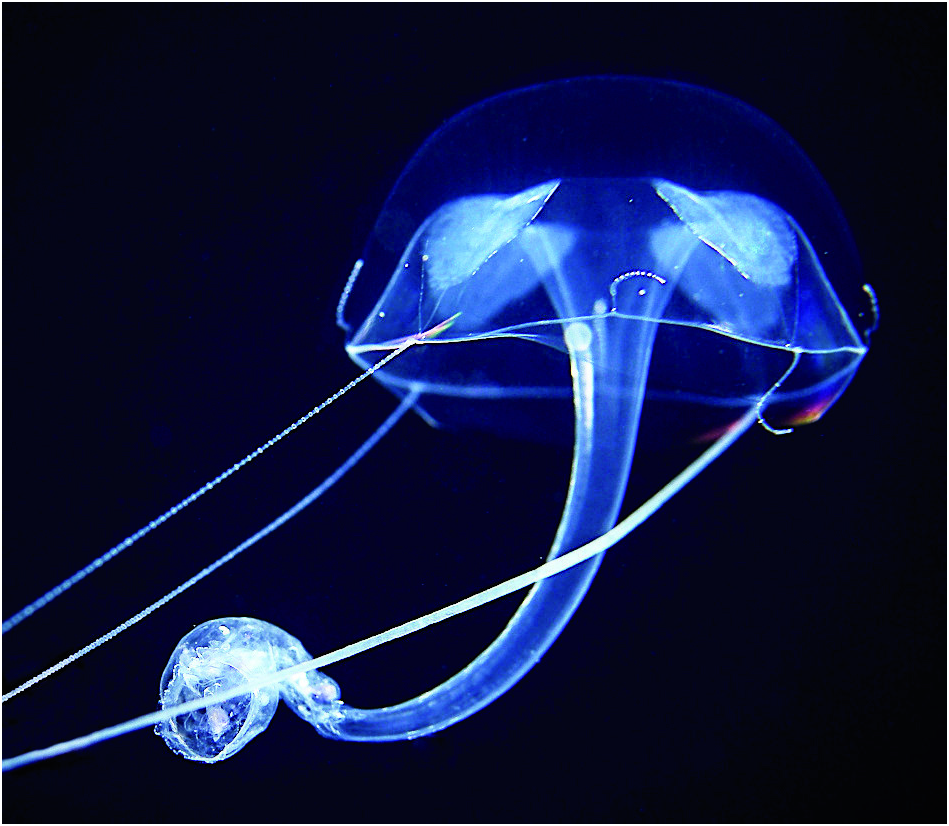
Examined material: BFLA 4026; 1 specimen; 15 - FEB- 2019; size 20 mm; preserved in alcohol for DNA extraction; 16 S sequence MW 528649. MHNG-INVE- 0031754; Mediterranean, Bay of Villefranche-sur-Mer; 43.6860 ° N 7.3170 ° E; 70 m depth; collection date 11 - MAY- 2001;> 2 specimens; size 3 - 4 mm; 1 preserved in formalin, others in ethanol for DNA extraction; 16 S sequence MW 528628. Observations: Specimen from Florida with nearly hemispherical bell, 20 mm wide, apical jelly thick, with long, thin gastric peduncle, peduncle length more than two times the bell height. Thin nematocysts tracks on exumbrella, four perradial and four interradial, interradial ones reaching only to base of short tentacles, perradial ones longer. Stomach on long gastric peduncle, relatively small, four indistinct perradial lips. Radial canals four, centripetal canals not visible on photos. Gonads very wide, flat, leaf-like, heart-shaped with pointed side pointing toward periphery. Four long perradial tentacles originating at bell margin, with ring-shaped nematocyst clusters. Four short interradial tentacles originating above bell margin on exumbrella, with adaxial nematocyst clusters.
Hydromedusae observed during night dives in the Gulf Stream
Remarks: Collins et al. (2008) suggested that this species may be referable to Limnomedusae. Distribution in South America: medusa — Pacific Ocean, Colombia to Chile, from 20 ° N to 20 ° S, from 22.50 ° S to 46 ° S (Kramp 1965, 1966; Alvariño 1976; Segura-Puertas 1984; Cely & Chiquillo 1993; Palma 1994; Palma & Rosales 1995; Pagès et al. 2001; Palma & Apablaza 2004; Apablaza & Palma 2006; Baldrich 2007; Palma et al. 2007 a p. 70, 73, 2007 b p. 74, 80, 2011; Pavez et al. 2010; IMARPE database of zooplankton; Chirichigno, pers. comm.); Atlantic Ocean, Colombia to Argentina, from 17 ° N to 39.84 ° S, at 47 ° S 59 ° W, at 54.97 ° S 66.80 ° W (F. Müller 1859; Vannucci 1951 a, 1951 b, 1957 a; Kramp 1957; Vannucci & Tundisi 1962; Alvariño 1968; Moreira 1973, 1978; Moncaleano & Niño 1976; Goy 1979; Navas-Pereira 1974, 1980, 1981; Ramírez & Zamponi 1980, 1981; Correia 1983; Giraldo & Villalobos 1983; Zamponi 1983 a; Zamponi & Suarez 1991; Zamponi & Genzano 1994; Tronolone 2001, 2008; Domínguez 2002; Migotto et al. 2002; Tronolone & Migotto 2005, abstract; Genzano et al. 2008 a; Nascimento 2010; Oliveira et al. 2010 b, abstract; Blough et al. 2011; Silveira & Morandini 2011; Nogueira Jr. 2012; Nagata et al. 2014 a, 2014 b; Gusmão et al. 2015; Nogueira Jr. et al. 2015 a, 2015 b). Habitat: holoplanktonic, eurythermic and euryhaline species, usually distributed and common in warm waters of all oceans (Kramp 1959 a).
Census of Cnidaria (Medusozoa) and Ctenophora from South American marine waters
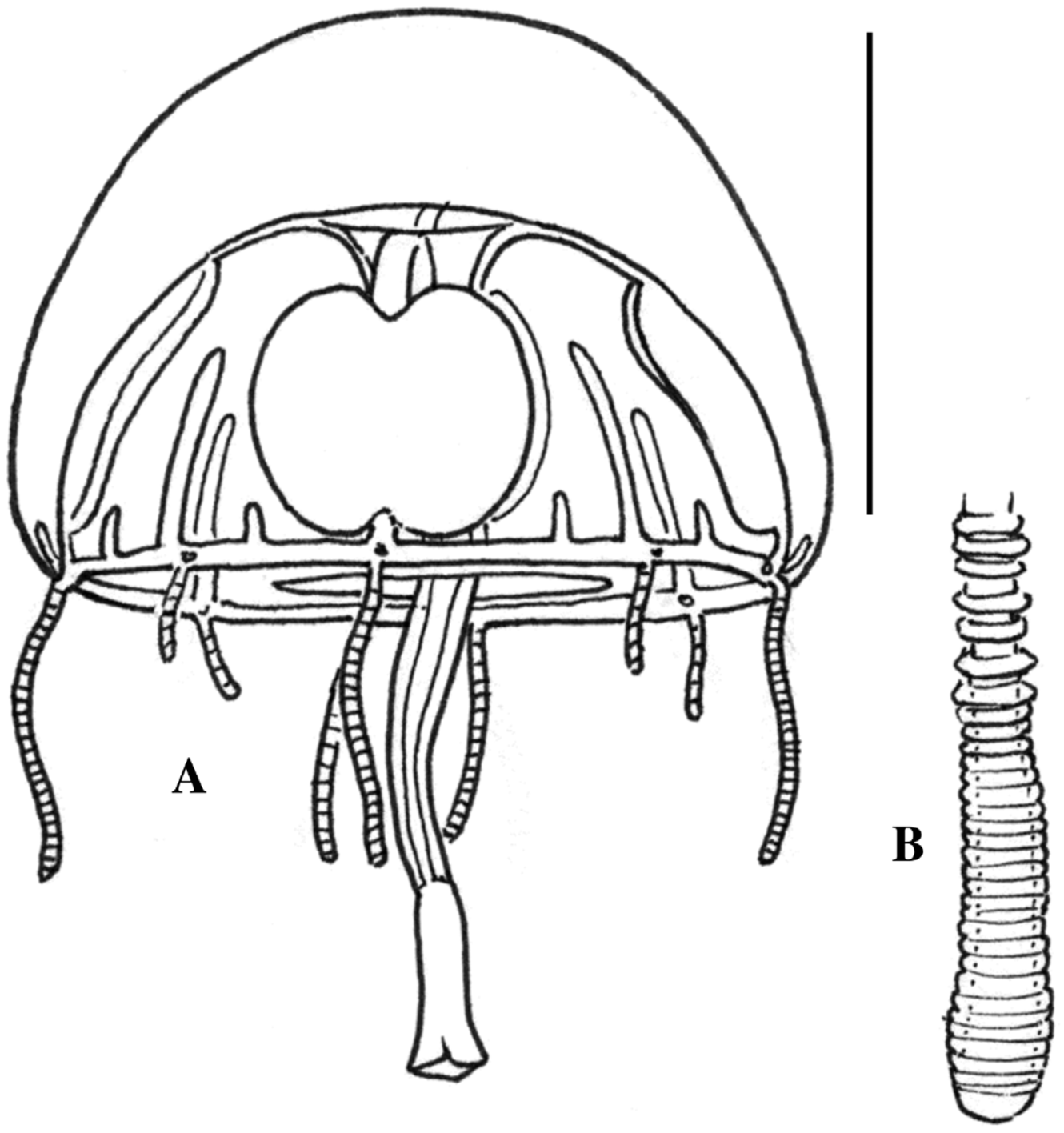
Description (after Mayer 1910 as L. exigua; Kramp 1959; Pagès et al. 1992): Medusa. Umbrella hemispherical, 10 – 30 mm wide, apex somewhat flattened, mesoglea thick, rigid; manubrium small, on long, cylindrical gastric peduncle, longer than umbrella diameter; mouth with 4 simple lips boarded with cnidocysts; with normally 4 radial canals (sometimes more) and 1 – 7 centripetal canals between each pair of adjacent radial canals; gonads variable in shape and size, generally heart-shaped, on either side of the middle of radial canals; velum broad; with marginal cnidocyst ring; typically 4 long hollow perradial tentacles with cnidocyst rings and 4 small solid interradial tentacles with adaxial cnidocyst clusters; 8 statocysts. Colorless. Cnidome Atrichous haplonemes and microbasic euryteles. Seasonality January – December (see Bouillon et al. 2004); May – June (Benović et al. 2005); January (Touzri et al. 2010) in several localities of the Mediterranean Sea. Reproductive period. From January to December (see Russell 1953).
The non-Siphonophoran Hydrozoa (Cnidaria) of Salento, Italy with notes on their life-cycles: an illustrated guide
Distribution. Common in temperate regions in all oceans, and in the Mediterranean Sea (Russell 1953; Kramp 1959, 1961; Medel & López-González 1996; Bouillon et al. 2004). Records in Salento. Common in the Gulf of Taranto (Belmonte et al. 2001).
The non-Siphonophoran Hydrozoa (Cnidaria) of Salento, Italy with notes on their life-cycles: an illustrated guide
Material examined. HCUS-S 121 (Hydrozoa Collection, University of Salento — fauna of the Salento Peninsula).
The non-Siphonophoran Hydrozoa (Cnidaria) of Salento, Italy with notes on their life-cycles: an illustrated guide
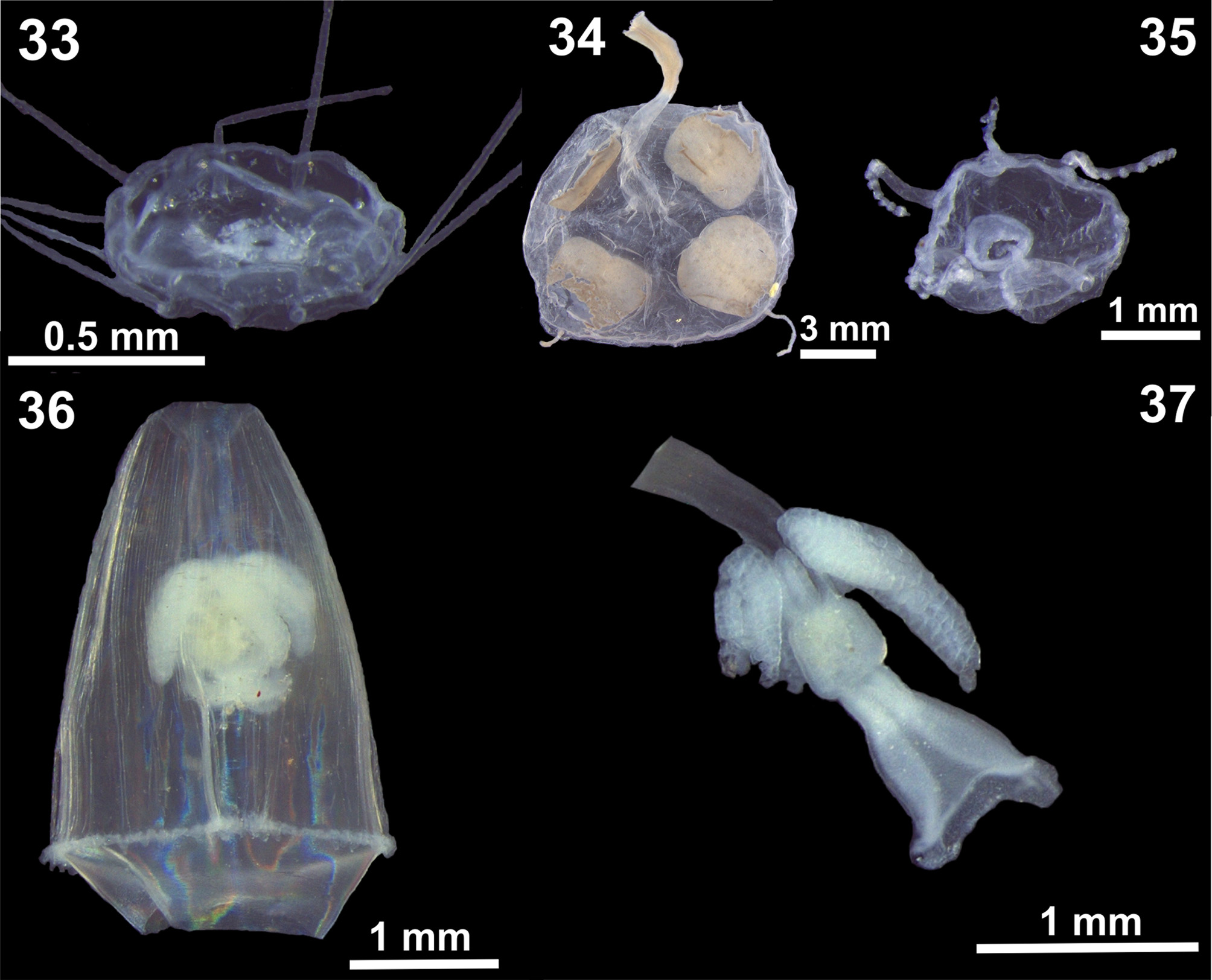
Description. Umbrella hemispherical, 0.25 – 17.5 mm in diameter, thin mesoglea with apical thickening. Small stomach, gastric peduncle of variable length, depending on the degree of ontogenetic development. In mature individuals, peduncle can reach 1 – 3 times the umbrellar height (Fig. 34). Mouth with 4 simple or slightly crenulated lips. 4 flattened, circular to leaf-shaped gonads on the radial canals, covering almost the entire subumbrellar surface (Fig. 34). 4 long and hollow perradial marginal tentacles, with nematocyst rings. 4 short solid interradial marginal tentacles, with adaxial batteries of nematocysts, which may be lost as the medusa grows. 8 statocysts at the base of the tentacles, with concretions. Young medusae (<2 mm) without peduncle, and with only interradial tentacles (Fig. 35). Systematic remarks. Other species have been described for the genus; however, it is currently considered monospecific (Schuchert 2013). Collins et al. (2008) suggested the existence of cryptic species based on significant divergences in mitochondrial 16 S and nuclear SSU sequence data. The species is easily recognized in all its stages of development due to the general shape, type and arrangement of tentacles, manubrium and peduncle shape, and long gastric peduncle in adults. Its morphology can be highly variable with respect to the shape of the gonads (Russell 1953), number of radial (Zamponi & Genzano 1989 a, b) and centripetal canals (Pagès et al. 1992), and size (Bouillon 1999). Biological data. In some regions the species occurs in oceanic waters, as in the Benguela Current (Buecher & Gibbons 2001), Humboldt Current, Chile (Kramp 1966; Palma et al. 2007) and off the California coast, USA (Suárez-Morales et al. 2002). However, in the Western Atlantic it is generally considered a euryhaline-coastal species (Larson 1982; Suárez-Morales et al. 1999; Tronolone 2007; Mianzan et al. 2000). In most studies of planktonic cnidarians in the western tropical and subtropical Atlantic, the species is dominant in coastal waters, and may occur in almost 100 % of the samples (Vannucci 1963; Larson 1982; Suárez-Morales et al. 1999, 2002; Tronolone 2007; present study). In Brazil, densities up to 1000 org. m - 3 were recorded off estuarine regions of Paranaguá (Paraná) and São Francisco do Sul (Santa Catarina) (Tronolone 2007). On beaches of southern Uruguay and northern Argentina, aggregations reaching densities of 4.7 * 10 6 org. m - 3 cause skin irritations in bathers (Mianzan et al. 2000). Its diet has not been studied in detail, but the species may be an important predator at different trophic levels, given the great diversity of planktonic organisms found within the manubrium, such as herbivorous crustaceans, chaetognaths, and fish eggs and larvae (Larson 1982).
Faunistic survey of Hydromedusae (Cnidaria, Medusozoa) from the coast of Paraná State, Southern Brazil
Distribution in Brazil. Along the entire coast, being abundant near and whithin estuaries (Vannucci 1957; Goy 1979; Navas-Pereira 1980; Montú & Cordeiro 1988; Tronolone 2007; Neumann-Leitão et al. 2008; Nogueira 2011, 2012).
Faunistic survey of Hydromedusae (Cnidaria, Medusozoa) from the coast of Paraná State, Southern Brazil
Material. Municipality of Pontal do Paraná, Balneário de Praia de Leste (25 º 44 ’ 15 ” S – 48 º 21 ’ 60 ” W): 01 / 12 / 1997 — 164 specimens; (25 º 46 ’ 32 ” S – 48 º 12 ’ 15 ” W): 01 / 12 / 1997 — 157 specimens; (25 º 48 ’ 10 ” S – 48 º 04 ’ 90 ” W): 01 / 12 / 1997 — 36 specimens; (25 º 50 ’ 25 ” S – 47 º 55 ’ 80 ” W); 01 / 12 / 1997 — 86 specimens; (25 º 42 ’ 65 ” S – 48 º 27 ’ 85 ” W): 22 / 12 / 1997 — 124 specimens; (25 º 46 ’ 32 ” S – 48 º 12 ’ 15 ” W): 22 / 12 / 1997 — 206 specimens; (25 º 48 ’ 10 ” S – 48 º 04 ’ 90 ” W): 22 / 12 / 1997 — 54 specimens; (25 º 50 ’ 25 ” S – 47 º 55 ’ 80 ” W): 22 / 12 / 1997 — 79 specimens; (25 º 42 ’ 65 ” S – 48 º 27 ’ 85 ” W): 23 / 01 / 1998 — 12 specimens; (25 º 44 ’ 15 ” S – 48 º 21 ’ 60 ” W): 23 / 01 / 1998 — 33 specimens; (25 º 46 ’ 32 ” S – 48 º 12 ’ 15 ” W): 23 / 01 / 1998 — 53 specimens; (25 º 48 ’ 10 ” S – 48 º 04 ’ 90 ” W): 23 / 01 / 1998 — 174 specimens; (25 º 50 ’ 25 ” S – 47 º 55 ’ 80 ” W): 23 / 01 / 1998 — 102 specimens; (25 º 42 ’ 65 ” S – 48 º 27 ’ 85 ” W): 20 / 02 / 1998 — 36 specimens; (25 º 44 ’ 15 ” S – 48 º 21 ’ 60 ” W): 20 / 02 / 1998 — 63 specimens; (25 º 46 ’ 32 ” S – 48 º 12 ’ 15 ” W): 20 / 02 / 1998 — 593 specimens; (25 º 48 ’ 10 ” S – 48 º 04 ’ 90 ” W): 20 / 02 / 1998 — 570 specimens; (25 º 50 ’ 25 ” S – 47 º 55 ’ 80 ” W): 20 / 02 / 1998 — 90 specimens; (25 º 44 ’ 15 ” S – 48 º 21 ’ 60 ” W): 31 / 03 / 1998 — 6 specimens; (25 º 46 ’ 32 ” S – 48 º 12 ’ 15 ” W): 31 / 03 / 1998 — 6 specimens; (25 º 48 ’ 10 ” S – 48 º 04 ’ 90 ” W): 31 / 03 / 1998 — 4 specimens; (25 º 42 ’ 65 ” S – 48 º 27 ’ 85 ” W): 22 / 04 / 1998 — 30 specimens; (25 º 44 ’ 15 ” S – 48 º 21 ’ 60 ” W): 22 / 04 / 1998 30 specimens; (25 º 48 ’ 10 ” S – 48 º 04 ’ 90 ” W): 22 / 04 / 1998 — 1 specimen; (25 º 50 ’ 25 ” S – 47 º 55 ’ 80 ” W): 22 / 04 / 1998 — specimen; (25 º 46 ’ 32 ” S – 48 º 12 ’ 15 ” W): 27 / 05 / 1998 — 27 specimens; (25 º 48 ’ 10 ” S – 48 º 04 ’ 90 ” W): 27 / 05 / 1998 — 19 specimens; (25 º 50 ’ 25 ” S – 47 º 55 ’ 80 ” W): 27 / 05 / 1998 — 2 specimens; (25 º 42 ’ 65 ” S – 48 º 27 ’ 85 ” W): 24 / 06 / 1998 — 21 specimens; (25 º 44 ’ 15 ” S – 48 º 21 ’ 60 ” W): 24 / 06 / 1998 — 7 specimens; (25 º 46 ’ 32 ” S – 48 º 12 ’ 15 ” W): 24 / 06 / 1998 — 8 specimens; (25 º 42 ’ 65 ” S – 48 º 27 ’ 85 ” W): 16 / 07 / 1998 — 29 specimens; (25 º 44 ’ 15 ” S – 48 º 21 ’ 60 ” W): 16 / 07 / 1998 — 25 specimens; (25 º 48 ’ 10 ” S – 48 º 04 ’ 90 ” W): 16 / 07 / 1998 — 17 specimens; (25 º 50 ’ 25 ” S – 47 º 55 ’ 80 ” W): 16 / 07 / 1998 — 10 specimens; (25 º 42 ’ 65 ” S – 48 º 27 ’ 85 ” W): 20 / 08 / 1998 — 585 specimens; (25 º 44 ’ 15 ” S – 48 º 21 ’ 60 ” W): 20 / 08 / 1998 — 922 specimens; (25 º 46 ’ 32 ” S – 48 º 12 ’ 15 ” W): 20 / 08 / 1998 — 154 specimens; (25 º 48 ’ 10 ” S – 48 º 04 ’ 90 ” W): 20 / 08 / 1998 — 14 specimens; (25 º 50 ’ 25 ” S – 47 º 55 ’ 80 ” W): 20 / 08 / 1998 — 3 specimens; (25 º 46 ’ 32 ” S – 48 º 12 ’ 15 ” W): 02 / 10 / 1998 — 84 specimens; (25 º 48 ’ 10 ” S – 48 º 04 ’ 90 ” W): 02 / 10 / 1998 — 234 specimens; (25 º 50 ’ 25 ” S – 47 º 55 ’ 80 ” W): 02 / 10 / 1998 — 60 specimens; (25 º 42 ’ 65 ” S – 48 º 27 ’ 85 ” W): 28 / 10 / 1998 — 10 specimens; (25 º 44 ’ 15 ” S – 48 º 21 ’ 60 ” W): 28 / 10 / 1998 — 207 specimens; (25 º 46 ’ 32 ” S – 48 º 12 ’ 15 ” W): 28 / 10 / 1998 — 101 specimens; (25 º 48 ’ 10 ” S – 48 º 04 ’ 90 ” W): 28 / 10 / 1998 — 79 specimens; (25 º 50 ’ 25 ” S – 47 º 55 ’ 80 ” W): 28 / 10 / 1998 — 36 specimens; (25 º 50 ’ 25 ” S – 47 º 55 ’ 80 ” W): 25 / 11 / 1998 — 35 specimens; (25 º 44 ’ 15 ” S – 48 º 21 ’ 60 ” W): 21 / 12 / 1998 — 7 specimens; (25 º 44 ’ 15 ” S – 48 º 21 ’ 60 ” W): 21 / 12 / 1998 — 6 specimens; (25 º 42 ’ 65 ” S – 48 º 27 ’ 85 ” W): 22 / 01 / 1999 — 38 specimens; (25 º 44 ’ 15 ” S – 48 º 21 ’ 60 ” W): 22 / 01 / 1999 — 20 specimens; (25 º 46 ’ 32 ” S – 48 º 12 ’ 15 ” W): 22 / 01 / 1999 — 30 specimens; (25 º 44 ’ 15 ” S – 48 º 21 ’ 60 ” W): 24 / 02 / 1999 — 2 specimens; (25 º 46 ’ 32 ” S – 48 º 12 ’ 15 ” W): 24 / 02 / 1999 — 3 specimens; (25 º 48 ’ 10 ” S – 48 º 04 ’ 90 ” W): 24 / 02 / 1999 — 3 specimens; (25 º 50 ’ 25 ” S – 47 º 55 ’ 80 ” W): 24 / 02 / 1999 — 23 specimens; (25 º 42 ’ 65 ” S – 48 º 27 ’ 85 ” W): 24 / 03 / 1999 — 2 specimens; (25 º 44 ’ 15 ” S – 48 º 21 ’ 60 ” W): 24 / 03 / 1999 — 9 specimens; (25 º 46 ’ 32 ” S – 48 º 12 ’ 15 ” W): 24 / 03 / 1999 — 72 specimens; (25 º 48 ’ 10 ” S – 48 º 04 ’ 90 ” W): 24 / 03 / 1999 — 3 specimens; (25 º 50 ’ 25 ” S – 47 º 55 ’ 80 ” W): 24 / 03 / 1999 — 11 specimens. Reference specimens deposited. MZUSP 1520, 34 specimens, MZUP 1518, 33 specimens, MZUSP 1495, 4 specimens. Dzoo-Cn 252, 8 specimens. World distribution. In the three great oceans and the Mediterranean Sea, in greater abundance within the 20 ° C isotherm (Thiel 1936, p. 52, fig. 10 cited in Russell 1953), and absent in the polar regions (Russell 1953).
Faunistic survey of Hydromedusae (Cnidaria, Medusozoa) from the coast of Paraná State, Southern Brazil

Export occurrence data

Darwin Core Archive (ZIP)

GEOGRAPHY

Distribution Map

Occurrence Map

Loading map…

Tiles © GBIF Maps API | Map powered by MapLibre GL

REGIONS

Geographic Distribution(56)

East Pacific
Western Atlantic Ocean
Mediterranean Sea
Atlantic Coast of Florida
Gulf of Mexico
European waters (ERMS scope)
North West Atlantic
Kenyan Exclusive Economic Zone
Azores Exclusive Economic Zone
New Zealand Exclusive Economic Zone
Japanese Exclusive Economic Zone
Wimereux
Gulf of Mexico
North West Atlantic
Kenyan Exclusive Economic Zone
Japanese Exclusive Economic Zone
Wimereux
Mediterranean Sea
Azores Exclusive Economic Zone
Atlantic Coast of Florida
Kenyan Exclusive Economic Zone
European waters (ERMS scope)
New Zealand Exclusive Economic Zone
Mediterranean Sea
North West Atlantic
European Marine Waters
Gulf of Mexico
Portuguese Exclusive Economic Zone (Azores)
BR
native
BR
native
BR
native
BR
native
BR
native
BR
native
BR
native
BR
native
BR
native
BR
native
BR
native
BR
native
BR
native
BR
native
BR
native
BR
native
BR
native
Wimereux(FR)
Japanese Exclusive Economic Zone(JP)
Kenyan Exclusive Economic Zone(KE)
New Zealand Exclusive Economic Zone(NZ)
Azores Archipelago(PT)
Atlantic Coast of Florida(US)

DATA

Occurrence Datasets

Loading datasets…

Common names used for this species across different languages and regions. Available in 5 languages.

engJewel JellyengspaTapiocaspacestrachymedúzka čtyřlistácesjpnカラカサクラゲjpnjpnカラカサクラゲjpn+2 more

Vernacular (common) names are the everyday names used for a species in different languages and regions. A single species may have dozens of common names worldwide. This taxon has names in 5 languages.

engJewel Jelly
eng
Source: Catalogue of LifeSource taxon #299644513
spaTapioca
spa
Source: Catalogue of LifeSource taxon #299644513
cestrachymedúzka čtyřlistá
ces
Source: Catalogue of LifeSource taxon #299644513
jpnカラカサクラゲ
jpn
Source: Catalogue of LifeSource taxon #299644513
jpnカラカサクラゲ
jpn
Source: Catalogue of LifeSource taxon #273073734
kor네잎백합해파리
kor
Source: Catalogue of LifeSource taxon #299644513
jpnカラカサクラゲ
jpn
Source: World Register of Marine SpeciesSource taxon #155437071

CLASSIFICATION

Taxonomic Classification Tree

MULTIMEDIA

Media Files(3)

Fig. 62. Liriope tetraphylla, BFLA4026, size 20 mm. The stomach is filled with prey items. The larger part of one perradial tentacle is broken off (right).

Imageimage/png© Schuchert, Peter;Collins, RichardHydromedusae observed during night dives in the Gulf Stream

FIGURE 115. Liriope tetraphylla: A, general view of adult medusa; B, terminal portion of a hollow perradial tentacle (redrawn and modified: A after Trègouboff & Rose 1957, B after Russell 1953 by A. Gennari). Scale bars: 1.0 cm. See Kramp (1961) for a complete synonymy.

Imageimage/png© Gravili, Cinzia;Vito, Doris De;Camillo, Cristina Gioia Di;Martell, Luis;Piraino, Stefano;Boero, FerdinandoThe non-Siphonophoran Hydrozoa (Cnidaria) of Salento, Italy with notes on their life-cycles: an illustrated guide

FIGURE 33 – 37. Solmaris corona (Keferstein & Ehlers): young medusae (33); Liriope tetraphylla (Chamisso & Eysenhardt): adult (34), and young medusae (35) a courtesy of Luis Eduardo de Mattos Pukanski; Aglaura hemistoma Péron & Lesueur: adult medusae (36) gonads attached on peduncle (37).

Imageimage/png© Nagata, Renato Mitsuo;Júnior, Miodeli Nogueira;Haddad, Maria AngélicaFaunistic survey of Hydromedusae (Cnidaria, Medusozoa) from the coast of Paraná State, Southern Brazil

IMAGES

Gallery(3)

See Gallery

Occurrences with images

CITATIONS

References(11)

  • 1

    Bigelow, H. B. (1938). Medusae taken during the years 1929 and 1930. Plankton of the Bermuda Oceanographic Expeditions. <em>VIII. Zoologica, N.Y.</em> 23(5): 99-189.

    source of synonymyWorld Register of Marine Species
  • 2

    Cairns, S.D., L. Gershwin, F.J. Brook, P. Pugh, E.W. Dawson, O.V. Ocaña, W. Vervoort, G. Williams, J.E. Watson, D.M. Opresko, P. Schuchert, P.M. Hine, D.P. Gordon, H.I. Campbell, A.J. Wright, J.A.Sánchez & D.G. Fautin. (2009). Phylum Cnidaria: corals, medusae, hydroids, myxozoans. <em>in: Gordon, D.P. (Ed.) (2009). New Zealand inventory of biodiversity: 1. Kingdom Animalia: Radiata, Lophotrochozoa, Deuterostomia.</em> :59-101.

    additional sourceWorld Register of Marine Species
  • 3

    Cairns, Stephen D., Dale R. Calder, Anita Brinckmann-Voss, Clovis B. Castro, Daphne G. Fautin,..., 2002: Common and Scientific Names of Aquatic Invertebrates from the United States and Canada: Cnidaria and Ctenophora, Second Edition, 2002. American Fisheries Society Special Publication 28. xi + 115.

    Integrated Taxonomic Information System (ITIS)
  • 4

    Kramp, P. L., 1961: Synopsis of the medusae of the world. Journal of the Marine Biological Association of the United Kingdom, vol. 40. 1-469.

    Integrated Taxonomic Information System (ITIS)
  • 5

    Liu, J.Y. [Ruiyu] (ed.). (2008). [Checklist of marine biota of China seas]. <em>China Science Press.</em> 1267 pp.

    additional sourceWorld Register of Marine Species
  • Source Information

    GBIF Backbone Taxonomy

    GBIF Backbone Taxonomy

    checklist

    The GBIF Backbone Taxonomy is a single, synthetic management classification with the goal of covering all names GBIF is dealing with. It's the taxonomic backbone that allows GBIF to integrate name based information from different resources, no matter if these are occurrence datasets, species pages, names from nomenclators or external sources like EOL, Genbank or IUCN. This backbone allows taxonomic search, browse and reporting operations across all those resources in a consistent way and to provide means to crosswalk names from one source to another.

    It is updated regulary through an automated process in which the Catalogue of Life acts as a starting point also providing the complete higher classification above families. Additional scientific names only found in other authoritative nomenclatural and taxonomic datasets are then merged into the tree, thus extending the original catalogue and broadening the backbones name coverage. The GBIF Backbone taxonomy also includes identifiers for Operational Taxonomic Units (OTUs) drawn from the barcoding resources iBOL and UNITE.

    International Barcode of Life project (iBOL), Barcode Index Numbers (BINs). BINs are connected to a taxon name and its classification by taking into account all names applied to the BIN and picking names with at least 80% consensus. If there is no consensus of name at the species level, the selection process is repeated moving up the major Linnaean ranks until consensus is achieved.

    UNITE - Unified system for the DNA based fungal species, Species Hypotheses (SHs). SHs are connected to a taxon name and its classification based on the determination of the RefS (reference sequence) if present or the RepS (representative sequence). In the latter case, if there is no match in the UNITE taxonomy, the lowest rank with 100% consensus within the SH will be used.

    The GBIF Backbone Taxonomy is available for download at https://hosted-datasets.gbif.org/datasets/backbone/ in different formats together with an archive of all previous versions.

    The following 105 sources have been used to assemble the GBIF backbone with number of names given in brackets:

    • Catalogue of Life Checklist - 4766428 names
    • International Barcode of Life project (iBOL) Barcode Index Numbers (BINs) - 635951 names
    • UNITE - Unified system for the DNA based fungal species linked to the classification - 611208 names
    • The Paleobiology Database - 212054 names
    • World Register of Marine Species - 188857 names
    • The Interim Register of Marine and Nonmarine Genera - 183894 names
    • The World Checklist of Vascular Plants (WCVP) - 131891 names
    • GBIF Backbone Taxonomy - 114350 names
    • TAXREF - 109374 names
    • The Leipzig catalogue of vascular plants - 75380 names
    • ZooBank - 73549 names
    • Integrated Taxonomic Information System (ITIS) - 68377 names
    • Plazi.org taxonomic treatments database - 61346 names
    • Genome Taxonomy Database r207 - 60545 names
    • International Plant Names Index - 52329 names
    • Fauna Europaea - 45077 names
    • The National Checklist of Taiwan (Catalogue of Life in Taiwan, TaiCoL) - 36193 names
    • Dyntaxa. Svensk taxonomisk databas - 35892 names
    • The Plant List with literature - 32692 names
    • United Kingdom Species Inventory (UKSI) - 29643 names
    • Artsnavnebasen - 29208 names
    • The IUCN Red List of Threatened Species - 21221 names
    • Afromoths, online database of Afrotropical moth species (Lepidoptera) - 13961 names
    • Brazilian Flora 2020 project - Projeto Flora do Brasil 2020 - 13829 names
    • Prokaryotic Nomenclature Up-to-Date (PNU) - 10079 names
    • Checklist Dutch Species Register - Nederlands Soortenregister - 8814 names
    • ICTV Master Species List (MSL) - 7852 names
    • Cockroach Species File - 6020 names
    • GRIN Taxonomy - 5882 names
    • Taxon list of fungi and fungal-like organisms from Germany compiled by the DGfM - 4570 names
    • Catalogue of Afrotropical Bees - 3623 names
    • Catalogue of Tenebrionidae (Coleoptera) of North America - 3327 names
    • Checklist of Beetles (Coleoptera) of Canada and Alaska. Second Edition. - 3312 names
    • Systema Dipterorum - 2850 names
    • Catalogue of the Pterophoroidea of the World - 2807 names
    • The Clements Checklist - 2675 names
    • Taxon list of Hymenoptera from Germany compiled in the context of the GBOL project - 2496 names
    • IOC World Bird List, v13.2 - 2366 names
    • Official Lists and Indexes of Names in Zoology - 2310 names
    • National checklist of all species occurring in Denmark - 1922 names
    • Myriatrix - 1876 names
    • Database of Vascular Plants of Canada (VASCAN) - 1822 names
    • Taxon list of vascular plants from Bavaria, Germany compiled in the context of the BFL project - 1771 names
    • Orthoptera Species File - 1742 names
    • A list of the terrestrial fungi, flora and fauna of Madeira and Selvagens archipelagos - 1602 names
    • Aphid Species File - 1565 names
    • World Spider Catalog - 1561 names
    • Taxon list of Jurassic Pisces of the Tethys Palaeo-Environment compiled at the SNSB-JME - 1270 names
    • Backbone Family Classification Patch - 1143 names
    • GBIF Algae Classification - 1100 names
    • International Cichorieae Network (ICN): Cichorieae Portal - 975 names
    • Psocodea Species File - 803 names
    • New Zealand Marine Macroalgae Species Checklist - 787 names
    • Annotated checklist of endemic species from the Western Balkans - 754 names
    • Taxon list of animals with German names (worldwide) compiled at the SMNS - 503 names
    • Catalogue of the Alucitoidea of the World - 472 names
    • Lygaeoidea Species File - 462 names
    • Catálogo de Plantas y Líquenes de Colombia - 422 names
    • GBIF Backbone Patch - 317 names
    • Phasmida Species File - 259 names
    • Cortinariaceae fetched from the Index Fungorum API - 234 names
    • Coreoidea Species File - 233 names
    • GTDB supplement - 139 names
    • Mantodea Species File - 119 names
    • Endemic species in Taiwan - 93 names
    • Taxon list of Araneae from Germany compiled in the context of the GBOL project - 88 names
    • Species of Hominidae - 78 names
    • Taxon list of Sternorrhyncha from Germany compiled in the context of the GBOL project - 77 names
    • Taxon list of mosses from Germany compiled in the context of the GBOL project - 75 names
    • Mammal Species of the World - 73 names
    • Plecoptera Species File - 71 names
    • Species Fungorum Plus - 64 names
    • Catalogue of the type specimens of Cosmopterigidae (Lepidoptera: Gelechioidea) from research collections of the Zoological Institute, Russian Academy of Sciences - 47 names
    • Species named after famous people - 41 names
    • Dermaptera Species File - 36 names
    • Taxon list of Trichoptera from Germany compiled in the context of the GBOL project - 34 names
    • True Fruit Flies (Diptera, Tephritidae) of the Afrotropical Region - 33 names
    • Range and Regularities in the Distribution of Earthworms of the Earthworms of the USSR Fauna. Perel, 1979 - 32 names
    • Taxon list of Diplura from Germany compiled in the context of the GBOL project - 30 names
    • Lista de referencia de especies de aves de Colombia - 2022 - 24 names
    • Taxon list of Auchenorrhyncha from Germany compiled in the context of the GBOL project - 20 names
    • Catalogue of the type specimens of Polycestinae (Coleoptera: Buprestidae) from research collections of the Zoological Institute, Russian Academy of Sciences - 19 names
    • Taxon list of Thysanoptera from Germany compiled in the context of the GBOL project - 19 names
    • Lista de especies de vertebrados registrados en jurisdicción del Departamento del Huila - 18 names
    • Taxon list of Microcoryphia (Archaeognatha) from Germany compiled in the context of the GBOL project - 15 names
    • Catalogue of the type specimens of Bufonidae and Megophryidae (Amphibia: Anura) from research collections of the Zoological Institute, Russian Academy of Sciences - 12 names
    • Grylloblattodea Species File - 11 names
    • Coleorrhyncha Species File - 9 names
    • Taxon list of liverworts from Germany compiled in the context of the GBOL project - 9 names
    • Embioptera Species File - 7 names
    • Taxon list of Pisces and Cyclostoma from Germany compiled in the context of the GBOL project - 6 names
    • Taxon list of Pteridophyta from Germany compiled in the context of the GBOL project - 6 names
    • Taxon list of Siphonaptera from Germany compiled in the context of the GBOL project - 5 names
    • The Earthworms of the Fauna of Russia. Perel, 1997 - 5 names
    • Taxon list of Zygentoma from Germany compiled in the context of the GBOL project - 4 names
    • Asiloid Flies: new taxa of Diptera: Apioceridae, Asilidae, and Mydidae - 3 names
    • Taxon list of Protura from Germany compiled in the context of the GBOL project - 3 names
    • Taxon list of hornworts from Germany compiled in the context of the GBOL project - 2 names
    • Chrysididae Species File - 1 names
    • Taxon list of Dermaptera from Germany compiled in the context of the GBOL project - 1 names
    • Taxon list of Diplopoda from Germany in the context of the GBOL project - 1 names
    • Taxon list of Orthoptera (Grashoppers) from Germany compiled at the SNSB - 1 names
    • Taxon list of Pscoptera from Germany compiled in the context of the GBOL project - 1 names
    • Taxon list of Pseudoscorpiones from Germany compiled in the context of the GBOL project - 1 names
    • Taxon list of Raphidioptera from Germany compiled in the context of the GBOL project - 1 names

    GBIF Secretariat (2023). GBIF Backbone Taxonomy. Checklist dataset https://doi.org/10.15468/39omei accessed via GBIF.org on 2026-06-16.

    CC BYPublished 8/28/2023View dataset
    GBIF Usage Key
    5186382
    Dataset Key
    d7dddbf4-2cf0-4f39-9b2a-bb099caae36c
    Origin
    source
    Backbone Key
    5186382
    Taxon ID
    gbif:5186382
    Last Crawled
    8/22/2023
    Last Interpreted
    8/22/2023