AnimaliaNot EvaluatedacceptedspeciesAccepted
Acrossota amboinensis

Acrossota amboinensis

(Burchardt, 1902)

GBIF:5841553

0datasets
0year

0

Descendants

0

Synonyms

0

Children

PROFILE

Species Profile

Habitat

Marine

ABOUT

Descriptions(3)

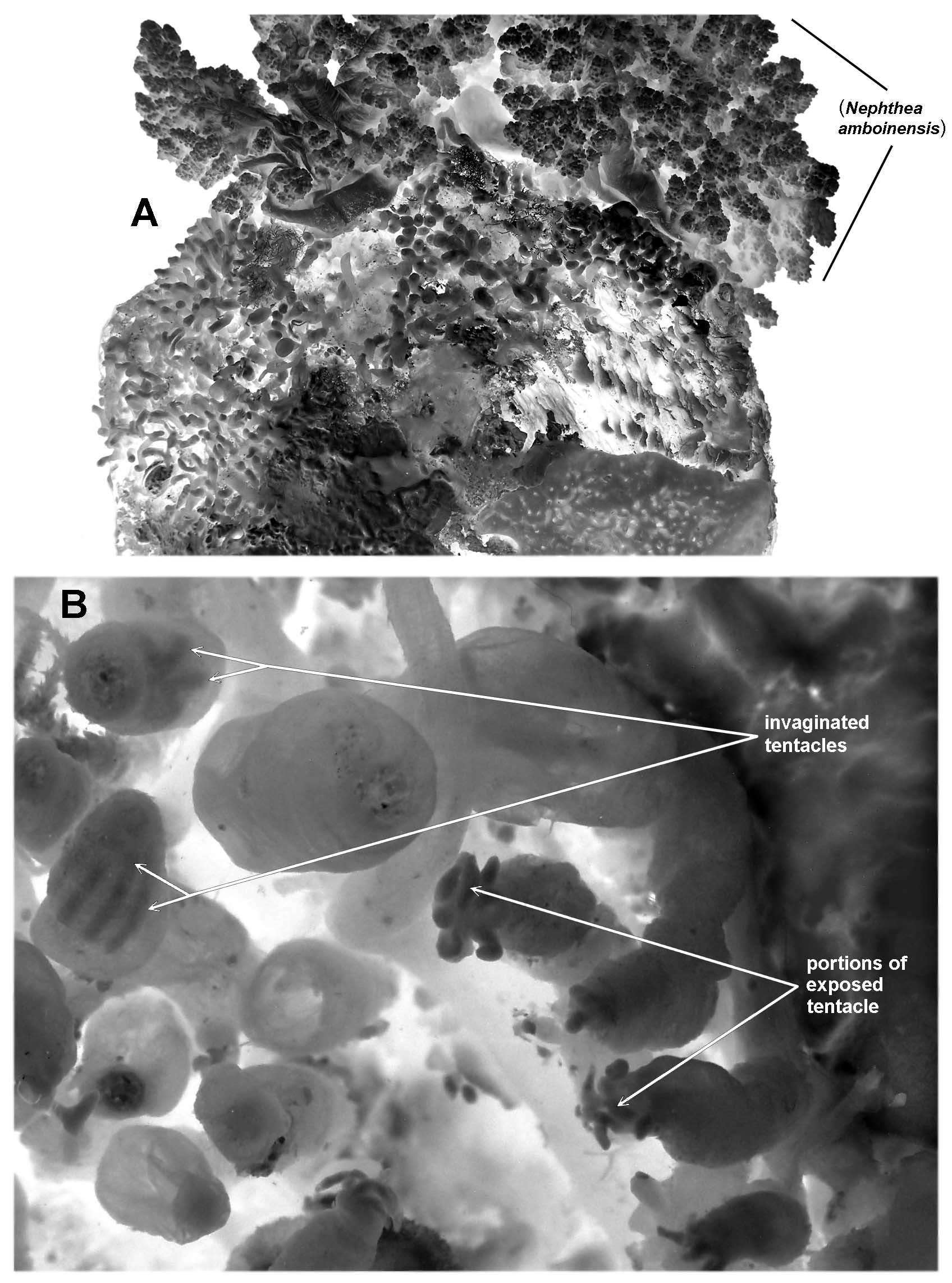
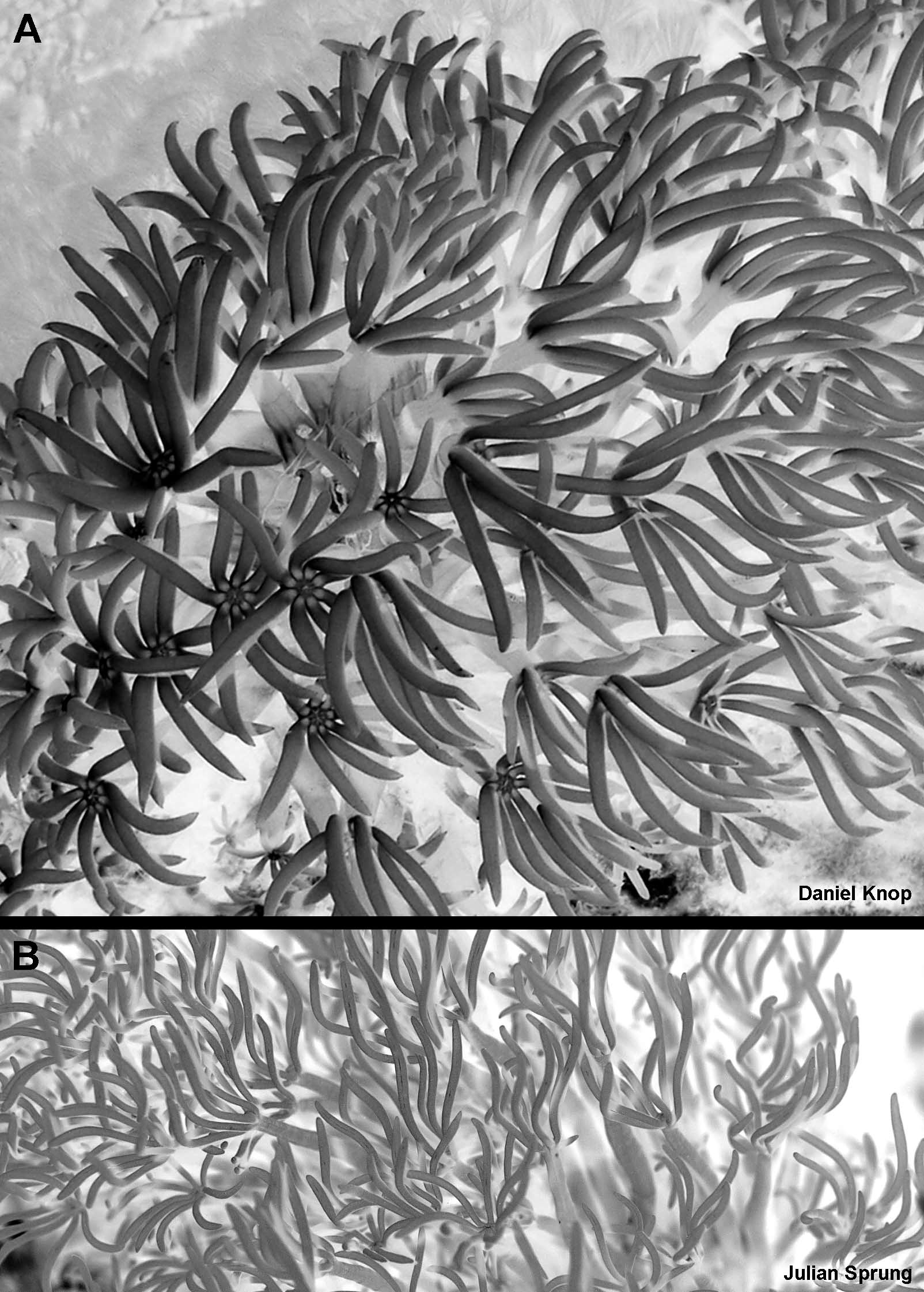
Description: Holotype. The colony described by Burchardt is shown in Figures 1 – 2. Virtually all of the polyps are on one valve of an oyster, situated on one side of the base of a syntype colony of Nephthea amboinensis. There is also much sponge and some bryozoan material on the shell. The two clusters of polyps that Burchardt thought were two colonies are joined by a few flat stolons that pass under a clump of sponge and the folded edge of the Nephthea colony. Very little of the network of stolons is visible without prising away the overgrowing sponge. The few main strands that are visible are about 0.8 mm wide, and these may be cross­linked by short, much narrower, strands. Wider portions, where the stolons are expanded into wider mats, can be uncovered, but their extent is unknown. Burchardt said that “ Eine Hornscheide ” was missing, but the stolons and the polyps are covered with a thin cuticle. It is not easy to detect on the polyps, but on some broken ones it can be seen to be peeling off as a very thin transparent sheet. The polyps in the small cluster (Fig. 2 B) are mostly 2.5 – 5.0 mm tall, wider at the oral end, and mostly c. 0.9 – 1.6 mm in diameter. Those in the larger cluster (Fig. 2 A) that are not surrounded by sponge are longer, at least up to 9 mm. Polyps that are growing through the sponge can be even longer; one measured 14.25 mm long and 1.37 mm diameter at the oral end. The protective cuticle on the lower part of these polyps where they pass though the sponge is much thicker than elsewhere and easily seen. It is yellowish brown against the yellowish white of the upper part of the polyps. The polyps are moderately translucent and the mesenterial insertions can be seen through the walls of many of them. Quite a number of polyps have the distal ends missing, perhaps as a consequence of Burchardt’s research. Of those that remain, all but a few have no tentacles visible. Burchardt’s account indicates that some polyps had the tentacles fully unfolded when he examined the specimen, but in the material now, where tentacles are visible, they protrude only by very small amounts (Fig. 1 B); there are no signs of pinnules. Through the body wall of many polyps, the withdrawn tentacles appear as an opaque cylinder or a cluster of opaque fingers in the distal part of the body (Fig. 1 B). Dissection confirmed Burchardt’s observation that the tentacles withdraw by invagination. They protrude into the gastric cavity of the polyp between the pharynx and the body wall. There are no sclerites in any part of the colony. NTM C 13618. The specimen is shown in Figure 3. It consists of a dense cluster of polyps attached to a piece of coral rock. Narrow colonial stolons can be seen at the margins of the polyp cluster. They are flattened, c. 0.3 – 0.9 mm wide, and anastomose with, or cross, other stolons. The stolons disappear beneath the dense mass of polyps, where they may join to form broad membranous expansions. The fact that some stolons cross other stolons without anastomosing may indicate that there is more than one colony here. Stolons and polyp bodies are covered by a thin cuticle. The polyps are greyish yellow; a couple with the tips of the tentacles exposed are mostly opaque. Some are more inflated and the mesenterial insertions and withdrawn tentacles can be seen within. These tentacles lie outside the pharynx and are invaginated. Polyp sizes vary from juveniles, 0.9 mm tall and 1.4 mm in diameter, to the largest c. 7.5 mm tall and 2.4 mm in diameter. There are a number of tubular, sinuous, stolonic outgrowths that rise free from the substratum, and have a very wrinkled cuticle. The outgrowths appear to be the vegetative parts of the colony that were involved in increasing colony size. They are up to 9 mm in length and they end in a polyp of reduced dimensions. Several similar­looking structures occur on the type specimen of Clavularia amboinensis — up to c. 7 mm long — but they stand erect and may not be analogous. Several polyps had had the head and tentacles removed while the colony was still alive and expanded. They are up to 4.4 mm long and 0.2 – 0.3 mm broad. A polyp head and close­up of the tentacles are shown in Figure 3 B – C. A living colony is shown in Figure 8 B. NTM C 13626. The lot consists of three parts — a cluster of polyps on a small fragment of coral rock, a large number of polyps on a larger piece of coral rock (Fig. 4 A), and an unattached section of stolons and polyps (Fig. 4 B). Many of the polyps in the unattached specimen have the smooth, highly contracted tentacles everted and there are several vegetative stolonal outgrowths (Fig. 4 B, arrowed), some of which have small swellings where autozooid polyps were developing. Stolons and polyp bodies have a thin covering of cuticle. There are no stolons on the larger piece of coral rock, and all of the polyps arise from a broad basal membrane. The polyps are quite long, up to c. 10 mm long and 1.1 – 1.8 mm in diameter, and many have c. 1.5 mm of everted tentacles exposed. There is a cuticle covering the membrane and the polyp bodies, particularly noticeable on the transversely wrinkled proximal third of each polyp. The third rock fragment has slightly more than 20 polyps on it that arise from a spreading membranous base. Many of the polyps have smooth tentacles protruding from the oral end. The dissected polyp shown in Figure 4 C, taken from the large rock, reveals the contortions involved in the process of retraction. Whole, or portions of, invaginated tentacles are free in the gastric cavity. They lie mostly alongside the pharynx, which has been pulled down by the muscles in those parts of the mesenteries proximal to it. The cylindrical region distal to the pharynx and the invaginated tentacles is that part of the body wall, now turned inside out, that was previously outside of and adjacent to the pharynx in the expanded polyp. This region is attached to the pharynx by mesenteries that must undergo considerable stretching during the invagination process. Some of these mesenteries, torn during the dissection, are labelled at the right of the figure. Those parts of the mesenteries remaining attached to the invaginated body wall pass down between the invaginated tentacles, along the length of the pharynx and down to the base of the colony. When the invaginated, upper body wall cylinder was opened, portions of three tentacles that had not completely invaginated were lying longitudinally within. At the proximal end of the cylinder, the peristome lay like a domed membrane across the top of the pharynx. If the invaginated parts of the tentacles are magnified they can be seen to be covered in a thick layer of zooxanthellae — presumably that which was previously inside the expanded tentacle prior to polyp retraction. The oral aspect of a polyp with the tentacles preserved in the process of invagination or evagination is shown in Figure 3 D. Clefts can be seen in the tip of each tentacle stub. NTM C 15379. This lot consists of two small clumps of fine gravel held together by a gelatinous substance. These support few polyps but many vegetative stolonic outgrowths with very little internal structure visible. The samples are portions of a colony initially obtained from a dealer in aquarium animals. The colony had been kept in an aquarium for some time, and its morphology is likely to have been affected by this. NTM C 15380. This lot consists of two small fragments of coral and coralline algae. There are 13 polyps on the largest fragment, and only one on the smallest piece. The largest piece has a number of anastomosed, narrow, flattened stolons supporting the polyps. Smooth tentacles protrude from a number of the polyps and can be seen within the gastric cavities of others. Polyps and stolons are of the same size range as the specimens described above. The live parent colony is shown in Figure 8 A. The tentacles are clearly of a simple, pinnule­less construction. This material was also from a colony obtained from a marine animal dealer, but it had spent very little time in captivity. NTM C 15381. This specimen consists of a piece of thin coral rock, about 47 x 43 mm in size, supporting a large number of polyps almost all of which have the tentacles withdrawn. Unusually, this specimen has polyps typical of both Acrossota amboinensis and the new taxon described below. The retracted polyps of the two different species look more or less identical, but those polyps with portions of the tentacles visible reveal that there are two forms present. Upon cursory examination it can appear that the two different forms are actually united on the same basal stolons, but careful tracing of the intermixed stolons proves this is not the case. NTM C 15506. There are over 40 polyps making up this specimen, all closely arising from a more or less complete basal membrane encrusting a near­triangular coralline tile about 2 cm 2 in area. Most polyps are about 4 mm tall and 2.3 in diameter, one has the tentacles extended, and one is inflated to a height of 7 mm and a width of 3 mm. The cuticle covering the polyps and membrane is quite conspicuous in many places owing to its dark greenish­brown colouring, which result from a fine covering of marine turf.
Pinnule­less polyps: a new genus and new species of Indo­Pacific Clavulariidae and validation of the soft coral genus Acrossota and the family Acrossotidae (Coelenterata: Octocorallia)

Remarks: The main morphological characteristics used to distinguish between species within similar stolonate genera are sclerite position, arrangement, and architecture, and the number of pinnules on the tentacles. The fact there are no sclerites or pinnules in Acrossota presents an interesting challenge to the taxonomist. The material described above, extra to the holotype, serves to confirm the validity of the existence of a pinnule­less genus of soft coral, but we are unable to establish with certainty whether they are conspecific with each other or whether they represent the same species as A. amboinensis. An identical situation pertains to Acrossota liposclera. The polyps of Bourne’s specimen are described as being about 5 mm tall and 1.75 – 2.00 mm in diameter, connected by flat stolons, and all covered in a thin cuticle. The tentacles are invaginable and without pinnules, and there are no sclerites (liposclera). “ From place to place a branch of the main stolon or a stolonar outgrowth of one of the zooids projects for some distance from the support as a long, free, thin­walled tube, near the end of which a zooid is developed ... ” (Bourne 1914: 263). “ (2) The portion of the body of the zooid immediately below the tentacles. This portion is invaginated in retracted specimens ... ” (ibid.: 267). Bourne’s specimen from the D’Entrecasteaux Islands of the eastern end of Papua New Guinea, could possibly be the same species as all or any of the above specimens.
Pinnule­less polyps: a new genus and new species of Indo­Pacific Clavulariidae and validation of the soft coral genus Acrossota and the family Acrossotidae (Coelenterata: Octocorallia)
Material examined: Holotype: Musée Zoologique, Strasbourg, # 158, Ambon, Indonesia. Other material: NTM C 13618, Indonesia, May 1997, purchased from a dealer by Julian Sprung; NTM C 13626, same data except October, 1999; NTM C 15379, Indonesia, September 2002, purchased from a dealer by Daniel Knop; NTM C 15380, same data except November 2002; NTM C 15381, Kapikan, Semporna Islands, 04 ° 38.843 ' N, 118 ° 49.813 ' E, depth 10 – 20 m, F. Dipper, 28 March 2000; NTM C 15506, Indonesia, August 2003, purchased from a dealer by Daniel Knop.
Pinnule­less polyps: a new genus and new species of Indo­Pacific Clavulariidae and validation of the soft coral genus Acrossota and the family Acrossotidae (Coelenterata: Octocorallia)

Export occurrence data

Darwin Core Archive (ZIP)

CLASSIFICATION

Taxonomic Classification Tree

HIERARCHY

Child Taxa(1)

MULTIMEDIA

Media Files(5)

FIGURE 1. Acrossota amboinensis, n. comb., holotype: A, with syntype of Nephthea amboinensis, life size; B, some polyps magnified.

Imageimage/png© Alderslade, Philip;S, CatherinePinnule­less polyps: a new genus and new species of Indo­Pacific Clavulariidae and validation of the soft coral genus Acrossota and the family Acrossotidae (Coelenterata: Octocorallia)

FIGURE 2. Acrossota amboinensis, n. comb., holotype: A, B, close­ups of main portions of colony.

Imageimage/png© Alderslade, Philip;S, CatherinePinnule­less polyps: a new genus and new species of Indo­Pacific Clavulariidae and validation of the soft coral genus Acrossota and the family Acrossotidae (Coelenterata: Octocorallia)
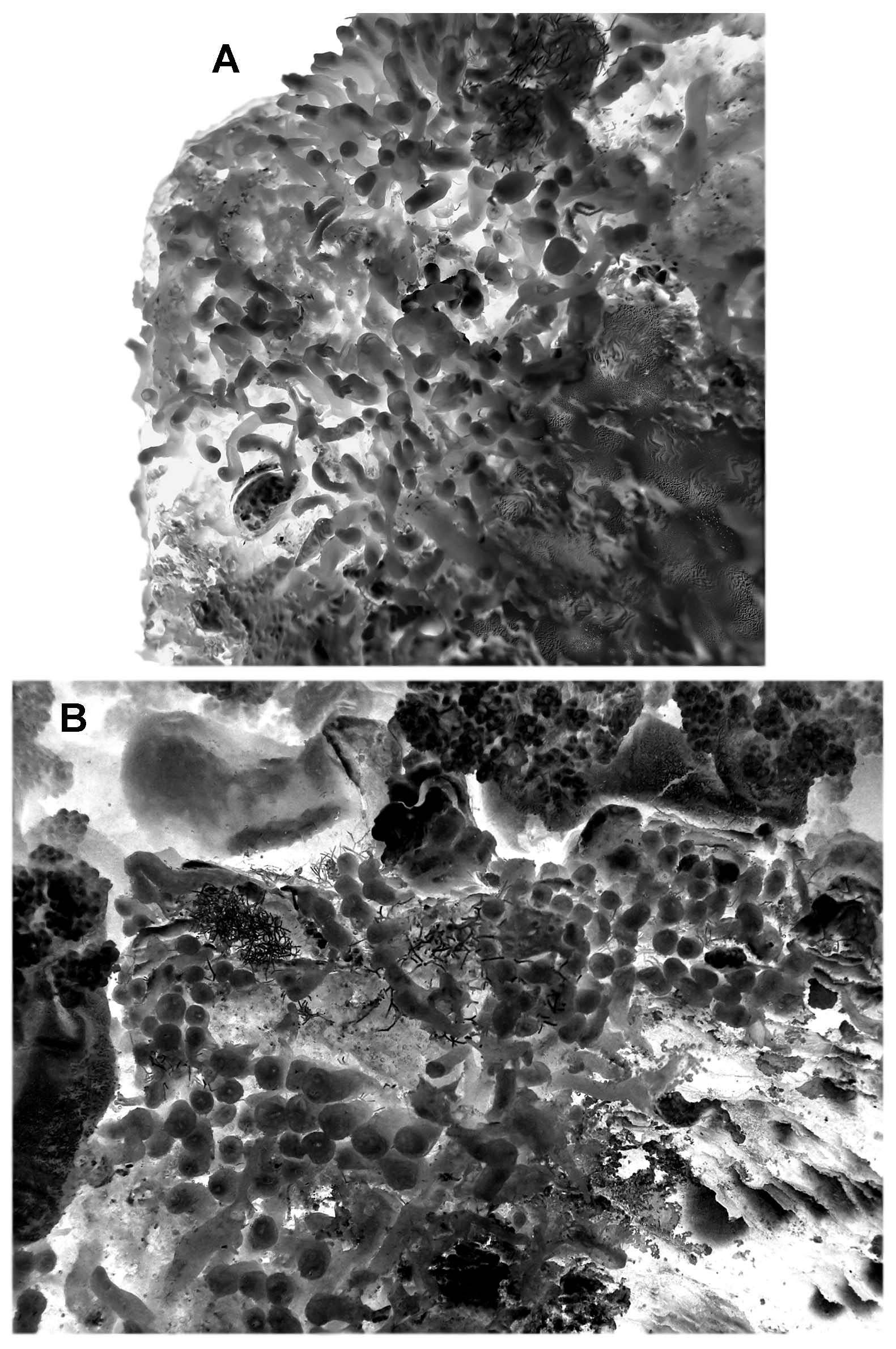
FIGURE 3. Acrossota cf. amboinensis n. comb., NTM C 13618: A, colony; B, tentacular region of a polyp; C, close­up of B; D, oral region of a polyp with partly invaginated tentacles.

Imageimage/png© Alderslade, Philip;S, CatherinePinnule­less polyps: a new genus and new species of Indo­Pacific Clavulariidae and validation of the soft coral genus Acrossota and the family Acrossotidae (Coelenterata: Octocorallia)
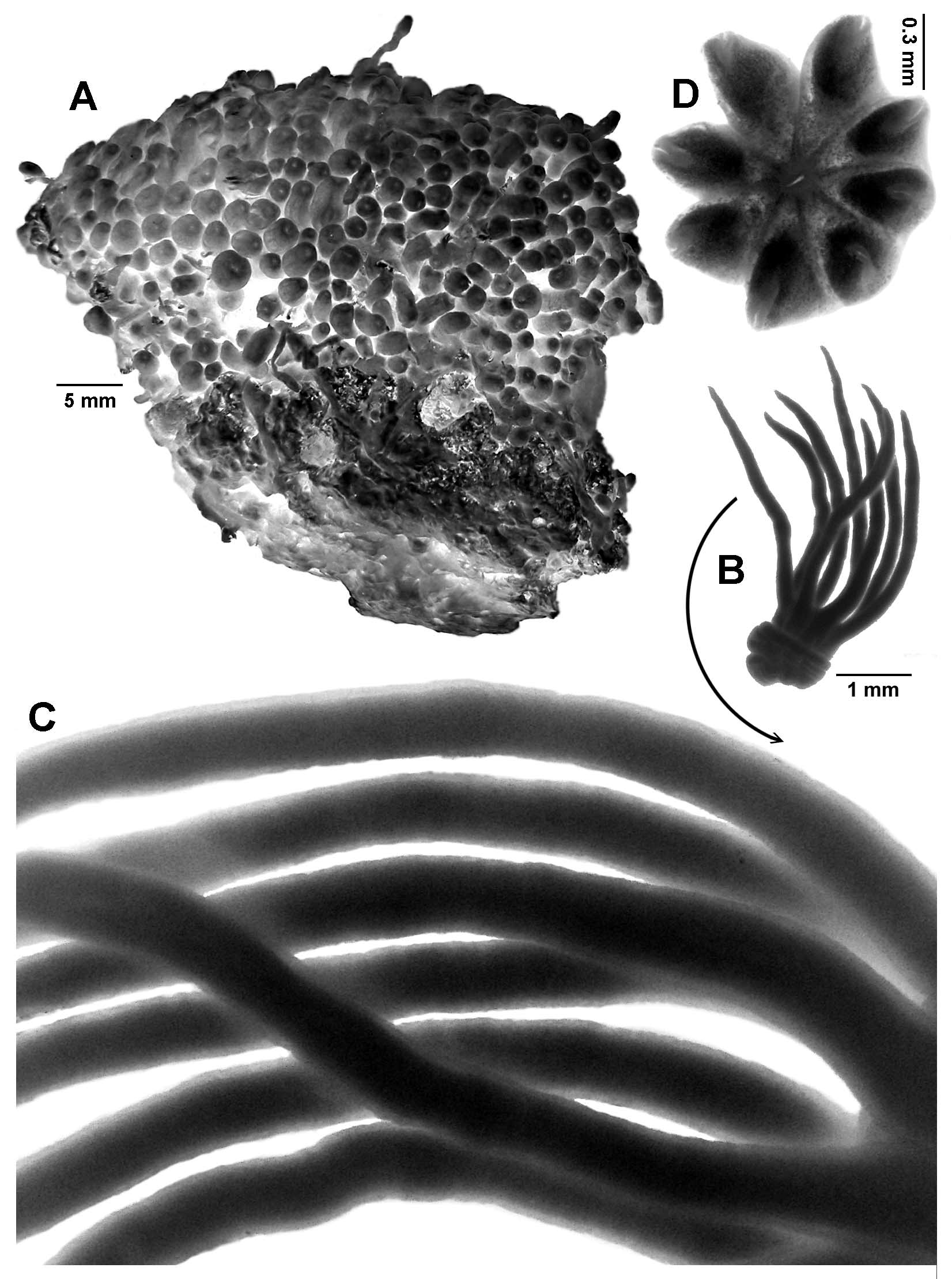
FIGURE 4. Acrossota cf. amboinensis n. comb., NTM C 13626: A, main portion of attached colony; B, unattached colony fragment; C, dissected polyp.

Imageimage/png© Alderslade, Philip;S, CatherinePinnule­less polyps: a new genus and new species of Indo­Pacific Clavulariidae and validation of the soft coral genus Acrossota and the family Acrossotidae (Coelenterata: Octocorallia)
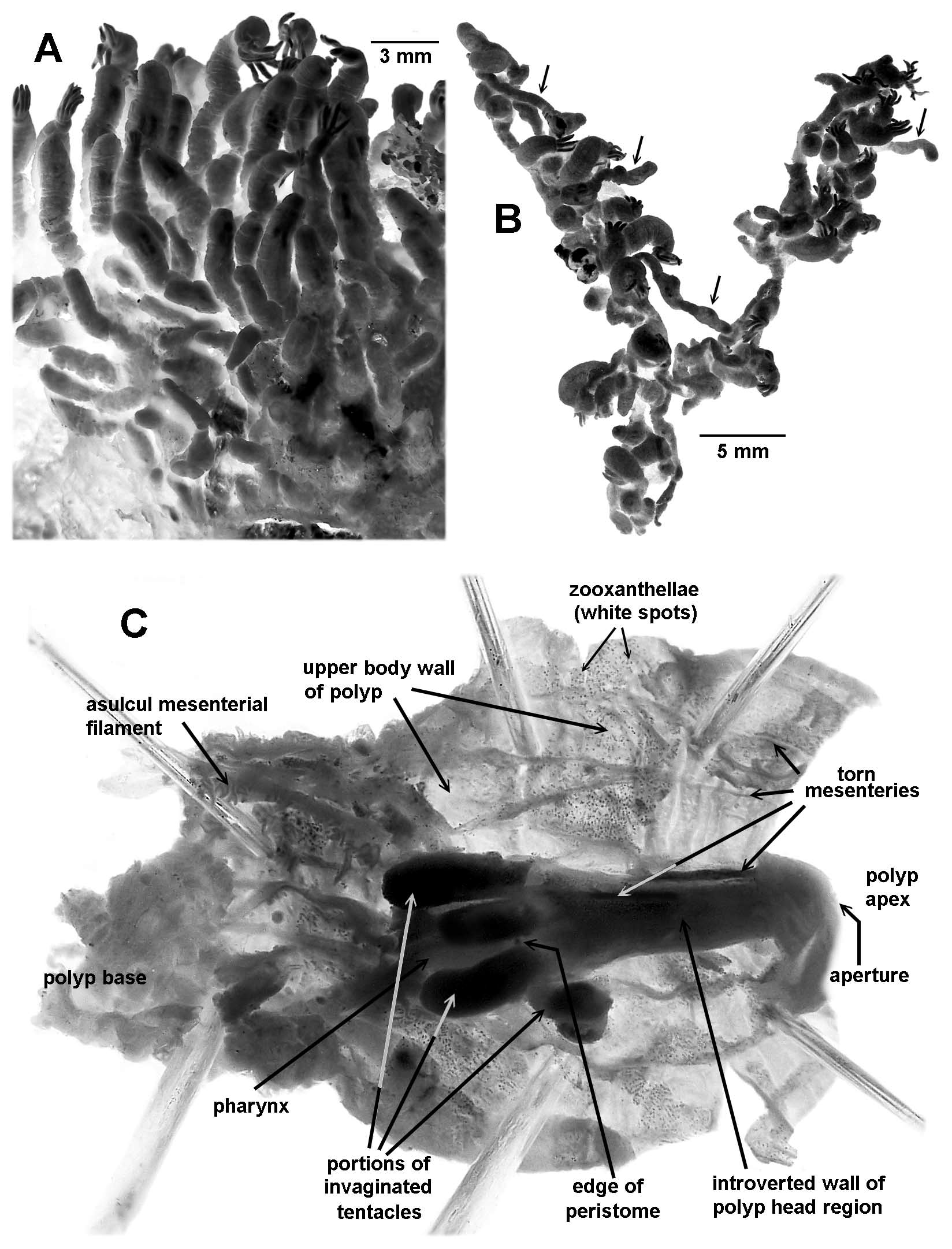
FIGURE 8. Acrossota cf. amboinensis n. comb.: A, NTM C 15379 in life; B, NTM C 13626 in life.

Imageimage/png© Alderslade, Philip;S, CatherinePinnule­less polyps: a new genus and new species of Indo­Pacific Clavulariidae and validation of the soft coral genus Acrossota and the family Acrossotidae (Coelenterata: Octocorallia)
IMAGES

Gallery(5)

See Gallery

Occurrences with images

CITATIONS

References(1)

  • 1

    Alderslade, P.; McFadden, C. S. (2007). Pinnule-less polyps: a new genus and new species of Indo-Pacific Clavulariidaeand validation of the soft coral genus Acrossota and the family Acrossotidae(Coelenterata: Octocorallia). <em>Zootaxa.</em> 1400: 27–44.

    new combination referenceWorld Register of Marine SpeciesDOI: 10.11646/zootaxa.1400.2
  • Source Information

    GBIF Backbone Taxonomy

    GBIF Backbone Taxonomy

    checklist

    The GBIF Backbone Taxonomy is a single, synthetic management classification with the goal of covering all names GBIF is dealing with. It's the taxonomic backbone that allows GBIF to integrate name based information from different resources, no matter if these are occurrence datasets, species pages, names from nomenclators or external sources like EOL, Genbank or IUCN. This backbone allows taxonomic search, browse and reporting operations across all those resources in a consistent way and to provide means to crosswalk names from one source to another.

    It is updated regulary through an automated process in which the Catalogue of Life acts as a starting point also providing the complete higher classification above families. Additional scientific names only found in other authoritative nomenclatural and taxonomic datasets are then merged into the tree, thus extending the original catalogue and broadening the backbones name coverage. The GBIF Backbone taxonomy also includes identifiers for Operational Taxonomic Units (OTUs) drawn from the barcoding resources iBOL and UNITE.

    International Barcode of Life project (iBOL), Barcode Index Numbers (BINs). BINs are connected to a taxon name and its classification by taking into account all names applied to the BIN and picking names with at least 80% consensus. If there is no consensus of name at the species level, the selection process is repeated moving up the major Linnaean ranks until consensus is achieved.

    UNITE - Unified system for the DNA based fungal species, Species Hypotheses (SHs). SHs are connected to a taxon name and its classification based on the determination of the RefS (reference sequence) if present or the RepS (representative sequence). In the latter case, if there is no match in the UNITE taxonomy, the lowest rank with 100% consensus within the SH will be used.

    The GBIF Backbone Taxonomy is available for download at https://hosted-datasets.gbif.org/datasets/backbone/ in different formats together with an archive of all previous versions.

    The following 105 sources have been used to assemble the GBIF backbone with number of names given in brackets:

    • Catalogue of Life Checklist - 4766428 names
    • International Barcode of Life project (iBOL) Barcode Index Numbers (BINs) - 635951 names
    • UNITE - Unified system for the DNA based fungal species linked to the classification - 611208 names
    • The Paleobiology Database - 212054 names
    • World Register of Marine Species - 188857 names
    • The Interim Register of Marine and Nonmarine Genera - 183894 names
    • The World Checklist of Vascular Plants (WCVP) - 131891 names
    • GBIF Backbone Taxonomy - 114350 names
    • TAXREF - 109374 names
    • The Leipzig catalogue of vascular plants - 75380 names
    • ZooBank - 73549 names
    • Integrated Taxonomic Information System (ITIS) - 68377 names
    • Plazi.org taxonomic treatments database - 61346 names
    • Genome Taxonomy Database r207 - 60545 names
    • International Plant Names Index - 52329 names
    • Fauna Europaea - 45077 names
    • The National Checklist of Taiwan (Catalogue of Life in Taiwan, TaiCoL) - 36193 names
    • Dyntaxa. Svensk taxonomisk databas - 35892 names
    • The Plant List with literature - 32692 names
    • United Kingdom Species Inventory (UKSI) - 29643 names
    • Artsnavnebasen - 29208 names
    • The IUCN Red List of Threatened Species - 21221 names
    • Afromoths, online database of Afrotropical moth species (Lepidoptera) - 13961 names
    • Brazilian Flora 2020 project - Projeto Flora do Brasil 2020 - 13829 names
    • Prokaryotic Nomenclature Up-to-Date (PNU) - 10079 names
    • Checklist Dutch Species Register - Nederlands Soortenregister - 8814 names
    • ICTV Master Species List (MSL) - 7852 names
    • Cockroach Species File - 6020 names
    • GRIN Taxonomy - 5882 names
    • Taxon list of fungi and fungal-like organisms from Germany compiled by the DGfM - 4570 names
    • Catalogue of Afrotropical Bees - 3623 names
    • Catalogue of Tenebrionidae (Coleoptera) of North America - 3327 names
    • Checklist of Beetles (Coleoptera) of Canada and Alaska. Second Edition. - 3312 names
    • Systema Dipterorum - 2850 names
    • Catalogue of the Pterophoroidea of the World - 2807 names
    • The Clements Checklist - 2675 names
    • Taxon list of Hymenoptera from Germany compiled in the context of the GBOL project - 2496 names
    • IOC World Bird List, v13.2 - 2366 names
    • Official Lists and Indexes of Names in Zoology - 2310 names
    • National checklist of all species occurring in Denmark - 1922 names
    • Myriatrix - 1876 names
    • Database of Vascular Plants of Canada (VASCAN) - 1822 names
    • Taxon list of vascular plants from Bavaria, Germany compiled in the context of the BFL project - 1771 names
    • Orthoptera Species File - 1742 names
    • A list of the terrestrial fungi, flora and fauna of Madeira and Selvagens archipelagos - 1602 names
    • Aphid Species File - 1565 names
    • World Spider Catalog - 1561 names
    • Taxon list of Jurassic Pisces of the Tethys Palaeo-Environment compiled at the SNSB-JME - 1270 names
    • Backbone Family Classification Patch - 1143 names
    • GBIF Algae Classification - 1100 names
    • International Cichorieae Network (ICN): Cichorieae Portal - 975 names
    • Psocodea Species File - 803 names
    • New Zealand Marine Macroalgae Species Checklist - 787 names
    • Annotated checklist of endemic species from the Western Balkans - 754 names
    • Taxon list of animals with German names (worldwide) compiled at the SMNS - 503 names
    • Catalogue of the Alucitoidea of the World - 472 names
    • Lygaeoidea Species File - 462 names
    • Catálogo de Plantas y Líquenes de Colombia - 422 names
    • GBIF Backbone Patch - 317 names
    • Phasmida Species File - 259 names
    • Cortinariaceae fetched from the Index Fungorum API - 234 names
    • Coreoidea Species File - 233 names
    • GTDB supplement - 139 names
    • Mantodea Species File - 119 names
    • Endemic species in Taiwan - 93 names
    • Taxon list of Araneae from Germany compiled in the context of the GBOL project - 88 names
    • Species of Hominidae - 78 names
    • Taxon list of Sternorrhyncha from Germany compiled in the context of the GBOL project - 77 names
    • Taxon list of mosses from Germany compiled in the context of the GBOL project - 75 names
    • Mammal Species of the World - 73 names
    • Plecoptera Species File - 71 names
    • Species Fungorum Plus - 64 names
    • Catalogue of the type specimens of Cosmopterigidae (Lepidoptera: Gelechioidea) from research collections of the Zoological Institute, Russian Academy of Sciences - 47 names
    • Species named after famous people - 41 names
    • Dermaptera Species File - 36 names
    • Taxon list of Trichoptera from Germany compiled in the context of the GBOL project - 34 names
    • True Fruit Flies (Diptera, Tephritidae) of the Afrotropical Region - 33 names
    • Range and Regularities in the Distribution of Earthworms of the Earthworms of the USSR Fauna. Perel, 1979 - 32 names
    • Taxon list of Diplura from Germany compiled in the context of the GBOL project - 30 names
    • Lista de referencia de especies de aves de Colombia - 2022 - 24 names
    • Taxon list of Auchenorrhyncha from Germany compiled in the context of the GBOL project - 20 names
    • Catalogue of the type specimens of Polycestinae (Coleoptera: Buprestidae) from research collections of the Zoological Institute, Russian Academy of Sciences - 19 names
    • Taxon list of Thysanoptera from Germany compiled in the context of the GBOL project - 19 names
    • Lista de especies de vertebrados registrados en jurisdicción del Departamento del Huila - 18 names
    • Taxon list of Microcoryphia (Archaeognatha) from Germany compiled in the context of the GBOL project - 15 names
    • Catalogue of the type specimens of Bufonidae and Megophryidae (Amphibia: Anura) from research collections of the Zoological Institute, Russian Academy of Sciences - 12 names
    • Grylloblattodea Species File - 11 names
    • Coleorrhyncha Species File - 9 names
    • Taxon list of liverworts from Germany compiled in the context of the GBOL project - 9 names
    • Embioptera Species File - 7 names
    • Taxon list of Pisces and Cyclostoma from Germany compiled in the context of the GBOL project - 6 names
    • Taxon list of Pteridophyta from Germany compiled in the context of the GBOL project - 6 names
    • Taxon list of Siphonaptera from Germany compiled in the context of the GBOL project - 5 names
    • The Earthworms of the Fauna of Russia. Perel, 1997 - 5 names
    • Taxon list of Zygentoma from Germany compiled in the context of the GBOL project - 4 names
    • Asiloid Flies: new taxa of Diptera: Apioceridae, Asilidae, and Mydidae - 3 names
    • Taxon list of Protura from Germany compiled in the context of the GBOL project - 3 names
    • Taxon list of hornworts from Germany compiled in the context of the GBOL project - 2 names
    • Chrysididae Species File - 1 names
    • Taxon list of Dermaptera from Germany compiled in the context of the GBOL project - 1 names
    • Taxon list of Diplopoda from Germany in the context of the GBOL project - 1 names
    • Taxon list of Orthoptera (Grashoppers) from Germany compiled at the SNSB - 1 names
    • Taxon list of Pscoptera from Germany compiled in the context of the GBOL project - 1 names
    • Taxon list of Pseudoscorpiones from Germany compiled in the context of the GBOL project - 1 names
    • Taxon list of Raphidioptera from Germany compiled in the context of the GBOL project - 1 names

    GBIF Secretariat (2023). GBIF Backbone Taxonomy. Checklist dataset https://doi.org/10.15468/39omei accessed via GBIF.org on 2026-06-16.

    CC BYPublished 8/28/2023View dataset
    GBIF Usage Key
    5841553
    Dataset Key
    d7dddbf4-2cf0-4f39-9b2a-bb099caae36c
    Origin
    source
    Backbone Key
    5841553
    Taxon ID
    gbif:5841553
    Last Crawled
    8/22/2023
    Last Interpreted
    8/22/2023