AnimaliaNot EvaluatedacceptedspeciesAccepted
Tamoya ohboya

Tamoya ohboya

Bonaire Banded Box Jelly(+9)·Collins, Bentlage, Gillan, Lynn, Morandini & Marques, 2011

GBIF:5842335

0year

PROFILE

Species Profile

Habitat

Marine

Characteristics

Extant

ABOUT

Descriptions(7)

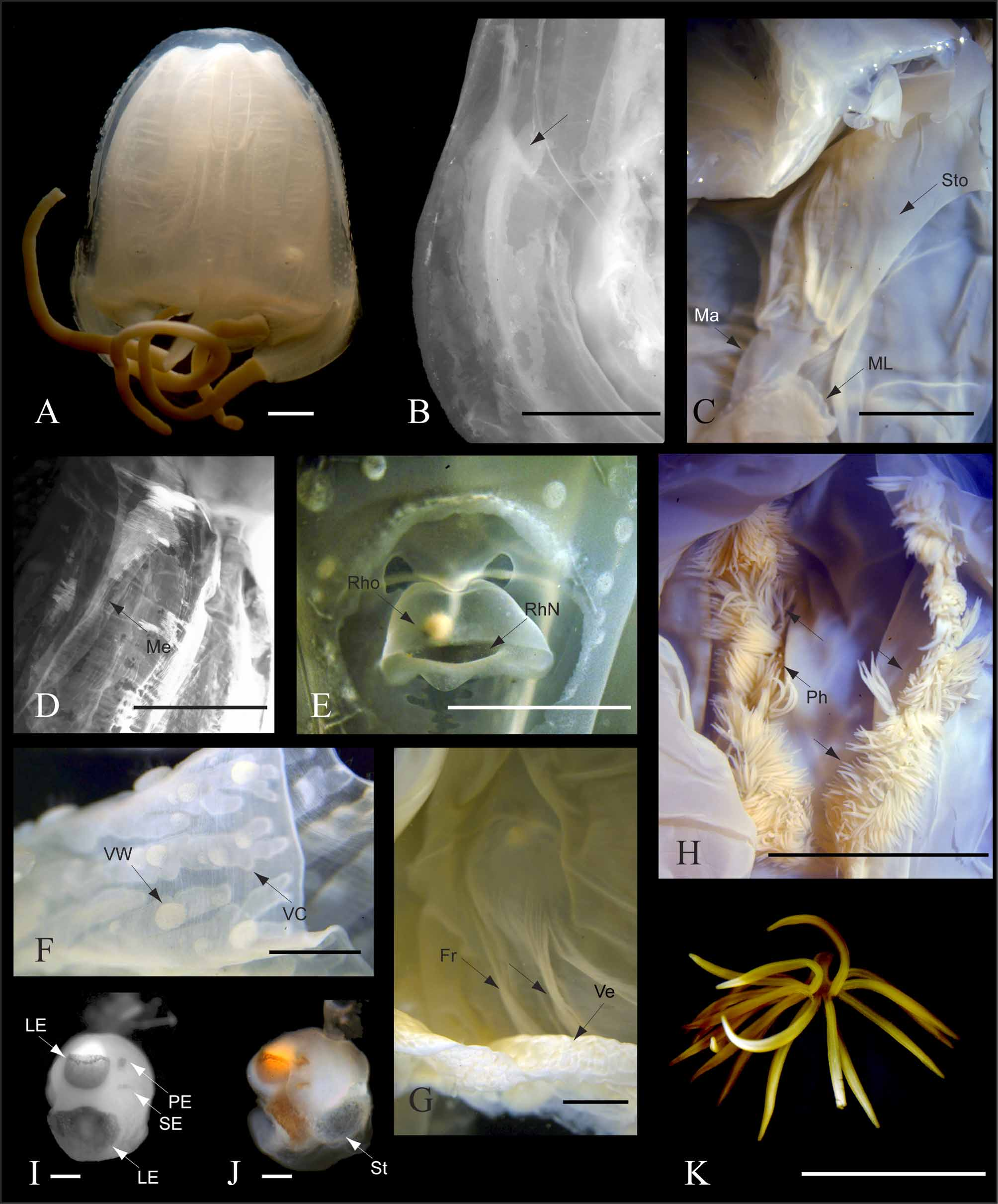
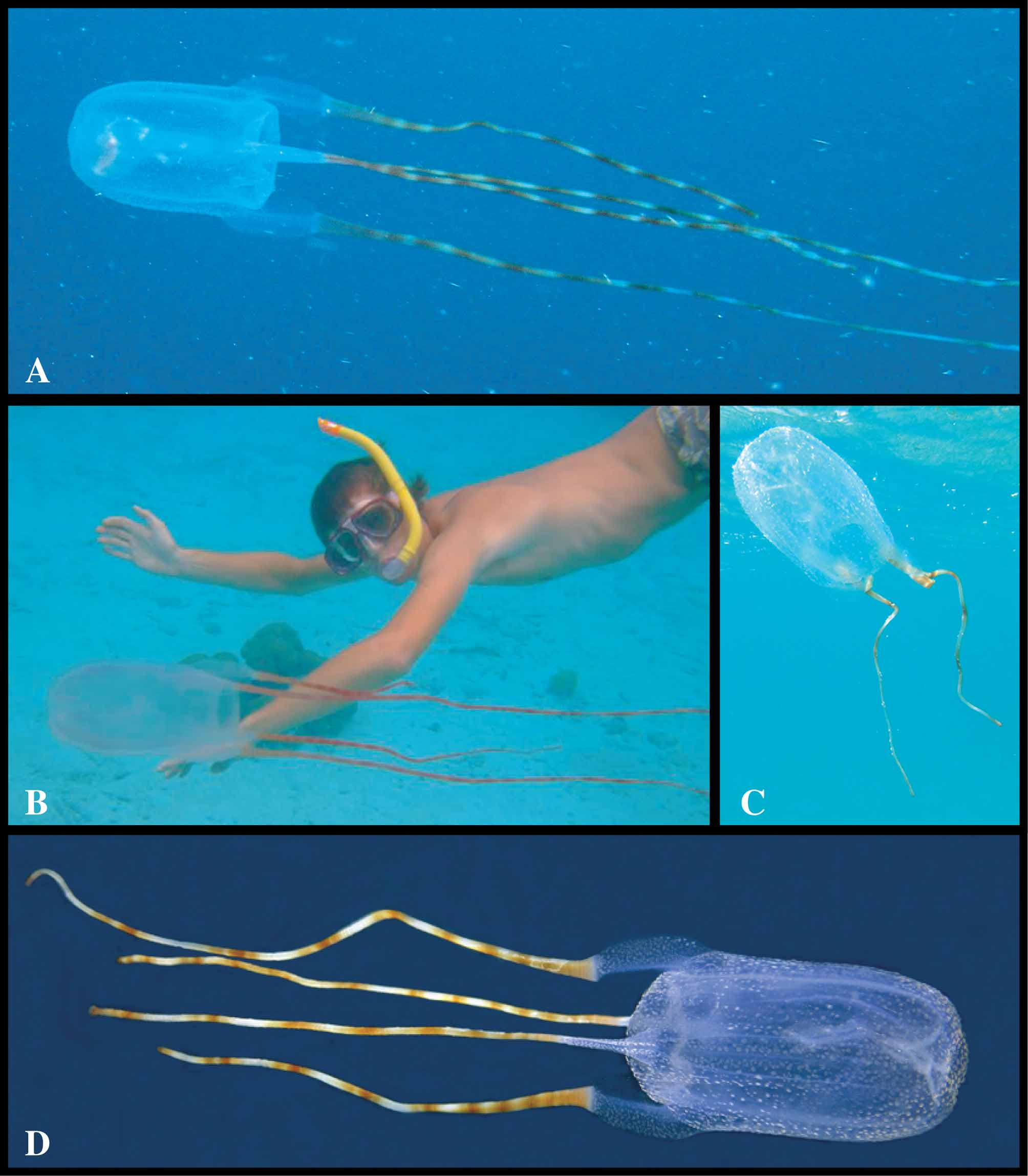
Description. Morphology & Anatomy: Bell translucent, densely covered in conspicuously raised nematocyst warts (Fig. 1 & 3 A). Pedalia covered with nematocyst warts, both on outer keel and inner wing; pedalial wing scalpel-shaped as in Tamoya haplonema. Pedalial canal bend with prominent spike (Fig. 3 B). Tentacles with characteristic bands, red or orange to brown (Fig. 1); tentacles flared at their bases, round in cross section (pictures indicate that in life tentacles are flattened when extended). Perradial gonads as leaf-like sheets. Stomach extending to about 1 / 3 of bell height into subumbrellar cavity (Fig. 3 C); stomach attached to subumbrella with four well-developed mesenterial bands (Fig. 3 D) extending about half-way between apex and velarial turn-over. Manubrium cruciform, without nematocyst warts; lips of square shape with nematocyst warts and smooth edges (Fig. 3 C). Rhopaliar niche opening raised, frown-shaped, with single upper and lower covering scales; rhopaliar horns lacking (Fig. 3 E). Rhopalia with two median lens eyes and four lateral eyespots, two pit and two slit (Fig. 3 I & J); statolith oval (Fig. 3 J). Velarium broad; numerous canals per octant, growing close to each other with diverticula mainly at distal ends of canals (Fig. 3 F). Velarium sprinkled on exumbrellar side with many white nematocyst warts (Fig. 3 F). Frenulae four, each consisting of two sheets bracing the right-angle connection from tip of rhopalial niche to about 3 / 4 distance between velarial turnover and its margin (Fig. 3 G); perradial lappets absent. Gastric phacellae forming four bands, one in each perradius, running vertically from top of stomach down to sphincter of stomach (Fig. 3 H). Gastric cirri numerous with branches arising tree-like from each stalk (Fig. 3 K). Cnidome: The following types of nematocysts are present in T. ohboya n. sp.: club-shaped macrobasic peuryteles; lemon-shaped microbasic birhopaloids; small oval isorhizas; spherical holotrichous isorhizas; and small, oval amastigophores. Small oval isorhizas are found in all body parts except phacellae; spherical holotrichous isorhizas in all parts but apex warts. Birhopaloids are located in tentacles, manubrium and phacellae and all of them probably belong to the same type (i. e., p-birhopaloid); v-shaped notch was indiscernible in tentacles (due to image resolution) and phacellae (all nematocysts discharged) but otherwise all birhopaloids appear morphologically very similar under light microscopy. Macrobasic p-euryteles in the tentacle tip are of two types (A and B) differing in shape and size of the lancet (Fig. 4 A, C). Spherical holotrichous isorhizas in the tentacle tip belong to two distinct size classes (i. e., L and S), but do not appear to differ in morphology (Fig. 4 G – l). The size ranges and distribution of nematocyst types across different regions of T. ohboya n. sp. are presented in Table 1. Genetic Data: No variation in mitochondrial 16 S is observed between the holotype (USNM 1146080) and paratype (USNM 1124022) of T. ohboya n. sp. Mitochondrial 16 S from T. ohboya n. sp. differs from that of T. haplonema from Brazil by 2.1 – 2.5 % and T. sp. from the southeastern USA by 10.7 – 10.9 %. Mitochondrial COI from the two samples of T. ohboya n. sp. differ by 0.4 %, whereas they differ from COI from T. haplonema from Brazil by 4.4 – 4.5 %. Differential diagnosis. Tamoya ohboya n. sp. is very similar to both T. haplonema from Brazil and T. sp. from the southeastern USA in gross morphology. All three species possess a deep stomach that reaches far into the subumbrellar cavity and is connected to the subumbrella by four mesenterial filaments. All three also share the arrangement of the gastric cirri as vertical bands along the stomach walls and similar frown-shaped rhopaliar niche ostia that lack the rhopaliar horns characteristic of the genera that used to be classified within Tamoyidae (sensu Gershwin & Alderslade 2005; Carukia, Malo, Gerongia, and Morbakka). These latter taxa have recently been united in the family Carukiidae (Bentlage et al. 2010). Tamoya ohboya n. sp. can most readily be distinguished from other species of Tamoya by the distinctive red to orange banded tentacles (but see remarks below). The overall cnidome of Tamoya ohboya n. sp. is also similar to those of T. haplonema from Brazil and T. sp. from the southeastern USA. However, the distribution of nematocyst types differs among the three species and T. ohboya n. sp. possesses more nematocyst types and displays more variation across all body parts (Table 1; Figs. 4 – 6). The absence of small oval amastigophores appears to differentiate T. haplonema from Brazil from other species of Tamoya, whereas small oval isorhizas were not observed in T. sp. from the Gulf of Mexico. Tamoya ohboya n. sp. appears to be the only known species of Tamoya to possess lemon-shaped microbasic birhopaloids and small oval isorhizas in its tentacles. In contrast to T. haplonema from Brazil, no lemon-shaped microbasic birhopaloids are present in its pedalial warts. No such warts were observed in T. sp. from the Gulf of Mexico so it is unknown if this character can differentiate the two species.
Naming the Bonaire banded box jelly, Tamoya ohboya, n. sp. (Cnidaria: Cubozoa: Carybdeida: Tamoyidae)
TABLE 1. Cnidome comparison of Tamoya specimens. L, W denote capsule lengths and widths, respectively, in μ.? indicates uncertainty of identification. continued next page FIGURE 4. Part one of the cnidome of Tamoya ohboya n. sp. A – I. Tentacle tip. J – P. Tentacle base. A and B. Club-shaped macrobasic p-eurytele A. C. Club-shaped macrobasic p-eurytele B. D and E. Lemon-shaped microbasic birhopaloid. F. Small oval isorhiza. G. Spherical holotrichous isorhiza L. H and I. Spherical holotrichous isorhiza S. J and K. Club-shaped macrobasic p-eurytele. L. Lemonshaped microbasic birhopaloid. M and N. Small oval isorhiza. O and P. Spherical holotrichous isorhiza. All images from paratype USNM 1124022. All scale bars represent 10 μ.
Naming the Bonaire banded box jelly, Tamoya ohboya, n. sp. (Cnidaria: Cubozoa: Carybdeida: Tamoyidae)
Diagnosis. Tamoya with distinctly dark brown to reddish-orange banded tentacles. Tamoya with lemon-shaped, microbasic birhopaloids and small, oval isorhizas present in cnidome of tentacles.
Naming the Bonaire banded box jelly, Tamoya ohboya, n. sp. (Cnidaria: Cubozoa: Carybdeida: Tamoyidae)
Remarks. One of us (WG) has been accumulating sightings of Tamoya ohboya since 2001 and has also had an opportunity to swim with the species in nature. Roughly 50 confirmed sightings, mostly by amateur naturalists, of the species between 1989 and the present have been recorded. Of the 50 tabulated sightings, 26 (including collection of the holotype and two paratypes) involve pictures or videos of the specimen that clearly show the body shape and banded tentacles. Many of these have been accumulated on the online photo sharing service Flickr (http: // www. flickr. com / photos / tesserazoa / tags / bonairebandedboxjelly /). The rest were confirmed by description and by having individuals that reported encounters examine available pictures presumed to be T. ohboya n. sp. The most distinctive feature that can be observed in photos is the prominent banding pattern of the tentacles. Occasional specimens identified as T. haplonema in Brazil also display similar tentacle bands. It is unclear if specimens of true T. haplonema sometimes have banded tentacles or whether T. haplonema and T. ohboya n. sp. have overlapping ranges in Brazil. Further remarks are limited to information garnered from the tabulated 50 sightings. Very little is known about the ecology of Tamoya ohboya n. sp., but it appears to be solitary since it has most often been encountered alone (49 of 50). The species may forage for prey during the day, given that nearly all sightings (49 of 50) have been during the day. Nevertheless, more people are in the water during this time and so it would be premature to conclude from these limited observations that T. ohboya n. sp. is a daytime predator. We also know little about the ecology of its congener, Tamoya haplonema, but the information gathered thus far suggests that it feeds during the night (Nogueira Jr. & Haddad 2008). Several Tamoya ohboya n. sp. individuals have been observed swimming back and forth between the surface and the bottom in shallow water, but the significance of this behavior remains unstudied. Specimens are reported to be fast swimmers. The vast majority of the 50 occurrences have been reported during July, August, and September (8, 14, and 9, respectively), though the species has been seen in all months of the year. Tamoya ohboya n. sp. is believed to cause serious envenomations to humans, although just three putative stings have been documented. The best-documented envenomation occurred 13 August 2006, when a 13 - to 15 - year-old girl was stung at Bachelor's Beach, Bonaire. Identity of T. ohboya n. sp. as the stinger was easily confirmed because the girl's father threw the jellyfish onto a nearby jetty after which it was photographed and collected (under the permit referred to in the introduction above; http: // blog. richterscale. org / index. php / weblog / unknown _ box _ jellyfish _ species /). This specimen was preserved and an attempt was made to bring it to the US for study, but it was lost for some time and not delivered to the Smithsonian until June, 2009 (USNM 1146084; kindly provided by Ned Deloach). The envenomation resulted in pain and agitation, and the girl received hospitalization involving compression wrap and antibiotic / analgesic cream. However, the condition of the patient worsened resulting in medical evacuation to Curaçao. Two other stings have been attributed to the Bonaire banded box jelly. One was in Bonaire and involved the daughter of an individual who is familiar with the species. This envenomation resulted in severe pain and skin damage. The victim was treated with StingThing (Remedy Marketing, Inc.) with proteolytic enzymes, and hospitalization was not needed. The third sting attributed to T. ohboya n. sp. took place on St. Lucia. The victim described the banding pattern of the tentacles and confirmed identity by viewing pictures of the species. We know little about the severity of this sting.
Naming the Bonaire banded box jelly, Tamoya ohboya, n. sp. (Cnidaria: Cubozoa: Carybdeida: Tamoyidae)
Distribution. Confirmed sightings have been made in shallow (<10 m) near-shore waters off Bonaire (Netherlands Antilles), St. Lucia (Lesser Antilles), St. Vincent (Lesser Antilles), Cozumel (Mexico) and Utila (Honduras), suggesting that the species has a widespread distribution across the Caribbean Sea. A picture taken from Fernando de Noronha archipelago suggests that its range may extend to northern Brazil. Of the 50 tabulated sightings of T. ohboya n. sp., 45 have been on the western margin of Bonaire.
Naming the Bonaire banded box jelly, Tamoya ohboya, n. sp. (Cnidaria: Cubozoa: Carybdeida: Tamoyidae)
Etymology. The specific name, ohboya, has been chosen by the public through the following process. Individuals were permitted to submit potential names and reasons for them via the Internet between 14 May and 14 June 2009 (see http: // www. yearofscience 2009. org / jellyfish). Seven potential epithets were then selected from all submitted names (n = 309) by the authors of this paper. Choice among these seven names was then tabulated with an Internet poll of more than 830 votes cast from 18 – 26 June, 2009. The winning entry, ohboya, was submitted by Lisa Peck, a high school marine biology teacher who provided the following reason for submitting the name: “ I bet " Oh Boy " is the first thing said when a biologist or layman encounters the Bonaire Banded Box Jellyfish. It is not often that a new amazing species is discovered, especially one so beautiful. I am confident that Bud Gillan exclaimed " Oh Boy " when he saw tourist Vicki Carr's video of the Bonaire Banded Box Jellyfish (a never before seen species of jellyfish). Vicki probably exclaimed " Oh Boy " when Bud called her to tell her the news of her amazing discovery. I am sure that " Oh Boy " was uttered by the three people who were stung by the Bonaire Banded Box Jellyfish. In addition, I bet that " Oh Boy " was spoken by the doctors when they saw the wounds inflicted by the nematocysts of the Bonaire Banded Box Jellyfish. Later, the doctors probably uttered " Oh Boy " when they were confident that these 3 people would survive their encounter with the Bonaire Banded Box Jellyfish. And finally, when I saw the website Year of Science: Species naming contest of the Bonaire Banded Box Jellyfish I loudly exclaimed " Oh Boy " !! Therefore I am suggesting the scientific name Tamoya ohboya be given to this amazing creature. ”
Naming the Bonaire banded box jelly, Tamoya ohboya, n. sp. (Cnidaria: Cubozoa: Carybdeida: Tamoyidae)
Material examined. Holotype: USNM 1146080, sex undetermined, 61 mm BH (bell height; measured from velarial turn-over to top of bell), 29 mm IRW (interradial bell width), collected 30 June 2010 at Divi Flamingo, Bonaire, Netherlands (~ 12 ° 8.61 ” N, 68 ° 16.60) by W. Gillan and M. Wilhemus. Paratype: USNM 1146084, sex undetermined, 67 mm BH, 32 mm IRW, collected 15 August 2006 at Windsock, Bonaire, Netherlands (~ 12 ° 8.03 ” N, 68 ° 16.98) by J. Richter, T. Dace and P. Keyes. Paratype: USNM 1124022, mature male, 63 mm BH, 30 IRW, collected 29 July 2008 mid-afternoon, at or close to surface a few meters from shore at No Name Beach, Klein Bonaire, Netherlands (~ 12 ° 10.03 ’ N, 68 ° 18.03 ' W) by Johan van Blerk. Type locality. Divi Flamingo, Bonaire, Netherlands (Dutch Caribbean).
Naming the Bonaire banded box jelly, Tamoya ohboya, n. sp. (Cnidaria: Cubozoa: Carybdeida: Tamoyidae)

Export occurrence data

Darwin Core Archive (ZIP)

Common names used for this species across different languages and regions. Available in 3 languages. 1 preferred.

engBonaire Banded Box JellyengengBonaire Banded Box JellyengengBonaire Banded Box JellyfishengspaCubomedusa de BonairespaengOh Boy! Jellyfisheng+5 more

Vernacular (common) names are the everyday names used for a species in different languages and regions. A single species may have dozens of common names worldwide. This taxon has names in 3 languages. 1 name preferred.

engBonaire Banded Box Jelly
eng
Source: Catalogue of LifeSource taxon #299603858
engBonaire Banded Box Jellyfish
eng
Source: Catalogue of LifeSource taxon #299603858
spaCubomedusa de Bonaire
spa
Source: Catalogue of LifeSource taxon #299603858
engOh Boy! Jellyfish
eng
Source: Catalogue of LifeSource taxon #299603858
porVespa-do-mar-de-tentáculos-listrados
por
Source: Catalogue of LifeSource taxon #299603858
engbanded box jellys
eng
Source: Catalogue of LifeSource taxon #273074385
engbanded box jellys
eng
Source: Catalogue of LifeSource taxon #299603858
engbanded box jellys
eng
Source: CnidariaSource taxon #114332279
engBonaire Banded Box Jelly
engpreferred
Source: Checklist Dutch Caribbean Species RegisterSource taxon #181855765
engbanded box jellys
eng
Source: World Register of Marine SpeciesSource taxon #155436669

CLASSIFICATION

Taxonomic Classification Tree

MULTIMEDIA

Media Files(2)

FIGURE 1. In situ photographs of Tamoya ohboya n. sp. A. St. Lucia, 1 – 2 m, 20 May 2007, photo by Tim Lowry and used with his permission. Note the deep stomach and long manubrium. B. Divi Divi, Bonaire, 0 – 5 m, 17 July 2008, photo by Marijke Wilhelmus and used with her permission. C. Bonaire, 1 – 2 m, 30 December 2006, photo by John Crum and used with his permission. Note flattening of tentacles proximal to pedalia. D. St. Vincent, August 8, 2008, photo by Ned Deloach and used with his permission. Note nematocyst warts on bell and pedalia.

Imageimage/png© Collins, Allen G.;Bentlage, Bastian;Lynn, Tara H.;Morandini, André C.;Marques, Antonio C.Naming the Bonaire banded box jelly, Tamoya ohboya, n. sp. (Cnidaria: Cubozoa: Carybdeida: Tamoyidae)

FIGURE 3. Tamoya ohboya n. sp., type series. A. Whole animal; holotype, USNM 1146080. B. Pedalial canal bend (arrow); paratype USNM 1124022. C. Deep stomach, manubrium, and mouth lips; paratype USNM 1124022. D. Mesentery attaching stomach to subumbrella; paratype USNM 1124022. E. Rhopaliar niche ostium; holotype, USNM 1146080. F. Velarium with velarial canals and velarial warts; holotype, USNM 1146080. G. Frenulum consisting of two sheets (arrows); paratype USNM 1124022. H. Gastric phacellae (arrows); paratype USNM 11240221124022. I. & J. Rhopalium; paratype USNM 1124022. K. gastric cirrus; paratype USNM 1124022. Abbreviations: Fr = frenulum; LE = lens eye; Ma = manubrium; Me = mesentery; ML = mouth lips; PE = pit eye; Ph = phacellae; Rho = rhopalium; RhN = rhopaliar niche ostium; SE = slit eye; St = statolith; Sto = stomach; Ve = velarium; VC = velarial canal. VW = velarial wart. Scale bars: 10 mm (A, C, H), 5 mm (B, D, E), 2 mm (F, G, K), 0.1 mm (I. & J.).

Imageimage/png© Collins, Allen G.;Bentlage, Bastian;Lynn, Tara H.;Morandini, André C.;Marques, Antonio C.Naming the Bonaire banded box jelly, Tamoya ohboya, n. sp. (Cnidaria: Cubozoa: Carybdeida: Tamoyidae)

IMAGES

Gallery(2)

See Gallery

Occurrences with images

CITATIONS

References(1)

  • 1

    Collins, A.G., Bentlage, B., Gillan, W., Lynn, T.H. Morandini, A.C. and A.C. Marques. 2011. Naming the Bonaire banded box jelly, Tamoya ohboya, n. sp. (Cnidaria: Cubozoa: Carybdeida: Tamoyidae). Zootaxa 2753: 53–68.

    original descriptionWorld Register of Marine Species
  • Source Information

    GBIF Backbone Taxonomy

    GBIF Backbone Taxonomy

    checklist

    The GBIF Backbone Taxonomy is a single, synthetic management classification with the goal of covering all names GBIF is dealing with. It's the taxonomic backbone that allows GBIF to integrate name based information from different resources, no matter if these are occurrence datasets, species pages, names from nomenclators or external sources like EOL, Genbank or IUCN. This backbone allows taxonomic search, browse and reporting operations across all those resources in a consistent way and to provide means to crosswalk names from one source to another.

    It is updated regulary through an automated process in which the Catalogue of Life acts as a starting point also providing the complete higher classification above families. Additional scientific names only found in other authoritative nomenclatural and taxonomic datasets are then merged into the tree, thus extending the original catalogue and broadening the backbones name coverage. The GBIF Backbone taxonomy also includes identifiers for Operational Taxonomic Units (OTUs) drawn from the barcoding resources iBOL and UNITE.

    International Barcode of Life project (iBOL), Barcode Index Numbers (BINs). BINs are connected to a taxon name and its classification by taking into account all names applied to the BIN and picking names with at least 80% consensus. If there is no consensus of name at the species level, the selection process is repeated moving up the major Linnaean ranks until consensus is achieved.

    UNITE - Unified system for the DNA based fungal species, Species Hypotheses (SHs). SHs are connected to a taxon name and its classification based on the determination of the RefS (reference sequence) if present or the RepS (representative sequence). In the latter case, if there is no match in the UNITE taxonomy, the lowest rank with 100% consensus within the SH will be used.

    The GBIF Backbone Taxonomy is available for download at https://hosted-datasets.gbif.org/datasets/backbone/ in different formats together with an archive of all previous versions.

    The following 105 sources have been used to assemble the GBIF backbone with number of names given in brackets:

    • Catalogue of Life Checklist - 4766428 names
    • International Barcode of Life project (iBOL) Barcode Index Numbers (BINs) - 635951 names
    • UNITE - Unified system for the DNA based fungal species linked to the classification - 611208 names
    • The Paleobiology Database - 212054 names
    • World Register of Marine Species - 188857 names
    • The Interim Register of Marine and Nonmarine Genera - 183894 names
    • The World Checklist of Vascular Plants (WCVP) - 131891 names
    • GBIF Backbone Taxonomy - 114350 names
    • TAXREF - 109374 names
    • The Leipzig catalogue of vascular plants - 75380 names
    • ZooBank - 73549 names
    • Integrated Taxonomic Information System (ITIS) - 68377 names
    • Plazi.org taxonomic treatments database - 61346 names
    • Genome Taxonomy Database r207 - 60545 names
    • International Plant Names Index - 52329 names
    • Fauna Europaea - 45077 names
    • The National Checklist of Taiwan (Catalogue of Life in Taiwan, TaiCoL) - 36193 names
    • Dyntaxa. Svensk taxonomisk databas - 35892 names
    • The Plant List with literature - 32692 names
    • United Kingdom Species Inventory (UKSI) - 29643 names
    • Artsnavnebasen - 29208 names
    • The IUCN Red List of Threatened Species - 21221 names
    • Afromoths, online database of Afrotropical moth species (Lepidoptera) - 13961 names
    • Brazilian Flora 2020 project - Projeto Flora do Brasil 2020 - 13829 names
    • Prokaryotic Nomenclature Up-to-Date (PNU) - 10079 names
    • Checklist Dutch Species Register - Nederlands Soortenregister - 8814 names
    • ICTV Master Species List (MSL) - 7852 names
    • Cockroach Species File - 6020 names
    • GRIN Taxonomy - 5882 names
    • Taxon list of fungi and fungal-like organisms from Germany compiled by the DGfM - 4570 names
    • Catalogue of Afrotropical Bees - 3623 names
    • Catalogue of Tenebrionidae (Coleoptera) of North America - 3327 names
    • Checklist of Beetles (Coleoptera) of Canada and Alaska. Second Edition. - 3312 names
    • Systema Dipterorum - 2850 names
    • Catalogue of the Pterophoroidea of the World - 2807 names
    • The Clements Checklist - 2675 names
    • Taxon list of Hymenoptera from Germany compiled in the context of the GBOL project - 2496 names
    • IOC World Bird List, v13.2 - 2366 names
    • Official Lists and Indexes of Names in Zoology - 2310 names
    • National checklist of all species occurring in Denmark - 1922 names
    • Myriatrix - 1876 names
    • Database of Vascular Plants of Canada (VASCAN) - 1822 names
    • Taxon list of vascular plants from Bavaria, Germany compiled in the context of the BFL project - 1771 names
    • Orthoptera Species File - 1742 names
    • A list of the terrestrial fungi, flora and fauna of Madeira and Selvagens archipelagos - 1602 names
    • Aphid Species File - 1565 names
    • World Spider Catalog - 1561 names
    • Taxon list of Jurassic Pisces of the Tethys Palaeo-Environment compiled at the SNSB-JME - 1270 names
    • Backbone Family Classification Patch - 1143 names
    • GBIF Algae Classification - 1100 names
    • International Cichorieae Network (ICN): Cichorieae Portal - 975 names
    • Psocodea Species File - 803 names
    • New Zealand Marine Macroalgae Species Checklist - 787 names
    • Annotated checklist of endemic species from the Western Balkans - 754 names
    • Taxon list of animals with German names (worldwide) compiled at the SMNS - 503 names
    • Catalogue of the Alucitoidea of the World - 472 names
    • Lygaeoidea Species File - 462 names
    • Catálogo de Plantas y Líquenes de Colombia - 422 names
    • GBIF Backbone Patch - 317 names
    • Phasmida Species File - 259 names
    • Cortinariaceae fetched from the Index Fungorum API - 234 names
    • Coreoidea Species File - 233 names
    • GTDB supplement - 139 names
    • Mantodea Species File - 119 names
    • Endemic species in Taiwan - 93 names
    • Taxon list of Araneae from Germany compiled in the context of the GBOL project - 88 names
    • Species of Hominidae - 78 names
    • Taxon list of Sternorrhyncha from Germany compiled in the context of the GBOL project - 77 names
    • Taxon list of mosses from Germany compiled in the context of the GBOL project - 75 names
    • Mammal Species of the World - 73 names
    • Plecoptera Species File - 71 names
    • Species Fungorum Plus - 64 names
    • Catalogue of the type specimens of Cosmopterigidae (Lepidoptera: Gelechioidea) from research collections of the Zoological Institute, Russian Academy of Sciences - 47 names
    • Species named after famous people - 41 names
    • Dermaptera Species File - 36 names
    • Taxon list of Trichoptera from Germany compiled in the context of the GBOL project - 34 names
    • True Fruit Flies (Diptera, Tephritidae) of the Afrotropical Region - 33 names
    • Range and Regularities in the Distribution of Earthworms of the Earthworms of the USSR Fauna. Perel, 1979 - 32 names
    • Taxon list of Diplura from Germany compiled in the context of the GBOL project - 30 names
    • Lista de referencia de especies de aves de Colombia - 2022 - 24 names
    • Taxon list of Auchenorrhyncha from Germany compiled in the context of the GBOL project - 20 names
    • Catalogue of the type specimens of Polycestinae (Coleoptera: Buprestidae) from research collections of the Zoological Institute, Russian Academy of Sciences - 19 names
    • Taxon list of Thysanoptera from Germany compiled in the context of the GBOL project - 19 names
    • Lista de especies de vertebrados registrados en jurisdicción del Departamento del Huila - 18 names
    • Taxon list of Microcoryphia (Archaeognatha) from Germany compiled in the context of the GBOL project - 15 names
    • Catalogue of the type specimens of Bufonidae and Megophryidae (Amphibia: Anura) from research collections of the Zoological Institute, Russian Academy of Sciences - 12 names
    • Grylloblattodea Species File - 11 names
    • Coleorrhyncha Species File - 9 names
    • Taxon list of liverworts from Germany compiled in the context of the GBOL project - 9 names
    • Embioptera Species File - 7 names
    • Taxon list of Pisces and Cyclostoma from Germany compiled in the context of the GBOL project - 6 names
    • Taxon list of Pteridophyta from Germany compiled in the context of the GBOL project - 6 names
    • Taxon list of Siphonaptera from Germany compiled in the context of the GBOL project - 5 names
    • The Earthworms of the Fauna of Russia. Perel, 1997 - 5 names
    • Taxon list of Zygentoma from Germany compiled in the context of the GBOL project - 4 names
    • Asiloid Flies: new taxa of Diptera: Apioceridae, Asilidae, and Mydidae - 3 names
    • Taxon list of Protura from Germany compiled in the context of the GBOL project - 3 names
    • Taxon list of hornworts from Germany compiled in the context of the GBOL project - 2 names
    • Chrysididae Species File - 1 names
    • Taxon list of Dermaptera from Germany compiled in the context of the GBOL project - 1 names
    • Taxon list of Diplopoda from Germany in the context of the GBOL project - 1 names
    • Taxon list of Orthoptera (Grashoppers) from Germany compiled at the SNSB - 1 names
    • Taxon list of Pscoptera from Germany compiled in the context of the GBOL project - 1 names
    • Taxon list of Pseudoscorpiones from Germany compiled in the context of the GBOL project - 1 names
    • Taxon list of Raphidioptera from Germany compiled in the context of the GBOL project - 1 names

    GBIF Secretariat (2023). GBIF Backbone Taxonomy. Checklist dataset https://doi.org/10.15468/39omei accessed via GBIF.org on 2026-06-16.

    CC BYPublished 8/28/2023View dataset
    GBIF Usage Key
    5842335
    Dataset Key
    d7dddbf4-2cf0-4f39-9b2a-bb099caae36c
    Origin
    source
    Backbone Key
    5842335
    Taxon ID
    gbif:5842335
    Last Crawled
    8/22/2023
    Last Interpreted
    8/22/2023