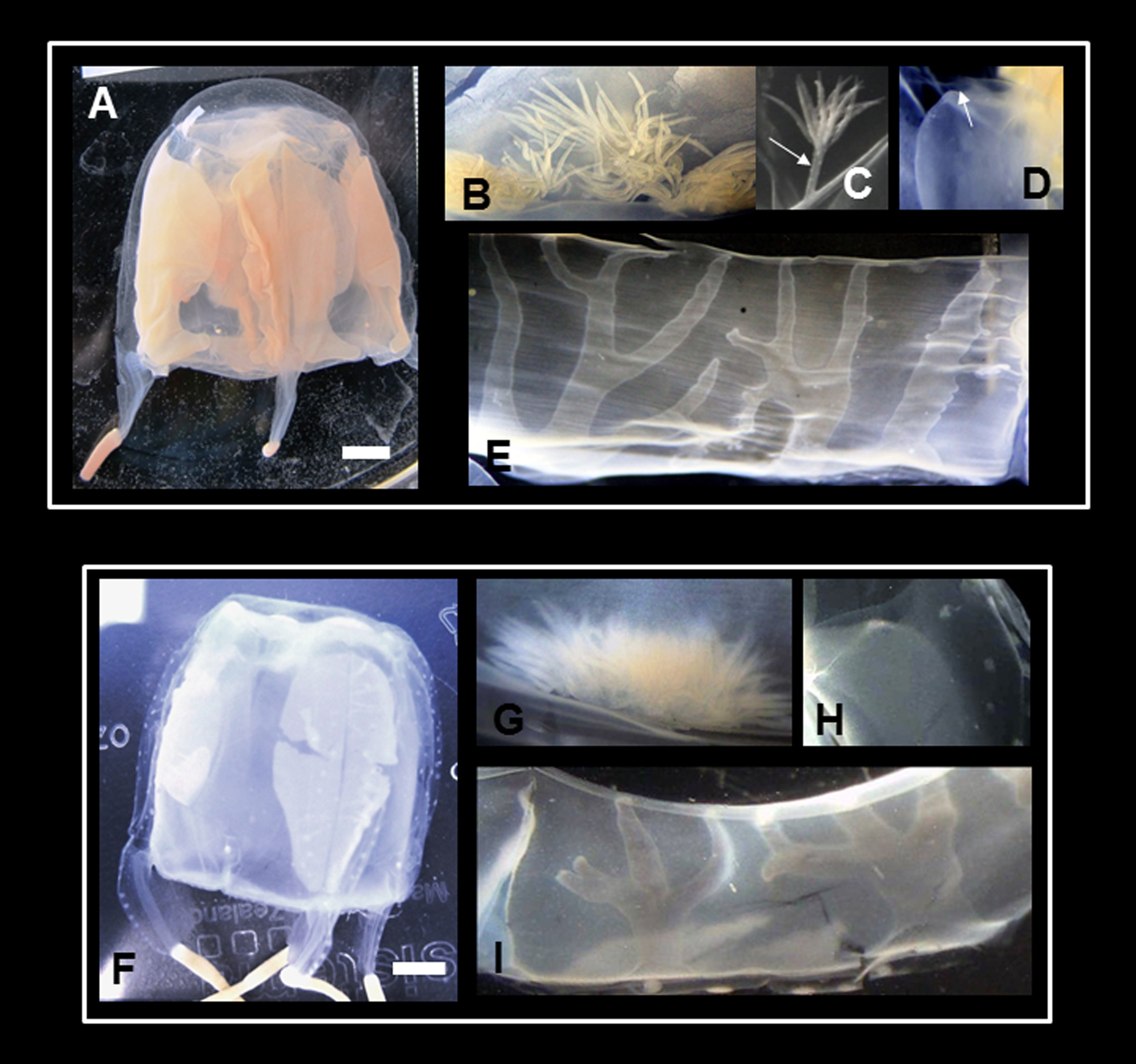
Description: Adult medusa: Bell (Fig. 3 A), highly transparent, colourless, bell-shaped, regularly scattered with very small, colourless, equal-sized nematocyst warts, from apex to bell margin; apex convex, mesoglea thick, slight horizontal constriction near the top present. Bell height up to 35 mm high, bell width up to 33.5 mm (IPD). Pedalia (Fig. 3 D), 4, simple, unbranched flattened, scalpel-shaped, approx. 1 / 3 – 1 / 2 bell height in length, situated in each interradial corner; outer wing scattered with very small, round warts, outer keel with irregularly shaped, white nematocyst bands; inner wing free of nematocyst warts, overhanging tentacle insertion; pedalium carrying single, white to flesh coloured tentacles in preserved specimens. Pedalial canal, diameter diamond shaped with sharp keels, flat and narrow at base, tapering below knee bend, flaring slightly towards mid-section, tapering towards distal end and flaring at tentacle insertion; going straight to slightly curved through pedalium, showing a slightly volcano-shaped to triangular knee bend with a sharp peak appended. Rhopalia, 4, located inside heart-shaped rhopalial niche ostium heart shaped, with triangular covering scale with distinct volcano-shaped tip; few small, round nematocyst warts on scale; approx. 1 / 6 to 1 / 7 of bell height up from margin; rhopalium with 6 eyes (2 median lens eyes + 2 lateral slit eyes + 2 lateral pit eyes). Velarium (Fig. 3 E), free of nematocyst warts, containing 2 velarial canal roots per octant, canals slim in width, seldom lobed, some side branches tend to grow in centripetal direction, rounded canal tips; canals roots flanking frenulum, giving rise to 2 main canals, 1 st canal simple, slightly lobed, without additional side branches, 2 nd main canal deeply forked into 2 branches with 0 – 2 additional side branches; canals roots flanking pedalia, giving rise to 1 main canal, deeply forked into 3 branches, with 0 – 2 additional side branches. Manubrium (1 / 5 bell height in length), very short, four-lobed, cruciform with sharply pointed mouth arm tips, without nematocyst warts, connected to flat and shallow stomach; stomach communicates perradially with 4 gastric pockets leading into velarial canals. Gastric phacellae (Fig. 3 B), 4, horizontal linear, in 4 stomach corners, consisting of 10 – 15 single, longstemmed, brush shaped filaments (Fig. 3 C) per quadrant. Gonads, 4 pairs, arrowhead-shaped, (narrow at base, widening in the first third then tapering towards the upper end to a sharp peak) separated by unperforated interradial septum, extending from stomach rim to bell margin, tapering distinctly towards stomach rim and at rhopalial niche level, flaring towards marginal rim; sexes separated but unimorph; ripe gonads milky whitish to flesh coloured in preserved specimens.
Revision of the genus Carybdea (Cnidaria: Cubozoa: Carybdeidae): clarifying the identity of its type species Carybdea marsupialis