
AnimaliaNot EvaluatedacceptedspeciesAccepted
Chrysopathes micracantha
Opresko & Loiola, 2008
GBIF:6472301
0countries
0year
PROFILE
Species Profile
Habitat
Marine
Characteristics
Extant
ABOUT
Descriptions(10)
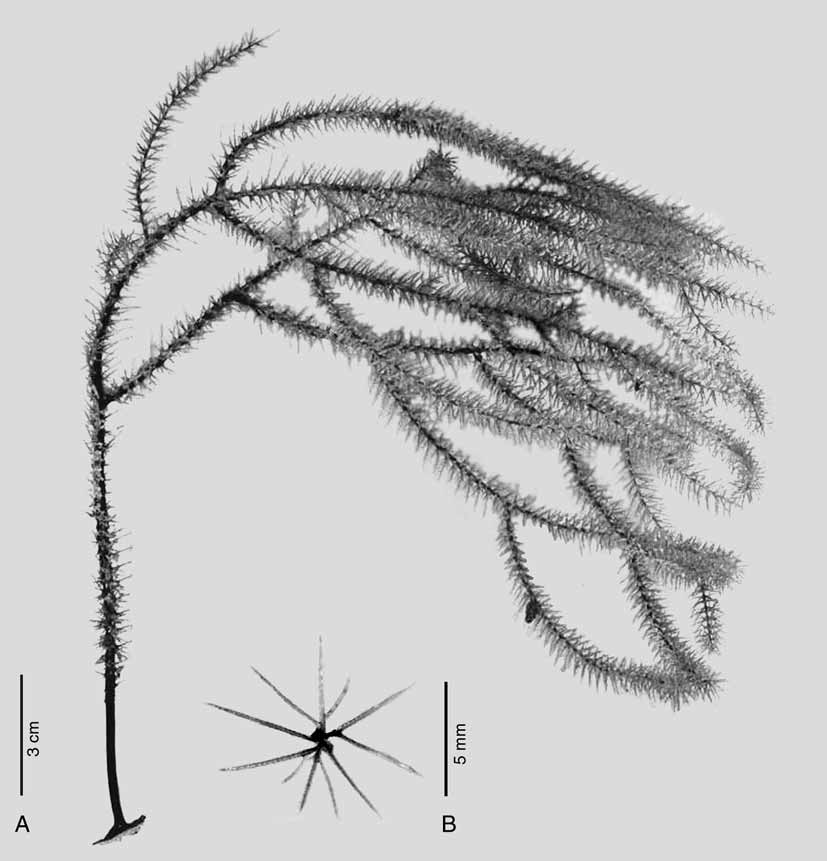
Description of holotype. Height about 30 cm, width 20 cm, basal stem diameter 3 mm; unpinnulated part of stem 3.5 cm long. Corallum (Fig. 3 A) branched to fifth order; planar with some overlapping branches (possibly due to preservation in small jar). Stem extends to top of corallum and has 12 branches of varying sizes along its length. Branches of corallum not evenly distributed; most 2 – 4 cm apart. Largest branch about 18 cm long; basal diameter about 2 mm. Branches extend outward at point of insertion (distal branch angle 40 – 50 º) and then curve upward to become parallel to lower order branch (or stem) from which they arise. Width across branchlets mostly 8 – 10 mm. Primary pinnules generally straight and stiff (Figs. 3 B and 4 A) and inclined distally (distal angle about 70 °). Each group of three primary pinnules occupies distance of 0.8 – 1.0 mm; distance between groups 0.4 – 0.5 mm; one cycle of six pinnules covers about 2.5 mm of axis. Pinnules mostly 2.5 mm apart in each row, resulting in five pinnules per centimeter in each row; total of 24 – 27 primary pinnules per cm for all rows. Primary pinnules generally 5 – 6 mm long (to 1.0 cm) and 0.2 – 0.25 mm in diameter near base, with laterals slightly longer than anterior and posterior primaries. One or two single secondary pinnules on anterior primary pinnules on higher order branches (Figs. 3 B and 4 A), less commonly one or two on posterior primaries. Paired secondary pinnules arranged suboppositely (Fig. 4 B). No secondaries on lateral primary pinnules. Secondary pinnules arise about 0.5 mm from base of primaries on lateral or towards lower side of primary and extend distally (distal angle about 45 °) relative to direction of primary. Secondary pinnules 3 – 4 mm long. Secondary pinnules on thicker branches and stem often found on all primaries and usually in subopposite pairs. Spines (Fig. 5) on distal section of pinnules distally inclined; abaxial edge to 0.14 mm and adaxial edge to 0.02 mm; height to 0.1 mm (measured from tip to middle of base). Spines along middle section of pinnules less distally inclined (i. e., proximal edge only 0.07 mm), and height generally no more than 0.06 mm). Spines on lower part of pinnules triangular and conical in lateral view with proximal and distal edges about equal in length; height about 0.03 mm. Spines generally subequal in size around circumference of axis; arranged in rows, four of which visible in lateral view. Distance between adjacent spines in each row about 0.2 mm. Spines on branches similar in size, shape and density as those on lower section of pinnules; 0.03 – 0.04 mm tall with about four rows visible in lateral view. Polyps present on some branches and pinnules; mostly 2.2 – 2.8 mm in transverse diameter (from distal edge of distal lateral tentacles to proximal edge of proximal lateral tentacles). Density of polyps could not be determined due to poor condition. Polyps arranged in single row on pinnules; however, relative position varies somewhat from pinnule to pinnule with most located on upper side (relative to direction of branch), others occur laterally. Description of paratypes. All have two secondary pinnules on at least some primary pinnules. Secondaries on younger branchlets most commonly found on anterior primaries. Secondaries present on some posterior primaries on lower parts of branches and stem. Lateral primaries generally without subpinnules on younger portions of branches, but may have one or two (usually subopposite) secondaries on older branches. Branching of corallum varies from planar with relatively short branchlets (USNM 77111) to more bushy (USNM 1086635) with more elongate and somewhat overlapping branches. Density of primary pinnules ranges from 24 – 33 per centimeter. Length of primary pinnules also variable, usually less than 1 cm (to 2 cm). In USNM 77111 maximum width of some branchlets 1.5 cm. Spines on USNM 77111 and USNM 1086635 mostly 0.05 – 0.08 mm tall (to 0.1 mm) and 0.2 – 0.3 mm apart. Three or four rows of spines visible in lateral view. Paratype from Brazil (MNRJ 5150) planar, 19.5 cm high and 15.0 cm wide: unpinnulated part of stem 3.3 cm, basal stem diameter 1 mm. Corallum branched to second order; distal branch angles about 45 o. Lateral primary pinnules 6 – 11 mm long; anterior and posterior primary pinnules usually not more than 4 – 6 mm long. Pinnules 2.5 – 3.0 mm apart in each row (four or five per centimeter) with 24 – 30 pinnules per cm total for all rows. One or two (subopposite) secondary pinnules, 2 – 6 mm long, on anterior, lateral and posterior primary pinnules. Subopposite secondary pinnules not very common; confined to branches in middle of corallum. Tertiary pinnules rarely present on anterior or posterior secondaries; maximum size 2.0 mm. Spines on distal portion of pinnules 0.07 – 0.09 mm tall; spines on lower portions of pinnules 0.04 – 0.06 mm. Six rows of spines visible in lateral view. Distance between spines in one row 0.17 – 0.3 mm; five or six spines per millimeter in each row. Polyps absent. Comparisons. Chrysopathes micracantha is differentiated from C. oligocrada primarily on the basis of the number of secondary pinnules present on the primary pinnules. In C. micracantha there are as many as two secondaries per primary, and these occur in subopposite pairs, whereas in C. oligocrada there is only one secondary per primary. Also, in C. micracantha the pinnules are spaced closer together (24 – 33 per cm) compared to C. oligocrada (usually 18 – 21 per cm). In C. micracantha the spines tend to be more appressed to the axis, especially those near the tips of the pinnules, and the polyps are slightly larger (2.2 – 2.8 mm in transverse diameter) than those in C. oligocrada (1.6 – 2.4 mm). A species found in the Pacific, C. speciosa Opresko 2003, is very similar to C. micracantha in having more than one subpinnule on the primaries. In C. micracantha the subpinnules are more regularly in subopposite pairs. Furthermore, C. speciosa may have more than two secondaries on a primary, and tertiary pinnules. These species can also be differentiated by the size of the spines. In C. speciosa the pinnular spines are mostly 0.06 – 0.12 mm (maximum 0.18 mm) and stand out from the axis, whereas those in C. micracantha are generally not more than 0.06 mm (maximum 0.1 mm), and are more appressed to the axial surface.
Two New Species of Chrysopathes (Cnidaria: Anthozoa: Antipatharia) from the Western Atlantic
Diagnosis. Corallum planar to somewhat bushy with overlapping branches; branched to fifth order. Stem and branches pinnulate and subpinnulate. Arrangement of primary pinnules as described for genus; 24 – 33 primary pinnules per cm. Anterior and posterior primary pinnules on smallest branches with one or two (subopposite) secondary pinnules; lateral primary pinnules usually simple or rarely with single subpinnule. Subpinnules more abundant on primary pinnules on thickest branches and stem; one subopposite pair per primary in some cases. Tertiary pinnules present on some secondaries but not common. Spines on pinnules simple, smooth, often very distinctly inclined distally; usually not more than 0.06 mm tall (from middle of base to apex) but to 0.10 mm at tips of pinnules. Abaxial side of spines three to seven times longer than adaxial side. Spines on middle and lower parts of pinnules becoming more triangular and less distally inclined. Polyps 2.2 – 2.8 mm in transverse diameter; arranged in a single row on upper or lateral side of pinnules.
Two New Species of Chrysopathes (Cnidaria: Anthozoa: Antipatharia) from the Western Atlantic
Remarks. Another specimen found in the RSMAS collection (from RV Pillsbury sta. 741, 1052 – 1066 m, off Venezuela, 11 ° 47.8 ’ N, 66 ° 06.8 ” W to 11 ° 52.4 ’ N, 66 ° 14.0 ” W) may represent a third species of Chrysopathes in the Atlantic. This specimen has more extensive subpinnulation than C. micracantha. Subpinnules occur on all primaries, although they are less common on the laterals. There are as many as three secondaries per primary. Where there are two or more secondaries they occur in a subopposite pair or in a cluster of three. Tertiary pinnules are present and these appear to be confined to the secondaries on the anterior primaries (polyps are not present on the specimen; therefore, the anterior / posterior orientation of the pinnules is difficult to discern). The primary pinnules are generally not more than 7 mm in length and there are 24 – 27 primary pinnules per cm. The spines are about 0.04 mm tall. The poor condition of the specimen and the fact that only one specimen is available for study precludes establishing a new taxon at this time.
Two New Species of Chrysopathes (Cnidaria: Anthozoa: Antipatharia) from the Western Atlantic
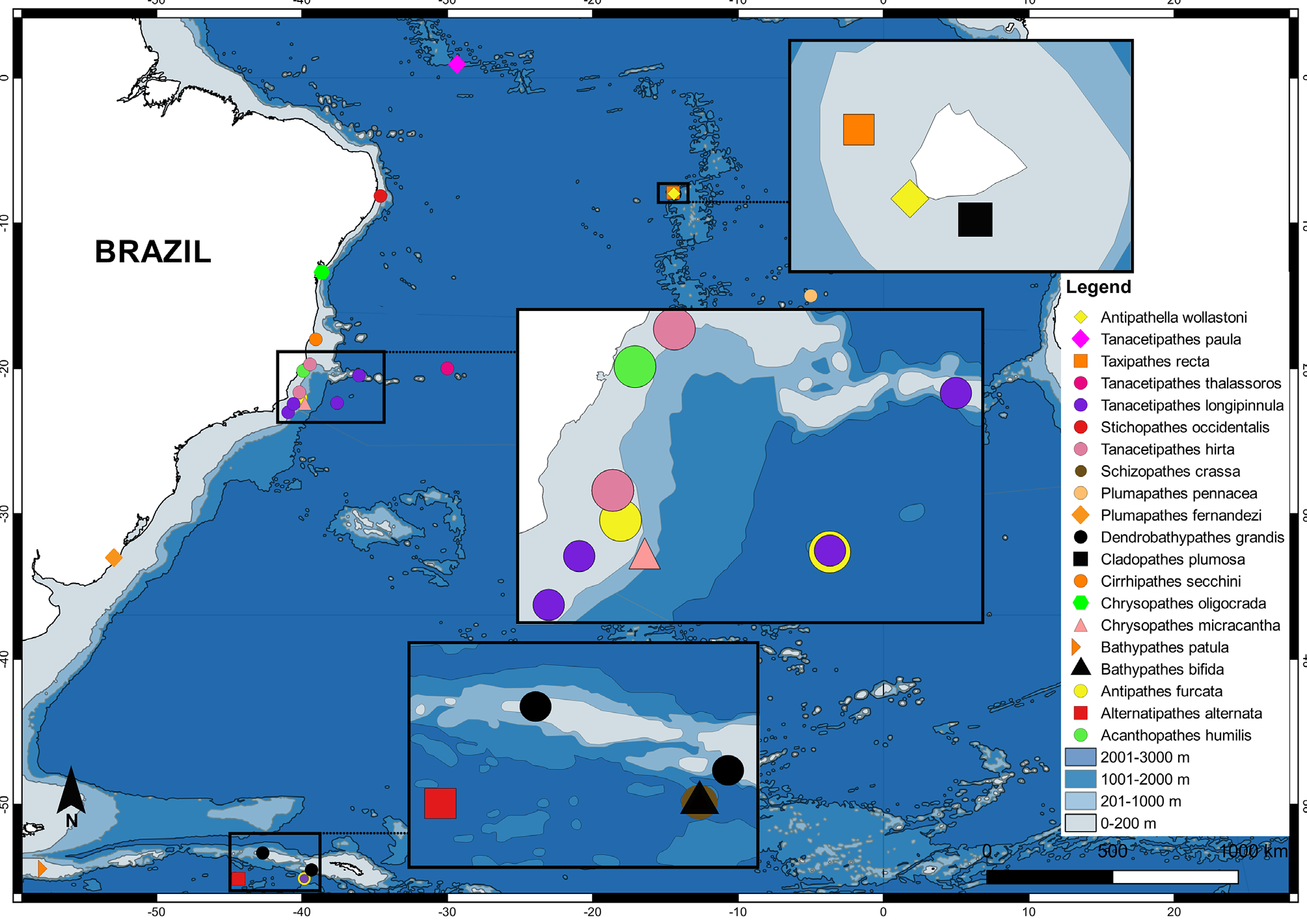
Distribution. The species has been collected in the western Atlantic, from Brazil north to off the southeastern coast of the U. S. at depths ranging from 658 to 1130 m.
Two New Species of Chrysopathes (Cnidaria: Anthozoa: Antipatharia) from the Western Atlantic
Etymology. The specific name is derived from the Latin micro (small) and acantha (spine).
Two New Species of Chrysopathes (Cnidaria: Anthozoa: Antipatharia) from the Western Atlantic
Holotype. USNM 1097219, Northwest Atlantic, off Florida, Reed Peak # 160, 29 º 50.9726 ’ N, 79 º 37.5976 ’ W, 2448 – 2857 ft (746 – 871 m), Johnson Sea Link, Dive 4912, spec. 2 - 009, November 9, 2005, coll: S. Brooke and C. Messing. Other material. Paratype (USNM 77111), off Georgia, E. of Brunswick, 30 ° 52 ’ N, 79 ° 34 ’ W, 658 m, January 21, 1972, RV Oregon II, sta. 11717 (1 specimen). Paratype (USNM 1086635), off Jacksonville Beach, Florida, 30 ° 16.56 ’ N, 79 ° 20.38 ’ W, Aug. 30, 2004, 836 m, Johnson Sea Link Dive 3470, collection No. T 10041060 (part of specimen deposited in the Marine Resources Research Institute, SCDNR, Accession No. 2004 - 0543, Catalog No. S 2332). Paratype (MNRJ 5150), Brazil, off Campos, 22 ° 24.655 ’ S, 39 ° 55.413 ’ W, 1130 m, BC-Sul-CENPES / UFRJ (1 specimen).
Two New Species of Chrysopathes (Cnidaria: Anthozoa: Antipatharia) from the Western Atlantic
Fig. 35 Chrysopathes sp. Opresko, 2005; Loiola, 2007 (in part).
Black Corals (Anthozoa: Antipatharia) from the Southwestern Atlantic
Diagnosis. “ Corallum planar to somewhat bushy with overlapping branches; branched to fifth order. Stem and branches pinnulate and subpinnulate. Arrangement of primary pinnules as described for genus; 24 – 33 primary pinnules per cm. Anterior and posterior primary pinnules on smallest branches with one or two (subopposite) secondary pinnules; lateral primary pinnules usually simple or rarely with single subpinnule. Subpinnules more abundant on primary pinnules on thickest branches and stem; one subopposite pair per primary in some cases. Tertiary pinnules present on some secondaries but not common. Spines on pinnules simple, smooth, often very distinctly inclined distally; usually not more than 0.06 mm tall (from middle of base to apex) but to 0.10 mm at tips of pinnules. Abaxial side of spines three to seven times longer than adaxial side. Spines on middle and lower parts of pinnules becoming more triangular and less distally inclined. Polyps 2.2 – 2.8 mm in transverse diameter; arranged in a single row on upper or lateral side of pinnules ” (Opresko & Loiola, 2008).
Black Corals (Anthozoa: Antipatharia) from the Southwestern Atlantic
Distribution. Western Atlantic, from USA to Brazil (fig. 35) (Opresko & Loiola, 2008); occurs at depths between 658 m and 1130 m (Opresko & Loiola, 2008).
Black Corals (Anthozoa: Antipatharia) from the Southwestern Atlantic
Type and type locality. USNM 1097219 (holotype): 29 ° 50.9726 ’ N, 79 ° 37.5976 ’ W, off Flórida, United States, 746 – 871 m; USNM 77111 (paratype): 30 ° 52 ’ N, 79 ° 34 ’ W, off Georgia, United States, 658 m; USNM 1086635 (paratype): 30 ° 16.56 ’ N 79 ° 20.38 ’ W, off Florida, 836 m; MNRJ 5150 (paratype): 22 ° 24.655 ’ S 39 ° 55.413 ’ W, Bacia de Campos, Brazil, 1130 m.
Black Corals (Anthozoa: Antipatharia) from the Southwestern Atlantic
Export occurrence data
Darwin Core Archive (ZIP)
GEOGRAPHY
Distribution Map
REGIONS
Geographic Distribution(8)
Brazilian Slope
North West Atlantic
North West Atlantic
North West Atlantic
Brazilian Slope
Brazilian Slope
North West Atlantic
BR
native
DATA
Occurrence Datasets
Loading datasets…
CLASSIFICATION
Taxonomic Classification Tree

RELATED
Related Name Usages(8)
Matching names from other GBIF-indexed checklists and datasets.
MULTIMEDIA
Media Files(4)
FIGURE 3. Chrysopathes micracantha new species, holotype, USNM 1097219: A, entire corallum; B, cross section of branch showing pinnules and subpinnules.
Imageimage/png© Loiola, LaiaTwo New Species of Chrysopathes (Cnidaria: Anthozoa: Antipatharia) from the Western Atlantic

FIGURE 4. Chrysopathes micracantha new species, holotype, USNM 1097219: A, cross section of branch showing arrangement of pinnules and subpinnules: B, close-up view of basal portion of subopposite secondary pinnules.
Imageimage/png© Loiola, LaiaTwo New Species of Chrysopathes (Cnidaria: Anthozoa: Antipatharia) from the Western Atlantic

IMAGES
Gallery(4)
Occurrences with images
CITATIONS
References(1)
Opresko D.M., Loiola L.L. 2008. Two New Species of Chrysopathes (Cnidaria: Anthozoa: Antipatharia) from the Western Atlantic. Zootaxa 1707: 49–59
original descriptionWorld Register of Marine Species