AnimaliaacceptedorderAcceptedRestricted
Leptothecata

Leptothecata

Thecate Hydroids

GBIF:712

0countries
0datasets

0

Descendants

0

Synonyms

0

Children

0

Species

0

Genera

0

Families

PROFILE

Species Profile

Habitat

Marine

Characteristics

Extant

ABOUT

Descriptions(13)

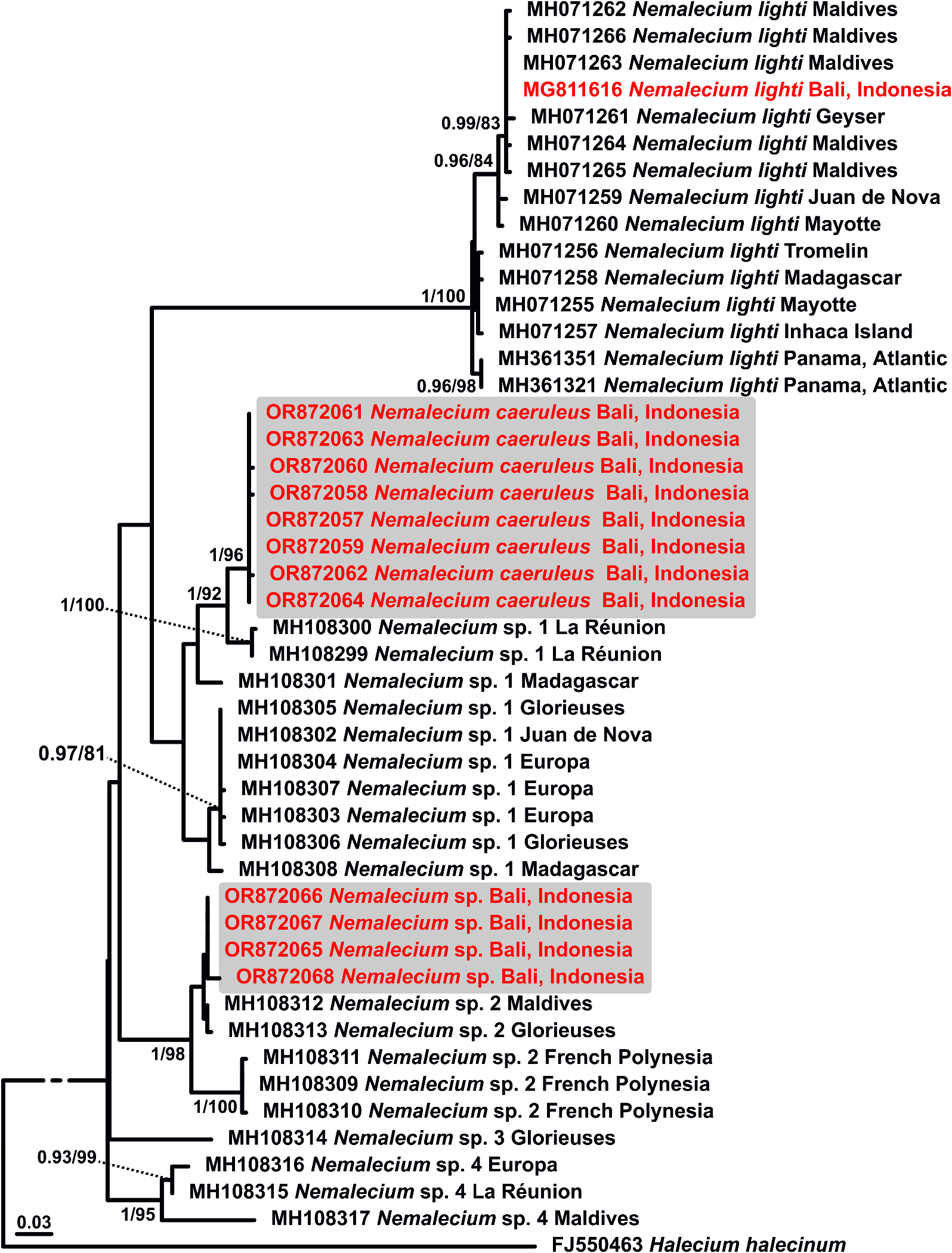
Boissin et al. (2018) assessed the genetic diversity of Nemalecium from the Indo-Pacific, including specimens belonging to N. lighti (Hargitt, 1924) and an unnamed congener (identified as Nemalecium sp.), and found a high genetic diversity in the latter, hypothesizing the presence of multiple cryptic species. We provide an updated 16 S rRNA phylogenetic hypothesis for the genus, including sequences of N. caeruleus sp. nov., Nemalecium sp. and N. lighti from Bali (Fig. 30). Nemalecium caeruleus clusters within a clade comprising sequences of Nemalecium sp. 1 sensu Boissin et al. (2018), even though that clade shows low statistical support. The overall genetic distance within the clade composed of N. caeruleus and Nemalecium sp. 1 sensu Boissin et al. (2018) is relatively high (2.5 ± 0.4 %), and so is the genetic distance between N. caerulues and Nemalecium sp. 1 from all western Indian Ocean localities (3.5 ± 1.0 %). These relatively high genetic distance values, together with the absence of any morphological and ecological information on Nemalecium sp. 1, leave open the question whether they belong to the same species or not. Specimens morphologically indistinguishable from N. caeruleus surprisingly clusters with sequences of Nemalecium sp. 2 sensu Boissin et al. (2018) in a well-supported clade (BPP = 1, MLBS = 98), showing a genetic distance of 7.3 ± 1.0 % from the clade composed of N. caeruleus and Nemalecium sp. 1, and an intra-clade distance of 2.0 ± 0.4 %. Finally, the sequence of the Balinese N. lighti clusters in a fully supported clade together with other conspecific sequences from the Indian Ocean and Caribbean Sea. It is evident that a great genetic diversity, with genetic distance values much higher than typical intra-specific values for most hydrozoan species (i. e., pairwise genetic distances between the supposedly cryptic species ranging 7.1 – 7.6 %), occurs among Indo-Pacific Nemalecium specimens studied herein and by Boissin et al. (2018), even between the morphologically indistinguishablesamples analyzed in this study. However, the absence of taxonomical accounts for the specimens dealt with by Boissin et al. (2018), together with the lack of any information about their habitat, hamper a clear understanding of the diversity of this group and, similarly, a correlation with the hydroid inhabiting coral crevices (Gravier-Bonnet & Mioche 1996) could not be established with certainty for all their clades.
On some tropical hydroids (Cnidaria: Hydrozoa), with descriptions of four new species
As equally shown in Fig. 32, genetic data (16 S rRNA) on the family Halopterididae are provided for the first time for A. sibogae (Billard, 1911 b), as well as for Balinese specimens of Halopteris vervoorti Galea, 2008 and Polyplumaria cornuta (Bale, 1884), supplementing those obtained earlier (P. Schuchert, unpublished results; Galea et al. 2018; Galea & Maggioni 2020) for A. billardi Galea (in Galea et al.), 2021, H. diaphana (Heller, 1868), H. longibrachia Calder & Faucci, 2021, H. plagiocampa (Pictet, 1893), H. platygonotheca Schuchert, 1997 and H. polymorpha (Billard, 1913). 16 S rRNA sequences of H. diaphana, H. plagiocampa, H. platygonotheca, H. vervoorti and P. cornuta cluster with conspecific sequences from other localities (Fig. 32). Finally, several Antennella secundaria - like colonies, white- to pale-green-colored and not morphologically separable from Gmelin’s (1791) hydroid were collected from the island, showing an overall high genetic divergence from each other (sequences OR 872075, OR 872076, OR 872077, OR 872078, OR 872079, MF 784533) and suggesting that the diversity of A. secundaria - like hydroids is currently underestimated (Fig. 32).
On some tropical hydroids (Cnidaria: Hydrozoa), with descriptions of four new species
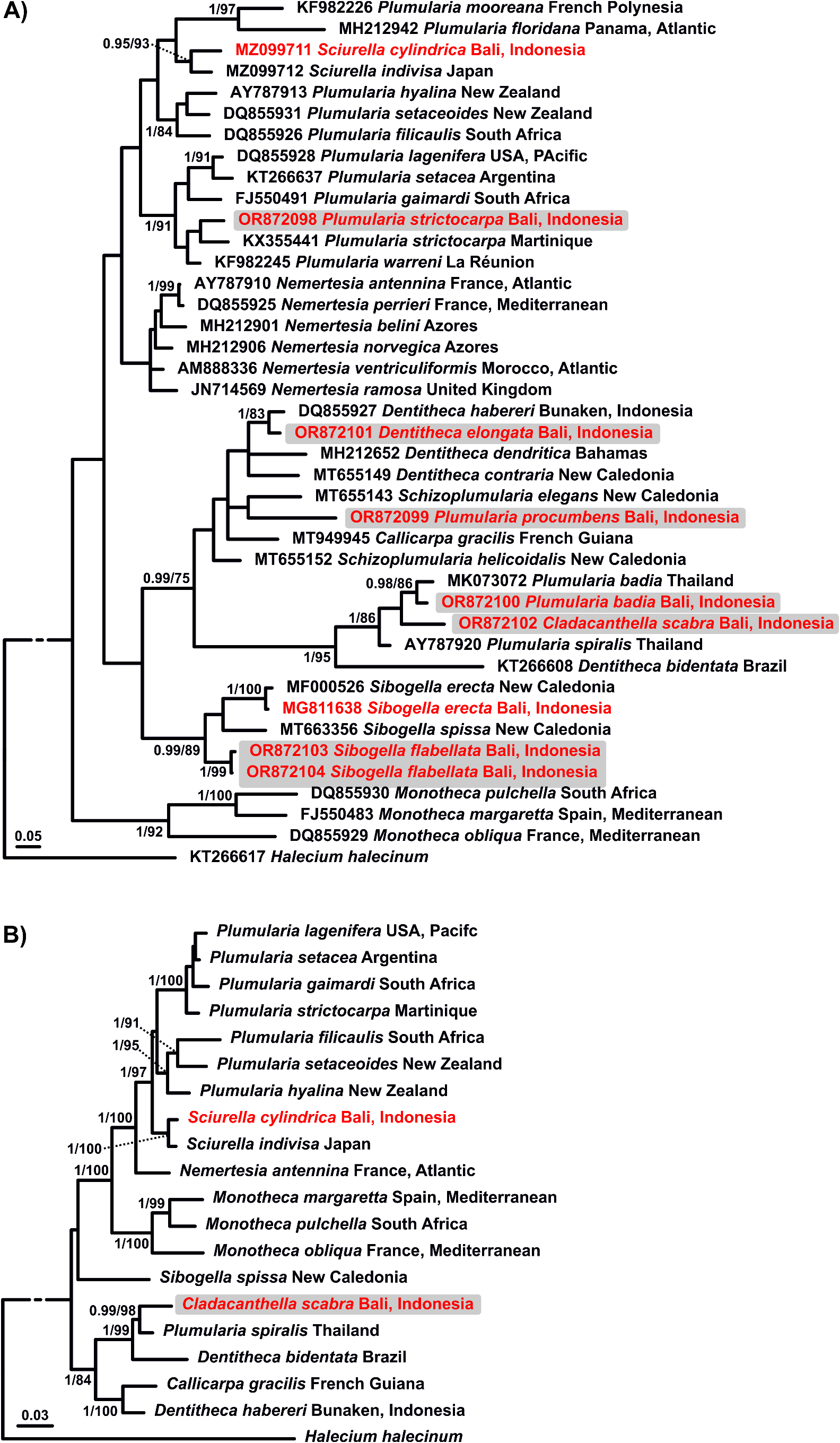
The sequenced plumulariid species from Bali include: Dentitheca elongata (Billard, 1913), Cladacanthella scabra (Lamarck, 1816), Plumularia procumbens Spencer, 1891 and Sibogella flabellata Di Camillo & Galea, 2020, for which genetic data are provided for the first time, and P. badia Kirchenpauer, 1876, P. strictocarpa Pictet, 1893, Sciurella cylindrica (Kirchenpauer, 1876) and S. erecta Billard, 1911 a (Fig. 31 A), with available sequences so far. A multi-locus phylogenetic hypothesis based on 16 S, 18 S and 28 S rRNA was also produced to assess the phylogenetic position of C. scabra, which results to be closely-related to P. badia, P. spiralis Billard, 1911 b and D. bidentata (Jäderholm, 1905) (Fig. 31 B).
On some tropical hydroids (Cnidaria: Hydrozoa), with descriptions of four new species
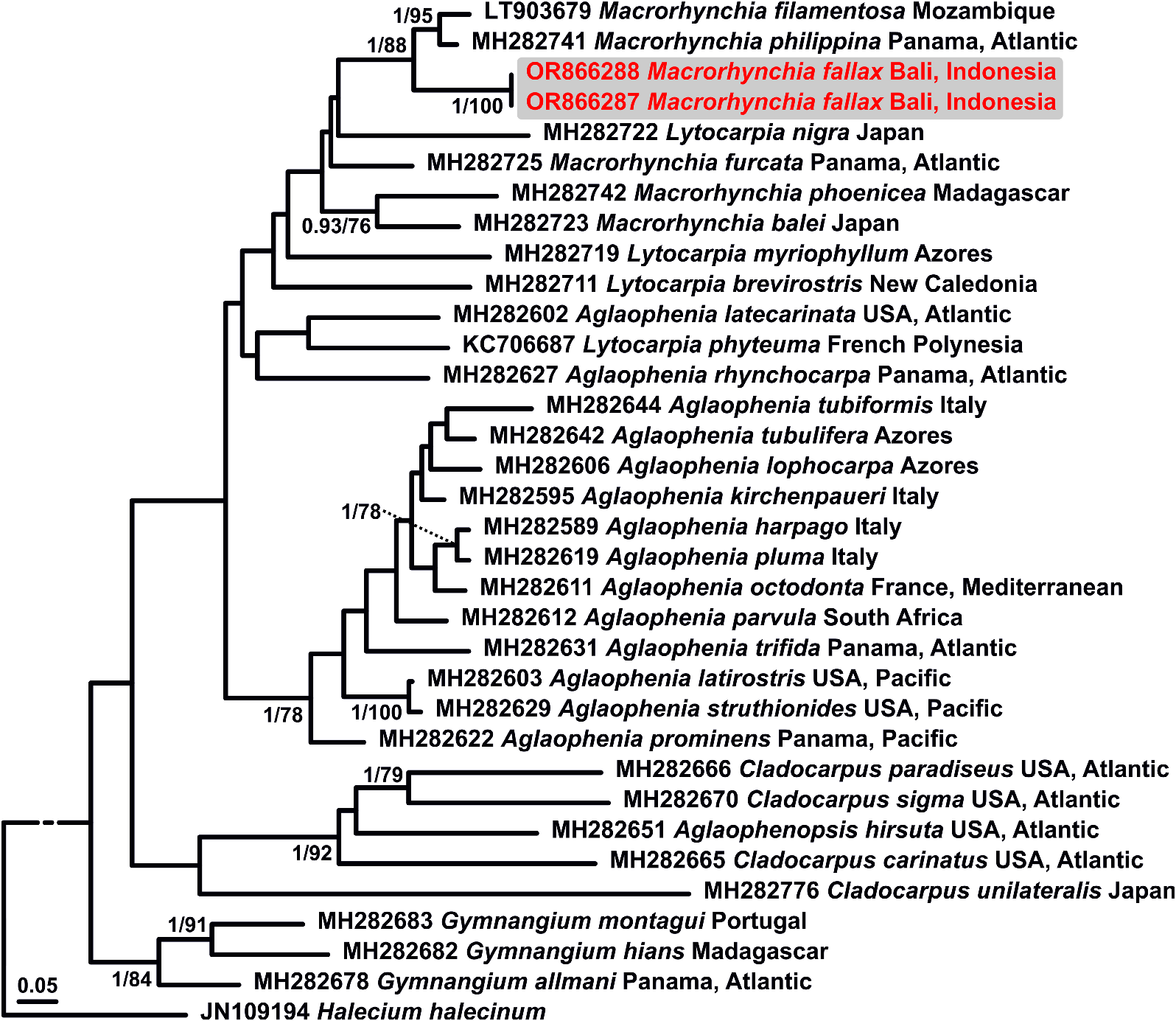
The 16 S rRNA region of M. fallax could not be amplified, despite several attempts, while other regions were successfully amplified and sequenced (COI, 18 S rRNA, and 28 S rRNA). Specifically, a phylogenetic hypothesis based on the COI region was obtained to assess the relationships between M. fallax and other aglaopheniid species (Fig. 34). The two COI sequences obtained for M. fallax are identical to each other and closely related to sequences obtained from M. philippina Kirchenpauer, 1872 and M. filamentosa (Lamarck, 1816). However, they show high genetic distances from these two species, viz. 9.9 ± 1.2 % and 11.1 ± 1.2 %, respectively.
On some tropical hydroids (Cnidaria: Hydrozoa), with descriptions of four new species
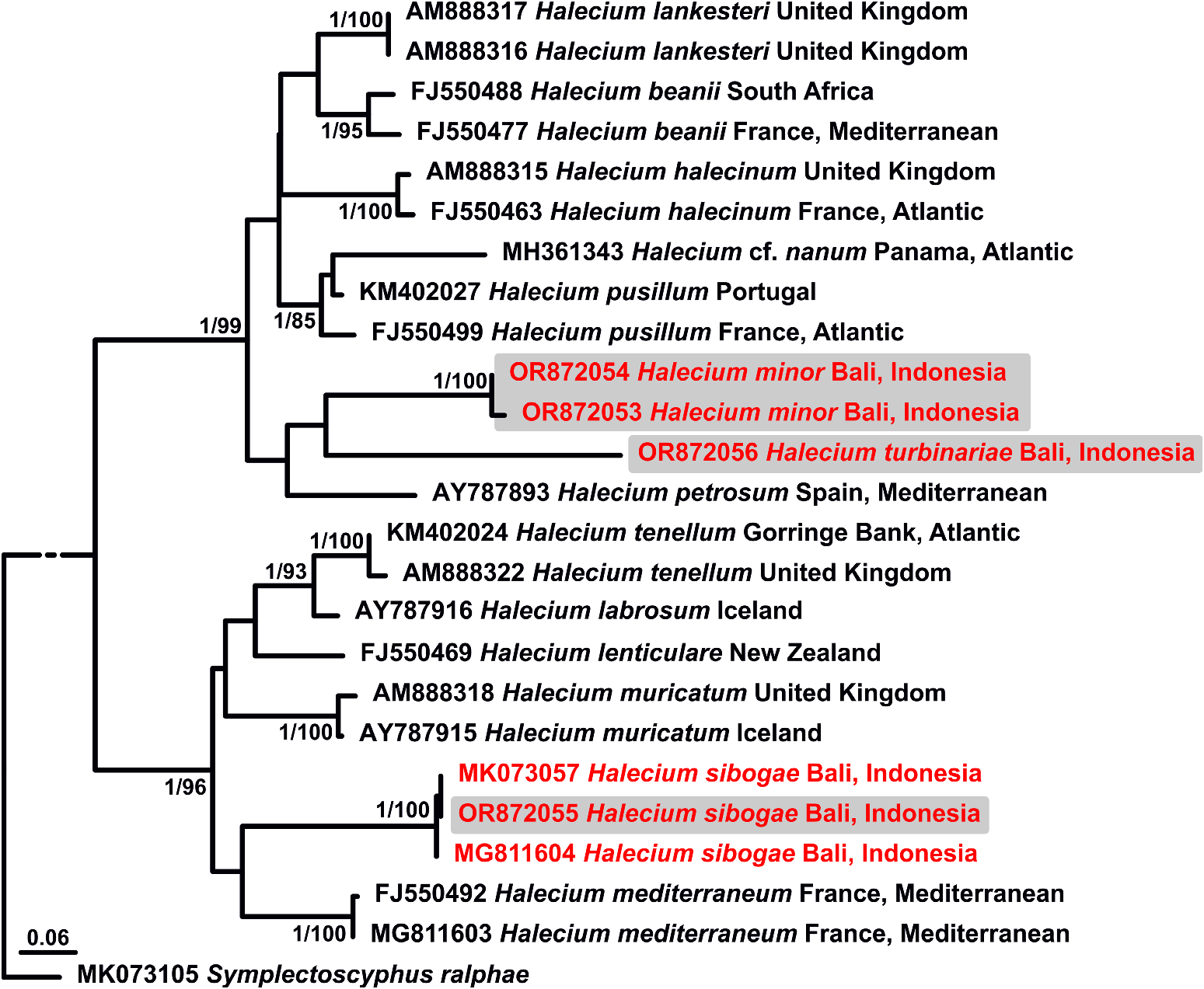
According to the 16 S rRNA phylogenetic reconstruction, Halecium turbinariae sp. nov. is divergent to all other sequenced congeners, thus supporting its establishment (Fig. 29). Halecium halecinum var. minor Pictet, 1893, originally described based on sterile material, reminds Linnaeus’ (1758) species through the regularly pinnate structure of its colonies. The species was rediscovered in Bali, although the available specimens are equally devoid of gonothecae. However, upon comparison with a profuse, fully fertile, female colony of H. halecinum (Linnaeus, 1758) from Britanny, France, it is realized that Pictet’s hydroid builds less robust colonies, with comparatively slenderer internodes, and the regular occurrence of a moderately-long, tubular, athecate internode at the origin of its cladia is distinctive. The two 16 S rRNA sequences obtained from Balinese specimens are divergent from Atlantic H. halecinum sequences (Fig. 29), also showing a genetic distance of 11.6 ± 1.4 %. Based on both morphological and genetic evidence, the so-called variety is raised to species, as H. minor, nov. status. Additionally, one newly-obtained and two unpublished 16 S rRNA sequences of Halecium sibogae Billard, 1919 form a fully-supported monophyletic group with minimal intra-specific distance (0.1 ± 0.1 %) (Fig. 29).
On some tropical hydroids (Cnidaria: Hydrozoa), with descriptions of four new species
The 16 S rRNA sequence of Tridentata borneensis Billard, 1925 a from Bali did not match any other sequenced sertulariids, but clustered with other Tridentata species (Fig. 28) in a well-supported clade (BPP = 1, MLBS = 89). Tridentata loculosa (Busk, 1852) has hydrothecae lacking the prominent, lateral, marginal cusps characteristic of the genus Tridentata, its hydranths are strikingly provided with a ligula, and its gonothecae (although transverselyringed) are closed by a watch-glass-shaped operculum (Migotto 1996: 72), making it somehow distinct from members assigned to that genus so far. Additionally, the 16 S rRNA sequence obtained from a Balinese specimen does not cluster with other Tridentata sequences, the latter forming a well-supported monophyletic group (Fig. 28) also including a sequence of T. trigonostoma (Busk, 1852) from Bali, which is identical to a conspecific sequence from Thailand. Two other sertulariids, namely Idiellana pristis (Lamouroux, 1816) and Diphasia mutulata (Busk, 1852), were also sequenced. The first clusters with a sequence of the same species from Thailand (with an intra-specific genetic distance of 0.4 ± 0.2 %), whereas the second, here sequenced for the first time, is sister to all other Diphasia sequences included in the analyses, even though the support values for the genus are low (Fig. 28).
On some tropical hydroids (Cnidaria: Hydrozoa), with descriptions of four new species
Genetic data (16 S rRNA region) for Sertularella decipiens Billard, 1919 and S. quadridens (Bale, 1884) are provided for the first time, whereas the sequence of S. diaphana (Allman, 1885) appears to be slightly divergent from that of a specimen from the Philippines (Fig. 27 B), with an intra-specific genetic distance of 2.7 %.
On some tropical hydroids (Cnidaria: Hydrozoa), with descriptions of four new species
Colonies of Thyroscyphus fruticosus Esper, 1793 from Bali comprise unbranched, up to 7 cm high cauli, sparinglybranched stems, with 1 – 3 irregularly-placed side branches not exceeding 9 cm in height, and more robust, pinnatelybranched stems reaching (or even exceeding) 12 cm in height. The first two display the same phenotype as the material assigned by Pictet (1893: 37, pl. 2 fig. 32) to Lytoscyphus junceus (Allman, 1876), and subsequently considered by Splettstösser (1929, as T. bedoti) to represent a species distinct from the widely-spread T. fruticosus 13. A careful microscopical examination off all morphotypes, supported by a comparison of their corresponding line drawings, revealed no difference, suggesting that T. bedoti is an artificially-created nominal species. Schuchert’s (2003: 194, fig. 48) account, based on the reexamination of Pictet’s material, confirms, in our view, this assumption. Our specimens from Bali, clearly do not belong to another congener, e. g. T. torresii (Busk, 1852), also known to occur in Indonesia (Schuchert 2003: 196), and conform to the concept of the species highlighted by Watson (2000: 39), i. e. more straggling colonies vs. a tidier aspect, and the absence of internodes from the stems and branches vs. a regular division by distinct nodes, respectively. Colonies of T. fruticosus from Bali display many colors: yellow, orange, pink and purple. The 16 S sequences obtained from Balinese samples are almost identical, despite their respective colonies showing a different coloration: MG 811641 corresponds to a yellow hydroid, while MG 811642 to a purple one. The material from India assigned by Arun et al. (2020) to the western Atlantic T. ramosus Allman, 1877 is obviously based on a misidentification (Fig. 27 A). Indeed, their sequence MH 392732 clustered with our sequences and is clearly divergent from the well-established Atlantic T. ramosus (Fig. 27 A). Boissin et al. (2018) identified two main clades of Indo-Pacific Thyroscyphus that they assigned to T. fruticosus and T. bedoti. However, they did not provide any morphological information on their samples. According to our data, their clade called T. bedoti, with which our Balinese sequences clusters (Fig. 27 A), appears to be T. fruticosus, whereas their other clade, called T. fruticosus, is likely another species (indicated in our tree as Thyroscyphus sp.). Of note, T. aequalis Warren, 1908, a species known to occur in the tropical East Africa and Madagascar (Millard 1975), builds similar colonies, and specific differences are mainly noted in the morphology of their hydrothecae; this species could have been erroneously taken for T. fruticosus.
On some tropical hydroids (Cnidaria: Hydrozoa), with descriptions of four new species
Synthecium flabellum Hargitt, 1924, here sequenced for the first time, forms a well-supported monophyletic group (BPP = 0.99, MLBS = 95) with both S. evansi (Ellis & Solander, 1786) and S. tubithecum (Allman, 1877) (Fig. 26 B).
On some tropical hydroids (Cnidaria: Hydrozoa), with descriptions of four new species
Genetic data for Hebella laterocaudata Billard, 1942 are produced for the first time, and so are the two sequences of a hydroid recalling H. furax Millard, 1957. The latter, however, are quite divergent from one another (genetic distance of 8.2 %), and one of them is very similar to the sequence JN 714647 provisionally assigned to Anthohebella parasitica (Ciamician, 1880) from the Azores, this actually appearing not to belong to that nominal species (Fig. 26 A).
On some tropical hydroids (Cnidaria: Hydrozoa), with descriptions of four new species
Campanularia spinulosa Bale, 1888, originally described without its gonosome and also sterile in the material at hand, recalls Obelia bidentata Clark, 1875 but, unlike that species, it builds flabellate instead of cypress-shaped colonies “ with lateral branches tending to be in right-angled pairs, successively on opposite sides of stem ” (Cornelius 1995: 292, fig. 68 A). Superposition of line drawings of specimens from Bali with Bale’s (1888) pl. 12 fig. 5, Thornely’s (1900, as Gonothyraea longicyatha) pl. 44 fig. 4, and Schuchert’s (2003, as O. bidentata) fig. 24 (right hand side drawing), revealed the same shape and proportions, suggesting that all are very likely conspecific. According to the present molecular evidence based on the combined 16 S, 18 S, and 28 S rRNA (Fig. 35 A), the species obviously belongs to the genus Obelia Péron & Lesueur, 1810, and it should be confidently referred to as O. spinulosa (Bale, 1888) 14. Two 16 S rRNA sequences of Clytia linearis (Thornely, 1900) were also obtained from Balinese samples, both clustering with other available sequences of C. linearis from the Atlantic Ocean and Mediterranean Sea (Fig. 35 B).
On some tropical hydroids (Cnidaria: Hydrozoa), with descriptions of four new species

Order Leptothecata Cornelius, 1992

Suborder Lafoeida Bouillon, 1984

On a collection of hydroids (Cnidaria, Hydrozoa) from the southwest coast of Florida, USAMagnoliaPress via PlaziNo known copyright restrictions apply. See Agosti, D., Egloff, W., 2009. Taxonomic information exchange and copyright: the Plazi approach. BMC Research Notes 2009, 2:53 for further explanation.

Order Leptothecata Cornelius, 1992

Aglaopheniid hydroids (Cnidaria: Hydrozoa: Aglaopheniidae) from bathyal waters of the Flemish Cap, Flemish Pass, and Grand Banks of Newfoundland (NW Atlantic)MagnoliaPress via PlaziNo known copyright restrictions apply. See Agosti, D., Egloff, W., 2009. Taxonomic information exchange and copyright: the Plazi approach. BMC Research Notes 2009, 2:53 for further explanation.

Export occurrence data

Darwin Core Archive (ZIP)

GEOGRAPHY

Distribution Map

Occurrence Map

Loading map…

Tiles © GBIF Maps API | Map powered by MapLibre GL

REGIONS

Geographic Distribution(3)

DK
not evaluated
NO
SE

DATA

Occurrence Datasets

Loading datasets…

Common names used for this species across different languages and regions. From 1 country. 1 preferred.

USThecate Hydroids

Vernacular (common) names are the everyday names used for a species in different languages and regions. A single species may have dozens of common names worldwide. 1 name preferred.

USThecate Hydroids
preferredUS
Source: Martha's Vineyard species checklistSource taxon #206230249

CLASSIFICATION

Taxonomic Classification Tree

RELATED

Related Name Usages(20)

Matching names from other GBIF-indexed checklists and datasets.

MULTIMEDIA

Media Files(12)

FIGURE 30. Phylogenetic hypothesis of the genus Nemalecium based on the 16S rRNA region. Numbers at nodes represent BPP and MLBS, respectively.

Imageimage/png© Galea, Horia R.;Maggioni, DavideOn some tropical hydroids (Cnidaria: Hydrozoa), with descriptions of four new species

FIGURE 32. Phylogenetic hypothesis of the family Halopterididae based on the 16S rRNA region. Numbers at nodes represent BPP and MLBS, respectively. N.B.: According to Galea et al. (2021: 341), Antennella varians (Billard, 1911b) MF784528 should be correctly regarded as A. billardi Galea (in Galea et al.), 2021. Sequences MF784526 and MF784531, identified in GenBank as Halopteris sibogae (Billard, 1913) (Galea et al. 2018: fig. 9), should bear the recently-introduced taxon name, H. longibrachia Calder & Faucci, 2021.

Imageimage/png© Galea, Horia R.;Maggioni, DavideOn some tropical hydroids (Cnidaria: Hydrozoa), with descriptions of four new species

FIGURE 31. Phylogenetic hypotheses of the family Plumulariidae based on the combined 16S, 18S and 28S rRNA dataset (A), and on COI region (B). Numbers at nodes represent BPP and MLBS, respectively. N.B.: According to Schuchert (2014: 2), Plumularia cf. lagenifera Allman, 1885 FJ550491 should be correctly regarded as P. gaimardi (Lamouroux, 1824).

Imageimage/png© Galea, Horia R.;Maggioni, DavideOn some tropical hydroids (Cnidaria: Hydrozoa), with descriptions of four new species

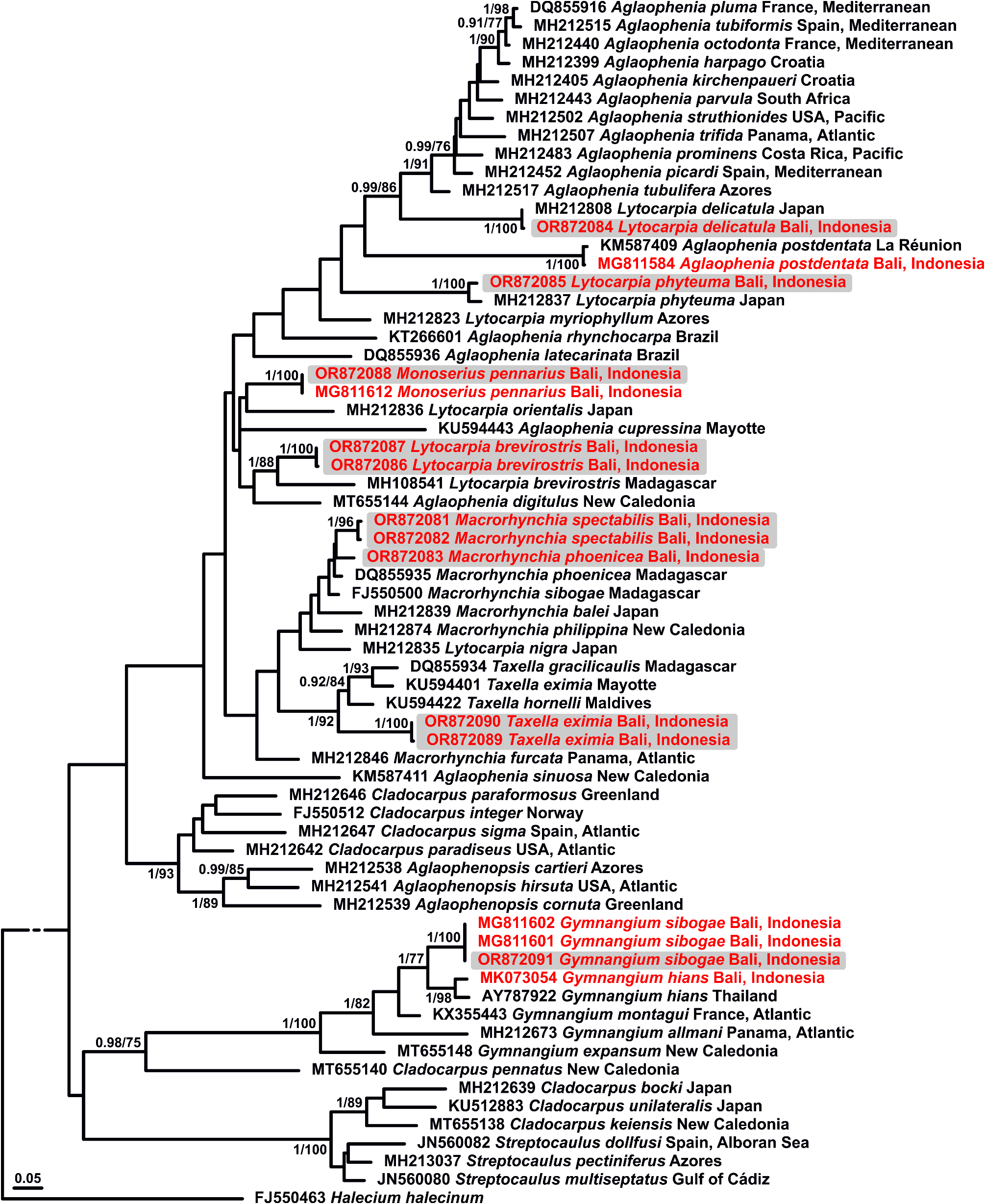
FIGURE 33. Phylogenetic hypothesis of the family Aglaopheniidae based on the 16S rRNA region. Numbers at nodes represent BPP and MLBS, respectively.

Imageimage/png© Galea, Horia R.;Maggioni, DavideOn some tropical hydroids (Cnidaria: Hydrozoa), with descriptions of four new species

FIGURE 34. Phylogenetic hypothesis of the family Aglaopheniidae based on the COI region. Numbers at nodes represent BPP and MLBS, respectively.

Imageimage/png© Galea, Horia R.;Maggioni, DavideOn some tropical hydroids (Cnidaria: Hydrozoa), with descriptions of four new species

FIGURE 29. Phylogenetic hypothesis of the genus Halecium based on the 16S rRNA region. Numbers at nodes represent BPP and MLBS, respectively.

Imageimage/png© Galea, Horia R.;Maggioni, DavideOn some tropical hydroids (Cnidaria: Hydrozoa), with descriptions of four new species

IMAGES

Gallery(12)

See Gallery

Occurrences with images

CITATIONS

References(8)

  • 1

    Bouillon, J.; Boero, F. (2000). Synopsis of the families and genera of the Hydromedusae of the world, with a list of the worldwide species. <i>Thalassia Salent. 24</i>: 47-296

    basis of recordWorld Register of Marine Species
  • 2

    Bouillon, J.; Boero, F. (2000). Synopsis of the families and genera of the Hydromedusae of the world, with a list of the worldwide species. <i>Thalassia Salent. 24</i>: 47-296

    basis of recordWRiMS
  • 3

    Calder (2010) Check list of Hydroids and Hydromedusae reported from the Skagerrak and Kattegat, Southern Scandinavia. WORKSHOP ON MARINE MACROFAUNA (September 2010). Sweden.Hydroids.Checklist.002.DOCX

    Dyntaxa. Svensk taxonomisk databas
  • 4

    Calder (2012) On a collection of hydroids (Cnidaria, Hydrozoa, Hydroidolina) from the west coast of Sweden, with a checklist of species from the region

    Dyntaxa. Svensk taxonomisk databas
  • 5

    Cornelius, P.F.S., 1992. Medusa loss in leptolid Hydrozoan (Cnidaria) hydroid rafting, and abbreviated life-cycles among their remote-island faunae: an interim review. In: J. Bouillon, F. Boero, F. Cicogna, J.M. Gili & R.G. Hughes, eds., Aspects of hydrozoan biology. Scientia Marina 56 2-3: 245-261.

    original descriptionWorld Register of Marine Species
  • Source Information

    GBIF Backbone Taxonomy

    GBIF Backbone Taxonomy

    checklist

    The GBIF Backbone Taxonomy is a single, synthetic management classification with the goal of covering all names GBIF is dealing with. It's the taxonomic backbone that allows GBIF to integrate name based information from different resources, no matter if these are occurrence datasets, species pages, names from nomenclators or external sources like EOL, Genbank or IUCN. This backbone allows taxonomic search, browse and reporting operations across all those resources in a consistent way and to provide means to crosswalk names from one source to another.

    It is updated regulary through an automated process in which the Catalogue of Life acts as a starting point also providing the complete higher classification above families. Additional scientific names only found in other authoritative nomenclatural and taxonomic datasets are then merged into the tree, thus extending the original catalogue and broadening the backbones name coverage. The GBIF Backbone taxonomy also includes identifiers for Operational Taxonomic Units (OTUs) drawn from the barcoding resources iBOL and UNITE.

    International Barcode of Life project (iBOL), Barcode Index Numbers (BINs). BINs are connected to a taxon name and its classification by taking into account all names applied to the BIN and picking names with at least 80% consensus. If there is no consensus of name at the species level, the selection process is repeated moving up the major Linnaean ranks until consensus is achieved.

    UNITE - Unified system for the DNA based fungal species, Species Hypotheses (SHs). SHs are connected to a taxon name and its classification based on the determination of the RefS (reference sequence) if present or the RepS (representative sequence). In the latter case, if there is no match in the UNITE taxonomy, the lowest rank with 100% consensus within the SH will be used.

    The GBIF Backbone Taxonomy is available for download at https://hosted-datasets.gbif.org/datasets/backbone/ in different formats together with an archive of all previous versions.

    The following 105 sources have been used to assemble the GBIF backbone with number of names given in brackets:

    • Catalogue of Life Checklist - 4766428 names
    • International Barcode of Life project (iBOL) Barcode Index Numbers (BINs) - 635951 names
    • UNITE - Unified system for the DNA based fungal species linked to the classification - 611208 names
    • The Paleobiology Database - 212054 names
    • World Register of Marine Species - 188857 names
    • The Interim Register of Marine and Nonmarine Genera - 183894 names
    • The World Checklist of Vascular Plants (WCVP) - 131891 names
    • GBIF Backbone Taxonomy - 114350 names
    • TAXREF - 109374 names
    • The Leipzig catalogue of vascular plants - 75380 names
    • ZooBank - 73549 names
    • Integrated Taxonomic Information System (ITIS) - 68377 names
    • Plazi.org taxonomic treatments database - 61346 names
    • Genome Taxonomy Database r207 - 60545 names
    • International Plant Names Index - 52329 names
    • Fauna Europaea - 45077 names
    • The National Checklist of Taiwan (Catalogue of Life in Taiwan, TaiCoL) - 36193 names
    • Dyntaxa. Svensk taxonomisk databas - 35892 names
    • The Plant List with literature - 32692 names
    • United Kingdom Species Inventory (UKSI) - 29643 names
    • Artsnavnebasen - 29208 names
    • The IUCN Red List of Threatened Species - 21221 names
    • Afromoths, online database of Afrotropical moth species (Lepidoptera) - 13961 names
    • Brazilian Flora 2020 project - Projeto Flora do Brasil 2020 - 13829 names
    • Prokaryotic Nomenclature Up-to-Date (PNU) - 10079 names
    • Checklist Dutch Species Register - Nederlands Soortenregister - 8814 names
    • ICTV Master Species List (MSL) - 7852 names
    • Cockroach Species File - 6020 names
    • GRIN Taxonomy - 5882 names
    • Taxon list of fungi and fungal-like organisms from Germany compiled by the DGfM - 4570 names
    • Catalogue of Afrotropical Bees - 3623 names
    • Catalogue of Tenebrionidae (Coleoptera) of North America - 3327 names
    • Checklist of Beetles (Coleoptera) of Canada and Alaska. Second Edition. - 3312 names
    • Systema Dipterorum - 2850 names
    • Catalogue of the Pterophoroidea of the World - 2807 names
    • The Clements Checklist - 2675 names
    • Taxon list of Hymenoptera from Germany compiled in the context of the GBOL project - 2496 names
    • IOC World Bird List, v13.2 - 2366 names
    • Official Lists and Indexes of Names in Zoology - 2310 names
    • National checklist of all species occurring in Denmark - 1922 names
    • Myriatrix - 1876 names
    • Database of Vascular Plants of Canada (VASCAN) - 1822 names
    • Taxon list of vascular plants from Bavaria, Germany compiled in the context of the BFL project - 1771 names
    • Orthoptera Species File - 1742 names
    • A list of the terrestrial fungi, flora and fauna of Madeira and Selvagens archipelagos - 1602 names
    • Aphid Species File - 1565 names
    • World Spider Catalog - 1561 names
    • Taxon list of Jurassic Pisces of the Tethys Palaeo-Environment compiled at the SNSB-JME - 1270 names
    • Backbone Family Classification Patch - 1143 names
    • GBIF Algae Classification - 1100 names
    • International Cichorieae Network (ICN): Cichorieae Portal - 975 names
    • Psocodea Species File - 803 names
    • New Zealand Marine Macroalgae Species Checklist - 787 names
    • Annotated checklist of endemic species from the Western Balkans - 754 names
    • Taxon list of animals with German names (worldwide) compiled at the SMNS - 503 names
    • Catalogue of the Alucitoidea of the World - 472 names
    • Lygaeoidea Species File - 462 names
    • Catálogo de Plantas y Líquenes de Colombia - 422 names
    • GBIF Backbone Patch - 317 names
    • Phasmida Species File - 259 names
    • Cortinariaceae fetched from the Index Fungorum API - 234 names
    • Coreoidea Species File - 233 names
    • GTDB supplement - 139 names
    • Mantodea Species File - 119 names
    • Endemic species in Taiwan - 93 names
    • Taxon list of Araneae from Germany compiled in the context of the GBOL project - 88 names
    • Species of Hominidae - 78 names
    • Taxon list of Sternorrhyncha from Germany compiled in the context of the GBOL project - 77 names
    • Taxon list of mosses from Germany compiled in the context of the GBOL project - 75 names
    • Mammal Species of the World - 73 names
    • Plecoptera Species File - 71 names
    • Species Fungorum Plus - 64 names
    • Catalogue of the type specimens of Cosmopterigidae (Lepidoptera: Gelechioidea) from research collections of the Zoological Institute, Russian Academy of Sciences - 47 names
    • Species named after famous people - 41 names
    • Dermaptera Species File - 36 names
    • Taxon list of Trichoptera from Germany compiled in the context of the GBOL project - 34 names
    • True Fruit Flies (Diptera, Tephritidae) of the Afrotropical Region - 33 names
    • Range and Regularities in the Distribution of Earthworms of the Earthworms of the USSR Fauna. Perel, 1979 - 32 names
    • Taxon list of Diplura from Germany compiled in the context of the GBOL project - 30 names
    • Lista de referencia de especies de aves de Colombia - 2022 - 24 names
    • Taxon list of Auchenorrhyncha from Germany compiled in the context of the GBOL project - 20 names
    • Catalogue of the type specimens of Polycestinae (Coleoptera: Buprestidae) from research collections of the Zoological Institute, Russian Academy of Sciences - 19 names
    • Taxon list of Thysanoptera from Germany compiled in the context of the GBOL project - 19 names
    • Lista de especies de vertebrados registrados en jurisdicción del Departamento del Huila - 18 names
    • Taxon list of Microcoryphia (Archaeognatha) from Germany compiled in the context of the GBOL project - 15 names
    • Catalogue of the type specimens of Bufonidae and Megophryidae (Amphibia: Anura) from research collections of the Zoological Institute, Russian Academy of Sciences - 12 names
    • Grylloblattodea Species File - 11 names
    • Coleorrhyncha Species File - 9 names
    • Taxon list of liverworts from Germany compiled in the context of the GBOL project - 9 names
    • Embioptera Species File - 7 names
    • Taxon list of Pisces and Cyclostoma from Germany compiled in the context of the GBOL project - 6 names
    • Taxon list of Pteridophyta from Germany compiled in the context of the GBOL project - 6 names
    • Taxon list of Siphonaptera from Germany compiled in the context of the GBOL project - 5 names
    • The Earthworms of the Fauna of Russia. Perel, 1997 - 5 names
    • Taxon list of Zygentoma from Germany compiled in the context of the GBOL project - 4 names
    • Asiloid Flies: new taxa of Diptera: Apioceridae, Asilidae, and Mydidae - 3 names
    • Taxon list of Protura from Germany compiled in the context of the GBOL project - 3 names
    • Taxon list of hornworts from Germany compiled in the context of the GBOL project - 2 names
    • Chrysididae Species File - 1 names
    • Taxon list of Dermaptera from Germany compiled in the context of the GBOL project - 1 names
    • Taxon list of Diplopoda from Germany in the context of the GBOL project - 1 names
    • Taxon list of Orthoptera (Grashoppers) from Germany compiled at the SNSB - 1 names
    • Taxon list of Pscoptera from Germany compiled in the context of the GBOL project - 1 names
    • Taxon list of Pseudoscorpiones from Germany compiled in the context of the GBOL project - 1 names
    • Taxon list of Raphidioptera from Germany compiled in the context of the GBOL project - 1 names

    GBIF Secretariat (2023). GBIF Backbone Taxonomy. Checklist dataset https://doi.org/10.15468/39omei accessed via GBIF.org on 2026-06-16.

    CC BYPublished 8/28/2023View dataset
    GBIF Usage Key
    712
    Dataset Key
    d7dddbf4-2cf0-4f39-9b2a-bb099caae36c
    Origin
    source
    Backbone Key
    712
    Taxon ID
    gbif:712
    Last Crawled
    8/22/2023
    Last Interpreted
    8/22/2023